Small Cap Value Report (Thur 21 March 2019) - IGG, NXT, GMD, KETL, TED, LSR/THAL

Morning all!
There are a few minor political headlines but I'm sure what you really want to hear about is the company news.
Today we have:
- IG Group (LON:IGG)
- Next (LON:NXT)
- GAME Digital (LON:GMD)
- Strix (LON:KETL)
- Ted Baker (LON:TED)
IG Group (LON:IGG)
- Share price: 507.5 (-7%)
- No. of shares: 369 million
- Market cap: £1,873 million
(Please note that I have a long position in IGG.)
I've increased my position in this share today, up from 4% to 6% of my portfolio.
My original purchases were in early 2017, between 505p - 530p.
I topped up last October around 610p.
Today I am back at it, again around that 505p mark.
The EU's ESMA organisation is responsible for all the trouble in this industry - prior to the announcement of its regulations, IG shares had reached a high of c. 950p.
Subsequent to that announcement, from late 2016 to mid-2018, confidence gradually recovered and the shares climbed back to the high at 950p.
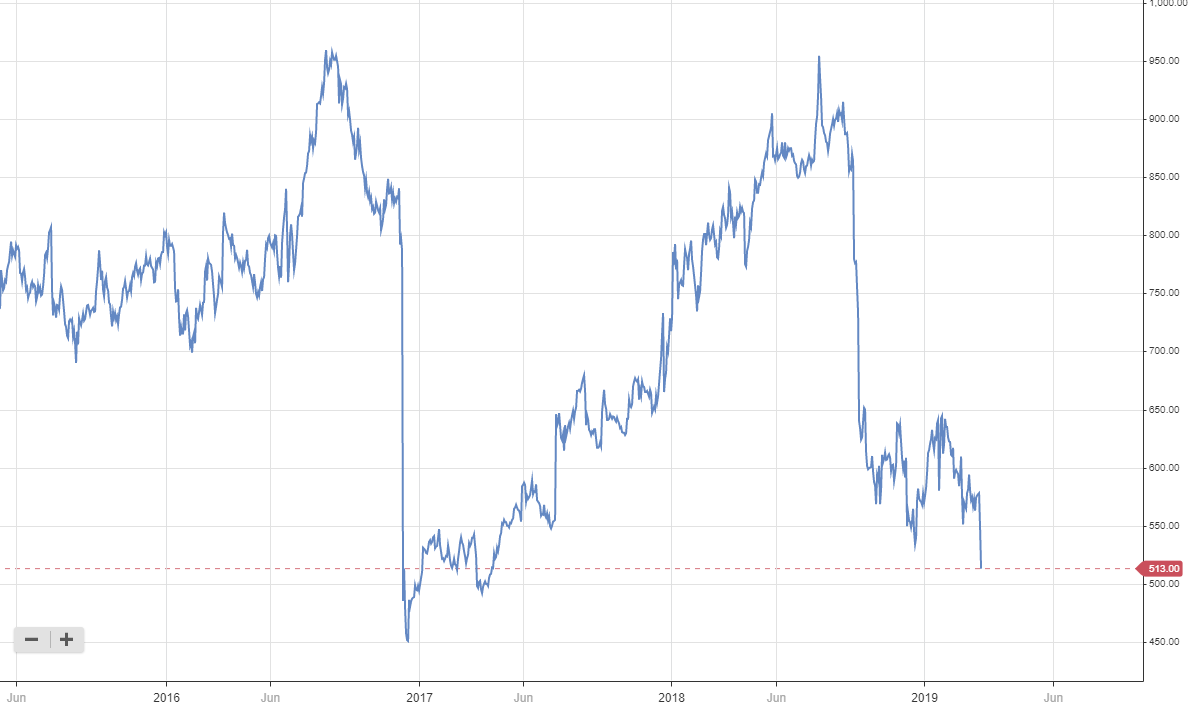
Unfortunately, the disruption caused by ESMA rules has been worse than we might have hoped, and this has been compounded in recent months by a lack of trading activity by clients. The same thing was reported by CMC Markets (LON:CMCX) (in which I have a long position).
According to today's update, IG's Q3 revenues (to the end of February) are down 12% compared to the prior quarter. The number of spread bet clients increased marginally, but they traded at significantly lower levels. As the ESMA rules were in force during the prior quarter as well, IG says that this is due to lower volatility.
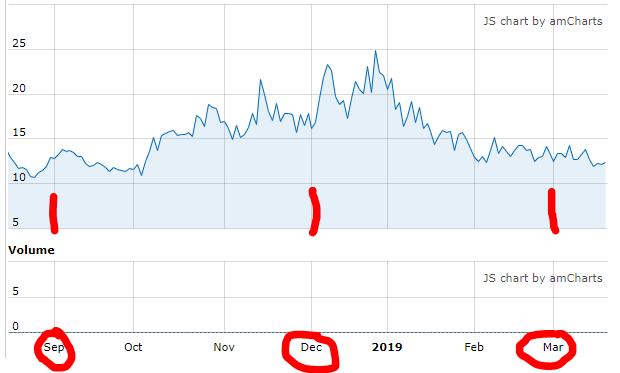
We can estimate volatility using the VIX and VFTSE indices (though these are supposed to be forward-looking rather than historical measurements).
VFTSE, the implied volatility of the FTSE Index, was high in December, but dropped back in February:
Similarly, the VIX had a big December but has spent much of January and February at lower levels:
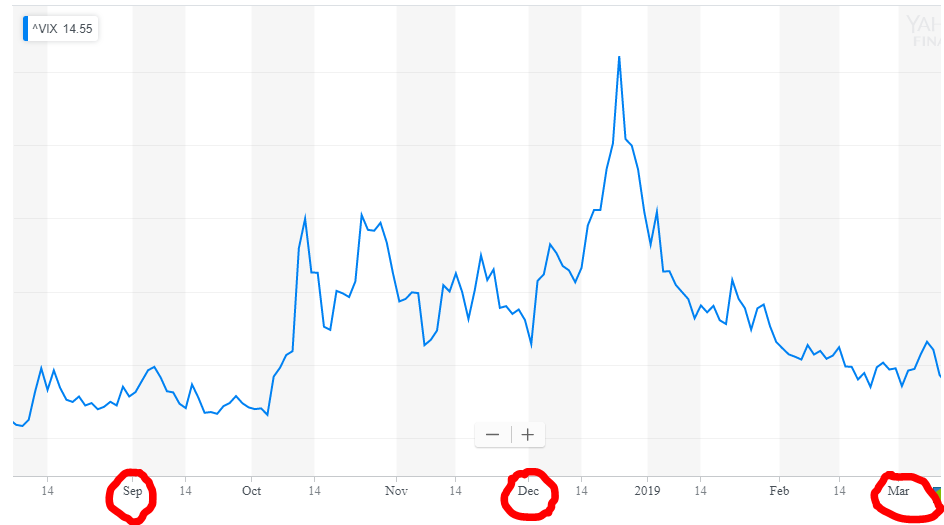
So I do think it is possible that volatility is to blame for the 12% sequential decline in revenues.
It's also possible that clients are finding that they don't enjoy trading or want to trade as much as they did prior to the ESMA rules.
Or it could just be bad luck - the fortunes of these companies are tied to a small number of high rollers, and if they don't feel they are in a position to trade (perhaps due to Brexit preparations - who knows?) then that can have a big impact on results.
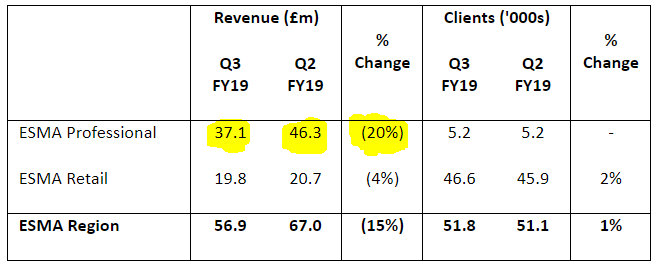
This table shows that the sequential reduction in revenues in the ESMA region was driven by the Professional Clients, i.e. by the ones who enjoy many exemptions from the rules. The behaviour of retail clients is substantially unchanged:
On a year to date basis, ESMA-region revenues are down by 27%, or by 24% if you exclude from analysis those clients who have been able to switch to an entity outside the ESMA region. This includes two full quarters during which the ESMA rules were in force.
Outside of the ESMA region, revenues continued to make gradual progress.
Outlook
There is little visibility - "the the level of revenue in the last quarter of FY19 is difficult to predict accurately".
Cost guidance is unchanged at c. £290 million.
Dividend to be unchanged at 43.2p on an annual basis until growth resumes.
My view
I have a lot of comfort with the integrity of this business as a whole, its market position and its reputation.
I'm also attracted by its high returns and the manner in which it is handling the ESMA rules.
New CEO June Felix is from an international payments background and I'm excited to find out what she can do, using her insights into financial technology. But she is probably still learning about the business at this stage.
As you can tell from my opening remarks, I have history when it comes to buying into IG around the £5 mark. It's easy to say in hindsight that I should have cashed in my chips at £9, but I want to be in this permanently and participate in the long-term growth of the core business, the APAC region and the stockbroking business.
As most people will know, valuation here is rather undemanding on a P/E basis. Even if turnover was as low at £432 million - annualising the very poor quarter just seen and bringing us back to 2015 levels - significant pre-tax profit margins would still be available after £290 million of operating expenses.
The consensus forecast prior to today was for 2019 revenues of £514 million. While I expect that hitting revenue forecasts will be difficult for the short-term, I don't plan to go anywhere as a shareholder and hope that I will still be around to enjoy the profit and dividend stream in 2021 and beyond.
Next (LON:NXT)
- Share price: £51.69p (-0.3%)
- No. of shares: 137.6 million
- Market cap: £7,112 million
Results for the year ending January 2019
(Please note that I have a long position in NXT.)
Next has outdone itself by presenting another comprehensive review of its business and the wider retail industry.
The key takeaway is that "NEXT's economic structure allows its profitable transition into the online world", based on a fifteen-year stress test which presumes that like-for-like retail sales will fall by 10% annually.
One of the big positives (which is incorporated into the model) is that rents are going to fall.
This year, rent reductions of 29% were achieved on lease renewals at 28 stores. The previous year, reductions of 29% were achieved. So rents don't have to be an endless source of pain: as they are renegotiated, they will adjust to wider conditions. Next's average lease term is 6 years, allowing for lots of lease renegotiations every year. The forecast for renewals this year is that they will produce a 27% reduction in rental costs.
There is a wider point here. Next reminds us that its stores play an important role not just in traditional retailing but also in assisting the online offer: online delivery is free to the customer's nearest store, and this can be more convenient for them than receiving the order at home. One third of online sales are delivered to stores rather than to the customer's home.
Additionally, more than 80% of online returns come back through Next's stores.
So the stores play a central role in the entire business, even if they must inevitably shrink in terms of their total number.
I love how clinical the company is when it comes to store decisions. It wants high margins: when it gets them, it stays. If it doesn't get them, it gets out. Assumptions in the fifteen-year model are as follows:
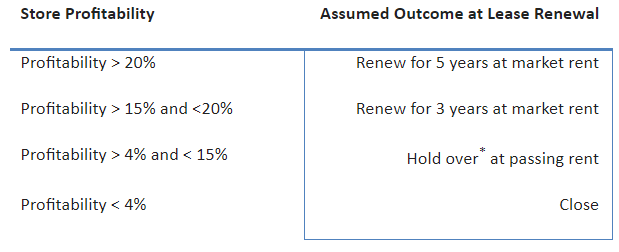
Of course there will be continued competition for retail space, even at the lower rates. But alternative uses such as residential, office, etc. offer much lower yields to landlords than Next and other retailers are currently paying (except in Central London). Therefore, Next is likely to only compete with other types of customer-facing retailer for space.
I don't want to get bogged down in too many details, but the conclusion of the entire exercise is as follows:
In summary, annual declines of -10% in like-for-like sales in our Retail business, combined with CAGR of +7.5% in our Online business looks likely to deliver cash generation of around £12bn over the next fifteen years, with cash generation in the final year being in the order of £1.1bn.
2019 Review
PBT falls by 0.4%, but EPS is up 4.5% (share count has reduced).
Within the online business, sales of 3rd party products are soaring (full price sales up 29%). This is consistent with Next's goal of being the first shopping destination for customers, who don't have to visit any other website to get a comprehensive offering. This division ("LABEL UK") is worth almost 20% of total online operating profit.
Within NEXT Finance, the consumer credit business, bad debts increased. Thanks to bigger overall scale and stable funding costs, net profit from this division still grew by 8.4% to £120 million.
"Discretionary cash flow" (roughly equivalent to operating cash flow, since it doesn't include capex) was £669 million. Capex of £129 million was paid out of this.
Outlook
Profits are forecast to "marginally decline". Next's record of forecasting its own performance is excellent, so I would lend a lot of weight to this.
EPS, on the other hand, is likely to grow by 4.9% thanks to continued share buybacks.
My view
I'm involved here for a number of key reasons.
Firstly, we have its excellent reporting style. Very clear, educational and humble.
Secondly, we have its focus on margins and returns. It doesn't waste time with activities that don't generate big returns. ROCE is consistently superb.
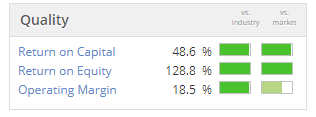
Thirdly, we have its long-term outlook. It takes actions today based on how those actions will affect results through an entire economic cycle, not just based on results for the next year. It has a plan and a model for the next fifteen years, not just the next two or three. That's the kind of business I want to be involved in.
Profit growth won't be easy and I'm not counting on it. Consensus forecasts see net income of c. £715 million p.a. out to 2021.
I do fully support the company buying back its own shares at the current level. If the market doesn't want to give Next an attractive earnings multiple, then it can simply force EPS growth by taking these cheap shares out of the market. Exactly the right course of action with spare cash, in my view.
GAME Digital (LON:GMD)
- Share price: 25.4p (-4.5%)
- No. of shares: 173 million
- Market cap: £44 million
At face value, these results are ok: GAME's PBT is up by 20% for H1, and adjusted EBITDA up 22%.
The cash balance was £96 million at January 2019, the seasonal high.
Revenues fell by 4.7%, however, and falling revenues could make life difficult during the quiet summer period.
Hardware was particularly weak. GAME is captive to the manufacturers and their design cycle. For example, it has been five years since the Playstation 4 was released, and the next one won't be released until 2020 or 2021.
Another weak category was pre-owned, down by 21%.
On the positive side, GAME is enjoying even bigger rent reductions than NEXT. And it has a famously short average lease length, as we've discussed here before.
Average lease length to break in the UK and Spain under one year and savings in the first half of 59% on those leases renegotiated
So there is a route to lower costs and a potentially reasonable outcome, although revenues at some point need to stop falling! Readers have been discussing in the comment thread below some new threats in relation to the online streaming of video games.
I share those concerns and therefore I would not be interested to hold this share for the long-term. Not only can games easily be ordered online, but they can increasingly be downloaded or streamed so there is no need even for a physical delivery. For this reason, I see GAME as a legacy retailer that would not be invented if it did not currently exist.
Its transformation strategy to become a provider of "gaming experiences and services" strikes me as a reasonable plan, but there is a very big tidy-up job to be done between now and then, and I see a risk of sustained losses while this is carried out. So far, the events and esports business is still really small and there is no sign of it springing into life.
Outlook
H2 has got off to a tough start with the wider gaming market down 5.9% in the UK, and also down in Spain. No other numbers are given in the outlook statement.
According to a note published on Research Tree, analysts have reduced FY 2020 forecasts from a small pre-tax profit to a small pre-tax loss, and FY 2021 forecasts are reduced to a tiny profit.
My view
Not something I would want to own permanently. Thanks to the short lease length, I do think that it has a chance to survive rather than heading back into administration (the last administration was in 2012). But it will spend most of its time shrinking and simply trying to minimise losses for the foreseeable future.
StockRanks see it as a Contrarian Buy.
Strix (LON:KETL)
- Share price: 159p (-5%)
- No. of shares: 190 million
- Market cap: £302 million
Strix Group Plc (AIM: KETL), the global leader in the design, manufacture and supply of kettle safety controls and other complementary water temperature management components, is pleased to announce its audited results for the year ended 31 December 2018.
This is an interesting company, headquartered on the Isle of Man. It makes kettle controls for which it owns the IP and supplies most of the world with them.
It IPO'd at 100p in August 2017.
Today's results show small increases in revenues, EBITDA and net income. Market share globally is flat at c. 38%.
Defending its intellectual property is an important part of what it does: eight cases were successfully concluded in 2018.
The final dividend is hiked up to 4.7p, making for a 7p total dividend for 2018. Debt reduced significantly during 2018.
Outlook - confident in the expectations for 2019.
My view - I like this company. I am currently trying to ascertain what is the average remaining life on its patent portfolio, and will let readers know when I have more information on this point.
Ted Baker (LON:TED)
- Share price: £16.01p (-6%)
- No. of shares: 44.6 million
- Market cap: £714 million
Ted Baker reports results under its Acting CEO, following the resignation of Ray Kelvin.
While sales were strong, margins suffered and pre-tax profits fell by some 26%. This is blamed on several factors:
...competitive discounting across the retail sector, consumer uncertainty, the well-publicised challenges facing some of our UK trading partners and the unseasonable weather across our global markets at different points throughout the period.
26% of total retail sales were online. This could be better (50% of retail sales are online at Next (LON:NXT), excluding finance income).
Dividend - small reduction in the final dividend. Total dividend for the year is 58.6p.
Outlook - "trading continues to be impacted by ongoing consumer uncertainty and an elevated level of promotional activity across many of our global markets". Confident in the Spring/Summer collections.
My view - seems like it's worth keeping an eye on this luxury brand. I'd probably be a buyer if the price was low enough. At the same time, I'm wary of ending up with too much retail exposure in my portfolio, so I'll stay away for the time being.
If I had to guess, I would say it is undervalued at current levels.
I'm out of time for today, I'm afraid. Tomorrow, if the company news takes a break, I will be able to go back and look at:
- Volvere (LON:VLE)
- Sopheon (LON:SPE)
- Portmeirion (LON:PMP)
- FW Thorpe (LON:TFW)
- Xaar (LON:XAR)
- Safestyle UK (LON:SFE)
For those of you following the battle between Local Shopping REIT (LON:LSR) and Thalassa Holdings (LON:THAL), there are new announcements as each party makes its case to LSR shareholders. The LSR Board is still hoping to liquidate and avoid the takeover offer by Thalassa:
- Thalassa Statement regarding LSR's Response Circular
- LSR Statement and Shareholder update
Thalassa makes a fair point that the precise NAV of LSR is currently unknown, but I think the LSR argument is much stronger: if the deal goes ahead, then LSR shareholders will be left with a large quantity of Thalassa shares whose long-term value is highly uncertain.
Some liquidity in Thalassa shares is provided by its buyback programme, but this programme might not be continued and ultimately it reduces the free float, making the shares even more illiquid. Selling large quantities of Thalassa shares could turn out to be very difficult.
Hopefully, LSR will succeed in achieving the liquidation that it has been working towards for so long.
Bye for now,
Graham
Disclaimer
This is not financial advice. Our content is intended to be used and must be used for information and education purposes only. Please read our disclaimer and terms and conditions to understand our obligations.

102 comments
Graham, re Strix (KETL) you rightly homed in on patent life in March...any further info?
Final comment on GAME Digital (LON:GMD) , not just google but now apple, got to really really believe in their gaming venue to invest in game.
Apple introduces Apple Arcade — the world’s first game subscription service for mobile, desktop and the living room
Hi timarr
Thanks for posting those links. The first 2 were very interesting. Will have a proper read of the 3rd one when having more time!
Morgan Stanley also provided detailed analysis several years ago showing that Companies buying back subsequently underperformed their peers whindid not buy back. That’s extraordinary really, and is something too few buyback fans seem to realise happens.
I’m sure we’re not far apart. Also Next are a rare example of buybacks being done quite effectively because they will only do them when specific criteria are met, and having now bought back more than half their shares, it means they can now afford more generous dividend payouts.
Great reply timarr. Thanks. It deserves far more than the 2 up ticks so far, and to be seen by buyback fans and those like me who think they are rarely worth doing. My dislike of them is also for non investment reasons. . i.e the sums spent on buybacks seem obscene when at best all they can do is reward shareholders and Company Directors.
e.g Apple are spending almost as much on their buybacks this year as the entire UK National Health budget!
Also the last time so much was spent on buybacks was in 2007 ahead of the big market crash in 2008. Hope history is not about to repeat itself. Some worrying signs from US on Friday.,
peterg.
We'll never know what the Next share price would be now, if Next had not bought back. We do know though that massive buybacks in 2007 weren't much help during that market crash. I know when I did some panic selling then, I didn't even think about whether, nor how much that Company had spent buying back their shares, and doubt if many other investors did too!
Hi ken
Thanks. We're not that far apart on buybacks - you think they're never a good thing, I think they're almost never a good thing :-)
CNBC did some research that shows that companies performing buybacks underperform their peers: https://www.cnbc.com/2016/03/2...
And this research suggests that a lot of companies are performing buybacks to shore up an overvalued share price, presumably so that the management can benefit from stock options: https://papers.ssrn.com/sol3/p...
The mood music in the US is moving against them - they were illegal before 1982 as they were viewed as a form of price manipulation - and there's certainly an argument that that's what we're seeing here.
Anyway I wrote about this years ago (actually 10 years ago, doesn't time fly ...) and nothing much has changed so far. But maybe this time it will be different: http://www.psyfitec.com/2009/1...
timarr
Ordinary people such as teachers and doctors found themselves suddenly negotiating repayment terms for mortgage-sized indebtedness to IG.
Being an ordinary person myself and also a client of IG, I have some sympathy with ordinary people like doctors and teachers who have lost money to IG. But ultimately the responsibility for losses lies with the punter not the system. Doctors and teachers should be smart enough not to gamble with money they can't afford to lose and not to get into situations they don't understand. Guaranteed stop losses are available on IG - admittedly at a small premium - but they should suffice to prevent losses becoming disastrous through slippage.
I tend to agree with the law firm who described IG Group (LON:IGG) as "a disaster waiting to happen”. ESMA and FCA regs have attempted to bring them in line with best practice at Plus500 (LON:PLUS) in regard to banning unlimited loss accounts. Whether this will be truly effective remains unclear as they seem to be porting clients which may or may not be flouting the lawmakers' efforts.
"I have a lot of comfort with the integrity of this business as a whole, its market position and its reputation.
I'm also attracted by its high returns and the manner in which it is handling the ESMA rules."
Prior to the introduction of the ESMA requirements IG Group (LON:IGG) routinely signed clients up to unlimitled loss accounts. So, when eventually a black swan type event happened, and stops were useless, some customers were ruined. Ordinary people such as teachers and doctors found themselves suddenly negotiating repayment terms for mortgage-sized indebtedness to IG.
And let's not forget also that IG has been hit with multi-milion pound fines for extremely sharp practice. Scurrying to protect their own positions while disregarding their clients mounting losses was not what I would consider admirable behaviour, even for a betting firm.
As for the brilliant idea that all they needed to do to circumvent the new ESMA and FCA regulations was to port EU client accounts to outside the jurisidiction, I recall them saying they'd dropped it but from this thread seems they've gone ahead anyway.
Thanks for the continuing excellent analysis on a daily basis - I find it informative and educational a real calling card for Stockopedia.
This is probably the wrong place to ask
But
Can I ask from and ignorant short-term momentum/break-out investors point of view (and I admit I am only an amateur learning all the time) what is the investment case of buying a stock (IGG) in 2017 for 505 which then rises to almost double in August 2018 only to fall back to the same level in Mar 2019? Apart from dividends over that time I have seen my money double and fall back to break even. Of course I am assuming that the holder did not sell but kept the shares throughout the whole period and did not have a SL. Downsides for me is two years no movement and giving up a profit of 100% even if I only sold part of the position I would have some profit.
Not trying to criticize just curious as an amateur the investment case.
Thanks
Guy
Clearly, with hindsight anyone buying in 2017 and knowing it would fall back to that level in 2019 would sell in Aug 2018. But, of course the issue is that as with any investment you don't know that when it's at the peak. So you have to find ways of dealing with that. Some people like stop losses, and clearly in this case one would have crystalised some gains. But stop losses also stop you out of good investments, sometimes at a loss, when there is a short term price fall. Others take a view that buying on good fundamentals and holding, perhaps till there's a clear change in those. There is no simple answer, and multiple approaches can work for different people (or not work). The ultimate issue is that whatever your approach you will end up holding shares that make a loss, or reverse on gains. That's a fundamental of investing that has to be got used to and dealt with in a way that suits you.
Yet another brilliant update today Graham. Don't now how you and Paul have the stamina and endurance to update in such detail day after day, bearing in mind that those updates also reflect a lot of time spent analysing results information too.
Much appreciated your Next update (and what informative comment from Next too).
Re the success or otherwise of Next buybacks, there was a very good article in Investors Chronicle last week headed "Buybacks versus dividends - which is best?"
Link here but it's a subscription site:-
https://www.investorschronicle.co.uk/comment/2019/03/08/buybacks-versus-dividends-which-is-best/
Included in that article is detail on Next buybacks including Next's own sensible rules for doing their share buybacks.
I prefer special dividends (Next pay those instead of buying back if buyback criteria not met) as investors actually get that cash unlike with buybacks.
The I/C article shows that very long term holders of Next shares have been rewarded as profits rose and the number of shares shrunk. BUT over the last five years their buybacks have not worked with total returns to shareholders virtually zero despite £921 million (roughly £6 per share on the 2015 count) spent on buying back their shares. In 2015 their average buyback price was £63.90 , and in 2016 it was £68.38. The shares subsequently fell to just £36 and though now well over £50 that's still a long way below those earlier buyback prices.
I bought Next a while ago at £38 thanks to convincing Paul Scott SCVR comment. At that time their criteria for buying back were not being met, so they paid special dividends instead . With those specials the dividend yield was almost 10%. The share price subsequently rose to over £60 and with dividends and specials on top. BUT since they became confident enough to buy back again instead of specials, the share has fallen back.
I agree that Next are much better at buying back than the many Companies buying back without any criteria for doing so. But even for Next there can be long spells when buying back does not reward their loyal shareholders, but they do reward shareholders who want out,
The I/C article shows that very long term holders of Next shares have been rewarded as profits rose and the number of shares shrunk. BUT over the last five years their buybacks have not worked with total returns to shareholders virtually zero despite £921 million (roughly £6 per share on the 2015 count) spent on buying back their shares.
The flaw in that argument is that it doesn't know, or account for, what would have happened had Next (LON:NXT) not been buying back. It would certainly be the case the SP would have dropped further than it has, and quite possibly by more than the £6ps that they've spent on buy backs.
I peters
It is not a certainty that the share price would have dropped further than it has. Investors often buy and sell without even considering the buybacks.So the share price could be the same as now, or even higher or lower. Eps would be lower if share price the same as now and PE ratio would be higher. Also the dividend yield would be a bit lower too because of the increased number of shares in issue.
Also Companies that buyback can see their share price drop a lot.
E.g Standard Life Aberdeen share price has fallen heavily despite current big buybacks. And the falls were relentless for months despite daily buybacks.
There are a lot of misconceptions about buybacks. Plus and minus points, including for Next are well explained in that Investors Chronicle article.
Buybacks are just another way of returning money to investors. In certain circumstances, it may be more tax efficient for the investor.
I don't think it matters much if a company is paying dividends, buying back shares, paying down debt or investing in growing the business, provided the overall investment is attractive, after analyzing all factors.
Obviously the valuation needs to be adjusted downwards if the company does require the capital to fund growth or pay down debts.
It is not a certainty that the share price would have dropped further than it has.
You're right of course, just extremely likely!
The Investor's Chronicle article in question can be boiled down to a single quote:
This is exactly the point Warren Buffett always makes, although he uses the Ben Graham derived term "intrinsic value" as shorthand for the value of the company. In this situation the remaining shareholders have their holdings' value enhanced by the buyback at the expense of the selling ones.
In fact most buybacks are executed at ridiculous prices by companies for less than clear reasons - offsetting EPS dilution from share options vesting is quite a common one. It's no accident that companies tend to buyback their shares in buoyant market conditions - which is usually exactly the wrong time to do so.
On Next (LON:NXT) the IC article is a dog's dinner. It calculates the Equivalent Rate of Return (ERR) on Next over the last five years. Roughly it averages out at 10% - basically that's the economic benefit of the buyback to shareholders - and it's almost spot on Next's target.
It then calculates the total shareholder return (TSR) actually achieved by Next shareholders over the last five years - basically share price appreciation plus dividends - and shows that it's nigh on zero, because the share price has fallen from £62 to £48 (at the time of publication). So basically the share buybacks have contributed to a TSR of zero despite that ERR.
It then argues that this "proves" that the buybacks were a waste of time and shareholders would have been better off receiving £6 worth of additional dividends. Which, of course, is the equivalent of arguing all the money spent on solving the Y2K bug was wasted because there weren't any problems.
The article even acknowledges that its conclusion is a bit dubious:
Maybe, maybe not. But an ERR of 10% suggests that Next's management are mainly buying back shares below intrinsic value and that probably the share price - and therefore the TSR - would be lower if they hadn't bought shares back (and when they can't hit that hurdle they pay out special dividends instead). In any case using TSR as a measure of the success or otherwise of a buyback program is simply stupid - it doesn't tell you anything about the intrinsic value of the company and ignores the point the article made in the first quote above.
The arguments around Next tend to miss the point, however, as usually they're constructed to argue that companies should never buy back their own shares. That's simply wrong. But for every management with the discipline of Next's there are dozens who use it to enhance EPS rather than shareholder value.
We wouldn't let an investment trust buy back shares at a premium, but that's exactly what a lot of companies do with buybacks.
timarr
I have an account with IG but investing in spreadbetting firms has never appealed as I`ve always felt that spreadbetting is a ultra competitive business and one that has such a high ratio of losing clients that need regularily to be replaced with new clients
Strix (LON:KETL)
I picked up on a recent webcast that they sell their controls for 11 cents each and the CEO said that was a reason appliance manufacturers have not been too aggressive on copying, as it's cheap already.
Some positives: good investment in robotics very low FTE on the plant, so can hold down unit costs, have been investing in new heating technologies around instant hot water, coffee and baby foods and the water purifier seems to be gaining sales. Dividend covered nicely by free cash.
It's a slow burn company, ticking along, nice dividend, fits a long term hold option.
Interesting, I looked for their patent, and I see one in Europe for Strix which expires in Feb 2022, see link below
https://patents.google.com/patent/EP1233649A1/pt
That for me is the question mark and perhaps doesn't fit well with the long term hold view I stated above!
What do you think is the forward P/E multiple for IG Group (LON:IGG) ? G
IG Group (LON:IGG)
21 (£400m Rev - £290m Opex less C Tax = Net profit of £89m = EPS of 24p)
Phil
Hi Phil
IG Group (LON:IGG): 21 (£400m Rev - £290m Opex less C Tax = Net profit of £89m = EPS of 24p)
OK, I can see that, if you annualise last quarter and assume a further decline. It's pessimistic, but who knows, it's possible I suppose. Until we see the run rate for a few more quarters it's hard to unpick the impact of regulations from the noise of market conditions. And that's before looking at the effects on competitors and the new US and German operations. Forecasts are always unreliable, but they're particularly so here.
But that £290 million opex isn't fixed. It includes elements of variable remuneration plus investment in technology both to meet the new regulations and to drive new business. They'd be hacking into that well before revenue fell to those levels.
timarr
Hi timar
IG Group (LON:IGG)
Accept all you say - my back of a fag packet calculation is cautious - mainly using it as an argument as to why I don't think the current PER is "undemanding" as IG Group (LON:IGG) 's revenue is currently on a downward trajectory and I do think they'll be slashing costs next year - not something I want to be involved in with a CY PER of 13.
Phil
I think the variable remuneration for IG Group (LON:IGG) isn't that large a proportion - £35.9m to be precise. It is hard to see that dropping far, as within that the biggest component is general bonuses which are paid against internal targets, not financial performance against the previous year.
That is understandable in some way, it would not be very motivating to ask staff to beat last years record revenue.
For the rest of the costs, the largest bit is technology and innovation at £88.5m, which according to the annual report are largely fixed and do not flex with revenue.
Prospect acquisition is next at £79.8m. This is more discretionary, and depending on the outlook this could fall some way (ESMA banned incentives, but I am not sure IG were offering them on the same scale as Plus500). Customer churn would be a lot lower than others but they still need new blood as well.
Could costs be cut to offset the drop in revenues? I don't think they can find £100m of costs to trim off in the short term, and it is hard to see new operations gaining traction so quickly, although the next trading update will be interesting.
I think the surprise for me was the drop in Professional revenues,with Retail staying flat, I would have thought regulations would have affected it the other way around.
Another surprise is the rather low level of professional eligibility: 14% of people that applied were accepted. The comparative figure for Plus500 is 44%. The ESMA eligibility guidelines are the same, so why the difference? I can only think Plus are being lax.
That said, they do deserve a premium rating. I have no problem with their services
Hi snoo
RE: IG Group (LON:IGG)
Well, those remuneration costs could be slashed as well, if times got really tough. Although I can't say I'd be particularly keen on IG Group (LON:IGG) cutting costs even if revenues dropped further, I'd rather they invested and cut the dividend. The interesting thing here is that you have a market leader suffering due to industry wide problems caused by increased regulation. So everyone must be hurting.
We can see that Plus500 (LON:PLUS) and CMC Markets (LON:CMCX) have also been impacted, so we can guess that smaller, less well capitalised competitors must be really struggling. The big question is what the size of the total addressable market will end up being? Smaller than it used to be, for sure, so the existing players need a bigger proportion of that just to standstill. IG Group (LON:IGG) has other opportunities as well, but until those generate real revenues there's no way of assessing those.
The comparison with Plus500 (LON:PLUS) is interesting, too. The basic professional eligibility rules are to meet 2 of the following 3 conditions:
So, somehow, Plus500 (LON:PLUS) attracts more of these high rollers than IG Group (LON:IGG) - which seems odd. CMC Markets (LON:CMCX) quoted a 29% conversion rate so there's some discrepancy there too. On the face of it, it suggests one of two things - either IGG has lower quality of applicants or higher standards of eligibility testing. I wonder which it could be?
timarr
Hi timarr.
On your last point about professional eligibility, there’s possibly a third interpretation. When I was contacted by IG Group (LON:IGG) on the matter, they were pretty low key in selling the professional status and focused on the loss of certain protections (such as guaranteed stops) when changing status. This didn’t put me off, but it might make some punters think about making the change. In contrast, having seen some of the Plus500 (LON:PLUS) advertising, I could imagine they’d make professional status sound like the next best thing after winning the lottery. It might be IG Group (LON:IGG) had one eye on not falling foul of future mis-selling recriminations from the regulators at some point down the track and thereby achieved a lower conversion rate.
In terms of verification, I’m pretty sure all of the tests were self certifiable so that for the last two tests at least there was no attempt to check the size of my portfolio or previous professional experience.
Gus.
Hi,
One point to consider regarding professional status, is this part of the IG Group (LON:IGG) Interim Results (emphasis mine):
In the second quarter of the year (Q2 FY19), when the ESMA measures were in effect throughout, the Group's net trading revenue of £122.1m was 8% lower than in the same period in the prior year. Revenue in the ESMA region in Q2 FY19 was 18% lower than in the prior year. This was offset by the 9% growth in revenue from the Group's OTC leveraged derivatives business outside ESMA. Both these figures are underlying changes, adjusting for the 1,200 clients who previously contracted with a UK entity who are now trading with an entity outside the ESMA region.
I am not sure the regulator will be too pleased that a significant number of clients are avoiding the new ESMA rules by simply changing to contracting with an entity outside ESMA.
IG Group (LON:IGG)
Clouds, I suspect those individuals have at least one address and/or bank account outside ESMA.
Gus, I believe they do ask for trading records. Interesting that they didn't seek evidence of portfolio size/experience. G
The professional eligibility rules are rather unreasonable, particularly the first requirement that "You have traded in significant size, at an average frequency of 10 per quarter over the previous four quarters"
This is ludicrous. Clearly they think that long term low frequency investors are incapable of making professional decisions. To the extent that people like Warren Buffet and Terry Smith might not trade frequently enough to meet this aspect of the professional criteria.
Somewhat further down the scale, I have made 1 trade so far this calendar year. Over 30 years experience counts for nothing.
For anyone who hasn't actually worked as a professional, it's necessary to satisfy this rule to meet their eligibility requirements. Utter madness.
Jonesj, I totally agree. The rules were written by people who don't understand trading and investing.
The ESMA rules are a bit clunky for sure, but how many false positives (retail investors really missing something due to be banned from using very high leverage) do you think there are?
IG Group (LON:IGG)
"As most people will know, valuation here is rather undemanding on a P/E basis."
Sorry Graham, I, for one, think the valuation here is very demanding given my expectation of falling profits, not just in FY 2019 but also FY 2020 and uncovered dividends in both years.
(Can't help but feel to keep their "high-rollers" they've given away a huge chunk of margin.)
Anyway, good luck, and as I always think .... time will tell.
Phil
Just listened to Next (LON:NXT) webcast and gone through slides. Absolutely brilliant as usual. Model of clear, long term, joined up business thinking. Mandatory reading for anyone interested in retail and prospects for the High St.
Few builds on Graham's note from Lord Wolfson's comments:
* Online is partly winning for convenience but actually access for more people (eg in smaller towns) to a much wider of goods is driving channel shift (just as Supermarkets with 40,000skus did vs mom&pop high sts
* As a consequence, NEXT's UK share will likely drop in long run (its stores accessibility moat declines); however equally, Next can now sell much more effectively overseas
* The NEXT platform is emerging a real asset that offers 3rd party access to Next's 4Mn customers, website, credit and fulfilment systems for only 39% of sale cost - no wonder people wnt to jump on board
* returns level on womenswear is >50% (discussed in this column in respect of £SOS)
* In 10 years time Next may keep open unprofitable stores /develop new mini stores formats to support online - since customers value the ability to collect instore (50% of orders, 35% of value since avoiding delivery fee is important on smaller orders
* Instore even more important for returns (80% of returns) since more convenient than giving to a delivery man
More great stuff throughout!
For £IG I have averaged down a few times, and still the price drops. It is in my ISA so I am going to allow the dividend reinvestment feature to take up some of the slack of the averaging down process - otherwise it is going to be disproportionate to the portfolio.
I do wonder if a bit like the big utility regulators, it is just too easy to keep coming back to the same area for more tweaking. Of course Terry Smith of Fundsmith fame does claim that regulators tend to create moats around the survivors, because it is harder for competitors to enter the business because of regulation. I am clinging to that notion for the time being.
Re: Next (LON:NXT) excellent write up Graham.
I've hardly ever been into one of their shops, but stand in admiration of this business and the management, in terms of results and open reporting. Maybe they've cracked the hybrid model between online and bricks and mortar.
@Graham, the plot of VFTSE over a longer timescale doesn't support the IG Group (LON:IGG) argument on volatility (unless they have attributed lower revenues in the past to lower volatilities in previous quarters)
Below is a plot showing 2017, 2018, 2019. Volatility for that period according to the data was higher than previous quarters on a like-for-like whether you take average, baseline or peak . This is just VFTSE, if you compare CBOE VIX over those periods the same is true. We have had a very strong rally in that quarter with very good technicals which has made trading lot easier (on a relative basis). I suspect enhanced customer profitability has had more impact than underlying market volatility. I know I have had a very good quarter thus far
I have no position in IG Group (LON:IGG) although I use their services as they are in my view the best in the market
Hi Dscollard, thanks for that. Not sure if your yellow marks correspond to December-January-February, though? Looks to me like you might have included October 2018 and November 2018? It can be hard to draw these things! G
@ Graham, thanks: I have a doctorate in Physical-Chemistry (from the other place, UCD) I can read a simple data plot ;-P
Maybe this helps when I break them out by the exact quarters for each of the three years in reverse order
Thanks dscollard. I wasn't accusing you of not being able to read plots - it's more that I couldn't make sense of the thing myself!
not a problem Graham , I was responding to this comment which kinda does suggest I am not reading the data right. The data clearly shows that the IG Group (LON:IGG) narrative is not supported by evidence on a YOY.
My original point was about objectively reading data as opposed to allowing company narrative to confirm a bias arising from being long.
A couple of things caught my eye:
GAME Digital (LON:GMD) - Inventories continue their recent upwards trend despite revenues falling. I continue to be suspicious about the disposal value of their second-hand inventory in particular. More positively the average lease length continues come down (0.8 years vs 0.9 6m before) and I calculate the average lease length of the approx. 115 stores not due this calendar year to be 1.6-1.7 years, giving quite limited scope for the average to hide a tail of long, highly unprofitable leases. Cash looks excellent, but always does in the H1 report - I suspect 26th January is pretty much exactly the high point over the year. I hold.
LoopUp (LON:LOOP) - Organic revenue growth has fallen to 20%, and they could have been more upfront about this.
Strix (LON:KETL) for information, Simon Thompson has published another article in the IC today. It's subscriber only but concludes with:
"Trading on a 2020 forward price/earnings ratio of 10, and offering a prospective dividend of 4.8 per cent, I continue to rate Strix’s shares a buy and have a 200p target price. Buy."
The article is here
https://www.investorschronicle.co.uk/comment/2019/03/21/strix-aims-to-clean-up/?utm_campaign=Copy+of+ICDailyEmail_new2016&utm_source=emailCampaign&utm_medium=email&utm_content=
I hold.
Strix (LON:KETL) For those interested in Strix, we have published on results this morning. https://www.equitydevelopment.co.uk/edreader/?d=%3D%3DgN1UjM
We will be interviewing them later to discuss the growth and this will be available on our website tomorrow.
Thanks.
Another vote for Sopheon please. Results seem in line with guidance so share price reaction seems a tad surprising. Possibly a reflection of outlook statements which contain some ambiguous wordings. Would welcome your input Graham.
Also Strix (LON:KETL). great cash generation as well as growth capex
LoopUp (LON:LOOP) results do look excellent, shares were up around 8% but have fallen back, would welcome Graham's view on these.
Hi Herbie, I'm afraid I don't study LoopUp (LON:LOOP), maybe Paul will comment on it again soon.
Best regards
Graham
Sopheon (LON:SPE) interesting comment from Chairman "Strategically, now is the time to accelerate investment and solidify our leadership position … we will continue to assess corporate paths to accelerate our progress." does this hint at a capital raise?
Sopheon (LON:SPE) Or a reverse takeover with a private equity competitor or a trade sale (directors and major shareholders are 65-70 yrs old) or using the cash balances of $16 million plus.
A small number of insiders own 50% of company so incentives presumably aligned, as seen last year when they sold some of their shares.
Can I politely remind people to include in their posts the name of the share they are commenting on.
IG Group (LON:IGG)
My own forecast (since the company won't) would start with adding Q3 again and coming up with revenue of £467m for the year - take off operating costs of £290m gives operating profit of £177m and profit after tax of £143m. Suggests EPS of 38p and a PER of 13 at 500p - quite a miss compared to the consensus and means the dividend is not covered.
In general terms a PER of 13 seems very high to me given that they refuse to forecast a result.
As we speak adding on Q3 again would be the top end of my forecasts - as has been mentioned above the VIX was very high in December, high in January and quite a bit lower in February - I would have said that should have equated to good quarter for IG Group (LON:IGG) . Currently the VIX is at low levels and seems to be edging down to the lows seen last summer.
It would be quite reasonable to put forward an argument that Revenues for FY 2020 may only be £400m .
I used to think that the CFD sector was very good for investment but the news over the last few months lead me to believe all is not well - obviously there's ESMA but this seems like there's way more than that.
Phil
No holding
Portmeirion (LON:PMP) -
Not a alot to say - fall asleep and come back in 3 years with this one perhaps?
Expected EPS per stocky 72p - actual EPS 72p. Expected 2019 EPS 77p.
PE of 14 seems about right , probably a bit stingy for a company that's sales growth is almost as consistent as CAKE in its pomp (OMG did i just say that?)
Fulcrum Utility Services (LON:FCRM). Fulcrum Utility Services. Year end statement not expected til next week - does anybody know the reason for today's sharp fall? I know of its unusual registration (though as a spin off from British Gas, its pedigree seems OK), but its business seems straightforward, with the added attraction of longterm secure profit from ownership of energy connections
Hi sheeza = re. Fulcrum Utility Services (LON:FCRM)
The co. issued a statement around 11 a.m. today.
This is what I posted on a well-known BB
"
The update is useful.
revenues 57m, Broker Forecasts 61m, -7%
EBITDA 11m against FY18 8.4m , +31%
Based on these numbers, back of fag calculations tell me eps will be close to BF of 4.5p.
If this is correct, then a near 20% drop in sp in last few days is unjustified, unless there are other cockroaches we know nothing about.
I have taken a small position.
"
Please DYOR
Hi Ramridge - I have also taken a small position (annoying at what I thought was a bargain at 39p!). On another SCVR thread someone pointed out the market may be spooked by the Chancellor's announcement last week that no new homes from 2025 would have gas central heating so that might be part of the issue? However, that's quite far off and gas hobs would still be allowed and given the demand for gas hobs I would have thought Fulcrum would continue to need to build some gas infrastructure in new homes even after 2025.
Re Fulcrum Utility Services (LON:FCRM)
It may also be that someone has wind of sliding turnover. Their RNS today said £57m but the reported H1 of £29.2m so almost a standstill in H2. H1 also stated LFL turnover in H1 was +12.9%.
May be wrong but sitting on the sidelines on this one. Please advise if I have the wrong end of the stick here
Re Fulcrum we recently switched from a gas hob to induction and the induction is way better. I don’t see builders bothering to connect up to a gas supply just to power a hob.
Somero Enterprises Inc (LON:SOM)
Arden Partners have intiated research on Somero Enterprises Inc (LON:SOM) with a sell note and a TP of 300p. (on ResearchTree)
Wow - that is a bit strange i would love a chance to buy in at 300p based on what's is in the public domain. I can only guess they are ultra cautious in every regard and perhaps taking the point of view the company has traditionally been on a very modest rating and they expect that to continue so any reversion back to no growth or reduction in profits could see the shareprice back down at the 300p level perhaps. I guess that is a possibility and i suppose it's semi honest that the Brokers are taking a somewhat quirky viewpoint of their own - at least it shows they aren't towing the party line. (Broker big balls award of the century is already secured by Kevin Ashton)
I do note that there are no forecasts showing for 2020 on Stockopedia year - not sure when these expected numbers will show up - but i always feel more comfortable when that the next year out forecasts are on Stocky and show positive progress.
Ref broker big balls of the century award - further info from Telegraph article 18/7/14
At the time, Canaccord – which yesterday declined to comment – claimed the technology broker’s exit was “for personal reasons” and “in no way relates to his research coverage of Quindell”. “We are looking forward to his return to work as soon as he is ready,” it added.
But Mr Ashton is in no rush to make that comeback, after terminating his contract with Canaccord this week. He humorously updated his LinkedIn profile yesterday to “Boss, Independent Gardening” – a new role that involves tending to “fuschia, japonica arabica, one daisy and plenty of snapdragons”.
I have every sympathy that he found his position was untenable - particularly as the same article mentioned that he would probably have been moved over to working on Globo after presumably pointing out the obvious Quindell fraud problems had he stayed in his job - that's a bad run of "make something positive for that company please" instructions from the bosses.
From same article
Elsewhere at Canaccord, Diary wrote yesterday how the company will have its work cut out in its new role as joint broker to Globo, the mobile software provider.
I wander if he is living it up large with John McAfee perhaps.
I’ve had it confirmed that Arden are not retained by Somero Enterprises Inc (LON:SOM) they’ve just decided to do the 44 page sell note off their own back
I wonder why
Morning Graham
Portmeirion (LON:PMP) and/or Strix (LON:KETL) if you have time. Both sets of results look good to me. I like Strix (LON:KETL) strategy of investing for the future and R&D.....acquisition of Halosurce assets, new factory in China and presence in Seattle etc. This is what will drive future growth and is very much in line with one of Philip Fisher's investment mantra's. Cash generation is excellent as evidenced by debt reduction. I suspect in a few years the company will be debt free.
Regarding Portmeirion (LON:PMP), it is in my view a well managed company in a niche market with some very attractive and valuable brands and is cash positive.
Both companies sell globally and have attractive quality metrics. The also pay good dividends. I hold.
Portmeirion (LON:PMP) has been on my watchlist for a number of months now and I'm looking to buy in at some point in the future. I had a scan of the results which overall seem positive. I was however quite taken aback by the rise in Receivables (Trade Debtors) year on year which seems much higher than the rise in revenue. Would anyone know of a reasonable explanation for us. I don't want to think they are getting slower payments from their customers.
Strix (LON:KETL) final results of interest here too.
Maintaining high global market share in kettle controls and improving margins in spite of difficult climate.
Significant cash generation paying down debt and increased dividend as promised with 4.4% yield
Rigorous patent enforcement to protect brand and curtail copying designs
Aim to restore growth in Chinese market with lower cost product
Plans for new factory in China will impact free cash flow during next couple of years
Water filtration a growing product line
All in all, looks to me like the company is delivering on its strategy and is in good shape.
Dreadful results from Xaar (LON:XAR) this morning. Share price down c. 7% though announcement only confirmed recent trading update with no new negative news as far as I can see. Still have £28m in cash though current rate of decline £15m a year. Interested in any thoughts on whether this business is in terminal decline or can be saved. They seem to be pitching for a strategic partner to ride to the rescue. With a price to book value of well below 1 is there value here either to buy and dismantle or to try and turnaround?
Strix (LON:KETL) for me as well please.
results don't seem exactly explosive, but as previously stated seem to provide steady growth.
Lloyd
Somero Enterprises Inc (LON:SOM)
Arden Partners have intiated research on Somero Enterprises Inc (LON:SOM) with a sell note and a TP of 300p. (on ResearchTree)
I'm a bit concerned as it states:-
" * Arden Partners acts as corporate broker to this company.
# This company is a research client of Arden Partners."
The SR does not confirm this .
Anyway I'm now going to read the 44 pages.
Phil
I hold, but less than I did 30 mins ago
Hi Phil,
That does sound odd, can you let us know the gist of the note please?
Cheers
Chris
Arden are saying the Somero Enterprises Inc (LON:SOM) PE should be 10 to balance risk and reward because they expect a slowdown and possible recession in the US market.
Seems more about their macro view of the US than concerns about the company.
Somero Enterprises Inc (LON:SOM)
Hi Chris
The gist is they believe there will be a US slowdown and the current PER is not reflective of this. I think Graham noted this risk last time he covered.
I think this has always been on the bear case side of Somero Enterprises Inc (LON:SOM) - but I haven't yet digested and decided which side I fall on.
Phil
Thanks Phil, that's great.
It's a fair opinion for them to take, what seems odd (but honourable) is that Somero appears to be a client of Arden's. Fair play to Arden, we've wanted independent research analysis for years, so this should be seen as a good thing. Having bull and bear cases out there in (not very) publicly available research notes is what should happen across the board.
I'll probably hold on to my Somero shares for the time being. In the full year results, they said:
"We see continued strength in the underlying non-residential construction industry in the US and an extended pipeline of projects that remain in front of our US customer base. Going into 2019, market drivers in North America continue to be demand for replacement equipment, technology upgrades, fleet additions, and new products."
Now an actual recession would change all that, but I'll stick with the company for now.
Ta
Chris
I think that it's useful to remember that Directors tend to be naturally optimistic.
In March 2019 Somero said "We see continued strength in the underlying non-residential construction industry in the US and an extended pipeline of projects that remain in front of our US customer base".
In March 2008 Somero said "the non-residential construction market in the US remains strong and sales in the Rest of the World continue to grow in line with our expectations."
Bear in mind that the US recession had already begun when Somero wrote the latter words in their 2008 Annual Report (!)
The last recession had a major impact on Somero's P/L:
As for whether a US recession is pending, there are many economic variables one could follow.
The simplest (& possibly most successful) recession predictor is the one used by the New York Fed which looks at the difference between the 10 year Treasury yield & the 3 month bill rate. When the former falls below the latter, a recession is all but guaranteed.
Yesterday the 10 year Treasury closed at 2.54%, the 3 month bill 2.41% i.e. a gap of 0.13%
This is the narrowest gap since the last recession.
We have been warned.
(The red columns denote recessions. The 1970's/early 1980's were clearly an economic mess)
There's no question that Somero Enterprises Inc (LON:SOM) would be hit by a recession but I'm not sure the last one is an indication of their absolute performance in the next one. If I remember correctly they went into the last recession having been floated on a sea of debt by PE owners and nearly went bust servicing it.
In contrast the company now has no debt and is in a much stronger position. Whereas last time all it could do was hunker down, preserve cash and hope for the best, next time it should be able to invest while its competition struggles. In fact, if the trend towards warehousing continues they might be able to grow even while the overall market falls.
No reason to be complacent, but I don't believe the historic figures are entirely relevant to what might happen next time.
timarr
Actually, that's not quite accurate. It is certainly true that all recessions occur when the 10y falls below the 3 month bill BUT there have been many occasions when that effect has been seen with no subsequent recession, so it is not "all but guaranteed".
I agree it is a warning indicator to be wary of though.
I actually don't see any real sign of a recession in the US next year. I do however, see quite a few potential black swans that could cause a knock on impact leading to a recession, so neither am I complacent/ too relaxed about the macro environment either.
davidjhill
Looking at the '10 year Treasury minus 3 month bill' spread chart in Howard Marx's post, it would appear that there have been 8 recessions since 1960, and:
1) apart from the first one, all recessions occured after the spread went negative
2) there was just one false positive (1967) ie where the spread went negative but no recession followed
So the assertion that a US recession is likely seems sensible if history repeats.
For me the question is what will the time lag be e.g. the spread went negative more than 12 months before the last recession
So the assertion that a US recession is likely seems sensible if history repeats.
Likely but not definite. Leaving aside the timing issues there have were notable false positives in 1966 (inverted) and 1998 (flat).
More problematically the relationship is a correlation - it's unclear what the causal connection is. It could simply be that people have learned that the indicator "predicts" a recession and in reacting to pre-empt it cause it.
Fun, this investing lark ...
timarr
Timarr, I too would like to establish a causal relationship before following what might be a spurious correlation. One possibility is that rising short term interest rates depress future economic activity and at the same time create a reverse yield gap. I expect there are other possible explanations too.
Richard
Hi Richard
I too would like to establish a causal relationship before following what might be a spurious correlation.
Many smarter people than I have tried to do the same, but no one has come to any definite conclusions. My very broad, and completely unactionable view, is that markets are complex adaptive systems populated by irrational but intelligent actors. Once people identify some form of predictive correlation they start to behave differently - and cause the markets to behave differently.
For the correlation to hold even though the whole word knows what it predicts it would probably have to represent some deep structural truth. Or just possibly, recessions come along eventually so one will always appear at some point after the yield curve inverts ...
timarr
Couldn't agree more timarr.
I spent 17 years watching the yield curve in both the US & UK along with the swaps curve. Not one economist ever got their predictions either on it or regarding its impact right consistently. Plus, if it was a perfect indicator The Fed would use it solely in their decision making.
As to its use to The Fed, it is a contributor but the about turn seen in the last few weeks should be a live example about how they might not be considering it a worthwhile indicator right now. Up until very recently, most banks were predicting three rate rises this year with possibly a further one in December and the curve was little different to today. However, it is now emerging that there may be no rate hikes this year and yet the curve is little changed, so does this mean recessionary risk has increased for them? Apparently, The Fed is in fact most concerned about the possible Japanesification (a bloated balance sheet causing years of stagnation) of the US economy and as a result will now err on the side of caution for 2019. All the while the yield curve is little changed in terms of its steepness. So go figure how reliable it is as a recession predictor based on it being virtually unchanged at the same time as the interest rate outlook for 2019 changing completely in a little over 3 weeks.
It brings to mind the story about The Queen, when she asked a load of supposed economic experts how they all missed that the GFC was coming? Then I think of Buffett and his quote that goes something like ten minutes trying to predict the economy is ten minutes wasted.
"All the while the yield curve is little changed in terms of its steepness. So go figure how reliable it is as a recession predictor based on it being virtually unchanged at the same time as the interest rate outlook for 2019 changing completely in a little over 3 weeks. "
But hawkipa, the Yield curve (spread between 10 year Treasury & 3 month bill ) HAS fallen 66% in the past three weeks.
This was the reason I mentioned this reliable recession predictor.
Fair point Howard Marx. Embarrasingly (for me), my feed was showing the curve just below 20. Now refreshed. Back in my box!
Interesting discussion on the the 'yield curve' and whether it is signalling a recession (& if so when).
For info I had a ramble around this subject late last year, when there was quite a lot of noise about the "curve inverting" and you can find this here together with some very useful comments in the feedback.
To precis - the yield curve (however you define it) looks to me a somewhat useful indicator, but lacking the precision to make it usefully predictive.
Gromley
Quite. I am not saying the relationship is not an important factor to watch, nor that it is a warning light to pay close attention to, but there are lots of components to this.
For example according to Credit Suisse, US stocks tend to rise by 15% or so in the 18 months after the yield curve has inverted, so there could be a lot more upside to this market before any recession occurs and therefore one may miss out on a lot of upside by getting timing wrong.
It is also true that US growth is slowing. Unsurprising given recent strength.
But, I am increasingly cautious of the potential black swans out there that could trigger a recession so maybe i should look at some 12-24 month downside protection anyway.
Somero Enterprises Inc (LON:SOM) Sounds very odd to me too. Very unlike a broker to say sell on a client.
Is it just me or is the reply bit on stocko rubbish now?
This is a bizarre report imo. FinnCap conversely have a target of 465p (reports within 1 week of each other) so that's a wide bid/offer spread on valuation!!!
The company itself is pointing to strong growth in 2019 just a week ago. That doesn't appear to be reflected in Arden's forecasts.
The FED last night said they were happy with the US exhibiting continued growth and strength in the economy albeit slightly slower than 2018, which again doesn't point to recession or problems for Somero Enterprises Inc (LON:SOM) in the near future.
Report seems to hinge almost entirely on the thesis of a US recession next year whilst still attributing just a 25% chance to that (and I'd say that's inflated for effect, personally - I'd put it sub 20%).
Odd !
I have found broker sell notes often a good time to buy, one recent example is Trade Desk, have a look at 19th Feb to 22nd Feb, broker sell note was on 19th Feb. I read a report once that said the broker sell notes outperform. Still holding onto my Somero Enterprises Inc (LON:SOM).
The results from IG Group (LON:IGG) don't seem any worse than I was expecting. The reduction in revenues seemed in the area that has been previously indicated, and they have gained clients, albeit slowly. From this point of view the price fall seems overdone.
On the other side though it looks like a struggle to hit full year revenues now (I'm using the stockopedia figure of 509.3 because I'm not 'sophisticated' enough to get other research - don't get me started) which will impact on profit obviously.
I must admit I'm really not sure whether I should get out or top up. I'm not brave enough to buy Plus500 (LON:PLUS) , I thought IG was a safer bet.
YTD is already 15% at this point, and the Q4 will undoubtedly be down as well because that year did not have the ESMA restrictions, or the cryptocurrency craze.
What seems worrying to me is that quarter on quarter, revenues are falling by 12%, and these should be comparable as the restrictions applied in both these periods. I don't quite buy the excuse on volatility for the reasons above.
We've had a few weeks in March now for the company to comment on Q4 but they have chosen not to. I would take that to mean it would be adverse again, and sub-£100m revenues would see FY at around £450m, perhaps 20% down.
It seems rather easy to see that for this year the decrease goes straight into reduced profits as costs are stated to stay the same.
The dividend is expensive at this rate, although even on the reduced results I don't think they will be losing cash, and of course they have cash balances.
In retrospect I wish I had sold yesterday, as clearly others had a good idea that this was coming, but I am out today, perhaps with a view to getting back in on the Q4 results. I do think given the quarter on quarter decline more time will be needed to see the effects.
GAME Digital (LON:GMD)
This can’t be good news for them:
Google revealed that it will wade into the gaming market as it unveiled its Stadia digital platform on Tuesday, a device which the tech giant said will allow gamers to play without the need for discs or downloads.
https://www.hl.co.uk/shares/stock-market-news/company--news/google-unveils-stadia-cloud-gaming-platform
I previously commented that the board had virtually no shares in this company & and requests to Investor Relations were not answered. Since then the country manager for Spain exercised his 207k nil cost options, and promptly sold the lot.
Nov 2018, three CO’s awarded 3.3m no cost options, seems a lot to me without any requirement to personally build a holding.
Surprising, to me at least is the holdings of Miton & Hargreaves Hale , who must really like the recovery opportunity, or they just love a punt.
Name Equities %
Sports Direct International Plc 44,000,000 25.4%
Miton Asset Management Ltd. 28,850,996 16.7%
Hargreave Hale Ltd. 20,409,666 11.8%
That was my thought on GAME Digital (LON:GMD). If video gaming shifts to the cloud and no one needs a gaming console or fancy graphics card or physical game media, then what are they for?
Microsoft are also said to be working on their own X Box version of Stadia. Stadia goes live later this year, and users will definitely need high speed, low latency internet connections so the switch won’t be immediate but the direction of travel seems clear.
Maybe that’s what Game stores can become - games venues with super fast internet? But then when 5G comes in....
It will be high speed Internet that the kids want for Christmas, not the latest Play Station.
Re. GAME Digital (LON:GMD) If Stadia is going to be the Netflix equivalent of gaming (which is what Google are saying), then this innovation is going to be a game-changer (pun unintended).
What Google hasn't announced yet is the pricing model. To carry on with the Netflix theme, if they charge a fixed subscription of say £6.99 p.m. and you can eat as much as you want, then Microsoft, Sony and Nintendo will be sweating buckets.
uptake will still be bounded by internet speed : Google's recommended minimum is 25MBps although a gamer can lower the FPS to use less bandwidth but that defeats the purpose and 4K games will be much higher. (PS4 minimum for online gaming is just 3MBps)
I live in a rural area and have a very reliable 8MBps which is fine for most things; I have friends in cites who have north of 100MBps during the day dropping to below 1MBps in the evening depending I reckon on local teenage population. That variability will kill a pure online streaming game service owing to frustration and lack of flexibility. That kind of variability is the fallacy of OpenReach's high speed fibre: it's a fibre to the cabinet not to the premises and will still be cannibalised by sharing bandwidth and throttling by ISPs.
FWIW, I will be on 960MBps from May '19 via FTTP; part of the connected rural digital Britain , backbone is in place and an 80 metre connection from our private road to the backbone is costing me just £130 for the install including digging up our road. That speed is geektastic
No doubt online gaming is the future,,, I suspect its adoption will be lumpy and bandwidth-limited until FTTP infrastructure penetration is higher
To Ramridge: Building on your comment above, on Google's recently announced Stadia intending to "be the Netflix equivalent of gaming" being a negative for GAME Digital (LON:GMD), Microsoft/Sony/Nintendo), does this not also imply we should also look early for long winners as gaming content providers?
I don't do gaming myself so am looking from without gaming-as-a-service makes sense and would be a huge industry. Before thinking about this, I was already tempted by Frontier Developments (LON:FDEV) on a 3 year horizon. They have a 25yr track record pre-2013 IPO of providing quality content to others, and since got experience of big budget "franchise" games - both under licence eg Universal and for themselves (Elite) with a stated focus on longevity of game franchise ie investing in planned refreshes.
Next year is already announced as a bit fallow so will see revenues fall after this years blockbuster results behind Jurassic Park but thereafter, I see 1 major release p.a. as a nice, doable plan /story. Good chance of steady success; possibility of a wild out-of-the-box success and companies like this must be under the ruler of Google etc as a takeover target or strategic partner.
Really interesting and supportive thread on Frontier Developments (LON:FDEV) started 5th Sept 2018 by InvestedGeordie (who owns the stock) He quotes the founder CEO with >30% of the company still as positioning £FDEV to move towards 'Games as a service". (As an aside, these company specific separate threads are a brilliant part of Stockopedia community. Thanks to all who do them).
Also very interesting investor presentation by £FDEV on gaming industry generally, the link hidden on their at https://frontier-drupal.s3-eu-...
I am encouraged to buy but have not done so yet. Hoping to make use of a possible Brexit induced market crisis - although not much sign of despite latest crazy (whatever your views) political dramas. Maybe bad news priced in :)
Another request for Sopheon (LON:SPE) please. Results seem to be very good and the dividend is up 30%. I would be interested to learn more about basic and diluted EPS in this share - seem to be telling opposite tales.
Earnings per share - basic 68.60c 71.92c
Earnings per share - diluted 64.98c 55.92c
The had loan notes from when insiders had to lend company cash. They converted these into shares to stop paying interest and tidy things up. It's a one off.
Hi, would welcome comments on what looks like a nice, boring, tuck-away share who released reassuring final results today - Strix (LON:KETL).
In addition, surprising reaction to good figures from Sopheon (LON:SPE).
Thanks!
Good morning Graham
Please could you comment on yesterday's acquisition announcement by SimplyBiz (LON:SBIZ) of Defaqto?
Warranstar,
I second that. We are talking Fintech here.
sorry, Simplybiz we are talking about.
Difficult to know how to interpret the IG Group (LON:IGG) results. The market obviously dislikes them.
I think the overall decrease in revenue will be less pronounced than others because of the greater range of product that they have.
That being said, was there really lower volatility in the three months to February? I seem to remember that in the last quarter there has been a massive sell-off and recover. Sure the trend is down, but VIX actually peaked in December.
I don't think I can resist having a nibble at Plus500 (LON:PLUS) - either their company is terrific value or a fraud, I'd rate the chances of this as 75/25.
good point, I track market sentiment and volatility: VFTSE (the FTSE VIX) was elevated until mid Jan although volatility in general has been low for a few years compared to longer term trends.
In the plot below VFTSE on 28 Dec 18 was at its highest for over 2 years (actually since the Brexit referendum in July 2016)
Not a small cap, but Next (LON:NXT) full year results always worth a read for an insight to state of U.K. retail. Might take a while to read through though ....
https://www.investegate.co.uk/next-plc--nxt-/rns/next-plc-results-for-the-year-ending-january-2019/201903210700135196T/
Gus.
IG Group (LON:IGG) struggling to uncross at 505p, looks to open sharply down on that TU but auction is still running at 08:05. The multiplicity of profit warnings strikes again
Morning Graham,
Would welcome your thoughts on IG Group (LON:IGG) who issued a trading update this morning. Revenue for Q3 reported as 12% down compared to Q2. Believe 2019 revenue will be below 2018 revenue levels but haven't quantified by how much. Reiterated commitment to pay the dividend at the current level.
Best wishes,
Imran.
My morning smallcap tweet: No bouquet for Wynnstay
Wynnstay (LON:WYN), Chemring (LON:CHG), PV Crystalox Solar (LON:PVCS), GAME Digital (LON:GMD), LoopUp (LON:LOOP)
Wynnstay Group (WYN) guides FY substantially below current market expectations after weak H1. Blames warm winer and low farmgate prices.
Chemring Group (CHG) AGM: expects FY in line but a more significant H2 weighting.
PV Crystalox Solar (PVCS) FY results. Will return £38.5 = 24p/sh. Net cash €54m = £46.7m "Any further possible cash return will be strongly dependent on developments in the German business and the decisions taken on the Group's listing." I hold.
Game Digital (GMD) H1 good with adj EPS yp 53% to 9.8p. No div. Outlook not super clear: "We believe there will be ongoing economic uncertainty and market headwinds which are expected to affect the performance of the Group in the near term, however we remain confident in the longer term growth prospects of the Group."
Loopup Group (LOOP) FY rev up 96%, adj EPS up 111%, 'well ahead of market expectations'.