Small Cap Value Report (Tue 1 Dec 2020) - BILB, MERC, SOS

Good morning, it's Paul & Jack here with the SCVR for Tuesday.
Jack has kindly agreed to take the lead in the morning, to give me a rest. Then I (Paul) will be passed the baton probably around mid-morning, to do the afternoon shift.
Today's report is now finished.
Jack’s section
Bilby (LON:BILB)
Share price: 26.45p (+10.2%)
Shares in issue: 58,721,845
Market cap: £15.5m
Bilby (LON:BILB) provides gas heating and building services in London and the South East. It does a lot of work for housing associations and local authorities - areas driven by government standards and legislation that tend to lead to long-term customer relationships.
Since its IPO in 2015, Bilby has acquired P&R Installation, Purdy Contracts, Spokemead Maintenance and DCB.
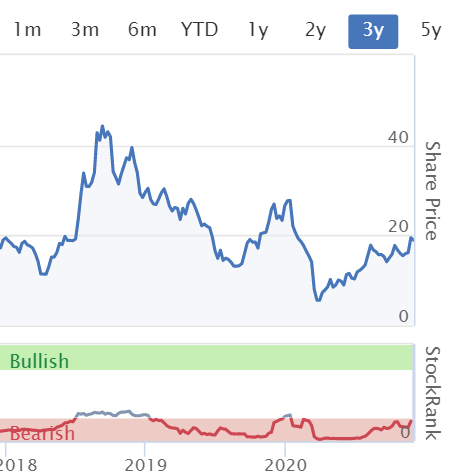
For all that though, it’s clearly been a rough ride for shareholders so far if you compare the 2015 IPO share price of 58p to today’s share price of 24p. Shares were closer to 150p at one point before falling dramatically in 2018/19.
It’s a volatile performance and the stock is rightly classified as Highly Speculative, but you can see there has been buying at these levels from value hunters:

This buying activity has come from private investors, but directors have also been buying in 2020.
Much of the share price drop appears to be a result of getting into ‘severely loss-making’ contracts. Checking out the Financial Summary, we can see that the group made a pretty chunky £8.6m loss in FY19:

It looks like lumpy, volatile earnings from that EPS Growth line. Couple that with persistently low operating margins (on average just 1.7% over the past six years), then the group’s cheap valuation appears to be justified.
But the StockRanks look promising, jumping by 40 or so points in August and currently suggesting improving Momentum and good Value:

So a mixed trading record in a lumpy, low margin, contract-driven market but with potentially good upside if management can execute on the turnaround strategy established in 2019.
Half year results for the six months to 30 September
This period obviously includes the first lockdown and so year-on-year comparability is reduced.
Financial highlights include:
- Revenue -21% to £23m,
- Gross profit -23% to £6m,
- Underlying operating profit -27% to £1.4m,
- Loss after tax of £0.16m,
- Basic EPS of -0.26p, and adjusted EPS of 1.92p
These are quite adjusted results and the company does not report its statutory operating profit or PBT/PAT in the highlights.
The group does say that work appears to have been deferred rather than canceled, and its ‘three year visible revenues’ increased from £172.1m to £182.4m. Net debt has come down and cash generation looks to be improving.
Turnaround
This is where things get a bit more interesting - the previous contract struggles and a £2m equity fundraise in 2019 have prompted an explicit turnaround strategy.
Progress here has probably been obscured by Covid, but underneath all the disruption there could be a fundamentally better business emerging.
Net debt fell to £4.9m in September from £7.2m as at 31 March 2020 - a reduction of 33% - and over the past twelve months, net debt has more than halved by £6.2m from £11.1m.
Cash generation has also improved markedly and the group is targeting additional debt reduction this year. Meanwhile, costs have been cut and will result in annualised savings of over £1m. That’s substantial for a company of Bilby’s size.
Conclusion
While regulation does indicate that Bilby will generate a certain level of trade, visibility on timing is poor. That and the group’s low margins and wobbly track record call for caution.
But there are also avenues worth investigating further: Bilby’s turnaround strategy and restructuring could result in a fundamentally better business. Net debt is reducing and cash generation is improving, but it’s still all quite early.
If it can stick the landing then today’s share price could offer good long term value. The company has a market cap of just above £15m on FY20 sales of £65m, which suggests promising scope for upside if the management team can steady the ship.
Three-year revenue visibility appears to be good and it does sound as though Bilby is transforming into a financially healthier and more cash generative outfit.
The improving StockRank, director buys, net debt reduction and the improving cash generation suggest Bilby is worth a closer look, but this potential must be balanced against the group's poor past performance and volatile share price.
.
Mercia Asset Management (LON:MERC)
Share price: 24.65p (+5.6%)
Shares in issue: 440,109,707
Market cap: £108.5m
Mercia Asset Management (LON:MERC) is a specialist regional asset manager with £800m of assets under management (AUM) and around 400 portfolio companies. It is halfway through a three-year strategic plan to expand AUM ‘to at least £1bn’.
Its niche is in supporting regional SMEs and the group provides capital across four asset classes: balance sheet, venture, private equity and debt capital. The focus is on technology, software, and healthcare - all areas that can offer big returns.
The group initially nurtures businesses via its third-party funds under management (FUM), then over time Mercia can provide further funding to the most promising companies, by deploying direct investment follow-on capital from its own balance sheet.
What’s interesting right now, scrolling through the group’s portfolio companies, is the exposure to Life Sciences. Seven of Mercia’s top 20 holdings at 31 March 2020 were in this sector, valued at £29m in aggregate or 33% of total portfolio value, with another c 40 earlier-stage life sciences investments across its third-party managed funds.
COVID-19 has obviously accelerated the opportunity for this type of small company, with an explosion of potential new treatments, diagnostics, and support infrastructure. These are areas where Mercia is already invested through companies like lateral flow diagnostic testing specialist Abingdon Health. But is it a boom or a bubble in this space right now?
Given Mercia’s low StockRank of 18, an F-Score of 2, and the fact it qualifies for a short selling screen (James Montier 'Unholy Trinity'), it does look to be at the more speculative end of asset management though.
It’s an ex-Woodford holding - some of these ex-Woodford stocks could be due an eventual rerating now that a large, distressed seller has left. You can see the impact on Mercia’s share price:

Interim results for the six months ended 30 September 2020
It’s a ‘strong first half year performance’, driven by sector-specific recoveries in asset prices and a buoyant trade sale market in Mercia's leading areas of investment focus (small, regional tech and life science businesses).
The market likes these results, with shares up around 5% at the time of writing. Highlights include:
- Total AUM up 78% year-on-year to c.£872m,
- Revenue up 51% to £8.4m,
- Adjusted operating profit of £1.1m compared to an H1 2020 £0.6m loss,
- Profit after tax up from £2.1m to £8.2m, and EPS of 1.87p (H1 2020: 0.69p),
- Net assets up year-on-year from £128.4m to £149.9m,
- Maiden interim dividend of 0.1p.
The group is building scale in its third-party fund management business, which is improving adjusted operating profit. Total AuM have increased to c.£872m, c.£722m of which is third-party funds under management.
Mercia’s CEO says:
We are increasingly optimistic about the potential of the companies within our direct investment portfolio, many of which are in sectors such as Life Sciences, Software and Digital Entertainment which are experiencing strong tailwinds.
On that note, COVID-19 has accelerated structural changes in Mercia’s targeted sectors. In its key areas of Life Sciences, Software and Digital Entertainment (which represent c.82% by value of its direct investment portfolio) ‘there has been a marked acceleration in growth trends, positioning us well for the future.’
In the six months to 30 September 2020 it invested in 81 businesses, including 26 new companies in the third-party managed funds' portfolios. The total amount invested was £42.1m.
Notable exits include the sale of NAC at an 8.4x return on original direct investment cost and a c.65% IRR. This is a leading producer of infectious disease reagents that include antigens for COVID-19 antibody test kits.
A new company was also added to the portfolio: MIP Diagnostics Limited. Mercia holds a 3.3% fully diluted direct investment plus a c.30% fully diluted stake through its managed funds. MIP is a spinout from the University of Leicester that has developed a proprietary process to provide molecular imprinted polymers to the vitro diagnostic, bioprocessing and oil and gas industries.
Conclusion
I like the regional focus and Mercia’s chosen sectors. These are areas with potential for high returns.
A recent report published by Beauhurst ('Exits in the UK, Acquisitions and IPOs') states that between 2011 and 2019, c.70% of exits occurred from businesses located outside of London. Of these, c.98% were through acquisitions and c.87% were sold for £200million or less. This is the area in which Mercia operates.
It’s a tricky one to analyse here given the breadth of portfolio companies. The quality of this portfolio is what will ultimately drive or destroy shareholder value. There’s a lot of detail in this update and it arguably deserves much deeper research.
My interest has grown though due to the regional tech and life science focus. There is plenty of value outside of London, often with more attractive valuations and less spin attached.
Mercia claims to have net assets per share of 34.1p, so with the shares at 24.65p that’s a useful 28% discount to stated net asset value.
This is a company covered by Edison - you can find the coverage here. That will likely be my next port of call.
.
Paul’s Section
Sosandar (LON:SOS)
Share price: 18.3p (down 8% at 10:40)
No. shares: 192.3m
Market cap: £35.2m
(I hold)
Interim results & trading update
There’s a webinar on PIWorld at noon, which I want to watch, so I’ll rattle through the numbers here and publish it just before noon. I'll put up the recording link, when it's ready)
- H1 revenues up 52% to £4.28m
- Seasonality is strongly weighted to H2 (LY: H1 £2.82m revs, H2 £6.18m revs, with heavy H2 marketing spend LY)
- Gross margin is very good for the small size of the business, at 52.3% - slightly down on LY H1 due to discounting at start of lockdown, since moved back to full price, so that’s fine by me
- Loss before tax in H1 drastically reduced, from £2.8m H1 LY, to £1.1m H1 TY. That is very important, and of key importance, in my view - deep cost-cutting, and marketing spending halved
- Repeat orders up 88% compared with revenue growth of 52%, is a strong sign of building customer loyalty, in my view - important
- Returns rate down from 49% LY to 42% TY - very good, but is it sustainable? Probably partly due to change in products sold, more casualwear during lockdown, as opposed to dresses, which have a high return rate due to more complex fit
- John Lewis & Next website sales going well, and ranges being increased. No figures given, but mgt have previously told us it’s starting small, then building
- Record sales in Oct, etc. Needs to be!
Estimating sales for H2 (my figures, as there are no broker forecasts, still suspended - disappointing!):
Method 1 - since H2 to date is up 115% compared with H1, then if this continues, suggests H2 might be £9.2m.
Method 2 - 17% Y-on-Y revenue growth, implies if continued, £7.2m sales in H2.
Average of these is £8.2m, which is my best guess for H2 revenues, giving £12.5m revenues for FY 02/2021 - this is a long way short of original forecasts for around £20m revenues in FY 03/2021. However, the cost base has been greatly reduced this year, so the breakeven point is now much lower.
Cash position - very impressive, the company is conserving cash (and with minimal, £80k, deferral of tax creditors) and still has c.£4m net cash yesterday. This is much better than I was expecting, especially as H1 is the quiet half, so I was expecting prodigious cash burn and another fundraise. This is probably the key, positive point from today’s results - cash burn drastically reduced, and I reckon it could possibly even be cash generative in H2, but let’s not jump the gun there!
Marketing spend efficiency - greatly improved. The marketing spend was turned on again in Sept, and is half the spend vs last year, but delivering the same results - very encouraging, but does indicate that half of the marketing budget was arguably wasted in the past! Still, it’s the future that matters. TV is very effective at driving signups, which later can be converted into sales. Spending is now split roughly equally between TV, social media, and direct mail glossy booklets. I think the cash burn/crunch has forced them to become leaner & more effective, a good thing.
Third party websites of Next & John Lewis, has started well, and ranges are being expanded. However, it’s negative for working capital, so is being restricted. What a pity - I’d like to see Sosandar explore loan funding options to expand this - maybe something along the lines of invoice discounting, or asset-backed lending (as done recently by French Connection (LON:FCCN) [I’m long]). It seems a pity to miss out on expanding a profitable opportunity due to working capital constraints.
Balance sheet - is good. There are negligible fixed assets, as everything is outsourced (IT, logistics, etc). So the £6.7m NTAV is almost all working capital.
Current assets total £8.9m (mainly inventories £3.8m, and cash of £4.5m)
Current liabilities total £2.5m, and there are zero longer term liabilities.
That’s a healthy surplus of £6.45m of net current assets, or a current ratio of a very strong 3.6
Cash burn in the seasonally slow H1 was only £795k. Hopefully H2 might even see little to no cash burn, given that sales are much higher in H2? This is looking like a potential game-changer. With high cash burn now behind us, and the breakeven point greatly lowered, the business looks to be on the cusp of commercial viability.
Based on these figures, I don’t think SOS needs another fundraise any time soon. Although costs are being squeezed hard, so once it moves into profit, I reckon company would need to increase costs, and stay at breakeven for a while. That’s fine by me. I don’t want profits, I’d rather see them grow the business, at cashflow breakeven, for a while, to maximise the opportunities.
Webinar today - Here are the key points I jotted down during today’s excellent PIWorld webinar;
- New CFO, Steve Dilks, sounds confident & has clearly hit the ground running
- Returns rate has settled in the mid 40s (percent) - good
- Huge learnings, so more efficient marketing spend now
- Latest cash figure is c.£4.0m at end November - very important, as I think they can manage without another fundraising
- Chart showed steep growth in repeat orders - now the bulk of sales - very important
- Conversion from website (was down to 2.58% in H1) has improved to 3.5% in Oct/Nov 2020 - very good, indicates to me that Autumn/Winter range is good
- “Incredibly successful Black Friday”
- Govt support was not a big element of admin cost savings achieved in H1 (i.e. furlough)
- Carbon negative bags to replace boxes currently used - cost saving too
- Customers are still buying glamorous styles (not just casualwear), because they want to cheer themselves up!
- Next/John Lewis - now 8% of total sales. Going very well, Next: 69 styles, J Lewis: 190 styles - constrained by working capital, “They would take as much stock as we could give them” - sounds like a big opportunity not being taken advantage of, due to cash restrictions - they need to find a way around this!
- Celebrities wearing Sosandar - lots going on, e.g. Strictly Come Dancing
- Email is biggest driver now - 37% of sales come from this (almost free) marketing channel, hence marketing spend drops as % of revenues as database grows
- Outlook - continued focus on cash conservation, and continued improvement in profitability
- Repeat orders drive profitability
- Suppliers - currently have 37, mainly in Turkey, India & China
- Denim doing very well, as they said it would last year, doing 15-20% of all revenues now
- Starting to look at international expansion opportunities. Not looking at doing menswear yet, that’s further out into the future
My opinion - I had gone rather lukewarm on Sosandar last year, as regulars here will know. This was because of repeated fundraisings, which increased the share count to almost double what it was when it listed, thus reducing the upside % per share. Also, I felt the high spending, rapid expansion model was burning through cash too fast. So I’m certainly not a blind perma-bull, I try to look at all shares rationally, and flex my view depending on developments.
After delving deeply into these interim numbers, and the excellent webinar today (which should be up on PIWorld’s website shortly, it’s not there at the time of writing), I’m warming up again somewhat on Sosandar. If I had to rate the share, for what the upside potential seems like, then I’d probably raise it from a C, to a B minus! If it trades well over Xmas, then I’d probably be inclined to move it up again to a B.
The game changer for me is the drastically reduced overheads, which has greatly lowered the breakeven point, from about £20m revenues, to maybe c.£12-15m revenues? There is no broker coverage, so those are just my very approximate workings. The point being that, at this lean level of overheads, the business is still growing nicely, yet is probably now quite close to breakeven.
Once people can see it’s at or near breakeven, then people tend to extrapolate out further growth, with operational gearing, and potentially exciting future profits. Then the share could re-rate to a much bigger market cap, pricing in future growth. Maybe! That's the bull case.
At the moment, I think the £35m market cap looks about right. So I’m not in any rush to buy more Sosandar right now, mainly because I’m concentrating all available spare cash into buying more Boohoo (LON:BOO) (my largest holding), which I think is more liquid, much less risky, and has bigger % upside than SOS. If BOO shares do what I think they should (i.e. go through the roof), then (a) it’s party time round at mine, and (b) I could see myself recycling some of the profits into buying more SOS.
The market crash in Feb-Mar this year has certainly made me much more wary about taking large, over-sized positions in tiny, illiquid shares, because you can't sell in a hurry, if at all, in a crisis - maybe that's a good thing, but not if you're geared, as I tend to be. Although to be fair, SOS is usually quite liquid.
That’s an interesting point actually. By reversing Sosandar into an existing cash shell, with lots of private investors, it created an immediately liquid market, despite being a small market cap. This has worked out much better than many other small floats, which the city brokers tend to place shares with institutions, nothing goes to PIs, resulting in almost zero liquidity for the first few years, or ever. Hence why bother listing shares at all, if you’re not going to create a liquid market? It’s crazy. For this reason I would look much more favourably on future new listings, where a company is reversed into an existing cash shell which has a decently liquid, fragmented shareholder base. That’s clearly a better way of listing small caps.
With cash burn so drastically reduced, and quite a lot of cash still in the kitty, then I think the bear case looks a lot weaker than it did earlier this year.
Sosandar floated at 15.1p. The fact that it's done a series of subsequent fundraises, and has burned through a lot more cash than originally planned, and is still about 20% above the float price, actually isn't bad at all - certainly not a disaster anyway.
.
.
That's it for today.
Regards, Paul.
Disclaimer
This is not financial advice. Our content is intended to be used and must be used for information and education purposes only. Please read our disclaimer and terms and conditions to understand our obligations.

102 comments
Excellent update, very much appreciated - thank you Paul
Hi Paul, I hope gorgeous Paddy is ok and thinking of you at this difficult time.
Thank you for your tireless work here as always it is very much appreciated by the vast majority!
Best wishes for Paddy, dogs certainly are one of god's greatest gift
@Johns54
regardless of the circumstances leading to your outburst here, you need to get a better grip on your entitlement affectation - rude and ignorant don't do enough to describe how your post comes across - even if Paul had just fancied a cheeky kip in the afternoon, let alone what he may actually be going through at the moment.
if you don't like the service, I suggest you find a website elsewhere that offers you guarantees over delivering what you feel you deserve. There's no call amongst mature adults for attitudes like this, and frankly I find your post quite offensive to my morals.
why ruin the internet for everyone else, can't you just not post comments and let us enjoy it without you?
"If BOO shares do what I think they should (i.e. go through the roof), then (a) it’s party time round at mine" - made my day :)
Sosandar (LON:SOS)
Paul - One thing that I picked up from the analyst presentation was a comment Julie made about mix of marketing. In relation to the cost of acquisition she mentioned something along the lines of email now being over 37% of marketing and growing, which is more or less free marketing. But more importantly she mentioned that email alone generated in excess of £1m of their sales in November. Thus I wonder if we can extrapolate that Nov was a £2.5m+ revenue month? If that is the case then given October appears to have been not far behind and December/January should also be strong given new user sign ups then H2 revenues might be closer to £11m don't you think?
That may account for the revenue bridge from your "method 1" £9.2m. Since marketing on new customers has only recently been restarted then if we look at the graphs from last year of marketing spend against timing/magnitude of revenues coming through they seem to be mirroring trends but at a higher level and at only 50% of the marketing cost.
So that would make full year around £15m+ Be interesting to see if that plays out.
davidjhill - Re Sosandar (LON:SOS) . I didn't take it quite that way. My understanding was/is that email plays no or very very little part to play in the "cost of acquisitions". The cost is tv, facebook, press etc. advertising where potential customers are attracted to the brand and either gravitate to the website or email the company to be put on their email/brochure/social media lists.Those forms of advertising have costs.
Once the company has the details they then regularly email marketing material - this costs next to nothing but this aspect is not an "acquisition". OK maybe part of it is until the customer makes their first purchase. After that emails are about "customer retention".
My point is that if they only market via email then they are only going to stand still or go gently backwards as some customers inevitably move on. To acquire new customers they have to spend money. Even celebrity endorsements have some cost (retaining and encouraging new celebrities, supplying clothes, monitoring celebrities' social media, feeding any "endorsements" to their own social media and press etc).
If "email alone" is generating 80% of turnover then maybe they should look at payback on what looks like quite an expensive brochure that they produce and mail out? My wife seems to receive one every two or three months even though she's never purchased anything from them.
Disclosure - I hold (down 14%) and happy to stay on board to see how it all pans out.
Hi - I definitely think I heard her mention the point that email alone generated £1m+ in November. Given that the use of email makes up only 40% of marketing activity that extrapolates to £2.5m. Be good to clarify that but I suspect they won't.
I agree with what you are saying on marketing in general. The email database comes from previous paid marketing, be that TV, Social Media etc. so the email element is made up of the lead generation from other forms. However, it is incrementally free to use going forward.
Not sure where you get email making up 80% of turnover though? It was around 37% in October.
Note : the %ages come from the optimised marketing mix in the pie charts on slide 21. This describes the %age of revenue generated from each form of marketing.
I heard similar to you David (re: Sosandar (LON:SOS) ) Julie made mention that where they could track sales coming from an email click through (i.e. sales made in the same session from when the click was made), this totaled over £1m in November.
Re Sosandar (LON:SOS) -
"Not sure where you get email making up 80% of turnover though? It was around 37% in October"
Sorry, that's probably me adding apples and pears and coming out with oranges. I took your figure of £1M for November and made that £12M for the full year together with Paul's estimate of £12.5M for the full year, adding a bit to make £15M, and calculating £12M as being 80% of £15M
But, I have to admit it was done without checking the presentation again (I don't think it's available) or even today's Results and Trading Update so apologies if I've blundered.
hey - no worries Laughton. The thing I like about the SCVR is that everyone can put their take on a presentation or set of results without fear of reprisal. Even if you don't agree on a share it often acts as a useful sanity check.
You are correct that the presentation is not available online for distribution by the looks of things - it was a one time shot only! Fortunately I did download it though so have a copy and can check the numbers, but I can't verify anything that was said unfortunately so I can't guarantee my take on what actually does extrapolate out to what I think. That's a shame because if it is correct then it gives us some useful tools to assess likely range of y/e revenues. I shall just use it as a possible reference I think.
it's very encouraging that the loss was only £1M, and they have in excess of £4M in the bank, However, I wonder how long that will last when they start ramping up advertising online and on tv ? I suspect they're going to raise more capital, who knows when, market conditions aren't great, but I'm sure they won't want to leave it too late in case things get worse. you would bet things will look better in 12 months than they do now (well I would anyway). I liked that they seemed focused on cash preservation and optimising the spend. I would have liked to hear when they thought they might show a profit, or at least an idea of how far away from that we are.
I think they more or less inferred all of this but in a roundabout way. FD basically said they could trade profitably pretty much now but at the expense of killing cashflow. Ie sounds like if they did a decent size raise the business would look profitable but with cash outflows. Instead they are focussing on cashflow and moving into profitability : that says two things to me (1) they ideally want to do this without raising more money/dilution and (2) profitability sounds like it is actually not that far away.
(1) was interesting as I hadn't expected that so I need to recalibrate my expectations. There are pluses and minuses of course.
I missed the presentation but I'm liking your report of the new FD. Having been there and done it at Regatta I was hoping he would bring a wealth of experience and knowledge with him and sounds like he has.
Hi Paul, I was wondering if you might comment on Ince (LON:INCE) which you have discussed before? This morning's results look pretty good and they look like they are coping with their deferred consideration.
Also interested in Ince (LON:INCE) - I know Paul is going to shoot me down on this (and I accept all the arguments about partners taking all the profits) but for all its faults it is ridiculously cheap on absolute metrics and compared to listed peers like Knights Group. Looks like cash has (just about) stabilised and if indeed they pay a dividend next year there is real upside. Management clearly trying to present deferred partner considerations in more transparent light as well as not reporting partner pay as 'non controlling interests'. It's not a bad law firm - well known in shipping etc. Yes pretty risky. But yes extremely cheap!
Hi TimeAndTide,
Nah, I think Ince (LON:INCE) has a terrible structure, and I don't want to waste any time on it - see previous reports. There are so many other things to report on, I've got to filter out stuff that looks badly flawed, as Ince does.
Sorry about that.
If I had a whole team of writers to help me, then we could cover everything - that's the plan longer term!
Best wishes, Paul.
Some points on Mercia Asset Management (LON:MERC) (which can be a bit tricky to understand on a quick read as its a hybrid of Inv Trust and asset management biz)
So layers of value
Current price of Mercia is implicitly very negative on their model and ability to realise value as both direct VC biz and 3rd party asset manager. 'Rationally' a 'normalised' view of Mercia would see sp at a premium to direct investments + cash, and a positive view would see value at direct investment + Cash + 3rd party asset manager valued at 3% of FUM and perhaps even a little premium.
The above talk is purely value...obvs the biz wants to grow too...there is ability to value the growth potential in both asset manager (and growing dividend it might support) and recycling of capital into direct investments
It's unlikely to be a rocket and may take time. One of the big 5 or so holding being exited for a premium would be a catalyst.
QVM is likely to struggle with Mercia due to hybrid biz. Its possible that 3rd party asset manager if it could be stripped of direct investments (inc extra op costs that go with having that biz that is supported by earnings from asset management) could well show up as a positive QVM like other listed asset managers
Mercia Asset Management (LON:MERC) .
Both the Edison note and Jack's commentary value these shares on a discount to NAV basis which make them look good value to me. Edison say they cant yet value the shares on an earnings multiple ( I don't know why) but with an EPS of 1.87 p for the first half they may make 3 or 4p for the full year , I'm just doubling the number, this would put them on a very low multiple of 6 to 10 times.
Most of Mercia Asset Management (LON:MERC) earnings is asset revaluation...so that's why NAV more relevant at the moment and will dominate until asset management is considerably bigger. But as asset management contributes more earnings/cash/dividends then it becomes sensible to attribute some more value to it. If Mercia does well then people will positively value the hybrid structure
https://www.morningstar.com/ne...
Interesting reading for Boohoo (LON:BOO) (I hold) But suppose it's the inevitable shift to online accelerated by Corona.
Calnex Solutions (LON:CLX) H1 results presentation. An interesting business. 16% CAGR since 2015. A strong order book going forward. Contract values £50-150k. Market driven by change in telecoms technology, eg. 5G etc. IPO'd October 2020. Institutions who bought at IPO: Slater Investments 6.2%, Pershing Securities, 15% and Otus Capital Management 8.6%.
Here Tommy Cook, CEO & Ashleigh Greenan, CFO present interim results for the period ended 30th September 2020. Video & podcast.
Wh Ireland (LON:WHI) announced the acquisition of Harpsden yesterday. Harpsden have £250m AUM, and £140m assets under influence. Harpsden reported Revenue of £2.9m. Cost synergies expected of £0.6m. Assuming no further changes, the acquisition would increase WHI's pro forma AUM by 14% to £2bn. Total consideration £7.8m. Placing to raise gross proceeds of c £5.3m at 40p per share.
Here Philip Wale, CEO & Stephen Ford, Executive Director, Head of Wealth Management, outline the WHI plan for growth, and where the Harpsden Wealth Management acquisition fits into that. Video & podcast.
Tracsis (LON:TRCS) FY20 results presentation. A comprehensive results presentation given by Chris Barnes, CEO, Max Cawthra, CFO & Andy Kelly, (incoming CFO from February 2021) during last week's roadshow. Outlines the results, strategy & outlook. Video & podcast.
Subsequently The Yorkshire Posthas reported, Tracsis (LON:TRCS) is to help the NHS set up vaccine centres.
Sosandar (LON:SOS) - just to flag, I don't think SOS will publish the recording of the 12 noon presentation today, so if you want to see it, you'll have to register to attend here.
The NAV figure of 34.1p doesn't include the Fund Management business. Joint broker N+1 Singer values that at about 6p and have upgraded MERC this morning.
Bilby (LON:BILB) - thanks Jack for the detailed summary. I see that the new CEO was responsible for the turnaround and early growth at Anpario (LON:ANP) which i thinks augurs well for 'sticking the landing'. What i like about the Anpario (LON:ANP) experience is that the company did well when he was there and has continued to do well in the years that followed.
disc I am value investor + hold
Here are my heat maps for today (prices as at ~10am).
Overall state of the market by ICB Industry classification:
Key to the Industry heat map contents:
SVCR world filtered to 'interesting' instruments ('interesting' means: reporting soon or recently; trending; breaking out; increased volatility - volume / ATR up; moving more than a 20d EMA of the ATR):
Small Caps reporting today:
Big movers today in the SCVR world (moving more than 20d ATR EMA against either yesterdays close, or today's open):
Breakouts today in the SCVR world:
And finally the key to the heat map contents:
The heatmaps are ordered by Stock Rank™, and are limited to the top 75 instruments.
The heatmaps are images and will be resized by your browser to fit your screen. If the heatmaps images are too small to read on your screen, right-click on the image and select 'Open image in new tab'. This will open the heatmap in a new tab in your browser where they can be zoomed as necessary.
I use heatmaps a lot and generate many (from my own application and database) to help focus my research. I use them to help me quickly find instruments which pass my basic 'tradeable' criteria (a 'T' in the top-right of the heatmap, meaning: profitable; low-debt; reasonable liquidity), have a high Stock Rank™ and Quality Rank, and are trending (Tr+ or Tr++) or breaking out (Br+ or Br++) ideally on increased volume (V+). I then research the identified instruments in more depth using the Stockopedia StockReports.
How (or indeed if) you use these heatmaps is up to you, I contribute these SCVR relevant ones here in the hope that others may also find them interesting or useful.
greensiax
Very handy, thanks for taking the trouble. As for sizing, I re-size the Chrome browser to 175% before checking the heat maps and returning to normal size after. My latest habit, having set my Stocko alerts to tell me of RNS's my email, is to download those RNS's for daily notes to be recorded. Not really interested in fresh investments, just in easing dogs out of my kennels and placing dividends where they might do the most good.
Silver
its come back
Hi i'm finding still won't load through chrome but will work through Microsoft Edge very odd.
I had to reload the cache to get it back. On Chrome use CNTRL-SHIFT-R.
Thanks did the same and its worked.
THats strange as working as normal for me on Chrome from around 8.50am today. Did not need to clear cache or anything.
Still cannot get Stockopedia on my laptop
Any ideas
I only got it again late last night after rebooting my laptop. It was working fine on my phone from late afternoon.
jack
What do you mean by “stick the landing”? Is it a flying metaphor?
Close, gymnastics! "To accomplish a feat successfully."
I just mean if management can successfully execute the turnaround.
Does anyone know what's happening with Ra International (LON:RAI) in the past couple of days? Down nearly 10% but no obvious reason why from what I can see. Have I missed something? Thanks.
RA International (LON:RAI)
Does anyone know what's happening with Ra International (LON:RAI) in the past couple of days?
I suspect it's just a return to the normal state of affairs for this company unfortunately (very unloved) , kinda wish i had sold now at 56p+ - their last trading update and ongoing contracts wins persuaded me to hang around - sigh. If i had sold i would be buying back in now if i had the cash.
I suspect (pretty sure) it was only the share buybacks (to dish out to key personnel!!) that lifted the shareprice in the short term - so a return to pre buyback levels shouldnt be a shocker now the buyback process is complete.
As it's a covert operation to allow better known and higher profile names to make 'security payments' to help insure and ensure their aims and operations in dangerous places? Therefore the potential for reputation damaging negative surprise is high beyond just the more obvious risk of an area of operation (eg Somalia) deteriorating such that assets and earnings from the area are damaged/destroyed?
RA International (LON:RAI)
Therefore the potential for reputation damaging negative surprise is high beyond just the more obvious risk of an area of operation (eg Somalia) deteriorating such that assets and earnings from the area are damaged/destroyed?
Yes it goes without saying that their areas of operation are extremly risky and the lumpy nature of contracts mean that something will probably go wrong somewhere reasonably big style at some stage. Points in their favour are solid order book quality customer base solid cash in the bank and reasonable expansion of services to more geographical areas. They seem to fulfill a necessary (appreciated?) function on behalf of the agencies they work for so hopefully their customers are not the normal construction kind of customer looking to screw over their suppliers to make a quick buck - having said that i can't imagine any contract ending particulalry well if you are forced to up sticks and leave the country forever with immediate effect - which is distinct possibility in some of their key areas.
Jack, can you have a look at Topps Tiles (LON:TPT)
Buried in their annual financial results is recent trading. Up 19.6% like for like in the 8 weeks since end Sep! Doing well in lockdown2.
Topps Tiles (LON:TPT)(I hold) I would second that.
Interesting that they still say "Commercial market remains subdued but activity levels starting to improve" further down they state "Although data indicates an improvement in new project starts, they remain below FY19 levels and it is likely the commercial market for tiles will remain somewhat subdued for the next 12-18 months" That seemed to be the issue the market didn't like at the last trading update. Is it possible that with the vaccine news market is now looking past this?
The muted outlook on commercial is worrying. This was meant to be one of the growth drivers for Topps.
Albeit one could argue that they had good momentum in commercial before covid. It is starting from a small base so they're best placed to disrupt and steal share from incumbents, even if the market is weak.
Stil, if one estimates H1 LFL revenue at +20% compared to fy2019 and H2 LFL at +5%, and assume a bit of operational gearing to PBT, the current broker forecast for FY21 is low and ripe for upgrading IMO.
I guess it would be important to understand what are the main sources of commercial demand - my first thought is that hotels would probably be a big area and it is perhaps understandable that demand here would be low with capex deferred to shore up cashflows.
Am I right in thinking though that this would be the main area of demand?
Hotels are clearly an important part (but far from only part) of the commercial business for Topps Tiles (LON:TPT) as this section of the report shows:
“Notable projects we delivered this year include supplying the tiles for over 11 hotel projects including the Hilton, Hyatt, Marriott and Grosvenor hotel groups. We continue to supply major UK retailers and 2020 has included some exciting work with Harrods that will continue into the new year. We have worked closely with residential building development partners to deliver unique tile designs including the Silk District Whitechapel development where we supplied bespoke tiles for 700 apartments.”
With commercial at <4% of total revenue, I don’t think disappointment in the outlook for commercial (reinforced by the write down of the goodwill in the Parkside and Strata acquisitions) is really a driver of the share price reaction. I think more relevant is the failure to pay a dividend, despite the stupendous cash generation in Y20, indicates management is not certain how long the current DIY boom will last.
Polarean Imaging (LON:POLX) No RNS, but a mention in the BBC News today about an Oxford University trial using the Polarean Imaging (LON:POLX) patented Xenon gas scanning technology to identify long COVID lung damage not picked up by conventional scans.
I was alerted to the company because it is held by the Amati UK Smaller Companies fund where is is hailed as the biggest advance in lung imaging for 40 years. SP up 10% at moment. May be be of interest to Health related investors. I hold as a starter stake.
https://www.bbc.co.uk/news/hea...
Polarean Imaging (LON:POLX) is awaiting to see if their product will be fast tracked for FDA approval, they should hear by Dec 2nd (tomorrow). If it is then the SP could push on, if it isn't I will view it as a buying opportunity as long term this has the potential to be enormous, imo (I hold).
sorry, that should read next Monday (7th) of December.
Mixed bag from Sosandar (LON:SOS)
The autumn trading period is probably the most indicative where they are up only 17% versus last year, which seems rather pedestrian for a small high growth company even if it was achieved with lower marketing spend.
Despite some other numbers lauding the growth being achieved despite reducing marketing spend they are still loss making. This is very worrying. The justification for being loss making would normally be that marketing spend is high but growth is also high and so will turn profitable in the near future.
No indication of when the think they might be able to break even is given. Others will be more forensic on this point but if growth continues at only 17% then it seems very unlikely they’ll reach break even next year even. So, this seems vastly over priced to me.
(No position)
Agree I've worked in the online space for over 20 years and it's clear to me they are very weak in the digital marketing area. Puny growth.
Sosandar (LON:SOS)
No indication of when the think they might be able to break even is given. Others will be more forensic on this point but if growth continues at only 17% then it seems very unlikely they’ll reach break even next year even. So, this seems vastly over priced to me.
Yes - its tricky to get a handle on when breakeven will be , at some stage some decent operational gearing should kick in (one would think) - but the problem is as gross profit increases they are likely to ramp the marketing back up which will probably obscure slightly the standstill breakeven point - they should possiblly have used some standstill breakeven stats (presuming they are favourable!) similar to Naked wines to evidence their progress , taking customer acquisition costs "partly" out of the picture ?
At least the cash burn rate has massively reduced - so if they decide to keep ticking along i kinda guess they could make it to breakeven with current cash - but i suspect a further raise is almost certainly on the way to leave them with an extra kitty and/or some more firepower to get them to that breakeven point quicker. In some respects with shareprice backup to nearly 20p if it stays here i wouldn't surprise me if they had someyhing coming along pretty soon in that regard.
I suspect one item not currently in their favour is the extended lockdown period(s) , i guess their core customer base doesn't have the same incentive to buy something new and shiny for the xmas party season (or any other party night out unless your name is Rita!) as they would do normally. I note the average order basket is down 10% and i expect thats simply down to social distancing measures rather than anything they are doing wrong operationally speaking in that regard. Perhaps they will have a post lockdown spike when the ladies need a complete new wardrobe ordering when the realise everything they have is more than 18 months old (god forbid).
"I suspect one item not currently in their favour is the extended lockdown period(s) , i guess their core customer base doesn't have the same incentive to buy something new and shiny for the xmas party season (or any other party night out unless your name is Rita!) as they would do normally."
One of the elements I liked about their update is their rapid shift into comfy lockdown clothes/ranges. From the RNS:
"The nationwide lockdown had an impact on what women wanted to wear, as they largely prioritised clothing that was comfortable, but also made them feel good. Evidencing this, we saw an increase in sales of loungewear (up 3,500%), denim (up 128%) and tops (up 72%)."
Admittedly loungewear is starting from an extremely low base, but could be a nice earner for the long term with large margin lines. I notice they're also dipping their toe into activewear too, another important area during lockdown and beyond.
yes that's great, in which case why has growth only been 17% ? It seems that boohoo, picked up on this and had good growth even from a much higher base. Was it really a good idea to cut spend quiet so much at a time when the shops were closed ? I agree demand was probably lower but you had a lot of people at home, many of whom were getting paid, looking for something to do to entertain themselves or cheer themselves up, perhaps hitting these people with some advertising of the right products might have yielded good results ? It seems to have worked for boohoo ??
Sosandar (LON:SOS) just seems to me to be a serial disappointment. Losses and dilution. Competition is increasing. Is it worth a market cap of £35 million? Seems a lot to me.
Good morning. Any chance of a look at Mitie?
Morning Samson2297,
Mitie (LON:MTO) (I hold) announcement this morning seems to just be confirming completion of the deal to buy Interserve Facilities Mgt.
248,396,183 new Mitie shares are being listed, as part consideration for the deal, plus the cash element is £105.0m, less than the £120m price, due to debt & working capital adjustments.
It looks as expected, so not price sensitive in my opinion. Details of this substantial acquisition had previously been announced, so nothing of any significance today that I can see.
Regards, Paul.
May I suggest a look at MERC? They have issued very pleasing interims for a period affected by the pandemic and the announcement of a progressive dividend policy will support a valuation that has been at a 30% plus discount to NAV for months.
I have been an holder of this one for just over a year and was considering ditching it recently to make some space for other stocks in my portfolio. Today was a good update and finally the investments are paying off. Whilst the maiden dividend is small I hope it will help narrow the gap to NAV and maybe trigger a re-rating.
Jack, when you've had time to research this I think you'll see that the F-Score of 2 gives a false impression and I'm satisfied I can make a good case that the F-Score will increase (I have it at 8). A higher F-Score removes it from the short selling screen (James Montier 'Unholy Trinity') results. I think the company is the exact opposite of the qualifying criteria ie. undervalued (30% discount to NAV), financially strong (lots of cash available for investment and no debt) and well managed (performing ahead of target with surprise launch of a progressive dividend policy).
My morning smallcap tweet:
Cyanconnode Holdings (LON:CYAN) Sportech (LON:SPO) Van Elle Holdings (LON:VANL) Equals (LON:EQLS) Fulcrum Utility Services (LON:FCRM) Bilby (LON:BILB) Sosandar (LON:SOS), Bigblu Broadband (LON:BBB), Deepverge (LON:DVRG)
CyanConnode (CYAN) guides H1(Sep) rev up 50%. Gets £400k unsecured loan from directors to fund increased working cap. No interest rate given. [SP=5.63 Cap=10m]
Sportech (SPO) sale of Global Tote as mooted. Will get £30.9m subject to working cap + US pension adjustment. The business made a pretax loss of £0.8m. [SP=28 Cap=53m]
Van Elle (VANL) guides H1(OcT) rev down 22%. "Revenues in September and October reached pre-Covid levels, enabling the Group to trade profitably," [SP=44.1 Cap=47m]
Equals (EQLS) guides last 5 months rev £114k/day cf H1 £110k/day. Wirecard failure: exceptional charge c. £1m. Staff cuts due to covid is another £1m. [SP=33.97 Cap=61m]
Fulcrum Utility Services (FCRM) update on the sale of its domestic customer gas connection assets and associated meters. Received £4.7m yesterday. Another £27m to be received, with the majority expected to be collected over the next two to three years. [SP=42 Cap=93m]
Bilby (BILB) H1(Sep) rev down 21%, U/L pretax down 32%. Outlook: "confident the mandatory nature of our work, driven by regulation, will be delayed rather than cancelled. However, the visibility on implications and timings remains challenging." [SP=24 Cap=14m]
Sosandar (SOS) H1((Sep) rev up 52% (as guided), pretax -£1.1m (-£2.8m). Sep-Nov: 17% growth in revenue, 49% reduction in marketing spend and a reduction in cost of acquisition of 52%. Cash over £4m end Nov. [SP=19.91 Cap=38m]
In line: Bigblu Broadband (LON:BBB) Deepverge (LON:DVRG)
Interesting as a backdrop to the investing environment...
"Pandemic expected to deliver £60bn boost to pension funds"
https://www.thetimes.co.uk/art...
With regard to excess deaths there is a stark difference between the very high spike early covid and the figures for June onwards - there is a weekly chart showing these stats linked below.I suspect any worst case scenario numbers mentioned in the linked article will not pan out.
https://www.cebm.net/covid-19/22268/
That only goes up to 9th October there has been considerable excess deaths since then.
There are a lot of regional variations re excess deaths . The biggest number of excess is actually deaths at home not in hospital. This has been the case for several months now. I suspect it is a corollary of lockdowns and the fearfulness associated with going out, getting treatment or even ability to access treatment.
That only goes up to 9th October there has been considerable excess deaths since then.
Yes and no - excess deaths are now running at about 2.5K a week, which is the highest level since the first wave, but is significantly below the peak. At the moment we're at about 60,000 excess deaths.
Even without a vaccine excess death rates over the next few months might be expected to be lower - respiratory illnesses are the biggest contributor to excess winter deaths, so if vulnerable people are shielding and taking the recommended Covid precautions then you'd hope that even if CV-19 deaths are a bit higher then the overall excess death rate wouldn't grow a lot. Less flu deaths, for instance.
It also looks as though hospitals are now much better at saving people. People going into ICUs have a better chance of surviving. There's also tentative evidence that people who get it aren't getting it quite as badly - not because the virus is less lethal but because the various measures in place mean that people tend to get a lower viral load when infected.
So, all told, unless we get a crazy post-Christmas peak and hospitals are overloaded we probably won't get to 100,000 excess deaths. You'd hope so, anyway.
timarr
Yes around 2.5k per week, although Covid deaths in the last 2 weeks have been around 6.6k, so getting to 100k by the end of March maybe possible, depends how bad this winter is, I don't see it being higher than 100k. There is about 23 weeks to go to end of March, the latest figures are up to 14th November. Covid deaths may have peaked last week, we will see later this week but cases have been falling. If a vaccine is available in January that could protect the most vulnerable.
Yes around 2.5k per week, although Covid deaths in the last 2 weeks have been around 6.6k, so getting to 100k by the end of March maybe possible,
I think we are all agreed the 100k number is in play here - my original point was that they quoted a figure of 250k as being the "worst case scenario" anything like that number thankfully seems highly unlikely at present.
By the end of March, we are into 15 months so 1.25 x 616,014 = 777,017
* 616,014 = 2018 UK number of people dead
COVID is still just 13% of this would-be number.
Not exactly World War Z or The Spanish Flu.
Worth damaging the economy, destroying ordinary peoples' lives, jobs and businesses, and burdening tax payers for years to come over this...
I guess that if all countries are in the same boat their economies will match. It will be Evens-Stevens.
You have to look at the total deaths compared to prior years, you cannot say the "Covid" deaths are in addition to the other deaths. Everything is being labelled a covid death if there was a positive test but the patient died because of heart disease, cancer, etc.
The good thing about covid is that we are not having deaths from flu any more. So nothing is so bad that it is not good for something.
Could you provide a link to that?
This the latest figures up to 14th November, there should be another report out tomorrow, this is just for England and Wales: https://www.ons.gov.uk/peoplepopulationandcommunity/birthsdeathsandmarriages/deaths/datasets/weeklyprovisionalfiguresondeathsregisteredinenglandandwales#:~:text=Main%20points%20from%20latest%20release,average%20(1%2C904%20deaths%20higher).
So really no excess deaths since June. Its like Mike Yeadon (ex Pfizer) says that it has fizzled out since late spring. We have a "casedemic" with people testing positive but it is not translating into serious illness and death.
Not translating into serious illness! Are you sure Marigold? If it’s not serious why have all those people gone to hospital in Northern England?
Yes that first quote should probably be along the lines of:
‘....not translating into serious illness or death beyond the normal range for the time of year (compared with April/May when the pandemic produced figures considerably beyond the normal range).’
Don’t think so. The excess death numbers can be argued about till the cows come home but people don’t go into hospital for fun or with a slight cough.
So, the large increases in hospital cases in Northern England doesn’t mean mild cases caused by an insignificant disease that has little likelihood of causing fatalities.
What it means is that if nothing changes, restrictions etc, the trend continues and hospital capacity becomes exhausted. The consequence of that is that the fatality rate will start increasing dramatically.
People will argue that capacity didn’t get exhausted before so we can wait and not impose restrictions. So you could wait until the situation is desperate, but as we found out earlier in the year, if you delay taking action by even just 2 - 3 weeks, the outcome is very ugly in terms of deaths and the subsequent lockdown has to be more severe.
I was only making a statement about excess deaths - which are a statistical reality. Re the rest of your statement, I am not disputing it but would remind you that a significant proportion are people in hospital for their existing conditions who then get infected whilst in hospital.
"people don’t go into hospital for fun or with a slight cough."
Actually, speaking with geriatric parents, vulnerable people are taken away to hospital often on a precautionary or exploratory basis.
No GP, or Ambulance tech wants to treat a patient only to find they curl their toes up 12 hours later... so off they go to The NHS.
* something I would argue is that hospitals are horribly unpleasant places to be a victim, I mean, "patient" of. Having sat there for hours with broken bones... waiting... with no urgency in their urgent treatment, staff sauntering along slowly like you'd never find in a private business. The visit to a hospital is often more traumatic than the accident or original cause. Why can't hospitals be like a "BA Club World Executive Lounge"... with nice seating, decent drinks, and stewards.
** When you go to BUPA, they wait for you at the door, swipe your credit card, wisp you to your consultant, bring you coffee, and your newspaper. Want a X-Ray? The waiting time is 4.5 minutes, 7.5 minutes if you need some analysis... Priceless
not translating into serious illness or death beyond the normal range for the time of year (compared with April/May when the pandemic produced figures considerably beyond the normal range)
The trouble with that is that it makes it seem as though the pandemic has gone away when there's no evidence that the virus is any less infectious or dangerous than it was in the early part of the year. In its natural state CV19 has an R rate of between 3 and 4, it's very infectious, so keeping it around 1 has meant a lot of lives have been saved.
We can come up with a rough estimate of the number of deaths we would have seen without mitigation by looking at the peak back in April, which was where we were with the disease allowed to run around without restrictions. The three peak weeks were running at around 10,000 deaths a week. Say we saw that every week until the end of this year and then halve it to take account of lower infections in the summer months then you get about 200,000 excess deaths.
Is that a reasonable estimate? Well, obviously it's hard to know, but we can compare with Spanish flu from 1918 which killed about 225,000 Brits - about 0.057% of the population. CV19 is estimated to be a bit more lethal and quite a lot more infectious but if we use the same scaling factor we get to 382,000 deaths.
I have no idea what level of deaths we would need to get to to justify the economic restrictions and hardships and the curtailment of personal freedoms we've seen this year but I think we can be reasonably certain that they have saved quite a lot of lives.
timarr
The article talks about reduced life expectancy from the effects of the recession, and presumably lock down turmoil. The thought of millions of younger people having their life chances impaired is disturbing. I'
I'd hope things naturally improve over time, and governments take what action they can. From a shareholder perspective, it's likely the political imperitive to address the wider social after effects from the pandemic will mean higher taxes, swamping any reduced pension fund liability.
MasterInvestor had an article that so far the UK has printed £1trn, 3x as much as after the 2008 crash. Not only will we have massive asset inflation, but the government will be forced to increase taxes to somehow get some of this money back. This on top of massive unemployment, small business failures (as well as not so small, as Debenhams has just gone into liquidation), a backlog of health issues that have not been dealt with, destruction of the hospitality sector etc.
Its not fair on the younger generation when the problem could have been solved in other ways, Sweden being the prime example.
But Sweden has changed tack recently. What worked in Sweden may not have worked here they have a much different population density for one thing. Sweden only has about 10m people in a country that is 85% larger than the UK. Many countries in Europe have had similar issues to the UK.
If cases had risen more then hospitals would be overloaded, it would have been worst for health. Debenhams was already in serious trouble before this year.
Not only will we have massive asset inflation, but the government will be forced to increase taxes to somehow get some of this money back.
I wonder. Where the bonds that the BoE bought have matured, the BoE has just returned the capital to HMG, just as they do with coupon payments. So the BoE is printing money to fund HMG current spending, with no apparent impact yet on Sterling. Maybe the MMT theorists are right.
" to fund HMG current spending, with no apparent impact yet on Sterling. Maybe the MMT theorists are right."
One of the factors why Sterling hasn't collapsed is because everybody (The US, EU, probably every other part of the world too) is doing the same financial trickery. (Taking from the poor to enrichen the rich like us.)
* Why am I so against Lockdown and COVID fear? Because it hurts people rather than betters them.
I don't know for sure...but my guess is...
If the UK explicitly embraced a policy of MMT to fund investment spending (infrastucture, energy, R&D, navy, etc) and separated from pure consumption based stuff I think GBP would strengthen as UK would be the first country to have a workable plan. Capital flows to UK would be strong (in an uncertain world the UK remains desirable and stable jurisdiction despite its woes)
Markets know that spending can't fall and that debts wont be repaid. Someone needs to tell Rishi before he demands something stupid as a strategy like austerity.
In the 1930s markets rewarded countries breaking from the gold standard (although many warned it would be the end of society etc)
Post WW2 we embraced a new direction which could be labelled a capitalism and welfare hybrid based on Keynesian ideas (and initially boomed...of course much recovery)
Then in the 70s as the previous socioeconomic norm soured and became very stale we embraced Reaganism and Thatcherism (which the EU is really an offshoot from too) and notions of free markets and deregulation.
Then we shifted gear to globalism on top of western free market capitalism...the Chinese outplayed our hubris and we've ended up in another stink for last decade or so that we need a way out of without a massive deflationary depression...
The new game is to be made and won...its probably MMT-ish and more welfare/harmony etc bias...but with much more individualism than 1950s. The good thing about MMT is that it will provide a way to 'level up' without over taxing the wealthy....rather than take your money away it will be inflated gently away and corporate profit margins (particularly large biz) will decline.
Wake me up in the future ;)
Good morning Jack and everyone
Any chance of a look at Equals Group (Eqls)?