Small Cap Value Report (Tue 10 Nov 2020) - SNWS, MCS, WEY, CPI

Good morning, it’s Paul here, with the SCVR for Tuesday. Jack's busy with other work today, and I reckon I can handle the relatively modest newsflow on my own today.
Today’s Agenda
Smiths News (LON:SNWS) - left over from yesterday, refinancing (Paul, done)
Wey Education (LON:WEY) - Final results (Paul, done)
Capita (LON:CPI) - Trading update (Paul, done)
Mccarthy & Stone (LON:MCS) - Irrevocable undertakings, re takeover bid (Paul, done)
Zoo Digital (LON:ZOO) - Interim results - see tomorrow's report
.
Timing - update at 12:55 - I'm taking a break for lunch now, and will finish off the last 2 sections later this afternoon. Should be done by 4-5pm. Today's report is now finished.
.
Market gyrations (written by Paul)
What can I say about yesterday? FTSE-100 up c.276 points, to 6,186. What a remarkable day - large, seemingly knee-jerk market moves up (and down) happened on a colossal scale, once the seemingly positive news from Pfizer came out about its vaccine, subject to all the usual caveats about peer review, further testing, and regulatory approvals.
I hope readers did OK overall. When such large market moves up or down happen in such a short space of time, I’ve noticed that things seem to fan out afterwards - some instant gainers continue rising, whilst others gradually give back the gains as people bank profits. Hence it should be an interesting process of price discovery in future, as the short term traders bank their profits or losses, and we get to see how much conviction investors have in their positions.
For me, it was a generally up day, I’m positioned for an overdue covid recovery rebound, but there were some losses too. Such is life. In the overall scheme of things, one day is nothing more than a blip on the chart. That said, it does feel like a turning point has possibly been reached, where we should be looking forwards, towards a gradual reduction in covid over the next 6 months, as mentioned here last week, with lucky timing.
That said, personally I’m not interested in chasing up stocks that have perhaps already priced-in a recovery. I want plenty of upside (100%+ ideally), because there’s an opportunity cost at times of great opportunity. If you back the wrong stocks in a recovery, then the bull market can gallop right past you. Mind you, there are always overlooked laggards - I remember having a very good year in 2009, when everything was soaring, it left behind some smashing bargains amongst smaller shares. Mind you, that still wasn't enough to repair the damage from 2008 - I lost about £5m of mine & Spreadex's money (£3m mine, £2m there's), which was certainly a harsh lesson in combining illiquidity with gearing, something I never tire of warning newer investors about. Illiquidity on its own is survivable. Gearing can be survivable, if you manage it well. Combine the two, and you're toast. It's only a matter of time.
I’m also mindful that many larger, often travel-related companies, have been forced to take on very expensive debt, to survive through this unprecedented year. Therefore, I wonder how much of the recovery ends up paying bumper coupons to debt providers? Bonds in big travel companies might be safer than equity? Or could debt-laden companies refinance later, onto cheaper debt? Then resume divis? Analysing the terms of debt and pension deficits, strikes me as a key theme going forwards.
Anyway, I’ll leave the short term stuff to traders, and the debt to experts. I’ve got no idea what short term share prices are going to do. It’s just sentiment in the short term, but logic in the longer term.
.
Let's start with a straggler from yesterday, as I got swept up in the market chaos, and couldn’t concentrate properly yesterday afternoon.
.
** This section written by Paul **
Smiths News (LON:SNWS)
Share price: 27.2p (up 11% yesterday)
No. shares: 247.7m
Market cap: £67.4m
I last covered this share, in a fair bit of detail, here on 1 Oct 2020. The main issue was expiry of bank facilities imminently (31 Jan 2021). A decent trading update made it look a bit more interesting, as I concluded at the time;
The long-term chart tells a story of a business in structural decline. It could be a nice trade, if the refinancing is pulled off without dilution, but it's not the sort of thing I would want to hold long term.
Today the company has addressed its biggest issue, saying;
New term loan and revolving credit facilities
The Company is pleased to announce it has signed a new facility agreement to refinance its existing senior finance agreement, which was due to mature on 31 January 2021.
The new facility is expensive, which reflects the risk involved, with a weak balance sheet;
The new three-year £120 million facility, comprises a £45 million amortising term loan (Facility A), a £35 million bullet repayment term loan (Facility B) and a £40 million multicurrency revolving credit facility (RCF). The agreement is with a syndicate of banks comprising existing lenders HSBC, Barclays, Santander, AIB and Clydesdale and one new lender, Shawbrook Bank. The final maturity date of the new facility is 6 November 2023.
The facility is available at an initial margin of 5.5% per annum over LIBOR (in respect of both Facility A and the RCF) and 6% per annum over LIBOR (in respect of Facility B). This pricing is higher than current levels, but remains competitive, and is reflective of the tightened credit markets at this time.
The margin reduces as the Company reduces its net leverage.
The announcement makes it very clear that the banks want to reduce their exposure, so this probably delays an equity fundraising until better times - which is good;
Consistent with the Company's stated strategic priority to reduce net debt, the new facility agreement includes an amortisation schedule of £15m per annum for the repayment of Facility A and certain restrictions on payments of dividends and other distributions, which in the short term will preclude a dividend in respect of FY2020. In addition, the Company and its principal trading subsidiaries will provide security over their assets to the lenders.
I can almost detect the relief in the CEO’s comments here, since the company has clearly sailed far too close to the wind;
Commenting on today's announcement, Jonathan Bunting, Chief Executive Officer, said:
"We are pleased to have reached this agreement after a thorough and robust process. The support of our banks positively reflects the strength of our business and the vital role we play in serving thousands of communities throughout England and Wales. This agreement, together with the recent completion of all our major contract renewals, completes a year of considerable strategic progress which further enhances the resilience of our trading and business model."
The Company was advised on the refinancing by EY Capital & Debt Advisory and Herbert Smith Freehills.
My opinion - disaster is averted for shareholders. So perhaps a situation where nervous laughs and deep exhalation is warranted, rather than trying to grab the bunting back from shareholders in last week’s premium takeover bids.
Banks hate risk. Only one customer going bust, wipes out the profits from lending to dozens of other customers. This deal looks to me like a pragmatic compromise, but don't be under any illusions that the clock is now ticking, and the banks want their exposure reduced. So an equity fundraising still looks highly likely. I'm not convinced there would be much appetite for a business that could be seen as "old economy".
I was naive on this very issue, re Revolution Bars (LON:RBG) - a new banking arrangement was agreed, and all looked well. But it turned out that behind the scenes the bank deal was probably linked to a future equity fundraising. This one has the same smell.
.
General points
Banks don’t want to put fundamentally decent businesses into administration. Why would they, when interest rates are near zero? Or rather I should say, when base rates are near zero. This announcement shows that when banks perceive risk, they want a hefty premium to lend.
There was a very good newspaper article over the weekend, complaining that banks are cranking up interest rates for riskier lending. So far from having interest rates at an all-time low, apparently the real-world lending rates are going up. This is blamed on something like £60bn going out in Govt-backed covid loans, leaving banks a bit short of capital, and wanting higher margins. Stands to reason, doesn’t it? Therefore, maybe the next step needed could be wider intervention by the Bank of England, to ensure low interest rates are pushed through to actual lending? Watch this space, I reckon they’ll probably do something. All of which is probably bullish for shares. I just don’t see any rationale for the Govt slamming on the brakes. So why do people think a recession is likely? It doesn’t make sense to me, but we’ll see.
I had a fascinating chat with Ed earlier, and he recommended I read, “The Deficit Myth”, by Stephanie Kelton, which is about modern monetary theory. We’ve got to approach things with an open mind, and I’ve already mentioned several times here before, how QE and conventional economics seem to be diverging. So if all this MMT stuff is right, or even partially right, then some equities could be really good value still. I’m starting to lean that way, and am interested in nice GARP shares that also have decent dividend paying ability, longer term.
After a day staring at computer screens, poor eyesight means I can only manage audiobooks these days, being in the Saga (I hold) demographic. Thankfully, The Deficit Myth is available on Audible, so I soaked in the bath this evening, and listened to a couple of chapters, finding it alarmingly persuasive at first. Although I'd also like to take Ms Kelton on a guided tour of Zimbabwe, to show her what happens when money printing gets out of hand, as it seems to have done in the past.
Could we be coming to the end of the GAAP fad? (Growth At Any Price)? E.g. Tesla and Zoom? Possibly. It does feel that way a bit. Similarities with 1999-2000 are cropping up a bit in my mind. Not with the top tier FAANGs, but with the next tier down maybe.
That's enough late night rambling, see you in the morning.
Mccarthy & Stone (LON:MCS)
Share price: 115.7p (unchanged)
No. shares: 537.8m
Market cap: £622.2m
It looks as if the American bidder (Lone Star Real Estate) for this retirement housing developer, is struggling to get much traction for its 115p cash bid.
There’s an almost embarrassing update today, which indicates that another MCS Director has given an irrevocable undertaking to vote in favour of the deal, for his, wait for it… 399 shares! Representing;
0.000074 per cent. of McCarthy & Stone's issued share capital
So far, it looks as if only the Directors total shareholdings combined (under a million shares) and one major shareholder, are supporting this deal, as far as we know;
...amounting in aggregate to 902,964 McCarthy & Stone Shares, representing approximately 0.2 per cent. of the issued share capital of McCarthy & Stone; and (b) funds and entities managed by Anchorage Capital in respect of a total of 91,740,467 McCarthy & Stone Shares representing approximately 17.1 per cent. of the issued share capital of McCarthy & Stone. In aggregate, irrevocable undertakings have been received in respect of 92,643,431 McCarthy & Stone Shares, representing 17.2 per cent. of the issued share capital of McCarthy & Stone.
My opinion - 17.2% is very low, which raises the interesting possibility that;
- Lone Star might need to raise the offer price to get more acceptances, or
- Someone else might launch a higher priced bid, or
- The bid might fail, and share price fall back again, although probably not all the way back to the 70-75p range where it traded over the summer, because we now know that under-valued the company.
The 115p offer price is certainly not generous. It was a nice premium to the prevailing share price, but the prevailing share price was obviously wrong! There was no reason at all why MCS should have been trading at a discount to NTAV, which is why I bought some shares in it over the summer. Covid has made sheltered housing a much more appealing option for the elderly, than ending up in a care home and contracting covid there. Therefore MCS really should trade at a premium to NTAV, like other housebuilders.
I shall watch from the sidelines, as for me personally, I was very happy with a >50% profit in just a few months, and sold my MCS shares in the market as soon as the bid was announced. A bird in the hand, etc.
It doesn’t bother me if a higher bid happens. As I was saying to a friend yesterday, it’s pointless to do “if only”, or “what if” scenarios in your mind, after the event. I just make a decision, and then live with the consequences. There’s no point in looking back with regret, other than to learn from each mistake, but then draw a line under it & move on.
.
Wey Education (LON:WEY)
Share price: 26.5p (down c.4%, at 09:17)
No. shares: 138.6m
Market cap: £36.7m
This is a very interesting little company, which operates online schooling. I researched it in a fair bit of detail a couple of years ago, and very much like the concept. There are even some online videos available, created by students at Wey’s schools, who speak very highly of the experience.
Covid has highlighted how hopelessly outdated our current system of education is, and that we really need to modernise it, including use of online, at least some of the time. This can make education so much more efficient, and broader, e.g. offering niche subjects in small schools, by scheduling them online, with one teacher simultaneously teaching students in different schools, thus making it economic to teach a wider range of subjects.
So, a very interesting company, and concept, which has a lot of potential I think.
There’s an online presentation tomorrow afternoon, which anyone can tune in to, on the InvestorMeetCompany platform which I find very good.
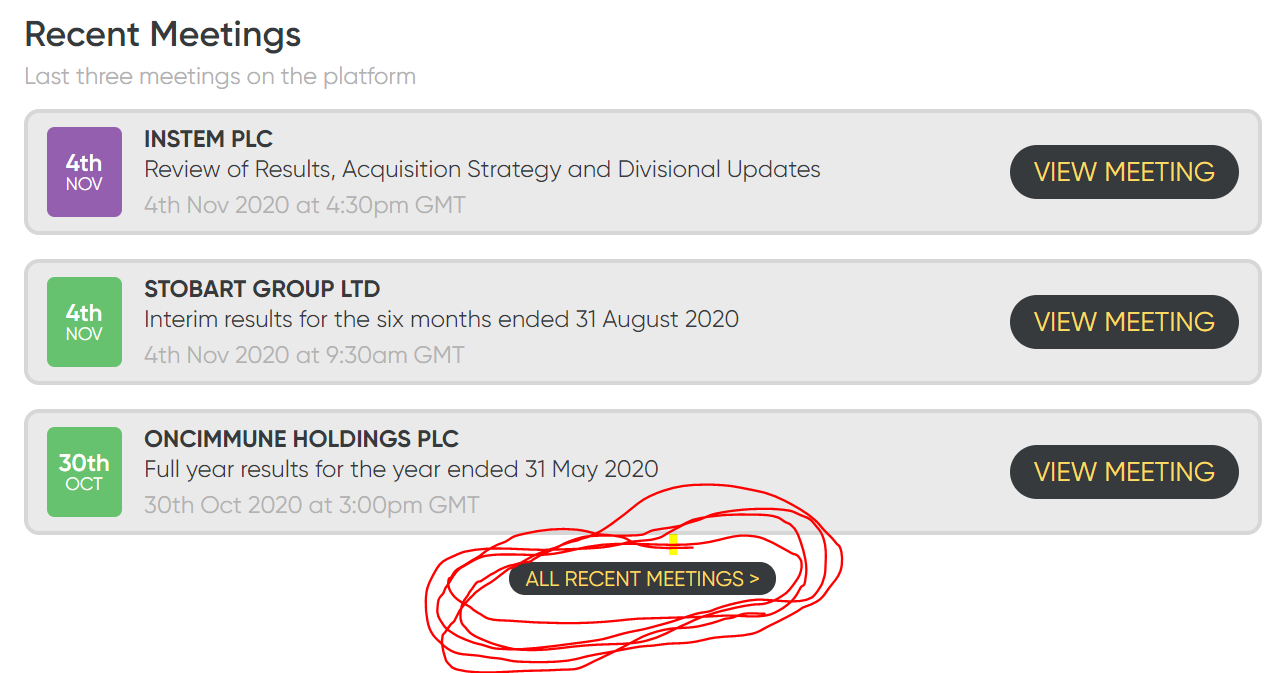
Incidentally, I asked if IMC could make it possible to browse all their recordings of previous meetings, which they thought was a good idea, so they have recently added the button below;
.
.
I must find a better way of highlighting things, as it looks like a 4-year old has scribbled on the page!
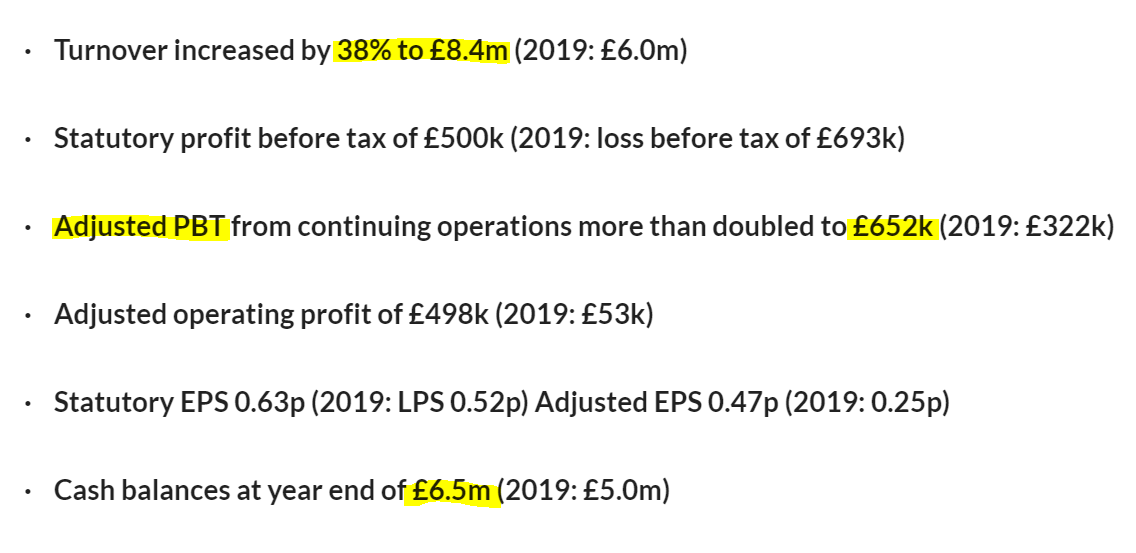
The highlights for Wey’s FY 08/2020 look quite good;
.
.
Nice revenue growth. A small profit of £652k, after adding back a few adjustments, like £75k share based payments. Plenty of cash in the bank.
I’ve reviewed the balance sheet, which looks fine to me.
The cashflow statement looks fine too. The increase in cash seems to mainly be due to increased liabilities, which I’m guessing is likely to be deferred income - i.e. monies received up-front from student fees. That’s a nice business model, being paid up-front is always good! So no issues there.
Outlook - rather over the top language, as MrC flags in his daily roundup in the comments section! This is an interesting point;
...robust strategy for accelerated growth has meant that the pandemic growth and subsequent changes in behaviour have presented yet further opportunities.
My opinion - I like the company, and the niche it operates in. There’s clearly a big opportunity long-term. Getting digital marketing right is probably the key to growth, and being able to manage rapid growth whilst maintaining quality of service is vital too.
Which brings me on to valuation. I think this company, for where it currently is, might sensibly be valued at say £10-20m. The actual market cap is £36m, so I think it’s significantly over-priced at the moment, therefore it’s not of interest to me.
Barriers to entry are fairly low, for example I know plenty of private individuals who teach online, one-to-one. With Zoom, and other platforms, it’s quite straightforward to teach online. Although I appreciate that Wey has a much wider offering, with the ability for students to confer, and various tools to allow the teacher to monitor & control a class online.
My other reservation, is that I’m not convinced Wey are ambitious, or aggressive enough, to make this into a really big company, therefore it might be overtaken by new entrants at some stage, possibly? Plus, as it grows, the likelihood seems to be that profit generated would be sucked into increasing overheads, and a larger marketing budget.
I can see why people like the concept, and the company, but for me, I’m lukewarm about it at the current high valuation, for what is a very small company, that’s only eked out a small profit this year.
.
.
Capita (LON:CPI)
Share price: 30.7p (up 18%, at 12:08)
No. shares: 1,669m
Market cap: £512.4m
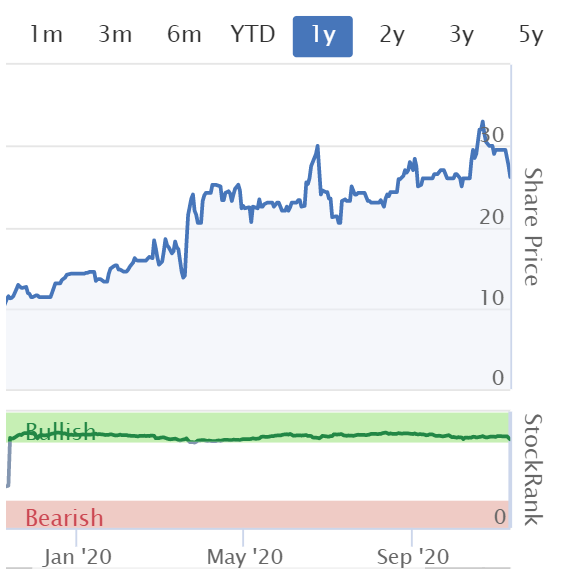
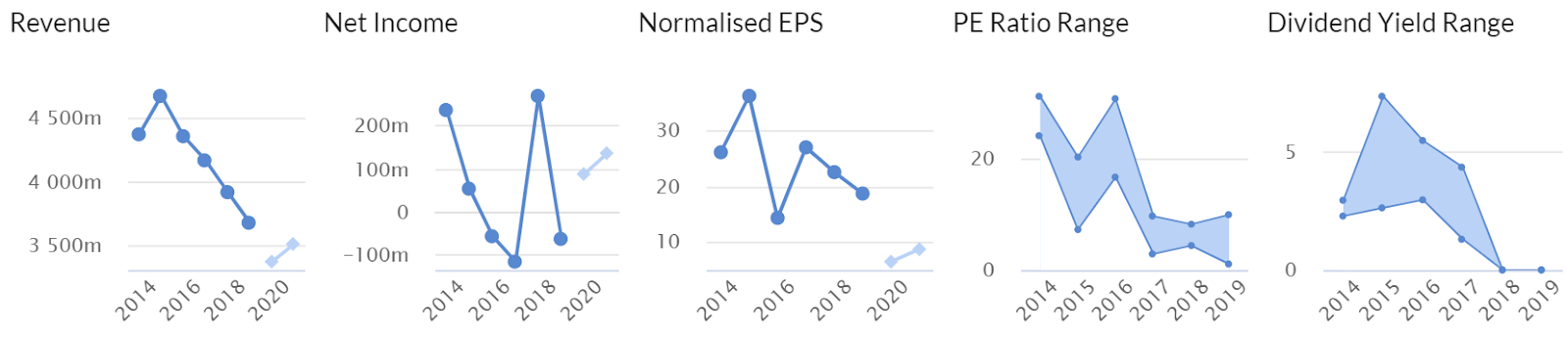
This is a sprawling outsourcing group, which manages a lot of services for Government. Check out the figures in the graphs below, it’s astonishing that such a large group is appearing in a small caps report, such has been the shareholder value destruction accomplished (see the dismal 5-year chart below);
.

.
.
Those little graphs tell us a lot;
- Huge, but declining revenues
- Lowish margins & erratic profitability
- Declining EPS trend
- De-rated from a PER above 20, to single digits
- Dividends have stopped
Trading update for Q3;
Trading in the third quarter was in line with our expectations at the time of the half-year results.
Q3 revenues down 11% to £803m
Adjusted operating profit flat at £66m (but the trouble is, this ignores a lot of costs - see the figures below from the last interim results, showing that adj PBT was just over half of adj operating profit)

The commentary for Q3 says;
The greater part of Capita’s revenues have remained resilient, with the vast majority of our colleagues able to deliver services for our clients. The year-on-year revenue reduction has been driven by both the impact of COVID-19, largely in our transactional businesses – such as travel and training - and contract losses announced in 2019. The revenue reduction this quarter has been mitigated through the cost actions we have taken over the last 12 months.
Disposal - discussions continuing re its education software business. Does anyone know what sort of price this might be sold for?
Outlook - uncertain, but continuing to trade in line with expectations.
Bank covenants mentioned (OK for 31 Dec 2020), which sounds like there might be a problem in 2021 perhaps?
Balance sheet - I checked the latest interim results, and Capita has one of the worst balance sheets of any UK listed company that I’ve seen. Intangibles (mainly goodwill) total £1,514m. Deduct that from negative NAV of £(87.1)m, and we get an alarming negative NTAV of £(1,601)m!
There’s loads of debt, with some needing to be repaid in 2021.
Going concern notes with the interims flag up that this share is a risky proposition at the moment;
Financial projections across a range of severe but plausible scenarios, in which downside risks are partially offset by appropriate mitigations, indicate that there is potentially limited liquidity headroom and a risk of insufficient headroom when assessing the Group’s future compliance with the financial covenants.
In considering the potential impacts of these projections, the Board has modelled the additional funds expected to be received from the disposal of ESS which is planned for 2020. It is the Board’s expectation that these funds will provide the necessary liquidity headroom to address any potential shortfalls arising in the downside scenarios evaluated. It is also the Board's expectation that these funds will provide for compliance with all covenants although in certain circumstances this headroom is potentially limited at June 2021.
The Board has confidence in the robustness of its primary mitigation (the ESS disposal) against these downside scenarios. The Group has several other options which are being actively pursued to provide further resilience in the event of a downside scenario. These include additional disposals and a refinancing of short-term maturities, which are discussed further below.
My opinion - this is too large and complex for me. Clearly it's a financially distressed special situation, so anything could happen. There looks a high likelihood that fresh equity is needed, to patch up a pretty disastrous balance sheet. That could involve a high level of dilution, as we’ve seen with some other financially distressed companies this year.
The going concern notes are very helpful, and demonstrate that the disposal of ESS seems very important.
For me, it's way too high risk, so I’m not interested.
I wonder if Capita is too big to fail, or if it might get nationalised, if it can't refinance in 2021?
My sector pick, for a risky outsourcing share, is Mitie (LON:MTO) which I've recently picked up, after reviewing it last week. Only a small position, as I hate this sector with a passion. But, it might do well from a return to work trend in 2021, maybe? Who knows, it's all guesswork to some extent.
.
I'll leave it there for today. Please see tomorrow's report for a new section on ZOO.
Best wishes, Paul.
Disclaimer
This is not financial advice. Our content is intended to be used and must be used for information and education purposes only. Please read our disclaimer and terms and conditions to understand our obligations.

110 comments
Inspired by Paul's comments on Wey Education (LON:WEY), I have written a downside case valuation here: https://www.stockopedia.com/co...
(Incidentally, this SCVR is not tagged with WEY)
Re: “The Deficit Myth”, by Stephanie Kelton.
If you want to get the gist here's a link to an FT article about her earlier this year...
https://www.ft.com/content/ea25934a-7b28-11ea-af44-daa3def9ae03
Codemasters Group (LON:CDM)
An announcement of exact details of the offer sneaked in after the market opened and so has not been picked up on this board. There is enough going on here but there is discussion at:
https://www.stockopedia.com/co...
Paul Please find attached an article about MMT .
https://www.brookings.edu/opin...
It has a history - Zimbabwe, Venezuela and Yugoslavia and is proposed as an alternativeto capitalism by politicians like AOC, Bernie Sanders and John McDonnell over here. It is based on the Marxist belief that the government allocates resources better than the free market and is associated with other Marxist concepts such as Universal Basic Income and Wealth Taxes.
The UK is adopting some of the MMT principles in monetising the deficit caused by their economic policies relating to Covid. This always ends up in the medium term as inflation. A recent example is Argentina where inflation brought on by unsustainable borrowing suddenly accelerated to nearly 50% in 2017.
I was reflecting on this the other day. I grew up in the 1950s and 1960s and we had far worse public health epidemics than Covid - polio, smallpox, Asian and Hong Kong Flu. I wondered why we didn't have lockdowns when it dawned on me. We couldn't have afforded it. Government debt had to be funded by third parties willing to buy it who expected an interest rate and that it be repaid. The notion that people would be paid 80% of their wages (not many salaries in those days) to do nothing would never have occurred to anyone. People just got on with it. They were rarely mentioned on the TV and there were no 'Beths' and 'Lauras' constantly asking the government to apologise for their actions.
There may be a case for these policies on a temporary basis. The trouble is that governments get hooked on the 'magic money tree' and borrows increasing amounts of money beyond the increase in productivity of the economy. This has to be 'paid for' either by taxation or inflation. That appears to be the choice for Rishi Sunak. There is no free lunch. Older readers will remember the Barber Boom in the early 70s when he simultaneously cut taxes and increased spending, losing control of the money supply and shepherding in an era of 25% inflation. My fear is that this is where we are now heading again.
Minor point of order, but polio, smallpox and Hong Kong flu weren't even in the same league as COVID. The worst polio year in US history in 1952 only killed 3,000 people vs 230,000 and counting for COVID. Smallpox was even less of a problem, confined to localised outbreaks in the 50s and 60s in the UK. In the notorious Bradford outbreak in 1962, only 6 people actually died of smallpox.
That's why you didn't have lockdowns, not the inherent stoicism of the population, or the influence of 'Beth' and 'Laura', whoever they are.
From Wikipedia - The Hong Kong flu, also known as the 1968 flu pandemic,[1] was a flu pandemic whose outbreak in 1968 and 1969 killed an estimated 1–4 million people globally and Polio - At its peak in the 1940s and 1950s, polio would paralyze or kill over half a million people worldwide every year.
The other point about. polio was its impact was mainly on children.
My point wasn't that people were more stoical (though I think they were) but that MMT in the form of debt monetisation was never contemplated. There was no way the government could possibly have paid people to sit at home.
[MMT] is based on the Marxist belief that the government allocates resources better than the free market and is associated with other Marxist concepts such as Universal Basic Income and Wealth Taxes.
It's not you know. Technically MMT merely postulates that governments can create as much money as they want as long as there's spare productive capacity in the economy - because under those circumstances inflation can't kick in. This is more or less what governments of all hues have been doing for a decade.
How that money is allocated is a separate question. In a centralised Marxist state then you would indeed expect it to be allocated (badly) by governments. In a capitalist state you'd expect that money to be deployed out into the economy for the market to best determine how to allocate it (also badly, but generally less so).
MMT is entirely separate from Wealth Taxes (or, as we used to call them, taxes) and Universal Basic Income. In fact UBI was first proposed by that notorious lefty Thomas Paine, and has subsequently been supported by figures from both left and right - Richard Nixon, for instance, advocated a form of it. Even that notable philanthropist Elon Musk has backed it.
None of these ideas are intrinsically Marxist. In fact Marx would almost certainly have been appalled by the concept of MMT as his theory asserts that money is a representation of value - which is pretty much the opposite of what MMT says.
Ultimately MMT in a capitalist society would serve much the same purpose as unfunded tax cuts driving up deficits. You don't see many people on the right complaining about those.
Personally I think it's more economic gibberish from the profession that brought us monetarism and trickle down economics. But economists are bound to try and describe what they see before them in terms of the tools they have in front of them.
As Munger says, when the only tool you have is a hammer every problem looks like a nail.
timarr
MMT based analysis of govt spending and debt is more real and practical than current received wisdom on the matter.
MMTers correctly observe that govt does not tax or issue debt to spend, rather they spend and then choose to cover that by tax or debt (mainly).
An essential piece of MMTing it is that the govt must pay all bills in a sovereign currency...cannot MMT if you use a currency that is not legally and fiscally yours...looking at you Europe.
It is really a very old concept but has been spruced up to counter modern monetary economics and the inflation battling wisdom of central banks (a nonsense conceit derived from the disastrous yet lauded Paul Volcker).
It can get out of control with inflation...but its all rather chicken and egg....why did the inflation come?...the MMTers argue as the productive capacity of the economy is inadequate to support demand. Economic luddites will say then cut spending (the woeful school of Dave and George hy-austerity).
How can you meet the demands through cuts?...its assumed to be by the IMF based magical thought of capital flows....which has been resoundingly debunked by ALL the developing economies that have progressed and particularly jumped to developed. Capital flows are hot and short term and fully in the financialised economy unless you make them slow and long term and lock up their ability to exit....ie capital controls and/or a closed and managed financial system...
So western economies that use MMT the issue is whether its used productively...investment and capacity. Undoubtedly this can create inflation but not the Weimar-Zim inflation of lack of productive capacity.
MMTers propose using tax as a way to cool inflation pressures thro targeted tax....I know, chortle, chortle...govt/CB popping bubbles etc...but its not MMT that is the problem there but the general political management process.
I believe we will embrace MMT as it is logical and the other option of a debt deflation spiral just ain't being allowed - see comment here https://medium.com/@mojomogoz/... (note, I put a copy of this in Stocko but can't find it to link here). I think if you believe we will 'cut our clothe accordingly' from here then you're off your head....it ain't happening...and it is the wrong thing to do too and pure self-harm.
The UK is in a fantastic position to lead this economic-political revolution. Sadly no-one seems to have given Dom or Rishi the memo...I note that last week when more QE, debt monetisation and furlough were announced all on the same day GBP was very strong...it is my belief that UK markets would rally strongly on explicit embrace of MMT....markets want it as they know it brings a stable platform to operate from rather than our current insane dance on the precipice of debt deflation. In addition, the UK would see very strong capital inflows with such a policy.
Sadly the Dems didn't win clear cut as that would have ushered in this approach in the US with strong support from Fed. TBH a clear cut Trump win would have done the same....now there is risk around the split in the House.
But, anyway, MMT is here now and it ain't going away. The 2020s are going to boom baby...the 2010s were a demi-depression after all.
In 2008 we learned through pain and stress that money is not real...and much of our concepts of govt, spending and debt are throwbacks to the idea that money is real (and it fo shiz was pre 1933...and to a lesser extent 1971).
In the Time of Corona (could so be a Gabriel Garcia Marquez novel!) we are in the process of learning that not all debt is real. Yes what we owe personally is, same for companies...but debts the govt (with a sovereign currency) owe or underwrites are not real....they inhabit a twilight zone not quite as unreal as money but very unreal at times if the govt chooses
Interesting stuff Mojo. I don’t pretend to understand the economy, or inflation etc. It seems to me that economists don’t understand it very well either, they just pretend that they do, or allow us to think that they do. MMT seems very much something that holds together in a narrow theoretical model, which is all well and good until something that the theoretical model didn’t factor in comes into play. I don’t like going by human instinct as so often it is wrong but still cannot help feeling that MMT sounds like a “free lunch”.
What role would you say that wage inflation growing faster than productivity plays in feeding through into price inflation? And to what extent are we beholden to the sentiment of our trading partners (in the sense that if we print vast quantities of money, what happens if they are no longer willing to trade in pounds or they decide that our pounds are worth less than they once were)?
Graham
No one truly understands economics...its too complex and economies have significant endogenous factors prone to cause periods of high volatility or regime shift that our heuristics can't keep pace with (2008). We all tend to rely on heuristics...the great heuristic of our post-Keynesian times (we are still Keynesian but not nearly as much as we were) is that the budget of country is like a household. This couldn't be more wrong....and in that regard I think the MMTers are more right than other key economics groups.
MMT is no more a free lunch than credit creation within licensed bank balance sheets and financial markets more broadly is. Its merely the govt and its institutions (central bank) taking a more direct role in this credit-money creation and spending. This is not necessarily good or bad. High debt issuance and QE are similar functions except there's a shell game whereby the financial system creates the money and then passes it back to the government to spend. Note at present that in the US with massive fiscal gap that the biggest buyers of treasuries are banks whom the Fed changed regulation to make it possible for US banks to effectively create bank money to buy govt paper without needing to place any risk weighting against this process....pure fiat credit creation within bank balance sheets. AKA supplementary leverage ratio https://www.federalreserve.gov...
In many ways MMT describes what's going on better and cuts out the complex opaque interim processes.
I think simplicity and honesty with self and others are good. In that way I think MMT is a positive step in knowledge and process. But you are right we could mess it up.....that said, the increase in debt, wealth gaps, poor infrastucture, significant decrease in opportunity for some groups (ie 'working class') etc suggest we ain't making a good job of our tools and immense wealth at the moment...
I think we will embrace MMT as we must....to stick to the old hard currency derived thoughts will mean ultimately a second great depression and/or a massive debt jubilee. The latter is preferable but hard to deliver directly in an excessively financialised economy...MMT is the soft and inflationary route to it.
Wage inflation is complex and not straight forward. In the UK we have had disinflation from growth in China and other EMs that has seen massive wage inflation in these countries. How we get inflation is beyond just local wages. All things equal higher wages are good if they derive from higher productivity and bad inflationary if not....however, some inflation is now a system good IMO.
MMTers propose using tax as a way to clamp down on inflationary pressures. This is good logic IMO...but super hard to implement...when do politicians really want to spoil a party?
On trading partners....I think the world is waiting for the next economic/policy step. Its my view that a careful but explicit use of MMT will be welcomed as its seen as system stabilising and provides catalysts for activity and growth. In a fiat system no one really worries about the sanctity of money (as if it were a hoard of gold), they worry about who's doing what next. The UK would receive strong capital flows too with clarity on a policy like this....wing nuts like AOC or John McDonald are sometimes right about some things :) ....
There is a third option its just cancelled off at maturity as per link below, normally you would expect to get inflation but we didn't see it in 08/09 and the Japanese print on a level that makes us look Sunday league and they can't get inflation even though they want it.
We did see some inflation in 08/09 onwards but it was in property and stock markets as a result of rock bottom interest rates I expect the same scenario to play out over the next ten years given this time round roughly 5-6 times more qe has been lobbed over the wall against 08/09.
https://www.thisismoney.co.uk/...
Hi kgb,
Yes, my instincts & experience are similar to yours, in that I am intrinsically distrustful of MMT, seeing it as folly, which has historically led to disastrous devaluation, then hyper-inflation, ruining millions of lives.
There again, I think it is important to keep an open mind. Hence why I've begun reading the provocatively titled "The Deficit Myth". What intrigues me, is that in a zero interest rate world, QE is proving (so far) a highly effective way to avoid an economic slump, and to fund huge crisis deficits effectively free. It has not caused inflation (other than asset prices).
Hence why, after 12 years of this apparent madness, we surely need to wake up to the reality that, whilst if goes against everything we know to be true, it's somehow working! That's why I want to explore the topic more.
My main worries with MMT, are that all this QE could ultimately lead to out of control asset bubbles, on leverage, and then a banking crisis - although surely that then could just be fixed with even more QE?
Or, maybe a situation where one of the major currencies suddenly collapses? Who knows?! It will be fascinating to see how it pans out.
Where to invest? I think reasonably priced equities in decent, profitable companies, and property (not retailing space!) look sensible places to focus on.
The most important thing to remember is that, nobody knows. People love to say emphatically, that this WILL happen, and that WILL happen, whereas in reality, they're just making it up! Maybe let's all try to be a bit more humble, and admit we don't know, and we're purely speculating.
If I'd told you in 2007, that the financial system was about to shake itself to pieces, and interest rates would be near-zero for (at least) the next 12 year, you'd have told me I was stark-raving mad!
Such a missed opportunity for me. Back in 2008, I had a lovely £1m house, a former rectory in Highfield, Southampton, and my mortgage was, amazingly, floating rate at 0.2% BELOW Bank of England base rate. It had no floor either.
As my finances collapsed in 2008, I felt obliged to sell the house. The buyer screwed me by gazundering me at the last moment before exchange to basically rob me of £40k, as he smelt that I was a forced seller, so suddenly reduced the price he was prepared to pay. All fair in love & war I suppose, and he probably thought he'd been terribly clever, in a Donald Trump type of way. I wished him well, and hoped that he would enjoy the lovely house, over dinner in a local brasserie. There's no point in letting bad feelings linger.
Shortly afterwards, I moved out of my dream home, and ended up in a basement flat in Brighton. I was burgled by some junkies 2 weeks later, whilst taking a nap, and had to chase them out, and fought one of them to get my laptop back.
Then the piece de resistance happened - a letter came through from my old mortgage company of the big house in Southampton. Due to interest rates being reduced to near-zero, my monthly mortgage payment was reducing from £3,500 per month, to £200 per month. Yes, you read that right!
I just collapsed in fits of laughter. It was such a ridiculous turn of events, that you have to laugh, to prevent you crying.
As Oasis always say, don't look back in anger.
As Cilla said, life is full of surprises!
So I ended up paying £1k per month, to live in crappy rented flats in Brighton, when I could have paid £200 per month to continue living in my lovely £1m rectory.
But does it matter? Not really. I miss the garden more than the house actually. Rattling around in a big house is pretty pointless, so it's better that a family are enjoying it now.
We've got to see things glass half full.
Best wishes, Paul.
What an excellent reply Paul , thumbs up, if we had emojis :)
I wonder if anybody with a good deal more experience than I would be able to shed some light and insight on what appears to be a short squeeze at Reach (LON:RCH) ? It's been on a tear of late, boosted apparently by a favourable note from Panmure and a PI world interview with Richard Leonard and of course some favourable coverage here from Jack also. I've no idea how much of the recent explosive share price action has been a result of this coverage allied to the positive HY results at the end of September and how much can be attributed to a short squeeze caused by the outstanding 1.9% short position of Luxor Capital. Whilst I can understand the basics of what a short squeeze is, I wonder if there is any way to tell to what extent something like that is driving the price and what we can expect to see happen especially if Luxor eventually capitulate? Would the price collapse if they did? How would a PI know if / when they capitulated? Any thoughts or insights would be gratefully received. I've been a happy holder and believer in the underlying digital transformation but the stratospheric share price movement of the last week or so is a little unnerving (it suddenly feels more akin to an in-play football bet than an investment) and I don't really know how to react or what to think. Also can anything be read into the recent appointment of a joint broker? Could that signify anything afoot or is it routine for a company of this size? Many thanks to Paul, Jack et al for all the wonderful analysis and commentary as always.
John - one factor might be that only 30% of the shares - and maybe less - are held outside the top 10 shareholders. Might be a lack of stock. I looked at it after Jack Brumby's review and that was one thing that put me off.
Hi JohnSmith (if that is your real name),
I'm also in Reach (LON:RCH) and trying to figure out what to do. I'm going to hold my stake for now, principally because the price to earnings ratio started very low at about 2 or 3, and is today only about 5, at c.150p share price.
This is the most important point for me, rather than the short squeeze, as what the Panmure note (and possibly the Richard Leonard/Andy Brough interview) did was to show that there is potentially a viable ongoing business, rather than just the declining print business. If that's the case, a PE of 3 was far too low, and this is just a re-rating to a more sensible PE. What PE the market decides to stop at, who knows. 6-7 looks reasonable whilst the market waits for proof of the digital side.
The next trading update is scheduled for 27 Nov, so only just over two weeks away. Depending on whether you are a trader or investor, and what level of profit you have already, you could wait for the trading update to see how the business is functioning.
In short, I think what I'm saying is the short squeeze is either a red herring or just a catalyst for the re-rating.
Thanks
Chris
JS – potential £RCH Short Squeeze.
The position is this – Luxor Capital are short of 1.91% of the issued share capital of Reach. That is somewhere in the region of 5.8m shares.
https://shorttracker.co.uk/com...
The share price was much lower when they went short so they have lost a substantial amount on the trade (on paper, so far) and lose more each time the price goes up.
The short squeeze happens if/when they decide to close the short all at once to avoid losing more.
This creates a demand to buy 5.8m shares, this compares with the average daily shares traded of around 500k over the last few months. Over the last few weeks the average shares traded has been higher at around 1.5m shares per day, but even at that Luxor need to buy around 4-days worth of normal trading. The “squeeze” is that in order to buy that many shares, the only way is to pay over the odds and therefore the price goes up further to exploit the forced buyer.
How will you know it is happening / has happened? A large increase in the daily shares traded could be indicative of it happening – however the 6m shares traded between 22-23 October does not appear to be Luxor (I think it was buying on the back of the broker forecast). So, we would probably only find out, when Luxor update their numbers in the reported I linked to above and there can be a two-day delay to that happening.
What will happen to the price once they close?
Well if their buying drives the price up, it should (all else being equal) fall by the same amount once they are done, maybe even a bit more if people who bought in anticipation of a short squeeze then sell.
Unless Luxor have failed to comply with the reporting obligations then they were not closing before late last week (if at all) so I don’t think there is any evidence of the “squeeze” happening thus far.
Of course, it may not happen at all. People can get transfixed about how much Luxor have lost (£ millions) but in the context of their overall portfolio closing to avoid further losses may not be a priority. I have seen quite a few instances of shorts sticking around for a long time, even when “under water”.
The potential short-squeeze might be an interesting sideshow, but for it’s not anything that I’m giving much thought to at this time.
Thanks for the helpful replies. I'm certainly an investor rather than a trader and so I plan to sit tight because I do believe there is a genuine transformation going on here. If the forthcoming trading update shows accelerating progress and is greeted positively by the market then I may need to top slice to avoid being too unbalanced in this one position. It's reassuring to hear that the short interest may only be a side show to what is a very rapid re-rating (so much for efficient markets!). Hopefully the movement is simply the market recognising the potential here. Regarding the low PER, I would caution that the huge pension liability is likely to drag on that for many years to come!
I disagree on the pension and here is why.
The deficit is circa £200m and is being unwound at £40m p/a. However, the triennial valuation is due fairly shortly and I suspect, given events over the last 3 years, the deficit may come down more sharply. The pension is closed to new participants so I would expect Reach (LON:RCH) to get rid of it once it moves to surplus (or possibly before if the triennial valuation is decent - ie they may use cash/take on debt to eliminate the deficit ) and thus remove the risk from its books.
But the pension valuation due soon could go either way, right? There is no guarantee it will reduce the deficit, it might actually push it higher.
How do they get rid of it? Can they just sell it?
True, it can go either way. And no they cannot just sell it. You can only sell of a DB pension scheme if you overfund it to a ridiculous amount - It's for sure a buyers market in this respect.
Unless companies are desperate for cash (as I believe 600 (LON:SIXH) were) the best option is just to ride the pension - in this context Reach (LON:RCH) are quite strong and they benefit from a constructive relationship with the Trustees who seem to recognise that the best way to support their pensioners is to let Reach succeed.
A definite risk factor to consider however.
R-G, not sell it, but they can pay for it to be taken off their hands.
The price paid will far exceed the value of the liabilities being shown in the accounts, as it will be valued on a "buyout" basis, designed to remove much of the risk that the buyer incurs on taking on liabilities which cannot be accurately valued.
Reach (LON:RCH) is a bit of story stock - not in the sense of blue sky technology but in terms of 'known for'. They shifted part of the negative history by the move to Reach vs Trinity Mirror. However, older fund managers will still remember
Re-rating can therefore only occur when/if they can drop the bad baggage (pension, phone hacking) as well as roll out the good (monetising consumer contacts). Whilst a pension exit looks plausible in 2-3 years all being well, phone hacking will also likely linger (see Econmist article this week on why phone hacking scandal wont go away) https://www.economist.com/brit...
On the positive side of the ledger, technology/digital connection is hot. But whilst the strategy may be good, collecting, organizing and monetising those email addresses even if can be done will take several years.
Net, this is a multi-year investor story and any multi-bagger potential needs to be seen in the context of that.
Thats an excellent example, thanks Gromley
personally I doubt a 1.9% short position would cause any type of short squeeze. It would need to be highly market illiquid for that to occur and Reach (LON:RCH) doesn’t strike me as that illiquid from watching it over the last few years.
In my experience stocks do tend to behave like this when they get re-rated. For years the naysayers have trembled at a declining print market and pension deficit without every really appreciating/realising the vast swathes of cash this business can continue to generate, let alone attribute any chance of success in migrating to digital. prior to Covid the stock had started to become more attentive to the bull case and was trading around 180p only to halve when Covid hit.
My read on this is that we are now seeing several effects come in to play that is driving the re-rate
1) trading and cashflow is more resilient than had been expected so some of the previous losses are being recouped.
2) several commentators have worked out that Reach (LON:RCH) under the new CEO is very focused on monetising its content through digital and that revenues are growing at sufficient pace that the business could be a very cheap content play given its market share in the UK
3) results due in a few days and anticipation that more on the digital strategy will be forthcoming
4) valuation metric comparisons are favourable to DMG and Future Group but Reach (LON:RCH) has potential to be even greater. People have worked out that the risk/reward looks favourable and I’ve seen target prices from 225p to 500p+ if Reach (LON:RCH) get the model right. I’m not making any forecasts myself but as a long term holder I can say that I have almost zero inclination to sell any of my shares at anywhere near the current levels. I take the view that Price rises are irrelevant if the business justifies the new valuation.
david - I suspect we are pretty closely aligned on both the short squeeze and the pension (your later comment)
But the short is at least significant against the average daily volumes and with 70% of the shares with large holders a 1.91% short is 6% of the "free float" (probably using that term wrongly)
£RCH was the lead recommendation in the recent issue of Small Company Sharewatch. It wouldn't be the first time that a recommendation in that tipsheet has had an impact on price at least in the short term.
Good point - thanks was I think a large driver of the rise last Monday. I would normally consider selling a SCSW tip a couple of weeks later, but in this case the uptrend was already well established and I think SCSW were almost just "noise" on this occasion.
I 'attended' the virtual Mello Monday meeting yesterday evening (well, about two and a half hours of it - I missed the first hour) with an open mind as I'm not a great fan of Zoom meetings but I have to say it was very good indeed. Very slick and well presented, none of the sessions went on for too long and it has reignited my interest in small caps. I particularly enjoyed the BASH discussion at the end. Highly recommended. I shall be buying a season ticket.
Gostevie
My first one as well. Something for everyone, but agree the BASH at the end was very good, even if it just confirmed some of my thoughts, but a great reminder that there can be multiple views and everyone has a very different take on risk vs reward. I have bought an annual pass and will ensure that even if I cant make every one I'll catch up on the recordings.
I like the idea as well that we can suggest companies for the BASH.
Hi Herbie47,
HL did kill off their iPad-specific app a few months ago, but the iPhone app still works on the iPad.
Here is the link to the App Store: https://apps.apple.com/gb/app/...
Neil
Regarding Zoo Digital (LON:ZOO) interim results this morning; very disappointing;
I therefore decided to lick my wounds and move onto something offering better opportunities. I could be wrong, but I feel that Zoo Digital (LON:ZOO) don't offer as much upside in the next few months as a number of other options.
However, HL's trading platform decided to kick in and despite at least 20 attempts to get a price (all below the EMS) I couldn't shift my holding for at least two hours. Only when the price had dropped a further 4-5% did I finally get a price.
Anyone else suffering these trading issues? Will potentially be looking for other platforms if anyone has any suggestions - I've been a long-term client of HL but little bugs like this cause me to question their service. I have previously been a big supporter and get the point around liquidity in smallish companies but Zoo Digital (LON:ZOO) are a little bit bigger than a tiddler.
No, but I'm not with HL. Hearing increasing complaints and with only 43 trades going through, but the market size is only 5,000 shares: it can depend on how much you were trying to sell,
Quickly realised that 5000 was the EMS so made sure that all of my attempts were at or below this.
(Just put this in Ed's Wey pitch so copy and paste from there)
I don't really get Wey Education (LON:WEY) and particularly why it is should hold a high valuation as there seem to be a number of significant weaknesses that will either muddy growth path or create high costs to growth. I'm probably wrong and just can't see it (not uncommon!). I acknowledge that its a stock with a sweet narrative...too sweet IMO as it enjoys a bit of hype-ish support in the PI world and it appeals to the self-made self-motivated (dare I say occasionally egotistical and liking to broadcast) geek sorts that like to believe they can outsmart the market...or at least out trade the other suckers ;)
Counterpoints:
Instinctively to me Wey feels like a wrongun...just as you have 'tech' doesn't mean you 'disrupt' (and we all hate schools in some way and/or know teachers we think are a-holes so we can be very ready to believe the disrupt bit). I think I could keep on going with the above but I'll stop now.
There will be a durable market for a service like Wey and it will have some growth. But why would Wey 'uber' or 'facebook' this market? Its not really suitable to a dominant educational delivery platform (there could be dominant enabling tech of course for some). Wey are likely to face very stiff competition from better brands. Eton online if they chose to commercialise and scale would be able to charge at least 2x as much as Wey and still outpace them....if you go weird in education and have money you're going to go brand.
Sell Wey...you might not see the sidewinder coming and at its current price a doubt re model will take the price down hard and their ain't a lot of liquidity for anything but the smallest PIs. A stock like Rm (LON:RM.) is harder to like for a variety of reasons (inc the superb homegrown CEO moving on) but is much better structurally places to monetise innovation and change in education
(There's a lot I don't know re Wey and the above is a quick view rather than very informed)
Hi Mojo, I sympathise with a lot of the points you make. For various reasons one of my children has struggled to attend school (school refusal) since she was about 8 and we were a customer of Interhigh at one stage. I believe for many home schooling is a compromise forced upon the family, rather than the preferred way to educate. We have probably tried 4 or 5 different 'alternative' schooling models, and none were that satisfactory. Interhigh (note this was back in 2016) was very well organised, but my daughter ended up spending so much time online. They have quite a full timetable, but critically all the friendship groups formed are also all online, so she would often be online from 8am – 8pm. About 4 hours would be for teaching the rest because all her friends stayed online between lesson sto meet up on there’s or other platforms. I concluded that the amount of online time was damaging to her and we went to back parental teaching after one term.
At the time we were using them they provided a niche for expat children who, for whatever reason, did not go to local school, or have access to an expat British School. I think that market will always be strong for them and they serve it well, but as an alternative to the local high, which my daughter has just re-joined for her final year and Scottish NAT 5s (GCSE for those in England), I wouldn't really consider it, and that put me off investing. Jonny
Interesting personal experience Jonny. All my comments on Wey Education (LON:WEY) are guesswork and prone to being misperceptions. I don't know the company well....partly as it doesn't make sniff test sense to me. I assume there's a major pivot down the road to bring scalable success...major pivots can be good, but can be hazardous for stock holders too.
My kids (neither angels or enthusiastic academics) would have been educationally better using Wey than a prior secondary school they went to that was a shambles (catchment very affluent London area...school seemed to struggle with cheeky posh kids TBH and a collective loss of hope and will amongst teachers...I think it may be almost a status driven thing?)....but I do think it would have been a cruelty to make them study at home from social perspective and counterproductive for general ability to function as people (fingers crossed on that...they'll probably be far better than I :) )
Now both go to different schools both much better. One is in one of the poorest central London boroughs (I think the poorest) and no doubt has a high share of kids with difficult personal circumstances but the school is great and on it (she commutes in as its UK's top 6th form basketball college for girls)
Here are my heat maps for today (prices as at ~11am).
SVCR filtered to 'interesting' instruments (reporting soon or recently, trending, breaking out, or moving more than 20d ATR EMA):
Big movers today (moving more than 20d ATR EMA against either yesterdays close, or today's open - not limited to small caps):
And finally the key to the heat map contents:
All heatmaps are ordered by Stock Rank™ and are limited to top 80 instruments (by StockRank™
[Edit: If the heatmaps images are too small to read on your screen, then try right clicking on the image and select 'Open in new tab...' ]
This may be wondersful but how are we intended to read any of it let alone do anything useful with it please?
TIA. Martin
This problem was covered yesterday but if you follow the instructions in the above 'Edit' then you will have it in a new tab on your screen. Then hold Ctrl and click +, one, two, or three times and the screen will enlarge to taste. As to what you do with it I leave that to the OP greenslax. Clicking Ctrl and 0 will return your screen to its normal size. HTH.
Re Wey Education (LON:WEY)
We've been hearing a lot through the Covid crisis about how beneficial it is for children to be going to school so that they have the stimulation of mixing with other children and so on. Of course, children can also get some of this from out of school activities but given the amount of time spent attending school it is clear a major chunk of that personal development happens.
Is it not possible that the online schools will suffer as parents realise that, apart from in some exceptional circumstances, it is beneficial for children to attend a physical school rather than a virtual one?
Wey Education (LON:WEY)
Is it not possible that the online schools will suffer as parents realise that, apart from in some exceptional circumstances, it is beneficial for children to attend a physical school rather than a virtual one?
Possibly but the point is their business model was geared up to work pre covid and there nmust still be a growing overall market for what they provide (presumption yhere !) so i would think that the pool of potential customes is unlikely to diminish anytime soon as any headwinds should be more that matched by the growth in online schooling numbers generally for other reasons- and that could be for logistical reasons perghaps more than anything else? - or having tied it once it may now be an option for those that would previously not have tjought about the online route.
I sold out recently at only a modest gain having held "most" of the way down and through the lazarus type recovery. I sold out partly on valuation metrics and partly the worry that they seemed more interested in global domination type activities rather than being a lean money making machine. Note i don't disagree with their policy of getting top talent and going the max on providing the full i am experience but i sometimes wander whether the extra investment into the future will generate the same margins that lean and mean would - ideally a balance between the two is what they want - and at least they have turned a profit this year so thats a much nice base than making losses. Anyway lets hope they live up to their own most lovely hype :)
Wey is going forward into the 2020/21 academic year with mastery, autonomy and a great sense of purpose.
I can see some issues with Wey Education (LON:WEY) re the online school/ classes. I don’t hold and don’t intend to.
I have some insight into this, as I don’t live in the UK at the moment and my children are doing a UK based home school program from a specialist home school provider based in Oxford.
This school was set up in 1894 and it is used by ex-pats around the world.
As Covid hit and UK schools closed, floods of parents signed up to the Oxford home school and the school decided to close to any further students to protect the service they provide to the existing ones.
There are some excellent points made in other people’s comments about Wey but there are 2 that stand out for me. Social interaction and being able to provide excellent teaching that is scalable.
We don’t live in an English speaking country and are in a rural location. We recognised that being in an actual school added more than learning, so we tried the local school, but this for various reasons this didn’t work for us, so along with some other families, we have set up a small home school classroom, where my children go each day to do their schoolwork, using the online platform from the school in Oxford and the same course books that they would use in a school in the UK. The other children do the home school program they chose to do. Our home school has 6 children in it and is run by a teacher, all of the children have become very self motivated but more importantly they need this social interaction. They also have after school activates which aren’t connected to our home school and I would say that they need both of these. Just having after school activates isn’t enough social interaction.
So, just having an online live school, where children sit at home in their bedrooms for x hours a day is really depressing. This is not a way to learn. I thought battery farming had ended in the UK.
As for scalability, I can’t see excellent teachers signing up for this. Maybe ones that are unemployed or newly qualified, or those who are disgruntled with their present job or disillusioned in some way, but the best teachers will stay in the their jobs.
That’s where the Oxford school we use shines. As it’s not a full time job for its teachers, it has a whole raft of outstanding teachers, who monitor our children’s progress, mark and comment on all their course work and respond to questions via the platform quickly.
These teachers have day jobs in Universities and UK schools and have excellent CV’s.
I cannot see that Wey will not be able to attract teachers of this standard, so for me, this isn’t good enough for my children and they would hate doing it too.
Finally as soon as schools get back to normal, all the parents will send their children back to their good school leaving Wey with lots of empty online classes.
Re Mccarthy & Stone (LON:MCS) ( I and my family have holdings). There have been significant increases in shareholdings post the bid announcement by the previous larger disclosed holders:
Alchemy - a hedge fund + 14.2 million shares to 5.69%
Bridgemere Securities - an offshore investment operation owned by Steve Morgan - the founder of and one of the largest shareholders in Redrow ( one of the UK mid sized and very successful housebuilding operations) +4.4million shares to 4.2%
Blackrock Institutional +11.5 million shares to 3.81%
In my view these investors are unlikely to be trying to pick up pennies by buying just below the offer price:. More likely they see another party coming in to make a more sensible offer.
Having said that since the price has hardly moved since the offer announcement and is around the offer price. It seems many sellers do not see an increased offer coming.
The forthcoming offer document will be interesting. Will it be announced as a "final offer" i.e. no increase allowed or will it just be an offer - implying that an increase is permitted ?
The situation seems to have limited downside but good upside but:-
- The Mccarthy & Stone (LON:MCS) year end was 31 October so I expect a horrific set of figures as everything bad is thrown into the pot so the offer looks good.
- Mccarthy & Stone (LON:MCS) previous years' ratios show a steady decline in ROA ROC etc so perhaps new management is needed to tighten up the operations ?
My issue with Wey Education (LON:WEY) is whether the model is scaleable. Their concept is not offering out online learning as a compliment to ordinary education. It's one big online school catering for people who for whatever reason (sports commitments, anxiety, bullying, travel) don't want to/ can't go to a physical school. The more sign up, the more teachers you need as classes are live and interactive. Maybe the b2b side is more scaleable. I've resisted the temptation so far but will listen tomorrow with interest
Yes that's my question too. I think we'll find out in 6 months how scaleable it is, with the sizeable increase in student numbers for the current school year. The 60% gross margins look nice, so if they can keep control of admin exps then we should see a big increase in operating profit next year.
Re the scalability of Wey Education (LON:WEY) , others who have been following more closely might remember the precise statement, but I seem to recall a year or so ago they expressed the ambition to become effectively the largest secondary school in the country. Or something like that.
If I am remembering correctly, that tells you both their view on potential scale, but also despite being online, they are pursuing quite a traditional model.
Please do look into this yourself though if interested as I haven't paid a massive amount of attention to this one. (It was at one stage one of my tiny strategic ignorance shorts)
Good morning,
Yesterday was a frustrating one for me.
After having taken a rather large hit on the COVID crash, I tried to be clever and catch dips. I usually got it wrong - holding too long onto shares as they fell, anticipating the impending bounce - losing my nerve - selling, and then watching the shares climb. Then entering the catch-up, FOMO, stage as the volatility would then go against me. Etc, etc.
So, I then decided to leave half of what I had in shares and the rest of my worth waiting for the safe seas of sureity. All of last week I was thinking that it was near time to fully invest. And then yesterday happened.
I couldn't trade. Halifax Share dealing was knackered and I spent the whole day trying to buy/sell - only managing a few transactions- all the time watching my chances of catching the rise evaporate.
I would have been far better off had I ignored my shares for the past ten months - rather than trying ( and failing) to use any form of logic.
I now feel a bit at sea after the whole experience and feel of little opinion as to how to strategically place my remaining money to best use...
Not sure what I'm trying to say, other than that the last few months have taken me from someone who thought they understood the ebb and flow of the market to one who has reacted blindly to fear and herd movement.
Don't give up. Markets have and always will be humbling. Get rid of bad or 'not sure' positions and look again. There will be many opportunities over the next few months. Start small again and build confidence and positions as and when they begin to work. 'Never get emotional'...is something I always try to remember with investing!!
Good Morning macbev - Sounds like my 2018
All I can suggest is follow Terry Smith's advice "Buy GOOD Companies DON'T Overpay, DO NOTHING, it bought me (for now) back into a better frame of mind and investment decision making
Can I add to this by saying "Buy GOOD" is defined by your own analysis, whatever that may be, the key is to develop that analysis to the point that you are totally confident in it and not diverge from it when the storms hit... you also need a clear exit strategy/plan for every holding i.e. what scenarios constitute an exit.
Evening Ginvestor - Re macbev's quiet cry for help
You are of course entirely correct as to what constitutes GOOD but without any malace in response - In my view when you have mataphorically fallen down a well - a long, complicated and comprehensive full escape plan shouted down to you is of little help, to start with you just need a simple 1st step instruction.
To me macbev like all of us at times had got to the point of overthinking everything and concluding very little. I only siuggest that as I personally recognise the issue all to well!
Technically however many thanks for clarifying step 2
Thanks for sharing, to many people want to share their successes and keep quiet when things don't go so well. I think we all have had some bumps this year, I still regret selling some heavily hit COVID companies far too late when it was obvious in February they were high risk.
I have had cash sitting on the side for a couple of years now when I sold my house and have just been dripping it into the market since then and will continue to drip it over the next couple regardless of where the market it.
As others have said buy good companies and good prices and ignore where they have been in March. Its where they are going thats important.
Sorry for your frustrations macbev and thanks for your open and honest commentary about your trading history. Given your experience, I would recommend turning away from individual stocks (other than small plays) for now and perhaps turning towards Investment Trusts.
if you do some digging and use the detailed rating info on Trustnet and MorningStar, they can provide all of the enjoyment (and investing should be enjoyable, not be about the awful, wrenching losses) but through a conscientious approach, can avoid the more severe roller-coaster ride of individual stocks.
It certainly was an interesting day yesterday! Many brokers could not cope yesterday and sites were down for hours. A lot of the smaller caps went firmly into the red and my watchlists were full of stocks closing lower; the Covid stocks and gold and mineral stocks etc.
It seems to me that a wall of money was just waiting to get involved on vaccine news. Major stocks like Bp (LON:BP.) are again well up today and Marks And Spencer (LON:MKS) has risen over 30 per cent in a week. A huge rally in Metro Bank (LON:MTRO) ......perhaps the next one to be bought out?
Where does this leave many of the bombed out property stocks? The reits for instance? Newriver Reit (LON:NRR) was just 42p in late September and is now 73p. That is a huge move for a reit.
I sense that a lot of money is to be made on stocks as uncertainty fades and we all look forward to next April (when I think we will have a number of available vaccines).
What is done, is done, everyone on here has missed opportunities and has invested at the wrong time. Why carry the weight of regret around, it isn't going to help you.
I always focus on my decisions not the results. I have made great decisions and got crappy results, equally I have made crap decisions and got good results. My point is look at the point in time when you decided what to do and judge that, rather than something you have virtually zero control over.
As far as I am concerned when the markets are all over the place, having 50% invested is not a bad move at all. Pfizer could have easily come out and said it didn't work (still can) and suddenly everything is upside down. You made a good decision, just got a crap result
I feel bad for you matey. I can't time the market to save my life! Don't bother. As the other guy's say, pick really good company's and try not to over pay. Easier said than done. Even the experts make huge mistakes. Like everything else in life you've just got to keep going and practice and learn. Recently I had a company go bust and take all my investment. I also have one that has tripled in value and is still rising. That's the way it goes. Don't gamble your hard earned cash, do your research and invest. Have you thought of drip feeding into a unit trust? That's how I first started years ago. Try not to get emotionally involved in the market. "Never give in, Never, Never, Never."
I understand completely how you feel, as I have been experiencing the same.
There is always factor investing (aka systematic investing) if you want to take the heat off and the emotions. Follow what Ed advocates in his NAPS posts: buy the best companies according to the highest StockRanks, diversify sectors i.e. a couple of stocks for each of the 10 sectors, leave them in your portfolio for one year, review and repeat the process next year.
Many great investors use factor investing one way or another. Good luck.
Many thanks all for sharing your kind words and advice. Onwards and (hopefully) upwards.
My advice regards buying shares and to minimise any potential loses is to only buy:
High Quality shares which have a good Balance Sheet, which are making a Profit and which have Momentum behind them. I ride out any stock market storms because the market always bounces back with time.
Hi Paul & Jack, really interesting and honest read about your loss in 2008. Also the psychology and mindset with the "A bird in the hand", "if only" and "what if" scenarios. Although I try to act in that fashion it's always difficult, and by reading it, it helps to reinforce that mindset!
Pdiddy
AZ/Oxford have conveniently white washed a number of vaccine trial peoples issues in south America (spinal inflammation & 1 death) blaming it on patients undisclosed/non known about medical conditions in those people.
Ok i am going to fact check you here somewhat Pdiffy - reference the one death that you use to evidence your point with regard to the AZ/Oxford trial - would you not agree that the reliable reports seemed to confirm that the death was in the placebo group and not someone who actually took the vaccine? - if you monitor 100k+ bods over several months unfortuantely someone will eventually die - thankfully the coin toss came down on the placebo side which avoided the need for an extended pause however that reported fact seems to be a problem for you?
Data that proves a placebo that was given? Rather than a statement? There is no getting past the spinal inflammation cases but I want to see hard evidence that chap was given a placebo. When vaccines are warp speeded to market they end up with big problems. Even the average of 10 years from inception to approval vaccines have had issues when gone to market.
'The board tasked with overseeing the data and safety components of the AstraZeneca clinical trials confirmed that the participant was injected with the company’s Covid-19 vaccine and not a placebo'
https://www.statnews.com/2020/...
Ref pateint death.
PDiddy
Data that proves a placebo that was given? Rather than a statement? There is no getting past the spinal inflammation cases but I want to see hard evidence that chap was given a placebo.
Fair enough you don't believe it till you see proof positive- i do understand your skepticism when it comes to tranparency and honesty with regard to drug companies - many have a very shameful not so distant past.
In the absence of proof positive we do have the following statement by the bbc - they seemed confident enough to put pen to paper so in the absence of proof IMHO its a reasonable thing to take the view that they are more likely to be right than wrong in this regard.
The BBC understands that the volunteer did not receive the vaccine.
https://www.bbc.co.uk/news/world-latin-america-54634518
I have already quoted above an article in which Pascal Soriot states that the patient concerned had taken the vaccine, not a placebo.
https://www.statnews.com/2020/...
Hello john2
I think we are cross purposes here - apologies everyone i should probably have let this go rather than clutter up the board.
Its known the spinal issue patient who caused the vaccine delay was given the vaccine and not the placebo.
What Pdiddy and i were discussing was whether the patient who died was given the vaccine - Pdiddy raised concerns the patient that died may have been give the vaccince and there was some sort of whitewash to gloss over this outcome. However the bbc have gone on record as saying they were given assurances the dead person was not given the vaccine - this being the case Pdiddy's accusation that this is some sort of whitewash with regard to the dead patient isn't realy telling the whole picture. Obviously if the bbc info turns out to be wrong pdiddy may have been correct in their claim.To me though it makes common sense that if they supended the trial previously reference issues that were flagged up it would seem unlikely they would carry on regardless when someone died unless it was clear they had taken the placebo OR it was clearly a non related death (eg if they were hit by a bus the death can "almost certainly" be put down to being nothing to do with the vaccine).
Ah, apologies - the reporting of the death had escaped my attention.
Good Job last night at / on Mello Jack.
To anyone not participating I would encourage you to try it once, I think it's excellent.
Distance and time has always prevented me attending a live event but I joined the first online one and immediately bought an annual ticket.
Is there anywhere you can watch a recorded version? I can’t see it on their site
Hi, there is, but there is a bit of a process to follow in order to do so. Firstly, you have to purchase a ticket for the event (or subscribe to a yearly subscription). You will then receive an email with a zoom link for the event (on the day). You have to register via the zoom link (event if you can't attend), which will then prompt a further email a few days later with a link to the recording. You could also try contacting Mello directly via the website: https://melloevents.com/
Hi Paul,
Would be great to get your thoughts on Plexus Holdings (LON:POS) - Announcement today released that a significant deal has been struck with Cameron, Schlumberger for there patented POS-GRIP friction grip.
re yesterdays collapse of the HL platform .
I did email them telling them that i did not accept their apologies for the 'hiccup'
i dont suppose i will receive a reply.
TBH it didnt really affect me but if it had i would be fuming.
what are other peoples views ?
Down not working again this morning. Poor show really.
Not working? I have just been in and got some trade prices?
I don’t understand why some people are having problems.
Are you using an App? Or the main site?
i have managed 2 sales this morning but it was very slow.
yesterday neither website or App would work after Vaccine announcement
and no answer on the phone.
I see but I did not have any problems yesterday afternoon. I thought they had got rid of the App. I used to have to use it on my iPad but then they said they were getting rid of it.
IMHO the App is better than the site.
the site is ALWAYS very slow.
Not on my computer, which device are you using?
My iPad is always much slower than my pc.
the App on iphone is very good, slighty different format than website.
I use microsoft edge on laptop
I managed a 1.2% increase yesterday which was pleasing given my adversity to any COVID impacted sectors and a few declines such as £LOOP.
My unexplainable passion for insurance companies clearly helped me. I moved some cash into my share account but resisted the temptation to join the frenzy and decided to wait a few days and see what happens.
I think Pauls points as always are very valid and there are some good companies there with good value but I will shy away from any who have taken a lot of debt as they are likely to get diluted. I still like £BOWL as an example and would love to buy back but am waiting to see if we really have a solution for the virus. I expect a lot of turbulence over the next few months with each piece of news good or bad on the potential vaccines.
Interesting StockRank performance since March - worst scoring stocks have done the best?
The higher volatility segments (from Adventurous to Highly Speculative) outperform considerably during ‘risk on’ market periods.
https://help.stockopedia.com/p...
Mind you, that still wasn't enough to repair the damage from 2008 - I lost about £5m of mine & Spreadex's money (£3m mine, £2m there's), which was certainly a harsh lesson in combining illiquidity with gearing,
Paul I have followed you since 2002 on PPP. I know this is a personal question and I completely understand if you don't want to answer it, but I have wondered for several years how you were able to trade your way back over the last decade after losing all your investment capital and going into significant debt?
Illiquidity on its own is survivable. Gearing can be survivable, if you manage it well. Combine the two, and you're toast. It's only a matter of time.
I think this is the most important rule any new investor/trader can learn
Hi unwise2,
Paul I have followed you since 2002 on PPP. I know this is a personal question and I completely understand if you don't want to answer it, but I have wondered for several years how you were able to trade your way back over the last decade after losing all your investment capital and going into significant debt?
A perfectly valid question, and I'm an open book on my investing disaster in 2008 - that way other people can benefit by avoiding what I got wrong!
The first step was I had to sell my house, and give the relatively small amount of equity in it to the largest creditor. Then I moved into a small rented flat, and lived very economically for the next few years.
Rebuilding the shares portfolio was a slow process. I scraped together a small amount of fresh capital, from family, and over a period of 7 years I was able to build up the new investment pot to a decent size, and negotiate payment plans & full/final settlement deals, with the various creditors.
It was quite stressful, but I found the best approach was to visit the major creditors, sit down with them - start off by apologising, and explaining what went wrong. Then ask if we could agree a payment plan over say 5 years, with them taking a haircut. When people can see that you obviously haven't got any money, then they're usually amenable to a sensible compromise.
I could have gone bankrupt instead, but to my mind that was never an option. How can you comment on financial matters, if you've been bankrupt?! So I preferred the hair shirt approach of just slowly negotiating haircuts, and paying creditors off on an agreed basis.
After a couple of astonishingly good years in 2016 & 2017, I was able to settle up early, and clear the decks.
I must add that both Spreadex, IG were very fair, and reasonable, for which I'm very grateful still. If you always answer the phone to them, stay in regular contact, and do what you say you're going to do, then they respect that. At one point in the 2008-9 crisis, apparently I was the only major Spreadex debtor that answered the phone at all, and the only one they didn't sue. Although as a friend quipped at the time, that's because they knew I didn't have the money! Whereas apparently other large debtors tried to worm their way out of their liabilities.
All a bit of a nightmare really, but just something that I had to deal with. It took a while to adjust to a more modest life, but after a while I quite enjoyed living a simple, frugal life, it's quite liberating.
With this kind of crisis, it's always best to remember that it's only money, and they can't take away what you haven't got. And life goes on, just differently.
Occasionally people who've got themselves into a mess contact me, and I'm always happy to listen, and give any helpful pointers I can. There's always a solution to any problem like this.
Regards, Paul.
well played you Paul
Great story Paul and absolute respect. I don't suppose many of us are equipped to make judgements that you have been able to in order to claw your way back. I'm not that ambitious just trying to do better than negative savings accounts! Always at the back of my mind is Alpesh Patel's remark: 'Always leave yourself room to trade', sounds so simple but its a line I try not to cross
I am looking forward to the autobiography Paul. Really is an interesting story that could be share with others.
Brilliant post Paul. Can I be cheeky and ask how much leverage you use in your portfolios now given your experience with it?
Hi lestat101,
Can I be cheeky and ask how much leverage you use in your portfolios now given your experience with it?
Good question! The ironic thing is, that to recover and rebuild my portfolio, I had to use gearing again! The very thing that got me into trouble in the first place.
The difference now, is that I am much more careful about the liquidity of each share. E.g. I'm happy to gear up say 2 or 3x on a mid cap share, because I can hit the sell button and exit instantly.
Whereas with micro caps, I tend to use little, if any gearing.
This is greatly helped by the newish tiered margining system being used these days by spread bet companies. So at Spreadex for example, the first c. £20k is margined at 18%, then the next c.£60k is margined at 40%, then if you want to extend the position beyond that, then it's 75% margin.
This system works incredibly well, I find. It forces me to diversify, and to put up 75% margin on my largest small cap positions, which means that even if the share crashes say 50%, it doesn't wipe you out.
My risk management is a lot better now than it was, that's for sure!
Whenever I chat to relatively inexperienced investors, I always beg them not to open or use a spread betting account. It's a very dangerous tool, which often leads to disaster with less experienced, or more impulsive punters.
However, people who are disciplined and manage the risk competently, then spread betting can produce remarkable returns in the good times. Plus it can be useful for hedging purposes, to put on some short positions when you're worried about something, which worked brilliantly for me in Feb-March this year.
Regards, Paul.
Well done Paul, total respect!
Brutal honesty - your integrity shines. Ive said it to you before ,you've got to find the time to write a book about your journey !
Agreed would love you to write a book Paul I remember your ramblings think this time last year where you talked about being a young skamp and flipping books between the local market and charity shops. One day maybe.
My morning smallcap tweet:
Zoo Digital (LON:ZOO) Gresham House Energy Storage Fund (LON:GRID) ValiRx (LON:VAL) Ethernity Networks (LON:ENET) Telit Communications (LON:TCM) Equals (LON:EQLS) Checkit (LON:CKT) Arena Events (LON:ARE) Wey Education (LON:WEY), SEEEN (LON:SEEN)
Zoo Digital (ZOO) H1(Sept) rev up 15%, pretax -$710k (+$374k). H2 to date rev up 20%. [SP=55.5 Cap=41m]
Gresham House Energy (GRID) share issuance programme to be conducted over the next 12 months through a number of tranches. Up to 250m shares to finance new projects. [SP=110 Cap=258m]
ValiRx (VAL) will evaluate Kalos Therapeutics' peptide KTH222 as a candidate for treating patients with ovarian cancer. [SP=20.99 Cap=14m]
Ethernity Networks (ENET) wins initial $122k order from a North American aerospace OEM co. Could lead to a significant expansion and further orders during 2021. [SP=17.4 Cap=7m]
Telit Communications (TCM) 9 months to Sept rev-cont down 11%. This is "resilient compared to H1." Adj EBITDA in line. [SP=162.4 Cap=216m]
Equals (EQLS) B2B Payments agreement with HomeSend, to "bolster HomeSend activities in the UK," [SP=27 Cap=48m]
Checkit (CKT) Q3(Oct) rev flat, ahead of mgmt expectations. Checkit Connect reccurring rev up 30%. [SP=47 Cap=29m]. I hold.
Arena Events (ARE) H1(Sept) rev down 52%, pretax -£4.7m (+£2.3m). Adj EBITDA positive and cash neutral. [SP=5.5 Cap=14m]
Wey Education (WEY) FY(Aug) rev up 38%, adj EPS 0.47p (0.25p). No current trading nos. "Wey is going forward into the 2020/21 academic year with mastery, autonomy and a great sense of purpose." Sick bag. [SP=28.85 Cap=40m] I hold.
In line: SEEEN (LON:SEEN)
// Third Quarter Trading Statement
// Average private weekly sales rates per site for the period 38% ahead of 2019
// Half-year Report
// Adjusted earnings for the period were £115m (15.5p per share), down 49%
// Trading Update for Q3 2020
// Average premiums were lower primarily and policies remained flat during Q3 2020
// Half-year Report
// Group revenue in H1 2021 was £908.9 million (H1 2020: £978.7 million), a decline of 7.1%
// Third quarter trading statement
// Group revenue for the first nine months of £1,301m, down 18% organically
// Half-year results
// Reported orders for the Group increased to £175.7m (2019: £165.7m) up 6.0%
// Half-year Report
// Group revenue was £421.5m, an increase of +15.0% on the same period a year ago.
// Trading Update
// Group revenue down £803m from £902m
// Trading Update
// Revenues were $245.0 million (30 September 2019 $274.5 million)
// Renewi plc: Half-year report
// Revenue and underlying EBITDA from ongoing businesses down 3%
// Half Year Results
// We made 110 new case investments (69% more than the same period last year)
// Half-year Report
// Revenue in the period was 36% lower than the prior comparative period at £34.0m (2019: £52.8m)
// 3rd Quarter Results
// Cruise Revenue excluding IFRIC-12 for the 9 months fell 70% to $13.7m
// Contract Win
// announce that it has secured an order from a new Northern European customer
// Interim Results
// Revenue grew by 15% to $16.4 million (H1 FY20: $14.2 million)
// Final Results
// Group revenues of £8.4m represents year on year growth of 38%.
// Trading Update
// Checkit Connect Recurring revenues for Q3 FY21 grew 30% compared to the prior period
// Interim Results
// The Group revenues of £42.8m (£88.3m for the same period last year - a 52% reduction)
// Q3 Trading Update
// YTD revenue down 9% at $6.4 million (YTD 2019: $7.0 million)
// Interim Results
// Increased contribution to the Group's adjusted EBITDA by 344% to £964,000
I've been in the Pharma industry for near enough 20 years. I'm also a glass half of empty person. Comments before people get to giddy about a C19 recovery, dont hang me for them as I am a miserable bugger but keeps me mentally strong prepping for the worst:- Pfizers news yesterday is promising but as per the millions of mink being culled due to a new strain of C19 being located and now 12 people known to be infected by such a strain I cant help but think Pfizers announcement is quite convenient for temporary share gain & fill the order book whilst they can, as they know the virus is mutating. To get on board orders (UK committed to 50m doses already!) to drive share price and revenue up from in my view a stale company looking at it's share price since 2013. They need return on their investments with BioNtech & others after all! What also annoys me is that the Russian vaccine via the Gamaleya institute is light years ahead in comparison to AZ/Oxfords similar attempt in that the Russian vaccine is a modified version of their proven vaccine used against Ebola. AZ/Oxford are trying to copy the Russian vaccine taking Adenovirus (from monkeys) and reprogramming it for immune response to ebola or C19 etc etc. Yet, AZ/Oxford have conveniently white washed a number of vaccine trial peoples issues in south America (spinal inflammation & 1 death) blaming it on patients undisclosed/non known about medical conditions in those people. Aslong as a drug is manufactured in ISO5/Grade A cleanroom conditions and audited by a regulator I'd rather take the Russian vaccine. But our gov wont subscribe to it due to politics and Western money staying in western moneys hands whilst our elderly people die on hospital beds. Sick, but that's capitalism/politics and the guise of how fantastic Pfizer/AZ is. Furthermore Pfizers MRNA vaccine, have a read about how that actually works to get the immune response with its genetic programming, in my view its pretty scary, and people wonder why cancer is on the increase when stuff like this is pumped into veins. Remember the Pfizer vaccine seems to have an awesome efficacy but this is a relatively small sample of trial people in the grand scheme of things! There are still numerous hurdles to overcome as history tells us everything we need.... if it is rolled out you only have to look at the polio vaccines deaths & hiccups along the way until it was sorted out. If I was old or with underlying conditions I'd consider taking either but I'm not so I'll take my chances fighting off something my body is highly likely of fighting off rather than putting either vaccine candidates stuff in my veins. Like flu vaccine, I'm relatively young, why do I need to put in chicken cells into my body when I can fight it off yet there is a mass push/recommendation for EVERYONE to have it. For Novartis/Seqirus and others to line their pockets I'd imagine is some amount of it. As I say, before people get to excited there are going to be a lot of hiccups on the way yet and prior to C19 we were experiencing the death throes of a long bull market. We are going to be in a long bear market.
Pass me a rope.....
Gimmers, i wouldnt be too quick with rope for PDiddy, although im not sure who the rope is for :) Never more so does it pay to consider alternative views.
There is a rocky road ahead in my opinion, if this remains voluntary and allows the government to say, its over ( and not a debate about if its over already) then fine. If they want to move to mandatory vaccines - (gov is already studying this against human rights) then thats a whole new development in this covid situation.
Either way markets are going to be volatile & this vaccine story has a lot further to run imo.
From Pfizer:
RNA vaccines work by introducing into the body a messenger RNA (mRNA) sequence that contains the genetic instructions for the vaccinated person’s own cells to produce the vaccine antigens and generate an immune response.5
Thank you
John
The 28 yr old Brazilian dr who died in AZ trial hadn't even had the vaccine.
OK then if that is a statement that can be proven (that he had a placebo) then as discussed to someone else you cant get past spinal inflammation cases :-)
Hello Pdiddy
Interesting comments but it does all sound a bit “Russia Today” if you don’t mind me saying so.
You mention “ I've been in the Pharma industry for near enough 20 years.”. Would you mind informing us of what roles your experience is in and if that is in the field of vaccines or not?
I am in an out of parenteral drug areas & OSD areas as an engineer and consultant for establishing new processes whether they are parenteral or OSD. For the transfer of raw material into production through to secondary packaging. Not a microbiologist or researcher. But I have terrific insight to the whole industry.
should also point out Graham that I take a bias view not a MSM view. I.e. there is no getting past that Russia after losing circa 29million people in WW2 beat the US into space, and created an Ebola vaccine and many other things, we could bat this ball about all day but their achievements are not to be underestimated no matter how much we create bad press of them as our monopolies and allies slander their allies and monopolies and vice versa. I've been to alot of vaccine manufacturing sites in the world and it surprises you generally that for example HIKMA (Jordan) is a fantastic, hygienic site I visited there maybe 6 years ago. Or Mylan in India their parental drug standards are second to none. After all these years I look at UK manufacturing sites -generally- and they make me weep. Outgrown, cramped & old. Or a good bulk of them shut down as UK bigpharma patents expire.
Crikey! Do we really have to bring issues of who got into space first into this to support a view that the Russian vaccine may be superior? Do we really need to cherry pick an example of one vaccine that Russia has produced against Ebola.
I am not against Russian technology and I agree that it remains to be seen whether the data from the Pfizer trial will pass regulatory scrutiny.
However, I do think that direct experience of working on evaluation of data from clinical trials for vaccines is what is needed here rather than general experience of manufacturing in the pharmaceutical industry.
And I’m afraid that your original post does sound to me like you have a general view that is biased towards Russia and against the West in the manner of Russia Today or at least seem to want to portray this as a Russia versus the West issue for some reason.
To me it is nothing to do with who has developed the vaccine and everything to do with its efficacy, availability and whether the data stand up to regulatory scrutiny.
Hi GrahamF,
My missus is a Geneticist. I showed PDiddy's post to her and she said she agreed with every word wrt to the vaccine technology. I asked her when we were next going on holiday to Russia :)
https://www.thelancet.com/jour...
https://www.nejm.org/doi/10.10...
https://www.standard.co.uk/new...
My missus is a Geneticist. I showed PDiddy's post to her and she said she agreed with every word wrt to the vaccine technology. I asked her when we were next going on holiday to Russia :)
Arf ... but the problem isn't the Russian or the Chinese science, it's the authoritarian states behind them. We had a taste of this in the the US where it was clear that if he could have Trump would have forced the FDA to announce early in order to give him his election win. Because that's what authoritarian leaders do, they subvert the scientific processes to their political needs.
The likelihood is that there will be adverse cases with all vaccines, that's the nature of them. At least with Western states we're likely to see the evidence of issues - but will we, have we with Russian or Chinese vaccines? Ironically, the fact that we're seeing trials stopped because of incidents gives me more confidence in the processes, not less.
timarrHi Forbsy
I still fail to see why the Pfizer vaccine is being evaluated by PDiddy as a Russia versus the West issue. I still fail to see why the Russian vaccine versus the AtraZeneca vaccine is relevant to whether or not the Pfizer vaccine is going to be useful or not.
And if we are going to throw around articles from the Lancet publishing the results from the Russian study, should we also not be putting that in the context of the queries raised about the validity of those studies.
https://www.nature.com/articles/d41586-020-02619-4
https://cattiviscienziati.com/2020/09/07/note-of-concern/
It is perfectly right and proper to query the outcome of the Pfizer trials provided that we do not seek to make it seem like the Pfizer trials are poor by setting up a straw man Russia versus the West type of angle to it and failing to also mention that queries have been raised about the Russian studies too.
I suggest a visit to St Petersburg by the way once travel can safely resume.
But leaving that aside what does your wife think of the queries raised about the Russian trials and the decision that has been made to start using that vaccine so early?
Thanks PDiddy. I've been following the scamdemic since the beginning of the year. I've read numerous studies and reports that never see the light of day through Mainstream Media because of mass censorship. Yet they come from reputable scientists who are now being vilified because they believe that truth matters and refuse to be frightened or bought off. The truth really is out there if people could be bothered to look.
Thanks Paul for a balanced review of Smiths News (LON:SNWS) it is always good to get a bit of luke-warm water poured when one is getting over excited!
Personally I think the equity raise is avoided rather than delayed - imv the prodigious cashflow coming from the Smiths New business (ex all of the disposed ephemera) will be more than enough to satisfy the banks desire to reduce exposure.
We will get a better view of this on Thursday with the prelims to August, these will of course be tainted with both the pandemic and the dog days of the Tufnells ownership, but I expect to see enough clarity to see the clean numbers.
As to the debt being expensive, I do agree. However (I do need to recheck my notes before Thursday to double check this) it seems to me only marginally more expensive than the previous renewed facilities - so I am not overly concerned about that.
As for the business being "old economy" that is certainly true, but I personally think the discount is way to much for just that currently.
It is so heretical that I will not mention it currently for fear of being laughed off stage, but I do think I see how they can grow outside of their declining legacy business. Think I may share my thoughts on that with Jonathon Bunting before I dare share them here!
Anyway, they have removed my biggest downside concern (I increased my position last week on a "hunch" that they must have) so I am looking forwards to Thursday.
Nice post, thanks Gromley!
I agree the main risk (of insolvency or a really ugly refinancing, e.g. at a deep discounted equity placing) with Smiths News (LON:SNWS) seems to have been averted.
We saw today with CWD how a wobbly balance sheet can make the equity stub pretty attractive to an acquirer.
So maybe my extreme caution with balance sheets now needs to be relaxed a bit, to reflect a more upbeat outlook? There could be some nice opportunities as things recover, who knows?
Good luck with it anyway!
Best wishes, Paul.
P.S. I imagine they might present the numbers with Tuffnells as a discontinued operation, so that could help. I'll run my sliderule over the results on the day, and we can compare notes! I've got an open mind on it, until I see the figures.
Morning Gromley
I agree with your view, while acknowledging Paul's rather cautious approach. To quote Peter Lynch of whom I am an admirer, "Negative growth industries do not attract flocks of competitors". Also the current circumstances seem to fit, as far as I can tell, Richard Crow's (aka Cockney Rebel) criteria for a successful turnaround. However there are no guarantees in life, least of all on the stock market.
I have a small position and am likely to add prior to the results.
All the best