Small Cap Value Report (Tue 21 Dec 2021) - EMR, GMS, TON, INS

Good morning, it's Paul here. Today's report is now finished.
Agenda:
Paul's Section:
Empresaria (LON:EMR) (I hold) - a positive trading update, saying it is "well" or "materially" ahead of market expectations. Combine that with a lowly PER, and a weak share price, and I think there's upside here. Sector read-across could make this an interesting area for fresh buys possibly?
Gulf Marine Services (LON:GMS) (I no longer hold) - news of 2 contract wins, at (unquantified) higher daily rates, confirms the bull case. EBITDA guidance is unchanged. Positive outlook also confirmed from higher daily rates, and higher utilisation. Limited capacity in this capital-intensive sector. Lots of tailwinds here, which should enable the company to pay down its vast debt pile. High risk, but an interesting special situation.
Titon Holdings (LON:TON) - brief comment (no section below) - only £12m mkt cap. Results for FY 09/2021 are quite good - £1.1m profit vs breakeven LY. Very strong balance sheet, with £4.8m net cash. Outlook - supply chain issues & costs rising (passing these on to customers). Korea remains subdued. It's too small to interest me, but looks one of the most sensible micro cap investments I've seen lately - so could be worth investigating further if you delve down this low in market caps.
Instem (LON:INS) - brief comment (no section below) - H2 China market update - contract wins, but no figures provided. Many thanks to subscribers Michael Tee and BnB who have left helpful comments below, in the comments section. I had a quick look too there, and concluded that this looks a potentially interesting (although not cheap) share.
Brief market comment from Paul
This morning looks like the opposite of yesterday, because futures are up strongly due to a big rally in the US overnight, so the FTSE 100 is forecast to open up 88 points (writing this at 07:00).
I've raised a small cash war chest, and will be deploying the whole lot (with some gearing on top) first thing this morning. My reasoning being that all the evidence seems to be pointing towards an imminent climax of covid cases (omicron being so contagious), then herd immunity within just a few weeks - which is seemingly what's happening in South Africa, who seem to be about a month ahead of us, with cases having peaked. and hospitalisations starting to fall sharply in the last week.
I reckon that could cause a large, and rapid improvement in UK small cap investor sentiment, once punters realise that the bad news is already priced in, and then upside recovery is now the thing to focus on.
There are bargains galore right now in my opinion, with many perfectly good companies having dropped in price by 20-30% recently. Although in many cases, the valuations had got a bit toppy earlier this year, so I see a general pullback/correction as being healthy.
The next big move seems more likely to be up, than down, for UK small caps, in my opinion, although as always nobody can predict short term market sentiment with any reliability, as it can turn on a dime depending on newsflow.
I could end up looking a complete fool, but we're here to give opinions (not advice), and my current view is that I think we could have reached a turning point where the recent extensive, and often irrational selling in UK small caps may be about to reverse into a recovery. Famous last words!
Explanatory notes -
A quick reminder that we don’t recommend any stocks. We aim to review trading updates & results of the day and offer our opinions on them as possible candidates for further research if they interest you. Our opinions will sometimes turn out to be right, and sometimes wrong, because it's anybody's guess what direction market sentiment will take & nobody can predict the future with certainty. We are analysing the company fundamentals, not trying to predict market sentiment.
We stick to companies that have issued news on the day, with market caps up to about £700m. We avoid the smallest, and most speculative companies, and also avoid a few specialist sectors (e.g. natural resources, pharma/biotech).
A key assumption is that readers DYOR (do your own research), and make your own investment decisions. Reader comments are welcomed - please be civil, rational, and include the company name/ticker, otherwise people won't necessarily know what company you are referring to.
Paul’s Section
Empresaria (LON:EMR) (I hold)
69p (pre market open) - mkt cap £35m
Empresaria, the global specialist staffing group, provides the market with an update on trading for the current financial year ending 31 December 2021.
2021 well ahead of market expectations
Short and sweet, here is today’s full update -
We are pleased to report that Empresaria has continued to deliver a strong trading performance across multiple sectors in the final quarter of 2021. As a result, profit before tax for the year ending 31 December 2021 ("FY21") is now expected to be materially ahead of current market forecasts.
The Group expects to provide a more detailed update on FY21 trading on 27 January 2022.
There’s no footnote on what market expectations are, nor any figures. However, this is just a flash note, to give us a flavour for how trading is going, with more detailed numbers to follow in late January, once the accounts department has had a chance to go through the numbers with a fine toothcomb.
Stockopedia is showing a lovely upward trend in market expectations for forecast EPS, see graph below. So to be “materially ahead” is the cherry on top, in a year that has shown a decent recovery.

.
Valuation - if we assume say 8-9p EPS (my guess for what materially ahead of 7.5p existing forecast might look like) for FY 12/2021, then at 69p the PER is probably only between 7.7 to 8.6 - which looks good value.
Both Singers and Allenby cover EMR, and kindly publish their notes on Research Tree, so I expect something might come through from them later.
EDIT: An update note from Singers has just come through (many thanks), they're upping from 7.5p to 8.4p (up 12%) for FY 12/2021. So much as I expected. There are no 2022 forecasts as yet from Singers. End of edit.
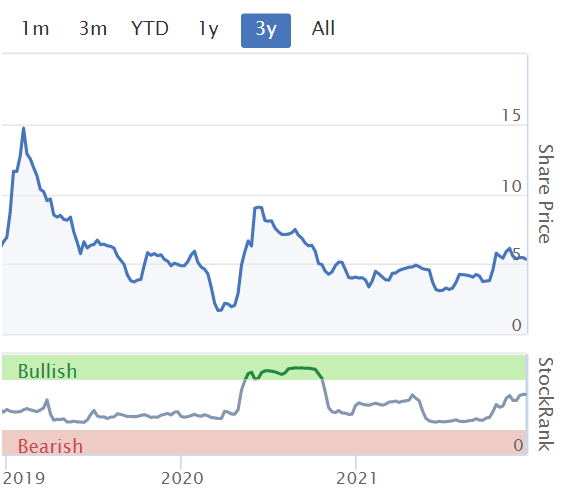
My opinion - this is a good example of an irrational sell-off, see chart below. It’s now cheap, and I think should see a decent recovery in share price. My position size here is only tiny, so I can’t justify disturbing the bunting from the cupboard where it’s been gathering dust in recent months. Note EMR shares are quite illiquid, so it might not be possible to buy in size.
What about sector read-across?
Gattaca (LON:GATC) saw a massive sell-off from its arguably irrationally high peak in June 2021, and now looks good value on a fwd PER of 7.7
Staffline (LON:STAF) doesn’t interest me at any price really, due to all the fundamental problems that surfaced in recent years
Robert Walters (LON:RWA) is a firm favourite here at the SCVR, performing well, but on a fwd PER of 15.9, not such an obvious bargain in valuation terms, although a better quality business than the smaller competition.
EDIT: Many thanks to subscriber BnB who flags in the comments below Sthree (LON:STEM) as another share in this sector that looks reasonably priced, and has fallen a lot recently. BnB sees STEM as a better quality business than EMR, which is probably correct. End of edit.
This could be a good time to nip in for some bargains in this sector - EMR is showing the ideal combination of -
- sharply falling share price,
- low valuation multiple,
- but an out-performing new trading update.
I really like that combination of factors, as the odds of making money are generally excellent, from that starting point.

.
Gulf Marine Services (LON:GMS) (I no longer hold)
5.6p (up 12% at 09:18) - mkt cap £57m
Just to clarify, I held GMS in my geared account, and got onto margin call recently, so decided to have a clear-out. I’m keen to buy back into GMS asap, and regret selling it now, because the bull case seems to be playing out as I previously explained here. The perils of gearing, eh! Just to be clear, I never ever recommend gearing, it’s often the road to ruin, if not handled with great care, so please avoid it to be on the safe side, so many people come unstuck with gearing - as I did in 2008, frequently explained here previously, so I won’t repeat that now.
Also, to clarify a recent misunderstanding here, I do not use stop losses on individual shares. For me, selling decisions always have to be carefully considered, and taken on the basis of facts & figures, not some arbitrary price level set previously. Again, that’s a personal choice, and everyone has their own way of doing things. Some people like stop losses, and if it works for you, then why not? “Keep doing more of whatever works” as my mentor told me years ago.
Bear in mind that GMS is a higher risk, special situation. Check out our archive here for my more detailed previous notes on it. Incidentally, I mentioned this share in my Nov 2021 interview with Paul Hill at Vox Markets. Someone on advfn referred to my GMS commentary as “a fact-free ramp!” which I thought was a bit harsh, and also inaccurate. The funny thing is, that (before covid) I often met this type of obnoxious keyboard warrior at investor shows, and found them to mostly be really pleasant and friendly in the flesh! Anyway, I can’t talk really, having had plenty of online meltdowns myself. Right, back to GMS -
GMS, a leading provider of advanced self-propelled, self-elevating support vessels serving the offshore oil, gas and renewables industries, is pleased to announce two new contracts both for E Class vessels.
The contracts are only 5, and 6 months, but (as is usual) have options to extend.
Daily revenues - No figures are provided, but the improvement in daily charge out rates is confirmed (this is key to the investment case, as higher daily rates feeds straight through to higher profits & cashflow) -
Our markets continue to improve with day rates on recent contract awards showing healthy increases from legacy contracts, which positions the company well for 2022 and beyond…
Fleet utilisation - another key metric, and this is a bit below what I had in the back of my mind (I thought utilisation was heading for 90-100%) -
GMS expects to end 2021 with vessel utilisation at 85%...
Guidance -
… confirm previous EBITDA guidance remains unchanged.
Outlook -
"GMS has had a solid year, delivering on expectations, including reporting a profit for the first time since 2016. Our markets continue to improve with day rates on recent contract awards showing healthy increases from legacy contracts, which positions the company well for 2022 and beyond. Given the strong pipeline of opportunities, combined with limited capacity in the market, we fully expect day rates and utilisation to improve further throughout next year."
My opinion - this announcement confirms that things are going to plan, which is reassuring. Although note that there’s no change to FY 12/2021 profit guidance, which is as I would expect, because contracts generate recurring daily revenues, rather than up-front revenues, so this late in the year new contracts would have little to no effect short term.
The forecast EBITDA is huge relative to the market cap, because GMS has excessive debt. That seems to be under control, and should reduce quite rapidly, now that fleet utilisation & daily rates are both improving. Therefore the upside could feed through entirely to equity, as debt becomes less of an issue. From a low market cap, that could be quite exciting.
Overall, I continue to believe this is an interesting special situation, and will be buying back in whenever I have available funds. On reflection, it might better suit my ungeared SIPP, where I could just park it for a year or two. Portfolio management has never been my strong point unfortunately, because my personality is too excitable. Hence mistakes occur rather often than I would like.
.
.
Disclaimer
This is not financial advice. Our content is intended to be used and must be used for information and education purposes only. Please read our disclaimer and terms and conditions to understand our obligations.

101 comments
Paul , great comments from you again - love the general market comments of late and I for one think (AND HOPE) that you are spot on about the good news from SA re Omi and believe that we could be seeing this here in a matter of weeks. Now looks a great time to buy !
Another contract win for £SBDT in its 4D product. Largest independent media & marketing agency in Australia with $300m of annual media billings has partnered with £SBDT as preferred partner. This coupled with the recent announcement they had won preferred partner for the 4D product with Equmedia €200m annual media billings in Europe and 150 clients all strikes me that the 4D product is actually gaining real traction and probably now worth paying closer attention to.
A cautionary note about £TON.
I bought these in April 2001 at 96p a share. I still have the Company Refs sheet from that month on which I made the investment decision. The then most recent results (to September 2000) showed £1.7m of operating profit on £14.6m turnover, an operating margin of 11.6%, in line with the five year average. Shareholders' funds of £10m included £3.83m of net cash. So operating profit as a percentage of operating capital employed was 27.6%, again in line with the five year average. Turnover increases over the preceding five years showed CAGR of 4.5%. The dividend yield was just over 7%, covered 1.72 times by earnings. So this appeared to be a well managed, conservatively financed business with some pricing power which could comfortably fund its steady (if unspectacular) growth alongside a generous dividend policy. Sadly, it disappointed again and again and I eventually gave up and sold at 49p a share in December 2013. So I missed the climb back to over 200p in 2018 but that has proved to be another false dawn with the share price now back around 100p again.
This morning's results show £1.1m of operating profit on £23.4m turnover. So sales have grown at 2.26% CAGR over 21 years but, over the same period, operating margin has fallen from 11.6% to 4.7% and operating profit on operating capital employed from 27.6% to 10.3%. The old Company Refs report indicates that in January 1997, the Titon share price was about 100p; as we approach January 2022, a quarter of a century later, it's there again.
The chairman, chief executive and largest shareholder in 2001 is still the largest shareholder and still on the board as vice chairman in 2021.
Is there a lesson in this? Or just a warning to those tempted by a perpetual value trap?
There are many such traps out there Titon Holdings (LON:TON) being just one example. I’ve held Titon Holdings (LON:TON) since buying 2 tranches in 2017 at an average of 145 pence and failing to sell at the 200 pence mark in 2018. I simply made a note: Wowee-Pow! Then there was a house-building recession in the South Korean part of the business which it doesn’t seem to have recovered from. A later note was entered: Just SELL at 200p. A quick calculation shows dividends returning 10.8% to date, that is 2.7% annually which is somewhat better than holding an underwater perpetual Value Trap with no dividends. However, things are looking brighter now, am looking to sell at 145p☹
Silver
Anyone out there familiar with Creightons Creightons (LON:CRL) ? I only just caught October's PI World 'Sell it to the City' video where Richard Crow (aka The Cokney Rebel) presented this company at 110p. Though not without risks of course, Creightons (LON:CRL) looks to have a lot going for it ..... Management with a good track record, low debt, exciting growth ahead in the beauty space etc. And with the recent share price fall, all this on a single digit PE! Needless to say, I've taken a plunge here ....
Hi Rajan
It is a very good company longer term personally. The shares are fairly tightly held and the senior management have been there a long time. A couple of things is obviously what happens when they go, and are they going to sell up or not so could create a large overhang at some point unless they can sell to the likes of a Mark Slater Fund.
The other note is 3 MD's or something like that, so quite a few managers in the pie there.
There has been a big acquisition done this year and new shares issued for it from memory at £0.90, with an additional bonus payable to the owners they bought from, that I remember if the share price hit, or was over £1.25. So there is an bedding in of that still going on.
I did hold for a long while but sold out about £1.10(ish) as I thought that it had gone up too fast, obviously it then went up a lot further. I am looking to buy back in (like several sells this autumn) but happy just to sit and let the market settle out first.
Tommy
ps. I do not hold Creightons (LON:CRL)
Tommy, thanks for your feedback. All very helpful. I’m really looking forward to seeing what management can deliver in the next couple of years.
I should have added that interims are out on 30th Dec.
Re £CRL there has been some nervousness about the delay to the interims that would normally have been released by now.
timarr thank you for your clarification on £TSL.
In response to Carvalio's question yesterday; "At what age should we stop believing in Santa's rally?", I'm over 50 and starting to believe again!
Not sure about a white Christmas however - my garden thinks it's Spring.
I still believe johnsmith68!
timarr thank you for your P.S. in your post today at 8.54 reference £TSL.
I am not a short term holder having built a position since June 2020 and on 21 November I was 128%.
I have decided to see what happens as my paper profit has been decimated in the last 48 hours.
Buy now pay later is growing at a huge pace but it is not without its problems. It does worry me that you say in your post `this looks like a Globo fiasco all over again`. Are you serious?
It does worry me that you say in your post `this looks like a Globo fiasco all over again`. Are you serious?
I was referencing ST's self-reported tendency to rely on management reports without cross checking other sources, not making a comment about Thinksmart (LON:TSL). As far as I can see the accounts look fine.
timarr
"My personality is too excitable"! Would that we all had your self-awareness, Paul. Have as great a Christmas as those clowns in no. 10 allow!
Robert Walters (LON:RWA)
Following on from Pauls points above, I hold RWA as a long term investment, for the following reasons:
1. Run by the founder, an 'owner-operator' business
2. Majority of earnings from abroad, so mostly insulated from UK economic issues
3. Strong foot print in Asia, which is where the global economic growth push is
4. I had some professional interactions with one of their offices in Asia, and was impressed by their professionalism, in a tough, commission industry
But, RWA hasn't sold off much in the last month, so can't say it's at a bargain price.
Paul - someone posted your ScS podcast on the LSE bb. I already held ScS for the reasons that you highlighted, but I liked your analysis, so here I am.
I like to assess the tangible surplus generated by a business, as often discussed in DT Questor comment. As you know, earnings can easily be manipulated and exaggerated, but the earnings that ultimately drop into the balance sheet are the genuine retained earnings and are often quite a bit lower than the declared earnings within the P&L.
The tangible surplus is the average annual net tangible equity growth that the business has generated over the past 4 years, added to the foward divididend yield. The sum of these two is then divided by the current MCap and is expressed as a % of the MCap. Adjustments are then made for share buy backs and share issuing over the same 4 year period. Typically, a tangible surplus of around 5% to 6% is a fair price, below 4% is clearly over priced, get above 7% and you may have found a bargain. This is an initial screen, a range of other factors need to be considered, obviously.
The tangible surplus is a good way of assessing the quality of a business and crucially, how much you are paying for that quality. When I assess Robert Walters' tangible surplus, I get a figure of c3.5% of Mcap. The tangible surplus being the average tangible equity growth and the dividend yield, is the best measure of what the business generates for its shareholders over the medium term and what you are paying for that return. On this basis Robert Walters looks over priced to me, the share price would need to be around half the current level before it was into bargain territory.
I find your emphasis on tangible surplus quite interesting because it is very different from my own approach to finding quality shares, which is an emphasis on ROOCE (return on operating capital employed), cash flow and EBIT margins . Yours is a strong focus on the value approach which is in contrast to my emphasis on growth and quality. We can both be right or wrong at times and it is my experience that the market's vacillations between the two factors of growth and value will have a bigger influence on returns, at least in the short term, than our mathematical endeavours.
Where your approach falls down in its rigid adherence to the quest for bargains, is that your methodology will steer you away from consistent quality overperformers with outstanding management, companies like Halma and Sprirax which have been amongst the best long term holds in the UK market. Similarly, in dismissing RWA as overpriced you miss out on one of the two highest quality listed names in its sector, which might prove a solid long-term investment over the next decade. I am fortunate to have an information advantage over most investors in this sector and I can reasonably claim to know RWA's strengths and weaknesses inside out. More to the point, I can hope to see further into their revenue prospects, which your backward-looking model doesn't facilitate. And my insight leads me to conclude that RWA is slightly undervalued with about 15-20% of upside by end '22 - in current market conditions.
Who is right? Well, as I stated above and in the short term, the wider market movements will have a bigger influence. Good luck in your endeavours and I hope we both do well.
BnB - I did reply to you in some detail, but my comment was withdrawn for further assessment and has not reappeared, which seems bizarre, looks like I may not go past the 2 week free trial here!
This issue has been reported before. You should report it to the support team, green button, bottom right on this screen. On long posts it is best to copy before posting then if lost you can just paste the copy. If Stockopedia are losing members because of this they may do something about it.
A pity. And sadly a known “feature” of the site. As RB says, we’ve learned to copy before we post anything of length!
If you find the time to re-compose your message I’ll be interested in continuing the discussion. And having experienced a 25%-30% drawdown in most of my US growth stocks this month, you won’t find me gloating at relative performance. “Expensive” quality has been kinder thankfully.
BnB - in summary, a business ultimately creates value for shareholders through growth in net tangible equity which is either paid out as a dividend or retained within the business - usually a bit of both.
All else is secondary. Earnings and cash flow are nice, but can only be treated as indicative, across the FTSE, probably a third of so called retained earnings never make it to the balance sheet and are therefore fictitious
My holdings grow their net tangible equity year after year. They are high quality growth businesses and by purchasing them when their net tangible surplus is c10% of their MCap, I buy that quality growth very cheaply.
This approach works well, my 12 year SIPP returns to last April were published by the DT under the pseudonym Bogdan Branislov.
Value growth pockets within the certian UK facing stock market sectors have become extremely under priced now, comparable to late 2009/early 2010.
I fear that approach would screen out every single company whose opportunity interests me. A pity - because I’d probably achieve higher returns by changing tack to a value-led approach. However a lifetime in tech, building nicely profitable and reliably growing enterprises, has me convinced in the inexorable march of digitisation, automation and electrification. It’s also the area that I best understand.
Is it even possible to participate in those trends using your methodology? Which tech winners would ever have triggered a buy signal - not an unreasonable question bearing in mind that some are actually reasonably priced today relative to the S&P average for their growth rate, eg Meta/FB, Alphabet?
BnB - tech is generally expensive again at the moment, so yes you probably would find nothing that is tech/new economy/or just popular that would currently generate a tangible surplus relative to MCap that is attractive.
There certainly have been tangible surplus qualifying tech opportunities in the past, from around 2009 to 2011, Apple was very attractively priced. It was the share buy backs once factored in that made Apple compelling back then. I did not buy Apple back then for the simple reason that I did not look closely at share buy backs and share issuing. My approach was more naive back then. Having said that 12 year SIPP returns to April 2021 were verified by the DT as 17x, i.e. 1,600% over 12 years.
Of my 4 compounding double periods, by far the longest has been the last one, it has taken me from c2106 to double my holdings. This is the period when my investment skills have been much better than the prior periods, but alas, UK facing everyday stocks have had a tough 5 to 6 years. The upshot of that is that the undervaluation of my holdings is now quite extreme, likewise the overvaluation of most tech/new economy/or just popular stocks is equally extreme.
Tech opportunities will come back and I will be open to some of them when they do, thise that offer me long term tangible equity growth at a cheap price, but right now, these sectors are the wrong place to be.
Fundsmith and SMT have had a much stronger last 5 years than me, but both are comfortably behind me over 12 years - for Fundsmith they began just over 10 years ago but are about half my SIPP returns for the same period. But, although they are ahead of me over the past 5 years, their average tangible surplus relative to MCap is typically between 1% and 2%, whereas my holdings have a tangible surolus of around 10%. That is a dramatic difference and my holdings are not static, they are growing their tangible equity rapidly, my favoured house builder has tripled its tangible equity in just 9 years, if that is not growth then I don't know what is.
BnB - I did reply comprehensively to your above post, but it was pulled again, fortunately I did copy it this time and I have forwarded the post to Ben at Stockopedia to ask why this is happening. Your question above was a very relevant one and I gave a lot of thought to the reply, this is so annoying!
BnB - I will try again in 3 parts:
BnB - tech is generally expensive again at the moment, so yes you probably would find nothing that is tech/new economy/or just popular that would currently generate a tangible surplus relative to MCap that is attractive.
There certainly have been tangible surplus qualifying tech opportunities in the past, from around 2009 to 2011, Apple was very attractively priced. It was the share buy backs once factored in that made Apple compelling back then. I did not buy Apple back then for the simple reason that I did not look closely at share buy backs and share issuing. My approach was more naive in those days. Having said that 12 year SIPP returns to April 2021 were verified by the DT as 17x, i.e. 1,600% over 12 years.
Of my 4 compounding double periods, by far the longest has been the last one, it has taken me from c2016 to double my holdings. This is the period when my investment skills have been much better than the prior periods, but alas, UK facing everyday stocks have had a tough 5 to 6 years. The upshot of that is that the under valuation of my holdings is now quite extreme, likewise the over valuation of most tech/new economy/or just popular stocks is equally extreme.
Tech opportunities will come back and I will be open to some of them when they do, those that offer me long term tangible equity growth at a cheap price, but right now, these sectors are the wrong place to be.
Fundsmith and SMT have had a much stronger last 5 years than me, but both are comfortably behind me over 12 years - for Fundsmith they began just over 10 years ago but are about half my SIPP returns for the same period. But, although both of thes funds are ahead of me over the past 5 years, their average tangible surplus relative to MCap is typically between 1% and 2% - hideously over priced, whereas my holdings have a tangible surolus of around 10% - chronically under priced.
That is a dramatic difference and my holdings are not static, they are growing their tangible equity rapidly, my favoured house builder has tripled its tangible equity in just 9 years, if that is not growth then I don't know what is.
Of my 4 SIPP compounding double periods, by far the longest has been the last one, it has taken me from c2016 to double my holdings for the fourth time. This is the period when my investment skills have been much better than the prior periods, but alas, UK facing everyday stocks have had a tough 5 to 6 years. The upshot of that is that the undervaluation of my holdings is now quite extreme, likewise the overvaluation of most tech/new economy/or just popular stocks is equally extreme.
Tech opportunities will come back and I will be open to some of them when they do, those that offer me long term tangible equity growth at a cheap price, but right now, these sectors are the wrong place to be.
Fundsmith and SMT have had a much higher returns than me over the last 5 years, but both are comfortably behind me over 12 years - for Fundsmith they began just over 10 years ago but are about half my SIPP returns for the same period. But, although these funds are well ahead of me over the past 5 years, their average tangible surplus relative to MCap is typically between 1% and 2% - i.e. hideously over priced, whereas my holdings have a tangible surplus of around 10% - i.e. chronically under priced.
That is a dramatic difference and my holdings are cetainly not static none growth businesses either, they are growing their tangible equity rapidly.
My favoured house builder has tripled its tangible equity in just 9 years, in addition to paying substantial dividends, my other holdings offer much the same, if that is not value growth then I don't know what is.
Housebuilders are very cyclical, I remember back in 2009, most were nearly bankrupt, shares were extremely low, so buying them then, would have brought huge returns in the next 5 years but the last 5 years you have been outperformed by Fundsmith, which has a fairly average performance, judging by funds performance tables. Most of Fundsmith is invested in US stocks, so not really comparable to the UK market. If there is a recession you don't want to be holding housebuilders shares.
Rustbucket - Bellway, Berkely and Redrow were not in trouble in 2009. A genuine recession would cause me to re-evaluate all my holdings, but we are not in a recessiona and PMI data will give a clear early warning of an approaching recession.
The longer the post, the more likely for it to disappear. Very rare for that to happen with something of this length, for example.
I’ll respond further a little later. And do t be put off by the glitch. This is a good community.
I agree the discussion is sensible and thinking.
Yes, thanks for that advice.
It’s good that you have a methodology that’s working so well for you. But we all have different motivations for investing. For most people it is to achieve positive returns after inflation. For many here it will be achieve the highest risk-adjusted returns, often with specific reference to a relevant benchmark. I picture you in this category, I hope accurately. For me, after a lifetime of business-building, with all the risks and rewards that entails, I simply want to enjoy this phase of life as owner of the very highest quality enterprises on the planet in established sectors with secular growth - the Fundsmith approach - or category definers in disruptive or burgeoning sectors that potentially define the future - the SMIT model.
This does not preclude finding undervalued names. A good example and a great investment has been Schneider Electric. But Microsoft and its peers haven’t been cheap in 10 years and if I had waited for an outstanding value entry I’d have missed out on the 200% return that has been the reward for holding for under 3 years.
I suspect that you care about returns more than I do. And I care more about what the future looks like and how I can own a part of it. As it is easier to be wrong about the future than to model past performance, and certainly riskier to pay the price for duration assets, you’ll probably outperform me. And that will validate your approach. Where I would take issue is in the description of, let’s say, Microsoft as expensive, just because it fails your particular test. Often, these category winners look very good value in retrospect. Now, if I could just avoid the losers ;-)
BnB - take for example ScS, which Stockopedia seems keen on, so am I, in fact it was a Stockp... vlog on the LSE bb under ScS which drew me here.
Sofas and carpets, not really a growth sector and generally over supplied, often big premises - hence hideous business rates, lots of smaller local non-listed discount suppliers. Tough to make a good profit in this sector, not really on anyone's radar. But ScS, caught ouy initially by Covid, decided to invest heavily in their website and online offering, refused to issue shares to do so.
In YE July 2021, they came storming back, generating tangible equity worth c30% of their current MCap, and they bought back some shares as well. This year will be quieter due to last year's post covid bounce and some supply chain constraints, but even if this years equity growth is around 2/3 of last year, the balance sheet impact over the 2 year period is quite mind blowing.
Very much a Peter Lynch scenario, find a business in an unexciting sector, asector that has often struggled to produce decent profits and so is 'off the radar'. But find the business that is greatly out performing within the sector, producing remarakble results.
Because the market is not watching, you have time to take a postion and benefit, this is rarely possible in popular sectors. This is not a bet on what ScS might do down the track, this is betting on the horse after it has already passed the winning post!
“this is betting on the horse after it has already passed the winning post!”
Terrific analogy.
But SCS shares are flat over 3 years. EBIT is forecast to fall 10% over the next two years and earnings to collapse so badly that PER will go from 8x today to 20x in ‘23. EV/EBITDA stays as flat as the revenues. You are seeing something that I do not - and I say that as self-criticism, not to undermine your case.
I have a lot of admiration for those who can see the potential in such situations. The ROOCE is first class. On the other hand the growth rate and operating margins don’t pass my tests for a business with enduring competitive advantages. Once the investing profit has been made, you’re off looking for the next win. That’s not my concept of business ownership, even if it makes you the more successful investor.
There’s a sense in which I am being self-defeatingly “purist” in my approach and you would be justified in levying that charge. But when an expensive purchase kicks on for decades with no further effort required, then it feels pretty good.
Enjoyable discussion.
BnB - important to view ScS in terms of what happened in the year to July 20 - hit by Covid and major investments in the online offering.
The subsequent equity build up last year was huge. The fact that earnings this year and next will be lower is not important. ScS is still expected to generate tangible equity growth this year which is c20% of its MCap and the same again next year. Surely the penny must drop for you now, this is astounding value accumulation relative to what you are being armed to pay! This is the overriding metric as it is what is generated for shareholders relative to their outlay.
I see the value and the likelihood of a good return but it does not necessarily make me want to buy the company. That will seem obtuse but we have different objectives. You have an accountant’s/analyst’s eye for value and risk management, I have an entrepreneur’s eye for markets and growth. I’ve built a portfolio of, to me, the world’s most interesting companies, many of which are never cheap. There’s a continuous process of refinement as selections disappoint or new possibilities arise, but my hope is for the annual churn to decline progressively. If I succeed in this endeavour, then I won’t have to worry about individual management, or the economic cycle*, or black swans - I just let progress do its thing.
No doubt you will outperform in investment terms because the “penny” will likely never drop for me! But that doesn’t stop me wanting to learn and I appreciate your observations.
* apart from a wary eye on inflation and its affect on duration assets
Scs (LON:SCS) (no position)
Hi Doug
I've written enough about Scs (LON:SCS) so don't want to delve further, though I thought it might be worth sharing this very old (2008) article on the company:
https://www.theguardian.com/bu...
All the best
A
abtan - clearly ScS was in a very different position in 2008. Today ScS is sitting on a sizeable and rapidly growing cash pile. The current strength and growing asset base of ScS reminds me of the position and extreme under vauluation of Dart Group (now Jet2) at the end of 2012. I did more than double my money on Dart Group, but I made the mistake of selling much too soon. Jet2 today does not offer anthing like the value growth on offer in 2013
But, although these funds are well ahead of me over the past 5 years, their average tangible surplus relative to MCap is typically between 1% and 2% - i.e. hideously over priced, whereas my holdings have a tangible surplus of around 10% - i.e. chronically under priced.
Excuse me for asking - but what is "tangible surplus"? I don't think I've ever heard that term before.
Apologies if you've explained it elsewhere.
timarr
The tangible surplus is the average annual net growth in tangible equity over the past 4 years, added to the forward dividend yield. This sum is then expressed as a % of the current market cap.
Long term tangible equity growth and the yield are the real wealth generated by a business for its shareholders. Expressing the sum of these two as a % of the current MCap is the most reliable metric for predicting forward medium to long share price growth as it highlights shareholder wealth generation and crucially, how much you are paying for that wealth generation.
Hi Doug, I follow the Questor comments too and have been looking at getting a filter set up for tangible surplus.
I wondered if you have managed to do so and whether it highligts the Questor favourites of Bellway (LON:BWY) Legal & General (LON:LGEN) etc,
Many thanks
only in part I think. i.e. you can screen for net asset growth, not net tangible asset growth and for a certain level of dividend. I don’t think that you can combine them as such either. Also you can’t factor in share issuing as far as I can see, share issuing and occasionally buy backs being the ‘great overlooked’ factors in stock analysis.
But you can say look for a several year net asset growth rate of over, say 5%, and a dividend of say 3% or greater. This will throw up a sizeable list for further assessment. The majority of those picked out by such a screen will either just be piling up the intangibles rather than the tangibles or will be serial share issuers, but such a screen can still give a useful starting point.
Ah Bogdan, I wondered whether it may be you, I was hoping to impress you with companies which may have fitted your criteria by developing such a filter. Nevertheless, I have sensed checked your companies on here and I think it is possible to see a clear trend. I hope you stay as I find the resource most valuable and your commentary would be a great addition.
I am Maria BTW!
FAFDM - the above screen does cover most of my current holdings, inc LGEN and BWY, as well as many others that I don't regard as investable, many dozens of others in fact, but that is okay. I only ever view screens as a starting point, to highlight possible candidates. If such a screen were to highlight just one or two possible candidates each year that I might otherwise of overlooked, then that is of great benefit.
I live in South Africa , and agree Paul with your opinion on Omicron. In fact, my own daughter in law caught the virus last week , and likened the effects to a cold. And not a bad one at that, as she recovered in a couple of days . Research here indicates that in the vast majority of cases Omicron does not attack the lungs and hence hospitalisation cases are significantly lower than in the past, and much lower than anticipated.
Obviously,here we are now in summer and masks are mandatory in public places, something that I think would be wise in the UK, especially in your winter.
Interesting comments on Omicron Paul. I have to concur - but then again I've been accused by many of being overly optimistic before! IMO it is well worth watching Dr John Campbell's podcasts on Youtube where he looks at the latest Covid data from around the world. A great summary and a excellent way of communicating. In a snap shot he's now saying that new infections are not being reflected in hospitalisations (yet) and the evidence points to them not being.
In a snap shot he's now saying that new infections are not being reflected in hospitalisations (yet) and the evidence points to them not being.
Anecdotally - my mother was admitted into hospital on Friday for a non-Covid related issue. It took 8 hours for the ambulance to arrive. To accomodate her they had to put her in a bed in the basement and they then built a ward around her.
Omicron doesn't have to be particularly bad to push the NHS over the edge, it's already stretched to breaking point. The latest UK report showed over 6,000 people being admitted to hospital with CV-19 in the previous week, although the majority of those are unvaccinated.
As ever there's too little data to draw any firm conclusions yet. But whatever you do, try to avoid needing to go to hospital over the holiday period.
timarr
The NHS is always overstretched in winter. Apparently 1/3 of NHS staff is off sick due to testing positive, so obviously that does not help either.
In a snap shot he's now saying that new infections are not being reflected in hospitalisations (yet) and the evidence points to them not being.
The "(yet)" in there is the key. It's still too early to be sure, hospitalisation generally lags infection by 2-3 weeks (with earlier variants). Add to which reports that in the week to the 17th Covid hospitalisations in London (the current centre of UK Omicron infections) were up 33% of the week before, and I'd think that saying the "evidence points to them not being" is definitely on the optimistic side. It may turn out that way, but it's really too early to know, and given how much more infectious Omicron is it would have to be causing much less serious symptoms for there to be no impact on hospitalisations.
There was a good Freakanomics a few weeks ago which appeared to confirm the (US) media has an inherent negative bias in reporting on Covid, though I can't remember the detailed stats they cited (these episodes can normally be listened at 2x speed) https://freakonomics.com/podca...
I would be a bit careful about using gearing in this environment. Omicron may be getting all headlines now, but I think the key driver next year will be how markets react to the withdrawal of monetary stimulus, and what happens to inflation. Remember that the main equity indices (S&P 500, NASDAQ and even the FTSE) have been remarkably stable this year, but if we do see a decent fall in those (which let's face it is well overdue) then this could reverberate out to small caps in a big way. Personally keeping a large amount in relatively steady things such as Supermarket Income Reit (LON:SUPR) or Caledonia Investments (LON:CLDN) until things a bit clearer.
I should have clarified, that gearing is dangerous, and I never, ever suggest that anyone else uses it. Remember my disastrous wipeout in 2008, which was a combination of using gearing in a collapsing market, and illiquid positions which were impossible to exit. That's the lethal combination: gearing + illiquidity. And remember that things which seem liquid now, can become highly illiquid in a bear market. Often there are no buyers at all in small caps, and market makers just try to prop up the price with small bid quotes, but you can't actually sell in any size if you try. Or every time you sell a tiny scrap, they market the price down 10%, making your margin call worse.
So just to be clear, if you're thinking of using gearing, don't! It often ends in disaster.
Regards, Paul.
Hi Paul I remember you saying you turned something like £150k into 4-5 million then went negative 2 million or such like, you have long warned on the dangers of gearing.
Personally what I think what would be a great xmas break read on here if we end up with a mini lockdown post Dec 26th is how you came back from this low and what was the share pick/s winner/s that made you realise the old Scott magic was back.
I've personally known a few very successful people who blew themselves up but fought their way back and I guess theres a message in your story and theirs in that no matter how dark the hour so long as you never give up and will fight you will find the way back into the sun.
I realise this is personal stuff but people love hearing Mavericks who break the rules tales but if you prefer not to share just tell me to b-gger off as I would imagine it probably took a few years from the scars to get the self belief back.
I for one did enjoy your rambles a few years back at xmas about how as a young scamp you started flipping books between charity shops and the market trading book stalls.
Thanks for all the pearls this year from yourself, Jack and Roland and lets hope Omicron does turn out to displace Delta and be far weaker and the markets roar for 2022.
Regards
Andy
timarr I am grateful for your posts this morning on Thinksmart (LON:TSL) which I hold.Unlike you I did not have the wisdom to sell into the spike created by the Simon Thompson article in November which I now regret.
I first bought in at 20 p but yesterday’s RNS has seen my substantial profit slashed and now I feel my best choice is to take the Shares in Block in the New Year.
I would welcome your views.
Hi portugull
RE: Thinksmart (LON:TSL)
I've had a chance to look at the Thinksmart (LON:TSL) position now, following a further nasty fall today. Please check my numbers, I'm notoriously inaccurate.
At the time of writing Thinksmart's market cap is £67.7 million. That includes £6.5m in cash and other assets.
The Clearpay stake will turn into 1.65m Afterpay shares worth about £73.8 million.
The Afterpay shares will turn into 618,750 Block shares worth about £81.4 million.
So if you think that the deal for Clearpay and the deal for Afterpay will go through then you're effectively getting the shares in Block (aka Square) at a 33% discount plus the other assets in TSL.
So, buying Thinksmart at this level is a no brainer if a) you think both deals will go through and b) you want to own shares in Block, currently trading (according to Stocko) at a forward PE of 86.1 and a P/FCF of 154.
The payments industry is my main gig. Personally I find Block's valuation hard to (ahem) square with what it actually does. But clearly neither the market or the TSL board agrees with me.
timarr
re Empresaria (LON:EMR) - a very poor quality operator of a rag-tag assemblage of price-taking synergy-bereft minnows, which is now nearer its recent highs than well focused, superior operator Sthree (LON:STEM), which has far better historical performance and vastly better long term prospects. Just buy quality in this segment, ie also £RWA.
Morning BnB,
Thanks for flagging Sthree (LON:STEM) - I hadn't spotted that one, which has sold off a lot recently, and still looks reasonably priced. I'll add that to the list in the main article as worthy of a closer look.
EMR - I agree it's a ragbag, but it's making good profits and paying divis again, which is all that matters to me. The very low PER reflects the perceived lower quality of its business.
Regards, Paul.
Thanks Paul, in my opinion SThree has a good runway within its tech and life sciences specialisms as the hiring momentum that follows major investments can last for as much as a decade. Unlike competitors, it is barely cyclical (pandemics aside) if at all.
The sell-off is on two concerns. Firstly the resignation of the CEO, who was popular with investors, for personal reasons. I got the impression that he was operating out of New York with a head office and back office operations in the UK. This may have put a strain on his family life, although I’m guessing. The second concern is margins, driven by cost-catch-ups which had been widely flagged in earlier TUs. Radnor has a good note on these concerns on ResearchTree. What the market has ignored, largely because it doesn’t understand the dynamics, is the momentum of contractor numbers. For a contract-dominated player, the most important metric is the number of, or growth in, contractor placements because that drives the forward order book - a bit like RPO for a SAAS software company. It provides management with a strong vision of future revenues ensuring that costs and therefore margins can be managed to deliver the right level of profitability. In this respect SThree is performing exceptionally well and you only have to look at the recent earnings from Accenture, with whom SThree competes to meet the same needs - but with a different product - to understand the booming demand for its services. I already have a large position but I would buy here and now if interested in the sector.
Prime People (LON:PRP) last week announced a partial tender and delisting in a not very minority friendly take-private deal. But I would also read this as a positive read-across for the sector (Prime People focuses on property sector recruitment as well as tech and infrastructure recruitment) as the company (which gains around half its revenue from the UK-based Macdonald business) is using all its spare cash for the tender offer and the 2 main principles (who will not tender into the offer) have decided it is a good time to increase their percentage holding. Too illiquid really to trade and will delist anyway now in January.
Prime People (LON:PRP) - i agree that the 84p take out price is not at all generous. disc I hold.
Impellam (LON:IPEL) - i think offers better risk/reward in the sector. it is a proven CASH generator from my analysis. disc i hold.
Anyone else having problems with Hargreaves Lansdown website this morning?
yep, it's not letting me login Looks like HL have system issues
Me too, and investegate is misbehaving too. More investment in tech required, methinks.
Yes ,
they are as good as your username !!!!
Richard
Yes my HL account stopped me logging in
can log in but error message at trading screen... "A technical error has occurred while attempting to process your trade."
Yes, i can now log in but cannot place any trades. I have spoken to them and they have absolutely no idea when it will be fixed.
Richard
May I ask Paul please... What site do you use to review the futures market for the indication of direction of the LSE the following day? Cheers bud, sorry its a basic question, still creating/refining my trade routine here.
Morning Lee,
I use IG - you don't have to have an account, the futures for main Indices (UK & US) come up on the IG home page.
Regards, Paul.
You could also try here
https://markets.businessinsider.com/stocks
Another option is Daily Fx, it has currencies, commodities and indices on it rates page
I would raise some money for the same purpose, but I only invest in stocks, many of which are beaten up already! I could sell my remaining resilient names but the tax bill would reduce the capital pile by a significant percentage to negate a good portion of the potential gains. Gearing, which Paul alludes to, is the answer, but I have a big aversion to it. So here’s a different perspective.
Instead, I prefer to think of investing as the process of business ownership, rather than of pursuing gains. As a lifelong entrepreneur, this sits more comfortably with me than it will with the average retail investor. As owners, we should ignore the price others place on the companies we own for as long as we are happy with their operational performance. And hopefully this will be for long periods. The fall in the likes of quality businesses Luceco and Somero run entirely counter to their reported performance. Yes, these are good prospects for new money, but the falls should not trouble the long term holder.
So I would be seeking bargains if I had the ready cash. But, lacking it, I’m focused on solid operational performance in my holdings (Boohoo, I’m looking at you) and trying to ignore the short term fluctuations in the price.
Instem: (LON;INS)
Positive update today from this high quality company in the Life Science / Software sector detailing SaaS contract wins in China from 4 clients, both new and existing.
No trading update or numbers given but positive nonetheless.
I have been invested here for a couple of years now. Management have always been excellent and give a lot of confidence.
Phil Reason, CEO of Instem plc, said: " We are very pleased to achieve these contracts, demonstrating the strength of our long-standing client relationships, the continuing transition to SaaS, as well as momentum in securing new business. The two existing customers have been clients for over seven years, illustrating the long-term nature of our relationships and how Instem supports its clients' growth.
"As reflected in our interim statement, Instem continues to capitalise on its market-leading position in China with these orders, highlighting the health of the early-phase R&D pipeline in this substantial market."
Investegate |Instem plc Announcements | Instem plc: H2 China Market Update
Morning Michael,
Thanks for your note on Instem (LON:INS)
It looks quite interesting, although on quite a punchy forward PER. That said, if it can achieve forecast increases in EPS, then you could have quite an interesting share on your hands.
I particularly like the trend of the graphs below. There seems to have been a step change in growth - a large jump like that in graph 1 is often due to acquisitions. Do you know if it has made acquisitions, or is this organic growth please?
.
Thanks for flagging it, and I encourage more members here to do the same. We want to share ideas in the community, not just from me & Jack. So well-written, balanced posts about companies you like that are reporting that day, are very welcome.
Regards, Paul.
Re Instem (LON:INS) - they recently took out a key competitor so M&A is definitely part of the mix. However organic growth has been constant and meaningful. I bought earlier this year seeing the attractive confluence of tech and life sciences and a valuation that, for a software company, was and remains far below the norm for UK mid cap software, eg £KNOS.
Instem (LON:INS)
Growth is organic and inorganic. Yes strategy is acquisitive and has demonstrated an excellent tract record with acquisitions.
In June 2020: "The Company today announces a proposed issue of new Ordinary Shares at a placing price of 435 pence per New Share, to raise proceeds receivable by the Company of approximately £15.75 million (£15.0 million net of expenses). A Placing Price of 435 pence represents a discount of 4.4 per cent. to the closing mid-market price of an Ordinary Share of 455 pence on 25 June 2020."
Usually after a placing I notice the SP falls below the placing price but not in this case.
"Strategy
The Board's strategy is to pursue expansion through both organic growth and targeted acquisitions, capitalising on current strong market dynamics. With a scalable platform in place, the Board believes there are three distinct and deliverable opportunities to drive further growth:
- Organic revenue growth from further market penetration, cross-selling and new products and services;
- Margin improvement through conversion to SaaS deployment and extensively leveraging global infrastructure; and
- Accretive M&A in existing markets as well as entry into adjacent markets, including strategic partnerships as a potential stepping stone."
Since then Instem has executed its strategy deploying the funds raised, making a number of acquisitions and is growing well. Instem knows its competitors well and buys market leading companies so they are always high quality. Instem also has an excellent set of clients including a large number of the biggest pharma. I could continue but I am biased. I really like the CEO Phil Reason, Instem have at least matched expectations since I have been a shareholder and the future looks exciting. It is the combination of 2 high growth sectors of Life Sciences and SaaS = double high growth, so IMO a high multiple is justified. There are regular presentations on Investor Meet Company and notes on Progressive.
Share price was 455p in June 2020, today 835p which is a nice rise but nothing crazy.
It is one of my 5 largest positions. I notice institutions seem to like it. When the market falls, this one doesn't move much.
Hope this is helpful to Paul and others but DYOR
Merry Christmas!
Good morning Paul, I'm just back from the dog walk where I have bene mulling exactly the same strategy as the one you outline here.
I follow @andrew_lilico and @jamesward73 on Twitter amongst others who provide very good analysis of the Omnicron variant statistics which suggest you may be correct. That doesn't mean to say we won't have more bumps in the road over the next few weeks but I for one share your optimisim for share prices in the next few months.
I dipped my toe in yesterday buying Sdi (LON:SDI) and Sanderson Design (LON:SDG) and intend to buy more; Checkit (LON:CKT) also looks like a screaming buy with the SP covered entirely by net cash; commodities like Rio Tinto (LON:RIO) may also be worth a look as well as £BP or £RDSB.. Old favourites like Saga (LON:SAGA) and Boohoo (LON:BOO) should be worthing adding at thse prices. Finally banks and insurers, in particular Barclays (LON:BARC) looks good value
What are you looking at?
cheers
Francis
I don't think the update from Thinksmart (LON:TSL) was mentioned yesterday.
To recap, Thinsksmart's main asset is a small stake in Clearpay, the BNPL provider. The remainder is owned by Afterpay, the Aussie BNPL leader. Afterpay is being bought by Square which has triggered a options clause to sell TSL's oustanding shares to Afterpay.
This was ace Investors' Chronicle tipster Simon Thompson's take on the deal, from November 10th:
Effectively, ThinkSmart’s sum-of-the-parts valuation is 151p a share with the valuation risk weighted to the upside. More importantly, Afterpay’s imminent change of control could lead to a major liquidity event to turn ThinkSmart’s valuable holding in Clearpay into cash.
https://www.investorschronicle.co.uk/ideas/2021/11/10/heading-for-a-profitable-exit/
So it's a bit odd that the TSL share price fell 22% to 62p yesterday.
The reason for this is that the deal negotiated with Afterpay isn't in cash - it's in Afterpay shares - and leaves the sum of the parts valuation at about 80p per share.
That the value of the Clearpay stake would be considerably less than Thompson's tip was well signalled by the fact that Afterpay had the stake on their books at under 50p a share. I think the board have done a decent job of getting significantly more than this.
As for Thompson ... well, judge for yourselves.
timarr
ST started covering Thinksmart as a strong buy at 15p!!!
ST started covering Thinksmart as a strong buy at 15p!!!
I'm aware of that. But on the other hand, suggesting a 151p valuation a month ago "weighted to the upside" when an idiot could look at the Afterpay accounts and conclude that TSL's own valuation was optimistic, let alone Thompson's inflated one, suggests, at the very least, a lack of attention to detail.
Frankly an idiot could see that his valuation was stupid. I should know because I was that idiot, and sold into the spike he instigated. People lost money because of this - although, frankly, if you're going to follow a tip in a paper without doing your own research you can't blame anyone but yourself.
timarr
Still he started covering it at 15p!!!!
Plus around 15p in dividends received!!!!
Have a good day
I think it's a bit harsh to slag off the person who came up with a stock idea, because everyone gets plenty of things wrong - we can't predict the future with any certainty, so inevitably some stock ideas work, and some don't.
I met Simon Thompson at an investor dinner, and he's a lovely chap - quite shy, but I soon coaxed him out of his shell!
Overall I think he comes up with lots of interesting ideas for us to DOOR on. It's a pity that people try to trade his tips for short term profits, but there's nothing that can be done about that.
Regards, Paul.
I think it's a bit harsh to slag off the person who came up with a stock idea, because everyone gets plenty of things wrong - we can't predict the future with any certainty, so inevitably some stock ideas work, and some don't.
I'd point out again the fact that figuring out his valuation was nonsense wasn't difficult. All you needed to do was read the Afterpay accounts. This wasn't about certainty or otherwise, it was simply about doing the legwork.
timarr
timarr - Yes I know, you made that point earlier.
The book valuation in the Afterpay accounts were certainly an indicator but by no means could you pin your valuation on this, just as you couldn’t pin your valuation on the book value in the Thinksmart (LON:TSL) accounts.
The devil was always going to be in the detail - the wording of the “valuation principles” in the agreement - which no-one in the outside world could see.
Totally agree Paul & seems like some investors can slag off people when things dont go to plan but its their own idea when it shoots the lights out. Also in Simon Thompson’s defence the Afterpay share price has dropped over 30% since he gave his SOTP of 151p. So that took it below 100p per share pre yesterday (when it was c85p - he also pointed out he expected it to trade at a discount pre deal). Investors should have tracked that & acted. It’s also not his fault the Directors have then done something different & opted to swap for paper when they could have waited 15 months max for the cash.
RE: Thinksmart (LON:TSL)
Totally agree Paul & seems like some investors can slag off people when things dont go to plan but its their own idea when it shoots the lights out.
I never do that, most investing decisions come trailing uncertainty. In this case it was sufficiently obvious at the time that I pointed it out on the SCVR:
Afterpay was the only possible buyer of the Clearpay stake. This looks like the Globo fiasco all over again - while Paul was pointing out it was a fraud, Thompson was still tipping it on the basis of statements from management.
Enough from me on this.
timarr
P.S. portugull - I haven't had time to look at the potential value here. The Square deal for Afterpay is share based, so presumably the TSL stake will convert into Square shares at some point. As it stands TSL looks like it's trading below the sum of its parts, presumably because of a hoard of disappointed short term holders jumping overboard. So there may be an opportunity to acquire Square shares "on the cheap". But as Block Inc is trading at a forward PE of 90 you have to take a view on the future growth.
Gulf Marine Services (LON:GMS) 2 new contracts. Can anyone guess the value of these?
Great to see some positivity!! Thanks for all your detailed and extensive commentary which I read with interest (nearly) every morning.
I have no scientific or medical background but continue to be hopeful that Omicron from a financial /business perspective could medium term be a positive thing. As you state the high level of infections could create herd immunity pretty quick. The continued small amounts of evidence that it seems a lot less deadly also points to COVID becoming more of a season virus, but one that does kill people just like the flu does each year.
I am keeping my fingers and toes and everything else crossed that this comes to pass and we can all get back to "normal" with our lives.
Thanks for your opinion. Can you say which you are looking to buy with your war chest?
in Paul we trust!
in Paul we trust!
You can certainly trust me for always giving my honest opinion on everything at that point in time. However, definitely do not trust me to be right about everything, as we're all frequently wrong about what is essentially trying to predict the future. Hence why making your own buy/sell decisions is so vital, and ignore me if you think I'm talking rubbish!
Best wishes, Paul.