Small Cap Value Report (Tue 25 Aug 2020) - UPGS, DFS, ALFA, NFC. PHD, CAR

Good morning, it's Paul here, with the SCVR for Tuesday.
Timings - I have to be finished before 1pm, as am taking my niece to visit a stately home this afternoon!
Today's report is now finished.
Here is today's agenda;
Dfs Furniture (LON:DFS) - trading update
Alfa Financial Software Holdings (LON:ALFA) - trading update
Proactis Holdings (LON:PHD) - trading update
Carclo (LON:CAR) - results FY 03/2020
Next Fifteen Communications (LON:NFC) - Trading statement
As usual, many thanks to MrContrarian & Dan Holland-Smith, for their early snapshots in the comments below. I am finding these posts very helpful in selecting which small cap shares to focus on myself in more depth. Thanks to both!
.
Clarification re Up Global Sourcing Holdings (LON:UPGS)
An adviser to UPGS contacted me yesterday afternoon, to say that the company was very upset about yesterday's SCVR. I reported on UPGS's RNS stating that they have decided to return the Govt furlough monies. In the same section, I reported on another item on my agenda, an article in the Telegraph about research saying that furloughed staff had widely been working from home, part time, in the UK generally, during April & May.
On reflection, I shouldn't have put these two items together, in the same section, as that led UPGS to misunderstand, and think I was linking the issues, or implying wrongdoing on their part. That certainly wasn't my intention, at the time it just seemed to make sense to put the one subject in a single section. I thought my use of the word "Separately...." made it clear that I wasn't linking UPGS to the Telegraph article.
On reflection, this was a mistake on my part, and I can understand their point of view, so am happy to give an unreserved apology for any offence caused. If I'm wrong, am happy to admit it, and apologise, so this has not been forced out of me, it's a genuine apology from me, as I can see why UPGS took offence, even though it was unintentional on my part. As stated in yesterday's article, UPGS has traded strongly, and I have been very impressed with its resilience & financial performance throughout covid.
UPGS is adamant that it's returning the furlough monies because this is the right thing to do, and out of a sense of civic responsibility, so I am happy to pass that message on to readers here. I'll go back and edit yesterday's article when I get a minute.
(I think they've forgiven me, just got email thanking me for the clarification, so peace is restored )
.
Dfs Furniture (LON:DFS)
Share price: 173p (up 15% today, at 08:46)
No. shares: 255.4m
Market cap: £441.8m
DFS Furniture plc ("DFS" or "the Group"), the UK's leading retailer of living room furniture, provides the following update on recent trading since our previous statement on 14 July 2020.
Strong trading continuing both online, and in showrooms.
The following section is rather confusingly worded, surely they could have simplified the numbers, by putting them in a table? I've bolded the bit that matters;
... year-on-year order intake growth over the last six weeks that is equivalent to c. £70m of revenues.
This trading is significantly ahead of our initial expectations and is in addition to our previously announced strong opening order book that will generate a further in year revenue benefit of c.£100m.
Reasons for strong trading -
- Cconsumers spending more on homes
- Pent-up demand post lockdown
- Advantage from hybrid stores/online offering [but surely all main competitors also do this?]
Outlook comments -
- Significant uncertainty re covid & Brexit
- "Exceptionally difficult" to assess outlook
- "Some consumers may be bringing forward spending decisions"
The last point is particularly interesting . I wonder what their evidence is for this? Why would people bring forward spending? Fear of future lockdowns, or Brexit disruption maybe? I don't know. If true, this might have read-across for other companies & sectors - i.e. are we seeing a short-lived spending boom at the moment, before consumers retrench again? Who can say.
Summary -
Notwithstanding these risks, recent trading and our current momentum does increase our earnings resilience and it has significantly strengthened our financial headroom. Furthermore, the Board continues to have confidence that the business is well-positioned to capitalise on opportunities as its markets recover.
Remember that furniture retailers typically receive customer deposits up-front, and pay manufacturers later, a favourable working capital business model. So an increase in the order book immediately leads to improved liquidity. That's the opposite of many other sectors, where increased orders can push weak companies into insolvency, as inventories & debtors both rise simultaneously when business picks up, resulting in them running out of cash headroom. Spring 2021 will be particularly key in this regard, as the favourable cashflow effect of deferred VAT unwinds.
It's a pity that today's update is so vague, as I can't take it any further without more specific guidance. There's nothing on Research Tree.
Remember that DFS has a horrendous balance sheet, but nobody seems to care. So it's really quite risky - e.g. in the event of another banking crisis, if banks were to withdraw credit again, which happens from time to time.
In this regard, Scs (LON:SCS) is the complete opposite, with a fantastic balance sheet, making it a much safer investment, despite being a lot smaller than DFS.
Before getting carried away with today's positive update, readers should check out the previous update here on 14 July 2020, which is fairly grim - losses of £56-58m for the 52 weeks ended 28 June 2020. Plus exceptional costs on top of that. Therefore the update today should be seen as catching up some of the lost revenues/profits from last year.
For me, its terrible balance sheet makes this share uninvestable. Although note that it raised £64m in a placing, in April 2020, which seems to roughly cover the trading losses incurred in FY 06/2020. Therefore the balance sheet might have stabilised, rather than got any worse. I doubt this will be the last placing DFS needs to do. As we've seen very starkly this year, companies with very weak balance sheets are often forced to raise fresh equity at the worst possible time - when the economy is imploding, and banks are reluctant to lend. This can cause large dilution to existing holders, when emergency funding needs to be raised. Hence why I try to avoid companies with weak balance sheets.
The Z-Score confirms financial weakness. It's always worth glancing at the Z-score, as it has a statistically well proven track record of flagging financial risk. A worrisome Z-score means we should focus on doing more balance sheet & solvency risk research before buying any share;
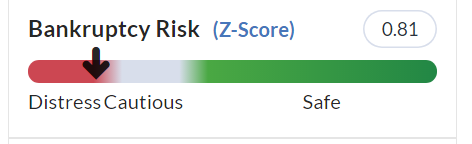
Its last balance sheet had NTAV negative £(335.5m) - that's ridiculous, even if you take into account the favourable working capital nature of this sector. It's a good business though, just weakly financed to an extent that looks reckless to me, but you may not see it that way, we all have our own way of doing things.
.
.
Alfa Financial Software Holdings (LON:ALFA)
Share price: 76.5p (up c.1% today, at 10:19)
No. shares: 300m
Market cap: £229.5m
This share is completely new to me, so this section will take longer than usual for me to research & type up.
Background
This is what it does -
Alfa Financial Software Holdings PLC ("Alfa" or the "Company"), a leading developer of mission-critical software for the asset finance industry...
It floated on the main market in May 2017 at 325p, with CEO & Chairman extracting a staggering £250m in the float, plus a £29m dividend pre-float. There's a terrific quick review of the IPO from Graham here in June 2017. Kudos to Graham (and Ramridge!) who correctly foresaw that the IPO was "severely overvalued".
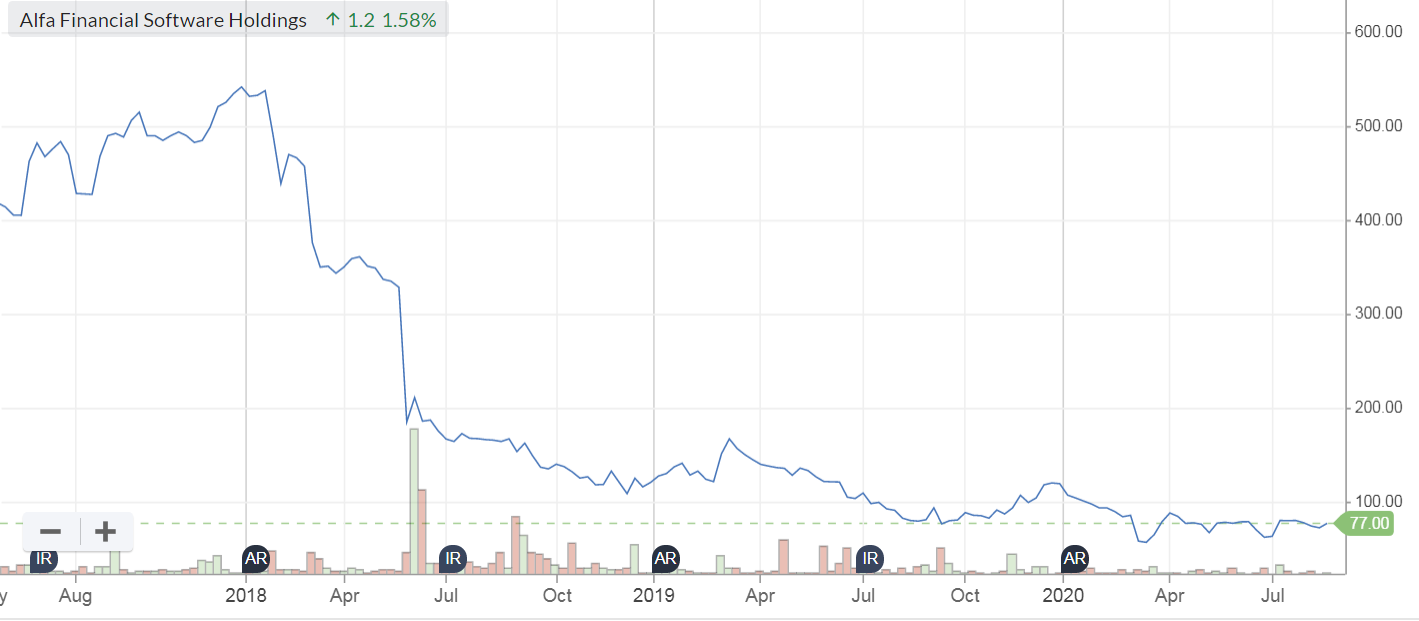
As so often happens, profits subsequently plunged, and have taken the share price down over 75% from the float price. There must be some very angry fund managers (and their clients) who bought into the story at flotation.
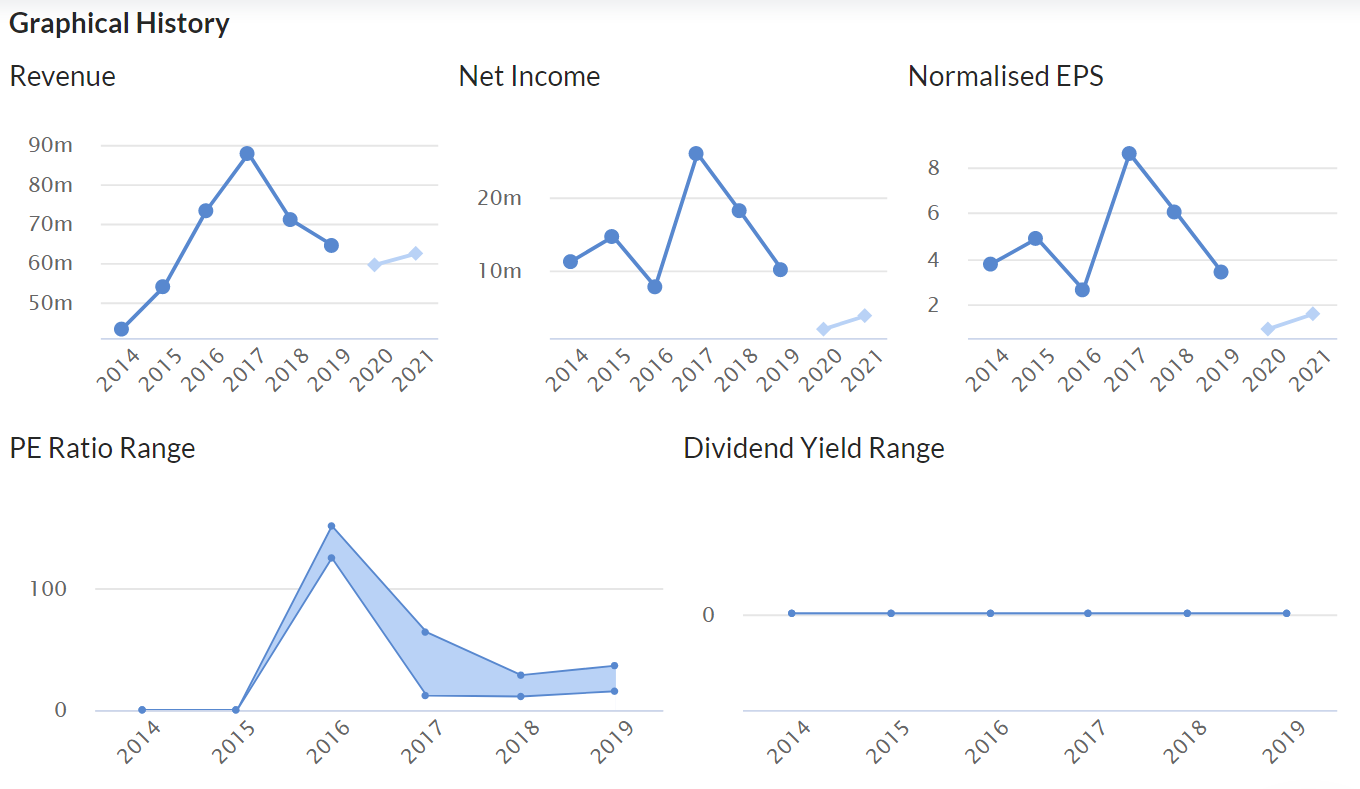
As you can see from the Stockopedia graphs below, the growth story conked out just after floating on the stock market (quelle surprise!), which happens a lot. Therefore it now looks a potential turnaround story, if we're optimists. I'd want to understand why trading & revenues have reversed - is there a competitor that is now eating their lunch, maybe? The figures suggest that might be the case.
.
.
Dividends - I cannot understand why ALFA doesn't pay divis, because it has a balance sheet which is groaning with cash - £58.8m at end 2019, or 19.6p per share cash!. Management seem to like sitting on a huge cash pile, and doing nothing with it. Surely share buybacks would be a good use of the cash, if they don't have anything else to do with it? And/or an acquisition or two?
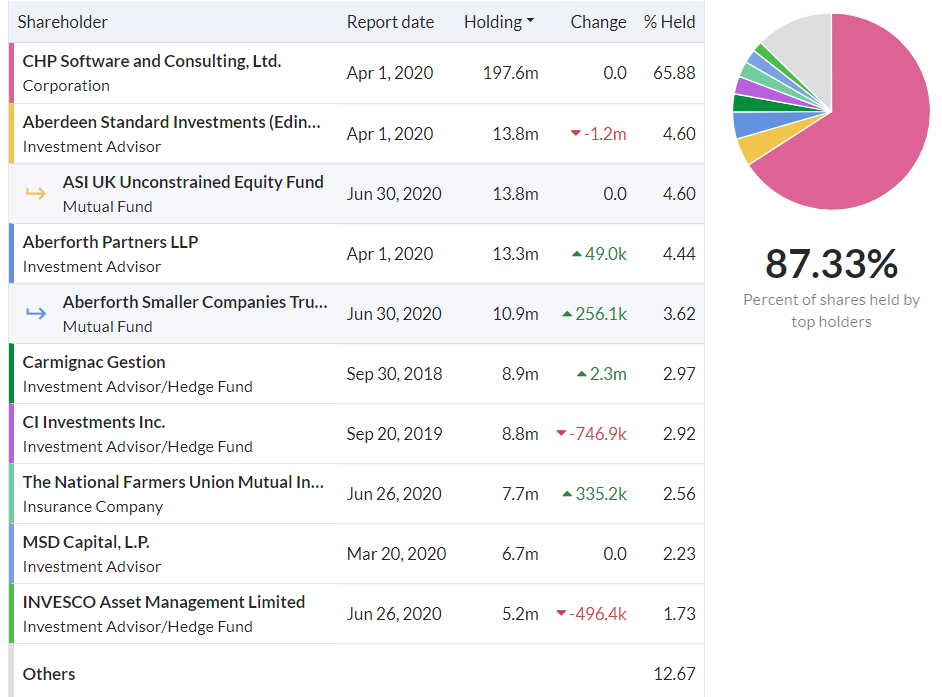
Controlling shareholder - as indicated on Stockopedia's page on shareholdings, there's a dominant shareholder called CHP Software and Consulting Ltd, which owns 65.88% of the whole company. So everyone else is along for the ride, which can sometimes be bad, and sometimes good. Does anyone know who CHP is? It might be connected to Directors, but it's going to take me too long to find out, so I'll crack on.
.
.
That's set the scene, so moving on;
Today's update - a bit mixed, but positive overall I think.
... as a result of strong year to date trading along with good progress on securing revenue, that the Board's expectation of results for the year ending 31 December 2020 are now ahead of current market expectations....
... we now expect our revenues and profits for the full year to be ahead of current market expectations.
Consensus market expectations are currently for revenue of £60m and EBIT of £4m.
We now expect revenues to exceed this by about 5% with the vast majority of this improvement also falling through to EBIT.
Many thanks to the company & its adviser (Tulchan Communications), for giving us the market expectations figures, this is so helpful, I wish all companies would do this.
This implies guidance of £63m revenues for 2020, and EBIT (operating profit) of perhaps c.£6.5m? As we've seen with other companies, EBIT is no longer a reliable number, because IFRS 16 means there might be property rental costs included lower down the P&L, in finance costs. Hence companies need to disclose (adjusted) profit before tax as the key number, not operating profit, and definitely not EBITDA.
H1 2020 trading has been very strong, with even more cash piling up (these numbers are not yet audited);
... we now expect to report total revenues of c.£38m with an EBIT of c.£10m and a net cash balance of c.£68m.
H2 2020 trading - is expected to be loss-making. Various factors are mentioned, including staff doing more billable hours in H1 and not taking holidays, which will reverse in H2.
Outlook -
- Strong H1 continued into July
- Making good progress on converting pipeline
- Increasing overheads, taking a long term view, so profitability could be lumpy;
- We continue to believe that this is the right approach and are therefore prepared that in the short-term we may, at times, have a mismatch between secured revenue and our cost base.
- Not yet secured all necessary revenue for 2020, but sound optimistic about this
- Early stage pipeline "weaker than we would like", so uncertain & cautious for 2021 & 2022 outlook
.
My opinion - this is just an initial impression, on first looking at this share. I like businesses with high quality metrics, and substantial historic profits, which have crashed in value because of short term problems. Hence this is the type of thing which inherently looks of initial interest, to do more work on.
The dominant shareholder, and lack of divis, concerns me, as it looks like a private company with a listing, where the controlling shareholder just does what they like. That can be a disaster (e.g. French Connection (LON:FCCN) in which I am long), or it can work brilliantly, e.g. Best Of The Best (LON:BOTB) (I'm also long), and (sometimes) Mike Ashley at Sports Direct, BooHoo (I'm also long) is another example of fantastic share price performance despite the supply chain issues rumbling around at the moment. Many top investors (e.g. Lord Lee, David Stredder) have done very well over the years targeting their investments into companies that are family/owner managed. Hence I just want to know more about the major shareholder in ALFA, and what its agenda is. Management remuneration is another thing to double-check when the major shareholder can do anything it wants.
I'd rather invest in something that has just delivered a blow-out profit in H1, and is cautious on H2, than the other way around! Maybe current momentum could continue, and deliver a better than expected H2?
I wonder what the split is between licensing revenues, and SaaS revenues? That's always a key consideration with software companies.
Finally, talking to customers who actually use the software is often a good way of identifying decent investments, and avoiding bad ones . I've known a couple of companies whose software was panned by people who used it, which turned out to be terrible investments in the long term.
Overall then, I'm intrigued on first look at ALFA, and would love to hear from any readers who know more about the company & its products.
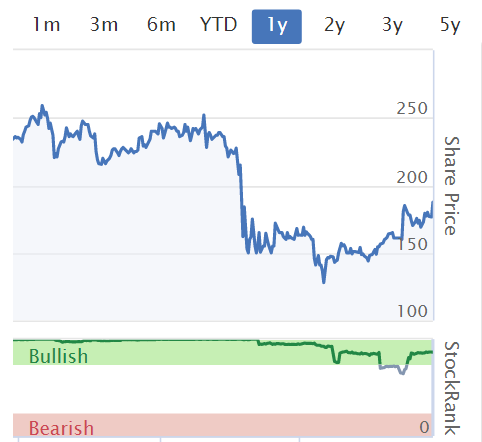
The chart is dismal since floating, but seems to be forming a base, which might attract short term traders if it starts breaking out. Hence there might be a trading opportunity here, as well as long term investment possibility?
.
.
Next Fifteen Communications (LON:NFC)
Share price: 440p (up c.18% today, at 11:52)
No. shares: 90.64m
Market cap: £398.8m
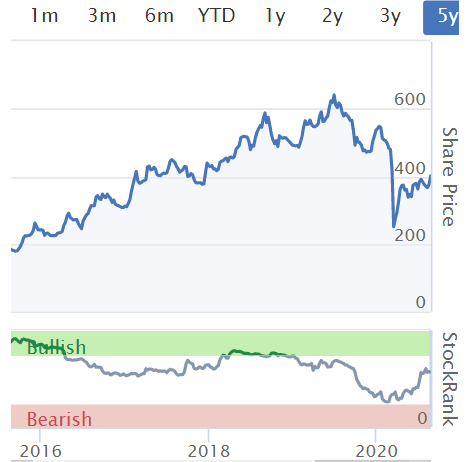
This is a marketing & PR group. I've not looked at it for over 3 years. As the 5-year chart below shows, it did really well, then got smashed in the covid sell-off, but is now recovering strongly.
.
.
Appointment of Joint Broker - Berenberg are now acting alongside Numis. Neither show any interest in private investors, not giving us access to research notes, so might as well not exist, for all the difference it makes to us. Which is a pity, because it means less PI interest in the shares, and hence less market liquidity.
Trading Statement - the year end is unusual 31 Jan 2021.
Next 15 is pleased to announce that trading has continued to remain resilient over the first half of the financial year and is well ahead of management expectations set in March of this year.
H1 to 31 July 2020;
Revenues up 6.5% vs LY, at £126m, BUT organically (excl. acquisitions) revenue was down 6%, which is a more meaningful number
Adj PBT up >16% to £20m+
Operating margin over 16% (LY H1: 14.7%) - although careful as this might include a benefit from IFRS 16, not stated either way
This is an interesting point, with read-across;
Client budget declines were typically related to those industry sectors most affected by Covid-19, whereas sectors such as technology and the digital services we provide have seen increases over previously budgeted spend.
Outlook - "cautiously optimistic" for H2. "Highly uncertain" economic environment. Despite this;
... we currently expect results for the year to be materially ahead of current market expectations.
That is really impressive, in current circumstances.
Liquidity - sounds fine;
We will continue to tightly manage our cost base and conserve cash. The group is highly cash generative and has a strong balance sheet, with net debt as at 20th August, after recent acquisition related payments, of less than £1m.
Dividends - resumption is under review.
Capital Markets Day - on 8 Sept. Combined with new joint broker appointment today, looks like a fundraising is in the offing. If so, why not? It's trading well, so it's good to raise money from a position of strength, if that's what they are doing, I'm just speculating here.
Checking the last balance sheet, it's quite weak, with negative NTAV and a fair bit of deferred/contingent consideration re acquisitions, so I think an equity fundraise to move NTAV into positive territory would be a sensible move. And/or to fund more acquisitions.
My opinion - I'm really impressed with how well this PR/marketing group has fared during the current crisis. Conventional wisdom is that investors in this sector should run for the hills at the first sign of an economic downturn, because discretionary spending on marketing/PR is usually the first thing that customers slash. NFC's comments on this are enlightening, re different sectors.
.
Proactis Holdings (LON:PHD)
36.5p (down 4%) - mkt cap £37.8m
Proactis sells spend management software.
Checking my previous notes, patchy performance & weak balance sheet was my impression. There were no takers when the company put itself up for sale.
Today's update is for FY 07/2020. It's in line with expectations (not specified).
Positive noises about record order intake, and growing pipeline - sounds encouraging.
The Board expects to report revenues of £49.2m for the year and adjusted EBITDA of £11.8m.
Net debt barely changed at £37.1m - too much. Where's the cash generation?
Outlook - mixed;
Overall, the outlook for the new financial year remains encouraging, although the Board remains cautious given the macro-economic backdrop and associated risk across new business trends, project implementation deferrals, volume-based contracts and customer solvency. The Board looks forward to the next 12 months and is confident of delivering significant value with the business now well positioned and with a pipeline that is building.
My opinion - not of interest to me, because it's got too much debt, and doesn't seem to generate cash.
.
Carclo (LON:CAR)
On a very quick skim of the numbers, it's much as I reported the other day, this is high risk, due to heavy net debt, and big pension deficit. However, recent deals on both have greatly reduced risk. The core business looks good, and this share could recover in time, possibly. Not a basket case any more, but won't be able to pay divis for a long time, and ultimately will need to do an equity raise to repair balance sheet.
All done for today!
Best wishes, Paul.
Disclaimer
This is not financial advice. Our content is intended to be used and must be used for information and education purposes only. Please read our disclaimer and terms and conditions to understand our obligations.

78 comments
In respect of ALFA Paul says:
Many thanks to the company & its adviser (Tulchan Communications), for giving us the market expectations figures, this is so helpful, I wish all companies would do this.
Hear, hear but there are some that go even further. OK, it has a £3bn, Mcap but Spectris (LON:SXS) provides great detail updated frequently on its investors website. Have a look at this: https://www.spectris.com/sites... Now if they all did that!
We don't know as there isn't sufficient information in a Trading update, but Proactis Holdings (LON:PHD) may have chose not to reduce debt in the current circumstances. However, they also don't say anything about relative cashflow strength
Sounds encouraging on the build of their pipeline of deals. Maybe this is more of a second half contributor, assuming no further Covid shocks.
The Small Cap report and the comments from subscribers shine a light on what is really happening to the economy and its not a pleasant picture. It would be great if the likes of Alok Sharma and Rishi Sunak could read Paul's valuable summaries and realise that this vitally important sector of our economy is in real trouble. Yes they may have been given support but this is only temporary and unless we get rid of all these silly and contradictory regulations we may wipe out large parts of it.
Perhaps Paul could join SAGE. Small businesses just don't seem to have a voice.
Paul et al
Regarding Alfa Financial Software Holdings (LON:ALFA) Directors Remuneration (2019 Annual Report) :
Page - Base £374k ( no change 2019 / 2020) / Total Comp £388m / waived eligibility to LTIP 2017 / 18 / 19 / 20 / Owns 181m shares
Denton - Base £321k ( no change 2019 / 2020) / Total Comp £338m waived eligibility to LTIP 2019 / 20 / Owns 16.5m shares
Re Alfa Financial Software Holdings (LON:ALFA) , I'm sure I'm just being thick here, but where do I find the Stockopedia page on major shareholdings?
on the stock report the little box with Institutions. This shows all shareholders with over 3%
Ah, thanks. I couldn't find it on the Old Site, but when I switched to the New Site it was easy to find.
Hi Paul,
Re the large shareholder in Alfa Financial Software Holdings (LON:ALFA) , the 2019 CHP Software and Consulting Annual Report states:
Its two Directors are the Executive Chairman and Chief Executive Officer of Alfa Financial Software Holdings (LON:ALFA) .
Profit Before Tax in 2019 was £10.387 million (down from £15.321 million in 2018).
There was no confusion between UPGS and the Telegraph comments hence no need to apologise but you have done so and that is fine. Some people like to feel 'hurt' and need re-assurance and comforting. There are a lot of 'snowflakes' about these days. For clarity I am not implying that UPGS or their advisers or the Telegraph or their readers are 'snowflakes'. etc. etc. etc. Let's pull down a statue and then feel what good people we are !
Paul love your sniper vision and thoughts as always but I do have a query re one point you make on Alfa Financial Software Holdings (LON:ALFA)
H2 2020 trading - is expected to be loss-making. Various factors are mentioned, including staff doing more billable hours in H1 and not taking holidays, which will reverse in H2.
I have spent a lot of my working life in Companies who's business is Billable hours. How does an employee (Fixed cost) Billing MORE hours than expected (and budget) create a loss!
Too many BOOKABLE Hours to a fixed price project YES
Might this be another not simplistically clear comment (AKA Up Global Sourcing Holdings (LON:UPGS) of yesterday)?
PS I have pedant tendancies!
I think the point is they will be doing less billable hours in H2 hence H2 being loss making.
Very superficially it strikes me that profitability must be pretty marginal if people taking their Annual Leave in H2 rather than H1 can swing them into a loss, even accepting that utilisation is a key metric for businesses like this. Maybe there is some more significant going on?
Hi ezlifeme,
Re. ALFA - You've read it wrong! Go back and read it more slowly!! ;-)
The staff charged more billable hours in H1, thus boosting profits in H1.
This will reverse in H2, as the staff take more holidays, hence charge fewer billable hours, hence a loss in H2.
Regards, Paul.
Sorry Paul, I was being a bit cheeky with my post and I used the right fly in my cast to get a rise! I had read a clear statement correctly, I was just illustrating how easy it is to get into an a difference of opinion on these matters. As any Panda who eats shoots and leaves. Or is that eats, shoots and leaves - will know
ATVB ezlifeme
Creightons (LON:CRL) have just announced a delay to the FY20 results, which were due tomorrow. They are now to be published Wednesday 2nd September. this is due to their auditors, who have informed the company that they will not have completed their internal clearance processes in time to meet the previously announced date. Obviously the CRL results webinar scheduled for tomorrow, will be postponed till Wednesday 2nd September at 12 noon. If you were already registered to attend tomorrow, your registration will move to next weeks date/time (no need to re-register), if you were NOT registered but would like to attend, you can sign up here: https://www.piworld.co.uk/events/ (Plus register for results presentations with: Property Franchise (LON:TPFG), Aquis Exchange (LON:AQX), Somero Enterprises Inc (LON:SOM) and the piworld interview with Castleford Tiger.)
That Alfa Financial Software Holdings (LON:ALFA) chart brings back memories. I started dabbling in individual stock investing in early 2018 - Alfa Financial Software Holdings (LON:ALFA) was one of the first I bought (based on no fundamentals at all, it just looked good to a newbie!). You guessed it - I bought in at almost exactly the high (around 540). The good news is I later joined Stocko; I recall there was a very good presentation by Ed around not holding losers, I took that advice and bailed out around 340 (40%'ish loss). As the chart shows it fell off a(nother) cliff shortly thereafter.
does anyone follow Arrow Global (Lon:ARW), half year results today. Performance solid but a hefty write down of near term collections expectations. Assumptions include UK house prices base case -8% and downside -10%, unemployment base case -7% and downside -10%. I don't think many housebuilders have these sort of numbers in their outlook.
LON:ALFA Hi Paul, really good start on your analysis. I hold ALFA (@124p) and am a little embarrassed about my lack of knowledge! Very interesting comment about the cash position - makes for an attractive PE at the current price.
Have had a quick dig around CHP and come up with a bit of a "stop being nosey" message. 2 Directors; Andrew Page (net worth £270m) and Andrew Denton. 2-10 employees working out of Bucharest. Looks like a holding company to me. Also there was an outfit called Oval Nominees floating around as a shareholder at some stage, but no longer.
ALFA was called CHP before it floated.
Great work Berksbee - Page is the Exc Chairman, Denton the CEO, so some serious skin in the game
Part of the reason I bought into £UPGS (and still hold) was the fact that two directors (one was the non-exec Chairman, I believe?) bought quite an unusually substantial amount of shares .
Some time after this the shares went down in price, but have rallied somewhat.
Regarding IPO pricing, whilst I can understand the motivations of founders to maximise their interests, in olden times brokers used to leave something in the pricing for the after-market. This changed forever, it seems, after the Dot-Com bubble. Brokers then and quite a while after committed some heinous crimes in bringing companies to market that were not worthy of floating. Arguably this desperate fees based mentality of the broker industry is part of the reason AIM as a whole is a poorly performing index.
The latest Investors Chronicle podcast covers this very well. You donthave to subscribe to the magazine.
FYI from the Internet
Chp Software and Consulting Limited was incorporated on 07 Jul 2015 and is located in London. The company's status is listed as "active". It currently has 2 directors. The company's first directors were Andrew Warren Denton, Andrew Neville Page. Chp Software and Consulting Limited employs 250-499 people.
So it has the same two directors as Alfa Financial Services. Interesting that it claims to have more than 250 people working for it as implies it is more than a holding/investment type company
Creightons (LON:CRL) results delayed until the 2nd of Sept.
Paul, or other experienced people,
Do you have any guesses as to what Creightons (LON:CRL) 's announcement might mean? Have the auditors found something questionable or is it just a COVID delay? Any speculation would be welcomed.
...auditors have informed the Company that they will not have completed their internal clearance processes in time to meet the previously announced publication date...
...the Company's over-all performance remains on track and that this decision does not affect the results that will be included in the Preliminary Results...
disclosure: not currently holding
Doesn't seem to have much of effect Up Global Sourcing Holdings (LON:UPGS) share price. Companies better ignoring comments.
BVS
Morning All,
If it's of any interest, Somero Enterprises Inc (LON:SOM) , Rm (LON:RM.) and H & T (LON:HAT) SP have all fallen in recent times due to Artemis reducing shareholdings. Given the low volumes of Aug and Sept, there maybe a while for the overhang to clear.
I am going to get into trouble I am sure but to my mind this comment page allows us to clarify our thoughts sometimes so here I go. Complete transparency I have added to a holding of RBG today. Thinking - 1) I have been to Cambridge 3 times in 3 weeks on a Thurs, Tues, and a Monday evening. Clearly trading very well. Good to hear if that is true of other branches. 2) Capital raising has given the Bal Sheet some solidity. 3) Govts local response to Covid derisks a 77 bar portfolio. Much like a well diversified equity portfolio. 4) Reports on tests and vaccine seem to be getting more positive and when something does appear these type of stocks should see a rerating. 5) The young person entertainment industry seems to be recovering faster than other age groups. 6) The management team took shares in the capital raising and seem more focussed and able than previous incumbents. I am interested in hearing negative views as I think I have become too positive on what is a risky share and need some reality perhaps.
Can Revolution Bars (LON:RBG) run at cashflow breakeven even in the event of a significant level of disruption from local lockdowns? If not, do they have enough cash to get through it without diluting you in a further fund-raising?
I haven't looked at it closely and it's not a favourite sector of mine, but the points you make are all valid, and if you are holding this whilst we get an early vaccine breakthrough (spring 2021, say) you'll obviously be on to a winner. I don't relish the likely profit margins under social-distancing constraints, but if you can tolerate the risk and things work out well for you perhaps you'll do very well.
When schools reopen they may want to curtail another area to balance it up? Chris Whitty said a while ago that we are at the limit of reopening the economy, But since then the govt have pushed on. If the figures go further in the wrong direction in the first few weeks of Sept (I don't think they have improved since Whitty's comments) then I reckon there is a good chance that pubs will be first on the list to close. Sorry if I am stating the bleeding obvious.
No good point dfs and one I think I have maybe under scored.
Is another national tightening likely? Obviously the hotspots like Oldham etc. get the headlines, but much of the country is now seeing very few, if any cases.
Surely there will be very negative reactions to national restrictions in the rural parts of the country where cases are now very low, and I suspect the government will also be mindful of the economic effect of closing all pubs in the country for example when it really only to needs to add restrictions in certain areas.
I agree that a national tightening may be unlikely - but the opening up of schools is a national loosening - if Whitty wants a comparable tightening to provide balance it would probably have to be something like pubs.
I also agree that it would may make sense to keep rural pubs where there are very low cases open - but I'm not sure how many Revolution Bars (LON:RBG) pubs are in rural areas? They are more likely in high density town centres. These are more likely to be the ones that get tightened.
All complete guess work and my guesses on macro stuff have been pretty wide of the mark in the last few months - so perhaps not worth a great deal!
Thankyou Ed. Worth noting. I agree and that is what makes me extra nervous. I usually apply an operating margin limit of 10% so not applying my own rules. But not a favourite sector of mine either, just strange times.
I run a group of bars in real life so have decent knowledge of this sector. If you want the negatives, here goes:
1) In bar trade, especially in recessionary environment it's all about operating margin. Trade can fluctuate wildly and as the furlough/ rent/ VAT/ grants/ Eat Out to Help Out/ rates schemes are withdrawn, RBG is going to have to face the reality of huge fixed costs/ massive debt on balance sheet and less trade. For a company that already ran at some of the industry lowest Operating Margins (before increased operating costs of COVID), that means significant price rises or a prepack (to jettison losers and renegotiate rents). I don't think they can raise prices.
2) It's true that trade has been stronger than expected in August but there are many reasons to believe this will change when September comes - unemployment will start to rise as recession kicks in reducing trade, weather starts to change (massively more important for trade now when some customers don't want to use inside space/ public transport/ taxis), kids back in school reducing free time.
3) Revolution has a model catering to students (who may no longer be on campus in new world), after work drinkers (who may no longer be working in office/ going out for drinks after work), Friday and Saturday night pre-drinkers (in a world where clubs no longer seem to have any way to operate). Their investment in fixed locations is enormous but we have no idea if those locations are the right ones anymore until we see what the new drinking patterns are).
4) Their balance sheet is a total mess - I mean even if COVID is cured tomorrow, how can it ever hope to pay off the massive debt levels it now has to sustain? OK, it's not in the banks interest to foreclose since it now has NEGATIVE EQUITY but that means it trades out the rest of it's days as a zombie company.
5) Government local response may or may not help Revolution depending on which localities are hit. But I'm not clear yet it is going to be a local response going forward. If COVID starts to spike in the country, I think the first thing government might do is shut down bars again. Last week in Belfast, R rate rose to 1.6 and executive made various changes to number of people who can meet in own homes etc. - it had zero effect on people's behavior and I'm sure on the R rate. If they need an actual national effect, choices are shutting schools (totally unacceptable), shutting bars/ entertainment (undesirable especially as they have pumped so much in trying to keep them going) or shutting offices/ factories (they can't afford to do this again).
I wouldn't touch any share in this sector until at least Spring next year. Chance are half of them aren't going to be there or have gone through some major restructuring by this time.
Excellent piece.
There are too many better opportunties out there with less risk.
BSV
Fair.
That's interesting. I'm not familiar with Revolution Bars (LON:RBG) specifically but my old local which used to charge £3.90 for a pint of Carlsberg (admittedly cheap for central London) has now raised it to £5.20. Will that put people off? I suppose only time will tell.
Yeah Gostevie, I did sort of skate over this point. I meant that it's difficult for RBG to substantially raise their prices. Their model is based on cheap vodka shots/ cocktails - in good times this is awesome because it drives volume. However, when costs increase it is much harder for companies like this to raise prices because their customers are by definition price inelastic - they only went there for the cheap booze and a small drop in volume can have devastating effects on their bottom line. Contrast this to a swanky cocktail bar charging £12 for a lovingly prepared concoction - if they raise their prices to £13, do their well heeled customers even notice? In recessionary times (which I believe we are entering), it is companies operating high volume/ low price models that tend to get into trouble first for this reason.
Regarding your local, it used to be cheap - now it's expensive. That will work if the customer goes there for other reasons than cheap beer - if their business is built on price (as I think RBGs is), the customer will stop going. I was really worried on reopening as we put our prices up substantially and have been shocked at how little the customer seemed to care. But our business was never price led. I wish now we had been braver and put them up more...
Ow thanks Phuntt! That is exactly what I wanted. It will take a little to think it through. Best wishes.
That's a brilliant assessment. Thank you very much. I've been mulling over for some weeks now whether I'm prepared to be as brave as Paul. But having read your assessment I am convinced that this is not a share for widows, orphans or me! Good luck to braver souls. May you reap your rewards!
re Yesterdays report and UPGS
'Separately, but on the same topic,' seems very clear to me. Perhaps PR advisors should learn to read properly.
Not sure they have done their client much good by raising the issue again like this. They might just be good corporate citizens and doing what seems morally right. But why are they so touchy about it?
The problem is the world in 2020 is full of PR people, "reputational consultants", and various marketing bods with virtually no qualifications (so it's hardly surprising they can't understand written English) that spend half their life scouring the internet for the slightest little thing. It's no wonder this country and half the developed world is screwed when this is considered a worthwhile job, instead of designing, manufacturing and selling something that offers genuine value to peoples lives and could even make the world a better place.
All the best, Si
I think we should run a poll on here to ask who amongst us believes that the UPGS board were acting solely in the interest of good corporate citizenship and in no way thinking of themselves.
Then give the PR rep permission to publish the poll result on UPGS's website!
I think we should run a poll on here to ask who amongst us believes that the UPGS board were acting solely in the interest of good corporate citizenship and in no way thinking of themselves.
The question you should really be asking is why they took the furlough money in the first place? You shouldn't take merit for something that turned out to be an unnecessary action. You need to question it if they can afford to hand the money back so soon. Did they just panic? If so, is that a good thing?
All the best, Si
Fair enough, though if in doubt I would expect a board to be cautious.
Paul, that rebuff was swift! But, as Mummy explained, you can't make an omelette without breaking eggs......
Silver
I think it is something and nothing guys. Frankly the Company has to defend its reputation where it sees ambiguity. Paul has said fair enough. Put it to bed. No harm done. No harm meant.
Exactly my view too, thanks Camtab!
I can’t see why people are getting so agitated about the semantics of yesterday’s piece about furlough payments and still working. The company felt they wanted to clarify that they haven’t done this in case readers might construe incorrectly (by association) that they might have done this. Paul has confirmed that there was no intention to imply anything of that nature. Both the company and Paul have behaved completely reasonably as far as I can see.
I think the whole episode just highlights how important Paul, and the SCVR, have become.
With great power comes great responsibility...
Excellent observation Frugal Tree ,have taken them of my watchlist to buy now,if directors haven.t got long term interest in the business & want to sucker in investors to line their own pockets then it's not for me.What a great source of information SCVR can be.
I thought I'd post what Paul wrote yesterday about the LON: UPGS RNS before it gets changed. What is wrong with what he wrote? It is Paul's normal thought provoking writing. Do we want company PR teams and management dictating what we read here? What is the point of the Stockopedia SCVR analysis if it can't be honest, open and clear.
"I salute their sentiments, but do wonder if there's more to it than that? I've not looked into the finer detail of Govt support schemes, so am wondering if any readers know whether companies have to demonstrate that covid/lockdown has caused them financial hardship, in order to be eligible for these schemes? Particularly for a listed company, if they're putting out positive trading updates, then I would hope HMRC would push back against any requests for deferral of taxes.
Separately, but on the same topic, there are articles in today's papers saying that research from Oxford, Cambridge, and Zurich Universities suggests that a staggering 6 million people continued to work (an average of 15 hours per week) whilst on furlough. That's about two thirds of people funded by the taxpayer scheme, which was meant to prohibit working whilst on the scheme, until amended later on, to allow some work.
I've no idea whether this could be a factor in companies returning furlough monies, but it would be very easy for HMRC to ask to see email records, and then demonstrate that people were working, when they shouldn't have been. It does seem crazy having a Govt scheme that actively tries to make people idle, but I understand the reasons it was brought in as a temporary way to prevent unemployment. The unintended consequences seem to have been problematic though.
Maybe we'll see more companies return furlough monies? A friend's small business received a Govt grant, and is not sure if they are entitled to it. They're having a huge internal row about whether to give the money back or not, and asked my opinion. I said that, in their position, I would segregate the money into a separate bank account, then write to the body that awarded the grant, asking for written confirmation that the recipient is entitled to keep the money, describing the business, its activities, and any other relevant facts & figures."
.
Presumably it is this bit: "I salute their sentiments, but do wonder if there's more to it than that?" UPGS responded saying there wasn't.
I agree Westway001 - many on here are getting upset "defending" Paul - but he "half" suggested it was underhanded.
Thats not a PR team worried their message is off track - its being "half" accused of illegality and then say "wait a minute mate"
Not a big deal IMO and I like the numbers from UPGS.
Jef, being a holder I like the UPGS numbers too and am pleased to see evidence that some company directors read the SCVR too. Coniston above implies that company directors should keep their noses clean and some of my AIM holdings tell me I should agree.
I expect the board would like to pay a dividend and themselves overly-generous bonuses. That's what I took "more to it than that" to mean, not to imply anything illegal. A clarification from Paul is useful; prostrating himself for touchy PR types is unnecessary. As for whether or not there is more to it than simple corporate good citizenship, time will tell. And I won't be surprised if in time the UPGS board will be shown to have had tongues in cheek and crossed fingers behind their backs.
I've decided not to change yesterday's article on UPGS, as re-reading it, I think it's fair commentary. But have added the clarification comment above into yesterday's article too, so that people don't misunderstand what I wrote.
I don't let companies or PRs bully me into editing articles, but am happy to add a clarification/apology if it has been misconstrued, as in this case.
Incidentally, I got a very rude response from the CEO of Optibiotix Health (LON:OPTI) which called me a liar, threw in a false, invented conspiracy theory about my motives, and ranted on about how wonderful his company is (despite its pathetic financial track record) some time ago! I was going to respond, but then just thought why should I waste my time on such an obviously rubbish company, and its aggressive CEO? I'll let the figures do the talking. Deliver some cashflow & profits, and I'll report positively on OPTI, simple as that. Meanwhile, talk is cheap. After 6 years, he's on borrowed time, hence probably why he lashed out at me.
Regards, Paul.
Good. In common with other responses here, I did not take your comments as a backhand accusation against UPGS and doubt any other readers did either (save for overly-sensitive PR hacks).
Paul - I think you should take this episode as a ringing endorsement of your blog and evidence that the movers and shakers of the financial industry pore over your every word!
Whenever i read your words Paul, i always think - this man has our backs. The individual investor does have some power - we have Paul Scott. Now behave.
UPGS; I didn’t link the two issues.
Nor me, their reaction seems hyper-sensitive.
The management team of Kenmare Resources (LON:KMR) presented their HY results at one of our Yellowstone Advisory webinars on Monday.
Results were in line, but its all about the successful delivery of capacity expansion now.
There's a write up on the stockopedia discussion page and recording of the webinar can be found on the Yellowstone Advisory YouTube channel or by clicking here.
Carclo (LON:CAR) updated with March 2020 results.
https://www.stockopedia.com/content/10-bagger-potential-car-dlar-649338?order=createdAt&sort=desc&mode=threaded
BSV
Morning Paul, I read yesterday’s report and didn’t get the impression that the content including Up Global Sourcing Holdings (LON:UPGS) and then those working while on furlough were linked. It was quite clear to me that those items were distinct.
Neither did I.
Morning Paul, I read yesterday’s report and didn’t get the impression that the content including Up Global Sourcing Holdings (LON:UPGS) and then those working while on furlough were linked. It was quite clear to me that those items were distinct.
Me too. I despair at the standards of basic reading comprehension these days. Use of the word "separately" puts a chasm between the two points in my mind. However, if you're already negatively disposed to what you're reading it is easy to miss...
I agree it would have been better had Paul made the general comments on the Telegraph piece in a separate section but then it would ruin the normal "stream of consciousness" approach that makes reading the SCVR so interesting.
All the best, Si
PR flacks are notoriously touchy....
”UPGS is adamant that it's returning the furlough monies because this is the right thing to do, and out of a sense of civic responsibility, ”
This alone makes me want to consider investing £UPGS. I would like to think more management think this way.
Hi Michael
In response to Paul's more general comment yesterday on why companies are repaying government support I made the following posts late yeasterday.
My understanding is that although a number of companies state they are repaying government Covid support "in the public interest", their main motivation is to avoid restrictions on dividends and executive bonuses. I am not an expert on the individual schemes but I believe that some contain explicit prohibitions and that there is a "read across" from those to the other schemes (which were introduced earlier) which don't have the explicit conditions but might be expected to have them implicitly (you can see the newspaper headlines - massive director bonuses paid to company X which claimed government covid support!).
Details of some of the restrictions can be found at:
https://www.gov.uk/guidance/apply-for-the-coronavirus-large-business-interruption-loan-scheme
see the end of the Eligibility section just before the Who cannot apply section
Given some of the other comments about the Up Global Sourcing Holdings (LON:UPGS) bonus scheme at IPO perhaps that gives the true reason for the return of the government support.
Regarding repayment of government support, the UP Global Sourcing Holdings (LON:UPGS) RNS yesterday specifically mentioned "Coronavirus Job Retention Scheme ('furlough scheme')".
My understanding and no doubt someone better qualified will correct me if I'm wrong, is that there are no conditions attached to this scheme relating to payment of dividends or executive bonuses. Those restrictions are only attached to the large company loan schemes (where companies claim and are granted repayable loans (not grants) that accrue interest).
I have no hidden agenda or particular interest in UP Global Sourcing Holdings (LON:UPGS) but most of the comments above and yesterday imply that the company has some ulterior motive behind repaying the monies claimed under the "furlough scheme". Perhaps they do, maybe they want to appear to be "doing the right thing" but enabling them to pay dividends or bonuses doesn't seem to be one of them.
All very noble of Up Global Sourcing Holdings (LON:UPGS), but we should remember that they floated this business on lofty forecasts that were quickly and savagely cut once the founders had sold their £50m+ of stock to the market. Still a long, long way to go to recover from such a start as a listed company.
LON:UPGS - If I remember correctly there was also some kind of profit sharing scheme to allow directors to suck more money out of the company?
Hey Samscvb, that was a scheme that existed pre-IPO and no after.
Rather than throwing dirt here's a more rational criticism (and it applies to many other AIM stocks):-
Founding directors often hold big stakes post IPO and then get paid through a dividend. Clearly a nice fat dividend cheque every year is very welcome. There can be a danger of pushing the payout ratio too high.
When this happens I'd like to see directors paid a rather minimal amount. Its about aligning with shareholders in the public setting.
And where a company has good growth prospects and shows a good return on invested capital I'd like them to hold some dividend back and build a bit of cash and/or invest a bit more. With £UPGS I believe they could invest more for growth
Superb point FrugalTree. Up Global Sourcing Holdings (LON:UPGS) broke the IPO code by listing when things were going well and having the audacity to talk things up in listing docs. As we know, most all cos do the reverse of that when listing....errrr....
Their profit warning followed sector wide difficult times. The price went too far down and offered a great buying opp.
I have some criticism for some of their communication but not for sharing here in irrational pile on
A better rule is never to buy an IPO. Its a mystery to me why any PI does....there will be some IPOs to buy but the level of access required to judge that is probably not coming your way unless you already have a link to the company in some way.
My morning smallcap tweet:
Alfa Financial Software Holdings (LON:ALFA) Catenae Innovation (LON:CTEA) £C4XD DFS Furniture (LON:DFS) Eden Research (LON:EDEN) Asimilar (LON:ASLR) Next Fifteen Communications (LON:NFC), Proactis Holdings (LON:PHD)
Alfa Financial Software (ALFA) ups H1 rev guidance to c.£38m, EBIT c.£10m. Guides FY ahead of market expectations of £60m rev and £4m EBIT. [SP=75.8 Cap=227m]
Catenae Innovation (CTEA) first commercial sale for the Onsite ID occupational health app. [SP=3.6 Cap=8m]
C4X Discovery (C4XD) drug progess update including a Phase 1 trial for C4X_3256 for the treatment of opioid dependence. [SP=25.09 Cap=30m]
DFS Furniture (DFS) order intake significantly ahead of initial expectations and is in addition to our previously announced strong opening order book. Last 6 weeks equivalent to c. £70m of rev. [SP=150 Cap=383m]
Eden Research (EDEN) its bio-fungicide gets approval Eden Research for use on wine and table grapes. [SP=7 Cap=27m]
Asimilar Group (ASLR) unsuspended as assignment to MESH Holdings of the Company's interest and rights to invest in Sentiance NV has now completed. [SP=70 Cap=77m]
Next Fifteen Communications (NFC) trading has continued to remain resilient over H1 and is well ahead of management expectations set in March. H1 rev up 6.5%, adj pretax up by over 16% to at least £20m. Guides FY materially ahead of market expectations. [SP=369 Cap=334m]
In line: Proactis Holdings (LON:PHD)
[deleted]
Fund This Project
Good morning! Below covers todays regulatory and potentially price-sensitive announcements.
In the period from 2016 to 2019, OSIsoft delivered a revenue CAGR of 9.7% and an Adjusted EBIT CAGR of 18.5%. This strong growth continued this year as the imperative for digital transformation has continued through the COVID-19 crisis, with year over year revenue growth of 10.0% in the six months ended 30 June 2020.
According to the World Bank, global GDP is forecast to decline by 5.2% in 2020, which would make this the deepest recession since World War II. NAV Return for the period was (0.5)% (constant currency: 0.6%).
Private Equity holdings delivered a Total Return of 2.3% (constant currency: 3.4%) for H1 2020 with the valuations of the Apax VIII and Apax IX funds both above those seen at 31 December 2019.
The Derived Debt portfolio achieved a Total Return of (1.5)% (constant currency: (1.1)%) ahead of comparable indices. The Derived Equity portfolio recovered to some extent during the second quarter, producing a Total Return for H1 2020 of (18.4)% (constant currency: (15.1)%).
At 30 June 2020, AGA was 97% invested with the Invested Portfolio valued at €1,024m. The largest sector exposure was Tech & Telco and Digital representing 44% of the Invested Portfolio, followed by investments in Services and Healthcare, representing 28% and 19% respectively. Consumer was the smallest sector exposure,
Interim dividend of 4.87 pence per share declared, equivalent to 2.5% of the euro NAV as at 30 June 2020.. ·
H1 2020 Total NAV Return1 was broadly flat at (0.5)% (0.6% constant currency).
Following a negative return of 11.9% in the first quarter of 2020 reflecting general market weakness, valuations strongly recovered during the second quarter at 13.3%, especially in the Private Equity portfolio.
At 30 June 2020, the Invested Portfolio was split 72% Private Equity and 28% Derived Investments and it is expected that AGA will maintain the majority of its assets invested in Private Equity going forward.
Outstanding commitments to the Apax Funds (together with recallable distributions and the new AX commitment) amounted to €499.2m (47.1% of NAV). · The Private Equity portfolio delivered a resilient performance in H1 2020 with a Total Return1 of +2.3%
We have continued to trade strongly both online and in our showrooms, with year-on-year order intake growth over the last six weeks that is equivalent to c. £70m of revenues.
This trading is significantly ahead of our initial expectations and is in addition to our previously announced strong opening order book that will generate a further in year revenue benefit of c.£100m.
We believe that this trading performance reflects a combination of consumers currently spending more on their homes relative to other sectors, latent demand caused by the nationwide lockdown and also a strengthening advantage from our hybrid digital and physical retail offering, which is particularly relevant in this consumer environment..
For the six-month period to 31st July 2020, revenues are expected to be up by approximately 6.5% compared with the same period last year to £126m and adjusted profit before tax up by over 16% to at least £20m.
This has resulted in an improved overall operating profit margin of above 16%, up from 14.7% last year.
The overall organic decline in revenues for the period was approximately 6%, though the decline was less severe in the US where organic revenues declined by just 2.5%.
Arrow has succeeded on both counts, enabling 100% of its workforce to work from home effectively
Net finance costs of £27.0 million were 1.9% higher (H1 2019: £26.5 million) and in line with expectations for the period..
The tax credit of £25.5 million represents an effective tax rate of 18.8% (H1 2019: 25.1%) on (loss)/profit before tax.
pleased to announce that it has entered in to an agreement and plan of merger with Rhapsody International Inc
pleased to announce the acquisition of the entire issued share capital of Osprey Consulting Services Ltd. ("Osprey") for a maximum cash consideration of £3.5 million, on a debt-free, cash-free, normalised working capital basis
New business deal intake for the year was at a record high as the Group secured a 29% increase in total contract value ("TCV") of £14.6m (2019: £11.3m).
showing significant efficacy in a pre-clinical model of Inflammatory Bowel Disease
Revenue from continuing operations increased by 4.9% to £110.5m (2019: £105.3m).
Group underlying operating profit from continuing operations was 14.4% higher at £7.3 million (2019: £6.4 million) with basic underlying earnings per share from continuing operations 133.3% higher at 4.9 pence (2019: 2.1 pence).
Group revenue from continuing operations increased by 4.9% to £110.5 million (2019: £105.3 million), underpinned by strong divisional performances from CTP and Aerospace.
As one of our KPIs, this is very encouraging. Revenue including discontinued operations increased £1.4 million to £146.3 million (2019: £144.9 million).
Underlying operating profit margin from continuing operations increased to 6.6% (2019: 6.1%) as the business started to realise the benefits of operational improvement initiatives.
Underlying earnings before interest, taxation, depreciation and amortisation from continuing operations increased to £13.4 million (2019: £10.9 million) which includes a positive im
Fund This Project