Small Cap Value Report (Wed 1 April 2020) - NXR, AIR, CGS, RNWH, TST

Good morning, it's Paul here with the SCVR for Weds.
Estimated timings - I'm a bit more with it today, so should be able to meet the 1pm official finish time. Today's report is now finished. My apologies for the unreliable timings this week.
Looks like we're in for another rocky day, with futures down heavily overnight. My view (subject to change on a daily basis) remains that I'm sceptical about the strong recent rally. As company updates are making clear on a daily basis, many (most?) shares are currently impossible to value, because we don't have any earnings visibility. For that reason I cannot see any reason to buy the market generally at the moment. Individual shares can make more sense, if companies have recurring revenues & strong balance sheets. But in other cases, why take the risk?
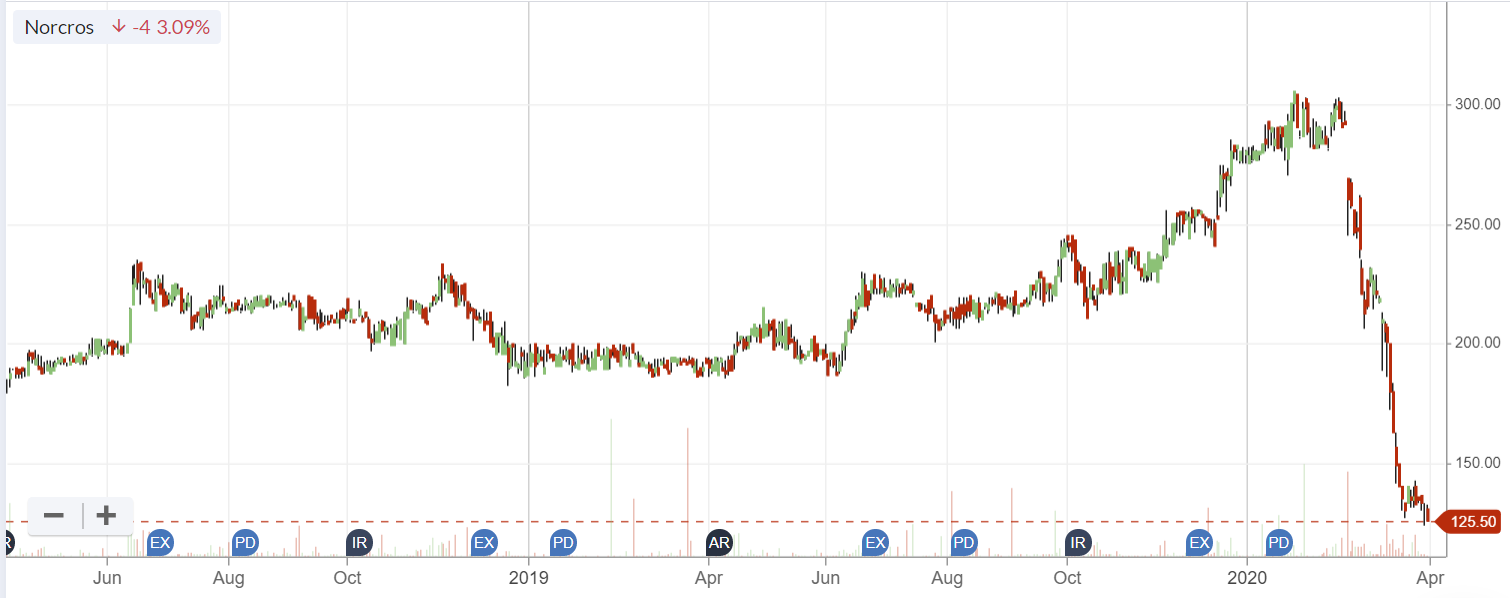
Norcros (LON:NXR)
Share price: 125p (pre-market open)
No. shares: 80.6m
Market cap: £100.8m
In light of the rapidly changing developments regarding COVID-19 (Coronavirus) since our last announcement on 20 February 2020, Norcros, a market leading supplier of high quality and innovative bathroom and kitchen products is today providing a further update on the potential impact on its performance for the year to 31 March 20201 and the measures it is taking to manage the associated risks.
Trading has slowed down in March 2020, meaning that it will now miss the full year numbers.
China supply chain now operating at "close to normal" levels.
Demand shortfall is now the bigger issue.
South Africa - trading has ceased due to Govt edict. 26 March to 16 April.
UK - customer closures mean trading is "now minimal". Norcros has therefore suspended its main UK assembly & manufacturing operations.
Guidance for FY 03/2020 is reduced, but bear in mind coronavirus only impacted the last few weeks of this period, so it's not terribly relevant;
We now expect our underlying operating profit2 for the year to 31 March 20201 to be approximately £31m compared to the previous consensus forecast of £35m. All of this reduction is attributable to the COVID-19 situation, is considered both temporary and exceptional, and follows a period of robust trading including market share gains.
This is probably the most important part of the announcement, saying that (relying on bank facilities) it can withstand an extended shutdown;
The Group has access to a £120million committed RCF financing facility, plus a £30million accordion facility, which mature in November 2022 and has drawn down £84m on the RCF facility to ensure that it has sufficient short-term liquidity.
We have modelled a number of different potential scenarios of different durations and severity including periods of nil revenues followed by periods of reduced revenues and assessed the impact on both profitability and cash flow over the next 12 months. We are confident that with the actions being taken to preserve cash and the financial resources available to it, mean that the Group is well placed to withstand an extended period of reduced trading.
Dividends - under review. I think it's safest to assume that there won't be any divis for the time being. It will need to reduce debt as the main priority once trading recovers.
My opinion - frustratingly, I haven't got enough information to make an assessment here. Nobody has got any idea how trading might pan out in the new financial year that starts on 6 April 2020 (note that it's a 53 week period to 5 April 2020).
It sounds as if liquidity, and therefore survival, is dependent on drawing deeply on the bank facilities. That is dependent on the bank playing ball, and of course that the company doesn't breach its Net Debt: EBITDA covenant during the year. We really need to know how that will be tested - e.g. is it quarterly, on a rolling 12 month basis? Zero revenues over an extended period could quickly turn that test ugly.
I also don't know the split of fixed, and variable costs. That's absolutely vital information in the current scenario.
On the existing broker forecasts, the PER is only 3.7 - but of course that is only of passing interest, as to what level of earnings the company might be able to return to, once the economy has fully recovered. But when is that going to be (if at all?).
Until we have more forward visibility, then unfortunately this share remains impossible to value.
Brokers seem very reluctant to publish sensible new forecasts. Therefore broker research is currently of little to no value.
Is it a bargain yet? Nobody knows.
.
Air Partner (LON:AIR)
Share price: 53.5p (up 16% today, at 08:16)
No. shares: 53.5m
Market cap: £15.3m
Air Partner, the global aviation services group, is providing an update on initial trading in the financial year beginning 1 February 2020. This is the second update to be given during the COVID-19 pandemic and will be followed by shareholder updates approximately every four to six weeks during the crisis.
That's a really sensible touch - giving us an idea when to expect further updates. I like that a lot. All companies should publish a similar schedule, and update shareholders regularly. After all, this is an intensely stressful time for shareholders, so long gaps in reporting by management are thoughtless at best.
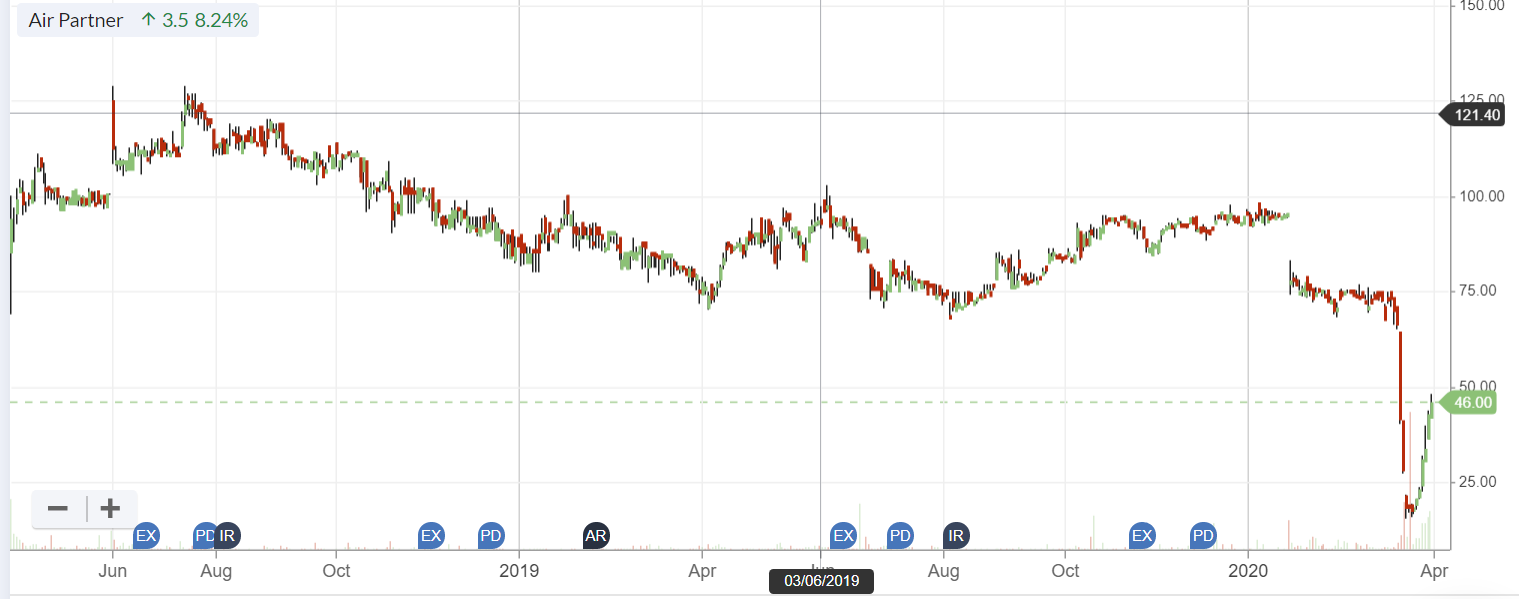
The share price for AIR has been all over the place of late;
.
This sounds really good;
The Group has had a strong start to the financial year. The unaudited management accounts for February and the flash report for March show that each month generated profits well ahead of both budget and the prior year. The current indication is that the Group has delivered around £2.4m of underlying profit before tax in the first two months of the year, as new business wins from the crisis, such as repatriation contracts, have outweighed a decline in Safety & Security and European private jet charter during the pandemic.
Outlook for April is "encouraging"
Cash & debt facilities sound fine
Private jet usage is down
Freight & charter both doing well from the crisis
This is impressive, especially the 20% Director pay cuts - we need to see more of that, Directors should lead from the front in times of crisis;
Cost management and cash conservation
The Board reminds shareholders that the Group owns no aircraft and does not operate as an airline. We continue to tightly manage costs to preserve cash and maintain our working capital. While we have enjoyed a strong start to the financial year, our expectation is that business will now slow as the pandemic continues to restrict aviation activity globally. Accordingly, we have implemented a series of temporary cost management initiatives and made use of the available government grants and benefits to significantly reduce our cost base for the coming months. These include every director taking a voluntary 20% pay reduction for at least the next two months.
The combination of a strong start to the financial year, the swift action on costs and our positive cash balance give the Board confidence that Air Partner is effectively positioned to cope with the challenges and uncertainty posed by the ongoing COVID-19 pandemic.
My opinion - this is an impressive update, but it sounds like some of the benefit from this crisis has only been temporary.
Overall though, it sounds like the company is nimble, and is taking advantage of commercial opportunities thrown up by the crisis.
It's got a decent long-term track record of being profitable.
It looks a rare bright spot in the aviation sector. Not sure I'd particularly want to get involved, given the small size, and lack of liquidity. The recent rebound looks justified, but is it worth chasing the price up any further? Maybe not, I don't know.
Castings (LON:CGS)
Share price: 296p
No. shares: 43.6m
Market cap: £129.1m
Castings PLC announces a trading update in respect of the year ended 31 March 2020.
This came out yesterday. Castings makes automotive parts, such as turbocharger housings for trucks. It has a long history of decent profitability, and a strong balance sheet.
We reported in November 2019 that the commercial vehicle sector was witnessing a decline in order intake in Europe. Therefore, as expected, we experienced lower output levels at the end of Q3 and into Q4 from this element of our customer base, which represents 70% of group revenue.
Meanwhile, more recently things sound like they've got a lot worse;
There were indications that demand was increasing slightly towards the end of Q4. However, the consequence of the COVID-19 outbreak is affecting the truck sector significantly. Many of the OEMs have recently reported factory closures as a result of labour shortages and supply chain disruption.
Whilst we have not completely closed either the foundry or machining operations, we have reduced production levels to reflect the significantly lower levels of demand. Given the uncertainty of the situation, it is not currently possible to predict the impact on the business heading into 2020/21.
Oh dear, well that effectively renders the shares impossible to value. We've had a discussion in the comments section, with one reader saying we can just value shares on previous average earnings, but I don't see things like that. There's a risk that approach could lead to us over-paying for businesses that might even collapse under ruinous losses over the next, say, year. Operational gearing in reverse, with revenues falling in some cases to zero, could destroy even a good business frighteningly quickly.
Pensions - sounds like a deal has been struck to buy insurance to cover pension liabilities, and it might even leave a surplus. Sounds good.
My opinion - neutral. I don't have enough information about the outlook, nor the potential extent of short term losses.
That said, Castings has a fantastic balance sheet, so even if it incurs heavy losses in 2020, there should not be any concern over solvency. For that reason, I'd be more inclined to have a punt here, than with other, indebted companies.
Renew Holdings (LON:RNWH)
Share price: 353p (down 6% today, at 13:02)
No. shares: 78.6m
Market cap: £277.5m
Renew (AIM: RNWH), the Engineering Services Group supporting UK infrastructure, announces an update on trading in advance of the interim results for the half year ended 31 March 2020.
H1 trading in line with market expectations
Acquisition of Carnell in Jan 2020 is going well
Covid-19 causing disruption in some areas, outlook is unclear
80% of activities are deemed "critical", hence protected from shutdown
Cash generation strong, net debt £15-17m which doesn't look a problem. Plenty of headroom in bank facilities
Sensible cash preservation measures taken, and I applaud the 20% pay cut for Directors - this is very important, and I'd like to see all companies do this, to demonstrate Directors are prepared to share the pain;
Since the escalation of the Covid-19 pandemic, the Board has been focussed on taking actions to preserve cash and protect liquidity in a way that does not compromise the long-term prospects of the business. These include deferral of all non-essential capital expenditure, a hiring freeze, cost reductions, deferral of VAT payments (£2.6m deferred in March), utilisation of the Government's Job Retention Scheme and a temporary 20% reduction in the salaries of the Board and senior management from 1 April 2020. In addition, the Board has decided to suspend payment of the interim dividend which would ordinarily have been paid to shareholders in July. We understand the importance of the dividend to our shareholders and will keep our dividend policy under review in the coming months.
That all sounds fine to me. Dividend cancellation or deferral are becoming the norm, for many companies.
No forward guidance, so shareholders will have to do you own spreadsheets of various scenarios.
My opinion - I think I'm right in saying that the operational gearing here is fairly low - i.e. the group makes a smallish profit margin on big contracts. It sounds as if most of Renew's contracts are ongoing, being essential maintenance services for infrastructure.
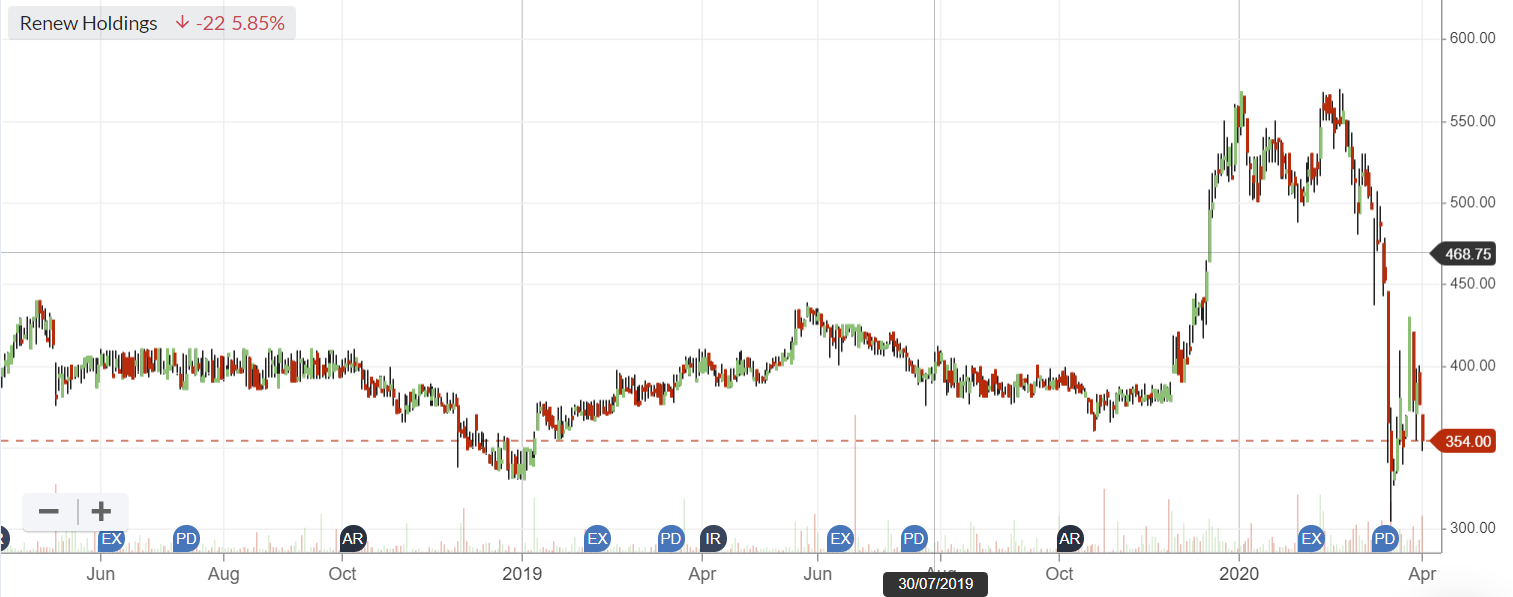
As you can see from the chart below, the share price has only corrected back down to where it was before a rather euphoric rally in autumn 2019. I wouldn't say it looks a particular bargain on valuation metrics, given that we're likely to see at least some hit to forecast earnings in 2020.
.
Sorry for the unreliable timings this week.
Regards, Paul.
Disclaimer
This is not financial advice. Our content is intended to be used and must be used for information and education purposes only. Please read our disclaimer and terms and conditions to understand our obligations.

59 comments
for those who value the viewpoints of the likes of Howard Marks (the real one), Paul Tudor Jones , David Tepper ..worth a read
https://www.forbes.com/sites/antoinegara/2020/04/01/billionaire-howard-marks-pitches-a-defensive-investing-outlook/#534bbc371324
From Marks
Thus he’s still preaching defense and patience, and readying a list of businesses to buy at what could be lower prices.
Anthony Bolton takes a different view and has started buying again.
Watkin Jones (LON:WJG) who a few of us hold put out an update at 14.00 today:
https://www.londonstockexchang...
Pretty much as expected, they're closed for business, have lots of liquidity but are cancelling the interim dividend. All of next year's developments and 80% of 2022's are forward sold - although under current circumstances there's always a chance that some of the counterparties may back out.
However, they look robust against all but the end of the world with cashflow and earnings visibility for two years.
On a non small cap note Auto Trader (LON:AUTO) raised nearly £200 million in a placing today. They're in pretty good shape anyway but cars are the first thing to get hit in a recession so they've wisely taken the view that they'll get their fund raising in first. Generally in this type of situations it's the companies that react first that cope best.
With car dealerships closed they're making advertising on the site free in April. With nowhere else to go the dealers are piling in. Long term you'd have to think they'll be a winner, but it's probably going to take a while.
timarr
Newriver Reit (LON:NRR)
Cheap!
A quick look at their last set of results - half year results to 30 September 2019
NRR have drawn down 523m in debt
From the funding section:
“Balance sheet fully unsecured and out assets are unencumbered
LTV covenant would require a 36% reduction in LTV
Interest Cover covenant would require a 47% reduction in net property income”
For the half year NRR generated 71.2m in revenue incurred 24.3m in property expenses thus earning 46.9m in net property income. So a 47% reduction in net property income calculates as 22m.
Risk is how variable are their property expenses. If there is no reduction in property expenses, then to drop 22m means a 31% reduction in top line revenue. The pubs alone accounted for 24.3m in top line revenue so if all this was lost, and there is no reverse operational gearing on costs, the covenant is breached.
Net finance costs were 10.8m and they have 23.9m in cash so they do have sit out cash if the debt holders don’t stir.
It’s a tricky one, given the bad news on income for a full quarter hasn’t come out yet. If they can’t control property expenses, there is a vulnerability.
Great piece here by Ben Carlson comparing now to the Great Depression.
He points out:
“To get to the level of losses seen during the Great Depression stocks would have to fall another 30% from there. Then they would have to fall another 30% from there. Next would be another 30% loss from that point and yet another 30% decline from there.”
Though this (effective shut down of most of the world economy) has never happened before and therefore anything is possible. I sold 85% of my holdings 10 days ago (retaining small holdings in Bioventix (LON:BVXP) Avon Rubber (LON:AVON) Anglo Asian Mining (LON:AAZ) Rockrose Energy (LON:RRE) Ergomed (LON:ERGO) and Sylvania Platinum (LON:SLP) the rest in cash and £PHAU) because I could not handle the mental stress. I don’t believe this was “too late” (and it certainly wasn’t for my mental health) to sell out even though many of the stocks I sold (Treatt (LON:TET) Boohoo (LON:BOO) Xp Power (LON:XPP) Plus500 (LON:PLUS) Tremor International (LON:TRMR) Arcontech (LON:ARC) ) have rallied since, I still think that if governments continue with lockdown “until it is over” (whatever that means) then I will stick with my prediction of a fall between that seen in the GD and GFC. (I know predictions are very hard especially when it is about the future)
I am not going to pick the bottom and when I am mentally ready I will drip a bit of money back in to the market (probably in the stocks I sold two weeks ago) but for now I am happy to sit on the side lines. If I am wrong and I miss some of the swing up so be it. Putting money into stocks at the moment is simply gambling on the basis that the price is 30%/40%/50% lower than it was last month it must be a buy. I would compare it to a roulette player saying to himself red has come up six times so black must come up next. The wheel has no memory and historical metrics mean next to nothing and there is simply no visibility to future earnings and cash flows.
The wheel has no memory
Maybe it shouldn't, but it actually does
Directors buys very interesting at the moment:
The Restaurant Group reported this morning that CFO Kirk Davis bought 276,797 shares in the company at 28.125p per share on 30 March.
For the CFO to buy, given what they are facing says a lot about the company or him!
Newriver Reit (LON:NRR)
I hold and have had a look at the tenants, lots of 'non essentials' in there. Encouraged that the valuation implies a 75% write down. I dont know enough about the sector but some these REITS must have the odds on their side at that price. If commercial retail fell 75%, well, that surely is doomsday as the knock on effects would be enormous.
New River yesterday said that, as at close of business on 30 March 2020, it ‘had received 60% of quarterly retail rents relating to the first quarter of the financial year ending 31 March 2021. This comprised quarterly rents due on 25 March 2020 for our assets in England, Wales, and most of our tenancies in Scotland, and, for the remainder, quarterly rents due on 28 February 2020. In total, these quarterly rents represented 77% of NewRiver's retail rent due, with the remainder being monthly rents, for which the next collection date is 1 April 2020.’
Hi John - re your post yesterday what was the significance of the percentages beside the pref shares ? - tks Santander UK Plc 10 3/8% Non Cum Stlg Pre 4.73%
Standard Chartered 8.25% Non Cum Ird Pref 3.88%
Those would be the coupons (yield) at the issue price (£100).
merci :
Thanks - it was the 4.73 % and the 3.88 % i was referring to - thnaks FR
Edit
Hi, bfogarty,
Thats the weight of the holding ( % at the end) in the fund, you can see it here:
https://www.hl.co.uk/shares/shares-search-results/s/shires-income-ordinary-50p-shares
John
Thanks for coming back i did assume it was a representation of a portfolio - just didnt know the conversation was about shire - tks for reverting and appreciate clarification
Even with the shares trading at 25% of NAV, I think the current share price of Newriver Reit (LON:NRR) “only” implies a 45% fall in values from the Sept 19 valuation. The properties were valued at £1,255m in Sept. With around £510m of debt and an equity value of £182, this gives a current “enterprise value” of £692m. So roughly 55% of the £1,255 gross property assets as of September. NAV only tells part of the story. Also to get comfortable, I would wonder what the refinancing timetable and covenants look like.
Restaurant (LON:RTN) - that is the same director who bought 90k shares at £1.10 last month along with other director buys at similar prices....
Not related to anything reporting today, but I'm really scratching my head about the current value of Avation (LON:AVAP) (in which I have a very small long position). I recall someone discussing it in the comments on a different thread, but can't find those comments for the life of me.
Long story short: they lease aircraft to airlines. They have very low, seemingly linear, administrative expenses (circa 10% of revenue) and manageable interest charges on the debt used to buy the aircraft. Not to mention that the aircraft will obviously be collateral for that debt.
Looking at their last interims and simply deducting current liabilities from cash, I give them $40 m on the balance sheet. This easily covers interest for 6 months and admin expenses, so even if they received no income, I think they'd survive for quite a while yet. That scenario also seems v unlikely, given that airlines will need to keep their planes, and presumably there are break clauses in their lease agreements.
They announced in Jan that they'd received interest from a potential purchaser, which is still ongoing. Most instis seem to be selling down, though one hedge fund, Oceanwood, are buying up those shares and now have 25.63%. Fairly close to mandatory offer territory, although they had 24% in Jan, so perhaps they have no intention of getting to 30%.
As you may have guessed, this seems like good value to me at this level, and I'm thinking of adding, but the market is clearly sending me a message that I'm being too dense to appreicate.
Can anyone enlighten me?
Hi Glorenfeld, others will likely have a more nuanced and detailed view on Avation (LON:AVAP), but isn't it the case that the market is just discounting the business in light of the current circumstances and likely collapse of the short term need for the leasing of aircrafts, while at the same time assuming the potential buyer is cognizant of that and therefore likely to not make an offer now if the business will be much cheaper down the line (or just not now proceeding due to market uncertainty). It is not my area of practice but I know anecdotally that the aircraft financing departments of several large law firms have slowed down.
Thus, to be buying the shares now you are assuming the above assumption of the market is wrong, or that the deal will fall through but the underlying business is nevertheless secure. I have no view on that.
Thanks - you could well be right.
I think my first concern is regarding how much demand will be retained for the types of aircraft they hold. I would expect there will be alot of airlines going into administration, and I had come to the conclusion that because their options for the ATR aircraft were so valuable they would be snapped up quite quickly.
As the ATR aircraft tend to be regional operators, I wonder if these will continue to operate regionally without disrupting the various levels of lockdowns imposed by crossing countries. This is only my speculation, nothing to back this up I am afraid.
We are very early days and it's hard to put an timeline on this and how much asset value can be retained the longer this crisis drags on. It's postive to see they had numerous party's interested beforehand though.
Glorenfeld
A good place to start looking at Avation (LON:AVAP) is to read Carcosa comments -there is a separate forum subject - on Lemon Fool. Noted is that a number of the airlines they lease to are either state owned or very near to it. Avation has always been careful to spread it's clients around the globe to lessen it's risk and Carcosa makes a post specifically on those clients. Whether his thoughts come to pass?
Disclosure long on £avap
Very useful thread - thanks for pointing me to that!
I don't own Avation (LON:AVAP) but some of the issues I would consider are:
- How long are the leases? What are the break clauses?
- What will the market for aircraft look like when these breaks arise, given that global gdp will be having possibly its worst ever shock, the shock may be deflationary and the last global recovery was slow? Given that, what will be the hit to future earnings?
- What are the covenants on the debt e.g. in relation to earnings?
- When will they need to try and roll over the debt and what state will the banks be in when they try to do that?
- Whether their customers are govt owned or not, they can still go in to administartion and emerge anew to renegotiate contracts. What would be the impact?
- If the expectation is that govts will bail out national carriers, how confident can you be that they will be able to do that? Their own finances will be very stretched (like our govt's) and these lease obligations will be in dollars, which their currency has probably fallen heavily against.
- If they end up in dispute with foreign govts, who has the most power? Would they even want to be in dispute with these govts in the first place, or would they effectively have to give these govts what they want?
I'm not saying that Avation (LON:AVAP) is necessarily a bad investment, my point is that at times like this, for any share, you have to think of a broader range of worst case scenarios. For many shares, tail risks have increased enormously.
These are all great points, thanks.
Debt Jubilee -
So at the start, when the bailouts started to happen I was thinking, as others here, what if the companies have to pay this back, give up equity, suffer a high corp tax rate.
My thinking now, is moving towards some form of financially engineered Jubilee. Any of the three above measures would stuff the economy for years, after it's already stuffed. What government wants that, post crisis, the only way out of social chaos will be a strong economy.
Trump last night 'lets have another $2T for infrastructure', make it $4T, and you know what throw in another couple of Trillion for 'free loans to start a business' - take as much as you want but just employee people, ok!
So what if the G20 got together and said, ok, lets take all this stimulus into a central 'C19' emergency fund, and you can all pay it back later, (if you can of course, whenever...) - Spain already asking for Covid19 bonds, happening isn't it?
Two months ago, nutty MMT policy, now, why not, centrally created 0% loans to the world from the C19 fund. Inflation sure, unforeseen consequences sure, but that's a problem for the future, sure is , but not today.....
Thanks for the update on Air Partner (LON:AIR), Paul. I’ve been a holder for many years now, and have always felt that it’s kind of a hedge against adverse events (volcanoes, earthquakes, coups, diseases etc.), through its one-off emergency evacuation business.
Thanks Paul for these regular updates which are especially helpful at the moment.
I agree with the sentiment about individual stocks and believe that we could be in for a rocky ride lasting for some time. The market has rebounded from its recent lows but still seems to be overly optimistic. I tried to get my thoughts in order at the weekend and wrote Are we nearly there yet having read the Imperial research presented to the UK Government.
Some forecasts that the S&P constituents will collectively see a 120$ decline in Q2 earnings
https://www.oaktreecapital.com/docs/default-source/memos/which-way-now.pdf
Individual shares can make more sense, if companies have recurring revenues...
It occurred to me the other day that we are now actually going to find out how defensive a software recurring revenue model is in extremis. I expect that not all will prove to be as resilient as they were intended to be, and it will depend a lot on the type of end customer you have i.e. I would expect governments and large multinationals to continue paying but if your end customers are small retailers, hotels etc. then you may find those payments drying up as customers conserve cash to save their business.
BTW It's important to note that the recent price weakness in Air Partner (LON:AIR) is in no small part due to Keith Ashworth-Lord selling the entire holding in his Buffetology Fund.
All the best, Si
Totally agree - it will be interesting. Another useful thing to look for when assessing a software company is the amount of development they capitalise each year. This has the effect of reducing expenses, making profits looks bigger. If their recurring revenue is not that strong, some firms may try and capitalise more development to offset this. I always try and avoid software companies that capitalise excessive development spend (when compared to profits).
"BTW It's important to note that the recent price weakness in Air Partner (LON:AIR) is in no small part due to Keith Ashworth-Lord selling the entire holding in his Buffetology Fund".
Hmmm. Well, he reports selling on the 20th when volume did exceed 5m. But that was the 3rd day it was trading under 20p. The big lurch downs were on the 16 and 17 March.
Hmmm. Well, he reports selling on the 20th when volume did exceed 5m
We only know the 20th is when a threshold was crossed that required the RNS to be issued, but it does looks like that was when he dumped his last 5 million shares (9.62%). However, he's been selling down from a position of holding nearly a fifth of the company since June 2019 which has depressed the price for some time.
All the best, Si
That is a good point. For those who are not aware in June Keith A-L said that the size of the Buffettology fund had reached a level where microcaps (defined as less than £100m MCap) were now too small to have much effect on the fund and would be discontinued. The three 'microcaps' held at that time were Air Partner (LON:AIR) , Driver (LON:DRV) and Revolution Bars (LON:RBG) . The holding in Driver was completely sold in December and that in Revolution Bars was reduced from 19.69% to 13.15% last week.
there was a spike up on the 20 March - traded volumes
K3 Business Technology (LON:KBT)
Is an example of a IT business with recurring revenues, but those are exposed to some extent to the retail sector. They are looking to sell/put in admin one of their divisions, which I suspect is lower margin, having accumulated decent losses there.
They have raised money as a loan from some shareholders in the meantime.
For some reason this came up when I had modified my original post which seems to have disappeared. Said my post was being reviewed. Cant see why but I trust this board to act sensibly. I dont think there is anything in my original post - where I was agreeing with Simoan on who would be able to afford anything in a consumer demand-led recovery - that is in any way contentious, objectionable or what other reasons for denial of posting. Best regards
Hi Paul. Glad to hear youre on better form today. For us mere mortals what is the quickest way to assess the health of a company’s balance sheet on the stockopedia data sheets?
BW
Hederz
Watch Ed's video on the home page - exact answer to your question. I found it very valuable - as a relative newbie
Morning Paul, whilst I agree that the bounce will be short lived I would argue its not so hard to value a company actually. I don't imagine many private investors will be building DCFs but they don't need to. The whole point of a PE is to average out the DCF to a simple crude measure. The PE though isn't a point estimate, its 10-20 years earnings. So whilst this years earnings may have evaporated ... this should not impact your long term valuation by more than 5-10%. The real question is therefore is what has happened to the future earnings potential of the business and how long will it take to get back there. The recovery rate will be different for each business and severely impacted for companies that need to raise money....you need to be able to support these.
Corporate guidance will massively lag any recovery so is useless as a tool to get you there but history is pretty useful. Taking a view on next year... in companies you are happy to hold for the long term, is a rather simple process.
Sounds like great advice. It might be an idea to add a factor for covid survival though. Average 10 year earnings is a good way of taking a measured view - but if the company goes bust then the last ten years are irrelevant. The government isn't going to bail out the airlines - they want existing shareholders to bear the brunt of any new capital requirements. And they are willing to see the number of players in the market fall. So we shouldn't be complacent in thinking the government are just going to bail everything out and we'll come out the other side exactly like we went in (but a few months older). Some companies are going to fail.
That's all sensible stuff. However, I think what lots of investors may be missing right now, is just how enormous the 2020 losses could be for many companies. It's not just a question of having a year of maybe breakeven, if's more likely to be the case that many companies could see a year of absolutely ruinous losses, which permanently damage the business possibly beyond repair. It's that operational gearing which worries me & could be a lot worse than the market is currently factoring in.
I've decided that I need either (a) an insanely cheap share price, or (b) a clearer outlook for how the recovery might look - timescales, and extent. For that reason I'm generally holding off buying things now.
The other issue which worries me, is that Covid-19 could be an ongoing thing. Lockwodn measures may well contain it for now, but what happens if the same issue strikes again, maybe mutated in some way? A second wave of pandemic could easily finish off many companies that had been seriously damaged in the first wave. Why take the risk?
not to mention secular and structural changes to the economy. Necessity is often the mother of inventions and the lockdown has necessitated a number of innovations in how we work and live
: a good few of which are likely to prove lasting. An obvious and immediate example: almost everyone I know has adopted ZOOM $ZM over conventional video conferencing including Skype, FB messenger, Facetime , Hangouts etc - many schools have implemented it as has employers. BTW, $ZM shareprice has doubled since the pandemic
https://www.forbes.com/sites/alexkonrad/2020/03/13/zoom-video-coronavirus-eric-yuan-schools/#60e2a904e714
So strongly agree with Paul about the risk of a second and possibly more severe wave. The risks of that have been totally ignored by Governments worldwide.
That was what happened with Spanish flu. Original outbreak death rate was, like now, modest. It was the second wave that was the terrible killer.
The kitchen sink has been thrown at this first wave. If there is a second severe phase before a vaccine then the consequences are terrifying from our own health and economic angle. What else could be done to tackle it then? The most extreme ammunition has been used up now.
A recent post questioning whether it might well have been better to go for the Sweden approach of partial lockdowns throughout the Country got no follow up. But keeping most places open, but with strict controls on numbers admitted and keeping to social distancing would have meant many more businesses surviving this. e.g garden centres where there are often large outside areas and plenty of space inside too. Same could and should imo have applied with shops. And THE most drastic response possible, total lockdown, would still have been available.
Few seem to have noticed that while there IS total lockdown in many areas of the UK where there are only a small number of recorded cases, meanwhile in badly affected London there IS partial lockdown with overcrowded tube travel at least until very recently. And NHS staff on front line, and STILL scandalously exposed to coronavirus as STILL no proper protective clothing, were until very recently travelling in these overcrowded carriages in their uniforms!
Also agree strongly that it is impossible to assess most Companies from investment angle. Total shutdowns are unprecedented even in the two World Wars. Even Next, throwing off cash like no tomorrow before this crisis, is at risk of going bust. And sometimes what applied on Monday is out of date a couple of days later.
e.g Mountain Warehouse went from discussing their expansion plans on a Friday, and by the following Tuesday expressed fears they would go bust!
So how can figures that may well be out of date as events unfold be relied on, except for a few Companies not obviously affected by coronavirus and a few who benefit. Market presumably knows about those with shares priced accordingly?
I suspect the response will get more nuanced as the pressure on the NHS flattens, as staying in lockdown is not credible.
The testing via the antibody test is urgently needed to see the scale of herd immunity.
The problem is the big Cities for any nuanced approached where lockdown is eased, because mass transport is required, and the young will have itchy feet to start living their lives fully.
Why take the risk?
At these levels, many companies are half the price of a couple of months ago. Ideally find the ones whose earnings will not be impacted much, then look at ones that will surely survive. These are the ones that will yield good investment returns looking out a year or two.
Strongly agree with this. There are good companies with strong balance sheets that have been dragged down in the general sell-off. Some will not be strongly impacted, and in some cases stand to benefit, from the current awful situation. Stocko + Google gives us all the tools we need to find them.
That said, the best advice I ever got was to invest in the market only the amount of money that doesn’t keep you awake at night. So I am buying, but not to levels that I would have three months ago. Health is wealth, and if on top of everything else investing is too stressful at the moment then stepping away from the market is absolutely the right thing to do.
I agree that plenty of companies will benefit. Look at the disaster that was Eddie Stobart and ESL the holding company. Business is soaring with their trucks on the road 24 hours 7 days a week delivering to supermarkets and so on and all the previous restrictions suspended. Would the business have even survived without this disaster? Ironic. Done very well out of this stock myself as it races up and down.
Paul, in your derisking have you scaled back on RBG too?
Hi Tim,
Paul, in your derisking have you scaled back on RBG too?
I've not changed any of my long term positions (in my SIPP).
In my trading account, I massively increased my Rev Bars position (over 6-fold) as the share price fell, but have more recently got cold feet about my total exposure if it goes bust. Hence I've cut about half this week. Overall then, it's still a big position, but survivable if it goes bust.
I'm looking at everything, and working out how much it would hurt if it goes bust. It's so sad to be looking at fundamentally good companies, and thinking that this crisis could destroy those businesses & all those jobs too.
In overall portfolio terms, I've had a disastrous time with my small, speculative longs (serves me right maybe!). But as reported here in February, my strategy has been to fully hedge my longs with big shorts on indices & travel companies. That's worked out well overall, so I live to fight another day.
Going forwards, I'm re-thinking the whole risk:reward calculations.
Best wishes, Paul.
In the midst of chaos a good update from Argentex (LON:AGFX) today:
Argentex is expecting to report a c.30% increase in revenues to c.£29 million for the 12 months to 31 March 2020 (2019: £21.9 million), with Foreign Exchange ("FX") Turnover exceeding £12bn (2019: £10.8bn). The Group continues to experience very strong growth in customer numbers, adding 450 new corporate clients during the period, while corporate clients actively trading increased by 12%. Following the Group's sustained excellent financial and operational progress, the Board is confident the Group will meet its full year profit expectations.
Wish all my holdings were doing that well :-/
timarr
Tim
Do you prefer Argentex (LON:AGFX) to Record (LON:REC) or are their businesses very different?
Hi FREng
I hold both, less Argentex (LON:AGFX) than Record (LON:REC) because I'm still trying to understand its business model and without the same history as Record it's hard to have confidence in the management.
However, the two companies are quite different - Argentex are a specialised forex broker whose main competitors are banks. In theory they don't take any risk on the transactions and part of their business model is to replace banks' own FX functions.
Record are more like an investment or hedge fund manager only they manage FX rather than assets. Same principle though. Their main risk is that they do a poor job and clients leave, reducing their fees and commissions.
This FX stuff is a minefield though - Alpha Fx (LON:AFX) who got caught out the other day are another type of intermediary managing dynamic hedging and is exposed to rapid changes in exchange rates - which theoretically doesn't matter but, as we've just seen, exposes them to counterparty risk. But Alpha Fx (LON:AFX) was far more highly rated than Argentex (LON:AGFX) or Record (LON:REC) so what do I know?
timarr
Thanks Tim. That's really helpful. Record (LON:REC) looks attractive to me.
Morning Paul,
I wonder if you'd like to comment on the 'trading update' by Argentex (LON:AGFX) this morning? I'm sure it'll infuriate you as much as it did me!
Thanks,
IG
Hi IG,
Sorry I didn't get round to looking at this. Doubt I would have any insights on this type of business anyway.
Regards, Paul.
I was fortunate to buy Air Partner (LON:AIR) last week ... (thanks to this newsletter and commentators for drawing my attention to it). It has rallied hard off lows, but the news out today certainly suggests it is still cheap / should have further to go (IMHO).
My morning smallcap tweet:
Renew Holdings (LON:RNWH) LPA (LON:LPA) Norcros (LON:NXR) Christie (LON:CTG) Westminster (LON:WSG) Air Partner (LON:AIR) Kin and Carta (LON:KCT) Plutus Powergen (LON:PPG) Zoetic International (LON:ZOE) Robinson (LON:RBN) Finncap (LON:FCAP) Seeing Machines (LON:SEE)
Renew (RNWH) guides H1 (end March) in line. Operational across the majority of sectors, but experiencing disruption in certain areas. Ne debt £15m-£17m. Revolving facility of £44.2m. Passes div.
LPA Group(LPA) a number of UK and export customers have temporarily suspended operations. Co reducing production capacity. All three units will remain open. No financial comment.
Norcros(NXR) trading in line until recently. Guides U/L op profit £31m cf f/c £35m. China supply chain operating at close to normal levels. Operations and trading has ceased in SA. UK sales minimal. Groupin a strong financial position. YE net debt c.£40m and leverage 1.1x. Covenant 3x. I hold.
Christie Group(CTG) Stock & Inventory Systems & Services division's physical activities stopped. "Pharmacy counts continue where we see it as supporting an essential sector. The cloud based visitor attractions system remains fully operational, but understandably online traffic has slowed. Professional & Financial Services division continues to provide a restricted volume." Most staff on furlough. Guides FY loss. Has enough cash to survive.
Westminster Group(WSG) co has multiple revenue streams.Airport operations hit but product sales experiencing record enquiries. Q1 profitable with rev up 30% to £4m. £2.2m cash.
Air Partner(AIR) Feb & March profits well ahead of both budget. The order book for April is encouraging. Co positioned to cope with covid.
Kin and Carta(KCT) A few clients scaling back or suspend some projects, partial slow down in pipeline conversion. "78% of our revenue is from multi-year client engagements and as such we are seeing many large digital transformation programmes continue as planned." Cancels div. Discussing the £3m PA pension deficit contribution. Co doesn't anticipate liquidity constraints, but potential breach of current net debt to EBITDA covenant. Banks supportive.
Plutus PowerGen(PPG) won't develop new gas sites. Co has no ongoing operations or revenue but holds interests in existing FlexGen sites which are up for sale. Lenders are suspending the provision of further funds giving significant cash uncertainty. Dependent on support of creditors.
Zoetic (ZOE) US CBD division costs unlikely to be covered from product sales and cash balances in the US are low. UK OK. Selling 3m feminised hemp seeds to raise cash. US O&G div srtuggling.
Robinson(RBN) upturn in demand for some products including hand wash containers and other personal care, household and food packaging. "To the extent this is driven by stocking (as opposed to usage), this may reverse over time. The largest threats to our business are still to materialise." Financial position remains strong.
Finncap (FCAP) trading in line with Feb stmt. Expects H2 broadly breakeven. Still has strong pipeline of M&A deals for Q1 but expects a number of deals pulled or delayed. Passes div.
Seeing Machines (SEE) wins pre-production license deal with a major car mfr. $5m license fee by June.
I favour a retest of the lows and potentially fresh lows if they fail , the VIX has remained highly elevated despite the rallies and is still above 50. The macro is pretty appalling and no amount of stimulus will change that anytime soon
Yip, agree. Lots of money to be made in bear market rallies (and lost if get carried away).