Small Cap Value Report (Wed 11 Sep 2019) - BOTB, SFOR, EPWN, PEB

Hi, it's Paul here.
Good morning! I'm settling into a pattern of writing from late morning, through to tea time, which works best for me. Therefore today's report estimated time of completion is 5pm.
Update at 16:57 - today's report is now finished. I decided to have a bit of a ramble about macro stuff in the last section about PEB, so will check it for spelling & grammar mistakes next (I type fast & inaccurately when something interesting crops up!), and then invite your comments!
I see we have 1 or 2 subscribers who insist on giving each report a thumbs down, every day, late morning, presumably because they are displeased that the report isn't complete by then. We agreed some time ago (overwhelmingly supported by readers at the time) that I would take my time writing these reports, and not rush for any deadline.
Therefore if you want to see a completed report, please come back at the indicated (above in bold) completion time. Thanks.
BOTB
Share price: 288p (up 6% today, at 11:12)
No. shares: 9.38m
Market cap: £27.0m
(at the time of writing, I hold a long position in this share)
Trading update (AGM statement)
Best of the Best PLC, (LSE: BOTB) the online organiser of weekly competitions to win cars and other luxury items...
Trading seems to be going well;
The Group is pleased to report that the positive momentum to the start of the year, reported at the time of the full year results in June, has been maintained and the Company has continued to make good progress and is trading comfortably in line with market expectations for the current financial year.
I'm not a fan of the phrase "comfortably in line". Surely that must mean: slightly ahead? In which case why not just say so?
The last physical airport site has now gone. Therefore BOTB is now an online only business, which makes it simpler to manage. The physical sites had a different business model - high ticket prices, as one-off purchases. So that wasn't really compatible with the online model of much cheaper tickets, to encourage frequent purchases by customers.
Note that the gradual closure of the physical sites in recent years actually masked the stronger growth coming from online operations. With those sites now all gone, this means that the top line growth rate could now accelerate - a trigger for a possible re-rating, perhaps?
Valuation - the latest house broker note (available on Research Tree) shows 17.0p for FY 04/2020. Although it notes today that there's possibly upside on that, given today's favourable RNS. That's a PER of less than 16.9 - which strikes me as excellent value, for a small, but decently growing, profitable & cash generative online business, with recurring revenues, that operates in a niche of its own. Its market is global, now it's online only, so there's almost limitless growth possible.
My opinion - I remain a happy, long-term shareholder here. The company has paid out loads of dividends in recent years, including specials. In drawing sensible salaries too, management has proven thoroughly decent, by treating minority shareholders fairly. Therefore I trust management to look after my & other small shareholders' interests. That matters a lot, as there are plenty of rogues around on AIM, as we know.
An adverse tax ruling has dented forecasts a little, but the company seems to have taken that in its stride (meaning that underlying growth is stronger than reported growth). Marketing spend can be dialled up & down as required, so the business is nicely set up, in the event of a recession. I get the impression that management is learning & improving what online advertising works best.
It's a pity the shares are so illiquid, so it takes time to build up, or unwind a shareholding here.
The valuation currently looks very appealing to me - it's a GARP share (growth at reasonable price) in my view.
S4 Capital (LON:SFOR)
Share price: 139.25p (up c.1% today, at 12:15)
No. shares: 365.1m
Market cap: £508.4m
About S4Capital
S4Capital plc (SFOR.L) is a new age/new era digital advertising and marketing services company, established by Sir Martin Sorrell in May 2018.
Its strategy is to build a purely digital advertising and marketing services business for global, multinational, regional, local clients and millennial-driven influencer brands. This will be achieved initially by integrating leading businesses in three practice areas: first-party data, digital content, digital media planning and buying, along with an emphasis on "faster, better, cheaper" executions in an always-on consumer-led environment, with a unitary structure.
This one is a bit bigger than the usual companies I look at, but the Martin Sorrell factor makes it particularly interesting;
Sir Martin was CEO of WPP for 33 years, building it from a £1 million "shell" company in 1985 into the world's largest advertising and marketing services company with a market capitalisation of over £16 billion on the day he left.
Therefore, his latest venture, S4 Capital is being closely watched. Sorrell is very scathing about conventional marketing, saying that it's had its day, and digital is the only area of interest to him now.
I looked at its last few trading updates, and thought they sounded a bit rampy, trumpeting top line growth, but saying little about profitability. Hence I decided to reserve judgement until the next figures are issued, which has happened today.
Interim results -
Revenue growth is strong;
Revenue was £87.97 million, up 41.6.% from £62.13 million on a pro-forma basis in the comparable period in 2018 pro-forma.
Operating profit - this is where it gets tricky to analyse. The statutory figures show a big deterioration from a profit of £12.2m last time (pro forma, to strip out the effect of timing of acquisitions), to a loss of -£6.2m this time.
Adjusted profit - there are nearly £15m of adjusting items, which improves this year's H1 to an H1 adjusted operating profit of £8.7m (although even the adjusted figure is down on last time's £12.3m). The company explains that it is in a dash for growth, hence is loading up on headcount to achieve further growth.
Adjusting items - are highly material, so needs scrutiny, see note 1 to today's accounts. These are the adjusted items;
Amortisation charge relating to acquisitions of £6.3m. That's fine to adjust out, in my opinion, and this is standard practice with most acquisitive groups. The book entries for goodwill & amortisation are irrelevant when it comes to valuing a company & assessing its underlying profitability.
Non-recurring expenses of £8.7m is the balance of the adjustment to profits. So what's in this total? Sub-note 1 tells us;
Non-recurring expenses relate to the total expenses for acquisitions of £ 7.4 million and share based compensation of £ 1.3 million. In addition, there is a (deferred) income tax credit of £ 1.3 million.
Since the group has been making large acquisitions, then expenses of £7.4m sounds reasonable to me.
The only item I normally quibble over, is share based compensation, which is really remuneration, and should therefore be expensed, in my view. But £1.3m is not terribly significant relative to the total figures.
Overall then, it seems to me that the adjusted profit is probably acceptable as a means to measure performance & valuation, in this case.
Sector thoughts - It's worth pointing out that PR/marketing companies are in the business of polishing things to appear better than they are. This often extends to their own accounts too, in my experience! They just can't help themselves. Therefore more than usual scepticism is required when investing in this sector.
Another sector risk is that marketing spend is often the first thing that companies cut back on, when recession bites. So if you have a negative macro view, then this sector is probably best avoided.
Balance sheet -
NAV: £334.3m
NTAV: is negative, at -67.6m - this is due to the humongous £401.9m intangible asset line, created when it made some large acquisitions. I don't normally like investing in companies with negative NTAV, but it can sometimes be acceptable if they are highly cash generative.
Overall, I'd say the balance sheet is weakish, but not alarmingly so.
Valuation - I think it's best to rely on broker forecasts, as we don't have a lot to go on re historic results, as this is a newly created, rapidly growing group.
The lastest figures I have are 5.4p EPS for FY 12/2019, and 8.5p EPS for FY 12/2020.
At 139p per share, that gives PERs of 25.7 (expensive), and 16.4 (more reasonable).
Therefore, if forecasts are likely to be achieved, then this share could be worth a punt.
There again, rapidly growing groups are not necessarily best valued on short term profitability. It can be all about creating the groundwork for a much bigger business in future. That's something to consider.
The Sorrell factor is another quandary for investors to consider. No doubt there are plenty of investors who are essentially backing his experience & judgement, rather than the short term results. He's getting on a bit in years, and his style may not be to everyone's taste, but it's difficult to argue with his track record.
My opinion - I like the whole digital marketing space, and Sorrell is an industry heavyweight. Therefore it's really tempting to just buy some S4 Capital shares, and tuck them away for the long term.
I can't see anything awful in the figures today. The adjusted profit looks OK. The balance sheet is weakish, but not a deal-breaker.
Overall then, this gets a cautious thumbs up from me.
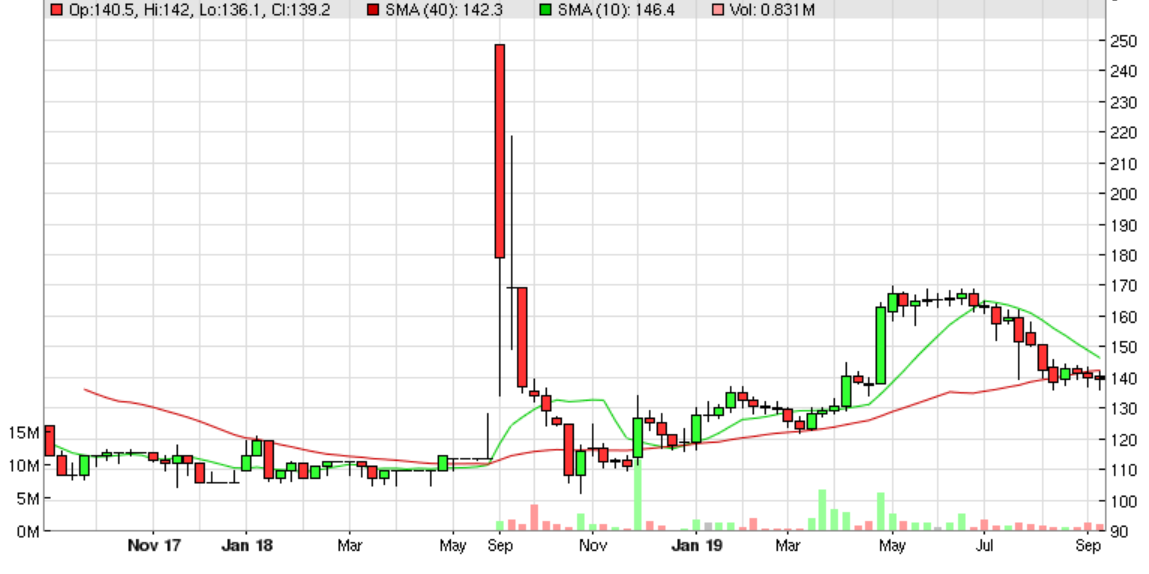
The spike in price in Sep/Oct 2018 seems to have been a speculative frenzy when the new group was set up:
Epwin (LON:EPWN)
Share price: 80p (up 6% today, at 14:16)
No. shares: 142.9m
Market cap: £114.3m
Epwin Group Plc (AIM: EPWN) ("Epwin" or the "Group"), a leading manufacturer of low maintenance building products, supplying the Repair, Maintenance and Improvement ("RMI"), new build and social housing sectors, announces its half year results for the six months to 30 June 2019.
A quick look at the StockReport here suggests that this could be an interesting value share: low PER & high yield;
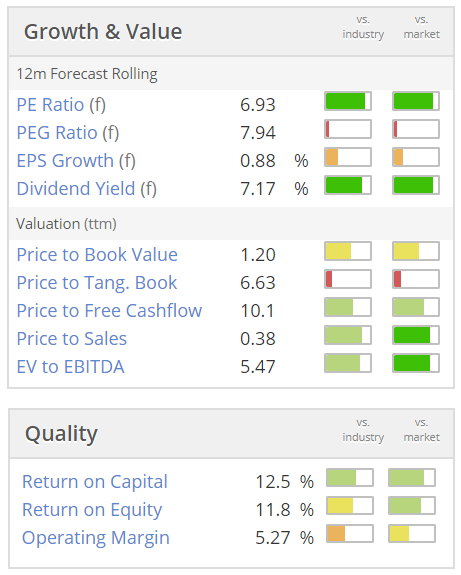
It's very unusual these days to find a dividend yield (7.17%) higher than the PER (6.93), and when you do - it's usually a sign of trouble!
Maybe Epwin could be an exception to that?
Outlook - sounds good - this excerpt below is the key part, with more detail available in the RNS for anyone interested in digging deeper (remember, my comments here are just a review);
The Group made an encouraging start to 2019 and trading since the half year has continued in line with expectations.
Price increases have begun to mitigate the significant material cost inflation experienced during 2017 and 2018, we have seen stable volume in our core products and the initial benefits of our footprint reshaping are coming through.
The Board anticipates adjusted profit before tax for the full year to be in line with market expectations.
However, despite the external environment, the Board remains confident that the actions it is taking to strengthen the Group's position by consolidating the footprint of its manufacturing operations and focusing it towards the higher margin extrusion and moulding operations, which have technological and investment barriers to entry, will deliver an improving financial performance.
The Group remains well placed in its markets, with sound prospects for the future, supported by our confidence in the medium and long-term drivers of the RMI market.
I particularly like the comments above about recouping previously absorbed (by Epwin) cost price inflation. I've come across this many times, both as an investor, and running a business myself (as part of a team). It is often the case that, in the short term, input cost increases have to be borne by a company, thus reducing its profit margins. However, over time, customer contracts are re-negotiated, and providing you present a good case to the customer as to why prices have to go up, normally they're pretty reasonable about it. Especially as competitors are also quoting higher prices, since they are also subject to higher input costs.
Therefore, there is typically a time lag when input prices rise sharply, which companies then gradually recover, in future, through price rises. It looks like Epwin is in that situation now - which makes the shares potentially attractive.
Purchase, sale & leaseback - this sounds interesting;
The Group's financial position remains strong, with good cash generation in the half year and net debt of £29.2m, representing 1x adjusted EBITDA.
Furthermore, the arm's length transactions to acquire, sell, develop and lease the new Telford warehouse and finishing plant, which are expected to deliver circa £8.0 million of surplus cash to the Group in the current year, will significantly reduce the Group's debt. This gives the Group significant funding headroom to continue to invest in the business and progress with its strategy.
I think investors need to look at this closely. Interest rates are incredibly low at the moment. Therefore, signing a lease at potentially a high implied rate of interest, may not be the right thing to do at all. It could lock in a high funding cost.
It might be a lot better to buy the freehold, and then put that into a SPV with a long-term, fixed rate (ultra low) interest rate, with no recourse to the group.
Investors might want to look into this & question the logic of it. Generally, I'm not keen on sale & leaseback type arrangements, to reduce gearing, as it can often mean committing to excessive future rents.
Again, I'm not judging this - merely flagging it to readers as something you might want to look into in more detail, if considering a purchase. More recent subscribers might not know that Graham & I just offer a review, and personal comments, on company results. We're never recommending, or tipping things. We leave that to the spivs elsewhere!
Balance sheet - usual key figures;
NAV: £86.9m, which includes £76.1m intangibles (ignoring the daft new right of use leasehold asset)
NTAV: £10.8m - I'd like this to be stronger, but it's not a deal-breaker.
My opinion - as with several companies I've reviewed this week, my preconception was negative (typically caused by previous disappointing results), but on scrutinising the latest numbers & commentary, I'm left with a more favourable view.
In terms of macro - it seems to be focused on products for housebuilding & maintenance, which are not likely to decline in volume any time soon. Also, the weaker sterling should help make it more competitive versus imports. As always though, macro comments & assumptions are little more than educated guesswork.
In conclusion then, I give Epwin a cautious thumbs up, and think it looks worthy of a closer inspection.
Pebble Beach Systems (LON:PEB)
Share price: 7.15p
No. shares: 124.6m
Market cap: £8.9m (NB. note the net debt of £9.0m)
Interim results yesterday show a good turnaround at the P&L level. However, the balance sheet is laden with way too much debt, so that will need to be refinanced at some point. Extremely high risk.
That said, with interest rates so low, banks are often happy to let struggling companies tread water, and trade their way out of problems, which makes sense for everyone concerned. They used to be called "zombie companies", but we hear that phrase very little today. The world has never seen sustained, ultra-low interest rates before. So we're in uncharted territory. It probably won't end well, as sooner or later, credit is likely to be withdrawn. Unless the banks are nationalised, and it becomes policy to continue extending un-repayable debt? e.g. China. That actually makes debt repayable (as it becomes re-financable), bizarrely. So who knows?
As an aside, I make a conscious effort now to stop using the artificial certainty of the word "will". e.g. this will lead to that happening. The reality is that all commentators are guessing. Very few people accurately predict the future, in fact hardly anyone does. Therefore, when I read commentary, I like to hear a bit of modesty. Since my decision to extinguish my strident, and rather angry Twitter personality, being aggravated and perturbed about almost every aspect of modern life, I'm trying to re-phrase comments more in terms of: this might happen, or that might happen.
Commentators who are certain that this or that WILL happen, are almost certainly going to be wrong. For reasons unknown, or not imaginable. When people predict things, they rarely have insights. They normally just extend current trends ad infinitum. e.g. we all know that the economy is cyclical. Yet, when the first signs of a downturn start, how many brokers start predicting an operationally geared downturn in earnings? Hardly anyone! They just keep the existing spreadsheets with a 10-20% growth in earnings, which don't make sense any more.
All I would say, is that history shows clearly that when people start to think conventional financial rules don't apply any more, then you're at or near the top of a bubble, with a huge crash impending. Why? Because cheap credit means that credit is mis-allocated, and creates over-supply through over-investment. Think too many glitzy but uneconomic restaurants (Jamie?), too many new hotels, too much of everything. As they become loss-making, and go bust, then banks withdraw credit from vulnerable sectors, which triggers a wider recession, as staff and suppliers begin to lose out.
Back to Pebble Beach: there are some smallish Director buys announced today.
My opinion - neutral. I'm just flagging this as a potentially interesting share, for turnaround specialist investors to possibly have a look at. I like the revenue growth, and upbeat commentary - so I see signs of life in the figures.
It's a bit too high risk for me personally, given the heavy debt burden on the balance sheet. Although it's tempting to have a small punt on PEB shares, in case the turnaround does take hold. At this stage, I would not invest anything more than fun money, as the risk of a 100% loss still looks quite high, albeit reducing following improved figures.
Closing comment - I realise that things are changing rapidly, but we must be one of the first (and possibly last) societies which ignores the wisdom of people who have lived the longest, and seen & done the most, and instead elevates the naive idealism & simplistic views of children.
Best wishes, Paul.
(P.S. if you don't put out the recycling bin, I'm telling Greta Thunberg!)
Disclaimer
This is not financial advice. Our content is intended to be used and must be used for information and education purposes only. Please read our disclaimer and terms and conditions to understand our obligations.

31 comments
I see Best Of The Best (LON:BOTB) has a front page advertorial on PH today (blokes' version of Mums' Net) - that must be worth a huge number of clicks https://www.pistonheads.com/news/ph-advertorial/win-your-dream-car-with-botb---promoted/40938
I don't know anything about medical insurance policies. However, I do think that the insurance companies that are underwriting them, could be bust, long term.
Why? A friend has paid something like £200 per month for years into a policy. His Mum recently fell ill. The NHS did a good job dealing with the emergency, then he moved her to a private hospital in London, at a cost of £6k <b>per day</b> to recover - funded by the insurance policy.
Anyone who is funding the liabilities side of medical policies, looks to me like a fool.
I hold Legal & General (LON:LGEN) and Aviva (LON:AV.) but I can see big risks in both.
It is not a question of refinancing liabilities. Their only meaningful liabilities are policies such as annuities and life assurance. Yes these liabilities are enormous but they don't have to be refinanced, they have to be paid out. The question is, will they have the assets to do this and leave something over for shareholders?
In the old days it was easy for them. Each year brought a new wave of demand for annuities mandated by law. They matched these up with govt bonds yielding 10% and hey presto, easy money. Now they don't have enough demand for annuities so they have to go out and find other liabilities e.g. pension transfer. They then match these up with ...... what? A govt bond with negative yield? How will that work? Yikes!
So the likes of LGEN have moved in to riskier areas (house building!) in search of higher returns. The issue here is what happens when the assets turn bad? LGEN have about £500 billion of assets and £9 billion of book value. So if their assets decrease in value by 2%, they are insolvent.
I'm not saying this is about to happen, far from it, but it gives some perspective. LGEN is a far more cyclical business tied to the fortunes of the UK economy than it used to be (AV is a bit different) so it is no surprise to see the shares recover as the odds of no deal Brexit have receded somewhat.
When you are talking about large companies, they are not overlooked by the market. So if they are cheap, they are cheap for a reason. No one on this board, including myself, will have the capacity to analyse these stocks to the depth that Mr Market does.
The policies are liabilities that need to be honoured. If they have a shortfall in their ability to pay what's due they will need to find the money from somewhere....ergo issuing equity to make good the gap in their cash (of course they can also increase costs for new policies etc)
I'm not convinced there is a good market in professional opinion about risk these sort of complex financial companies are exposed to unlike say Next (LON:NXT) where many have the capability to take an informed view.
Agreed the policies have to be honoured, hence the risks I discussed in my comment. Just to be clear, my comment about refinancing liabilities was in response to a comment above which said:
"The valuation rests squarely on their ability to refinance their enormous liabilities.
With rates so low, maybe they will but revenue is also shrinking as a result of yields.
Same situation with banks e.g. Barclays."
I was trying to explain that this isn't true and seems to be based on a misunderstanding.
Let me clarify my point as I wrote this in a rush, Aviva's liabilities are very long duration due to the nature of pensions, this means with rates falling, their net interest margin (NIM) is decreasing unless they take on even more duration on their assets. This is a real problem for insurers and why L&G have gone into property (even an empty property is better than negative rates or being pulled shorter duration).
However, on top, this doesn't just refer to their ALM management (£12.8bn policy liabilities), it also refers to their £7bn issued debt. However, as I said, this is less of a problem.
Additionally, the below comment wouldn't occur because their assets are generally matched to be correlated to liabilities (except for duration to produce NIM). This is why they aren't insolvent by just an asset decrease.
"LGEN have about £500 billion of assets and £9 billion of book value. So
if their assets decrease in value by 2%, they are insolvent."
Yes, that's the issue, can they fund those long term liabilities
I too looked at Aviva but stopped when I saw the BBB bonds on the asset side. Good luck with those.
No question the 9% dividend is stellar, but I would have to spend days drilling through the balance sheet to get a grip on asset - liability matching, including duration, in a global interest-rate declining world. That's even if the data is there in the public forum in sufficient detail.
Analysts have already done the hard work for broker reports ? Institutions would not buy without a view on this.
Hi,
You also have to weigh into the calculation the longevity risk and the capital amount of the asset for which a return is implicit in the annuity pricing. Everyone knows those calculations are only best guesses. However, this need to best guess is the real risk and I do know how much work is put into that issue. As longevity is falling at the moment that is a risk that is going their way, but I remain of the view that there is no complacency to the very real risks faced in a low yield environment.
Pension transfer is a great business for these insurers and whilst competition is increasing, the risks are manageable and quantifiable as the seller has to price it to be fully funded at transfer.
The move into buy to rent is not a step beyond expectation as it provides an asset for which they can price risk, which is an extension what they already do. Their growth has enabled them to expand into more diverse asset classes.
I have no ability to analyse these very many risks, but having met and in some cases worked with those that do, I have faith in their abilities and integrity towards the work they undertake.
Regards
"So the likes of LGEN have moved in to riskier areas (house building!) in search of higher returns. The issue here is what happens when the assets turn bad? LGEN have about £500 billion of assets and £9 billion of book value. So if their assets decrease in value by 2%, they are insolvent".
This is simply wrong. The vast majority of Legal & General (LON:LGEN) assets are financial investments relating to non-participating contracts. If these assets go down 2%, then the corresponding liabilities also go down 2% and book value does not change.
Under Solvency II, Legal & General (LON:LGEN) needs to be capitalised to a minimum 1-in-250 likelihood of insolvency in any given year (it will hold much more capital than this minimum requirement in practice). A 2% drop in the value of their assets is clearly very much more likely than 1-in-250.
Hi
I don't want to make an argument about this, I was only trying to fill in some blanks from some of the earlier comments, but:
- You say the vast majority of assets relate to non-participating contracts. In a non-participating contract the payout is fixed. The beneficiary does not participate in the performance of the assets. So LGEN's liabailities are fixed and do not reduce if the matched assets reduce in the way that you claim.
- I couldn't tell you what mix of contracts LGEN has (along with all the annuities etc) but the point remains that they are highly leveraged to the performance of their assets and those are mostly UK based assets.
- Solvency II is based on 1-in-200 year events, not 1-in-250 (actually a 99.5% chance of meeting claims over the next 12 months)
- If you look back over the last 50 years at the number of 1 in a thousand/million year events that have happened in financial markets, then it is clear that the industry has no real idea what a 1-in-200 year event really is because negative events are not independent. We saw how such models fell apart in 2008.
- To take one example, what are the odds of a hard-left Labour govt? Will it implement some of the wilder policies that have been mooted? What value in LGEN assets after that?
Aviva (LON:AV.) and Legal & General (LON:LGEN) - could be great investments. Does anyone understand their balance sheets and liability exposure? In addition, what drives revenue growth prospectively?
I think a lot of macro, political and financial risk is embedded in these stocks beyond the 'mere' risk of their books. But is there enough risk priced?...and what is are the odds of relatively catastrophic future risks? In a world of supposedly dead inflation and negative yields a fair degree of financial whiplash could come out of the blue....and that is magnified through these companies. Who knows, maybe in a few years time they need emergency equity raise as yields have risen dramatically and although that means their long duration liabilities have collapsed structured retirement products and shorter duration insurance liabilities plus any partial liability matching or dynamic hedging on longer duration liabilities may be wearing a large capital loss (which goes through P&L and to an indeterminate degree cash flow statement).
The above is making up negative scenario so not prediction.
About 9 mths ago I had a pop at analysing Standard Life Aberdeen (LON:SLA) to see if there was a mispricing due to transition from hybrid insurer and investment manager to global investment manager. I gave up quite quickly when trying to work out actuarial liabilities and gains related to insurance book that had been sold on.
I have zero forecast negative or positive on these stocks but interested in explanations either way.
(I did start out in the City as an actuary so have some understanding although switched course after a few years from liability to asset side when actuarial 'science' was just a bit too dull and arcane IMO)
M Winkworth (LON:WINK) Interims appear steady, slightly down on last year.
Hi Graham,
M Winkworth (LON:WINK) Interims appear steady, slightly down on last year.
I had a very quick look at Winkworth's figures this morning, but decided not to report on it in the end, as it's so tiny.
I very much welcome when subscribers want to comment on results here in the comments section, so please feel free to do your own synopsis whenever you like.
Typically I'll only have time & mental capacity to look into maybe 4-5 companies each day. So subscriber comments on more peripheral stuff is highly welcomed!
It's a team sport, after all. Some of the best ideas come here from the reader comments.
Best wishes, Paul.
M Winkworth (LON:WINK)
Had a brief look at Wink last month, given it was so cheap with a high dividend. Not gone through yesterday's results other than read Chairman's statement.
Buy case:
Cheap, high dividend, net cash on balance sheet
Insiders own 47%
Small real estate firms in the UK going bust, some low hanging fruit for Wink to pick up
Property market transaction in a cyclical low, due to Brexit and the removal of property investor income expense tax relief, but the market will eventually come back and revenue will jump up
Revenue hit by tenant fee ban, but landlords will eventually build this into rents, so it will wash
Good history of returning cash to shareholders
Sell case:
Eventually, all this activity should be (mostly) on-line, or perhaps more likely, Wink's growth is stifled as marginal business goes to on-line entrants
Probably in the round the bulls have it, but I personally prefer companies with higher growth potential, but as a value bounce on a property market revival, Wink could rerate nicely.
Onthemarket (OTM) signed a potentially big deal today with Barrats. Free initial contract so will not impact revenue this year but could be a sign of deals to come from other big house builders.
Re £BOTB : AGM statement that "trading comfortably in line with market expectations" and "confident" for the current financial year. No sign of any slowdown, now 100% online and tax issues settled.
Great quality (SR 98) and EV to EBITDA of <5 with Sales growing, albeit very modestly, at >30% op profit margin and no LT debt.
As ever then, a great lifestyle business, with nice if irregular total divis (ie inc. special divis) for shareholders but much more potential as part of a bigger, harder driven group.
I hold for OK income, hoping for either a takeover (or takeover rumour price spike) to brighten my day.
I am beginning to wonder why I bother with high risk AIM and small cap shares. Within the last 2 to 3 weeks I have bought Aviva (LON:AV.) and Legal & General (LON:LGEN) mainly for their circa 8% yields. They are both up over 10%.
I was prompted by a contribution to this site, I forget who by, but thank you. It is at least a collateral benefit from following this column religiously.
Why are these shares so cheap? Can it just be Brexit?
The yield is pretty much all investors have had from £AV. The share price is below the 1995 level.
I suspect this is one reason why investors look elsewhere, although of course it may well be good value going forward.
Buy low, sell high, collect the divis in between and don't let the grass grow under your feet.
The valuation rests squarely on their ability to refinance their enormous liabilities.
With rates so low, maybe they will but revenue is also shrinking as a result of yields.
Same situation with banks e.g. Barclays.
Aviva (LON:AV.) and Legal & General (LON:LGEN)
Strangely i too added these exact two shares too based on the same comments made - it was based on the realisation they were almost at that magical number the the motley fool guru used to refer too - anyway pe of approx 7 and dividend yield of approx 7 - with no future material forecast reductions expected seemed worth the risk.
All i would say is that what can easily spike up can just as easily spike back down - so i am not presuming the decent short term gain proves anything other than if i was to sell this minute my timing would have been lucky.
Aviva in particular is all very black box stuff to me - in that there are probably any number of unknown unknowns that could probably put the shareprice in reverse if they happened.
I also bought £AV and £LGEN at the same time!
Jefferies say today about Aviva:
"Aviva is the only Large European insurer that trades near its 2016 Referendum low. However, herein lies the opportunity; with a market-implied Cost of Equity of 12.4% and implied growth rate of just 2.2%, Aviva has an enticing valuation and is actively addressing balance sheet concerns. Moreover, with a potential sale of Aviva Asia and CMI_2018 releases on the horizon, we believe Aviva is taking decisive steps to create a Fortress Balance Sheet."
There are also user comments on FT Alphaville that £AV are a sitting duck for a takeover bid.
RichardK.
Was it this post?
https://www.stockopedia.com/content/small-cap-value-report-mon-19-aug-2019-ixi-gnk-rbg-bvc-mti-505711/?comment=21#21
All the shares in that post are higher, sometimes only thanks to sudden big gains this week. That’s the thing about buying bombed out good quality shares. They could languish for months more, but when they turn the gains can be fast.
Also it’s those initial gains,often a quick 30% or so, that are the easy ones to achieve. Buying after them increases the risks AND means a lower dividend yield. When I did that post a lot of bad news was priced in, including a chaotic nodeal Breixit outcome. Now the downside short term is higher than it was then, and though rewards longer term could be impressive, those easy gains are there already for some of the shares in that post, and many others that weren’t.
E.g I also hold Hammerson and averaged down at 204p aroundthe time of that post.Now Hammerson is up around 35% in no time AND they have also gone ex a 5% dividend.
Aviva at 391p and LGEN 246p are both up 10%ish and Aviva went even lower for a while.
ITV has jumped nearly 25% from 104p to 125p.
GALLIFORD helped by Bovis merger news this week is up 25%. Results today were unimpressive so downside risk if Bovis merger talks come to nowt. Even so and despite a cut the dividend is still around 8% and it was 10% at that August 555p share price.
New River Retail hit hard by Woodford forced sales is up 15% from 154p to 178p.
CENKOS report on the 19th. They’ve been winning more business so just might surprise on the upside. Share up a bit from 40p to 44p.
BT went a bit lower and until today was below the price in that post. A dividend cut might be seen as good news as it would provide £500 million or so extra for 5G investment.
BUT not sure about giving up on smaller companies and good quality AIM shares? I like those too and avidly read the excellent daily updates from Paul and Graham for possible buys.
Yes, Ken, it was your post. Thanks for sending the link so I can thank you directly now.
Richard
I personally don't care whether it's AIM, FTSE, DAX, DOW or whatever, The critical thing is whether you feel the company is in a position to give you above average gains in the period you are interested in investing for. Nothing else matters really.
andrea341/Paul/Stocko - The problem today is that
https://www.stockopedia.com/columns/paul-scotts-uk-small-cap-value-report-1/
goes to yesterday's report.
andrea341/Paul/Stocko - The problem today is that
https://www.stockopedia.com/columns/paul-scotts-uk-small-cap-value-report-1/
goes to yesterday's report.
Ah yes, I think the problem with that, is that I have to remember to set a flag on each day's report to make it come up on the SCVR landing page, and sometimes I forget. As it becomes part of my daily routine, I should gradually automatically remember to do this. In the meantime, as I gradually get used to doing that, readers can just find the placeholder articles by looking in the discusssion main heading. Graham & I are going to put up every week's series of 5 placeholders in advance, so there should always be a placeholder available in advance of each day.
I'm sure we'll all get used to it in time. Teething problems, etc.
The alternative is that we set the SCVR flag on all 5 placeholder articles in advance. But the problem with that, is the SCVR landing page would show at the top, 5 empty reports.
Regards, Paul.
Tricky results from Advanced Medical Solutions (LON:AMS) today. Most lines are growing nicely but their biggest line which is also growing nicely in most markets has stuttered in it's biggest market, US.
This one, albeit biggest, item dominates the results causing negative comparables. It must be said that last years H1 figures were strong too.
Throw acquisition related costs in too as exceptional and hey presto reported figures do not look good, diluted reported EPS -18%. Adjust out the exceptional and amortisation and it looks a bit better, -3%
My problem now is deciding which figure to concentrate on and whether the damage is done to the share price now, or whether to follow the profit warning guide and sell.
If I was impartial I might think it was a buying opportunity to get a quality company at a low PE multiple (around 25 which is low for AMS) on a temporary blip.
I'm not sure if this placeholder idea is working very well, as there are no comments on it at all at present; maybe people just don't know where to find it. Thus I'll boost it up with a request.
Please can you cover the results from Martin Sorrell's new digital media vehicle S4 Capital (LON:SFOR) please, Paul? Growth is explosive, and getting even stronger, with pro-forma revenue and gross profit were up 67.6% and 60.1%! Net profit is down, due to investment in this early-stage venture. (I have a small holding).
Morning andrea34l,
I'm sure we'll get used to the new placeholder article thing after a while. Maybe it needs me & Graham to remind readers in the preamble each day, that each week's placeholders are now going up in one batch.
Thanks for the prompt re S4 Capital (LON:SFOR) - yes, I will add that to my list of things to report on today. I had a look previously at its last trading update, and thought that it looked interesting, although I think the accounts had a couple of amber flags in them.
Regards, Paul.