Small Cap Value Report (Wed 12 Jul 2017) - FUL, CALL, EVE

Good afternoon, it's Paul here.
I'm running late again, sorry about that - I appreciate it must be annoying to find only a placeholder post, when you're expecting a full post. I'm on the case now properly, so will update this article this afternoon.
Falling knives
I see that the car crash at Carillion (LON:CLLN) shows no sign of abating. There's been an incredible destruction of shareholder value there, with the share price now down to only 70p (it was 300p in Sep 2016). Therefore it's come into my universe of small caps now.
I really don't know where to start, in terms of assessing Carillion. A quick look at its balance sheet shows that it's dominated by goodwill. Strip that out, and the NTAV is massively negative. So that rules it out for me (before or after the recent profit warning).
Falling knives generally can be a tempting, but easy way to incur losses. I've done a lot of these over the years, so have worked out which ones work, and which ones don't. Basically it's all down to the balance sheet. If a company reports bad news, but has a strong, cash-rich balance sheet, then over time it tends to recover. That stands to reason, because management are not distracted by a fundraising or disposals in order to stay solvent. Instead, they can just get on with fixing whatever issues have caused the profit warning to happen.
So for me, when assessing whether to buy a falling knife, the no.1 consideration is that it must have a strong and stable (!!) balance sheet, with no requirement for any fundraising. Carillion clearly fails that test.
The other key factor for me, is whether the problems which caused a share price to collapse are fixable. If it's just something that's a one-off, ring-fenced problem, then I would consider buying the shares after bad news. If it's a bigger, more serious problem, then I'd steer clear. That's a judgement call, so not something that could be computer modelled.
It would be interesting to revisit Stockopedia's awesome profit warning study, and introduce a balance sheet test. Would that improve the results, I wonder?
Contract companies
Carillion is yet another example of a company dealing with complex, large contracts, has gone disastrously wrong. This happens over & over again with this type of company. It's only a matter of time before a large contract goes badly wrong, and that often threatens the survival of the company.
A few years ago there was a company called "Rok" which turned out to be anything but rock-solid, and went into administration after some contracts went wrong.
There was another similar one, but I can't remember its name. (EDIT1: many thanks to tic_tac_toe, who has reminded us in the comments section below, of "Silverdell" being another failed contract company. There's one more which went bust too, so a 50p prize to the first reader who can post a comment confirming the name of that one too. EDIT2: djmram wins the 50p prize, with "Connaught" being the other contract company which went bust).
Also, since writing the above, readers have added loads more listed companies where contracts have gone wrong, so this sector really is a total minefield.
Also, we've seen various lesser things go wrong at T Clarke (LON:CTO) and Lakehouse (LON:LAKE) of course. The list just goes on & on. Those companies survived things going wrong in the past, but I think it was probably a close shave, and dependent on bank support.
So why do people invest in low margin, accident-prone contract companies? Nobody really knows what horrors might emerge from large working capital balances. We don't know whether the profits are real - e.g. Carillion seems to have just announced losses which equate to over 5 years' previously reported net profits! So the accounting just cannot be relied on with this type of company, in my view - there are too many large numbers which need estimates, to arrive at the profit figure each year. That can cover up all sorts of nasties.
Carillion also shows that an apparently generous dividend is not a safety measure at all - in fact it can often be a trap. So high yield investing definitely needs a strict balance sheet test, to avoid you getting sucked into an unstable company, lured by high divis.
Overall then, recent events are just solidifying my aversion to any company that deals with large, low margin contracts - especially ones involved in construction, or building maintenance & repairs. It's far too risky an area, in my view. Why take that risk, when we have so many other companies to choose from?
OK, on to some company results & trading updates for today.
Fulham Shore (LON:FUL)
Share price: 19.5p (up 1.3% today)
No. shares: 571.4m
Market cap: £111.4m
(at the time of writing, I hold a long position in this share)
Final results - for the year ended 26 Mar 2017.
This company operates the "Franco Manca" pizza chain, and "The Real Greek" restaurants. It's mainly based in London, but has begun expanding across the UK. So the share is basically a roll-out, using internally generated cashflows, supplemented with some debt, to finance quite rapid growth in site numbers.
Roll outs can be some of the best investments, if you pick the rights ones early on. However, the hospitality sector is out of favour at the moment, because of cost pressures (especially wages), higher cost of imported ingredients, Brexit worries (European staff feeling less welcome in the UK, and their UK wages being less in Euro terms), business rates rises (especially harsh in London). On the upside, this is all putting downward pressure on rents. So companies which are expanding (or renewing leases) now, can secure some fantastic deals from landlords.
Given all that uncertainty, I was worried whether FUL might warn on profits. For that reason, I sold most of my original holding earlier this year, and only have a small residual holding.
The nice thing about retail/hospitality shares, is that you can visit the stores to check out the product & service. Although care is needed not to draw too wide conclusions just from one or two sites, which may not be representative. For example, I was concerned about Franco Manca Brighton being devoid of customers, but rammed full of staff. I felt like I'd gate-crashed an Italian house party! Imagine my surprise then to read in today's report that it's actually one of their top performing sites.
I've been particularly impressed with several Franco Manca sites, although product quality of the pizzas has been somewhat variable. They are delicious though, but with a far too limited menu (only about 7 pizza options). They're proper, wood-fired, sourdough pizzas, which I think are becoming very popular, in London & the South East anyway.
Incidentally, I think this trend could make Domino's Pizza (LON:DOM) a good short - as their product looks stodgy & over-priced in comparison with proper wood-fired pizzas. DOM must be losing market share to better, newer competition such as Franco Manca, which also does home delivery now.
On to the numbers. Key points;
Revenues up 41.1% to £41.3m -a big increase, driven mainly by new site openings. I can't see any reference to LFL sales on the existing stores, so that figure is unknown.
Headline operating profit up 42.4% to £4.67m - a very similar percentage increase to the increase in revenues, which is always worth checking. So margins are stable overall.
However, if you check note 1 (segment information), the operating margin for Franco Manca actually fell from 14.9% last year, to 13.9% this year.
The equivalent percentages for The Real Greek are slightly better, with "headline operating profit" margin up from 11.7% last year, to 12.0% this year. What's interesting about this, is that everyone I've discussed this share with dismissed The Real Greek as being an unconvincing concept. Yet actually, its operating margin is pretty good, and improving. So perhaps investers ought to be taking The Real Greek a bit more seriously as a roll-out?
Is headline operating profit a reasonable measure? That's a very important question, because operating profit after all costs, is very much lower, at just £1.3m - not much for a business which is valued at £111.4m . Here are the adjusting items;
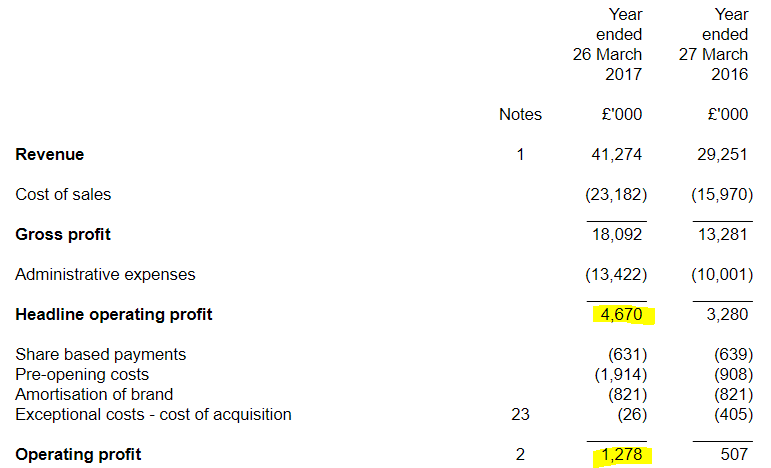
Share based payments - this is fairly static against last year, at £631k, which makes me feel this is not really a one-off, but looks like an ongoing thing. Therefore personally I'd be inclined to value the business after this cost - as it's just another form of employee/Director remuneration.
Pre-opening costs - has shot up to £1.9m, clearly a very material number. I've seen other retail/hospitality companies really abuse this number. In this case though, if you check the notes, the accounting policy is this;
PRE-OPENING COSTS
The restaurant pre-opening costs represent costs incurred up to the date of opening a new restaurant that are written off to the profit and loss account in the period in which they are incurred.
That looks fine to me. Also, the number is very large because so many new sites were opened - 16 new sites. So £1.9m divided by 16, works out at £120k per new site, which looks reasonable.
Amortisation of brand - this is just a silly accounting book entry, so it's fine to ignore this.
Exceptional costs - negligible this year. That gives me comfort that management are not using this as a dumping ground to inflate headline profit, so a tick in the box here.
Overall then, I'm fairly comfortable that the headline operating profit number is in the right ballpark.
Balance sheet - as you would expect for a rapidly expanding restaurant chain, the balance sheet is rapidly piling up fixed assets. The properties are leased, so there's not really much re-sale value from the fixtures & fittings, so no real asset backing to speak of. I don't think that particularly matters though, as this business will always be valued on a multiple of its profits and/or cashflows.
NAV is £38.6m, which reduces to NTAV of £11.3m once you strip out intangible assets. So not a very strong balance sheet, but not weak either.
I note that the current ratio looks very weak. That's partly due to the sector - since hospitality companies don't hold much stock, nor have much in debtors. They typically sell several batches of ingredients, before they have to pay suppliers for those ingredients.
Current assets are £3.9m, and current liabilities £14.0m, giving a very weak current ratio of 0.28. The trade creditors figure definitely looks stretched to me. This is confirmed in the narrative, when the company admits it was short of cash at the year-end;
At the year end, we took advantage of short term supplier trading credit facilities as we had several restaurants in build around year end. These are expected to reverse in the coming year.
That might sound alarming, but in this case I think it's fine. The reason being that increased bank facilities have been agreed since then, and the company is trading well overall. The time to get worried about bank debt, is if the economy goes into a proper recession, and trading deteriorated into losses.
Net debt was £5.9m at year end, which isn't a worry.
Cashflow statement - as mentioned above, the stand-out number is how much trade creditors has increased. Therefore, the impressive £10.3m operating cashflow is driven heavily by the £6.9m increase in trade creditors.
I find that EBITDA (of £7.1m here) can be a better proxy for cashflow, because it eliminates unusual working capital movements, such as happened here. Also, banks typically lend on a multiple of EBITDA, so it's wrong to just dismiss this measure. It's one of many variables that need to be taken into account.
Detailed narrative - I recommend people read the full narrative to today's results from FUL. The Chairman's statement in particular, is very interesting with a good sector overview, from an experienced expert in this field. A few snippets;
Over-capacity due to "unprecedented amounts of capital" having been invested in the restaurant sector in recent years.
Brexit - is making forecasting difficult.
This bit is terrific, and correctly identifies the risk factors facing restaurants;
Against this backdrop, some restaurant businesses will make the grade and others will not. We believe that operators with;
"me-too" offerings,
over-rented sites,
tails of unprofitable sites,
dated menus,
too much debt,
poor concepts and
unincentivised staff
(or all of the above) will struggle.
It's so good, I've reorganised it into a list. I suggest keeping that list bookmarked, and referring to it when an apparently cheap restaurant or retail share crops up. I immediately thought of Tasty (LON:TAST) and perhaps Restaurant (LON:RTN) (where I have a short position) when reading through that list.
Emphasis is put on using good quality, fresh, and organic ingredients. It really does show in the product too, in my opinion, which is very tasty. Compare that with Dominoes for example, where they've used revolting & obviously cheap ham & sausage for years. Customers notice things like this.
Incentivised staff - unusually, this company pays all staff the over-25 Living Wage, regardless of their age. Again, it really shows - every site visit I've done is noticeable by energetic, happy staff. That makes it a pleasant experience. So, very impressive. Staff are also given shares too, so many are small shareholders. Again, a very nice touch.
Cannibalising sales - by opening sites nearby. There has been a bit of this in London, but sites "gravitate back to original levels after a period of time".
Outside London - sales are building more slowly, expected to be over 3-4 years. This is probably my main worry with this share. I think the very high margins being achieved in London may not be replicated as the chain expands outside of London. So it's probably prudent to assume that the operating margin may gradually fall over time, due to this factor, and cost pressures. To emphasise, that just my opinion, and it could be right or wrong, time will tell.
Click & collect - this is good news, as it's additional LFL sales, on a largely fixed cost base;
We continue to see growth in the sales of take out, delivery and ordering on-line. Both The Real Greek and Franco Manca offer these services to our customers. 'Click and collect', where customers order on-line and then collect their order themselves from the restaurant, is proving particularly popular at the moment.
Expansion - continues to be mainly focussed on Franco Manca, but TRG looks to be an improved prospect, longer term;
We have seen excellent results from our new The Real Greek openings and we are looking to step up our opening programme from March 2019 onwards. We will, as we have at Franco Manca, bolster The Real Greek's central team over the next 18 months to support this increased pace of growth.
That means more up-front costs of course. So short term negative, long-term positive.
In total 15 new sites are planned for this year, with 9 already opened. This is a very rapid expansion so that does increase risk - of staff & systems not being able to cope perhaps?
Current trading & outlook - this excerpt sounds a little hesitant to me.
Also note that skilled European staff are proving harder to find;
Trading during the current financial year has so far remained in line with our expectations. However, there are many uncertainties out there: another General Election would be unhelpful, terrorist incidents have always reduced London public confidence (and therefore restaurant visits) and the long-term Brexit impact is unknown; it is, however, already affecting the availability of skilled European restaurant staff. In addition, food costs are currently on the increase and there is some evidence of reducing consumer expenditure.
Despite this, the UK dining out market continues to grow and as a nimble and agile operator with great restaurant brands we are confident of another year of good progress.
My opinion - I really like this company. However, the sector faces so many headwinds right now, that I can't bring myself to buy back in any size.
The trouble is that the company may continue to trade well. Or it may not. The narrative seems to be warming us up for potential disappointments in future. It would be strange if the company doesn't see profit margins reduce, as wages are likely to be forced up.
One broker has reduced its current year EBITDA forecast by 5% today.
Another broker says the results are impressive, and beat their expectations.
For what it's worth, I'm genuinely on the fence here. I really like the company, and think its roll-out, and experienced management, are likely to be a long-term winner. However, the current valuation does look rather ambitious, given the numerous headwinds facing the sector. So far FUL has done OK, but if the staffing bill goes up say 10%, then that would mean additional cost of £1.5m p.a. Remember that staff costs are likely to rise a fair bit every year now that Living Wage is in operation.
The company doesn't seem to publish its LFL sales increases, and so many new shop openings muddies the water. So I'm finding it unusually difficult to work out what the best course of action is here.
On balance, I'm probably going to play it safe, and retain my small existing holding, but not add to it. If there is a profit warning at some point in the future, and the price is slammed by the usual 30% knee-jerk fall, then I'd probably start buying at that point.
Please note that there's an excellent, detailed note about FUL, from Allenby Capital, available on Research Tree, dated today.
Cloudcall (LON:CALL)
Share price: 118.5p (up 15.6% today)
No. shares: 20.1m
Market cap: £23.8m
(at the time of writing, I hold a long position in this share)
Trading update - patience is beginning to pay off, for long-standing (or should that be long-suffering?!) shareholders here. The company is a software/telephony business. Its product combines telephone calls & recordings with existing CRM systems. The company used to be called Synety.
The problem is that it was a start-up, which grew fast, but not fast enough. So there were several cash calls, which understandably dented investor confidence. However, things now seem to be improving, and the share price has more than doubled since last autumn - not bad for a share that many people thought was a busted flush.
These are the bullet points from today's announcement;
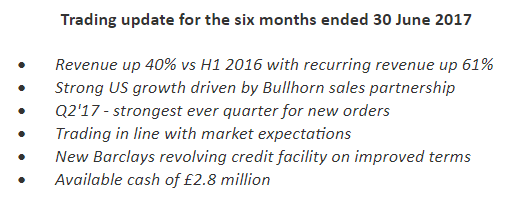
The company is still loss-making, but with decent growth, it looks as if the path to breakeven isn't too long;
"These new orders are now translating through to revenue, and our annualised run rate** broke through £6 million in February and £7 million in June.
This revenue growth, combined with the strengthening relationship with Bullhorn, means that we are well placed to deliver substantial operational and financial progress in the current financial year.
The pathway to EBITDA breakeven remains clearly within our sights."
I seem to recall that breakeven turnover was about £9m a while ago. So being past a £7m annualised run rate, means that it does indeed look close to breakeven. The monthly cashburn should be steadily reducing. There's only £0.9m cash left, but with an additional £1.8m bank facility, it looks as if the company should be able to reach breakeven without any more dilution for shareholders.
I suspect that it might want to raise more equity in future, but that should be possible from a much stronger position, and hence higher share price.
My opinion - the figures have always suggested to me that, if it can reach breakeven, then the market might take a much more positive approach to valuing the company. This is because it has a number of very attractive features to its business model, namely;
- High level of recurring revenues (hence why Barclays are happy to lend to it)
- Strong organic growth
- High gross margins
- Low customer churn
Put that together, and you've got an attractive business model, once it moves into profit. There's big operational gearing, so profits could move up dramatically.
The market seems to be anticipating this happening, hence the valuation rising quite nicely.
I believe the company is presenting to private investors at a ShareSoc event tonight, so I look forward to hearing feedback from that. The affable & enthusiastic Simon Cleaver tends to be a bit of scatter-brain at presentations, constantly flying off at tangents, and confusing listeners! Let's hope he's better prepared tonight than at previous presentations I've attended.
Note that the StockRank is dismal, at just 12, and the Styles section rates this as "Speculative", and a "Momentum Trap". So the Stockopedia computers are very definitely not convinced (yet)! Although I would expect that, as the historic figures are dismal. It will be interesting to see when the computers pick up on the fact that the future is now looking brighter?
eve Sleep (LON:EVE) - this is a recent float (May 2017) which sells memory foam mattresses online, claiming that they are the world's most comfortable mattress.
Today's update sounds positive;
Revenue for the period increased by 126% to £11.5m (H1 FY16: £5.1m) with strong e-commerce led performances across all territories. UK revenue grew 107% to £6.3m (H1 FY16: £3.0m) with combined revenue from all other countries in which eve operates increasing by 153% to £5.2m (H1 FY16: £2.1m).
The strong trading performance demonstrates eve's continuing momentum and reflects the brand's increasing penetration in existing territories, successful expansion into new markets, extension of the product range and development of retail partnerships.
There are lots more positive comments, culminating in this conclusion;
The Company remains on-course to meet the board's expectations for the current financial year.
That all sounds great. Unfortunately, what they omit to mention, is that the company is not trading strongly at all. It's forecast to remain massively loss-making this year & next.
Also, what's so special about memory foam mattresses? Granted, EVE mattresses look particularly thick, so no doubt are very comfortable. On checking their website, I can buy a memory foam mattress elsewhere, at a quarter of the price quoted by EVE, and the cheaper ones are perfectly satisfactory.
I see Neil Woodford's funds hold 18.6% of the company.
The Stockopedia computers rate this as a "Sucker Stock", with a StockRank of just 2. I agree. Quite why anybody would value this at £130m, is beyond me. The trouble with this type of company, is that building substantial revenues requires so much in marketing spend. It's not clear to me that they've done anything new. Memory foam mattresses have been around for years, and it's very easy to buy them online, and they've delivered in a bale, with all the air squished out. So EVE don't seem to have done anything more radical than squish it into a trendy-looking box, as opposed to an un-trendy, but much cheaper thick plastic bag.
Do any readers understand why EVE is supposed to be so exciting? Apparently you can return the mattress at no charge in the first 100 days, but how many people could be bothered?
I'll leave it there for today.
I still need to circle back and finish Tuesday's report, which is on the to-do list. Sorry for my erratic performance this week.
Regards, Paul.
Disclaimer
This is not financial advice. Our content is intended to be used and must be used for information and education purposes only. Please read our disclaimer and terms and conditions to understand our obligations.

59 comments
I hold Fulham Shore (LON:FUL) shares and have eaten at 2 FM stores Westfield and Southampton (and viewed but not eaten at Brighton). The stores were fine... clean and tidy and serving good pizza. To me they look extremely similar to Pizza Express but cheaper and better pizza.
Generally I hold extremely boring shares... this is one of my very few higher risk investments. For me this share has true multi bag potential.
The stores I have seen could all have been busier but were doing ok. And from my visit a month ago to Southampton I noticed that the Real Greek (next to FM) was doing good trade. The same was the case at Westfield (where I visited about 3 months ago). When the update came out yesterday I saw that the management view reflected this... that they see The Real Greek as a surprising success outside London. This could be good news as TRG is much higher price and better margins. In Southampton on a Sat night it looked like young dating couples were looking for a more exciting option than a pizza. So TRG was filling that space quite well. Over the last year or so it seemed that the story with Fulham Shore (LON:FUL) was Franco Manca - but maybe we should all be getting excited by TRG instead.
Hi dfs12,
Interesting what you say about Fulham Shore (LON:FUL) smaller brand, The Real Greek.
Can't remember if I mentioned it before, but I mystery-shopped their new branch in Bournemouth recently. From the menu, it just looked like over-priced kebab shop food.
However, my experience was positive. What they've done is quite clever - taking fairly ordinary Greek-style food, and presenting it in a very attractive way - using 3-tier cake-stands to present the food on 3 levels, was a really innovative, and pleasing touch.
Also, I liked the way they scattered a mix of fresh herbs (I could identify coriander & dill) over the food, and wrapped some items in own-branded greaseproof paper. Little touches like that really did dress up quite ordinary food into seeming special.
Plus they serve my favourite Greek beer, Mythos. Service wasn't great, and only 1 member of staff out of a large team was actually Greek (I asked lots of questions). It's a new site though, and I got the impression that staff were still learning the ropes, so a bit chaotic, and they looked harrassed - which unsettles customers.
On a sunny day, it was busy, with myself & others basking in 30pC sunshine on the day I visited, on their pleasant terrace. It actually reminded me of being on holiday in Greece, drinking Mythos in the sunshine, whilst enjoying OK greek-style food. So I think this format could actually have legs.
Also, I noted that TRG branch in Bou'mth is literally just over the road from the same company's Franco Manco site. Therefore, the opportunity to pool staff, and switch people from one site to another at busy times, is a very useful advantage.
Regards, Paul.
FUL
??Interesting that the Allenby note…
http://www.allenbycapital.com/research/research-fulham_16_1316430210.pdf
…states the average Franco Manca (FM) site earned revenue of £1,050k during FY 2017, which was down 7.0% on the £1,129k for FY 2016.
I have worked out the H1/H2 splits for FM... and H2 2016 was £1,158k, H1 2017 was £1,120k and H2 2017 was £977k. I have ignored the H1 2016 figure as FM was part-owned during that period.
Anyway, the trend is not great, and Allenby appears somewhat bold by predicting average revenue per FM site of £1,085k for FY 2018 (+11% on the H2 2017 of £977k) and then £1,100k for FY 2019.
Fulham Shore (LON:FUL) play it straight in only allocating genuine pre-opening costs to start-up expenses, so given their rate of opening new sites I would expect some ramp-up effect in revenues for those new sites.
Hi TMFMayn,
You said;
…states the average Franco Manca (FM) site earned revenue of £1,050k during FY 2017, which was down 7.0% on the £1,129k for FY 2016.
Quick query: have Allenby adjusted for new site openings during the year? Given that FM is opening so many new sites throughout the year, the average turnover of the whole estate would be meaningless - because new site openings part-way through the year would depress the average revenue figure to a considerable extent.
The average revenue per site would only make sense if calculated on an LFL basis - i.e. sites which have all been open for 2 complete years or more.
I haven't read the Allenby note in full yet, because I recently knocked over a glass of vodka + fanta (yes, classy, I know!!) onto it, and all the pages have stuck together.
Regards, Paul.
Hello Paul
Quick query: have Allenby adjusted for new site openings during the year? Given that FM is opening so many new sites throughout the year, the average turnover of the whole estate would be meaningless - because new site openings part-way through the year would depress the average revenue figure to a considerable extent.
Here is the pdf again and a screenshot of the relevant section:
http://www.allenbycapital.com/research/research-fulham_16_1316430210.pdf
Allenby has taken a simple average of sites for each year.
I did the same for the H1/H2 splits. My figures for Franco Manca are (calculated on an annualised basis):
H2 2016: £9,847k revenue, 17 sites, £1,158k rev per site
H1 2017: £12,595k revenue, 22.5 sites, £1,120k rev per site
H2 2017: £14,171k revenue, 29 sites, £977k per site
The average revenue per site would only make sense if calculated on an LFL basis - i.e. sites which have all been open for 2 complete years or more.
Perhaps, but because FUL does not disclose LFLs — and there is not a set standard to calculate LFLs anyway — these numbers are all we have. Indeed, Allenby is basing its forecasts on this particular revenue per site number.
I only mention all of this because I hold shares in the hapless Tasty, where revenue per site stats were showing a marked deterioration well before this year’s warning.
Calculated on the same basis as FUL, TAST’s revenue per site for 2011, 2012, 2013 and 2014 were £910k, £942k, £909k and £929k — sure, a bit up and down, but reasonably stable.
Then for 2015 the figure was £852k, with H2 at a worrying £833k versus £938k for the prior H2.
Then for 2016 the figure was £841k -- so no major improvement.
Then came the warning in early 2017.
TAST’s drop between for H2 2014 and for H2 2015 was 12% — at a time when it, too, was accelerating its rollout and everything ought to have appeared sound.
For comparison, FUL’s drop for Franco Manca between H2 2016 and H2 2017 was 16%.
Mike Ashley's investment's in the likes of Debenhams (LON:DEB), French Connection (LON:FCCN), etc so far have been crap. It was reported he lost £200m+ spreadbetting on HBOS back in 2008. He comes across as a (uber rich) mug punter. Given his track record I took it as a negative that he'd picked up a large stake in £GMD
why did he take such a interest in Game? The one part of Game Digital's business that might appeal to Ashley is its exposure to the fast-growing eSports market, where people do battle in cyberspace playing conventional sports like football.Sports Direct hasn't commented on the interest, but there could be some overlap between eSports fans and its own customers who buy soccer boots and replica t-shirts.
whatever the reason it doesn't always work out for Ashley like at debenhams or Tescos... or even the casinos lol
On eve Sleep (LON:EVE) I previously posted a table showing competitors with a similar business model: http://www.stockopedia.com/content/ipo-alert-eve-sleep-185583/?comment=8#8
Paul well done on game. especially when it was seen as a bargepole stock
Hi vik,
It's the balance sheet again - that's the key thing. Very few investors/punters actually check the figures you know. That's where you can gain a terrific competitive advantage I think, especially after bad news.
Who cares what market sentiment is, when the company is soundly financed, as is the case with Game Digital (LON:GMD) ? I bet you hardly any fund managers or PIs have properly crunched the numbers! It's not financially distressed at all, but is dirt cheap That's the way I see it anyway. But as always, nobody really knows for sure, unless you are an insider.
Regards, Paul.
Personally I do not like Franco Manca pizzas much especially the base but I really like the restaurant and the feel of it. My Muswell Hill branch is moderately busy but the one in Canary Wharf is rammed to the rafters. If you don't get there by 11:55 for lunch expect a long wait.
Paul, well played on Game Digital (LON:GMD), I see it bounced 22% today. I don't see any news. I wouldn't have touched it with a bargepole!
Mike Ashley has taken a 25% stake in Game Digital (LON:GMD) apparently;
http://news.sky.com/story/billionaire-ashley-swoops-on-25-stake-in-troubled-game-digital-10946454
Bizarre but true, he's bought out Neil Woodford amongst others
Mike Ashley/Game Digital - Proof if any where needed that Mike Ashley really is mad. Or he has just gone on one of his drunken benders and got carried away.
Hi ratioinvestor,
Mike Ashley/Game Digital - Proof if any where needed that Mike Ashley really is mad. Or he has just gone on one of his drunken benders and got carried away.
Why do you think he's mad, for buying shares in a business that is valued at half its own net cash?? Also GMD is a business that is still cash generative, and has the option to walk away from about 70% of its leasehold property in the next 18 months.
Maybe Mike has done more research than you?!
Regards, Paul.
Hi ricky65,
Well, everything has a price. My thanks to "our Graham" for flagging up Game Digital (LON:GMD) as a potential special situation here: http://www.stockopedia.com/con...
What Graham spotted, in his words, was this;
I think he's spot on with this.
Retailers generally go bust because they run out of cash & have too much debt, and because of lease liabilities. So GMD is interesting because it doesn't have a debt problem, and its leases are amazingly short term. So it can just hand back any shops which don't make a profit.
Also, maybe there's some upside on new gaming as a sport, and virtual reality headsets?
Bottom line, GMD is amazingly cheap right now. Also, I love it when almost everyone hates a stock, and assumes the numbers are terrible, without even checking them! That's where you occasionally find a bargain, as might be the case here?
With Mike Ashley having taken out the overhang, who knows what might happen?
Maybe we should invite him out on the lash, to find out??!!!
Regards, Paul.
Game Digital (LON:GMD) & Mr Mike Ashley: "Maybe we should invite him out on the lash, to find out??!!!"
Now that would be an investor meet up to behold.
Cheese all round I'd say
If anyone could give old Mike a run for his money - our Paul could!
DANCE OFF: Ashley Vs Scott!
Hi Paul
Thanks for the reply.
You and "our Graham" (lol) make a compelling case for Game Digital (LON:GMD). £69m cash, no borrowings, short leases. As a special situation I can see the attraction. I've had success with special situations recently (Molins (LON:MLIN), Hargreaves Services (LON:HSP) ).
It's clear that Ashley sees potential here somewhere. Sky article says he "is thought to see opportunities in Game's presence in the fast-growing e-sports market". In my day job I'm a software developer and occasionally work on games. I can only see esports growing in popularity. I was tempted in buying some shares of the esports company Gfinity (LON:GFIN) a few months ago but was put off as it has never made a profit. That turned out to be a mistake as the shares have nearly doubled since then.
As a Minervini fan it's hard to buy a chart like this. It fails all his Trend Template criteria. I do feel however that it's worth a punt. Besides, theres a gap to fill to 32p!
Kind regards
Ricky
Hi ricky65,
As a Minervini fan it's hard to buy a chart like this. It fails all his Trend Template criteria. I do feel however that it's worth a punt. Besides, theres a gap to fill to 32p!
I'm also a Minervini fan, and I learned so much from his book.
I think it's important to remember that Minervini's approach is all about finding multi-baggers, and in a bull market, it works brilliantly.
But there are loads of other successful investing approaches too. We don't have to limit ourselves to JUST doing Minervini-style stocks. I like doing a bit of everything - anything that works basically!
GMD seems to me one of the (potentially) best special situations (i.e. value-focused) things I've seen in ages. Mike Ashley taking out a big chunk of the overhand is great. I wonder if he's looking ahead to gaming as a sport, and utilising spare space in DEB and SPD perhaps?
I'm surprised the share price hasn't risen more actually, but there might still be others selling - I think Hargreave Hale were dumping stock recently?
For me, I don't intend holding GMD forever. I do see a chance that it might rise to 50-100p, where I'd be happy to sell up & move on.
Regards, Paul.
I agree that there are lots of other successful investing approaches. I guess it’s personal taste on which you choose. Doing a bit of everything certainly works for you! Not all of us have your skill in being able to combine multiple approaches. I adhere to Minervini’s strategy because it’s where I have had most success. There’s also the counter argument that it’s best to stick to one style and avoid “style drift”.
Back to Game Digital (LON:GMD)
I don’t see Hargreave Hale on the major shareholders list on Morning Star. http://investors.morningstar.com/ownership/shareholders-major.html?t=XLON:GMD®ion=GBR
There were a couple of holdings RNS yeterday and I see that Woodford is completely out now and Invesco nearly completely out too. Looks like they don’t see any value here.
I’m not sure about Ashley. Looking at his track record of share price destruction at Sports Direct over the last few years makes me wary.
You’ve called it well thus far so kudos. It will be interesting to see what happens!
Kind regards
Ricky
Hi Ricky,
Not all of us have your skill in being able to combine multiple approaches. I adhere to Minervini’s strategy because it’s where I have had most success.
To be fair, I think I got lucky in the last 2 years, in spotting that some serious multiple expansions were happening in growth companies. Then I stumbled across the Minervini book, at just the right point in the cycle. So a happy coincidence.
I'm dipping in & out of the Minervini book, thinking about things, then drawing up my own checklist, which heavily relies on his approach, but combines/adapts it with other things that I've learned over the years.
Here's another interesting thing - Minervini suggests that we should be selling things when the bull market leaders begin to collectively roll over. That seemed to be happening lately. Indeed, a lot of PI favourites have dropped c.20% recently. So I think it does feel like we could be pretty close to a market top. But who knows?! Things never seem to pan out how any of us expect them to.
So far so good with Game Digital (LON:GMD) - up 40% from the lows, in less than a fortnight. I think it could go much higher - my target is 50-100p.
I had an interesting chat with a friend the other day, who is a computer gamer (he admitted, in a slightly embarrassed way), in his late 20's I would guesstimate. He said that he actually prefers to buy a physical software cartridge for his gaming machine. He doesn't want downloads - because what happens if, say, the publisher goes bust, or they change their T+Cs? You could lose downloads. Whereas a physical cartridge is yours forever, and can be re-sold.
So maybe the existence of physical shops to buy & sell computer gaming cartridges might last longer than people think? It's a bit like music. I use Spotify, but there's nothing quite like owning a CD. I moved house recently, and boxed up loads of old CDs & DVDs. Couldn't bring myself to throw them out, even though none had been used in years. However, on moving into my new flat, I've started unboxing & playing some of the old CDs, and have re-discovered all sorts of cracking tunes that I'd completely forgotten about, and never would have heard again using a streaming service. And nobody can take those CDs away from me, unless they steal them, or there's a a fire.
Regards, Paul.
Hi Paul
Definitely more skill than luck for me. I think your calls on Boohoo.Com (LON:BOO) and £G4M in particular were strokes of genius. Looking at my notes on Minervini, I get the impression that he doesn’t believe in luck - “Success in the stock market has nothing to do with hope or luck. Winning stock traders have rules and a well-thought-out plan. Conversely, losers lack rules, and if they have rules, they don’t stick to them for very long; they deviate.”
I share your sentiment that we may be close to a market top. I’m not seeing many good long opportunities. Minervini mentions to look for multiple previous market leaders reversing on heavy volume. JD Sports Fashion (LON:JD.) And Domino's Pizza (LON:DOM) are two that appear to fit that criteria. I’ve been having a discussion with someone as to whether the recent 266p high on Boohoo.Com (LON:BOO) was a climax top. Possibly but too soon to tell for me.
Interesting about your friend, reminds me of someone I know. I’m 28 and consider myself a PC and Playstation gamer. There are advantages to owning physical copies of games, as your friend mentioned. The problem is, I’m lazy. It’s too easy to just click a few buttons on Amazon and order a Playstation game. For PC games, I mostly download them from the Steam platform. My friends are the same. I’ll only pop into somewhere like Game If I happen to be out. Perhaps esports tournaments at the stores will bring gamers out?
I definitely think there will be a market for physical games. In recent years there’s been a nostalgia for old games. Later this year Nintendo are going to release the SNES Classic which will have cartridge games. I’m just not sure if it will have mainstream appeal or be a small niche.
Kind regards
Ricky
For balance here, I am unashamedly a big Domino's Pizza (LON:DOM) fan (the pizza, not the stock). It is my standout favourite pizza for taste by some distance. I think some of the comments here are a bit harsh, but I am clearly in the minority - each to their own! I once tried Franco Manky (as we now call it at work), the pizzas were cheap but you could see why - next to no topping (I counted 6 pieces of pepperoni), and burnt in places. I don't think anyone finished theirs. I won't be going back - nor investing.
JohnEustace - Not really sure I agree with the logic of what you are saying. For restaurants having Deliveroo/UberEATs is great. They aren't paying extra rent or having someone sitting in. They are merely sweating their existing assets more effectively. Opening these "dark kitchens" is precisely because restaurants don't have capacity at peak times. The restaurants will still stay open they are not going to save costs by moving the whole restaurant to an industrial estate. There is no saving there is an extra cost to have new units on an industrial estate. Moving to an industrial estate is not a sign of strength it is a sign that restaurants aren't able to complete large delivery orders at certain times. Domino's strength is in high throughput at peak times linked to its in-house delivery.
GavSmith01 - you are not alone. Please see the slide entitled "Market leading satisfaction" in the below link (Domino's is the most popular for satisfaction - maybe just for delivery I can't tell from the slide if it means the pizza too?):
http://investors.dominos.co.uk/system/files/uploads/financialdocs/capital-markets-day-presentation-2016-v1_0.pdf
Pizza Hut seem like not great competition and Papa John's is also weak. Domino's is at least trying to innovate. Pizza Hut seems to be stuck in the 1980's. This topic of who has the best pizza generates a lot of reactions and emotions. A bit like Apple versus Android. But at least that means that a lot of customers are loyal to a particular brand.
The Franco Manco on Tottenham Court Road usually has queues outside if I walk past on a Saturday or Sunday evening. I have a small position in The Fulham Shore.
Paul - interesting point on Domino's about new competition. I think about 80% of what Domino's sells is through discounts though so the headline pizza prices are misleading. Also Domino's have a higher end Italiano range. The main focus of Domino's is joined up delivery especially at peak times or after restaurants close. When Franco Manco is busy on a Friday night I doubt you could get orders for takeaway completed quickly. Domino's also aim to deliver a hot pizza while a Deliveroo person with Franco Manca is likely to struggle.
I agree that the backdrop has become more competitive but I wouldn't necessarily write-off Domino's yet. I think you do have a point on the taste front though. Domino's and the other fast food chains make the dough etc in large processing sites and then send it to the stores. This isn't exactly the same as making a pizza fresh in house.
With regard to Franco Manca it seems like a good brand and the pizzas look nice. So probably there is still a place for Domino's. If all the nasty takeaways that provide food for Just Eat (they don't look great most of them) can do well then there must be a market for Domino's!!!!! However, I have to admit I wouldn't eat a Domino's pizza myself.
I don't think Fulham Shore (LON:FUL) are much competition to Domino's Pizza (LON:DOM), I had a look at Franco Manco outlets and there seems to be nothing north of London and not much outside it either. I'm seeing quite a few Papa John's, there are more than 250 stores in the UK now. Indian food seems to be on the wane.
Deliveroo are opening 30 "dark kitchens" in the UK this year. These are sites where chefs from five or six of their partner restaurant brands, including Franco Manca, cook exclusively for Deliveroo customers. These are cheaper sites that can be located on industrial estates as opposed to paying high street rents.
This allows them to deliver to areas that don't have established restaurant sites and also avoids the issue of competing for capacity with customers in the restaurants at peak times.
http://www.telegraph.co.uk/technology/2017/04/05/deliveroo-opens-30-kitchens-meet-surging-takeaway-demand/
About Carillion , I invested solely for the chunky dividend just over a couple of months back after reading a tip from Motley Fool. The author highlighted the dividend and its huge order book! Clearly a trap waiting for private investors like me. I got out early this week with a manageable but still painful loss. Hard lesson.
I was delighted with the Fulham Shore (LON:FUL) report today. Big picture growth remains on track. Critical mass is being achieved without too much sign of executional stress. IT Systems were invested in last year and Franca Mance Central tea; next year same for The real Greek. Real sense of Management being in control (of what they can control) and spending well even as they grow topline. Two more years at this level of growth and it will be a substantial group and central overheads will less of a drag and i think executional risk will start to drop as roll out become standardised as new stores are a smaller proportion of growth.
I also think they might BENEFIT from a bit of consumer recession!! The Chairman has previously specifically mentioned a pricing strategy focused on value eg that Franca Manca pizza are are their most expensive should be cheaper than Pizza Express's cheapest for example. Franca Manca is high class takeaway (vs Domino's) or novel destination (cheap date) for those trading down from serviced meal out towards pizza in front of TV. They look good and are that little bit different and word of mouth is generally very good. At the end of the day in a highly competitive but very large target market if you have the product and price right, you should do well in almost any market condition. Right now they must have people falling over themselves to offer good locations or deals (watch the links to retailers needing footfall and surplus space being used up).
The "only 7 pizzas and small locations" Paul mentions means simple, high volume ordering and low operational complexity. And where will the European staff go - Brexit will take forever (if it occurs !!) and jobs/wages are not great back in Italy and Poland right now. This tight menu and focus on consumer value also tells me there will be no Revolution Bars (LON:RBG) style cost over runs here.
Net, Management are expensive but experienced and doing their job. They will their big money if the shares grows steadily. I have a relatively large holding for me and am happy to think in 5 years, they will be worth much, much more. If they fall in the short run I may take a bigger pizza-d-action!
With regards Fulham Shore, the Franco eatery at Broadgate Circle (I walk past 4 times a day) is never particularly busy and neither is the Comptoir Libanais. In the evenings, people are piled up in the Botonist (literally sometimes) and a couple of other places on the circle but these two never seem that busy.
There are a load of "Streetfood vans" that show up daily and there are often more people queuing at each van than in the restaurants in total.
Sample size of one and a fairly unique demographic in that part of London but I thought I would share. That site must be costing them a fortune.
No position in either company.
James
Paul - thanks for pointing out the Allenby Capital research note on Fulham Shore (LON:FUL). Just to flag this is in fact available for free on their own website: http://www.allenbycapital.com/research/research-fulham_16_1316430210.pdf
Hi paraic84,
Thanks (re post 23). I was not aware of that.
Regards, Paul.
Speaking of Purplebricks (LON:PURP) it's just announced a major recruitment drive in the UK to further build its market presence: https://www.estateagenttoday.co.uk/breaking-news/2017/7/more-details-emerge-of-purplebricks-expansion-programme
Tangible book value deducts goodwill http://www.stockopedia.com/ratios/price-to-tangible-book-value-746/ Negative values are usually 'bad'. Large differences between this and Price to book value http://www.stockopedia.com/ratios/price-to-book-value-696/ are usually down to goodwill.
TBV>0 and below X for value strategies are a useful screening criteria. X depends on how you much importance you place on this measure. 1-1.5 is fairly 'strict'.
Hi Paul,
Any chance you could do a short piece on basic balance sheet tests using Stocko highlighting how to check for to much goodwill etc for the 90% of us on here who aren't up to the speed of the pro traders. Great that the likes of you , Graham, Robbie Burns etc are about to make complex stuff reasonably simple.
Cheers
@Paul - a good shout on shorting Dominos, a little while back they had lowered prices after Pizza Hut aggressively undercut it on bundle deals, which account for about four-fifths of its UK revenue.
they seem to have young uni students who know nothing about cooking a pizza properly. last time I ordered from them they pizza tasted wet. its put me of for ages.
Purplebricks (LON:PURP) holders you may get Amazoned-
Just mentioned 9:45 eastern Time-
"Report: Amazon.com pushing Zillow in agent referral space
Jul. 12, 2017 9:45 AM ET|
In an otherwise sunny market so far following the release of some dovish remarks from Janet Yellen, Zillow (NASDAQ:Z) is 0.7% lower as Inman reports that Amazon.com (AMZN +0.9%) is set to throw one of its many hats into the real-estate referral ring as well.
A placeholder "hire a Realtor" page suggests that the retailer will be adding real estate agents to a burgeoning professional services marketplace. "
The Amazon entrance into Real Estate agent referral, would be a good thing for Purplebricks as they focus on the transactions and having another source of qualified traffic that they can lean into with their technology and marketing spend to optimise against (generally they do this better than competitors) opens up a greater customer acquisition opportunity. Note that Amazon tries lots of these initiatives to leverage their traffic but very few go into deeper plumbing like Purpebricks are doing!
Agreed but as own label is now the leading brand for batteries and baby wipes sold on Amazon and as there is a bit more money in flogging houses I suspect they may end up becoming an estate agent!
are you not reporting on call- i thought iis one of your holdings paul?
Perhaps bizarrely, I enjoy reading through things like the significant accounting policies in the annual report to see how much leeway management have to make the numbers be what they want them to be. Another reason to hate construction is the percentage of completion accounting methodology. It seems to give rather a lot of leeway such that issues can be buried for multiple years before surfacing. Conversely, my reaction when first reading through Bioventix (LON:BVXP) and Arcontech (LON:ARC) annual reports was how clean everything was. Not far off cash accounting.
"There is therefore a high degree of judgement in: assessing the level of the cost contingencies to recognise; appropriately recognising variations and claims; and estimating the revenue recognised by the Group based on the projected final out-turn on contracts." That's from the 2016 Carillion (LON:CLLN) auditor's report by KPMG who judged that there had been no movement (relative to 2015) in the "Risk of Material Misstatement" related to "Recognition of contract revenue, margin, receivables and liabilities." (page 86(88)).
Note 1 to the financial statements - Significant Accounting Policies - also contains this: "IFRS 15, which is effective for accounting periods beginning on or after 1 January 2018, prescribes the accounting treatment and disclosure requirements associated with revenue from contracts with customers.The Group is performing a detailed assessment of the impact of IFRS 15, with the assessment expected to be completed in the first half of 2017. The Group will be examining the potential impact on the timing of revenue recognition in relation to construction contracts. It is difficult at this stage to determine with any certainty the impact on revenue and profit from adopting this standard but further clarification will be provided in the second half of 2017 as it becomes available."
I wonder whether the Carillion (LON:CLLN) announcement was triggered by the in depth review they were doing to prepare for adoption of IFRS 15? If so, they certainly can't be the only ones going through such an exercise. There's a useful primer from EY on IFRS 15 with specific issues to think about by sector here (https://webforms.ey.com/Publication/vwLUAssets/IFRS_15_The_new_revenue_recognition_standard/$FILE/IFRS15_low.pdf)
@gsbmba
That thought occurred to me also. Carillion (LON:CLLN) may be especially bad but it will be interesting to watch for any increase in short positions elsewhere in the construction sector. I imagine there are quite a few sharks sensing blood and looking for their next meals.
It will be a brave bidder that makes any move to take over Carillion.
I have a broad rule which says to avoid any company where the revenue stream is dependent on winning contracts. This rule of thumb came to me after costly experiences with the following companies: Carillion, Balfour Beatty, Firstgroup, Serco. These were all sold a few years ago now, but not before a significant loss was incurred.
Williamhargrove - good points. I refer to it as contracting risk. Management can go for growth by undercutting competitors on new contracts. They get their bonuses and the contracts blow up 10 years later. Also there is a general dynamic whereby contract bidding gets more competitive when times are good and there is lots of capital heading towards contracting companies (Serco). The costing for contracts is also notoriously difficult and winning contracts can introduce bribery issues (Petrofac etc).
More generally I think watching companies and sectors blow up helps identify all these risk factors. Then avoiding them is a good way to do well. Its not what you buy but what you don't but that often drivers investment performance.
"It would be interesting to revisit Stockopedia's awesome profit warning study, and introduce a balance sheet test. Would that improve the results, I wonder?"
I would also be interested to see if strong balance sheets had any impact. Also were there any other commonalities to the minority of shares that bounced back quickly from a profit warning?
Unless I see any quantitative evidence to the contrary, my blanket ban on buying after a profit warning will remain in place.
And G4S
I've learned my lesson. I just give them a miss.
But £G4S shares are up nearly 80% in the last year.
Costain (LON:COST) is another but that seems to be doing alright at the moment.
Mitie (LON:MTO) is another, has had a rather mixed year.
Other service companies with large contracts and major profit warnings / share price collapses - Serco, Capita...
You can add Balfour Beatty (LON:BBY) and Interserve (LON:IRV) to the list of construction/contract companies that have had large contract whoopsies. The support/services and construction sectors are a total bargepole for me now. Low margin, difficult customers constantly changing their minds on the requirements, highly competitive with little economic moat in the business, contracts are often won on price alone and then when one goes bad it can wipe out 3-4 years operation profit in a flash.
connaught
I'm looking forward to your Fulham Shore (LON:FUL) comments Paul. I note they didn't publish any like-for-like sales figures and I also can't decide if the RNS is a bit of a warning about future profitability or whether they're just trying to reassure the investment community that although the restaurant sector itself faces headwinds, Fulham Shore (LON:FUL) is likely to ride those fairly well.
Hi paraic84, I read it as both. To me they were signalling that they would not be as adversely effected as the wider market (they emphasize that operators with expensive leases and large debts will be particularly effected), but that the growth story may be more limited going forward. So not a profit warning, just a managing of expectations for future growth. I sold out a few months ago as I was concerned that the growth of the company, while impressive, was not explosive enough to support its very high valuation. Its a shame as I love the concept and they make great pizzas... Very interested to hear what Paul has to say.
I've been sitting on the fence on Fulham Shore (LON:FUL) but decided to make an initial small buy this morning. I see them as a smart operator that is well positioned despite the many headwinds in the sector.
Their new Franco Mancas in Ealing and Reading seem both to be trading very well and generating strong word-of-mouth recommendations based on recent family visits.
Maybe it was Connaught you we're thinking of?
"At the heart of the matter is a string of loss-making service contracts that the company entered into with local authorities and housing associations."
http://www.bbc.co.uk/news/business-11228059
"There was another similar one, but I can't remember its name." Silverdell ?