Small Cap Value Report (Wed 19 Feb 2020) - KETL, RPS, GHH, EBQ, COG

Good morning, it's Paul here with the SCVR for Wednesday.
Estimated completion time - as usual, it will be mostly done by the 1pm official finish time (when the emails go out), but I might carry on adding more material after that, if there's anything interesting on the newswire.
Edit at 14:59 - today's report is now finished.
By the way, as I'm using the new site now, I don't see any thumbs down votes at all, which makes me happy!
China & coronavirus
This is still the main pre-occupation for investors right now. The quandary is that, we know this is a temporary issue, but we have no idea how serious it might become. So far, China seems to have done a remarkable job in containing it as much as they can. But the measures taken are so extreme (shutting down transport & factories in many areas) that they cannot possibly continue. Therefore, as China begins to return to work, after the extended new year holiday, the big question is whether the virus begins to spread more aggressively, or not, once people are mixing in close contact again, on public transport & in the workplace?
We only have to look at the devastation caused on the cruise ship, by confining people in close proximity. It may have quarantined the ship from the rest of the world, but it caused the rapid spread of the virus on the ship. Thus proving how contagious this thing is. I'm no expert on germs, or science, but as a layman, I can see that there still seems to be a very considerable risk to health and wealth, from this problem.
As regards shares, which is the topic here, it sometimes feels inept to be focusing on that when people are dying, but we have to. The issue for shareholders, especially in volatile small caps, is that we have to balance the fact that China supply chains are starting to be significantly disrupted. The press is full of reports that factories are running low on parts from China (Jaguar Land-Rover saying they only have enough for 2 weeks, and are rationing things like key-fobs (1 per car, not 2), and flying small items into the UK in suitcases). Complex, just-in-time supply chains are obviously the most at risk.
It's clear that we have become far too dependent on China. Not just for parts, but for parts which go into the parts - e.g. one article said that 80% of raw materials for medicines come from China, and are running low & seeing rising medicine prices in India.
There are two ways to look at it;
1. Recognise this is temporary disruption, and ride it out, or
2. Sell now, because as Tekmar (LON:TGP) demonstrated yesterday, small cap share prices are being smashed up when companies report disruption from this issue, even though it's a known issue.
It doesn't have to be binary, we can also reduce position sizes, where in doubt (e.g. sell half, keep the rest - I often do that when in doubt).
I think the worst approach is to decide now to ride things out, but then panic when a share drops 30-40%, and sell it at or near the bottom. Hence investors who decide to ride things out, really need to run through your head how you would react if one, or several of your shares plunged on China disruption? How do you normally react to profit warnings? If they cause you intense upset and pain, then it's probably best to trim positions now, before any possible damage. We can always buy back later. Ultimately each investor has to work out this stuff for themselves, dependent on your own risk tolerance, so I'm not suggesting any particular course of action, nor giving advice.
I remain very cautious, and think it's possibly too soon to be thinking about buying the dips, for China-related shares, but nobody really knows. Markets tend to anticipate events, so the recovery in shares is likely to be before there is clear news that things are getting better on the ground.
My interview tomorrow with Up Global Sourcing Holdings (LON:UPGS) should be very interesting, I'm looking forward to that. Graham's covering me here, so that I'll be free to focus 100% on my interview tomorrow.
OK, it's 7am now, so here we go...
Please see the header for today's running order.
Strix (LON:KETL)
Share price: 190p (up 10% today, at 10:48)
No. shares: 190.0m
Market cap: £361.0m
Statement re current situation in China
Isle of Man based Strix, is a global leader in the design, manufacture and supply of kettle safety controls and other components and devices involving water heating and temperature control, steam management and water filtration. Strix's core product range comprises a variety of safety controls for small domestic appliances, primarily kettles. Kettle safety controls require precision engineering and intricate knowledge of material properties in order to repeatedly function correctly. Strix has built up market leading capability and know-how in this field since being founded in 1982. [Source: "About Strix Group" from today's RNS]
Background - the last update on 23 Jan 2020 was an in line update for 2019, reviewed by Graham here. It mentioned USA/China trade tensions, but did not mention coronavirus (too early probably). The other China references, are that this group sells products in China, as well as manufacturing parts there too.
KETL is building a new factory in Guangzhou's Zengcheng district. Probably like me, many readers are starting to become vaguely acquainted with Chinese geography, for the first time. This province seems to be just north of Hong Kong, quite a long way from Hubei.
Talking of Chinese geography, my grandparents visited China in the 1980s. They brought me back a small metal globe, as a present. Clearly the designer thought that the British Isles were so small & insignificant, they didn't appear on that globe at all! You could only just make out France & Spain, as pimples on the Western edge of Europe, which was just a wiggly line.
Today's update - seems to have reassured investors, as the price is currently up 10% on the day.
The Company's manufacturing operations, which are located near Guangzhou, resumed on 10 February 2020 which was only a one week delay from the planned opening and in line with the government policy for an extended and mandatory closure over the Chinese New Year holiday period. Strix's facilities have experienced minimal impact to date.
Currently two-thirds of the workforce have returned to the facility and whilst others have been hampered by travel disruption this remains sufficient to fulfil the customer commitments for February and the Company are now focussed on securing March and April to minimise any disruption.
That sounds reassuring to me, so I can see why the share price is rising. Contrary to media reports of an almost complete economic shutdown, it sounds as if things are returning to normality. Although clearly, the part of China that companies are operating from, seems of key importance. Therefore Strix's quite positive experience, with "minimal impact to date" being the key phrase, may not be applicable in other regions of China, especially those in, or close to Hubei (the epicentre of the outbreak).
Customers - a mixed bag here, but again sounds reassuring;
The Company remains closely in touch with all of its largest OEM customers. The majority have either resumed production or are expected to imminently. Strix has seen some customers increase order sizes due to disruption elsewhere in their supply chain.
The importance of regions is emphasised. Apparently China has regional clusters for particular sectors, so that's an important consideration for investors to consider when assessing the risk for each company;
There are also no immediate concerns regarding Strix's supply chain, given over 80% are based in a same area near Guangzhou and were able to restart production last week.
Finally, there's a plug for KETL's most recent acquisition, HaloSource, which coincidentally has a disinfection product.
.
My opinion - a notable omission from today's update, is any comment on performance versus market expectations. The implication being that the company probably didn't want to explicitly confirm that it is in line with expectations, just in case things get worse. Also, we're only near the start of FY 12/2020, so it's difficult to predict this early, I suppose.
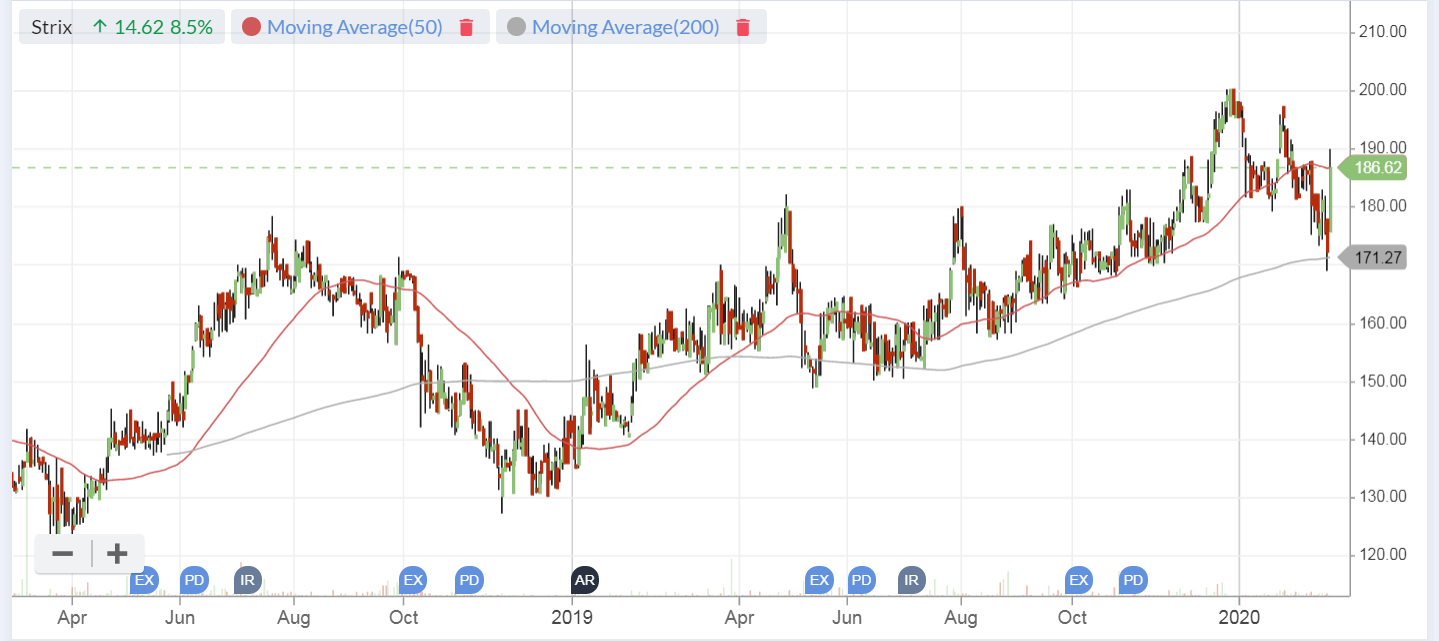
Looking at the chart, KETL shares were only starting to fall (presumably on China worries), therefore today's reassuring update seems to have nipped things in the bud & restored confidence.
.
Therefore in this case, so far the best action to have taken would be nothing - to sit tight & ride out any China worries. That could change of course, if the virus starts spreading more rapidly, and further shutdowns are required. Then we would be into different territory altogether. So I feel there are still considerable unknowns out there. We're apparently still a long way from sounding the all clear over coronavirus risk. Hence why I don't see risk:reward here looking particularly good. If the share price had plunged to say 150p or less, then it might have been worth considering a purchase. It doesn't interest me at these levels.
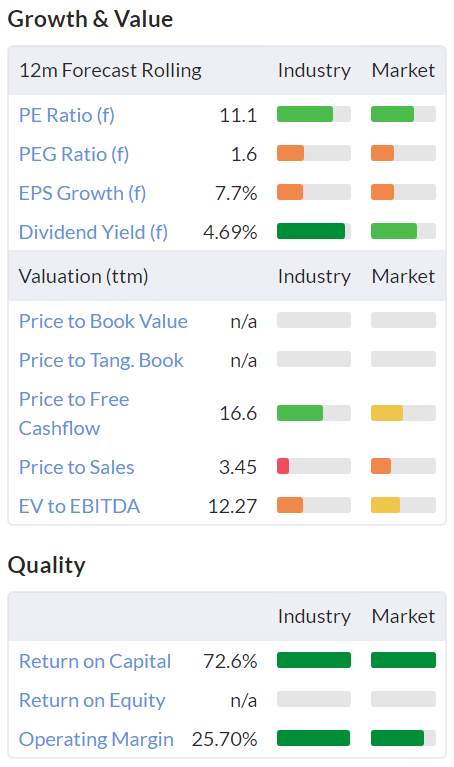
Having said that, looking at the Stockopedia stats, it does look reasonably priced, and good quality. So perhaps I've overlooked that? It might be worth a fresh look, with a StockRank of 92, and plenty of dark green on the graphics below.
Perhaps this might be an interesting share to ignore the China risk, and concentrate on the value & quality? Tricky one, I can't make up my mind, so will declare myself neutral.
.
.
Rps (LON:RPS)
Share price: 147p (down 14% at 11:22)
No. shares: 227.2m
Market cap: £334.0m
I don't seem to have ever looked at this consultancy group, not sure why, but possibly because the share price used to be higher, so it might have been above my maximum market cap size?
RPS, a leading multi-sector global professional services firm, today announces its Final Results for the year ended 31 December 2019 ('FY 2019').
The results have been given one of those little summary titles;
'FY 2019 in line with expectations, continued strategic progress'
It's quite helpful to flag that results are in line, in a header, as that saves me time having to work out if they're below, in line, or above. We can then just skip to the outlook statement, and then we have a quick overview.
My initial notes from first thing this morning are that RPS achieved 12.3p adj EPS, which looks a small beat against Stockopedia's consensus forecast of 11.87p. The company says its in line, so they must be using a higher consensus forecast figure - not stated, it would have been helpful to put the figure in the footnote, which is incomplete, just saying;
(2) The Board considers market expectations to be the consensus fee income, PBTA and fully diluted adjusted earnings per share published in the notes of those analysts who regularly follow and interact with the Group.
Broadcasting the analyst meeting - is a great idea, I wish more companies would do this sort of thing;
A meeting for analysts will be held at the office of Buchanan, 107 Cheapside, London, EC2V 6DN commencing at 9.30am. Attendance is strictly limited.
A video webcast of the meeting will be available from 12 noon via the following link: https://webcasting.buchanan.uk.com/broadcast/5e31691cb9710760e292473b
Profit is well down on last year, and note that broker consensus has also been reduced considerably. Therefore the in line result is stepping over a lowered bar.
- Adjusted profit before tax of £37.3m is down nearly 26% on 2018.
- Statutory PBT is only £4.8m, down 88% on LY. This would need closely looking into, for anyone considering a purchase here.
- Note the substantial exceptional costs this year, of £23.4m.
- There's a big, £12.3m exchange loss that by-passes the P&L, but reduces net assets directly (see the usually overlooked "Consolidated statement of comprehensive income" statement)
Balance sheet - wowee, this group has been on a major acquisitions spree by the looks if it. Intangible assets of £378.7m. If we write off this, as I usually do, then NAV of £348.5m becomes NTAV of negative -£30.2m - not good.
Debt looks too high to me, with £110.5m borrowings in long-term creditors. Net debt of £94.1m looks too high for me to be comfortable owning this share. It's stated as 2x (EBITDA, presumably).
Outlook comments seem a bit limp;
As we enter 2020, trading conditions in our markets are generally satisfactory and we anticipate more stable results from our segments. We will continue to invest, especially to deliver better connectivity, but we will do so in a measured way. We remain focused on building a business that in due course is capable of delivering mid-single digit rates of organic growth and a double-digit operating margin. The Board remains confident in the medium term outlook for the Group and anticipates that the year ahead will be broadly in line with 2019 with growth accelerating in 2021.
That doesn't make me want to rush out and buy this share.
My opinion - a PER of 12.9 looks superficially good value, but less so once you take into account the debt pile, and lack of growth in the short term.
Consultancy businesses have proven attractive bid targets in recent years, so maybe there could be upside there?
Otherwise, I can't get excited about this share, based on the information provided today.
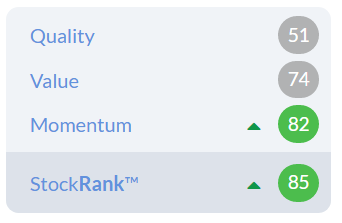
Stockopedia likes it though;
.
Gooch & Housego (LON:GHH)
Share price: 1350p (up 5.5% at 11:59)
No. shares: 25.0m
Market cap: £337.5m
Trading update (AGM)
Gooch & Housego PLC (AIM: GHH), the specialist manufacturer of photonic components & systems...
Background - I reviewed its last interims results here on 4 Jun 2019. The price dropped by nearly a quarter on the day, but soon recovered - this seems to be a share where the market gives it the benefit of the doubt over disappointments.
Graham had a quick look at its in line update here on 7 Oct 2019
.
.
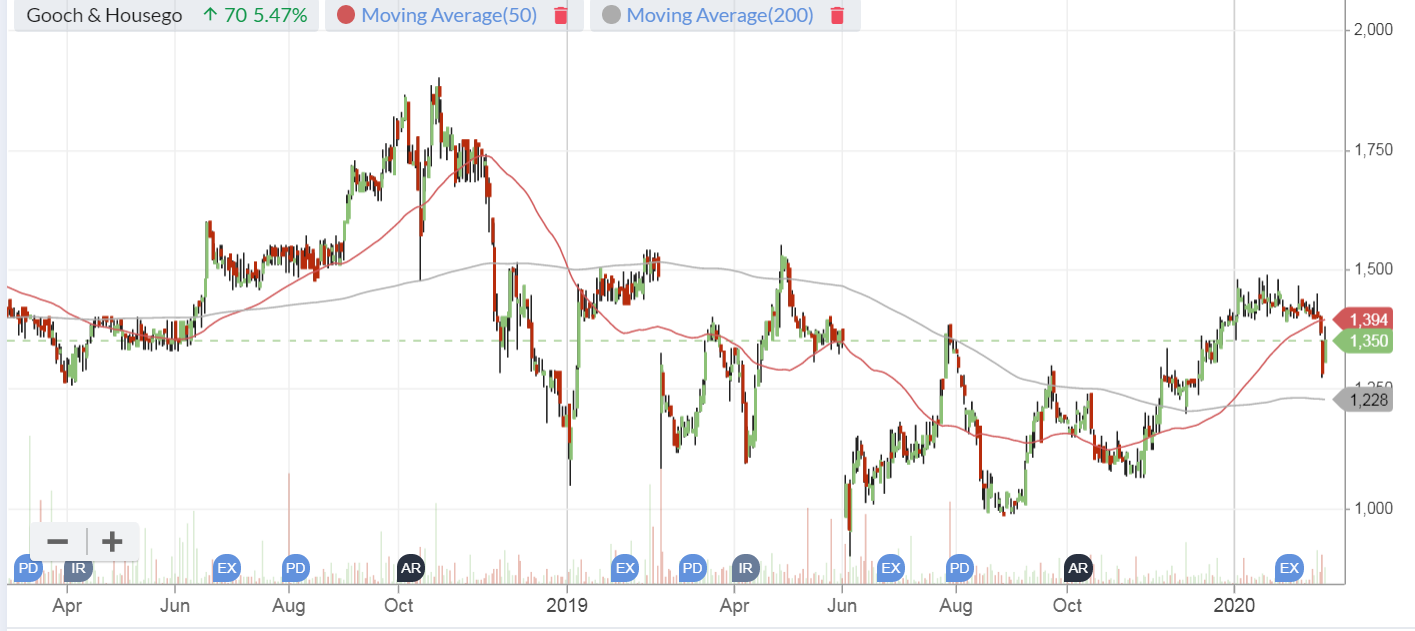
As you can see from the choppy 2-year chart, this business seems to regularly disappoint, but is quickly forgiven by the market, and it remains on quite a punchy valuation of a forward PER of about 25 after today's price rise. Clearly investors feel confident about the future, because the past doesn't really justify that type of rating, in my view.
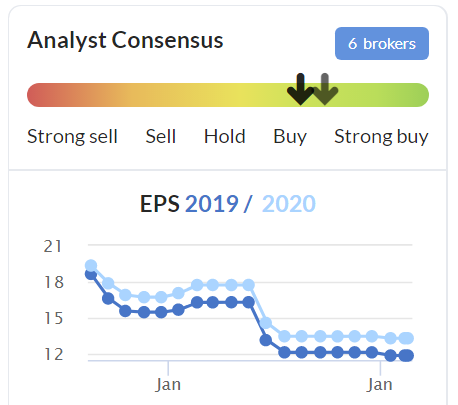
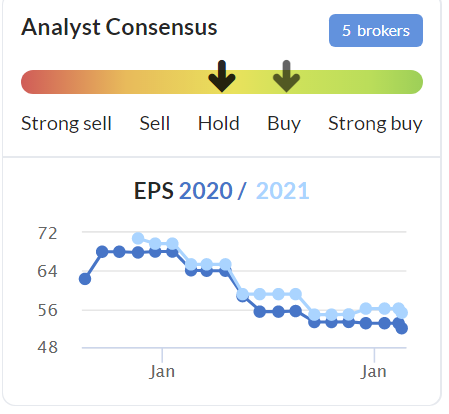
It's all the more surprising, given how earnings forecasts are repeatedly going down, not up;
.
.
Update today - it has a 30 Sept year end, so this covers the first 4 months.
During the first four months of the financial year trading reflected previously reported trends.
A challenging macro-economic environment for our industrial laser sector contrasts with high levels of demand for fibre optics, hi-reliability fibre couplers used in undersea cables and our A&D and life science capabilities.
Coronavirus is mentioned as a potential drag on performance, but "difficult to quantify".
More detail is given, but the company doesn't pull things together adequately. We should be told how performance is going compared with expectations. The company declines to say. Instead we get this waffle;
Overall we expect to show progress on last year's result and we will continue to monitor the potential impact of the coronavirus on our industrial laser products. We will provide further updates throughout the year.
Order book is up 3% vs a year earlier.
Outlook - is more about aspirations, than guidance;
"Technical innovation, such as 5G and new laser-based industrial manufacturing techniques will ultimately drive improved demand in the industrial laser sector.
We remain confident in the long term growth potential for our chosen photonic technologies in all of our target sectors.
"G&H will continue to pursue further progress on our long term goals of greater diversification and moving up the value chain".
My opinion - I find this a rather hesitant, and vague update. It side-steps the key issue (of performance vs expectations) like a politician on Newsnight. That's just not good enough.
Why the share price is up 5% today, is a mystery to me. Perhaps there has been some positive broker commentary that I'm not aware of? Or perhaps people were worried that its China exposure might be more serious than appears to be the case?
Overall, I cannot see why the share price is this high, based on the numbers.
Ebiquity (LON:EBQ)
Share price: 31.5p (up 21%, at 12:58)
No. shares: 75.9m
Market cap: £23.9m
Ebiquity plc ("Ebiquity" or the "Company"), a leading independent marketing and media consultancy, announces a pre-close trading update for the financial year ended 31 December 2019, ahead of the preliminary results announcement planned for 26 March 2020.
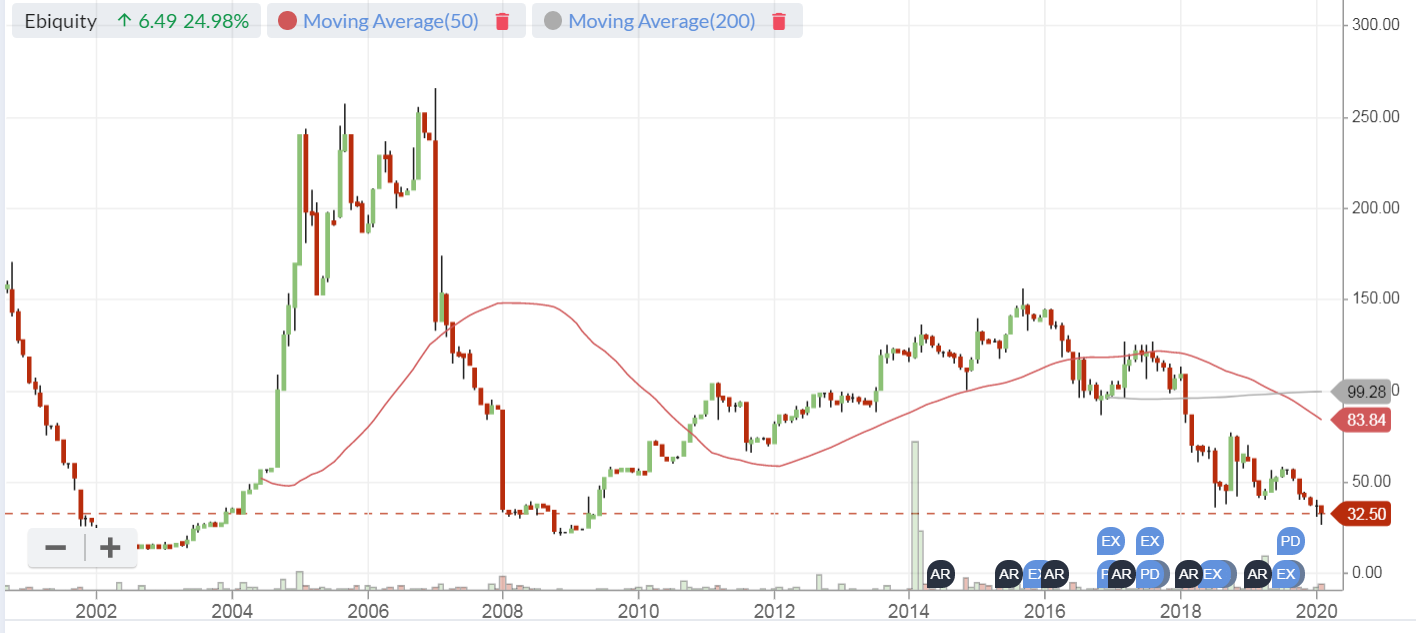
Background - I last wrote about this here in Nov 2014. I haven't missed much, as it doesn't seem to have made any commercial progress since then, and the share price has fallen heavily;

.
.
Not a great shareholder return, over 20 years, is it? Dividends have been negligible over this period. I wonder how much management remuneration has extracted from the business over that time?
An optimist might look at the chart, and say the current level has twice provided a good springboard for a price recovery - a spectacular, if fleeting one in 2004-2006.
Update today - it's only in line;
Ebiquity's trading for the year ended 31 December 2019 was in line with the Board's expectations. Its performance in the second half of the year was consistent with the trend reported in the first half...
What are expectations? The only forecast I can find is a note from Edison, showing £5.3m adj PBT, and 4.0p adj EPS for FY 12/2019. Stockopedia shows after tax forecast of £3.65m, and 4.05p EPS. Therefore, about 4p seems to be the ballpark for EPS.
At 31.5p share price, I make that a FY 12/2019 PER of 7.9 - not expensive, but why would you pay more, for a small, people business? That said, digital marketing is a great growth area to be in.
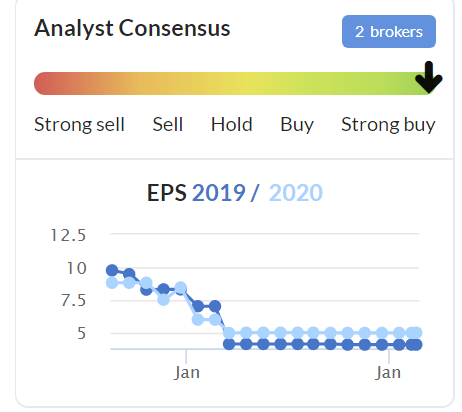
Continuing a theme of today's companies, this is another one where broker forecasts have fallen a lot, so achieving the reduced forecasts is not impressive in the wider picture;
.
Net debt is down. £5.8m at 31 Dec 2019, down from £7.0m 6 months earlier, and a huge reduction from a year ago, when it was £28m - a disposal cleared most of that debt. Interesting.
Closure of a rival is said to create opportunities.
Balance sheet - I'm looking at the last reported balance sheet, at 30 June 2019, and note that gross bank debt looks high, at £14.0m. However, a new bank facility of £24.0m was agreed in Sept 2019, with a 4 year term. So it looks like the bank is happy with everything.
I'm not keen on the balance sheet overall. NAV is almost all intangibles, and receivables look extremely high.
My opinion - it looks quite cheap, and could bounce a bit from here, but it's not something I would want to hold long-term, due to its long-term track record of not creating shareholder value.
Cambridge Cognition Holdings (LON:COG)
Share price: 24p (down 20%, at 14:20)
No. shares: 24.2m before placing + 7m placing = 31.2m
Market cap: £7.5m (after placing)
Trading update
Cambridge Cognition Holdings plc (AIM: COG), which develops and markets digital solutions to assess brain health, announces a trading update for the year ended 31 December 2019.
Background - this company has quite an interesting, and innovative product, with a lot of history & extensive data behind it. The problem is that, to date, the business has not been able to scale up. It just chugs along doing £5-6m revenues each year, and the StockReport numbers section is just a sea of red.
Wave after wave of optimists have funded the cash burn, with lots of small placings. I might have even taken part in one myself, it rings a bell. It hasn't worked commercially so far, but that doesn't mean it never will. If it does spark into life, and investors get excited again about potential growth, then you can see the potential from the chart;
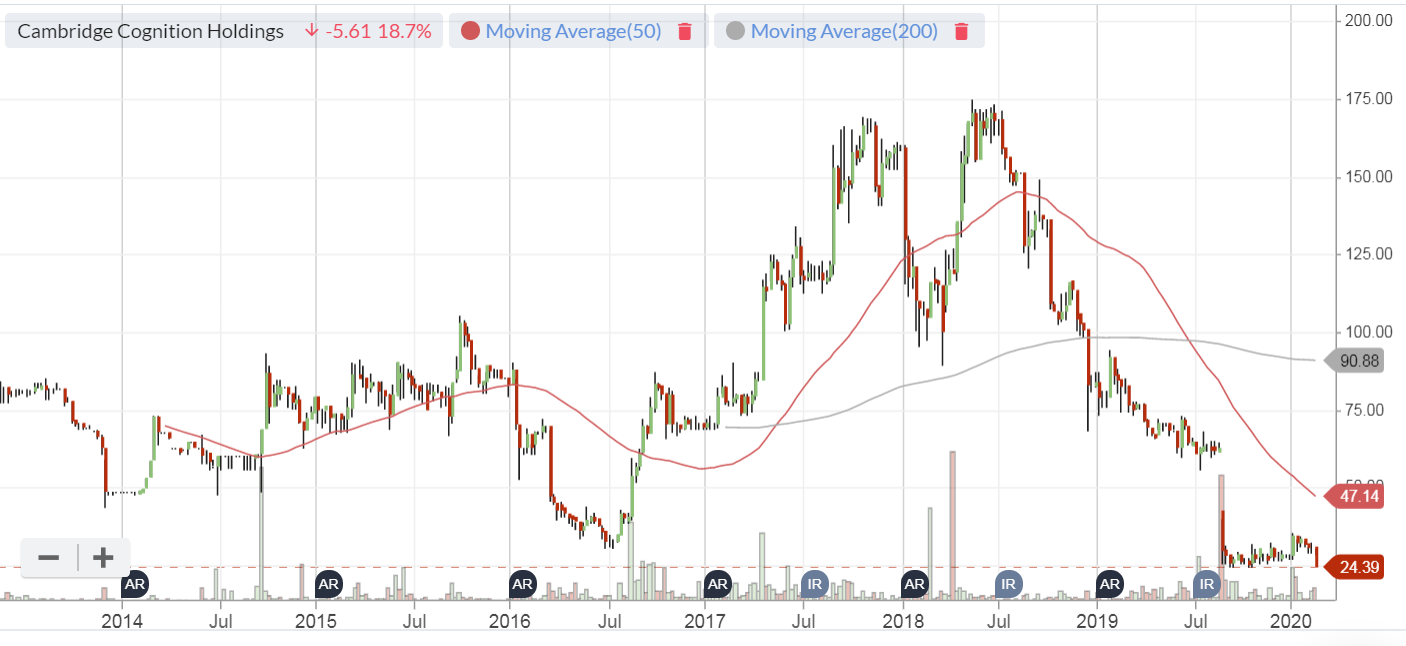
.
The share count has risen, but not drastically, from c.13m in 2013, to 31m shares today, so some strong newsflow could take it to say £30m mkt cap - c.100p per share, or a 4-bagger from here. How likely is that though? Answers on a postcard please, as I haven't got any view on that. Investor sentiment can turn on a dime. People hate a share one minute, then when some better news comes out, they suddenly love it - e.g. Bigdish (LON:DISH) which was 1p at Xmas, and is now 4.5p (I'm long of this one, my most speculative holding). Some of the best % gains can come from situations where investor sentiment is totally bombed-out, but not very often.
Update today - summarising it;
- H1 & Q3 weak
- Q4 & early 2020 "seen a return to significant growth"
- Orders - £4.1m already in the pipeline for 2020 {not bad, so early in the year, given that it usually achieves £5-6m in an average year)
- Poor 2019 results - £5.0m revenues, £2.9m loss - clearly can't carry on like that, so I think the company is probably now drinking in the last chance saloon
- Cash - down to £0.9m at 31 Dec 2019, hence the need for a top-up placing today, of £1.4m before costs (probably about £100k costs, as even small placings tend to be ridiculously expensive)
- Cost-cutting done, and profitability expected in Q4 2020.
My opinion - I've tried to set out the dismal track record, but also the potential opportunity above.
It could go either way. If sales accelerate, then you could double, triple or quadruple your money here. If not, then it could just grind down further in price, with de-listing a possibility.
It's just a punt now really, but one I find moderately interesting at this level. It's the sort of share that I would put say 10% of my profits from something else into, as a fun punt.
The product is real, and has won some big contracts. If it can scale up, then it's a multi-bagger potentially. But people have been saying that for the last 7 years, and it hasn't yet managed to achieve scale.
Let's leave it there for today. I dropped National Milk Records from the list, because it doesn't have a proper listing, and I cannot see why it's listed at all. Also profits are down, and it had a cyber-attack. What a weird company!
Best wishes, Paul.
Disclaimer
This is not financial advice. Our content is intended to be used and must be used for information and education purposes only. Please read our disclaimer and terms and conditions to understand our obligations.

35 comments
Re Cambridge Cognition Holdings (LON:COG)
CANTAB - the underlying product(s) - is OK; has been going 30 years. There are many alternatives. Largely peddled as an iPad app. A lot of research is needed to stay up-to-date, and most research done in the field is done by unconnected academics and clinicians. Originally all about Alzheimers. The emphasis in recent years on early diagnosis and MCI doesn't seem to have produced substantial profits. Now targeting clinical trials. I doubt if there's much about the app they can patent (and there are competitors who seem to stay in larger markets), which leaves the neuroscience research as the copyright bit. I've never thought much about it because I have always struggled to see how it will achieve substantial scale or dependable profits; not impossible, but i would have expected them to get there by now if they were going to do it. Maybe the clinical trials market will offer better opportunities - it's certainly less price sensitive.
Toscafund increased stake in Ted Baker (LON:TED) again today, up to 17% now.
Paul, can I be a thicky? Why does Strix have no return on equity?
Liabilities exceed assets, so there is no equity to have a return.
Ref profit warnings interesting - i must be unlucky/stupid buying into the 5% brigade so often when it goes wrong.
Hey ho Fevertree Drinks (LON:FEVR) is currently on 2 warnings not out so perhaps i should be looking at the above stats with confident for the future :). Shame i topped up after profit warning number 1 - sigh.
Laura Ashley Holdings (LON:ALY) issued an RNS at lunchtime that holders may have missed:
Further to the announcement on 16 February 2020 in response to press speculation, the board of Laura Ashley Holdings PLC (the "Company" and, together with its subsidiaries, the "Group") is pleased to announce that discussions between Wells Fargo and MUI Asia Limited relating to the Group's immediate funding requirements have concluded and the Group should be able to utilise requisite funds from its working capital facility with Wells Fargo to meet its immediate funding requirements. As previously announced, this is not a cash injection by MUI Asia Limited into the Group.
The Company welcomes the support from MUI Asia Limited and continues to review its working capital needs on an ongoing basis. The Company will update shareholders in due course in relation to the review of its working capital needs.
Well spotted FREng, thanks for posting that info on Laura Ashley Holdings (LON:ALY)
It would have been interesting to be a fly on the wall in those discussions. I wonder what assurances or deal was given to Wells Fargo to persuade them to extend their exposure?
Sounds like a temporary sticking plaster, but the more fundamental problem ALY has, is that it needs to do a CVA, or pre-pack Administration, to ditch the loss-making shops. Hence equity probably still worth nothing.
Paul, On Rps (LON:RPS) you say
"Otherwise, I can't get excited about this share, based on the information provided today. Stockopedia likes it though"
... and show the current QVMS bars. But these are based on data before today's results. of course, and may be downgraded once the data has been analysed.
Hi FREng,
Yes that's true. But since the results from RPS were in line with expectations, then I wouldn't have expected the Stockopedia figures to change that much, so that's why I put them in.
The sharp drop in share price today would improve the value scores, if anything, I imagine.
Regards, Paul.
The supply chains are getting a lot of focus on the corona front and whilst its giving a lot of companies food for thought from a business continuity perspective I assume they will get back up to speed when it either becomes another strain during flu season or goes away. Of a bigger concern to me at present is the impact of tourism, I noticed on the BEEB they were saying footfall at the Bicester outlet center used by a lot of tourists on their way from Stratford and the coltswalds was down 40%.
I walked into the old town of my city the other day and noticed how quiet it was and the throngs of Asian tourists coming in on the river cruises just weren't there, and actually the boats have stopped. Restaurants that were normally awash with Japanese and Chinese tourists were empty.
Looking at the markets I wouldn't be comfortable being in airlines, hotels, restaurants and other tourist driven businesses. I think it'll take a couple of years for people to be comfortable traveling again.
China import problems: How do we identify ‘China related companies’? If the test is reliance on imported products from China, this could affect most manufacturing companies and many pharmaceuticals.
There's an old stock market saying that "profit warnings come in threes". Ed and the team did some excellent work expanding on that. Generally it is a bad idea to buy on a profit warning, there's no doubt about it.
There's another excellent old adage about the four most dangerous words in investing. But my personal view is that indeed - "this time is different". That's because profit warnings such as that from Tekmar (LON:TGP) are different from the norm. Profit warnings generally come in threes because there is an underlying weakness in the business that the directors are unable, or unwilling, to recognise and fix. A profit warning due to supply chain issues is a different beast. Granted, the initial problem will cause other problems, but the underlying issue has a natural fix and if the business has a decent balance sheet it will ride out the problems.
That's why I bought Tekmar yesterday and will look to buy similarly downgraded shares. Tekmar fell 33.5% early yesterday while the market fell by something like 0.5%. I don't believe that the true value of this business fell by one third based on the new information yesterday. But the idea that it fell by one third relative to the market as a whole, is absolute nonsense.
Broadly speaking, there are 2 paths forward from here regarding Covid-19. Either we find that it can be contained and the world returns to work, with some disruptions. Or we find that it can not be contained and the issues spread across the globe. In neither of those scenarios is Tekmar suddenly worth 33% less than the market as a whole.
I scaled back on some of my largest holdings at the beginning of this. That gives me a lot of room to work with in dripping small amounts in to opportunities like Tekmar. If I hadn't scaled back at the beginning, I would now be selling slices of those that haven't moved down much and buying in to those that have.
I wouldn't recommend that approach to everyone - it suits my personal style of scaling in to positions and may not suit you - but I do think there's room for a whole range of different approaches to the current situation that are worth thinking through. I don't believe we should only be thinking about selling at this time.
"There's an old stock market saying that "profit warnings come in threes". Ed and the team did some excellent work expanding on that. "
I must have seen a different version of Ed's 'Profit Warning Survival Guide', because the copy I read definitively refuted this adage (!)
Good point! I think it depends on what is a "warning", over what period you measure it (this often drags out over several years, so what's a new warning and what's a follow on warning? I don't think you can limit the look-back to 12 months) and what set of data you're looking at (i.e. not just 3 years of a bull market as in Ed's piece). I've seen a report (a while back) that was in the US that suggested the saying was valid; not to say that there were literally three warnings, but that bad news/good news was serially correlated.
Either way, whether subsequent price action is due to a "warning" or not, something causes the price to fall further, long after the first warning, on average. So buying after the first warning is, on average, a bad idea which is the key point that I was making above. Do you disagree?
Agreed cmpeckham, that was another of the empirical observations in the 'Proft Warning Survival Guide' - share price recoveries post a profit warning are drawn out affairs, on average.
If I remember correctly, the key takeaway on profit warnings was that there is no rush whatsoever to buy following a profit warning. On average you can safely take a year. Great research!
I recently put this insight to use after Avast's recent RNS. Not exactly a profit warning, but definitely a bad-news event which slashed the share price. So happy (sort of) to sell and wait to see what happens when the dust has settled.
On Cronavirus, and looking into the impact on Alliance Pharma which I hold, I came across the below.
I suspect it's quite possible we are underestimating the possible impacts on supply disruption. The below article is about a testimony to congress last October. 'china...supplies as much as 80 percent of the world’s active pharmaceutical ingredients – the stuff that actually makes medicine work'
China’s Chokehold on America’s Drug Supply is a Nightmare Come True
BY CATHALIJNE ADAMS
https://americanmanufacturing....
China has gained a chokehold on America’s pharmaceuticals, experts warn, creating a critical leverage point that, if it were to be exploited, could lead to catastrophe. Testimony before Congress this Wednesday highlighted China’s domination of the pharmaceutical industry as a strategic move meant to undermine our nation's security.
“China has an active plan to become an increasingly dominant source of medicines to the world,” Michael Wessel, a commissioner on the U.S.-China Economic and Security Review Commission, said. “Pharmaceuticals and medical devices are a key sector in their Made in China 2025 and 13th Five-Year plans. Billions of dollars of support are coupled with government policies, investment strategies, and intellectual property acquisition approaches, both licit and illicit. China wants to win, and it has a plan to do so.”
China is well on its way to achieving this mission. Currently, it supplies as much as 80 percent of the world’s active pharmaceutical ingredients – the stuff that actually makes medicine work – according to Rosemary Gibson, senior advisor at The Hastings Center and author of ChinaRx: Exposing the Risks of America’s Dependence on China for Medicine.
Hi John
I used to need to analyse the global pharma manufacturing industry in a previous role. I believe the situation is rather more complex than the 80% made in China mentioned in the article, which provides no source for this statement.
The first question is are we talking volume or value?
Many generic drug active ingredients are high volume but very cheap. By contrast many of the patented products are many times more expensive.
The active ingredient manufacturing of generics is mostly done in China and India these days, but unless the Chinese have somehow been massively more successful than India in the last few years I very much doubt that they have 80% of that market by volume.
If we are talking value, some of the value is captured by the companies involved in secondary manufacturing. For example, acetaminophen (known to most of us probably as paracetamol) used to be made in the West but manufacturing of the bulk active ingredient was discontinued in the West several year’s ago as the West became uncompetitive and India and China had progressed to the point where they could meet the necessary quality standards. So, now a pharma company in the West May buy the bulk active ingredient from Asia but then turn it into a finished dosage form such as a tablet or capsule (incorporating various excipients to do so).
However, this is generic drugs. The situation with drugs still under patent is much more diverse with USA (including Puerto Rico), Western Europe and Japan all having significant share of active ingredient manufacturing for those products. (Even if the manufacturers of those products do have some of that manufacturing in China - e.g. GSK)
So, the impact is most likely to be on some generic medicines and much less on the patented products. So for the article to imply that 80% of medicines may have supply problems seems like an exaggeration to me.
Hi Graham,
Re cronavirus/medical supply chains If you follow the link to 'tesimony before congress' you'll find the testimony mentioned in the article:
https://energycommerce.house.gov/sites/democrats.energycommerce.house.gov/files/documents/Testimony-Gibson-API_103019.pdf
you'll find all the details such as below. Which 1, is worrying not least from supply chains, but from an indication that we have no real idea as individuals how pervasive the china impact is. And 2, also, enlightening how China has operated and maybe why Trump is following the tariff attack. So not looking to really drill into the specific example, but to highlight we often know very little about an area so large.
''The United States can no longer make penicillin. In 2004, the last U.S. penicillin fermentation plant in Syracuse, New York announced it was closing. The attached graph from the European Fine Chemicals Group, the trade association of pharmaceutical ingredient makers, illustrates how it happened.
Chinese companies formed a cartel and dumped penicillin ingredients on the global market at very low prices beginning in 2004, the same year the New York plant closure was announced. It could not compete with China’s illegal trade practices and its government subsidies. China’s cartel also forced the closure of penicillin fermentation plants in Europe and India. After four years, when China gained a chokehold on global supply, the Chinese cartel increased prices dramatically.
This is China’s playbook: drive U.S. and other manufacturers out of business by selling below manufacturing cost for several years and then raising prices when its domestic companies achieve global dominance.
To be clear, the United States has also lost virtually all of its other antibiotic raw material production capability.
Mothers who give their children generic antibiotics for ear infections; seniors who take generic antibiotics for pneumonia, and patients in the hospital with life-threatening sepsis are likely dependent on the mercy of China to supply core components.''
Hi John
Many thanks for the link. I’ve had a quick read and will read again in detail later.
But my quick thoughts are....
The author has an axe to grind. She’s written a book in a highly emotional style and has a vested interest in creating a panic to promote further sales of her book. Her criticism is as much about poor business practices in China (unfair competition, predatory government directed cartels, insufficient inspections by FDA and lack of supply chain vigilance from the secondary manufacturers) as it is about over dependence on China.
But that’s all going off topic. In terms of how dependent the US is on China and we are on China, one of the more telling sentences seems to be this.
“ The Association for Accessible Medicines reports that 8.5% of generic drugs sold in the U.S. are made in China.”
Now, if I read that correctly, that’s the figure around the time of her testimony and so I don’t see so far how 8.5% becomes 80% dependency on China unless she’s saying that the Chinese fine chemicals and intermediates industry has a stranglehold on the rest of the world supply. She makes some comments about India media reports but as her style is so emotional I struggle to know whether she may have verified the truth behind those reports or not. It could be the equivalent of citing the Indian version of the Daily Mail for all I know.
Anyway, I do expect that there may be some shortages on some generics. I said this to a friend just the other day. However, I don’t think it will be as much of a problem as the scary 80% number suggests. China needs to keep their API plants producing to supply their own country too.
“ The Association for Accessible Medicines reports that 8.5% of generic drugs sold in the U.S. are made in China.”
Problem is said to be to do with intermediates and raw materials, so this figure doesn't tell us much. I read somewhere the 80% in regard to India rather than US, so I suspect the base data (which i don't know) is being misused sometimes. India is an important supplier of generics to Europe, and presumably to US. Many NHS prescriptions are manufactured in India.
“ Problem is said to be to do with intermediates and raw materials”
Not quite. China and India manufacture the bulk API (active pharmaceutical ingredient). This is the component in the finished product (pill, capsule, etc) that gives the medicinal effect. However, rather than starting with basic raw materials, API manufacturers may choose to buy in intermediates to reduce the complexity of their processes. The suggestion is that Indian API manufacturers may be over dependent on Chinese intermediate manufacturers. And the same for raw materials.
It is not possible to start up manufacturing of an API or a finished product quickly In another plant because the process has to be validated. However, as you go further back in the supply chain towards more and more basic raw materials this regulatory hurdle gets progressively less. So, APIs are a bit more tricky than the intermediates or raw materials.
In addition to the supply chain for the API, there is also the supply chain for the excipients. These are not medically active but part of the finished product and may be substances like binding agents, colourings, coatings and so on. So secondary manufacturers who turn the API into the finished product cannot do that if they cannot get hold of the excipients either. So, it may not even be the API supply that stops production of the finished product.
It is quite complicated and I expected that no one has really fully analysed the dependencies.
RE UP Global Sourcing Holdings (LON:UPGS)
I notice that their Employees Trust scheme has bought 500,000 shares at 62.5p. Generally such purchases support/hedge the issue of options, so that new shares dilution is not required when they are exercised.
That seems to me a sensible policy, providing the Company takes a commercial view that this represents a good price at which to buy, and that such purchases do not prejudice the company's cash flow, as it represents sunk money until they are exercised, and the employee pays the exercise price for the shares.
They have bought up to 4.6% of their issued shares for the EBT to date. I think the technical limit for EBT's is 10%? So this can be used as a covert share price support mechanism in the wrong hands.
Normally, the exercise price money would be used ultimately to pay off the money loaned by the company to the Trust, to buy the shares. This should be a virtuous circle in that case, Worse case is the share price sinks lower on poor performance or a poor market, but that would need a longer term perspective..
However, it may also mark a flag to say the Company believes their shares are under priced. Many motives may underpin such purchases.
Yes, EBT's are a hedge, so can cut both ways. They can be used to fund both share awards and options, although the normal course for options is to create shares on vesting. The 10% limit of issued share capital is governance guidance (rather than a hard and fast rule), and most companies comply with it - however it relates to the creation of shares (and hence shareholder dilution) rather than share purchase on the market by the EBT.
There is no limit to the number of shares that can be held in the EBT - but the company no longer owns these shares (the funds to buy them have to be gifted to the Trust, which is an external third party) - auditors would expect the value held in the EBT to relate to outstanding share awards.
Companies have to treat share awards as a cost, so they hit their P&L. However, the cash position is quite different. Often these "outrageous" levels of Executive Pay that you read about are mostly made up of vested share awards - if the companies hedged the awards fully at the outset via the EBT, the "pay" actually costs them the value of the share awards at the time of the award. All the subsequent "outrageous" increase dubbed as "pay" has been funded by Mr Market - having hedged the award, the company gets it for free (and the executive is liable for tax on the value of the award when it vests).
Paul, thanks for the Corona virus thoughts and update on £KTEL
I think there is a third way of working out what to do. I think it was the naked trader which said, set a stop loss and take the emotion out of it, the market know more than we do, which is what I do. 20% for those still meeting my criteria, 10% for those that no longer do.
Was this line a Freudian slip or intended humour, I thought it was funny
Finally, there's a plug for KETL's most recent acquisition,
Yes, some people like stop losses, some don't.
Re plug & kettle, unintentional joke at first, but then when I spotted it, thought it was funny so left it in :-)
look fwd to your interview with UPGS. I am sitting tight on this one!
Paul's comments about mentally preparing for the 'China statement' are both good and important. I had been trying to do that with Strix (LON:KETL) which last night closed at 172, its lowest since the middle of November so this morning's statement is something of a relief.
Meanwhile I have sold my holding in International Consolidated Airlines SA (LON:IAG) on the grounds that most profits come from getting the load factor above a certain level and with people less keen to travel (that is why BA flights to Hong Kong have been halved) it could hit. (Farewell to my oldest share - bought at privatisation in 1987!).
08 08 Strix (LON:KETL) 178.8/182
$IAG has been a dismal share to hold for the last 5 years rising from 600 to 650 but the special dividend last year was pretty generous!
Strix (LON:KETL): Good to see their "coronavirus RNS" mentioned the welfare of their workforce in China.
Not all these updates have done that, highlighting the globalisation disconnect and that the remoteness is not just geographical but a management state of mind too.
My morning smallcap tweet: PureCircle gets sweet waiver
Gooch & Housego (LON:GHH) Pennant International (LON:PEN) Audioboom (LON:BOOM) Moneysupermarket.Com (LON:MONY) Purecircle (LON:PURE) Cambridge Cognition Holdings (LON:COG) Distil (LON:DIS) Strix (LON:KETL), Ebiquity (LON:EBQ)
Gooch & Housego (GHH) AGM stmt - trading reflected previously reported trends. "Overall we expect to show progress on last year's result and we will continue to monitor the potential impact of the coronavirus on our industrial laser products.
Pennant (PEN) statement of intent for a potential major new contract for a suite of generic training aids worth up to £5m. Expects contract in H120. Up to £3m could be recognisable in H2.
Audioboom (BOOM) expects for the Strategic Review process (including the formal sale process) to conclude during the third quarter of 2020. Co has received initial enquiries but is not in discussions with any potential offeror yet.
Moneysupermarket.com (MONY) CEO to leave, will stay for a smooth transition.
PureCircle (PURE) gets Waiver and Amendment to its Senior Facility Agreement - provides for full waiver of all previous defaults. Also additional $8.6m liquidity from shareholders. Shares still suspended after accounts hoo-ha.
Cambridge Cognition (COG) weakness continued into Q3 but Q4 and early 2020 has seen a return to significant growth. Guides FY19 rev £5.04m (£6.13m) and post tax loss £2.9m (£1.44m loss). "While sales and marketing spend is being increased, R&D and overall administrative costs are being significantly reduced and the Company continues to expect to achieve profitability in Q4."
Distil (DIS) guides FY profit marginally below current market expectations. JV with British Honey Company for a new range of branded botanical spirits and other products. Horrible MBA bollx "the collaboration will enable both parties to leverage their complementary competencies." It's just bottles of booze guys, not a cure for stupidity.
Strix Group (KETL) minimal disruption from coronavirus so far. "Two-thirds of the workforce have returned to the facility and whilst others have been hampered by travel disruption this remains sufficient to fulfil the customer commitments for February."
In line: Ebiquity (LON:EBQ)
Love the Distil (LON:DIS) commentary, Mr C, made me laugh. Nice way to start the day (laughing)
cheers
Francis
Strix Strix (LON:KETL)
Have today issued a quite measured and detailed "Statement regarding current situation in China" Interesting to see the markets reaction (I Don't currently hold)
The Strix (LON:KETL) announcement is the most interesting one of the day, so I'll be covering that first.
I have been watching developments on this one, a great coy, but until a definite indication the China issue is on the wane, I am steering clear.