Small Cap Value Report (Wed 27 Oct 2021) - preamble on markets, WIX, ACSO, BMY, OTB, RPS

Good morning, it's Paul & Jack here, with the SCVR for Wednesday.
Agenda:
Paul's Section -
Preamble on the markets generally - just some random thoughts that I woke up thinking about, that I thought would make an interesting discussion starter.
Accesso Technology (LON:ACSO) - a positive-sounding update, albeit very confusingly worded in places. Bulls in the share will probably be encouraged by talk of strong trading (undefined), and improved margins. I look forward to reviewing the FY 12/2021 numbers in due course, when we'll see the full picture. Personally, I've never been convinced by this share - it hasn't grown much in the last 5-6 years, and has not produced reliable profits or cashflows. So it doesn't seem to be a value or GARP share at the moment.
On The Beach (LON:OTB) - this beach holidays company has only just resumed trading. The valuation is about 20 times peak pre-covid earnings. So where's the upside for me, if I pay up in full. now, for a recovery that has only just started? There could be a couple of years bonanza trading from pent-up demand though.
Rps (LON:RPS) - a solid Q3 update, in line with expectations. Looks a decent company, probably priced about right.
Jack's section -
Wickes (LON:WIX) - recent listing that has been reporting positive updates on the back of increasing demand for home renovation. Today's Q3 is slightly less good, but total revenue is still up by 16.3% over two years and the company reiterates it is on track to meet the upper end of analyst expectations. The valuation appears modest.
Bloomsbury Publishing (LON:BMY) - confirms it is on course to meet FY expectations but I wonder if another 'trading ahead' might be in store. That depends on how much business has been pulled forward from customers stockpiling ahead of Christmas. Trades on a fairly high PER, but its IP is top class and digital is growing strongly, so still worth considering.
Preamble from Paul
Whilst the UK small caps market seems bearish about temporary supply chain issues, and inflation, the US markets continue to romp ahead to record highs, seemingly ignoring any worries about the future. It's a strange mismatch of investor sentiment. They can't both be right.
I'm still digesting the ugly profit warning from Ig Design (LON:IGR) yesterday. How can we spot similar situations in advance? The key factor seemed to be;
IGR is a low margin business - the operating profit margin, even after a ton of adjustments, was only about 4%, or 2% before adjustments - that's dangerously low when costs are rising suddenly.
Inability to pass on price rises to customers. How on earth do we predict this for other companies? It's not a factor that is typically included in financial reports. I suppose retailers have an advantage, as they set their own selling prices. Whereas manufacturer/distributors have contracts with customers, who will obviously try to resist price rises. All we can do is to quiz management of every company about this issue, in webinars they do, during the Q&A.
With my own portfolio, I've already gone through every position, and tried to work out supply chain risk. Most have fallen a lot already, so I'm happy that downside is already in the price. If a profit warning comes out, so be it, I can live with a say 10-20% drop, if the price is likely to recover next year. Shares go up & down, and if you can't cope with short term losses, then you're in the wrong game.
I've also avoided low margin businesses with obvious cost pressures, so I sold all my supermarket shares a while ago, when the rise in NI was announced. On top of rising input prices across the board (e.g. product, wages, energy), a significant hike in both employers and employees NICs is yet another headwind for these low margin businesses which already face cut-throat competition from Aldi & Lidl. Hence it's just not a sector that looks attractive to me at all.
A commentator on CNBC last night made a really good point about eCommerce. He reckons that supply shortages could be widespread, as peak Christmas season buying combines with a bit of early/panic buying, and supply holdups (e.g. Los Angeles port is apparently chock-a-block). Hence if the shops start running out of some products, which seems likely in the UK and other counties, then eCommerce businesses could well be the beneficiaries, seeing stronger demand and being able to raise prices. Who knows?
If things are in short supply, then sellers can raise prices in some cases. I'm still mesmerised by the huge profits being made by car dealers on secondhand cars at the moment. Why are customers bidding up prices so high? (reports are saying some prices are up 10-20%). That's both a problem with supply shortages, but it's also a clear sign of excessive demand, due to money printing & the Govt's covid support measures arguably over-stimulating the economy - i.e. people can afford to, and are willing to pay much higher prices for used cars.
So this looks like a combination of demand pull (too much money sloshing around) and cost push (shortages, and rising cost inflation) happening at the same time. Nobody really knows of course, experts and interested amateurs (like me) usually get predictions wrong, because economics is not a precise science, and predictions from everyone are usually laughably wrong after the event, apart from a lucky few who happened to guess correctly.
So if you're looking for some predictive pearls of wisdom from me, forget it! Overall, I suppose I'm currently (subject to change) seeing things like this (and it's only one person's opinion remember) -
- Inflation looks like it's going to be a much bigger problem - anecdotally I'm hearing of big price rises in the pipeline for goods. The full impact hasn't hit consumer prices very much at all yet, due to the delays caused by forward purchasing. So the next wave of goods hitting shops in early 2022 could cost a lot more.
- Skills shortages with labour are also clearly pushing up wages (a good thing in my view, but not good for corporate profits).
- Logistics problems widely reported, but nobody seems to know when they'll get sorted out - but they will get sorted out, timing is the only question. So this could help inflation moderate, at some point next year maybe?
- Pricing power is everything at the moment, so I'm only happy holding shares in companies that make decent profit margins, and can pass on price rises to customers (the absolutely key question to ask in webinar Q&A sessions).
- Or avoiding companies which shift physical goods at all - maybe it's better to focus investments into services companies?
- Share prices in UK small caps have fallen a lot already, and some that have reported stable supply chains, and are managing the problems well, are rebounding in price. Most of my companies have reported already and it's generally been OK.
- It's probably too late to sell in many cases. If it's a fundamentally sound business at a reasonable price, then I'm happy to sit tight and wait for recovery in 2022 (or maybe earlier).
Everyone will be doing things differently of course, each of us has to make our own decisions. But there are lots of opportunities out there at the moment, as well as threats. Plenty of good companies have been punished with nasty moves down (often from unrealistically high starting points, as the everything rally got out of hand in the spring/summer I think). So, for the brave, there are opportunities for sure. I think the trick is to remove the uncertainty, by buying companies which have already reported on supply chain/inflation, and not seen particularly bad problems.
I think this is a time when good management shine, and take these problems in their stride. Poor management & business models are brutally exposed in circumstances like these, and certainly there have been some surprises (so far), with probably more to come.
Paul’s Section
Accesso Technology (LON:ACSO)
915p (up 8%, at 08:41) - mkt cap £379m
accesso Technology Group plc (AIM: ACSO), the premier technology solutions provider to leisure, entertainment and cultural markets, today gives the following update on trading…
The current year is FY 12/2021, so at this stage the company should have a good idea what full year performance is likely to be.
Accesso mainly provides digital queuing & ticketing systems for theme parks, with other bells & whistles. It’s obviously a recovery share, with theme parks re-opening.
Whether it’s any good, even once its business is operating normally again, is the main question. I’ve never seen any convincing evidence to date of a decent, or cash generative business here, and nobody wanted to buy it when it was put up for sale a few years ago.
However, let’s look at it today with fresh eyes, as things may have improved.
Summarising its update today -
“continued strong performance through September and into the October trading period. “ - great, but what is strong performance? It’s not defined.
“High demand in end markets” - and “increasing use of its revenue-generating technology” by customers. Again a bit vague.
Revenue guidance for FY 12/2021 is >$124m - that’s a nice uplift on H1’s $50.7m, so $73.3m in H2, with theme parks re-opening more. I don’t know what the breakeven revenue level is, so it’s difficult to put this in context. Seasonality with this share does I believe have a heavy bias to H2 anyway, so maybe the uplift from H1 to H2 is not so great?
“profitability continues to improve as the growth in its higher-margin products outpaces those products with lower margins.” - sounds good, how about some figures?!
Costs - this is confusingly worded. To me, the word “impact” means something bad, i.e. lower profits. But Accesso seems to be using it the other way around here, i.e. a sort term benefit form reduced costs -
“… It also continues to see an impact from a lag in its return to normal cost levels while it deploys additional resources to calibrate for the increased demand. As previously signaled, these investments will have a limited impact on Cash EBITDA in 2021, while their full annualised effect will be felt in the 2022 financial year.
Actually, that’s so badly worded, it’s getting close to being gobbledygook. Can I suggest the RNS writers at ACSO and its advisers submit to some retraining in how to explain things in plain English?
The last bit above seems a convoluted way of telling us that costs are going to rise next year, which is what the company said previously (from memory).
Cash EBITDA - is not defined in today’s announcement, and we know from its history that Accesso has been extremely aggressive in capitalising development spend. Nothing necessarily wrong in that, development spend is a genuine investment. However it renders EBITDA meaningless, and often grotesquely inflated at software companies, since often a large part of the payroll is entirely ignored, and is in reality a normal running cost of the business, usually.
... Due to these dynamics the Group now expects its Cash EBITDA margin for the full year 2021 to exceed 20%.
My opinion - if you already like this share, then I would imagine you view today’s update positively.
Personally, I don’t like this share, because it’s not really a growth company (see graphs below), and has never established a decent level of sustainable profits or cashflows, like say some other software companies, e.g. Dotdigital (LON:DOTD)
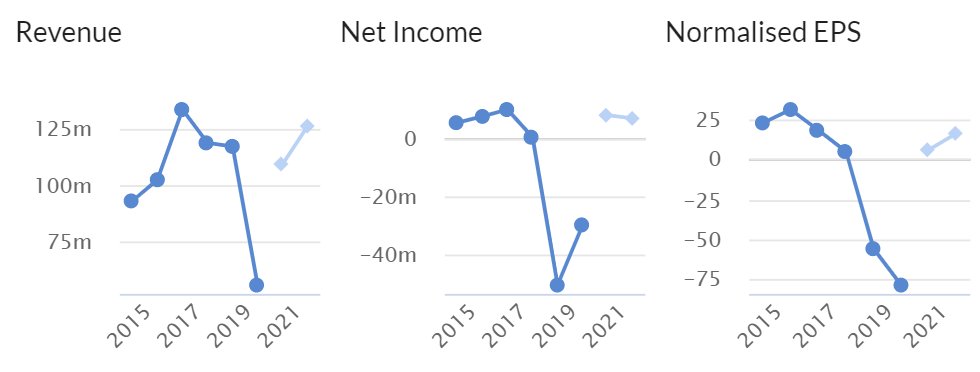
The story feels quite stale now with jam tomorrow never really being delivered, well not of Bonne Mamon quality anyway!
That said, it’s a tech business, and we’re in a tech boom, so anything could happen to the share price. Punters bid up the market cap of this one to c.£1bn in the past, so who knows we could see a repeat of that? Market sentiment is anyone's guess, and seems completely irrational in some areas at the moment.
From the perspective of a value/GARP investor though, this share has little to no appeal to me. Of course that doesn’t mean a thing, because we’re in a bull market, and different types of investors buy into this type of share, often impervious to real world economics & valuations it seems.
If we're heading towards higher interest rates (driven possibly by tapering of QE, and higher inflation), then I wouldn't want to be holding growth shares whose valuation relies on guesswork about future growth.
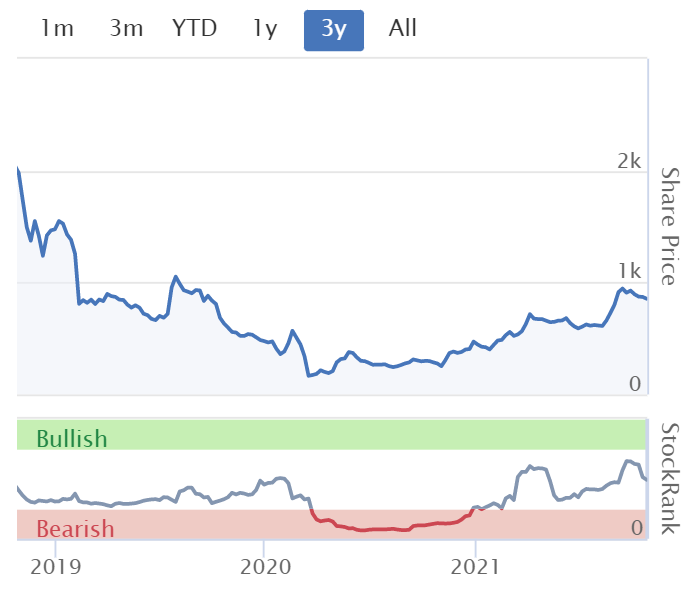
UPDATE at 09:39 - Broker forecasts - getting hold of broker research on this company is fiendishly difficult, but a friend has just contacted me to give me the latest broker forecasts, which are:
FY 12/2021 - Profit before tax $20.1m, EPS 26.1p = PER 35.1 (based on share price of 915p currently)
FY 12/2022 - Profit before tax falling to $16.7m, EPS 21.4p = PER 42.8
That reinforces the point that the shares are certainly not cheap. However if that $20.1m profit is genuine, and turns into cash, then I would view this share a lot more positively.
Let's see what the full year numbers look like in due course. I tend to put more reliance on the cashflow statement, than the P&L, with this type of software company.
.
Rps (LON:RPS)
124p (down <1%, at 11:35) - mkt cap £344m
RPS, a leading multi-sector global professional services firm, provides the following trading update for the quarter ended 1 October 2021 ('Q3-2021' or the 'period').
“Performance in line with the Board’s expectations”
Revenues & margins improving
Year to date fees up 4% (at constant currency) to £353.6m
Net debt of £34.4m looks fine for the size of business, at 1.2x EBITDA
Plenty of headroom on bank facilities
Market confidence is generally improving
Outlook - sounds fine -
"Group performance has, as anticipated, strengthened as we have progressed through the year, and we expect momentum and business performance improvement to continue in the final quarter."
Forecasts - many thanks to Liberum, for an update note today.
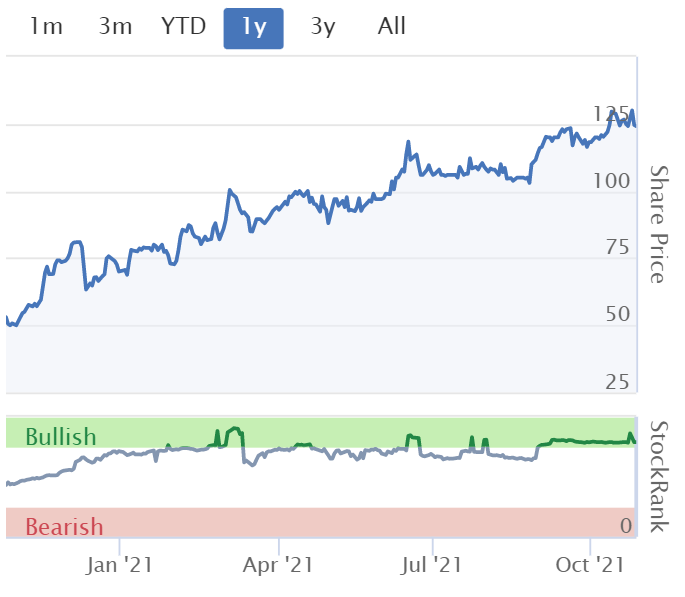
They’re guiding for 5.48p in FY 12/2021, rising to 6.57p in 2022.
The PERs are 22.6, and 18.9 respectively, which looks about right.
My opinion - this looks a decent company, and trading is recovering.
Valuation? Looks about right to me, therefore it doesn’t interest me. I’m looking for things that are either cheap, or are beating expectations, primarily. RPS has had a smashing run, which looks justified, but I think we would need to see performance exceeding expectations to justify any further share price rises for the time being.
.
.
On The Beach (LON:OTB)
326p (down 3%, at 10:53) - mkt cap £541m
On the Beach Group plc (LSE: OTB.L), the UK's leading online retailer of beach holidays, today provides an update on trading for the 12 months to 30 September 2021 ("FY21") ahead of announcing its Preliminary Results on 9 December 2021.
The company only resumed selling holidays from early Sept 2021 - so numbers for FY 09/2021 are irrelevant - good job, as we’re not told what they are!
Is it going bust, is the main question? It looks in a solid position from this:
Liquidity - I would need to see the whole balance sheet to be sure, but on the face of it this sounds a comfortable liquidity position -
On 30 September 2021, the Group had cash in excess of £55m, excluding customer prepayments of c.£40m which are held in a ring-fenced trust account. The Group has access to a £75m credit facility which is undrawn. The Group continues to refund all customers in cash and in full where their holidays are cancelled.
There might be other stretched creditors, we’re not told either way.
Outlook -
… demand for international leisure travel currently remains below pre-pandemic levels, our specific initiatives, including the "Free Covid Tests" promotion, combined with a further softening of government restrictions, have stimulated bookings in the final weeks of the financial year. The increased awareness of brand and strengthening of trading over this period provides confidence that there is pent up demand for travel, and positions the business well as we enter 2022.
My opinion - this update is light on details. Would I really want to pay £541m for a business that has been effectively dormant, and burning through cash, for c.18 months?
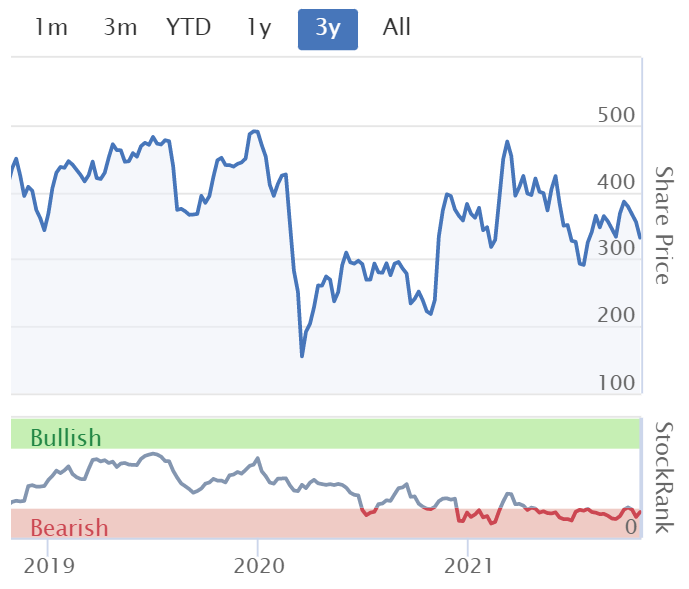
Peak earnings - net (i.e. after corporation tax) profit peaked at £26.2m in FY 09/2018. Therefore the PER is currently 20.6 times peak earnings. That doesn’t make sense to me.
It’s possible that FY 09/2022 earnings could be a blockbuster year, with pent-up demand.
OTB makes strangely high profit margins, which suggests to me that it might find headwinds from impressive competitors such as Easyjet (LON:EZJ) and Jet2 (LON:JET2) who I imagine would also be likely to launch massive advertising campaigns, and both offer package holidays too, not just flights.
Put that together, and I can’t see any attraction in OTB shares at the current price - it factors in all the upside, in my opinion, whilst the company has only just resumed trading. Why would I want to pay in full, and up-front for future recovery that hasn’t actually happened yet?
I remain of the view that by far the most strikingly mis-priced leisure sector (hybrid) share is Saga (LON:SAGA) (I hold) - where the market seems to be studiously ignoring the upside from its resumption of travel operations, and also seems to be ignoring the fact that its successful insurance business fully funded the cash losses of the travel divisions. Plus belt & braces refinancings, mean it’s sitting on an over-sized cash pile, with long maturities on the debt. Nothing else I’ve looked at comes even vaguely close, in terms of positive risk:reward. Obviously other people don’t see it that way at the moment, but such is life.
.
.
Jack’s section
Wickes (LON:WIX)
Share price: 221.2p (-2.12%)
Shares in issue: 259,637,998
Market cap: £574.3m
Wickes is a recent listing, a well known brand spun out of Travis Perkins. Such situations can be interesting as it’s often a case of a successful division being freed of a larger companies time and investment constraints. I believe Peter Lynch said as much in One Up on Wall Street, which was one of the first investment books I read and is well worth a look for anyone that hasn’t picked it up.
It’s a home improvement business that has invested heavily in its digital proposition, offering products to local trade and DIY and DIFM (‘Do It For Me’) services to customers. Revenue is split fairly evenly between these three lines and Wickes says that few others offer such a spread of activities.
New listings can be risky though. So far, the share price has not really moved.

But the company is receiving some interest from the community, perhaps due to its brand name and the idea that more people are now spending time and money at home.

While the enterprise value is significantly higher than the market cap, this difference is almost exclusively capital lease obligations (presumably on its shops), so on a pre-IFRS 16 basis the company should be net cash.
Wickes continued to perform well in the third quarter, with a resilient sales performance. As expected, Core sales moderated as we annualised tough 2020 comparatives, and remained strongly ahead on a two-year basis, underpinned by our digital leadership and operational strengths.
Core sales were down 2.3% like-for-like on the prior year but up 27.4% on a two-year basis. DIFM was up 0.7% but down 12.4% over two years. Total revenue was therefore -1.6% yoy and +16.3% over two years.
Comps over the past year or so have been quite variable owing to lockdowns with a surge in DIY products in the same period last year, but there is a declining trend over the past two years (although still positive), with 2Y LfLs of +25.6% in Q1, +19.7% in Q2, and +16.3% in Q3. That Q3 is decent of course, but the trend itself could be something to monitor.
This graph is from the group’s interim presentation, so is slightly out of date now, but provides a good impression of rapidly changing conditions.

Core sales were supported by strong performance in local trade, where home renovations continue to drive robust order books for our trade customers. Supply shortages had no material impact on sales in the period, although the group does note an acceleration in price inflation. Wickes is focusing on cash margin recovery while maintaining its price position.
DIFM reported sales were ahead year-on-year, with an improving trend on a two year basis. Q3 DIFM ordered sales (which are not yet recognised in the accounts) were 'broadly' in line with 2019. The total DIFM order book remains considerably higher year-on-year, impacted by extended project completion lead times, and this will result in a higher carry over of orders into 2022.
The full year outlook for adjusted PBT (excluding demerger and IT separation costs) remains in line with expectations and guidance given with the interim results. This is from the interims:
Given the strong outlook for Core and DIFM trends, together with half year results which delivered adjusted Profit Before Tax £1.5m ahead of guidance, we now expect adjusted Profit Before Tax for the full year to come in towards the upper end of analyst expectations (range £67-£75m).
Conclusion
Declining 2Y trends or not, this is still a double digit 2Y improvement and it means Wickes is on course for PBT at the upper end of £67m-£75m. That values the company at just 7.8-8.8x profit before tax.
The group has strong brand recognition and appears to have built up a fairly unique market position, with its DIFM line particularly hard to replicate. It is cash generative with a healthy and well-invested business and a strong digital presence that has served it well over a difficult period. So if there is to be a UK renovation boom, then at the current valuation, Wickes looks well placed to benefit and perhaps even take market share.
There are cost inflation pressures, as with a lot of operators, but there is also healthy demand from a large and growing home improvement market. I think the shares look good value given the outlook, although the usual caveats concerning recent listings remain. The good news with that though is that there will be a wealth of material in the recent prospectus to dig into.
It’s a particularly difficult time to gauge companies’ prospects at the moment. Wickes management refers to it as a ‘dynamic’ environment, which means there are all sorts of competing factors at play. Cost inflation, logistical logjams, spiking demand, and varying abilities to meet that demand.
The company is flagging a moderating trend in 2Y growth rates, so that must be considered. Again though, I come back to the valuation. This alone makes Wickes worth looking at in order to more deeply assess its outlook, as a net positive environment and continued earnings increases could lead to good upside over time.
Bloomsbury Publishing (LON:BMY)
Share price: 368p (+4.55%)
Shares in issue: 81,608,672
Market cap: £300.3m
We last covered Bloomsbury after it published its third profit upgrade of the year and declared a special dividend. The share price has appreciated by about 20% since then, understandably. Trading can be choppy for publishers depending on the quality of what they have coming out, but Bloomsbury has been able to generate dependably profitable results.

This is reflected in a Quality Rank of 91. In fact, the StockRank has been exceptionally strong for a long time now.

The current valuation requires ongoing growth, so it’s good to see that brokers have been raising both FY22 and FY23 forecasts.

Highlights:
- Revenue +29% to £100.7m,
- Adjusted PBT +220% to £12.9m; PBT +265% to £11.1m,
- Adjusted diluted EPS +210% to 12.82p; diluted EPS +263% to 10.41p,
- Net cash down a percent to £43.7m,
- Interim dividend +5% to 1.34p.
Cash conversion was some 173%, with £43.7m of cash generated.
Consumer division - revenue was up 29% to £62.9m and adjusted PBT increased by £5.6m to £8.4m. The Head of Zeus acquisition, completed in June, contributed £2.7m of revenue and £0.4m of profit before tax.
Within Consumer, Adult Trade performed well with revenue up 27% to £23.9m and adjusted PBT up 23% to £1.3m. It was the ‘excellent’ performance in Children’s Trade that did the heavy lifting though, with revenue up 31% to £39m and adjusted PBT up by £5.4m to £7.1m.
Harry Potter sales were steady, sales of the front and backlist titles of Sarah J. Maas grew by 130%, and other Children’s titles increased by 10%.
Non-consumer division - again, an ‘excellent’ performance with revenue up 27% to £37.7m and adjusted PBT up some 220% to £4.6m. Another acquisition completed in June, RGP, contributed £1.7m of revenue and £0.4m of adjusted PBT.
Bloomsbury Digital Resources (BDR) revenue increased 44% to £8m with profit up from £1.2m to £2.8m and the group has some ambitious targets for this division. It is on track to achieve its five year target of £15m in revenue and £5m in profit for 2021/22, with a new target from next year of achieving a further 50% organic growth and 30% margin.
CEO Nigel Newton comments:
Retailers and online booksellers have significantly increased stock levels over previous years to ensure they have sufficient stock for Christmas given the supply chain problems. Our first half revenues have therefore been boosted by customers ordering earlier than in previous years.
Whilst the Board remains mindful of the external environment, including impediments in the supply chain and the possibility of higher returns of the increased stock ordered early, the strength of the first half performance means that we are confident in achieving market expectations for the year ending 28 February 2022.
Expectations are for revenue of £193.4m and profit before taxation and highlighted items of £19.3m. Given that results tend to be heavily H2 weighted and the group has already reported H1 adjusted PBT of £12.9m, I would think there’s a fair chance of exceeding these expectations, although that depends on how significant this first half increase in stock from customers is.

The group sheds some light on this in its outlook. Print supply chain challenges are ongoing and Bloomsbury is working with suppliers to print earlier, working with customers to deliver earlier, and ‘being agile’ about where it prints.
The result of this is that Bloomsbury has achieved earlier print sales to customers, ‘well in advance of our historical peaks in the run up to Christmas and at the beginning of the academic year in the Autumn’, meaning first half revenues have been boosted by customers ordering earlier than in previous years.
Conclusion
Bloomsbury is a top tier publisher, there’s no doubt about that. Its backlog, reputation, and market position are solid competitive advantages. It’s amazing to see that the first Harry Potter book was the fourth bestselling children’s book of the year, some 24 years after it was first published. But there is more here than the boy wizard.
The business has had a particularly successful past four years or so, growing diluted normalised earnings per share well over that period.

Looking to the future, the group has several long term growth objectives. In Non-Consumer, characterised by higher, more predictable margins and greater digital and global opportunities, it wants to grow the portfolio. In Consumer, it wants to nurture and retain high quality authors and illustrators, while looking at new ways to leverage existing title rights.
And the group also has international ambitions. Last year, 64% of group revenue was overseas and 76% of Academic BDR sales are international.
There’s a long-term strategy for growth, including growing digital formats. Supply chain issues have no impact on digital sales, which continue to materially increase and are a growing proportion of both revenue and profits.
Digital and non-print sales accounted for 26% of revenue in the first half and the group is on target to achieve its five year ambition for BDR revenue of £15m and profit of £5m for 2021/22. The new BDR target from 2022/23 is to achieve a further 50% organic growth and 30% margin over the next five years.
This is probably a company I should have paid more serious attention to earlier, but it’s never too late for the right company. It’s possible that we’ll get another ‘trading ahead’ update at some point, depending on just how much H2 demand has been pulled forward.
The PER multiple is on the high side for a book publisher and I do wonder about that, but I can also see the argument for why it might be deserved in Bloomsbury’s case.
Disclaimer
This is not financial advice. Our content is intended to be used and must be used for information and education purposes only. Please read our disclaimer and terms and conditions to understand our obligations.

69 comments
Hi Jack (and the other Bloomsbury Publishing (LON:BMY) contributors today)
Thanks for the write-up. It is one of my largest holdings and I remain a fan.
I thought I would offer some thoughts on your last paragraph:
"The PER multiple is on the high side for a book publisher and I do wonder about that, but I can also see the argument for why it might be deserved in Bloomsbury’s case."
I prefer to split the business in 3 and value each part separately to explain why I think Bloomsbury Publishing (LON:BMY) deserves its current valuation:
1 - Harry Potter Revenues
By my calculations Harry Potter (HP) revenues made up 20% of Total revenues in the last financial year @£37m.
Very crudely applying an historical 14% Operating Profit margin achieved by the Children Segment (it was 18% in H1 this year) = £5m operating profit.
It's a powerful brand, with 2 more Harry Potter films being released in 2022, and whilst I can see revenues fluctuating, I can't see them going away.
I personally apply a x20 operating profit multiple here
= £100m HP Valuation
2 - The BDR (Bloomsbury Digital Resources)
Operating Profit this year is forecast to be £5.0m this year.
I can't help thinking that the company is holding something back here as:
In any case:
Given the growth here I personally apply a minimum x20 operating profit multiple based on this year only:
= £100m valuation today
I actually think I'm still undervaluing the BDR, though I'm happy to leave my assumptions as they are to account for the slowdown in growth announced from March 2023 until February 2028.
How the company can forecast this revenue stream so many years in advance I don't know - I hope they are simply being overly-cautious and I look forward to more clarity in due course.
I should add that even modelling growth into next year before 5 years of slower +10% CAGR growth, gives me an operating profit close to £10m in about 3 years, so there's much room for my valuation above to increase very quickly.
3 - EVERYTHING ELSE
In H1 the non-BDR segments generated £8.4m of operating profit.
For prudence I am assuming that OP for the full year will be £16m, £5m of which will be Harry Potter related leaving £11m of non-HP and non-BDR revenues.
I only apply a x10 multiple here due to revenues being less reliable = £110m valuation
---
1 + 2 +3 = £310m
The current market cap is £300m and the company has £40m of cash, so there's at least 20% upside from today's price to reach what I would see as a Fair Value.
So, whilst Bloomsbury Publishing (LON:BMY) might look expensive as a publishing company, I'm hoping the recurring Harry Potter profits and the hidden value from the BDR segment justifies its seemingly high premium.
In the meantime, the company is highly cash generative allowing it to grow by acquisition if necessary.
Cheers
A
Was just going through On The Beach (LON:OTB) results, and also reading Paul's commentary above.
On the topic of airlines - like Jet2 (LON:JET2) £EZY Wizz Air Holdings (LON:WIZZ) and the rest. With oil prices high as it is and potentially if they keep increasing, will we see huge losses next year? Presume many airlines hadn't forward hedged big amounts of fuel next year given COVID uncertainty and already stretched financial situation. So therefore, more spot buying to come at high prices?
Pent up demand will help to balance out as there'll be demand willing to pay whatever price increases for flight seats. But how will it all play out? Pent up demand vs high oil prices.
It's an interesting thought. Usually airlines will always hedge forward but given the levels of uncertainty around travel they may well have done much less hedging to avoid additional large derivative liability losses if their flight schedule was disrupted.
So agree some spot buying appears more likely and corresponding increases in seat prices. It may be quite a muted effect though as some futures hedging will inevitably have been performed and I suspect a number will also have used call options at a reasonable out of the money strike. Premiums would be small enough not to hit p&l much given the out of money nature but if they were quick enough oil may have even been priced in the $40-50 region.
Jack, thank you for a sound and balanced write up on £BMY. The company and share price went through the doldrums after the end of the Harry Potter film series, the share price coming back from £3 + to just over a £1 from memory. So being a long term holder it has been somewhat of a journey, hence I admit to a little bias.
I see the company as having a good runway for growth and the financial capacity to fund it. Hopefully Nigel Newton and his team will continue to skilfully manage the process. As Richard Leonard remarked in his PI World interview last year, the Harry Potter books are not dissimilar to an annuity. They have become a children's classic and will be read by future generations, much as is Thomas the Tank Engine to name but one is.
Hi Jonno
It is one of those things I remember reading HP books to my nephews years and years ago.
We borrowed the first three last year to read to our oldest daughter (now 8) and both her and the younger daughter (now 6) love them. We bought the remaining 4 books, and are on something like the 3rd or 4th reading as bedtime stories - sometimes we even manage to sneak another book in as a change.
We took the plunge in the summer holidays and bought book 1 on Audio Book (not cheap at £31) but amazing for long car journeys and has not left the car CD player in 3 months. My wife has just taken the kids down to see family in London and Surrey and we got book 2 (Audio) again last month, so doing our bit for Bloomsbury Publishing (LON:BMY)
I wonder if Harry Potter is going to become something like Lord of the Rings, Peter Pan or Narnia so last for a long long time and then enter the world of IP challenges?
Tommy
ps. I do not currently hold (having sold)
Hi Tommy
My introduction to Bloomsbury Publishing (LON:BMY) was over 20 years ago when I met Nigel Newton, the CEO at a book fair. At that time Harry Potter and the Chamber of Secrets, the second book in the series had just been published. He asked me if my children read. My son was about 9 at the time and an avid reader, his sister 6. Nigel Newton very kindly gave me a copy of Chamber of Secrets on the back of which I bought 600 shares. it was all I could afford at the time. The rest as they say is history.
My son is now 33 and his sister 30, as an annual outing I would take them see the Harry Potter films as they were released. Memories!
All the best
The main Budget item which should help some of my investments, is the additional year of 50% business rates relief, for retail, hospitality & leisure, up to £110k per site I think. That will be a big number for lots of smaller retail chains, and pubcos. I see J D Wetherspoon (LON:JDW) and Revolution Bars (LON:RBG) (I hold) went up about 5% when the measures were announced, plus reform of alcohol duties. 3p cut in the price of a pint, whoopydo!
6.6% rise in Living Wage to £9.50 is going to be a tough one for many businesses in those sectors though (plus increases in NICs) and reduction in other pandemic measures such as lower VAT for hospitality.
How it all combines, nobody seems to have worked out the net effect yet.
Regards, Paul.
Paul, I did a very basic writeup on Taylor Maritime Investments (LON:TMIP) here. The company has released their Quarterly NAV and Trading Update today which, to my untrained eye, looks quite decent. I wonder if you might have time to cast your forensic eye on this company?
Hi turbo,
Thanks for posting your article about Taylor Maritime Investments (LON:TMIP)
It's not the sort of thing we would cover in the SCVRs, as it looks an investment company, and quite specialised. There are lots of these things around, and they take too long to analyse for us to cover them here. Sorry about that. We can't cover everything.
I'd be curious to know who was behind the flotation, and what their track record is? Also what are the administrative costs, and are they reasonable?
Owning ships does sound like a potentially lucrative area at the moment, although for how long shipping costs remain elevated, who knows?
Regards, Paul.
I dont follow the sector so when I read the RNS pre-0800 this morning, I was wondering what DIFM means. Clearly it is a euphemism for Commercial, versus DIY.
I would also add the general comment for any day that it is in a company's own interests to put a brief statement about what they are about at the beginning of any RNS, but many don't.
Additionally, a brief one liner executive summary eg 'continues to show strong growth' gives a bit of extra spice to catch the eye, unless it is a profit warning of course!
I am glad I am not the only one !
I spent ages trying to work out what on earth DIFM meant .
I assume it's Do It For Me.
Do It For Money?
Hi Paul,
Re Accesso Technology (LON:ACSO) , IMHO any company that is being vague in a TS is doing so deliberately with the aim of not providing a clear picture of the state of the business.... ...presumably because they have a lot to hide. Why would anybody invest in a company where directors think other shareholders can be treated like this?
I still see little to no evidence of "excessive demand, due to money printing & the Govt's covid support measures arguably over-stimulating the economy". I see evidence of people largely trying to go about their normal business and the second hand car market is no different. The price increases are easily explained by demand being displaced from 20/21 to 21/22, the shortage of new cars and an extra years worth of learner drivers entering the market. Those are all temporary factors caused by disruption to the market. The only factor where there is new additional demand is where people are switching away from public transport, but that additional demand is not driven by QE, it's driven by pandemic related behavioural changes.
If we start seeing more "car porn" shows on TV where people show off their collection of second hand Nissan Qashqais then there will be solid evidence of over stimulation but I don't see that now. Largely people are spending money on what they see as a necessity and the additional cost is paid for by money saved on foreign holidays or commuting to work.
The fact that inflation is largely about cost push, not demand pull, is demonstrated by your concern about margins. If inflation was demand driven we wouldn't be seeing the margin pressures that you are discussing. Demand pull inflation is no threat to margins. In fact, we would expect to see higher margins for a time in this scenario. Businesses could put up prices immediately and achieve higher profits. It would only be when their suppliers caught up with higher demand levels and put up prices themselves that profits would normalise down again.
What we are seeing is the opposite. Price increases are being driven up from the supply chain. As you say Paul "anecdotally I'm hearing of big price rises in the pipeline for goods.
The full impact hasn't hit consumer prices very much at all yet". I agree, but if this is caused by over stimulation of demand then why haven't price increases started at the other end of the chain?
Uls Technology (LON:ULS) I hold, trading update today which seems positive. Housing market still going strong. Has been some director buying this year. Shares are down 32% from the 52W high but up 4% today.
Deflation next year? - look how far Copper and Lumber prices have fallen since spring.
Inflation - don't forget that short term inflation doesn't matter very much; compound inflation is what hurts.
So seeing price rises now doesn't mean inflation is a much bigger problem. What you are seeing currently are primarily the effects of supply chain disruption, an increase in savings and an increase in commodity prices. (ie predominantly Covid response driven)
These, on their own merit, are one off effects (non compound) and whilst they may well have a small effect on GDP aren't a problem in their own right. Freight costs will come down as supply chains reset, energy/commodity prices are already stabilising and peoples covid related savings (or excess demand) will get spent.
The inflation problem rears its head though if labour prices increase too much, leading to continued excess demand and thus a strain on supply. In the UK this is starting to concern me a bit - Chancellor is purported to be increasing the minimum National Wage by a lot in %age terms and also raising public sector pay. Combined with labour shortages in certain sectors this could indeed become inflationary if the net effect is too much cash in peoples pockets.
The US is a bit different and a number of respected bods think inflation has already peaked there (though not everyone). The labor market (spot my attempt at humour :) ) is also very different and far less prone to forced wage increases.
But.......and this is my key concern : Since the worlds supply chain went increasingly global from the 90's onwards developed countries haven't seen inflation, so they haven't managed through it. Therefore I suspect the economic models are highly flawed. The cross border impact is a big unknown for me and the one thing I worry more about.
Hi david,
That's an excellent summary/opinions, and all makes complete sense to me!
Thanks for posting.
regards, Paul.
Paul, the U.S indexes are hiding whats actually happening in the overall market. The Dow, S&P 500 or the Nasdaq 100 aren't the market, they are a flawed snapshot due to Mcap weighting. Currently 63% of stocks on the Nasdaq are below their 200dma. This year 50% of Nasdaq stocks have lost 20% and 20% have lost 50%. Very few people have noticed because they are to busy watching the popular indexes.
Hi unwise2,
That's a great point, thanks.
I did notice that a lot of former darlings (e.g. SPACs, etc) have been pulverised lately. As you say, it's the mega caps that are holding up the big indices mostly.
I should have given more thought to shorting something more appropriate.
Regards, Paul.
IGR - CEO Paul Fineman selling the bulk of his holding a year or so ago was a pretty good sell signal imo Paul
Morning Richard,
IGR - CEO Paul Fineman selling the bulk of his holding a year or so ago was a pretty good sell signal imo Paul
Yes I agree. I flagged that in yesterday's report, that Directors had banked about £25m in share sales in recent years.
Then we had the debacle with Best Of The Best (LON:BOTB) (I hold) recently too.
On the other hand, I was put off Cerillion (LON:CER) by large Director selling, and it's since multibagged!
It would be good to find some data on the correlation between large scale Directors selling in UK stocks, and subsequent share price performance.
At the very least, it's got to be seen as greatly increasing risk, in my opinion.
I've cut back on Watkin Jones (LON:WJG) for the same reason - good prospects, but the family keep selling big chunks.
I can't afford to take any more big hits, so am being much more careful right now.
Regards, Paul.
There was a report on director selling on here a year or so ago, I think it was inconclusive.
It may depend on what type of director is selling but even then you don't know why.
I'm not keen on large selling and should have followed directors at £BOO.
But as you say shares can go the other way such as £CER.
Personally I think Cerillion (LON:CER) is more a symptom of just how bonkers parts of the market are right now (i.e. an outlier) rather than something which necessarily disproves the rule. Call me an embittered value investor but 50x (historic) plus P/E. Really!? Operating Profit was £2.1m in 2017 and £2.8m in 2020. The SP has multi-bagged in the interim; tens of millions of pounds of market cap have been added on the back of a £0.7m nominal delta in Op profit. I know, I know - it's going to grow to the moon like Tesla. Let's see; let's re-discuss Cerillion (LON:CER) in 2025 and see where the SP is then. The fact this has been achieved DESPITE the clear signal from management says more about the current market euphoria than it does about management. Another one that comes to mind is £FEVR. Don't get me wrong it's a great business and may still one day exceed it's former high. But whenever the 'inside' (aka smart) money leaves the room en masse (and it's outside of a specific corporate event e.g. takeover) just ask yourself why they are doing so if it's such an astonishing investment. I would say this is the case at whatever the market cap but triply so in the small cap space given the (normally) shorter corporate histories, and the small nominal tolerances at play. I refer you back to that £0.7m delta
I think a lot of it is because of the forecasts for 2021 and 2022, eps forecast for 2021 is +151%. Profit is forecast to be £4.4m. Latest update was "ADJUSTED PROFIT BEFORE TAX IS EXPECTED TO BE SIGNIFICANTLY HIGHER THAN CURRENT CONSENSUS MARKET FORECASTS"
They are picking up new contracts. So I think there is some justification for the share price.
The director selling I think Paul refers to was back in 2020, the more recent ones seems to mostly share options. A lot depends on growth and meeting or exceeding forecasts.
Re Fevertree Drinks (LON:FEVR) the big director selling was @ 635p and 1945p, shares went on up to 3190p.
Granted. I am being a bit facetious re. £CER. And I appreciate that there is a lot of good news at present. But it's still a current Enterprise Value of £235m playing £4.4m of forward EBIT i.e. a multiple of EV/EBIT of 53x. That's an eye-watering multiple in my book. My point is only that you only need that EBIT to undershoot by a nominal £0.5m or so (which is nothing in the business world) and you are sunk. So perhaps management are just being prudent to cash out after such a re-rating.
Re. £FEVR. It's true that the share price made further progress all the way up to the £30s but then it retraced all the way back down to £9 in subsequent years and after some recovery has been (justifiably) becalmed. Again no surprise given the valuation multiple. The market just got way ahead of itself. So perhaps management in both cases were vindicated but just early. Even they could not predict how far the market would overshoot.
Anyways. I still think any significant management selling is a major red flag, particularly if 1. the business is in any way low margin i.e. Ig Design (LON:IGR) or another example that comes to mind, Accrol Group (LON:ACRL) and hence particularly vulnerable to exogenous shocks. Or 2. has recently multi-bagged e.g. Best Of The Best (LON:BOTB)
I think a lot of it is because of the forecasts for 2021 and 2022, eps forecast for 2021 is +151%
Using Stocko EPS forecasts vs previous is a very bad idea. Historic EPS numbers are normalised (by Thomson) and forecasts are nearly always adjusted if the company reports adjusted EPS. Stocko has 2020 EPS at 8.75p but if you read the results RNS adjusted EPS was reported as 12.4p. I have seen companies appear to have triple digit earnings growth forecast but if you check previous results the real number is much lower.
Vianet (LON:VNET) (I hold)
Mcap 27m
Share Price 96p
H1 Trading update from Vianet, provider of data monitoring, contactless payment and cloud based analytics services to the hospitality, unattended retail (that's vending machines to you and I) and remote asset monitoring sectors reports H1 revenue up 55% to 6.3m - slightly exceeding managements expectations - to which we are not privy!
Trading is now effectively back to fully open in its smart zones (pubs and bars) division and there is a 12.9% increase in connections in its smart machines division.
Assuming no further lockdowns or worsening semiconductor shortages they anticipate paying a full year dividend. Which gives some implied confidence on the current level of cash generation and profit.
A positive update - but as usual short on figures.
On re-reading the update I notice an interesting note on semiconductor shortages
'Working with our suppliers, we have so far managed to mitigate the
impact of the global semi-conductor supply shortages on customer
installation programmes, however this has resulted in paying marginally
higher stock premiums for components.'
They do stress that 90% of the H1 revenues were recurring - so the impact of semi-conductor shortages is more about potential to impact their sales growth than profitability.
It's getting harder to remember that back in April the country was still locked down and that restrictions were still in place through to July.
Under the circumstances this seems a good result but for me this is about the growth prospects particularly for real-time data analytics and associated contactless billing and payment services in unattended retail and remote asset monitoring,
There is a general discussion thread on Vianet here
cheers
Mark
The big elephant that is missing in the Vianet (LON:VNET) update is whether the decline in their Smart Zones division, which was a big problem pre-COVID, has now resumed, accelerated, or decelerated since re-opening.
One would assume many pubs have closed and/or are in financial difficulty and about to close. Especially with rising labour costs, supply chain issues, etc.
Pre-COVID, the growth of the Smart Machines were not big enough to offset the Smart Zones declining business. Still unknown if that's still the same situation now.
dahokolomoki,
Vianet (LON:VNET)
'The big elephant that is missing in the Vianet (LON:VNET)
update is whether the decline in their Smart Zones division, which was a
big problem pre-COVID, has now resumed, accelerated, or decelerated
since re-opening.'
- good point. Well made. I did say it was waffly didn't I?
Details of smart zone sites, active, inactive, disconnected, new connections and upgrades were given in the last annual report.
Net result 10,500 down from 11,600 with 660 net disconnections and 440 inactive (but paying reduced rates). My estimate based upon the 6.3m revenue is that this has not changed a large amount.
'One would assume many pubs have closed and/or are in financialdifficulty and about to close. Especially with rising labour costs,
supply chain issues, etc.'
One would assume so. I certainly think so. Though I am not sure that all pubs will shut - I imagine that we are going to end up with a smaller more sustainable estate. Far fewer boozers (wet led pubs in the terminology) and a lot more venue or destinations. For some time Vianets estate has been reducing in numbers - but as the remaining connections upgrade to the new systems and services they seem to be much more valuable. New connections are also being made and these are unlikely to be boozers. More like the AMC theatre installations in the US I imagine. I have consistently over-estimated the impact of old connections being lost.
Pre-COVID, the growth of the Smart Machines were not big enough to
offset the Smart Zones declining business. Still unknown if that's still
the same situation now.
Well I thought so to. But here's the thing.
Over the 5 years pre-pandemic from 2016 to 2020 revenue rose from 14.3 to 16.3m and net profit more than doubled from 1m to 2.4m. That doesn't quite stack up with the closing down pubs narrative? It seems that Vianet have confounded both of us?
In addition during this period the vending connections have been changing over from a capex - sell them a telemetry box model - to a sell them a service model. That's now based upon a super swanky new cloud based real time data monitoring, and analytics with new services such as contactless payment launched at the start of the pandemic. During this transition revenue growth has been suppressed as capex sales have fallen but initial recurring revenue is lower. But with more services coming on stream - particularly the contactless payment - the recurring revenue stream appears to be building faster than I had expected. Some useful data on revenue per connection in smart machines in the last report.
Adding 12.9% new connections to smart machines in the first half seems to be on target for significant growth - at an annualised rate of 25% - which would be above what I had been expecting. Seems the new sales team is earning their keep so far, but of course it may just be a flash in the pan - but I think the comment on restoring the dividend is intended to convey confidence on the recovery continuing. Personally I'd prefer that they invest in the business pay down the debt and go for growth, but I wouldn't be too upset at a nominal dividend if they insist.
As always there is plenty of execution risk, and Vianet have seemed on the cusp of achieving great things for years now, but I sense that this time it may be different .......... as increasing labour costs and the pandemic drive demand for both smart zones and smart machines and align with the technology that Vianet have now launched.
cheers
Mark
I've also avoided low margin businesses with obvious cost pressures, so I sold all my supermarket shares a while ago, when the rise in NI was announced. On top of rising input prices across the board (e.g. product, wages, energy), a significant hike in both employers and employees NICs is yet another headwind for these low margin businesses which already face cut-throat competition from Aldi & Lidl.
With the NI increases and recently announced increases to the living wage, I think it has become clear that companies with low margins and large reliance on labor as one of their inputs are at significant risk. The nature of inflation is that (very wisely) employees try to get ahead of it and the end result of this is that for low margin businesses it is almost impossible to manage their margins - they just can't raise prices fast enough to compensate for rising inputs.
Besides supermarkets, for me the other obvious casualty here is the hospitality sector, which has high operating margins but really low net margins.
Not an obvious listen for an aspiring investor but check this out for a brilliant summary of the problems facing the industry right now:
https://www.bbc.co.uk/programm...
OTB in my experience are an awful operator, we had 12 months of stress trying to claim our moneyback from covid cancelations, with endless e mails to them we came to the conclusion they were just trying to wear us down, in the end we went through our bank who paid us in full within a couple of days. On questioning the bank on why it was so easy to claim through them,their reply we will attach costs to that debt,suprise ,suprise,OTB contacted us to pay in full.So not at all surprised there's conflict with the Airlines,
Morning Paul - Your comments of second hand cars pricked my ears up this morning
Why are customers bidding up prices so high? (reports are saying some prices are up 10-20%).
My son in law (by definition a younger generation) told me he has several colleagues who have car lease deals due to end. They have just woken up to the fact that they have left it too late to get a roll over new car renewal deal (supply issues) and are panicking about having to purchase the current car at the end of the deal (no capital) OR buy a 2nd hand one at any price on finance
Short term Dealer win win
ezlifeme,
Your son in law's friends may find that their current lease providers are happy to extend their current cars on a month by month basis to close the gap until their next car is available.
That's what I'm doing - may depend on lease arrangements, credit scores, etc. but I would expect them to try to hang on to good customers if possible. Maybe now they prefer to take the profit on the cars reaching end of lease, but worth asking.
I love a good preamble in the morning, great stuff.
Calnex Solutions (LON:CLX) (i hold) continuing its recent move up this morning.
I have copied this from a poster on a bulletin board, would be of interest to holders or watchers.
https://www.pressreader.com/uk...
Richard
Cal expo looks a lovely quality business and Tommy’s ‘tache is a clincher for me. More seriously, he interviews well in person as someone who really knows his market. It’s a company that ticks all my boxes.
Thanks for the article Dicktrade on Calnex Solutions (LON:CLX), an interesting read.(I hold) This is a very interesting company and appears to be in the right sector at the right time. Michael Taylor also did a chart analysis in Investor Chronical last week. He reakoned there may be a breakout at 130p which based on the recent rise looks like he may be correct.
Today's report is being written from a volcano in the Atlantic Ocean! (Calheta, Madeira)
Just about warm enough to sit outside now!
Best wishes, Paul.
im going there for xmas Paul. looks lovely
Looks great! And thank you v much for your preamble on the markets Paul - I find this sort of commentary from you really valuable. As someone who works full-time in a busy job I often don't have the time to reflect on the markets. I sold out of Finsbury Food (LON:FIF) recently for exactly the sorts of reasons you suggest as that feels like the sort of company that might get walloped at some point and hasn't really been affected by the wider small caps malaise so far.
Hi PatrickL,
We've noticed from the Thumbs Ups that readers seem to really like preambles, when we have something to say, so will try to keep them coming when inspiration strikes!
I sold half of my Finsbury Food (LON:FIF) for the same reason you suggest, that it must be facing cost pressures, and I don't know what ability it has to pass them on to cost-conscious customers like supermarkets and hospitality chains. The only thing is that, FIF say they are the most efficient operator, so if they're charging more, then so will all their competitors too. So it could just be a timing issue,
I decided that since the market seems on a permanent downer with FIF anyway, I'll probably get a chance to buy them back cheaply anyway, so selling half seemed a good move.
I also ditched £PM recently on worries about costs (which we discussed on a webinar with the company), and I imagine its furnaces might also be subject to wild price spikes in gas, but don't know what contractual arrangements it has in place.
Again, there's nothing heroic about holding onto something when there's uncertainty. Although I could miss a takeover bid, which is the main issue there, but there don't seem to be a lot of them in the small caps space, with mid caps seemingly more interesting to private equity.
Regards, Paul.
Morning Paul. I too really enjoy the preambles and overall market commentary. While the thumbs up is a satisfying endorsement I and I am sure many others don't always remember to click it despite making several visits to the commentary during the morning.
Paul, I assume from context (price rises on gas fuelled furnaces), £PM is a typo for Portmeirion (LON:PMP) and it is that you have sold out of.
Personally, I have held on to them as the price has held up well because it was was IMHO significantly undervalued before and the Sept trading update reassured that the volume is going to be good - they make half at home and hold high stocks.
Subjectively, I think they are dialling in their % off their unreal, unpromoted RRP prices ie its now only 20% off vs 50% off deals. In other words, if volume is still moving they are successfully increasing prices!
Online presentation - product, photos, layout/font, creative offers - also all still seem to be improving and the ex CFO MD's first wave of offsetting cost cutting automation is now in place. So yes gas, labour and delivery costs will be up but there is movement on the other side as well. MD says online is 10+ margin ppts better for bottom line.
Net, this all makes sense to me as (I think) the audience for their expensive mugs and porcelain is older and affluent - exactly the group who have been saving a lot of money and spending even more time at home and buying online more.
Net, I am hoping for a bumper run up to Christmas and an exceeds expectation New Year. Time will tell. (I hold)
Sorry I got the ticker wrong above, I was referring to Portmeirion (LON:PMP) which I've (temporarily) sold due to worrying about import costs & gas prices.
Wickes (LON:WIX)
Morning Paul and Jack, I wonder if you've looked at Wickes at all? It demerged out of Travis Perkins this year, looks good value on 10x pe this year. Its shown good growth over the 2 years , especially compared to £SHI. Its had a more in line update today post 2 upgrades earlier in the year. I have just started picking some up. However, the share price has been a bit of a dog as the shareholder register gets sorted out. I thought it might have implications for Electra Private Equity (LON:ELTA) post demerger.
Morning MH1, I'm just about to publish some thoughts on Wickes (LON:WIX) now actually. I agree the update is less strong that previous updates, but the valuation is attractive.
Morning Paul
A great overview of the current situation, particularly for UK small caps, many of which have had their share price battered as much by sentiment as economic concerns.
Air Partner (LON:AIR) and Scs (LON:SCS) perhaps being good examples, I would also add Supreme (LON:SUP) to the list. All three have provided positive updates to the market and are financially sound, yet the share prices languish. Scs (LON:SCS) in particular is laden with cash, although perhaps more exposed to supply chain issues, as Supreme (LON:SUP) is vertically integrated with its own UK based production facilities.
I'm not worried about Scs (LON:SCS) supply chain, because in the furniture sector, all that happens is orders are delayed, not lost. The longer the order lag, the higher the company's cash balances! Also, they make c.50% in the UK.
Anecdotally, I bought a new reclining chair recently, from a competitor furniture company, and noted that they were subcontracting out the customer deliveries using local man+van type operations, which worked very well. So I do think companies generally seem to be finding ways around problems, as they always do.
And if people are struggling to buy physical goods, or get home improvements done (workers seem to be like gold dust at the moment as they're booked up), then people have more money to spend on eating out. So I think hospitality is a great sector at the moment. I don't think another lockdown is likely, due to the new antiviral drugs coming on stream, and 3rd jab boosters for the vulnerable. Many of the deaths are from very frail people who, e.g. go into hospital for some other serious ailment, and end up catching covid, then dying with covid, which is very different from dying entirely from covid.
Regards, Paul.
Positive announcements from four companies I hold, although whether they will improve the share price is another question, I suspect not given the mood of Mr Market, but patience will out in the end I believe.
Bloomsbury Publishing (LON:BMY) impressive interims. Appear to have managed supply chain issues adeptly, see comment by timarr below.
Hargreaves Services (LON:HSP) confident of achieving full year expectations and IPO of Tungsten West provides opportunities for the services division.
Air Partner (LON:AIR) close on the very good interims, announces that its the freight division continues to be extremely busy with covid related activities.
Atalaya Mining (LON:ATYM) introduction of inaugural dividend of 29p or thereabouts, depending on $/£ exchange rate, giving a yield in excess of 7%.
I have been fortunate so far and the portfolio holdings have managed to dodge the proverbial bullets, fingers crossed that continues.
All the best
I don’t often use leverage, but if I did, I would be looking at whether being leveraged now is a good idea. Some stocks have fallen, I think others could fall further - I’m expecting a blood bath for my On The Beach (LON:OTB) position today given their no update trading update.
Morning IGPJ,
Talking of leverage, as mentioned before here, I do use gearing with my small caps, but hedge with shorts when times get difficult. That's worked extremely well for me in the past, and indeed worked well in September.
However, this last month it's been a disaster. I've been long of UK small caps which have been subjected to a strange, often indiscriminate sell-off, even for companies reporting positively. So I got clobbered by that, multiplied by gearing.
Then my US index shorts, which had generated large profits in September, promptly bounced back all the way to record highs! So a double whammy.
I know there's no direct correlation between US indices and UK small caps, but they do tend to follow a roughly similar path.
Overall then, anyone worrying about having had a poor October, don't feel so bad, because mine was almost certainly much worse!!
Anyway, losses are part of this process, and whilst difficult emotionally, it's essential to learn to live with losses, and learn something from each situation. There's never any point in running through "what if" scenarios. We can't turn back time. So if a strategy has failed, then taking action to sort things out, is much more important than agonising over the current situation.
I always remind myself that I'm in a much better position than most of the other people on the plant, so I appreciate what I've got, and don't cry over spilt milk. We can always make losses back on other things in future.
Regards, Paul.
Interesting mixture of metaphors, Paul, but the point is well made - better position that most of the other people on the plant (a new one on me) and the old chestnut, don't cry over spilt milk (why shouldn't I, if I want to, as the song goes!)
Dear Paul
I would like to thank you for your thoughts
I look after 4 members of the family money and my own, as well as being a full time dad and full time day job - this is the first night I have not had one of the girls since summer school holidays. So the last 7 weeks have felt :( but the reality is, the house is secure, bills are paid, food is on the table and the girls get to school in clean ironed presentable uniform with a good breakfast (assuming they eat it obviously), packed lunch made and there on time, so really this is about a level of luxury rather than a basic need.
It is always hard to see your Net Worth of whatever metric you use go down, I do a spot price on the 5th of each month for each portfolio with sub analysis on growth/dividend/buy/sell, but whilst it is OUCH that is more than my salary this month, it is also get a grip, look in the mirror, if you told most of the kids parents at the school gate after a lot of hard years work you had £XYZ invested in the stock market and the mortgage paid off they would be in the seriously jealous mode if not can you lend me £1000.
Cheers
Tommy
Was surprised that Sylvania Platinum (LON:SLP) recovered so well yesterday after the initial drop on Q1 results but actually nothing really unexpected in the results and I see this morning that the company stepped in and bought back 82,000 shares opportunistically. that probably helped. I hold
Yes bounce back was impressive. RNS today indicates they were in the market buying their own shares but not a massive volume - could have been enough to swing the MM's prices upwards........
Yes Ned, and Sylvania Platinum (LON:SLP) have very large pockets of cash at the moment. Unusually, it says they bought the shares back FROM employees, unless that was a misprint!
Not sure if it was already picked up elsewhere, but at the minnows end of the food chain, Ince (LON:INCE) announced an all share takeover of Arden Partners (LON:ARDN) yesterday afternoon.
https://www.investegate.co.uk/....
Interesting tie up adds brokerage and research services to Ince’s existing predominantly pensions advisory platform. Terms of the offer for Arden Partners (LON:ARDN) at about a 40% premium to its previous share price and gives Arden shareholders just over 20% of the combined entity. Ince (LON:INCE) always seems to be a good value share (depending on your view of how the partner remuneration policy serves to snaffle a goodly portion of the P&L) but the price has been in the doldrums for much of the second half of this year. I hold.
Gus.
Atalaya Mining (LON:ATYM) is looking very strong and excellent news of a big inaugural dividend (c. 29p) this morning. I hold and thought about buying some more yesterday but didn't. Grrrrh!
Any chance of a ramble on Bloomsbury Publishing (LON:BMY): chaps dividend lifted, record high profit reported, confident of achieving expectations for year ending, supply chain issues with printed material but digital not affected and board confident of hitting targets set out in five year plan.
Maybe a good boring core holding all be it the spread can move around a bit during trading day but normally narrows towards the close of day.
Regards Andy
Hence if the shops start running out of some products, which seems likely in the UK and other counties, then eCommerce businesses could well be the beneficiaries, seeing stronger demand. Who knows.
Don't really understand that. E-commerce companies are just another delivery channel, surely they'll be just as badly affected by supply chain shortages as bricks and mortar retailers? Obviously companies that can deliver digitally (books, music, e-gifts) won't be impacted - so perhaps that's what was meant?
The Ig Design (LON:IGR) update was extraordinary I thought. Going great guns on revenues yet hammered on earnings. It's an early warning of what inflation, and supply chain issues, can do to low margin businesses.
One other thing to look out for is suppliers reporting knock-out results because of companies increasing stock ahead of the Christmas period. The Bloomsbury Publishing (LON:BMY) results today note that:
Retailers and online booksellers have significantly increased stock levels over previous years to ensure they have sufficient stock for Christmas given the supply chain problems. Our first half revenues have therefore been boosted by customers ordering earlier than in previous years.
Although otherwise, at first glance, the Bloomsbury results look excellent. Shame I don't hold :-/
timarr
Morning timarr,
Don't really understand that. E-commerce companies are just another delivery channel, surely they'll be just as badly affected by supply chain shortages as bricks and mortar retailers?
Sorry, I didn't explain that point well! I think what the commentator on CNBC was saying, was that some of the eCommerce companies have more nimble supply chains (e.g. Boohoo (LON:BOO) & £SOS (I hold both) are air freighting in product, whilst some traditional competitors probably have containers stuck in ports or en route). But as you correctly point out, there's no reason why physical retailers couldn't take steps to accelerate their supply chains too.
Maybe all these shortages & delays are self-fuelling, as retailers accelerate orders, and stock-pile, to prevent shortages, thus helping to put extra pressure on supply chains?
Maybe the other point he was making, was that if people perceive shops to be running short of supplies, they might stay at home and order everything online instead?
I reckon we're likely to get very strong updates from retailers over the next few weeks, as people do their Xmas shopping early, there are already reports of that, since the shopping public are fearful of shortages.
Thanks for the pointer on Bloomsbury Publishing (LON:BMY) either Jack or myself will take a look & report back, it's a nice company that's done perhaps surprisingly well in recent years.
Regards, Paul.
RE: On The Beach (LON:OTB)
They're suing Ryanair due to the airline making life difficult for them:
It claims the budget airline has tried to prevent it from booking seats on flights on behalf of its customers, as well as making its customers go through costly and onerous check-in procedures.
https://www.bbc.co.uk/news/bus...
timarr
On The Beach (LON:OTB)
They're suing Ryanair due to the airline making life difficult for them:
I can't see how OTB are going to end up the winners here even if they win the legal battle , bad enough trying to deal with budget airlines in the first place "direct" but if Ryanair are explicitly warning their customers not to book via third parties i fail to see how this can have a positive outcome for OTB's customer experience. Not sure how reliant on Ryanair they are?
I once printed off a report on all the "extras" RyanAir could charge you for. It ran to three pages!
As always thanks for your thoughts Paul. In my folios I have added the columns operating margin and net margin so can identify any shares with low margins. In buying into companies I have the word inflation highlighted to easily pick out how companies are managing this (would like to see text highlighting specific words added in Stockopedia please admin!), I also search for this word (and margin) in the annual report to again flag any issues or to see if this issue is being managed.
Thanks Paul for your thought. Pre Brexit I moved out of most "goods related" stocks expecting supply issues and/or export issues and have largely continued to be out of them in favour of services type companies. They should also be less impact by labour costs given most of them pay pretty decent salaries already.
It still doesn't seem to have stopped me getting whacked a bit over the last couple of monthly....LOL