Small Cap Value Report (Wed 3 Oct 2018) - TPT, WIN, BOTB

Good morning!
Did you see that TV programme about RBS last night? It was fascinating, and showed the extraordinary recklessness, hubris (and inadequate regulation) of the top brass at RBS leading up to the 2008 financial crisis.
This reminds me of an excellent book on the financial crisis, written by the then Chancellor of the Exchequer, Alistair Darling, called "Back from the Brink". This is a book I enjoyed, so it's well worth a read. I must dig out my copy & re-read it. Our banking system literally came within hours of collapse.
I see that Aston Martin Aston Martin Lagonda Global Holdings (LON:AML) has announced its offer price, which is £19.00 per share. With a total of 228.0m shares, this values it at £4.33bn. 57m shares are being sold by selling shareholders, about 25% of the shares in issue, with a further 5.7m shares possibly being sold. There doesn't appear to be any new money raised for the company.
I've added it to my price monitor, more for curiosity than anything else. There's a lot of volume being traded in the first 12 minutes of trading this morning, at the time of writing, 3.5m shares already traded, with the price moving slightly above & below the £19 issue price.
The development costs of new models are astronomical. So when I saw that AML was quoting EBITDA (which ignores those costs of course!), then I rejected it immediately as a possible investment. I like driving Aston Martins, but I wouldn't want to own shares in it.
It will be interesting to see how this deal works out. My broker tells me that the IPO and fundraising market is awful at the moment - with several proposed IPOs and placings being cancelled due to lack of interest from investors. Therefore this might not be a good time to be holding shares in listed stockbrokers, if they rely on deal income.
Topps Tiles (LON:TPT)
Share price: 66.4p (up 5.8% today at 08:06)
No. shares: 196.4m
Market cap: £130.4m
Topps Tiles Plc (the "Group"), the UK's largest tile specialist, announces a trading update for the 52 week period ending 29 September 2018.
Following on from surprisingly good results from SCS (LON:SCS) yesterday, this announcement also gets filed in my "surprisingly good" tray. A few key points;
LFL sales in Q4 (13 weeks to 29 Sept 2018) rose by 1.2%, a sequential improvement on -2.3% in Q3
Trading over the fourth quarter has seen an improvement due to a combination of the continued effectiveness of our strategy and outperformance of our market.
As a result, the Board now expects adjusted pre-tax profits for the year ended 29 September 2018 will be slightly ahead of the top end of the current range of market expectations2.
There's a footnote setting out what market expectations are - this is incredibly helpful, and saves investors time. I'm more inclined to buy a share, if its announcements are simple and clear, as this one is.
2 Market expectations for underlying profit before tax for the year ended 29 September 2018 are in the range of £14.6m to £15.2m, with a consensus of £14.9m
Therefore, the company is set to slightly beat the £15.2m figure for adjusted pre-tax profit.
I prefer to work on EPS numbers. Stockopedia is showing the broker consensus as 6.08p for FY 09/2018. If that's going to be slightly beaten, then we're looking at a PER of about 11. That seems fairly good value, but where's the upside going to come from? Earnings have roughly flat-lined for the last 4 years.
Outlook - cautious, so not much upside here either;
Looking ahead, the uncertainty in the UK economic outlook means we remain cautious and will be maintaining our focus on our industry leading gross margins, tight cost control and strong underlying cash generation.
My opinion - there could be a bit of upside on the current share price, as the company seems to be trading well, and the valuation seems undemanding. Note there's a good dividend yield of c.5%.
It joins my list of things that look quite good, and I might revisit once the current political/economic uncertainty has been resolved.
Wincanton (LON:WIN)
Share price: 224p (up 0.7% today, at 08:24)
No. shares: 124.5m
Market cap: £278.9m
Wincanton, a leading provider of supply chain solutions in the UK and Ireland, today issues the following trading update ahead of its half year results for the six months ended 30 September 2018.
A solid update;
The Group has continued to experience good levels of trading in the first half of the year and the Board expects results for the financial year to 31 March 2019 to be in line with expectations.
Pension deficit - this is just recapping on a previous announcement in August;
As previously reported, the Group concluded its Triennial pension negotiations in August. The agreement provides an affordable and sustainable platform, retaining the Group's ability to invest in the business and to maintain its progressive dividend policy.
Checking back to the announcement in August, the pension deficit recovery payments are very considerable, so this is a big factor in how we value the company;
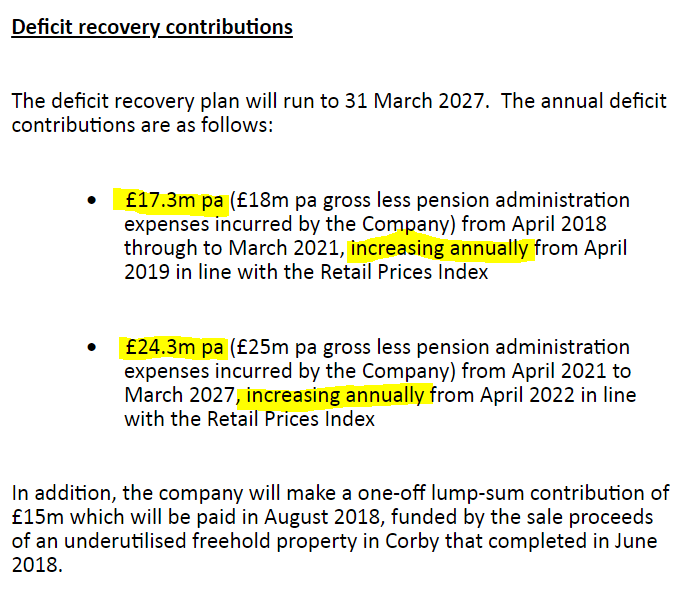
Looking at broker forecasts, these figures above seem to mean that about half the company's profits will be needed to fund the pension scheme deficit. This explains why this share trades on such an apparently cheap PER of 7 - it's because half the company is funding its pension scheme.
My opinion - Wincanton's track record of growing profits & EPS is excellent.
For me though, the very weak balance sheet is a deal-breaker. I sound like a broken record on this. There is another angle on this though - if you think the pension deficit may reduce, as interest rates eventually rise, then this share could be a bit of a punt on that pension scheme issue becoming smaller over time, and maybe the above recovery payments could be revised down in future?
CEO Interview - Best Of The Best (LON:BOTB)
I've been busy working on this today, so apologies that the rest of the report has been somewhat neglected. I think in future I'll schedule interviews for days when Graham is writing the main report, otherwise it overloads me (as there's hours of preparation necessary to do an interview).
Anyway, I think it went well, with interesting answers to your questions submitted here on Monday. Thanks very much for the excellent questions you asked.
Here is the link to the audio interview, on my interviews website. It's 31 minutes long.
Disclaimer
This is not financial advice. Our content is intended to be used and must be used for information and education purposes only. Please read our disclaimer and terms and conditions to understand our obligations.

39 comments
"What on earth do you think the distinction between the nature of the asset held as tangible, financial etc has to do with anything in relation to solvency? "
There is a distinction however that is not the point I am seeking to make. My point is that the "intangible" are created out of thin air and really just layers and layers of IOUs. When the liquidity crisis (in your opinion credit) crisis started to strike there was a scramble to find deliverable real assets. Perhaps the simplest lens to see this through is that gold tends to fall when counterparty fail to delivers occur rather than be the immediate safe haven. Why this happens is complex but is a function of effective gold supply going up when people seek to realise their holding due to the way that central banks account for their gold holdings (I'm willing to provide research on this if interested).
If the assets where toxic in 2008, why are they not toxic today? The fact remains that the actual credit losses from 2008 were small (contained mainly in the relatively small subprime market). The toxicity you refer to is simply the drying up of liquidity (ie banks not trusting each other) in a fiat system (the global eurodollar market the de facto prime currency of the world that happens to be accounted for in dollars).
AIG could not meet liabilities in the moment as the liquidity crisis was driving up spreads everywhere. This problem was solved by giving AIG and the market more liquidity (remember USD swap lines etc).
So AIG "went bust" as it was caught in a liquidity spiral. In that regard it had written bad business as it had not factored in what happens when there is lack of liquidity. HOWEVER, the underlying book was not toxic and Fed exited with considerable profit. This is impossible if loads of credit was written off as writing options on what was perceived to be decent quality credit at the time of writing does not give you the asset base to cover to much credit impairment. The fact is that AIG paid out on everything.
A parallel is the LTCM crisis. LTCM sought to do something similar to what investment banks do with their balance sheets (pre 2008) by arbitraging small spreads in assets globally (eg on the run versus older issue treasuries). Investment Banks would occasionally get into trouble doing that too as spreads are at times "irrational" (usually as there is a liquidity problem somewhere and trust breaks down). However, IBs pre 2008 had the capacity to extend their balance sheets (unregulated - so effectively thro eurodollar money creation) and could keep hitting the spread until it corrected. LTCM has investors and fixed capital. Note, this fact is why most prop traders from IBs blow themselves up when they start hedge funds
We disagree. I have provided factual points in response.
No it is not my opinion that it was a credit crisis that led to the collapse of the likes of RBS, that was the symptom not the cause. Please read what was said:
" The cause was toxic assets that the entities could not impair without destroying their balance sheet and meet their liabilities as they fell due."
If really is nothing to do with gold/fiat scrips/MMT etc. It is simply the fact that the likes of RBS had impaired balance sheets without the reserves to cover them. Hence no one would lend to them. Compare and contrast with Barclays operating in the same liquidity/credit conditions.
"If the assets where toxic in 2008, why are they not toxic today?"
For the simple reason that the likes of RBS do not hold enormous balance sheets with assets they cannot afford to impair, the nature of which they do not understand. See the banking reforms on capitalisation levels/reserves/stress testing/ringfencing etc. The degree of toxicity to an asset holder is related to its ability to absorb fluctuations in that assets value. If it can't, it has solvency issues, which brings us back to RBS.
Re AIG, you ignore the recapitalisation via the TARP program to prop up its balance sheet via the purchase of $68bn of preference shares. That is NOT liquidity operations, it is shoring up the impaired balance sheet. See above re RBS.
Well, we could say the same things to each other and get nowhere it seems. I feel I could equally say to you 'please read what was said" however that would be irritable, patronising and assuming a superior position....right?...
Recap at AIG was necessary due to liquidity crisis, just as LTCM needed a 'recap' to stem its liquidity crisis. $68bn is a drop in the ocean for all the credit exposure AIG had. That govt/Feb made good on the whole process of working through AIG is proof that credit problem, hence "toxicity" of assets was of low order. It was small even compared to other credit related crises. But the crisis within markets was stupendously large despite the ultimate smallness of the credit right offs. Its all about the roll the eurodollar plays in global finance.
Of course, new capital is required to restore confidence...that is always the way as financial markets only believe in unicorns and fairies when the times are good...and when the nightmares come they want someone to hold their hand. The proof in the pudding is whether capital stumped up was gobbled up by the toxic monster you mention.
Perhaps the problem is your use of toxicity in place of specifically credit or liquidity. What is "toxicity"? Its an emotional concept from how the crisis was reported. There is not a financial variable or quantity defined by toxic.
Barclays v RBS...well that is an interesting story as Barclays after the event have been investigated and fined for what they disclosed during the crisis. It is arguable that they didn't tell the truth and RBS (more fool them did). RBS had a funding problem. Long duration assets and short duration liability. Hence was minced in liquidity crisis.
You twice told me that I said the problem was a credit one when I had not. I was correcting your persistent mis-statement of what I had said and asked you to take the time to read what I had actually written having twice claimed I stated something I didn't. That I would suggest is not unreasonable.
"Recap at AIG was necessary due to liquidity crisis."
Recapistalisation is necessary when the balance sheet is impaired due to the write down on assets. See RBS also. Preference shares most definitely aren't the remedy for short term liquidity issues! They are expensive, non tax deductible long term capital.
'What is toxicity? Per above:
" The degree of toxicity to an asset holder is related to its ability to absorb fluctuations in that assets value. If it can't, it has solvency issues, which brings us back to RBS."
RBS had far too large and weak a balance sheet to be able to absorb the losses on its impaired assets acquired at a vastly inflated price. Hence those assets were fatally toxic to it and led to its insolvency.
"Barclays v RBS...well that is an interesting story"
Indeed. Barclays was fined for disclosure issues of fees related to obtaining its funding. Nothing to do with its ability to obtain finance in the same credit environment faced by RBS.
RBS short duration liabilities and long duration impaired assets its weak balance sheet couldn't handle writing down = insolvency.
Dear dmjram
Its all a matter of interpretation. Look perhaps we agree but choose a different hierarchy and importance of things in how we explain things. In some ways we are not a million miles apart despite the heat.
On something like toxicity and whether it exists beyond narrative...where are the real world write-offs that are in anyway proportionate to the scale of the crisis. As you know IMO the crisis was primarily one of confidence, so liquidity, ignited by the always ephemeral "confidence" and its waning. There was a catalyst which was some bad subprime credit and instruments linked to it...but reaction was out of proportion. Therefore it is necessary to explain the lack of proportionately which leads to liquidity and the workings of eurodollar. Repeating that AIG or RBS had assets injections does not counter this. Its just a myopic perspective on a systemic event.
I saw it your way in the past. However, I have never found it a satisfying explanation as by now the acute credit crisis should have arisen again. I'm sure you'll accept as fact my point re lack of actual credit losses in meaningful scale?! All this "toxicity" and yet no visible sustained impact on asset and credit profiles? (remember toxicity - which you explained somewhat tautologically and I assume you really mean quality of the underlying assets/credit but wont say directly as supports my point and undermines your logic)
But the media, ten-a-penny crisis books, opinion, politicians all trot out lines that seem to verify your view. Toxic is said like it means something and people who don't really understand nod and agree and bemoan the toxicity of bankers. Ergo by being non consensus I must be wrong...
Its good to learn. I agreed with your assessment until a couple of years ago. Before the crisis I was somewhat a student of previous crisis. I had seen the crisis coming, mainly as I was lucky enough to speak to people who were cleverer than I and explained it to me (ie Big Short related sorts and that circle). It was a credit problem and I positioned to profit...and did. I thought there would be massive intervention and not the end of the world so positioned to recover in early 2009. It wasn't the end of the world but the years after 2008 did not fit with what resolution of a massive credit crisis would involve....market valuations and credit and asset growth should have been harder as bad assets/credit should have swallowed a lot of good capital (inc that provided by central banks and govts) and real economic growth should have been easier/higher from the bottom due the clearing of so much dead wood (ie there was not this clearing). Things worked very differently. We have not been a recovery process from a massive credit crisis. We are in something different and hard to explain....
I find an explanation that our financialised economies, to achieve high levels of growth, are very reliant on continual high funding and hidden gross credit/asset creation by banks (which nets close to zero) through eurodollar market to be persuasive (if hard to understand).
Once caged (by liquidity provision and some backstopping) the crisis disappeared from markets and they roared like nothing had happened. Of course, it is a different issue economically, socially and politically. IMO this is as we have suppressed the actual engine of our growth....eurodollar liquidity...without replacing it effectively.
Now, we may have a credit crisis on the horizon...but it can't be 2008's crisis reborn as that is too old and stale. It will be a new crisis.
I believe I am looking at things as they are and not through bias or borrowed narrative. I may be very wrong. I can never be sure and it is always uncomfortable to be contrarian.
I enjoyed talking about this as its interesting and a topic that I still struggle to understand. But I'm going to drop out now as we are at a dead end that will just become antagonistic and boring for others. For anyone interesting in learning more then I recommend the "Eurodollar university" discussions linked below. I don't believe it all but I found it reassuring re the view I had developed and gave me a deeper understanding. It's over 7 episodes and 7 hours all together but the info is truly stupendously great. The opening blurb is general market chat. I recommend MacroVoices as a top quality weekly macro chat. I believe that the interpretation provided by Jeffrey Snider is and will be adopted by those that govern the economy over time as it is so persuasively illuminating....
https://www.macrovoices.com/edu/321-eurodollar-university-featuring-alhambra-partners-cio-jeffrey-snider
A lot to listen to but very illuminating.
Over and out.
Best wishes
Paul
Entities with stretched, weak balance sheets holding assets at an inflated purchase price of dubious quality is really not a matter of interpretation re RBS. Neither was the subsequent £12bn rights issue made in an attempt to prop up itself up when Goodwin and co grasped their position. Nor was the £15bn write off on in RBS books for ABN alone, added to which ABN itself wrote off £16bn on its assets in one year when RBS had got shut of it.
It is a statement of fact.
As is the impact of said asset write downs on the solvency of the company. I'd say the impact was pretty toxic for its balance sheet health, wouldn't you?
Hey, we could have just exited the conversation gracefully but you got to be curmudgeonly. I gave you the chance to respond magnanimously whilst still maintaining that you are correct and I am wrong.
So...what to say?...I have given explanations on 2008 and consequence in general. I might not be right but it is coherent and based on high quality insider direct experience (an insider to a "toxic" balance sheet that took a bank down and then an onlooker, as a sort of "professional" short seller due to circumstance, to many more balance sheets and connected subprime instruments). I have researched subsequently as with hindsight even though I made money and was in the middle of it I came to believe I never really understood what happened properly. As I pointed out above the trajectory of recovery is not consistent with a credit crisis. The spasmodic until now on-off nature of economic activity with no one able to sustain a quality burst for a long time is a big clue that we are not resolving a credit crisis today. Reality trumps tabloid narrative.
RBS is a specific case - "toxic" was overpaying for ABN and holding a relatively small portfolio of subprime (but just a whiff and the once super liquid and open interbank funding market - all propped up on eurodollar magic money creation - would dry up) and both were well short of 100 billion never mind your hyperbolic 100s billions. Please specify where the 100s billions of bad credit on RBS's balance sheet is. Your tabloid term toxic is just a way of covering your lack of specific comprehension of complex issues. At no point have you specifically linked 'toxic' to what drove the 2008 crisis at large which is what I was mainly discussing with RBS as an entry point. In general, 2008 didn't have much to do with goodwill write-offs for bad acquisitions (but of course when the tide goes out....etc).
But hey, no worries and nothing to be so embarrassed and defensive about as nobody really understands the financial system and that's why we are in a bit of a hole....so just lighten up a bit...you cannot make reality conform to what you want to limit it to or all that you are willing to acknowledge of it.
The UK govt provided £500bn in crisis to UK banks. £50bn of that was acquiring equity, £200bn through BoE special liquidity scheme and £250bn guarantee for lending between British banks. Most of it was loan guarantees. To date the govt has realised £2bn loss on the stake it took in RBS. At 250p they have another c.£20bn loss coming. In a purely arithmetic sense the hubris of overpaying for ABN can account for all that. The loan guarantees came out whole. So where's the massive "toxicity"?...
...where is the massive bad credit you have been implicitly on about whilst throwing around the toxic term? If all you wanted to say was that they hubristically overpaid for ABN then you should have stuck to that. I agree. RBS was also a badly run bank. Is that part of toxic too?
Just to be clear....you do know that implicit in all that you have said above you believe western financialised capitalism to be toxic? Will you be manning the barricades with the new messiah JC?
Good luck
Ciao
Hello again,
I will explain for the 3rd time that...
"where is the massive bad credit you have been implicitly on about"
...I have made no claims explicit/implicit/tacit about the credit conditions taking down RBS which is the discussion you entered. Indeed, I have explicitly stated that Barclays was able to obtain funding in those very same conditions to highlight how the insolvency issues were specific to RBS and not down to the liquidity/credit environment. So why you persist in stating that I have and ask me to provide evidence of something I never claimed is something of a mystery. See above (yet again).
It was...wait for it...the combination of a weak balance sheet and overpriced duff assets which said balance sheet couldn't handle writing down that did for RBS.
aka insolvency. NOT liquidity which was Roger's claim which you agreed with.
Which I believe is where we started before you started going on about fiat scrips, banks creating money as debt, MMT, gold, pref shares being the funding solution to short term liquidity issues and your latest musings regarding my religious fervour for political leaders.
PPS on the above...
That a profit was made out of the stewardship of AIG - hell central - is a huge clue that it was not a major credit crisis. This is not dependent on the price paid for AIG as if credit losses were massive then the price paid would need to be negative (ie AIG paying it!) due to the nature of writing credit protection contracts (a little money to cover a lot!).
Oh Paul you forgot the holding article, tut tut! :-)
Interested to hear that you enjoy driving Aston Martins Paul, how many have you got? On a semi-serious note, I expect nearly everyone who contributes to this board will have received at least one email about the current Smithson Investment Trust IPO. This IT is attempting to emulate the remarkable success of Fundsmith Equity Fund, but with what Fundsmith calls smaller companies, although I'm not sure an average projected market cap of portfolio companies of £7 billion of pounds is everyone's idea of a smaller company. The methodical investing method used by Smith has worked spectacularly for large companies but has been disappointing for emerging market companies for reasons which I will not discuss here. I suggested to Terry Smith that he start a small cap fund a couple of years ago but his assistant declined (I still have the email!). I have shown that Smith's fundamental investing principals also work extremely well with much smaller companies so how about Paul and Graham get together and get the necessary clearance to lauch a real small companies fund (market cap from £100M to £5 billion) using ROCE, free cashflow and some of the other types of principles used (but not monopolised) by Fundsmith. I'd certainly be an investor and I reckon that the reflected glory from the Smithson Investment Trust, which I expect to be at least as successful as the Equity Fund, would prove an attraction for many investors.
Just a note to your comment on Wincanton's pension deficit, Paul. Last week we had the ONS figures indicate stagnating growth in UK life expectancy. Here's one actuary's take on it; http://www.pensions-expert.com/Comment-Analysis/How-should-schemes-react-to-stagnating-life-expectancy?ct=true .
It's far too early to make changes, but a second year of stagnation might help the outlook for companies like Wincanton. Thoughts, anyone?
Gold looks good although it’s not rising fast the company’s mining it are HGM, CEY Etc and there’re cheap with dodgy economic news maybe a good investment. I hold both of these
And yet another vote for Avingtrans. Methinks a very well run company making good progress with their integration of their most recent takeover.
One of the lessons of the RBS saga, as shown last night, for us small/mid-cap investors, is that, whatever the size of company, if you have an uber-alpha (deranged) (male) CEO, you need an even stronger chairman to control him. Tom McKillop was not such a person, and was way out of his depth. (Arguably he would have been out of his depth in a paddling pool).
For those interested, ITV (LON:ITV) have announced they are NOT currently interested in buying Endemol Shine:
https://www.investegate.co.uk/itv-plc--itv-/rns/response-to-press-speculation/201810031034388437C/
The price is up as a result.
A further vote for your thoughts on the Avingtrans results please Paul, many thanks
Hi Paul
Any update on your meeting with Best Of The Best (LON:BOTB) earlier in the week?
Would be very interested in what they had to say on the future.
Thanks
Dave
Yes I watched the programme on RBS last night. Could have been a PR exercise for Alistair Darling when in reality he did a great job of destroying shareholder value by effectively nationalising RBS and partly the same for other banks. It was a liquidity crisis that the Bank of England could have tackled in the usual way but the Labour Government was keen to take control of the banks. As a result the Government, and us taxpayers, have lost billions on our stake in RBS.
The billions lost on RBS is the fault of the bank's management who didn't understand what they were managing. I suspect little has changed regarding the skillsets of bank Boards and investors should be appropriately wary of them.
No Roger, it was a solvency crisis, not one of liquidity.
Banks had trillions of toxic assets on their balance sheets which were impaired by the collapsing value of the assets/counter parties their value relied upon.
And RBS of course made it even worse for itself by buying those dodgy assets at vastly inflated prices when the egos in charge paid a ridiculous sum for ABN.
Correct. If this had been a normal liquidity crisis the Bank of England could have handled it in the normal fashion, but in 2008 liquidity issues were the symptom, not the disease. The underlying cause was counterparty risk: banks weren’t prepared to trade with each other because no one knew where the bodies were buried. That wasn’t a short term liquidity issue, it was a long term solvency problem.
As it turned out a lot of the corpses were piled up in RBS under Fred Goodwin’s desk and if they’d gone down then no one exactly knew what the ripple effects would be, only that it would have made the demise of Lehman Bros look like someone had raided a child’s piggy bank. Under the circumstances nationalisation was probably the only course open to the government. To argue that was a political action as opposed to a fiscal one you'd have to also argue that G.W.Bush’s mad libertarian Republicans also had a vested interest in nationalising U.S. banks. Which seems a tad unlikely, really.
What Labour got wrong, of course, was their management of the banks after nationalisation. Whereas the U.S. banks were allowed to trade their way out of their problems and eventually refloated at a profit, the risk management restrictions on RBS means that it’s still trading below the nationalisation price. But that’s a problem under multiple administrations, not exclusively a Labour party issue.
You can’t say that the last Labour government’s economic policy of spending as though the economic cycle had been abolished was particularly intelligent, or that their light-touch regulation regime worked out well. But under the circumstances that prevailed in 2008 nationalising RBS was about economic necessity, not political ideology.
timarr
There were other ways it could have been handled, as it was in other countries such as the USA. The Immediate problem was that the RBS bank was out of cash - that tells me it was a liquidity crisis not a question of balance sheet solvency - the latter only appeared as a result of actions by the Government, the Bank of England, et al (or lack of action).
Are you saying when someone doesn’t pay their bills it is never a hint they might be broke?
And why was RBS out of cash?
Because no one would lend to it because it had solvency issues. Just like AIG in the US - toxic assets all over its balance sheet which needed a state backed bail out. As in the UK.
Compare and contrast RBS with Barclays which luckily for them "lost" the ABN auction and didn't overpay for toxic rubbish. They were able to raise funds from the private sector.
RBS acquiring duff assets at stupid prices was not the result government activity.
On RBS and 2008 generally...
It was a small credit issue magnified by a mega liquidity issue. RBS had hubristic management and made some bad choices so were more exposed more quickly than others.
Of course. there is a reflexivity between the credit quality and liquidity but I think Roger Lawson is correct in the view that it was liquidity crisis...this is what was ultimately realised in the US and massive liquidity and some Fed back stopping was the solution. Hell central turned out to be AIG as they were massively short volatility due to the huge unbackable writing of credit default insurance. This credit default insurance was traded between bank balance sheets as a form of liquidity to permit them to leverage their own capital to the max.
Ground central for the crisis was the eurodollar market. Pre 2008 central banks would not really acknowledge its existence. The eurodollar is a massive sort of uncontrolled virtual currency. It is accounted for in US dollars but they are not real dollars. It is a massive (dwarfing any other currency) liability swap between banks.
Today we are hearing that the world is massively short of dollars again and that is why EMs are getting smashed up. This is a partial truth. There is some tightening of real US dollars however it is the loosely connected eurodollar liquidity that is contracting and creating shortage. Eurodollar and US dollar liquidity does not need to head in same direction. 2002-2008 saw significant US dollar tightening and yet the liquidity of eurodollar markets and so economic activity went through the roof (the more exotic the more boom - EM, commods, "innovative" credit, etc). However, post 2008 regs and reforms have brought USD and eurodollar closer together. This is not intentional but the consequence of those in charge not understanding the problem
Anyway, if interested in the above view here is a comment piece (short and not technical) I wrote recently for an econ mag...
https://medium.com/@mojomogoz/2008-2018-schr%C3%B6dingers-crisis-ddd7a30979e4
Best wishes
Paul
PS IMO the eurodollar liquidity issue was so systemic and huge and misunderstood that stewardship of banks was inevitable - AIG in particular (not a bank I know). Note, that actual credit losses from 2008 crisis were relatively small compared to prior credit crises.
Holding £hundreds of billions of assets on your balance sheet which are of dubious value is really not a liquidity issue.
PPS that a profit was made out of AIG is no indicator of the nature of the underlying issue faced at the time. Anymore than the value of a repossessed house a few years down the line is relevant to whether an individual is insolvent when the lenders came knocking for their money.
They are not assets in any tangible sense. They are IOUs between financial balance sheets that form the world's biggest and most traded currency (by huge margin) called the eurodollar.
If credit (ie bad assets) where the cause then why has the cure been credit? The credit/assets may be proven bad (well will at some point) but that point is the fall of western market capitalism as we know it and a systemic economic crisis we have not seen since the likes of the fall of Rome.
AIG is good singular proof of this. It was selling trillions of insurance for a couple of billion dollars on credit for global bank balance sheets (as part of the eurodollar money creation process). AIG ultimately paid out on all that it owed and the Fed still made money. The Fed did not directly finance any of the debt. The evidence to date is that there was a low level of bad credit between banks (compare to US savings and loan, great depression, Tequilla crisis - all had much greater %age of GDP credit impairment at a time when leverage levels in the economy were significantly less than 2008). Really you are saying you do not like currency by fiat. That is a valid perspective obviously and leads to the holding of gold and physical resources.
As an aside, the famous John Paulson after shorting the crisis in 2008 turned massively to gold as IMO he had seen the bottom and then saw right through it to oblivion (ie in fiat there is nothing holding up the system!). Many of the successful short seller of the time took a renewed shine to gold as they were in effect traumatised by their success. I know a few of them and IMO they saw the negative subprime effect coming so identified specific short opportunities but they did not see how it would go systemic.
I disagree with the idea of going back to asset backed currency on the basis that it would be death knell of liberal democratic market based economies. However, that does not mean that money supply should not be controlled which really means the global fiat of eurodollar rather than narrow domestic currencies.
The conundrum we face is that debt creates money and money/liquidity is essential for free market activity and growth. Perversely, that means that austerity is self harm and that UK govt should borrow and just monetise....at least until a new world order appears.
What on earth do you think the distinction between the nature of the asset held as tangible, financial etc has to do with anything in relation to solvency? The cause was toxic assets that the entities could not impair without destroying their balance sheet and meet their liabilities as they fell due.
If any entity holds large amounts of impaired assets which it hasn't the reserves to cover and cannot meet its liabilities as they fall due, it is insolvent.
Just as LTCM was 20 years ago - it too like AIG would have been profitable ultimately. It just couldn't meet its liabilities to get there! Hence it went bust.
indeed on IPOs, price discovery is a curious thing : Funding Circle Holdings (LON:FCH) is still trying to discover its value - IPO at 420p on Friday and now at 340p so 25% discount to the issue price
Paul
The dateline just under the heading is yesterday's even though the heading is correct.
Thanks for the excellent reports.
Martyn
Hi FREng,
The dateline just under the heading is yesterday's even though the heading is correct.
That's because I put up a placeholder the night before, so that the article is available at 7am for people to post comments. That way I can get stuck into reading RNSs from 7am, in bed, on my iPad, without having to worry about getting up immediately and posting the placeholder article. It just works better this way. Although as you point out, it does cause a slight anomaly with the date of the post. So just ignore the date of the post, and focus instead on the date in the article header, which is usually correct, apart from when I forget what year it is.
Regards, Paul.
UPDATE: Graham has just messaged me, to point out that I can manually alter the date of the article. So I've just done that, thus resolving the issue, so please ignore my ramblings above!
Nothing of interest for me today, but UP Global Sourcing Holdings (LON:UPGS) commissioned research from Equity Development that was issued yesterday as announced in the following RNS:
https://www.investegate.co.uk/up-global-sourcing--upgs-/rns/equity-development-initiates-research/201810021549557446C/
It could be argued that this is a misuse of the RNS system, especially as this type of thing is exactly what RNS-Reach was presumably designed for. It could also be argued that commissioning research is a sign of desperation.
Nonetheless the note is interesting and does show some interest in engaging private investors. If you share my opinion on UP Global Sourcing Holdings (LON:UPGS) you can understand some exasperation at the current valuation on the part of management.
Notes:FY Results out 6th November. Not an AIM share. Low NMS. A moderate-large holding for me.
Re LON:UPGS - the trading update a month ago had revenue down about 20% and operating profit down about 45% if I recall. The dividend was barely covered last year and I think won't be covered this time.
I'd expect the results in early November to be poor and the dividend to be cut if not withdrawn altogether.
Good luck to you though. Hope it comes out better than I'm suggesting.
JDW72
disc - no position in the past or currently
JDW,
Re: UP Global Sourcing Holdings (LON:UPGS) - yesterday's research (which effectively is management guidance) forecasts a FY2018 dividend of 2.7p maintained for FY2019. However debt is higher and free cashflow (after dividend) is much weaker than FY2017 at that dividend level so I have to agree it is at risk if anything else goes wrong. They also forecast that the business will be much more cash intensive going forward with expanding inventories & receivables, and so perhaps cash could also be under pressure in the event of faster growth.
Earlier today I read the report in detail and it really does underline just how exceptional FY2017 was in every way - they really did float on a high. I was already disappointed by the modest size of the forecast FY2019 snapback and I was very disappointed to see them forecast (approximately) 5% revenue growth for FY2020 and then 7% thereafter. Probably foolishly I had been hoping for a return to near 20% growth rates for a few years inline with B&M's revenue growth.
They still work as a "deep value" stock to park some money in for a short time, but less so as a medium-long term investment.
Good morning Paul
Another vote for Avingtrans (LON:AVG) please. Plenty to digest in this morning's prelims, but all seems to be heading in the right direction. Also the trading update from Ramsdens Holdings (LON:RFX), which despite the anticipated headwinds in FX continues to trade in line and is confident of the outlook for the full year. I continue to hold both.
Morning Paul, hope you're well.
A new one for me this morning that popped up on my Tech Screen recently - Thruvision (LON:THRU).
Still loss making but maybe worth a look, this is from this mornings update...
Thruvision (AIM: THRU) the specialist provider of people-screening technology to the international security market, is pleased to provide an update on trading for the half year ended 30 September 2018.
The Company continued to make strong progress, delivering a total of 60 units during the period to both new and existing customers, with repeat orders from the Philippines, Vietnam and China. This compares to 57 units for the full year ended 31 March 2018.
Seems to be in an area where there's not going to be a let up on need any time soon.
Thanks in advance.
My morning smallcap tweet: Topps tops top F/C.
PCI- PAL (LON:PCIP), Topps Tiles (LON:TPT), Feedback (LON:FDBK), SRT Marine Systems (LON:SRT)
PCI-PAL (PCIP) contract win for an initial three year period. Min total value of $850k of which annual recurring licence fee is $220k.
Topps Tiles (TPT) guides adjusted pre-tax slightly ahead of the top end of the current range of market expectations )£14.6m to £15.2m).
Feedback (FDBK) FY trading. Rev £458k (FY 2017: £466k) but invoiced sales of £771k up 51%. "As a result of the investment in our employees, we are seeing improved sales momentum throughout the business."
SRT Marine Systems (SRT) H1 rev £3.2m up 9%. Pretax -£1.4m (-£1.8m). No systems rev. "The transceiver business has now recovered from the stock shortages. Promises jam tomorrow. I hold.
The Morning Paul! Avingtrans (LON:AVG) please - hth acquisition appears to have integrated very well (no position, perhaps sadly!)
OptiBiotix Health (LON:OPTI) announces another licensing deal so will no doubt fall again (I hold but will probably only lose weight due to the falling sp meaning I will starve in a garret)
£aml - Aston Martin Lagonda floats at £19. Current shareholders only seem to be selling 25% though so is it a top of the market sell-out as some suspect?
Also Ramsdens Holdings (LON:RFX) - tu good but hot weather has affected fx. I sold out feeling the online fx market was crowded and fearing Brexit would mean staycations. Can't see this improving but can see the economy getting hit which might help them again with distressed Pawners & improved gold.