Small Cap Value Report (Wed 9 Mar 2022) - Takeovers, SOM, STVG, HEAD, GFIN

Good morning, it's Paul & Jack here with the SCVR for Weds.
The futures are indicating a rebound day today. The big question is whether the market is starting to form a bottom, or whether it's just a bounce in the downtrend. We've got no idea at this stage, so answers on a postcard please. I'll (Paul) be getting my chequebook out, with some early purchases of bargains on my watchlist. Selectively, I think there are some really attractive buying opportunities out there right now.
Agenda -
Paul's Section:
A brief comment on 3 takeover deals which have recently failed.
Somero Enterprises Inc (LON:SOM) (I hold) - superb 2021 results, in line with the update in Jan 2022. Lots to like here, and shares seem irrationally cheap.
Headlam (LON:HEAD) - briefly covered yesterday as looking a bargain, the price has moved up today on publication of excellent 2021 results, a solid outlook, bulletproof balance sheet, and news of both a special divi & buyback. This is right up my street, an excellent value share in my view.
Gfinity (LON:GFIN) - looks very wobbly, down 50% today on news of revenues falling short, and that it's run out of cash. Fundraising imminent, so expect considerable dilution. Uninvestable for me.
Jack's Section:
Stv (LON:STVG) - strong FY21 results and a confident outlook for FY22. This remains an intriguing property - Scotland’s most popular television channel and the fastest growing UK broadcaster video on demand service - but the operating enterprise is dwarfed by its pension schemes, which could be a deal breaker for investors.
.
Explanatory notes -
A quick reminder that we don’t recommend any stocks. We aim to review trading updates & results of the day and offer our opinions on them as possible candidates for further research if they interest you. Our opinions will sometimes turn out to be right, and sometimes wrong, because it's anybody's guess what direction market sentiment will take & nobody can predict the future with certainty. We are analysing the company fundamentals, not trying to predict market sentiment.
We stick to companies that have issued news on the day, with market caps up to about £700m. We avoid the smallest, and most speculative companies, and also avoid a few specialist sectors (e.g. natural resources, pharma/biotech).
A key assumption is that readers DYOR (do your own research), and make your own investment decisions. Reader comments are welcomed - please be civil, rational, and include the company name/ticker, otherwise people won't necessarily know what company you are referring to.
Paul’s Section:
Takeover offers
This is interesting as it looks like several deals may be collapsing in current chaotic conditions.
Oxford Instruments (LON:OXIG) - It’s outside our area here, but I noticed the price of OXIG shot up on a bid approach recently, from Spectris. That collapsed on 7 March, with Spectris pulling out, specifically blaming uncertainty created by Russia’s invasion of Ukraine.
John Menzies (LON:MNZS) - the Kuwaiti company offering 608p cash has not yet made it a formal offer. The PUSU deadline was extended yesterday 8 March. The share price has dropped to 488p, 20% below the indicated potential bid price, clearly showing the market thinks there’s a good chance the deal might collapse.
Photo-me International (LON:PHTM) - the ungenerous 75p takeover deal from the major shareholder has failed today, due to a very small level of acceptances from shareholders. The 36.5% major shareholder only managed to increase acceptances to 45.1% including its own holding, insufficient to achieve the required 50% threshold. It seems strange that the bidder went ahead with a poor offer price, without apparently having secured agreement privately with enough institutions to be sure the deal would succeed.
I wonder whether takeover deals generally are now off the table? Personally I doubt it. Valuations have dropped so much, that I reckon we’re likely to see plenty more takeover approaches, with acquirers looking to take advantage of low share prices and jittery shareholders perhaps happy to be provided with an exit.
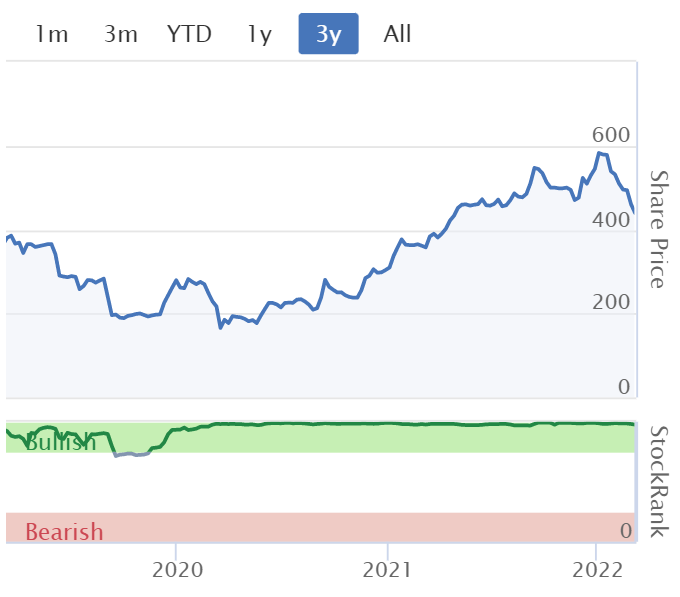
Somero Enterprises Inc (LON:SOM) (I hold)
450p (yesterday’s close) - market cap £252m
Somero makes & supports concrete laying machines, which are laser-guided, to achieve perfectly flat floors.
Stellar results for 2021, as expected and previously guided in the last trading update on 22 Jan 2022, which I reviewed here.
Actual results out today are in line with that guidance:
Revenue $133.3m (guidance $133m)
Adj EBITDA $47.8m (guidance $48m)
Diluted adjusted EPS: $0.61 = 46.5p (again, in line with guidance)
Net cash $42.1m (guidance $42m)
So everything’s fine there.
Everything’s also fine on the balance sheet, which looks terrific, and has pots of cash, which the company pays out in ordinary & supplemental divis, above what it needs to keep. I love businesses that keep throwing off surplus cash, and pay it out to shareholders.
Expanding capacity by 35%
International - Australia expanding fast from a low base - could this be the right model to expand in other overseas markets, where growth has been generally poor in the long-term? 80% of revenues are from USA.
New products contributing to growth, with more to come.
Russia negligible.
Very high profit margins.
Dividends - very striking, how cash generative this company is, and that it rewards shareholders so well, so for 2021 we have:
Interim divi 9.0 cents (paid Oct 2021)
Final divi 22.02 cents (payable 6 May 2022)
Supplemental divi 19.7 cents (also payable 6 May 2022)
That’s a total relating to FY 12/2021 of 50.72 cents, or 38.6p, a yield of 8.6%
The big unknown is to what extent this performance is sustainable, or possibly a cyclical high? We don’t know.
Outlook - modest growth is expected in 2022, with higher overheads, so EBITDA is anticipated to be flat in 2022 vs 2021. Management guidance tends to be cautious, and they said something similar this time last year, but then went on to smash forecasts.
Importantly, mgt says today that confidence in the outlook is based on feedback from customers, which have strong order backlogs from their clients. So there’s substance to the positive outlook for 2022, not just a wing & a prayer.
We need to consider the macro picture. There’s the risk that the higher oil price & general inflation might trigger a slowdown, or even a recession in the USA, SOM’s main market, but who knows? If Ukraine gets resolved, and oil reduces again, then the economy could continue booming. We don’t know, and anyone who claims they do know the future with certainty, is just guessing, whilst trying to sound clever.
My opinion - I reckon it makes sense to value SOM on c.50p EPS for 2022. I would put it on a PER of at least 15, so that’s 750p price target.
Hence the current share price of 455p just looks wrong - i.e. too low. How does a PER of 9 make any sense at all? That said, SOM has always looked cheap, all the way up. People have been factoring in a recession for years, whilst its earnings keep rising. Could it be that the growth is structural, as more clients require perfectly flat floors for new warehouses?
Anyway, it’s a nice problem to have - wondering why a share is so cheap, when it keeps performing superbly, with remarkably high quality scores. To achieve such high margins, SOM clearly has considerable pricing power, and dominates this niche. The shareholder list is fragmented, so I wonder if a larger group might make a bid for SOM?
.
.
Headlam (LON:HEAD)
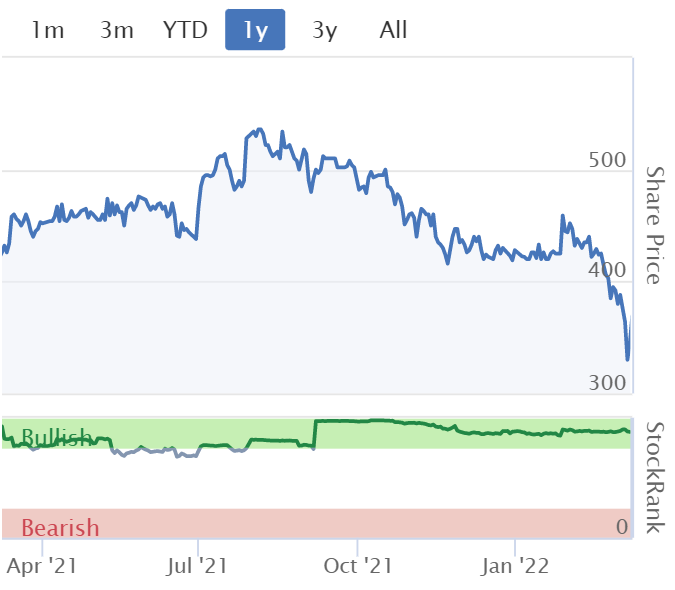
369p (up 7%, at 09:47) - market cap £315m
I had a quick look at this share yesterday, when a trading update was buried within an RNS entitled “Board Changes”. It just shows, what we should always read every RNS for companies of interest, just in case there’s additional information in there. The company really should have called the RNS something like this: Board Changes and Trading Update.
My conclusion yesterday was that the share looked a bargain at 330p, after recent indiscriminate falls. It confirmed yesterday that trading in 2022 “continued to be in line with plan”.
Headlam Group plc (LSE: HEAD), Europe's leading floorcoverings distributor, today announces its final results for the year ended 31 December 2021, and update since the year-end.
2021 a very positive year
I’m impressed with these numbers.
Adj EPS has risen from 13.7p in 2020 (hit by the pandemic), to 31.1p for 2021.
Revenues up 15.4% to £667.2m, so a decent sized business.
The underlying operating profit margin is rising nicely, from 3.0% in 2020, to 5.6% in 2021, and a target for 2023 of 7.5% - that’s an important point, as it could drive re-rating of the shares, if achieved.
There was a £9m benefit from furlough grants, but I see that as pass-through money, since it’s paid to idled employees.
A while back the company did a roadshow, explaining all the business improvements it was implementing. After reading a huge slide deck, I came away with the impression that the business seemed a bit of a shambles! That said, sorting out lots of basics that have gone wrong, is a nice catalyst for earnings to rise, which is what seems to be happening. Hence I’m working on the basis that HEAD should be able to achieve say 40-50p EPS in future. Put that on a PER of say 15, and the upside case could be very nice: 600-750p per share, versus 369p per share now. Plus it’s a generous dividend payer, so we’re paid to wait.
Balance sheet - a positive, stand-out feature of this share. NAV of £232.1m, deduct £18.1m intangible assets, and NTAV is £214m NTAV. This includes over £100m of freehold property, and £53.7m of net cash at end Dec 2021. This is exceptionally good for the size of company.
As regulars here know, I very much favour strong balance sheets with surplus assets, as it provides hidden upside (in for free very often, as it is here).
Also note that, due to this financial strength, HEAD did not need a refinancing during the pandemic, indeed the share count has remained static at around 84-85m shares in issue since 2015. It’s set to come down now, with a buyback.
Surplus capital distribution - a very strong move here. HEAD has more cash than it needs, so it’s declared a 17.7p special divi, on top of 16.4p total divis for 2021.
Above that, there’s a £15m share buyback announced today, which at 369p per share, would be just under 5% of the issued share capital - so that would give a boost to EPS in future years.
The company still has net cash after all that, and it’s a proven cash generative business, so it should be able to continue paying ongoing divis of maybe a 5%+ dividend yield - highly attractive in these more inflationary times.
My opinion - this looks a really solid value share, it’s right up my street, as a long-term hold.
It’s true that the residential property division would have benefited from people revamping their homes during 2020 and 2021. However, that was offset by a reduction in commercial. So as we come out of the pandemic, maybe that might reverse somewhat?
Another issue is the shortage of carpet fitters, which could be positive for ongoing demand continuing, from people having to defer replacement of carpets? Who knows. The crunch on household disposable incomes this year could be a downside risk, again who knows?
Overall, with a forward PER under 10, and a dividend yield of 5%+, on the back of a bulletproof balance sheet, this looks a very attractive share to me. Especially after the recent market-wide panic sell-off. I’ll be buying, as soon as funds permit, the current price looks a very good entry point to me.
.
.
Gfinity (LON:GFIN)
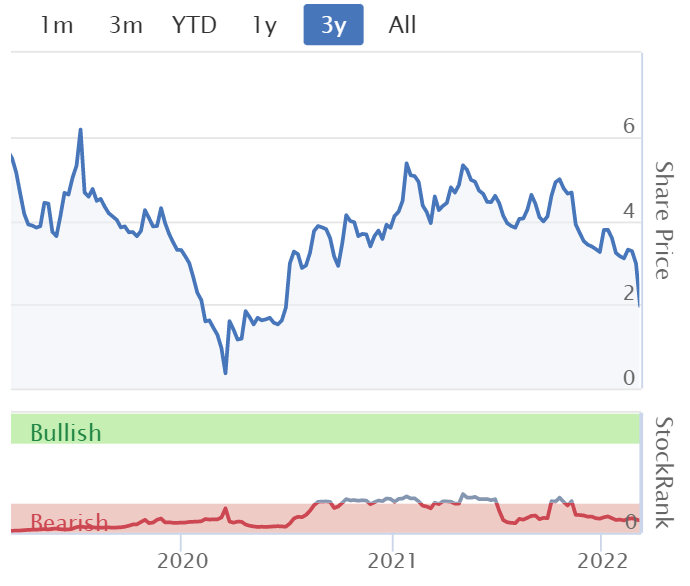
1.2p (down 50%, at 10:44) - market cap £13m
H1 (6m to 31 Dec 2021) saw revenues of £3.3m
Growth only 8% vs H1 LY (or adjusted up to 24% by excluding a one-off)
Still loss-making
Full year revenues likely to fall short of market expectations.
It’s almost run out of cash - £1.5m at end Dec 2021, now down to £0.8m
Fundraising now required, key shareholders said to be supportive. Any fundraise would be (hoped for) minimum of £1m, and include additional potential dilution from warrants.
My opinion - uninvestable for me, as existing holders are likely to be heavily diluted in the imminent emergency fundraising.
This is the type of speculative share that can do well in a roaring bull market. The trouble is, running out of cash, deep into a small caps bear market, is the worst case scenario.
I think the company needs a lot more than £1m fundraising.
It’s not yet clear whether it has a viable business model either.
Looks very high risk, so I wouldn’t go near it personally.
.
.
Jack’s section
Stv (LON:STVG)
Share price: 332p (+5.4%)
Shares in issue: 46,722,499
Market cap: £155.1m
Results for the year to 31 December 2021
STV has fallen by 15% or so along with the rest of the market despite previous positive updates. It would be of interest, but the glaring issue here is a large pension fund - it could be that a rising interest rate environment helps here, but so far it has prevented me from taking this one further.

That’s a shame, because the valuation is attractive and the group, as Scotland’s largest broadcaster, is potentially quite an appealing prospect.

For FY21, STV reports its highest ever revenue (up 35% to £144.5m) and adjusted operating profit (up 39% to £25.2m) ever. Adjusted earnings per share grew by 32% to 45.6p and the group paid out an 11p dividend, meaning the shares trade on just 6.9x FY21 earnings and yielded 3.5% in dividends.
Adjusted results are before exceptional items (of £0.8m) and include High-End Television tax credits (of £1.9m). The latter is an incentive to support creative industries and ‘is a critical factor when assessing the viability of investment decisions in the production of high-end drama programmes’.
The company continues to diversify, with 36% of adjusted operating profit now from Digital and Studios, and management says it is on track to reach 3-year growth targets in 2023.
Those targets are to:
- Double digital viewing, users and revenue (to £20m)
- Quadruple Studios revenue (to £40m)
- Achieve at least 50% of operating profit from outside traditional broadcasting
STV notes a ‘resurgent’ advertising market, with regional advertising up 22% and video on demand (VOD) advertising up 38%. Studios revenue trebled to £27m and cash generation was robust, with cash from operations +55% to £34.8m.
Outlook
Sounds positive.
The group has its ‘strongest ever’ content line-up for 2022, both on TV and online. Content cost guidance remains unchanged (a 3-year £30m investment plan to fund Digital & Studios growth, and national programming costs linked to advertising revenues under a long-term agreement).
Q1 FY22 total advertising revenue (TAR) is expected to be around +20%, with January +21%, February +26% and March +10-15%. April TAR is expected to be up +10-15%, although comparators get tougher from Q2. Studios has made 11 new commissions so far this year.
Pension and financial health
This is the bit that has put me off in the past. The pension scheme is much larger than the STV market cap (£440m of plan assets & £519m of PV obligations compared to a market cap of c£150m).
Agreement of the triennial valuations for the Group's defined benefit schemes was reached in October, based on a combined scheme funding deficit of £116m and a recovery plan running to October 2030. The Schedule of Contributions remains at the same level as the previous settlement with the contingent cash mechanism also in place.
The IAS 19 accounting deficit across the schemes was £79.4m (2020: £70.3m). The increase in the liability is primarily driven by an update to the mortality assumptions used, as well as reflecting the latest membership data following completion of the triennial valuation. These increases were partially offset by the gain derived from the higher discount rate and the benefit of contributions paid by the Group.
Anecdotally, I feel as though more companies have been reporting reductions in pension scheme liabilities, so it’s a shame STV’s remains stubbornly high.
Pension contributions were £9.3m in the year, so still a substantial chunk of the £34.8m cash from operations, although the proportion has fallen from last year. If you think of it as a sort of ‘interest cover’, then the ratio of cash from operations to pension contributions has increased from 2.33x to 3.74x, so a substantial improvement. If STV can continue to grow its cash flows, then the pension payments will become less of a concern.
However, a contingent cash mechanism also remains in place.
Contingent funding payments equivalent to 20% of any outperformance above a benchmark of available cash will be paid to the schemes.
One positive point is that the group is now in a net cash position of £0.3m, compared to net debt of £17.5m.
Conclusion
Operationally, STV appears to be in fine fettle. The group’s all-time viewing share is the highest it’s been since 2008, at 19.6% (up from 19.2%) and it remains the most-watched peaktime channel in Scotland (with a share of 22.2%).
It also reports the highest viewing share gain of any commercial channel in the UK over the past year, and STV Player remains the fastest growing UK broadcaster VOD service.
Is it worth taking on the financial risk of the pension deficit? It’s something I have done before, with Premier Foods (LON:PFD) , which ended up a profitable investment as the company slowly turned around, supported by underlying cash generation. But I remember the feeling well, of potential stakeholder conflict, increased uncertainty, and the equity holder’s diminished standing in the pecking order. It’s not a particularly comfortable position and at times can feel like more of a binary gamble on external outcomes.
My view is that pension trustees need the operating company to remain healthy as it depends on its cash flows. But that’s no guarantee of safety, and it remains a considerable risk that will understandably put many off. STV’s trading is encouraging but the pension scheme dwarfs the operating business, with assets of £440m and present value obligations of £519m. So small changes in assumptions can have a material impact on results. You can’t consider the stock without considering the pension scheme.
If STV can continue to grow, then this should become less of a problem. But if things start to go backwards, or if interest rates fall again, then those contributions could begin to hurt. This is another positive update though, so hopefully the former comes to pass.
Disclaimer
This is not financial advice. Our content is intended to be used and must be used for information and education purposes only. Please read our disclaimer and terms and conditions to understand our obligations.

42 comments
Related to the takeover point, my current employer is fund raising and it’s fair to say the climate is much more challenging than it was a month ago. Plenty have cash but there is a much greater reluctance to loan/invest until the world looks a little less uncertain. Feels much like March 2020 with the added attraction of Ww3.
Ms International (LON:MSI) could be interesting. They have a high weighting of cash vs market cap, pay a decent dividend and operate a defence supplier division that you'd imagine would be a major beneficiary of the current climate for years to come. Doesn't seem to have had any move during the current volatility.
A bit of good news from a post elsewhere, not really a small cap, but interesting all the same: Dan - LGEN looks great, tangible equity up almost 10% this year and that is after the 4.9% share buy back and the sizeable dividend. Average annual tangible surplus for the 4 year period is c12% - i.e. share price currently half of a fair value - and for this year alone the tangible wealth generation - tangible equity gain, dividend and buy backs - was over 20% of the MCap. Remarkable really.
I am long on Legal & General (LON:LGEN) and see this being a real coffee tin company. Its not going to hit the park out in any given year but with the progressive dividend there's a real opportunity I feel to use compounding at its best.
LGEN technically being a financial, although clearly not a bank, has had a double head wind, i.e. post 2008 caution re financials in general, in addition to the post 2016 head winds - some UK specific and some global, particularly since 2020.
So while the share price has been pretty static since 2014, it is worth looking closely at what happened to the share price from 2009 to 2014, despite the downer on financials. Since 2014, both the equity build up and dividend payout have been substantial. In 2013 LGEN's tangible equity was jsut under £6bn, today it is just under £11bn and that is after all those dividend payouts. The flat share price since 2014 can lead investors to think that LGEN just pays dividends and sees little share price gains, but if you look at the long term history of the share price and the last 8 year build up in equity and the current huge tangible surplus, LGEN is likely to multi-bag again, which it does have a history of doing after several years of a flattish share price.
Legal & General (LON:LGEN) life insurers have faced headwinds for several years from ever lowered interest rate (increasing liabilities) and more stringent capital requirements (Solvency 2 means they basically had to park more of their assets in zero yielding gilts) - the good news is that both of these forces could go into reverse, so these headwinds could become tailwinds. Very cheap and good growth prospects in my view.
The point being that despite the many headwinds, LGEN has paid a large dividend and accumulated tangible equity on an accelerating basis - indicating accelerating genuine earnings, with remarkable consistency.
I am intrigued as to why so many of you favour LGEN over Axa ... it scores higher on most metrics and a yield almost 3x greater .. what am I missing ?
AXA is french and not listed on the FTSE. According to my information, Legal & General (LON:LGEN) dividend is 7.47% on Stockopedia.
I don't have the European section on Stockopedia, so I can't see that information.
Paul, in addition to Somero Enterprises Inc (LON:SOM) Headlam (LON:HEAD) was in my view, the other outstanding set of results from a UK listed small cap, reported this morning. I assume that you will be reviewing the latter as well, given the special dividend of 17.5p and share buy back, each totalling £15m, together with other positives, such as progression of operating margin towards 7.5% and initial success of the 'business change strategy'.
I hold Somero Enterprises Inc (LON:SOM) and £HEAD. Potential headwinds are inflation, the general economy and of course execution. However both companies have excellent balance sheets and management has to date proved itself to be more than competent. Also I would suggest that both possess what young Mr Buffet describes as a moat Somero Enterprises Inc (LON:SOM) in terms of its technology and must have for producing level concrete surfaces and Headlam (LON:HEAD) as it dominates its UK market in its chosen field.
All the best
I work next door to the Headlam HQ, and their bosses cars are far less ostentatious than ours - so they get my vote.
Could you review Tclarke (LON:CTO) Paul or Jack ? Maybe not your favourite sector but forward p/e now at around 5x ! Great results today.
Headlam (LON:HEAD) FY21 results presentation by Chris Payne, CEO (was CFO). video & podcast. Revenue up 15.4%, gross margin +33%, underlying PTP £35.8m (20: 15.4m). Surplus capital return in a special dividend and a share buyback programme.
2022 has started in line with expectations with continuing strong margin performance.
Join the Q&A (after the presentation) at 11.30am today, 9.3.22. Register here.
Somero Enterprises Inc (LON:SOM) stunning FY21 results: Revenue +51%, EBITDA +83%, Operating cashflow +21%. Completed $1m share buy back. 2022: expect modest growth in rev & profits. Management presentation & Q&A Monday 14.3.22, 1.30pm. Register here.
Other results webinars over the next period, register for all here (scroll through them).
Litigation Capital Management (LON:LIT) interim results: Wednesday 16th March, 9am
Pebble (LON:PEBB) full year results: Thursday 24th March, 1pm
Personal Group (LON:PGH) full year results: Friday 1st April, 12 noon
Tracsis (LON:TRCS) interim results, Friday 8th April, 1pm
Please join us!
Paul, re Photo-me International (LON:PHTM) the bidder never wanted to win. It was an offer that was only made because it was compulsory to do so when the CEO bought shares that took his holding above 30%.
Hi John,
I'm not sure that's right re PHTM. Seems a strange thing to do. Was he not aware of the 30% bidding rule re PHTM? I assumed going over 30% was because he intended to bid for the whole thing.
Also, I recall the bid for PHTM was funded, with a large loan facility from a French bank. So it seemed a planned deal, not accidental.
Regards, Paul.
The offer document also stated that if successful they would not delist, signalling the desire to increase shareholding rather than takeover fully.
They massively restructured during lockdown, removing unprofitable machines and it is possible that this might prove to be a case of the chef not just eating, but gorging himself on his own cooking. A few years back there were very handsome dividends prior to investing in the laundry business. (I hold) Results due 21 March.
i had no idea what their laundry business entailed until i saw one of their machines outside my local co-op ! its basically a laundrette in car park.
I held PTHM till this share buy out bodge up...had great faith in the company restructure, and had just been tipped the weekend before that happened. I sold out that morning. What a shame, put a lot off I think.
MOIC = Multiple of Invested Capital :-)
positive announcement from *small cap* Polymetal International (LON:POLY) today;
sanctions don't seem to be significantly affecting them and they have cashflow from Kazakhstan operations to pay the bills for the next 12 months. They plan to pay the announced dividend of $0.52 (37.6p) against a SP of 92p
IG have however taken them off their books for ISA and spread-bet, does anyone know if there are other avenues for purchase (I personally feel the selloff is far too much overdone)?
Hargreaves Lansdown executed my order yesterday without problems.
thanks for that - AJ Bell are executing as well, managed to buy some this morning
Interactive Investor you can also buy from
to add to my woes SAGA, my largest position, Spirit of Spirit of Adventure is returning to Southampton following small covid outbreak. Strict entry requirements in the Carribean means the cruise no longer viable. Full refunds for passengers
Hi wpfool,
Yes that issue with covid on a Saga (LON:SAGA) (I hold) ship was actually flagged up here & discussed by subscribers earlier this week.
It's clearly annoying, and an ongoing risk, but this sort of thing happens on cruise ships from time to time - remember all those vomiting bugs that used to break out on cruise ships.
I don't think it should particularly impact the share price in a rational market, or in anything other than the short term.
SAGA makes customers take out insurance for this, and other risks.
Regards, Paul.
Yes. It’s worth remembering that although Saga (LON:SAGA) ‘s demographic, over 50s, were the first to be vaccinated and had a high take up rate, unfortunately it’s been quite a long time since large numbers of them had their booster shots leaving them less well protected and in the most vulnerable age group. (My parents are of this age and just about to depart on a Saga cruise by coincidence, so it’s on my mind.)
Word will get round about this cancellation and may affect future bookings for a while. They have a high level of future bookings but people may decide to cancel and lose their deposit rather than take the risk.
I have no position in this share myself, leisure sector just too risky in my view, but rather than Covid, I would be much more worried now about the cost of fuel and the cost of food. The company cannot pass on these higher costs because the price of the forward bookings is fixed. (Perhaps someone with a deeper knowledge of Saga’s Ts & Cs can correct that if it’s wrong). So, if prices do escalate for a substantial period, profits on these cruises may be considerably less than in the forecasts.
Airlines and cruise operators normally hedge part or all of their fuel costs for a period. Not sure what Saga's hedging position is, but would be surprised if they're fully exposed to higher fuel prices.
Hi GrahamF,
Note that in its most recent trading update, Saga (LON:SAGA) (I hold) raised 2022 cruise pricing by about 6%, and were getting close to being fully booked. So pricing power (which looks enough to absorb cost increases), and strong demand. That's why I'm very bullish on this share for 2022 & beyond.
Given that the latest strain of covid is nothing like as lethal as previous strains, then it doesn't seem to be stopping people booking cruises.
Regards, Paul.
Hi Paul
I agree. Saga (LON:SAGA) nearly fully booked and managed to get a 6% price increase through. Shows strong pricing power in a stable environment with good visibility of forward cost increases. The problem is what happens in an unstable environment.
The weakness is the model. They cannot raise prices again for those cruises that are booked. From their website.....
"Once you’ve booked and we’ve confirmed your holiday, we guarantee not to increase the price you pay, regardless of what happens to fuel prices or exchange rates."
In other words, their pricing power only extends to bookings not yet made. In normal circumstances their very strong pipeline of being nearly fully booked for months to come would be a considerable strength. Under a unexpectedly high cost increase scenario though it comes back to bite them as their pricing power for existing bookings is non-existent.
And from a comment on the Saga thread it sounds like they have not hedged very much.
No one knows where fuel and food prices are going, but I'm not hearing anyone predict small increases. So, my concern is that there has to be a high risk, given the current circumstances, that 6% is nothing like enough to cover it and if it isn't they are not going to be able to pass additional cost on. Hence, profits may be substantially impacted.
Regards
Graham
Re Saga (LON:SAGA) , the >80% of cruises pre-booked and its ability to raise prices.
Whilst what you say is true in 2022, after that I think ALL cruises will have to go up in price a lot but Saga will be relatively less badly affected than most since its 2 ships are brand new and more fuel efficient ie we can expect Carnival etc to go up by more.
In 2023/24/25, even if fuel prices stay high, that means bodies shifting to Saga (as well as those stopping cruising altogther). Since Saga targets and is priced for premium passengers already, I think they will still be able to pay and fill up ships esp if house prices keep going up. (Saga reports some crazy % of Saga customers are paper millionaires largely based on owning their own big property. At even 5% up on a house worth £500,000 is an extra £25K housing equity in a year vs a few thousand for a cruise even as your time spending it shortens!)
Furthermore, chances are that energy prices will fall back within 12months as oil is fungible -how much will a dodgy middleman cost for Russian oil to come back to Europe financially ‘cleaned’– +10% on cost? Alternatives to oil are also widely available after a delay, witness the EU plan.
I am not saying its nothing but if you believe that i) cruising by rich people will continue to cruise and ii) Saga is well placed to attract, on a multi-year basis the share price fall is overdone.
I hold Saga (LON:SAGA) on that basis and generally am struck by the power of Paul’s observation that in consumer stocks we need to be looking at the products for the 50+ market. For instance, I am betting on Unbound (LON:UBG) in a big way based on this insight.
I am more more worried that COVID or other outbreaks could undermine the appeal of cruising if COVID drags on for years which it could since as you say boosters only work for a time (and most of the world has had no jab at all!).
Regarding Saga (LON:SAGA) and other cruise lines, whilst the bookings are fixed price, this isn't the case for all of the added extras once on board. I would therefore say that some of the increased "fixed" costs could be offset against all of the little extras that people purchase eg. booze, tours, events etc. I Hold.
Hi Graham,
Funnily enough, I read only this morning in the Langton Capital daily email that "Some travel firms are already issuing fuel surcharges to customers who have already booked. Tour operators are allowed to impose surcharges if they can demonstrate that their costs have risen sharply. The Package Travel Regulations 2018 say the price can be increased at the latest at least 20 days before the start of the trip."
Now whether this applies to all/any of Saga's holidays and cruises, and whether Saga chooses to do this or not (might make a better PR spin not to) is a separate issue. We might find out in the next results/TU.
Thanks
Chris
hope that does not include the Norfolk Broads
I appreciate that resource stocks are not popular here, but given the current oil price circumstances and energy crisis I suspect a few may be having a look in the sector – even if just for portfolio hedging purposes. For anyone interested, Gulf Keystone Petroleum (LON:GKP) may be worth a look. There has been plenty written on it already, but the nutshell case for it for me is it’s an ultra low cost producer and its revenues are pegged directly to the oil price (it’s contracted to sell at $22 less than whatever the current per barrel price is). It has low and fixed costs (I seem to remember that its production cost is in the low single digits), such that every Dollar increase in the oil price drops straight to the bottom line for GKP. In the current market where the oil price has gone up 70% in a matter of a weeks, this is serious stuff. And all this set against the background of what had in any event been a favourable pricing environment given that the oil price had already been rising materially over the past 12 months, giving them a windfall over last year even before the recent spike up (forecasts were for $200m profit this year (against a market cap of only £450m, for context) even before the recent oil price rises kicked off as a result of the Ukraine conflict).
What is surprising is that the price of the stock hasn’t really reacted much yet to the oil market craziness of the past two weeks – presently sitting slightly below where it was on 9th Feb. pre the Ukraine conflict commencing. It’s started rising again this week, but I feel there is a window of opportunity to get in now before this rises further. It all depends on where oil prices go of course and how long present prices persist, but most analysts are raising forecasts and are now pricing 2022 average prices at around current levels. If this comes to pass then GKP will earn profit (not revenue) of two thirds of its entire market cap this year (and it has a further $90m net cash in the bank too) – so the company virtually pays for itself in profit and cash in bank within 12 months. For an already proven and producing asset this is a rarity amongst oil stocks. This is essentially a single field company, so any issues with the production would be a deal breaker and the market will always apply a discount for this risk (plus the fact that it operates in Iraq which will put many off), but things have been running smoothly for quite some time already and even factoring this in it looks too cheap to me. Given the current huge tightening in global supply due to the shock of potentially losing Russian oil & gas, it’s extremely unlikely the world will decide to impose sanctions or allow any other issues to interfere with the Iraqi oil supply this year so this also goes part of the way to mitigating the jurisdiction risk.
GKP are also happy to pay out cash to shareholders and have distributed $150m in dividends in the last 8 months alone – and this year should be a lot higher if things go on as they are. None of this factors in any increase in production either - they have several wells that are underperforming presently and the target is to increase overall production levels by ~15% this year to 55,000 bpd which would be a cherry on the top if achieved (but not needed to support the investment case).
I can see why the market is reluctant to ascribe a higher earnings multiple to what could turn out to be a relatively shorter spell of high oil prices, but when (i) even at $70 to $80 oil (not much more than half current oil price) profits are expected to be $200m+ for a £450m company and (ii) an 18 month bonanza at current oil prices could pay out the market value of the company, then it’s a slightly different perspective and much more compelling.
Not a free lunch by any means given the risk factors, but as a favourable risk-reward balance with a potentially very lucrative payoff, a chunky dividend in the meantime, and with some portfolio protection against runaway oil prices built-in, it looks interesting…
BIACS
I've held this share in the past and at first glance, it's an incredible bargain. They pay an amazing dividend. But wherever there's a bargain, there's a risk...
The risk here is that there have been legal questions regarding their licence in the Kurdistan region of Iraq. The uncertainty has now grown, because the Iraq Supreme Court (rightly or wrongly) recently issued a judgement that all oil licences agreed with the Kurds are null and void and that they have no right to sell any oil.
I think that the most likely outcome is that they make tremendous amounts of money and continue paying monster dividends. But there is a risk that the Supreme Court decision takes years to resolve, frightening off investors and dampening any share price growth. In the worst case, they could literally lose their licence and the company would become worthless. A decision by the Iraqi Government to enforce the judgement of the Supreme Court could cause the share price to gap-down in a 'major way'.
There are plenty of oil producers that do not have this risk and I'll be focussing on those instead of any Kurdish producers.
Out of interest, which oil producers are your looking at? I hold BP and Shell, but keen to add a couple of smaller or mid sized names. I guess Serica Energy (LON:SQZ) is the obvious one but that's already shot up.
Here are some names to consider for a watchlist:
Most of these are Canadian mid-caps.
It's all going to depend on your risk tolerance. I personally feel more comfortable with mid/large cap companies. One exception is the UK smallcap I3 Energy (LON:I3E), which is worth a close look.
One of the best energy analysts that I've come across is Eric Nuttall, who focusses on Canadian oil companies and who manages the top performing energy fund.
I took a starter position in Hurricane Energy (LON:HUR) last week following the U.K. govt highlighting the need for more domestic production. The price action on the chart suggests the bottom may be in for this one, when allied to the free cash flow they are currently generating, it seems like the company has turned a corner.
Re: oil companies
Riverstone Energy (LON:RSE) is a good call - could also look at Union Jack Oil (LON:UJO) or Iog (LON:IOG) for UK exposure, bringing production online at just the right time. They've shot up too, mind.
If you want to look outside the region then Jadestone Energy (LON:JSE) or Pharos Energy (LON:PHAR) combine production with decent exploration opportunities in regions that aren't too politically difficult.
If we assume that UK and European governments have finally woken up to the issue of energy security then we can reasonably assume significant investment in local hydrocarbons, nuclear and renewables. Get that right and we may get somewhere near to net zero by the middle of the next decade (frankly, I doubt it).
One added benefit of investing in any of these is that they're somewhat inflation proof, although clearly if we get a significant recession then the demand for energy will fall. So for anything other than on a short-term basis any energy based portfolio ought to try and diversify across potential energy sources rather than just focusing on hydrocarbons.
In the short-term, though, if oil remains over $100 then it's happy times for producers.
timarr
Yes, that is the core issue with Gulf Keystone Petroleum (LON:GKP) but the politics are slightly different. The Kurds are semi-autonomous and assert the right to their oil. They are not going to relinquish it just because the Iraq supreme court says so. To enforce anything the Iraqi government will most likely need to revert to force and the Kurds are probably the better military outfit anyway, so that approach is unlikely. The most likely outcome will be a renegotiation in my view.
That said the other angle here is the payment schedule. The oil is sold by the Kurdish government and then paid to Gulf Keystone Petroleum (LON:GKP) each month but it's not exactly reliable.
Those two uncertainties hold back the price from being a more fair reflection and have done so for a while.
There are others out there. Petrotal (LON:PTAL) as an example will have a negative EV inside of 12 months at anything much above $100 p/b. It suffers from sporadic local community protests against the government (not the company, where there are actually very good relationships) and these do restrict production at times. Though management seem good at playing the negotiator between government and the local community which probably bodes well for them in the long term.
Serica Energy (LON:SQZ) is mentioned but I think I'd look for a UK north sea producer. Given the Russian situation it is certain that the UK will move as rapidly as possible to energy stability and that means areas around Britain should be back on the menu. Expect tax breaks for companies that can ramp up fast etc. Haven't done much digging yet on specific companies but am inclined in this direction. I also think Chariot (LON:CHAR) could be a massive beneficiary from its gas around Morocco and wouldn't surprise me to see this rapidly developed with a partner either.
Yes, it's not without jurisdiction risk, as I mentioned, however the chances of Iraq wanting to shut down production on this field and cause a huge mess by revoking the license at a time of a global shortage of oil supply just doesn't add up and seems very unlikely - you can't view these things in a vacuum from the surrounding political and economic environment... If you were looking at this as a long term investment to hold for 5 or 10 years it would be a totally different analysis of course - but I'm looking at it as a 12 month oil price effect mitigant with an added big dividend thrown in and the decent chance of a capital gain on top if oil prices stay high enough. It won't be for everyone.
BIACS