Small Cap Value Report (Weds 20 July 2022) - VCP, NXR, FIF, PAY, COST, PDG, HSM, NET

Good morning! Paul & Graham are here with you today. Today's report is now finished.
This is turning out to be a busy time, what with all the half year updates being issued. Busy, and confusing too, given how uncertain the macro picture (and hence company earnings & outlook) are.
Agenda -
Paul's Section:
Victoria (LON:VCP) - I looked at these results for FY 3/2022 last night. The share price has scrubbed off about £1bn in market cap, with its two-thirds decline this year. Results beat expectations and are strongly up on last year's numbers. The PER in single digits now does look attractive, although a big debt pile is equal to the market cap, so cannot be ignored for valuation purposes. I think it's starting to look interesting. EDIT: although on closer inspection of the notes, I'm not so sure. The preferred equity arrangements look costly & complicated.
Norcros (LON:NXR) - a reassuring trading update accompanied yesterday's AGM. No sign of a downturn in bathroom fittings. Or rather a small downturn in the UK has been more than offset by strong growth in S.Africa. Looks dirt cheap now, but that depends on how macro develops. Don't forget the big pension scheme!
Finsbury Food (LON:FIF) - a very reassuring trading update for FY 6/2022. The key issue, is that FIF is successfully passing on price rises to customers, and enjoying volume increases too, as its end markets recover. A huge new bank facility has been agreed for acquisitions. I check out the balance sheet too. This share looks very good value now, after the recent 30% fall, given that we now know it can cope with higher inflation, and supply chain problems, which are likely to get worse later this year for food manufacturers.
Costain (LON:COST) - H1 trading update provides a lot of reassurance, especially on its ability to pass on inflation to customers, which is apparently built into contracts. Trading in line with expectations. Plenty of cash. Looks very cheap, but beware the cash hungry pension scheme. Tiny margins, so profit/loss can swing wildly. Might be worth considering though, at a modest valuation.
Netcall (LON:NET) - another positive trading update, for FY 6/2022. This software company is on a roll, and FY 6/2023 forecasts have been rising significantly in the last year. I think it looks very interesting. Expensive, mind you.
Graham's Section:
PayPoint (LON:PAY) (£416m) - an encouraging update from this provider of services to small retailers. Q1 revenues are up 6% and all divisions are showing nominal revenue growth, even the “Payments & Banking” division which includes services in structural decline. The company’s debt burden has reduced compared to a year ago, and dividends will be paid both this month and in September. I continue to admire the quality characteristics of this share and believe that PayPoint maintains a lucrative quasi-monopoly in its niche.
Pendragon (LON:PDG) (£300m) - this group of car dealerships provides an H1 update that looks to have reassured the market. Underlying PBT is only down by 6% (from £35.1m to £33m) compared to the extraordinary result seen in H1 2021. This is despite underlying operating costs increasing by £20m! Eye-watering price increases are being passed on to customers in this era of tight vehicle supply, and PDG shares are priced for normality to resume before too long. If normality does not resume, the positive share price momentum here should continue.
Samuel Heath and Sons (LON:HSM) (£16m) (+8.5%) [no section below] - This is a small bathroom fittings company but it has been listed since 1994 and reliably earns a small profit and pays a dividend every year.
Today’s FY March 2022 results show revenue slightly lower than the last pre-Covid year, but profits up sharply (operating profit £2.15m) due to a reduction in sales and marketing spending. This spending has been reinstated in the current year, “as being essential for the future growth of the business”. The outlook for FY March 2023 is mixed - good sales momentum is offset by product development spending, inflationary margin pressures and supply chain concerns. The company has cash of £4.4m and remains a family business. It might be that rare thing: a low-risk micro-cap.
Explanatory notes -
A quick reminder that we don’t recommend any stocks. We aim to review trading updates & results of the day and offer our opinions on them as possible candidates for further research if they interest you. Our opinions will sometimes turn out to be right, and sometimes wrong, because it's anybody's guess what direction market sentiment will take & nobody can predict the future with certainty. We are analysing the company fundamentals, not trying to predict market sentiment.
We stick to companies that have issued news on the day, with market caps up to about £700m. We avoid the smallest, and most speculative companies, and also avoid a few specialist sectors (e.g. natural resources, pharma/biotech).
A key assumption is that readers DYOR (do your own research), and make your own investment decisions. Reader comments are welcomed - please be civil, rational, and include the company name/ticker, otherwise people won't necessarily know what company you are referring to.
Paul’s Section:
Victoria (LON:VCP)
404p (down 6% yesterday)
Market cap £472m
Victoria PLC (LSE: VCP) the international designers, manufacturers and distributors of innovative floorcoverings, is pleased to announce its preliminary results for the year ended 2 April 2022.
I’ll call that FY 3/2022, as it’s only 2 days into April.
This is one of many mid caps that have come back into my small cap universe, due to the general market sell-off. This is providing us with some marvellous long-term buying opportunities I think, for good quality businesses, that have sold off too much, unreasonably. Remember we’re buying all the company’s future earnings, not just this, or next year’s earnings, and earnings always recover after downturns, for decent companies. Then the shares go back up again, so we should be excited about market falls, not despondent. That doesn’t apply to all shares of course. Many were over-priced last year, so are just coming back down to more realistic valuations.
Is VCP a bargain then?
Here are my notes for the FY 3/2022 results -
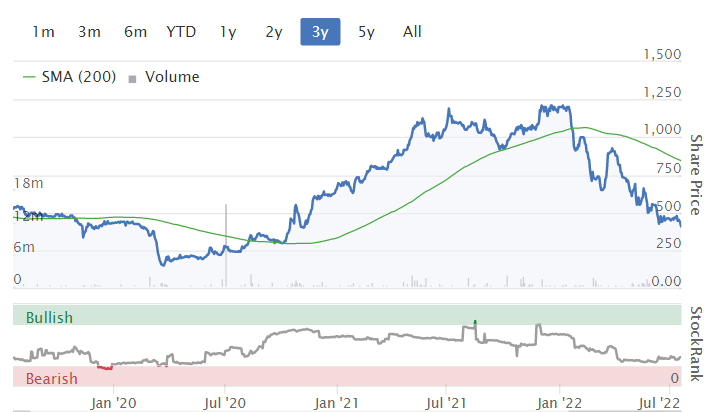
Share price has dropped by two thirds from the peak of c.1200p last year, that’s almost a £billion of market cap reduction!
Highly acquisitive floor-coverings manufacturing group, with mid to high end products.
Revenues £1,020m, up 54%, of which +19% is organic growth - impressive.
Underlying PBT £73.8m (up 47%) - note this is stated after a hefty £34.1m finance charge, due to high debt - so any deterioration in trading would be geared by finance charges remaining unchanged, but operating profit falling.
Net debt is very high at £407m, but this is secure, fixed rate, covenant-lite bonds - much safer than risky bank debt.
Diluted EPS 40.2p (up 40%) - PER of 10.0 - might seem cheap, but remember that net debt is about the same as the market cap, so the PER would be in the high teens if debt were replaced by equity (you have to remember to adjust out the debt finance charges if recalculating the PER on a debt-free basis, so it wouldn’t be as straightforward as just doubling the PER).
Supply chain constraints & “significant inflationary pressures” are mentioned.
5 acquisitions made in the year.
Special relationship with Koch Equity Development, who provide convertible debt, £150m more was drawn down in the year. Note there are some warrants, causing modest dilution. VCP says it intends to repay this debt before it is available for conversion.
Senior debt - is large, but all fixed rate, covenant-lite bonds, repayable in Aug 2026 and Mar 2028 - so the high level of debt should not cause panic for equity holders, this looks a much lower risk strategy than bank borrowings.
Liquidity - over £200m available at year end, sounds fine.
Outlook - main points are -
- Q1 (Apr-Jun 2022) revenues & earnings in line with original budget expectations - strange wording - why not just say consistent with full year market expectations, which would have been clearer?
- Geographic diversity helps, as some markets stronger than others.
- Mindful of macro headwinds, but “numerous actions” have been taken to mitigate.
- Well positioned overall.
- Commercial demand returning, after pandemic downturn. Early in the cycle.
- Lower demand for a time cannot be ruled out.
- Low operational gearing - i.e. most costs are variable with revenues - the benefit of this was demonstrated in the pandemic - remained EBITDA positive, even when revenues were down 80% temporarily - this is a really good point.
Net debt - is £407m, rather high, but as mentioned above, is secure long-term, fixed rate bonds. Made up of - £258m cash, £632m senior debt, £32m unsecured debt.
Balance sheet - NAV £203m, less intangibles of £504m, gives NTAV of £(301)m - normally I would run a mile from a balance sheet this negative, but the long-term, secure nature of the bonds, means it’s more tolerable, and of course gives nice gearing to equity when things are going well - and reverse gearing when things are going badly.
But of course we do have to adjust the valuation to include the large debt pile.
My opinion - I like this group. Chairman Geoff Wilding has worked wonders with what was originally a sleepy little UK micro cap, and is now a >£1bn revenues international group. The acquisition strategy seems to have worked very well, although picking up a lot of debt along the way. It’s long-term, and fixed rate though, which means it doesn’t particularly worry me. Similar to Saga (LON:SAGA) actually, in that respect. I wish more companies would finance themselves with bonds, rather than risky bank debt that is so vulnerable to covenant breaches & nervous bank managers, in an economic downturn. Whereas companies funded by bonds can breeze through recessions usually.
Overall, at just over 400p, I think VCP shares are starting to look potentially interesting. That's tempered by the uncertain macro outlook, which could trigger a downturn from current strong levels of trading, possibly. For that reason, I'll add it to my watch list, but it feels too early to buy.
EDIT - many thanks for shipoffrogs, who points out in the comments below the large difference between the underlying profit, and the statutory loss. This is a very good point. On doing some further digging, I'm less comfortable with this share, because the preferred equity funding looks expensive, and complicated (see note 6). End of edit.
Note that it's given up almost all of the vaccines bull run from autumn 2020 through last year.
.
.
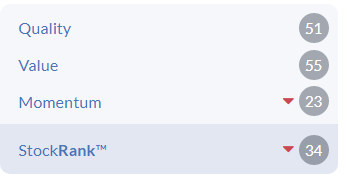
Stockopedia's emotionless computers wave a hand dismissively at this share -
.
Norcros (LON:NXR)
222p (up 2% yesterday)
Market cap £198m
Norcros plc ("Norcros" or the "Group"), a market leading supplier of high quality and innovative bathroom and kitchen products, issues the following trading update covering the 13 week trading period to 3 July 2022…
We might have expected a bathroom fittings group to be seeing a slowdown, now that the pandemic-driven home improvements boom seems to have fizzled out. That’s certainly what the share price has been anticipating.
Hence this is a pleasant surprise (very clearly worded too) -
The Group's overall trading for the first quarter was robust, with the Board's expectations for the full year remaining unchanged.
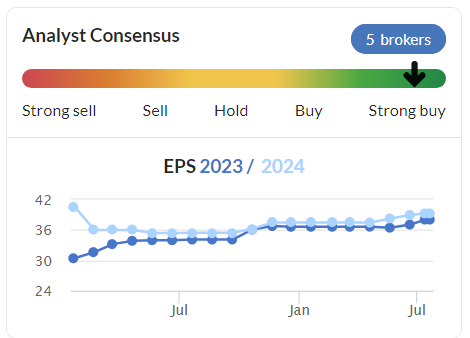
This is even more impressive, given that broker consensus expectations have been rising, not falling -
.
UK revenues in Q1 were slightly down, -2.2% vs LY, but 20.2% ahead of pre-pandemic, so most of that growth has stuck.
Some customer destocking in larger retail accounts is mentioned - destocking is worrying me a lot at the moment, as we’ve seen several companies (e.g. Luceco (LON:LUCE) & Supreme (LON:SUP) lighting division) taken by surprise at reduced demand, due to customers having over-ordered last year, and now winding down those excess inventories, as supply chains start to normalise. So it’s good to see NXR mention this, but it’s been absorbed without derailing the overall company performance.
South Africa (a big part of NXR) is storming ahead, at revenues +9% vs LY.
Outlook - this sounds upbeat, and I think NXR has established a good track record of telling it how it is -
"We have delivered a resilient first quarter performance against a backdrop of an uncertain economic and political environment. The Grant Westfield business is being integrated and continues to trade strongly. The Board remains confident that the Group's proven business model, leading brands, excellent service proposition and its commitment to new product introductions will continue to offer strong differentiation and deliver further progress and share gains, in line with its expectations, for the year to 31 March 2023."
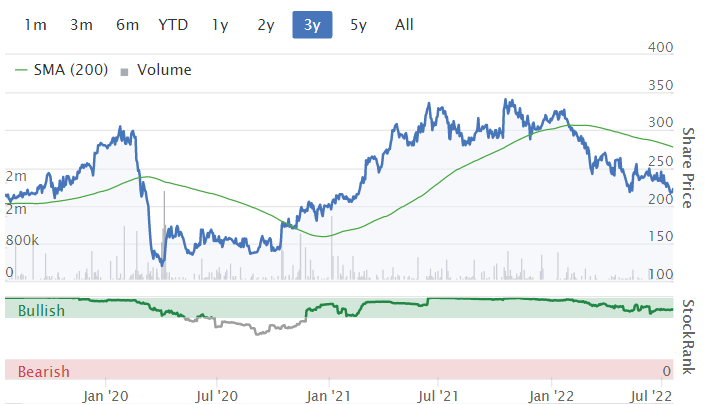
My opinion - the valuation metrics (see below) look really attractive. As with everything, it depends on how the macro picture develops. A prolonged recession would no doubt reduce demand, and see shares fall further.
Two big factors to consider when valuing this share - large pension scheme deficit recovery payments, and political risk from having material operations in South Africa.
After a steep fall in share price, combined with solid trading & outlook, this share looks attractive to me. It’s also proven adept at making good acquisitions, at reasonable prices.

.
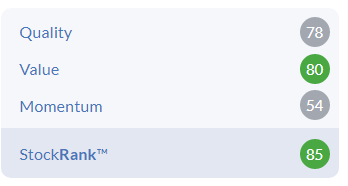
Stockopedia’s computers smile in an avuncular way on this share -
.
.
Finsbury Food (LON:FIF)
68p (before market open)
Market cap £89m
Finsbury Food Group Plc (AIM: FIF), a leading UK speciality bakery manufacturer of cake, bread and morning goods for both the retail and foodservice channels, is today providing an update on trading for the financial year, ended 2 July 2022, prior to entering its close period.
Let’s call that FY 6/2022. I don’t know why it used such a small font, I’ve had to zoom my screen to 150% to read it.
This sounds encouraging -
The Group delivered a robust full year performance in line with market expectations whilst having to manage and adapt the business under exceptional macroeconomic and inflationary headwinds.
FY 6/2022 revenues are up 13.9% to £357m.
It says 8.7% of the increase is higher volumes. The rest is due to price rises, which my workings suggest is +4.8% price rises. That’s encouraging, as it shows an ability to pass on cost increases, but we’re not told specifically what the cost increases are. Although since the overall result is in line with expectations, then clearly things have turned out as budgeted for, so that’s fine.
H2 was stronger than H1, with H2 revenues up 18.7% (volume +10.0%, the rest is price rises).
Cost inflation & passing on to customers - this is the key message to me, and I like it -
The Company has continued to be challenged by the persistent pressure from input cost inflation, staff shortages and other supply chain disruptions.
Pleasingly, it was able to mostly mitigate the impact of these pressures through revised commercial arrangements, operational improvements and other supply chain initiatives.
It will continue in the same vein as further inflationary cost pressures are expected in the new financial year.
That's the sort of thing well-managed businesses say. Badly managed businesses are taken by surprise by negatives, and put out profit warnings. We're really finding out now which are the well-managed companies, and which aren't. Hence I think I'll focus my share purchases on those that are successfully navigating these choppy waters, and avoid the ones that are struggling, no matter how cheap they look.
As we already know, food is a key area of higher inflation, along with energy, both of which are vital for FIF. Therefore, its reassurance today that it has been able to pass on these higher costs to customers, is tremendously reassuring.
New credit facility - I’m taken aback at the large size of this new borrowing facility, relative to the size of FIF. It strikes me as verging on excessive -
The Group also successfully negotiated a new four + one year £120m credit facility (£60m core + £60m accordion) effective as of 27 June 2022. As relayed in the February 2022 Interim Results announcement, the Board continues to explore opportunities to accelerate the growth of the Group through targeted acquisitions. Whilst the current stock market conditions persist and lower ratings of food manufacturers become a feature, these new credit facilities provide financial flexibility for the Group to pursue its significant growth ambitions.
Is this the right time to embark on a debt-fuelled acquisition spree? I would need some convincing. There again, FIF is trading well, and if it can buy up competitors on the cheap, then why not? Although it would increase the risk of something going wrong. Time to check back at what management track record is re previous acquisitions? If they've had to write off goodwill previously, then that would be a worry.
People who have done successful acquisitions in the past, and have a logical framework for what to buy, and what to pay, in a sector where they know the competition well, can work out well. Providing they can manage a larger group tightly.
Banks being willing to extend a large facility, in current conditions, demonstrates they have considerable confidence in the company & management, so that in itself is a positive.
CEO comments -
"To have delivered a record revenue performance this year that is in line with market expectations despite the challenging backdrop is testament to the hard work of our teams and the resilience of our model. Our Retail business performed well, we continued to see a bounce back in foodservice, and our Overseas division continued to see strong growth.
In recent years, we have experienced unprecedented challenges first triggered by the Covid crisis and now by significant input cost inflation and falling consumer confidence. While headwinds are expected to persist, we have a strong balance sheet and a successful track record of navigating challenging market conditions. I remain confident in Finsbury's ability to deliver on its long-term growth ambitions."
Uh-oh, he says they have a strong balance sheet, so I’ll have to check now.
Balance sheet - when last reported as at 25 Dec 2021 looks OK, adequate I’d say, not particularly strong. Once the £87.5m intangible assets are written off, NTAV is quite modest, at £26.4m, and remember this is a capital-intensive business, with £57.3m in fixed assets (PPE).
Note there is a pension deficit, on the last balance sheet at £14.5m.
The last annual report shows (note 12) that land & buildings are on the balance sheet at a NBV of £26.6m. That’s at cost. So there could be upside on the valuation of this property? The bank being prepared to lend £120m suggests to me that the property might be worth more than book value maybe? I'm assuming this is freehold property. The word "freehold" only appears once in the last annual report, in the depreciation policy note. I would have liked more details on this important asset.
So if there’s hidden property value here, it’s possible the balance sheet might be stronger than it looks.
If they do a webinar, I suggest asking: what is the current market value of the freehold property, would be a good question.
My opinion - I previously held a small position in FIF, but sold a while ago due to concerns over inflation.
Today’s update reassures me completely on this issue, and given that the share price has fallen about 30%, for as it turns out, no good reason, I think this share should go back on my personal buy list. Now that we know it can pass on higher costs successfully, then the downside risk on this share has greatly receded, in my view.
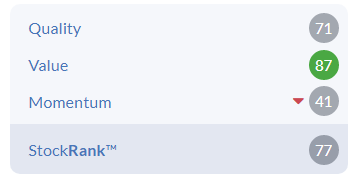
Look how cheap it is -

.
Stockopedia quite likes it too -
.
Costain (LON:COST)
38p (up 10% at 09:15)
Market cap £105m
Trading in line with expectations with strong cash performance
This is unusual - they’ve made the PR summary the actual title of the RNS. Why not? Quite a good idea, providing it’s accurate, which this is.
Costain is an infrastructure contractor, specialising in: transport, water, energy, and defence - all of which strike me as probably good sectors to be targeting at the moment.
Costain announces a trading update for the six months ended 30 June 2022, ahead of its interim results scheduled for 24 August 2022.
Inflation - very much like FIF above, COST addresses the main worry many investors have right now - the ability pass on inflation to customers. This sounds reassuring -
The Group has delivered a good performance in the first half, with revenue ahead of market expectations1, reflecting the inflation recovery mechanisms built into contracts as we passed through increased costs with higher prices, together with increased volumes delivering revenue growth in Transportation and Natural Resources. We expect revenue for the full year to be ahead of market expectations.
Particularly for a business like this, which operates on wafer-thin profit margins, being able to contractually pass on higher costs is not just nice to have, it’s essential for survival right now, I imagine.
Profitability - more important than revenues, and this is in line, not ahead -
Adj operating profit in H1 Is in line with management expectations.
FY 12/2022 - profit expectations are unchanged (but no footnote to say what they actually are).
Net cash - c.£95m at end June 2022, or 90% of the market cap! Ahead of market expectations, it says, due to “efficient working capital management”.
Good outlook for cash in H2 too -
...and we expect to deliver further positive net cash during the second half of the year.
Outlook - sounds good -
Our continued progress, supported by a strong order book and pipeline, gives us confidence for the remainder of the year and beyond."
My opinion - I don’t tend to invest in this sector, but the cheapness of Costain shares does make me wonder whether an exception should be made?
Looking through last year’s full accounts, the pension scheme seems to be consuming about £10m cash, that’s almost half of profits. So properly researching the pension scheme is of great importance before jumping in and buying this share blind. It’s shown as an asset of £67m on the last balance sheet - a very strange asset, that requires £10m p.a. cash outflows! Pension scheme accounting is just so rubbish, and highly misleading, it's a disgrace actually. Yet the accounting standards people don't seem to care. Same with the IFRS 16 nonsense. If people need to manually adjust accounts, then it means the accounting standards are no good, as a reader here correctly pointed out recently.
Lots of companies in this sector go bust, when big contracts go wrong. So checking for any contract disputes is another key point.
The last balance sheet looks fairly robust, with £146.5m NTAV, although that includes the false pension scheme “asset” of £67.2m, which I would delete (and should arguably be replaced by a liability for the real world cash outflows), which brings adj NTAV down to £79m.
Overall, the balance sheet looks OK, and it seems that COST receives cash up-front from customers, so it maintains a very nice cash pile.
The valuation metrics look ridiculously cheap, which is often because there’s a problem. Pension scheme cash outflows, super thin profit margins, high risk from big contracts, are the main reasons why. That said, there comes a point where even low quality businesses are too cheap. Given Costain’s reassurance today on contracts & inflation, its shares might be worth people taking a closer look, possibly?
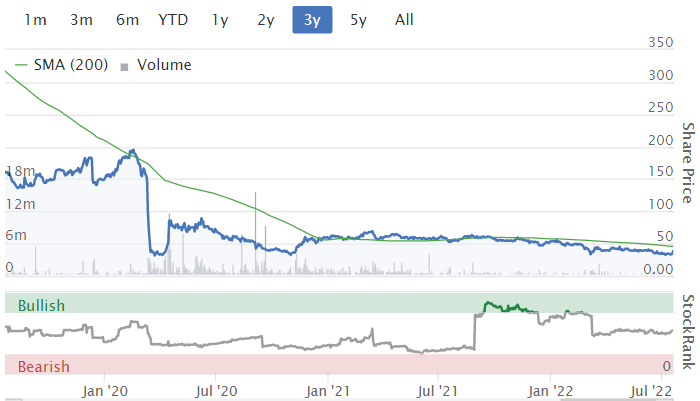
Be careful with drawing lines on the chart, because the share count has gone up from 114m to 275m in the last 3 years. So 200p in old money, is only really about 60p in new money -
.
.
Netcall (LON:NET)
89p (up 1% today)
Market cap £133m
This software company caught my eye here on 10 June, when it announced a major contract win. It seems to be on a roll, and whilst the shares look expensive, I think the high valuation could be justified.
Netcall plc (AIM: NET), a leading provider of intelligent automation and customer engagement software, is pleased to provide the following update on trading for the year ended 30 June 2022.
Trading is ahead of expectations -
Following a strong trading period with good demand across our product portfolio, the Board expects full year results to be ahead of market expectations(1).
(1) Netcall believes that consensus market expectations for the year ending 30 June 2022 is revenue of £29.8m, adjusted EBITDA of £6.0m and Net cash of £8.0m.
Revised guidance provided today is -
Revenues £30.5m
Adj EBITDA £6.4m
Most of revenues looks to be recurring, with Annual Contract Value of £24.2m.
Net cash is £13.4m, which seems to be way ahead of the £8.0m forecast previously.
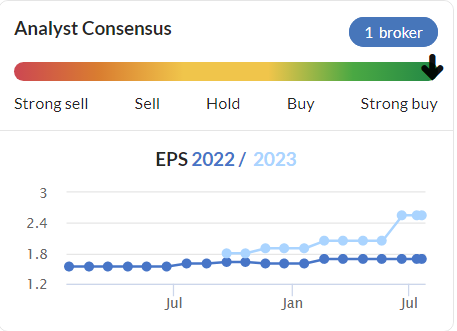
Outlook comments sound positive. The big contract win announced in June led to FY 6/2023 forecasts being raised significantly (see below, the lighter dotted line), to 2.55p EPS - a forward PER of 35 times - expensive for sure, but it seems to me something interesting is going on here, with growth accelerating.
.
Balance sheet check - this might surprise you, but it’s quite weak. At end Dec 2021, NAV was £26.1m, but that includes £30.0m intangible assets. Get rid of that, and NTAV is negative, at £(3.9)m.
Current assets of £17.9m (included £10.7m in cash) is less than current liabilities of £19.7m.
Does any of this matter? Not really, like many other software companies, NET gets paid up-front, before delivering the services. That means it can operate fine with a negative balance sheet, and has cash in the bank in advance.
But don’t let the talk of a big cash pile lull you into a false sense of security, because it’s customers' cash, paid up-front, not the company’s own surplus cash.
It’s not a criticism, I’m just flagging the facts.
My opinion - this looks terrific, although that’s been reflected in a high valuation on the shares.
Therefore the decision to make is whether to hold fire for a pullback, or throw caution to the wind, in the hope that the contract wins continue, leading to forecasts getting upgraded repeatedly again. With so much recurring revenue, the risk of a downgrade is probably fairly low.
Overall, I can see the appeal here, Netcall looks good to me. But expensive.
This video is 2 years old, but it shows a Doctor using the Netcall system, which is widely used in the NHS.
.
Graham's Section:
PayPoint (LON:PAY)
Share price: 603.6p
Market cap: £416m
Judging by the limited commentary on this share over the years, I’ve developed the impression that few private investors are interested in this one. But I’ve always thought that it has some interesting and attractive characteristics.
For example, how many UK small/mid-caps have paid a dividend every year since 2005, and continue to offer a generous yield? The yield on offer currently is 6.7%, according to Stocko.

The traditional PayPoint business revolved around helping customers to pay their bills, by visiting their local newsagent.
That business is naturally in decline. In general, people with good banking services who can use the internet do not need to pay their bills this way.
I think the strong association of PayPoint with this service helps to explain why its shares receive so little attention. If it was a shiny new fintech brand without any of its legacy activities, perhaps it would get a higher rating!
PayPoint’s services have broadened over the years. The company now provides “everything a modern convenience store needs”, including an electronic Point of Sale, a contactless payment device, parcel collection and ATMs. (link)
Let’s catch up with this morning’s trading update for April to June (Q1).
- Quarterly revenue +6% to £29.9m
- Largest division, “Shopping” is +8%, while the second largest division, “Payments & Banking” is +1.8%.
Note that Payments & Banking includes the services in structural decline (bill payments and mobile top-ups).
- Ecommerce division revenue £1.4m (2021: £1.1m).
This is the parcel delivery service Collect+. There has been “a resurgence in the clothing category”.
Analysis
PayPoint wants to be an all-in-one payments service provider to small shops, by offering a wide range of complementary functions available to every site. They appear to be succeeding in this mission.
In parcel delivery, they are starting from a small base. But they have potential, I think - they have a new partnership with wish.com, and have rolled out Amazon returns capability to 2,000 sites.
The Payments & Banking division is a mixed bag. PayPoint is very busy modernising it, as their traditional services dry up. But it’s not easy to guess at the future size of this division. Maybe they can tread water, and prevent it from shrinking at least?
Net debt reduces to £38m.
My view
I continue to have the impression that PayPoint enjoys a lot of pricing power over its customers.
Roland noted in his 2019 SIF article that PayPoint’s store network covers more than half the addressable market. PayPoint is the de facto standard solution for small shops.
And you can see the effects of this when PayPoint decides how much to charge, and when it changes its rates.
Earlier this year, PayPoint changed its service fee by half the RPI. The Federation of Independent Retailers wasn’t happy about this, and yet it had little choice but to accept it.
Indeed, the relationship between PayPoint and retailers hasn’t always been a very happy one. But again, I think a lot of this comes down to the fact that PayPoint has a lot of freedom to set its prices, and the retailers often feel like they have limited alternatives.
So for a company with this much pricing power, I find it curious that it has a P/E of only around 11x (adjust it higher for the debt load if you like)
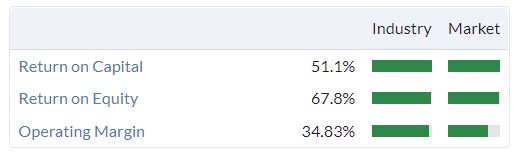
To me, it’s a fintech company with a quasi-monopoly in its sector. Its operating margin and ROCE statistics are always excellent, and it generates lots of cash.
So does it not deserve to be rated higher than this?
Pendragon (LON:PDG)
Share price: 21.5p
Market cap: £300m
This car dealership group updates with another “strong” performance in H1 2022, but there is a reduction in underlying PBT from £35.1m to c. £33m.
The exceptional profits of recent times could not last forever and a decline will have been expected. Judging by PDG’s share price reaction today, investors are cheered by this PBT number.
The company reports that the wider market for new cars was down by 11.9% in H1, as supply constraints continue to bite:
As a result, the Group's focus has continued to be on maximising the level of margin achieved per unit, and strengthening the already robust order bank. New gross profit per unit is higher year on year and more than outperformed the volume shortfalls.
I’ve been impressed by the ability of car dealerships to earn large profits during a car shortage. I suppose this is what happens when you have an inflationary environment and very strong consumer demand: higher prices can offset lower volumes!
Having said that, there has been a softening of prices in used vehicles:
Used vehicle volumes were also down year on year as supply constraints from lower new car production continued to have a knock-on impact on used car availability. Used gross profit per unit also remained strong; although, as anticipated, this has been lower than the exceptional levels seen in H2 FY21.
Higher gross profits are offset by £20m of increased costs - the removal of government support, marketing campaigns, and higher labour/utility costs.
There’s not much else of interest in this update. In the outlook section, the company cautions that vehicle supply will be a problem for the rest of 2022, at least, and that consumer sentiment could soften in H2.
My view
I like to read how the car dealerships are doing as a check on economic conditions, but I’m not sure if I'd ever want to buy their shares. They are often good solid performers, but I find it hard to differentiate between them.
PDG shares might be seen as a bet on current conditions prevailing for longer than expected: low vehicle supply, and extraordinary margins for dealers.
You can see this in the StockRank: PDG shares offer both high momentum and high value. If only things stay as they are for another year or two, then PDG can enjoy these bumper profits for longer, and these “cheap” shares can continue on their upward trajectory.
The adjusted PBT forecast for this year was only around £55m, according to the most recent broker note that I can find. Pendragon is already 60% of the way there…

Disclaimer
This is not financial advice. Our content is intended to be used and must be used for information and education purposes only. Please read our disclaimer and terms and conditions to understand our obligations.

63 comments
Pod Point group (LON:PODP) - what’s happened in the last month?
This is one unprofitable tech company that held up extremely well during the tech wreck - probably because it is one of only a few listed pure play EV charging names - and much cheaper than US-based BLINK or CHPT. Now that tech is just starting to consolidate in the last month, however, I see that Pod Point has fallen off a cliff with a near 60% tumble. Is this simply a case of catching up rather belatedly? Or does anyone know of any other reason?
EV/revenues at 1.3x FY22 is not expensive for a business growing revenues at 50% pa even if some profits wouldn’t do any harm. And this looks an attractive M&A target for the big energy firms looking to make a land grab.
Ref £PODP I haven't done anything more than spend 5 minutes looking at its stock figures and a quick glance at its FY21 results, but that has enough red flags for me to turn my back and understand maybe why its SP has dropped
- It is a recent listing and the majority of those listed in the last 12mths have fallen significantly - they listed at the peak of the market and now things have turned co's not making any money are being hit hard
- They don't make a profit and looking at their top-level accounts they seem to have doubled sales, but their EBITDA has got worse
- I couldn't see any signs for "real" profit/loss figures and EBITDA is enough to turn me off - we all know Mungers view!
- Whilst they don't have any debt their cash balance is likely to be burnt pretty quickly and therefore a new raise might be required at some point - this might be a while away, but it seems to be burning through cash
- I don't see them as a tech company - flogging EV car chargers is hardly high-tech. I have no idea if they have any USP vs others and what their pricing looks like, but EV chargers are pretty much two-a-penny now in a highly competitive market
- they look like they have BMW on board, but I haven't seen if they have any other tie-ups which would always be useful. BMW does offer some good opportunities as they will push buyers towards their preferred partners, but people should be canny enough to check out prices first
- Q,V & M scores are all low with an overall SR of 36 - enough to turn many people off
- Forecasts look like they don't show a profit for a few more years (no specific date) so def a jam-tomorrow company
- +ve is that it has plenty of II's on board, but over 50% is owned by EDF - not sure why this is or what it means
Therefore, in my eyes, it has enough significant issues I wouldn't want to touch it, but I can understand others may have another view and who knows, it might re-rate if it can turn its financials around and prove to be a good investment.
All the Best. K
Thanks for taking the trouble to reply in detail. However, my point, perhaps not comprehensively conveyed, was that all of this was understood by the market during the waterfall crash of Nov-May suffered by unprofitable tech. Shares of equivalents Chargepoint, Blink and Alfen all collapsed while Pod Point group (LON:PODP) stayed relatively strong. Now the counterparts have somewhat recovered and it is PODP that has collapsed. The net effect is comparable but the timing perverse!
Thanks to Graham for the PayPoint (LON:PAY) review. This is one I have held for quite a while, and have suffered a price hit like we all have. Its a good Company, I believe, though probably suffers from market perception of smaller retail shops, as not being sexy.
They could probably do with a bit more Financial PR.
I hold in my ISA and tend to reinvest the dividends, which is probably the nearest I come to averaging down at present.
Finsbury Food (LON:FIF) It's not obvious to me from the commentary that Finsbury Foods have been able to pass on cost increases to customers. The mitigation actions they mention seem to be more about operational efficiencies on the purchase side - perhaps shortening supply chains, bulk ordering? Well done to them for that, but there must be a limit to how much they can do on that front, and then they will need to raise prices. I am not saying they can't do it, but if they haven't actually tried it yet, maybe that's because they are not sure their customers will accept them? Supermarkets seem to be pushing back on their suppliers increasing prices, although I can't imagine most suppliers wanting the 30% increase Heinz were apparently asking of Tesco!
Good write up Paul, thanks. I agree with this post. Finsbury Food (LON:FIF) Bit suspicious of a 4.8% cost increase only. As someone who works in the larger bakery industry, cost inflation over last year is running at c +20%. These factories run on the energy of a reasonable sized town and we all know what's happened to wheat pricing. Add in packaging, wage inflation and transport and these point to a margin dilution. Happy to be proved wrong, but I'm watching this one from the sidelines for the time being.
Costain (LON:COST)
Following Paul's write-up and a number of comments, if anyone wants to follow up there was an excellent 12 minute summary of how Costain has been transformed over the last two years given by the CEO at the AGM on May 5th. You can access the recording here:
https://www.costain.com/invest...
He starts at 2m 45s in . Following yesterday's headlines on heat effects, his comments on working for Network Rail and resiliance of infrastructure are apposite even if it was floods that he gave as an example!
@Paul
Just saw your Tortilla mystery shopper report. Many thanks for doing that, customer service levels here through the roof!
:)
Hi MJP,
Actually, I mystery shopped Tortilla Mexican Grill (LON:MEX) again yesterday, this time through Deliveroo.
The product was excellent again, but with some extras, ended up really expensive, at over £20.
But it arrived quite quickly, and well packed.
I think overall, I'm happy with the product at Tortilla, and would consider buying the shares, if they get into bargain basement valuation territory. Not there yet!
Regards, Paul.
The risk with Samuel Heath and Sons (LON:HSM) is that it is a lobster pot, and you have the potential risk of zero ability to sell whatsoever, if you do ever manage to get a position in the first place. It has traded zero volume on 211 days (84% of days) in the past year, with an average daily value traded over the course of the year of £1,100. I'm surprised you covered it!
absolutely right…it’s a share that is almost impossible to buy ..NMS is 150…& only occasionally possible to sell..in the event of bad news it would be a painful company to get out of ..if it were possible at all…that is something to bear in mind at all times.
I like it for other reasons..not least the fact that it fits my ideal holding timeline of forever
Regarding pension deficits (Norcros (LON:NXR) in the article). I think that any company with legacy defined benefit pensions, even if in surplus, is a big risk in an environment of rapidly rising inflation and falling corporate profits. The inflation of the mid 1970's (when inflation reached 25% and I first became interested in investment) pension deficits contributed to a number of corporate failures. I don't know how to evaluate that risk for a company. I have tried in the past using the company pension reports, but for me, unless the pension scheme has reduced to a very small size and close to winding up, I prefer to stay away.
This may be off topic, but I do not know where else to go.
Inflation is now over 10%. Crucially, it does not look like it is going away by Christmas.
I am not old enough to remember other periods of high inflation as an adult (from 68 to 92 CPI was generally over 5% and since then under 5%) but do remember people behaved rather differently.
For example, I do not buy things that I do not need right now partly because I have an expectation I will probably be able to buy that same thing for less later. My parents tend to behave in the opposite way, thinking it will cost more - if it is still available.
At the moment their behaviour patterns seem better suited to the zeitgeist than mine (dad has 2 full large petrol containers in the garage and tells me it has outperformed his stock of stamps - and all his investments )
Clearly supply chain resilience has (currently) more utility than 'just in time'.
It leads me to ask:-
What types of company will be gaining from this
One simple answer that springs to mind is that as companies need more stock on hand, they will need more space (warehouses) to store that stock. I may be wrong. There may be other answers.
Dragging myself roughly back on topic (small caps). Increasing the cost of capital (interest rates rising) and increasing the amount of stock needed to carry on operating (more working capital, more stock control, more warehouse space) reliably will not work well for a small cap co with little working capital.
I have sold anything that does not have positive net assets and positive FCF over the last few weeks.
Of course that may be the wrong thing to do.
you are rubbing it in a bit but I get your dad. Companies with strong balance sheets and good management. Companies who work with governments. NOT companies working on long term contracts which cannot be adjusted for changing times. NOT interest rate sensitive products, e.g.housing unless you think house inflation will out move interest rates I don't. I think companies which will be involved in changing the infrastructure of the country will be winners. This is one time when what was will not be ok for the future, thanks to Putin and Climate change. These are just my ideas dyor.
You want companies with big margins (to better absorb cost increases) and low Capex spend (no constant reinvestment in capital at rising prices). An example would be £FEVR.
Somero,
Big feature in the telegraph today calling it the IBM of its sector. Surley this can’t be the reason for the 15pc increase today
On Somero Enterprises (LON:SOM) (I hold)
Looking at IBM's performance over the last 20 years or so, that is not a compliment
Supermac,
Yes, Questor tips can move share prices a lot in a single day
Yes Questor and Midas (Mail) tips can both lead to spikes - as well as Simon Thompson tips in the IC. I suspect it's a case of the market makers moving up the price in anticipation of demand. They generally fall back after a few days as people get bored and take profits, so generally not a good idea to buy straight after the tip.
£somero
Unbound Group Unbound (LON:UBG)
Paul, your comprehensive synopsis of Unbound Group on 30th June after a call to the Company was most informative. The current decline in share price seems at total odds with outlook. The new Unbound Group multiple drop-ship platform launches next Thursday 28th July so the current nadir? In price offers significant short term upside as well as the longer term. It's interesting to note that nil paid options to directors only vest if the EPS exceeds 18.5p in 2025.....that's very optimistic given the current share PRICE is only marginally higher. Management are convinced this is achievable as it has been divested from Electra. As you pointed out, the jury is out, but the Hotter brand which is the current platform providing the migration, is directed at the over 55s. It's a huge and growing demographic audience and Hotter has captured a significant market share. You mentioned several interviews given by the CEO. This is also an excellent one.
https://www.theindustry.fashio...
I notice that there was a comment on Royal Mail below Royal Mail (LON:RMG) (I do not hold), and agree with the negative outlook. I looked into Royal Mail a few months ago when it was high on the StockRank listings. I did not like it as in my opinion there is better value elsewhere, for me the debt is worryingly big. They have the advantage that they are unlikely to go bust, but for me they missed the opportunities on offer during the co-vid highs.
My opinions of the Royal Mail are superficial and not founded on more than a cursory overview, however what I did wonder was whether anyone else had noticed the large swing on the StockRanks rating (from 94 in May to 56 today). Has the quality of the business fallen so significantly in 1 month, and is the timescale of the momentum indicator relevant in bear markets (yes, I can see that it does suit Games Workshop (LON:GAW) over 2017 - 2021). Maybe Royal Mail is an edge case, does anyone else have a view on this ?
on another note..
I noticed some criticism of Richard Leonard (as pointed out, not by the SCVR), and I think that perhaps we are all a little more stressed than usual (my fixed rate energy contract runs out in August...). Anyway, I would like to say that I find his style enthusiatic (perhaps a bit too bullish), and I enjoy listening to him. I did look at Made.com when he mentioned it, but did not find his business case of 'my daughter really likes them' not strong enough (I looked on trustpilot at the time, they seem to have improved things since last year as there were alot of complaints when I looked at it). However his views on Tracsis Tracsis (LON:TRCS) were pretty spot on at the time, and one could also argue he was right on Quixant £QXT. Anyway, I dont have a problem with people talking their own book when it is transparent, I would add that there are some of the interviews that I have seen where I suspect there are murkier arrangements...
sorry to go on... I am often lurking, and so am too long today !
Thanks for the podcasts Paul - I listen and enjoy. Keep up the good work.
And just for fun...
Does anyone remember when the markets were so quiet in 2012 that Paul did xmas sandwich reviews ?
www.youtube.com/watch?v=DI8wFk...
Samuel Heath and Sons (LON:HSM) I’ve held this for a few years now…it’s horribly illiquid but what I like is that it produces high margin highly engineered brassware products from its Grade 2 listed but state of the art machining facility in Birmingham. https://www.samuel-heath.com/p...
products are nearly equally balanced between U.K. & fast growing export markets ..in particular the US. Customers are at the luxury end of the market & more sensitive to design & engineering quality than price so arguably price inelastic. They are cash rich ..over £4m of cash offset by a pension deficit of similar magnitude…but that is reducing fast through £1.036m contributions by the company & rising bond yields. They are investing heavily to grow beyond the turnover levels they’ve achieved in prior years. They also supply luxury hotels Claridge’s etc…many of these refurbishment projects were deferred in recent years…but products like this https://www.samuel-heath.com/p... the newish 100 collection are gaining increasing traction
I like that I’m being paid to wait whilst the pension fund issue dissipates & liberates significantly more cashflow for investment or increased returns to holders…the business is run for the long term & I wish there were more like it in the U.K. listed space
Costain (LON:COST) agree that this looks very cheap and tempted even though I normally avoid the sector. I wouldn't entirely write off the £67m pension surplus either - they could easily offload this to an insurance company and at that point would be able to monetise any surplus (I suspect it would now be even more than £67m given that corporate bond yields and hence the discount rate used to calculate liabilities have been surging).
Costain (LON:COST)
Operating margins put these infrastructure companies on a knife edge IMO.
Big penalty clauses on these projects, make it a risky investment, and Costain (LON:COST) along with others have had their fair share of them over the years.
Wages for machine and plant hire have gone through the roof over the past couple of years with Brexit not helping the wage increases, and estimating these large scale projects well in advance, with clauses to cover all eventualities, and being able to pass these costs onto the client, takes great skill.
Its great to know I can drop back into construction anytime and get an excellent wage, but that makes me not want to invest with those margins, in this current climate. I would want to see some increase in margins first.
Whilst not an expert on what jobs Costain (LON:COST) do or do not have on the books currently, as one bad project can wipe the whole company out for a year...
I would also add you need to add in that all materials are up, so anything not bid recently, e.g. those jobs bid and won last summer Costain are losing money on unless they are a "cost plus" or "reimbursable" project which are few and far between in construction. Or Costain have passed the risk to their supply chain and running the risk there that their suppliers go bust...as they are just managing rather than doing the direct work?
The other obvious note is that the use of Red diesel is being removed from site, so machines now cost more to operate than hire.
A lot of tenders are out there but contract awards being pushed back and deferred, and a lot of pressure being put on supply chains once more and trying to pass down all the risk back to the bad old days of paid when paid and who cares if your company exists tomorrow we will just work with someone else. (I work for a Tier 2 UK national company).
I would raise the question on inflationary pass through, the majority of projects have an indexation clause on a stated anniversary for multiple year jobs referenced to CPI or RPI, not material price indexation (with a previous company we were really hurt on a multiple year project when the steel price doubled), so unless Costain are in an incredibly powerful position and prepared to walk away (look at Bond Street Station on Crossrail, Skanksa Costain JV walked away rather than finish it not the proudest moment for "The Best of British Construction" but lets park that one!
https://www.constructionnews.c...
Tommy
ps. I do not hold any construction companies...
Good presentation by Pressure Technologies this morning. I am a holder. On Investor Meet if anyone with interest hasn't seen it.
Victoria (LON:VCP) - having read yesterday's RNS and the above article - it would be too easy to conclude that Victoria (LON:VCP) reported a profit. To set the record straight - they lost over £12m.
Hi shipoffrogs,
Re Victoria (LON:VCP)
Fair point! Although to express it more completely, I based my figures on the underlying results, being £73.8m u/l PBT, whereas your £12.4m loss figure is the statutory loss after tax, once all the adjustments & exceptionals, etc are taken into account.
I don't think it's a case of one being right, and one being wrong. They are both of interest. The underlying numbers are trying to show how the business is actually trading, ignoring one-offs, non-cash items, etc.
Although, as you imply, there's a huge difference between underlying, and statutory profit. So I've double-checked the detail -
£32.4m is amortisation of goodwill, which most people are happy to adjust out, that's how fund managers & brokers work, so I'm also happy with this.
The other big item is £33.0m, called "Preferred equity items", which seems a lot. That must relate to the financing arrangement with Koch, but it's a big number, so probably needs more investigation. It's a non-trading thing though.
There's a note disclosing exceptional items of £6.9m, which are a mix of income and costs. That looks OK to me, reasonable items, and not excessive.
There's a partial breakdown of it here;
.
Overall, I think you're right to point out that there are a helluva lot of accounting adjustments., that's useful, thank you!
Regards, Paul.
P.S. See note 2 to VCP's accounts today for full detail of non-underlying adjustments.
Note 6 covers the "preferred equity" arrangements, which is expensive & complicated debt, it seems to me. After reading note 6, I think I've talked myself out of this one, as it looks too complicated ,e.g. here is the £33m P&L charge relating to preferred equity -
Thank you for the reply.
I do not think note 6 was written with any intention that it be understood by readers of the accounts - it just names components of the charge with meaningless titles.
I'm also not sure I understand how the company can go into such an old established sector and start doing "extraordinary" things.
They have an investor call open to the public where you could ask about the underlying/ reported numbers if you wanted to.
I hold a small amount and think it is an interesting opportunity on value grounds - of course that the underlying numbers are an accurate presentation of the true position of the company.
Morses Club (LON:MCL) looking like a goner for current PI 's holders? I hold, was thinking last week of doubling down....
I think the chance that the company goes to zero is very high. They're looking for funds to aid liquidity and want to negotiate a package to satisfy claims that still gives them a chance to stay in business. Too many things that can go wrong here as opposed to too many things that have to go right in order to stay in business for me to invest. But, if you're a gambler and regard the market as a kind of casino - you could 10x, 20x or even 100x your money - that's what people want to hear right? Un-investable for me.
Re Morses Club (LON:MCL) - this a personal disaster ( I held a lot) but also a societal one. Ambulance chasing claims firms have now closed the whole 150 yr old regulated doorstep lending business (Provident / NSF / now Morses) and it is still unclear to me what they have done wrong legally ie they have complied with regulations but lost out on a case by case basis. Yes lending rates were high, yes some poor/vulnerable people should not have agreed/requested to take out loans but at least a much larger number could access credit, often otherwise difficult to get hold of and via structured companies. Now expect the re-emergence of loansharks and informal lending practices and hundreds of thousands of people shut out. At the same time Klarna and others are hardly regulated at all.
For me you have to think how these claims companies work and then it became obvious. The general consensus among the public is that doorstep lending businesses are unethical. Not that they are or not, but public perception is that they are. So, any cases that go to a magistrate court will most likely go in favour of the public as judges in these courts are members of the public - more than they are experts in law. The companies that were formed to chase down claims against banks mis-selling PPI had to find another avenue once that business run out and door stop lending is made for them. A race to the bottom for both the door stop lender and the claims companies - and one could say that the public lose in the long run but in the short run, they win and the vast majority of people are short term in thinking and actions even when they say they're not.
Lenders have had an obligation to check the borrower's ability to pay for a long time. This from 2013 "The FCA’s guidance on a customer’s ability to pay and responsible lending, states a firm must be able to show that the customer’s ability to repay was taken into account" https://www.experian.co.uk/blo...
And this guidance from 2019 https://www.fca.org.uk/publica...
As an aside MrC, the affordability test for mortgage borrowers is being scrapped from August (a potentially disastrous move in my opinion) https://wolferstans.com/knowle...
Lenders have had an obligation to check the borrower's ability to pay for a long time. This from 2013 "The FCA’s guidance on a customer’s ability to pay and responsible lending, states a firm must be able to show that the customer’s ability to repay was taken into account"
MrContrarian, I agree with the above and re Morses Club (LON:MCL) believe they do so given the steps they are required to go through before lending now. I would argue that this is especially true now lending is driven by a centralised, online script (accepting there are always agents who dont follow trained practice). Will the alternatives people use be better? I doubt it.
So as an investor I knew I took a risk on regulation change the govt or FCA but I am not sure this is what has undone me. Rather it has been legal interpretation so you may be right but that is rather worrying why!
I feel for you. I had £MCL and was well ahead at one stage. Due to the notional paper loss as it came down in price I sold whilst I was actually still in the money. I kept it in my monitor and was tempted to get back in but thankfully didn't. The fact that the bloke who joined from Sainsbury's Bank put £250k in appears to have lost the whole lot makes me feel less of a chump for getting involved in the first place. As other readers have commented, it looks like the loan sharks will now have an open field.
Positive AGM update from £BMY. I hold and have done so for quite some time. I saw that Richard Leonard got some criticism recently on the SCVR for some of his stock selections on his most recent PI World interview.
In fairness Richard together with the vast majority of investors would not have foreseen the senseless war in Ukraine that has provided a tailwind to the present economic woes and the current bear market, especially in UK small caps, but to his credit he did wax lyrical about Bloomsbury Publishing (LON:BMY) saying that it was the one stock he intended to hold for the long term.
I very much like his enthusiastic and engaging commentary, but conscious of the fact that we all make mistakes, myself more than most.
All the best
Hi jonno,
I saw that Richard Leonard got some criticism recently on the SCVR for some of his stock selections on his most recent PI World interview...
Just to clarify, there was no criticism from me or Graham of Richard Lennard in the SCVR. I think he's quirky & good fun. And all of us make plenty of mistakes re picking shares, especially at the moment.
It was one or two reader comments that were critical of him, not the SCVR itself.
I think that's an important distinction to make.
Regards, Paul.
Hi Paul
Yes, I am aware that you and Graham, or the SCVR were not party to the negative views on Richard Leonard's stock selections. The thought of Richard Leonard came to me as I was posting the brief comment on the AGM update from £BMY.
My intention was perhaps to 'balance the books' a little, no pun intended and give Richard credit for his selection of £BMY.
Best wishes
Bloomsbury Publishing (LON:BMY) (I hold)
Hi Jonno
"to his credit he did wax lyrical about Bloomsbury Publishing (LON:BMY) saying that it was the one stock he intended to hold for the long term. "
I was literally thinking the same thing 5 minutes ago.
I remember Richard Leonard being excited about the Bloomsbury Digital Resources (BDR) segment. I didn't think much of it at the time, but after I did some my own research on £BMY , I could see what why he was so positive about this area of the business.
Indeed, the BDR was one of the main reasons for my Bloomsbury Publishing (LON:BMY) purchase.
I don't agree with a lot of his holdings, or his rationale for buying, but I did find him quite honest when admitting to ideas that went wrong.
I enjoyed, and will continue to enjoy, listening to his interviews.
A
Morning Abtan
I read Richard Beddard's article recently on Bloomsbury Publishing (LON:BMY) available on the ii website ( link below) and at the risk of confirmation bias agree with his view. I also think that Harry Potter will follow in the footsteps of his namesake Beatrice Potter and be read by children for generations to come, providing annuity like revenue for £BMY.
It is difficult to see Bloomsbury Publishing (LON:BMY) remaining independent and at some point I can see it being acquired, we shall have to wait and see.
Richard Beddard: many good years lie ahead for this famous firm (ii.co.uk)
Bloomsbury Publishing (LON:BMY) (I hold)
Thanks Jonno
I've shared my Bloomsbury Publishing (LON:BMY) workings with Richard B in the past (specifically on HP sales, which I've worked out and track each year) and enjoy reading his articles on the company probably because, like you, he agrees with my own positive view - a dangerous reason to like someone.
If there was 1 thing I would add it's that the Sarah J Maas sales are on the verge of overtaking Harry Potter sales. I only worked this out recently and was shocked to see it.
Of course, she's unlikely to have the longevity of the Harry Potter franchise, but it's certainly a an excellent cash cow right now, and I must admit to being particularly impressed by her success on tiktok, clearly an excellent place to be popular right now.
Cheers
A
As far as I can make out Maas' sales are 12 million and JK 500 million.
RE: Bloomsbury Publishing (LON:BMY)
As far as I can make out Maas' sales are 12 million and JK 500 million.
That's historical. The publisher only gets paid for current sales. So abtan is pointing out that her current sales are roughly equal to JKR's current sales.
timarr
Bloomsbury Publishing (LON:BMY)
Hi Funnymoney
As timarr pointed out re. Sarah J Mass:
I believe it was correct around March 2021.
The Bloomsbury Publishing (LON:BMY) Annual Report for FY22 (which ended March 2022) said lifetime book sales were now 19m i.e. 7m Sarah J Mass books were sold in FY22 alone. Highly impressive and for me at least, completely surprising.
Cheers
A
Strong 25% sales growth, a further 24% advance in membership numbers and important progress at the Masterton Bond facility from Artisanal Spirits (LON:ART) today. The company reiterated its ambition to double sales revenue between FY2020 and FY2024. With a focus on the ultra-premium category, a fast-growing global membership base and embedded value in its maturing whisky stocks we continue to argue that fair value for the shares is 150p.
Investors should recognise that the company’s maturing stock of Scotch whisky has an estimated value of £430m. This is more than 10 times the entire market cap of the company. The current share price shows no recognition of the intrinsic value that underpins it.
In addition to this, there are strong arguments for the shares to trade higher on revenue growth considerations. We reiterate our 150p per share fair value at which price the shares would trade on 5.5x EV/sales in FY2022 and 4.1x sales in FY2024, based on our estimates. https://www.equitydevelopment....
“Buy” recommendation for Somero Enterprises (LON:SOM) in The Telegraph today. Highlights the ROC of 65% is truly exceptional making the PE of 7.8 an anomaly.
Confident update from Kin and Carta (LON:KCT), raising revenue forecast by 5%, other measures broadly in-line with previous guidance - so no downgrades* despite recession fears. Pension also tidied up. I have added to my holding at open.
* consistent with reports from DX providers globally
A good update from Costain (LON:COST) with profit inline but good cashflow as a result of which net cash is 'around £95m' compared to last night's closing MCap of £95.45m so the profitable business is in for free! Maybe Mr. Market has not forgotten two disastrous contracts a few years ago but new management (CEO May 19 CFO Nov 20) has reformed its tendering processes so that everything is about risk management.
Be careful here as the cash is not actually shareholders cash. A big chunk of that cash is needed for contract disputes and remedial work.
Thanks
If the cash is needed for contract disputes and remedial work presumably those figures are in the creditors or provisions?
No they are not
Also it's almost like banks with their Tier 1 capital. A certain amount of free cash's itting around is needed to give clients of Costain (LON:COST) confidence in contracting with them.
If you look at net cash vs revenues, it is small.
Royal Mail (LON:RMG)
Paul always right the pandemic boom in parcel volumes bolstered by the delivery of test kits
and parcels is over. Royal Mail is currently losing one million pounds per day
and the efficiency improvements which are needed for long term success have
stalled."
Finsbury Food (LON:FIF)
In line trading update with growth in sales. The company has arranged a £120M credit facility, not to keep the business going but to look for value acquisitions. I find the following statement very interesting:
Whilst the current stock market conditions persist and lower ratings of food manufacturers become a feature, these new credit facilities provide financial flexibility for the Group to pursue its significant growth ambitions.
Clearly Finsbury Food (LON:FIF) sees the current depressed market conditions as a buying opportunity and a potential for cheap growth/expansion.
Increasingly I am believing that the market has simply marked down All companies in certain sectors and at some point (maybe sooner rather than later) we’ll find that the best companies will rise again. Stock picking could be very important over the next year.
Upbeat trading update from Bloomsbury Publishing (LON:BMY) . Trading in line with sales up 27%.
They seem to think reading is here to stay following the lockdown serge.
So far so good,
Market exp - Rev - £242.6 million with Pre tax Profit £26.9 million which fits with Stocko screen.
I Hold
Worth noting that last year the corresponding Bloomsbury Publishing (LON:BMY) AGM trading update also highlighted strong sales growth and stated they were trading in line with broker expectations, as per https://www.investegate.co.uk/...
They quoted broker expectations as "** The Board considers current consensus market expectation for the year ending 28 February 2022 to be revenue of £193.4 million and profit before taxation and highlighted items of £19.3 million."
Back to the read world, they actually delivered FY22 revenue of £230.1m and PBT and highlighted items of 26.7m.
On this basis, it does not seem unduly optimistic to expect upgrades to this year's expectations in due course
Bloomsbury Publishing (LON:BMY) (I hold)
Hi Shanklin
Last year I think the company kept some reserves in the tank for the release of the Sarah J Maas book in the last 2 months of the financial year.
Any sort of delay could have led to a huge miss if those numbers had been built into forecasts.
By my calculations these books sell almost as well as the Harry Potter books in any given year, so they're material to the overall business.
There are no Maas books expected to be published in FY23, so I'm personally not expecting any positive surprises this year (yet.)
Cheers
A