Springfield Properties: repositioning for Scotland’s energy boom

Welcome back to our Stock Pitch series. Today I want to look at an AIM-listed small cap housebuilder that boasts Super Stock status and a StockRank of 99 at the time of writing.
In my view, Springfield Properties (LON:SPR) can also make a strong case that its business prospects are genuinely differentiated – and potentially more favourable than most other listed housebuilders right now.
The Pitch
Most of the housebuilders that are listed on the London market focus on building properties in the most densely-populated regions of the UK.
Springfield Properties is doing the opposite. It operates in Scotland and is currently focusing much of its attention on opportunities in the North of Scotland – perhaps the UK’s most remote and least populated area.
This isn’t as crazy as it might sound. Springfield has a large, well-located landbank and is lining up opportunities to build homes to house a small army of workers who will be upgrading the UK’s energy infrastructure over the coming years.
Recent market volatility has seen the stock fall by more than 20%. That’s left Springfield trading at an unusual discount to book value:

The company is now also the top-ranked housebuilder on the UK market:

Despite a recent share price dip, I think it’s also fair to say the medium-term uptrend in Springfield’s shares could still be intact:

February’s interim results reiterated full-year guidance, with management confident of achieving underlying growth this year. Management noted “an improvement in consumer confidence” so far in 2026 and “a very strong orderbook in affordable housing”.
Prospects are seemingly more positive than those being reported by some of the big England-focused housebuilders. I think Springfield could offer genuine differentiation versus mass market peers, with future profits supported by structural trends not present elsewhere in the UK.
The Big Picture
Springfield’s new strategy appears to be driven by a well-defined opportunity to benefit from the need for UK infrastructure upgrades and greater energy security. In my view, this strategy fits well with the group’s historic policy of building a mix of private and affordable housing.
Upgrading the UK’s power grid: Springfield signed an agreement with SSEN Transmission in December to build nearly 300 homes at sites in the Highlands, Moray and Aberdeenshire. SSEN (part of SSE (LON:SSE)) is investing £20bn to upgrade Scotland’s electricity network to support higher demand and the transmission of electricity from offshore wind farms to the wider UK, where demand is higher. The homes are expected to be delivered within three years, leased for four years and then sold or re-let by Springfield.
£6.5bn of investment and 10,000 long-term jobs: the Inverness and Cromarty Firth Green Freeport has ambitious investment targets to support the UK’s decarbonisation and energy security, with £850m of new projects secured to date. This could support long-term economic growth in the region, driving housing demand.
Highland Council wants to double housing supply: Northern Scotland is a major hub for renewable energy, but housing is limited in many areas. The Highland Council wants to “double our current housing supply and accelerate the delivery of both public and private housing”. The council has set a target of 24,000 homes over the next 10 years. Springfield has 4,362 plots across relevant areas and says it can see a pathway to securing around 10,000 plots in the region.
Discounted valuation: most housebuilders have been hit by falling share prices since the US attacked Iran at the end of February. Springfield is no exception and its stock has fallen by around 20% since 25 February. However, I think the company’s revised strategy should mean it’s less affected by any general weakness in UK housing. The shares now trade around 25% below book value, which I see as a potentially attractive discount for a profitable housebuilder. Springfield also qualifies for the Benjamin Graham NCAV Bargain Screen, a deep value strategy.

Going Deeper
Digging a little deeper has given more additional confidence in the quality and long-term credentials of this business:
Family ownership & long-term management: chairman Sandy Adams is the grandson of the company’s founder. Together with family members he controls around 23% of the company’s stock. CEO Innes Smith joined the company as FD in 2005 and has been in charge since 2012, suggesting this business could have the kind of long-term management culture I seek.
£64m Barratt Redrow sale funds strategic pivot: in February 2025, Springfield sold around 40% of its land bank to FTSE 100 housebuilder Barratt Redrow for £64m. The cash will be paid over four years, supporting substantial debt reduction and funding the strategic pivot to the North of Scotland. Near-term earnings expectations fell as a result of this sale, but it leaves Springfield well positioned to deliver a more differentiated strategy by focusing on a region of high demand where it has scale and proven local expertise.
Long-term record of creating shareholder value: Springfield’s discount to book value is even more attractive to me when I consider that the company has grown NAV per share at a compound growth rate of 15% since its listing in 2017:
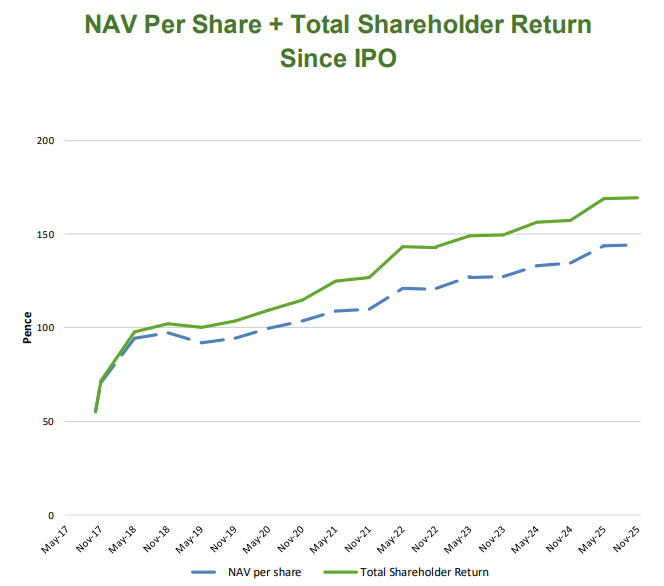
If the company can maintain this record of NAV accretion, then I think the shares could re-rate significantly if profits start to rise again.
What The Brokers Say
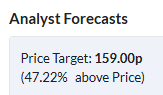
Three brokers covering Springfield have an average rating of Strong Buy and a price target that’s nearly 50% above the current share price:
However, it’s worth noting earnings forecasts have trended lower over the last year:
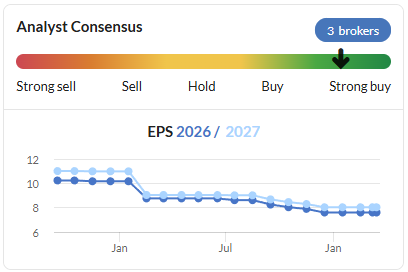
While a negative trend like this is never ideal, I think this is less worrying than it might seem:
The big drop in February 2025 was prompted by the £64m land sale to Barratt Redrow I mentioned above. There were further trickledown effects during the year as Springfield continued its pivot to the North of Scotland.
2026 is expected to mark a low point for earnings as profitability begins to improve. The altered economics of leasing properties (rather than transferring ownership) is also expected to contribute to enhanced margins from 2027 onwards.
The Bear Case
Here are some of the concerns I would consider in detail before deciding whether to invest:
Falling profits: profits are expected to bottom out during the current year (y/e 31 May) and then return to growth. But the company’s strategic pivot and more difficult market conditions could mean that visibility on future earnings is lower than usual. It’s worth noting that current guidance was issued on 17 February, before the start of the Iran war.
Move to leasing brings risk as well as opportunity: Springfield will presumably have good visibility on the rental income it expects from SSEN for the workers’ housing it hopes to build. But after the initial four-year leasing period the company will have to re-let or sell these homes. I can see some risk in terms of valuation and demand, depending on location and market conditions at that time – factors that are hard to predict today.
Political risk: a strategy based on long-term investment in green energy is inherently dependent on supportive government policy. A change of government in 2028/29 could alter the outlook just as Springfield is too heavily committed to easily change direction.
The Bottom Line
I believe Springfield Properties is a well-run homebuilder with an attractive regional focus and a proven culture of long-term management and value creation. Family ownership suggests to me that this is likely to remain true.
Springfield’s strategic pivot to focus on supporting the UK’s drive for decarbonisation and energy security provides genuine differentiation versus listed peers. I think it could generate attractive returns on a medium-term view.
Although this strategy inevitably carries some political and execution risk, I think Springfield’s robust finances and attractive landbank should support reasonable long-term returns in most likely scenarios.
The shares are currently trading around 25% below book value. My research suggests that’s unusually cheap, historically. I think this could be an interesting opportunity for a new investment in the housing sector.
Disclosure: At the time of publication, Roland has no position in Springfield Properties.
Disclaimer
This is not financial advice. Our content is intended to be used and must be used for information and education purposes only. Please read our disclaimer and terms and conditions to understand our obligations.

5 comments
Fwiw, the following dropped into my inbox this last week....
https://tinyurl.com/4ka8ed9n
UK HOMEBUILDERS LOOK CHEAP AFTER WAR-DRIVEN SELLOFF - MORNINGSTAR
Hard hit British homebuilder stocks have caught the attention of Morningstar analysts, with some looking "deeply discounted" after the Iran war upended the macroecomonic outlook.
The real world impact of inflation fears and dashed rate cut hopes is clear in the data. UK house prices slid last month as buyers face rising mortgage rates.
An index of FTSE 350 homebuilder stocks .FTNMX402020 has shed 28% since the end of February after a strong start to the year, a considerable underperformance versus the FTSE 350 .FTLC which is down by 3.6% since then.
But in the event interest rates do end up falling and house prices stabilise, Morningstar says there are some compelling opportunities for stockpickers.
They highlight Bellway BWY.L and Barratt Redrow BTRW.L - down a respective 29% and 32% this year - as "undervalued stocks to buy". Morningstar also throws Persimmon PSN.L, Taylor Wimpey TW.L and Berkeley Group BKGH.L into the mix.
Morningstar economist Grant Slade still expects inflation to drop to 2.2% by the end of the year and the BoE to deliver one rate cut.
"To justify the current valuations, we would need to see resurgent inflation to 2022 levels and rates rising materially from here, which is not our base case," he said.
Earlier this month, Berkeley warned of a slowdown in profit growth and a halt to land purchases, and last month Bellway trimmed its profit margin outlook.
Persimmon bucked the trend with a strong 2026 outlook earlier in March, and the stock is Morningstar's top pick - having rallied to its "fair value" level before the war and now trading at a 50% discount, say the analysts.
Looking at the UK housebuilders by StockRank....
And then by Price to Book....
For anyone considering a buy it is worth viewing the presentation of the recent results by the CEO and CFO on Equity Development iirc in February. It was the best I can remember seeing in years.
Starter position tomorrow.
Thanks Roland and I agree there is plenty of opportunity for Springfield. One aspect I would like more clarity before investing. Can you give info on how the deal with SSE is structured. You mention that after 4 years Springfield would have to sell or rent out properties - which may not be difficult but what are the financials driving this ?
Hi bohenie,
Thanks for your comment. You can read the full details announced so far on the SSE deal here (17 Dec 25) - this is describes as an initial agreement, so I there is still a lot more detail to be fleshed out:
https://www.stockopedia.com/sh...
The key points seem to be:
Under the initial agreement, the Group will provide the enabling works to prepare selected sites for the main construction and will receive payment from SSEN Transmission to fund these site-opening costs. It is intended that the parties will, in the near term, then enter a further agreement for the build and lease of the housing. It is expected that homes will be delivered by Springfield on a phased basis over the next three years and will be leased for an initial four-year period.
As far as I can see there is still plenty of uncertainty about the post-lease period - this is one of the risks in my view, given the difficulty of predicting housing market conditions in perhaps seven years.
Roland