Stock in Focus: Drax Group

Electricity generator Drax’s decision to convert half of its generators from coal to biomass appears to have been well timed.
The pressure on coal-fired generators to reduce emissions through costly modernisation or emission capture schemes is rising.
 Utility peer SSE recently decided to close Ferrybridge, one of its two remaining coal-fired stations, for these reasons. So Drax’s move to biomass, at a cost to shareholders of some £700m in capital expenditure, appears to make sense. The firm has some big institutional backers, too. Amongst them are Schroders, which recently doubled its stake from 5% to 10%, and noted fund manager Neil Woodford.
It hasn’t been a trouble-free process, though, partly thanks to the government’s apparently confused and short-term thinking on energy.
Drax shares have fallen by 50% since March 2014, and lost 10% in one day in December last year, when the government hinted that subsidies available for biomass conversions might be changed.
Drax shares are now trading close to their all-time lows.

Is now a good time for contrarian value investors to buy, or is this a business in decline?
The story so far
Drax generates about 8% of the UK’s electricity. In 2014, the firm reported revenue of £2.8bn and gross profit of £450m. With a market capitalisation of £1.5bn, it’s a pretty substantial business.
The company has changed in recent years. Originally owned by the Central Electricity Generating Board, it was the last coal-fired power station to be built in the UK when its final units were completed in 1986. Although privatised in 1990, Drax has only been listed on the London Stock Exchange since 2005.
In 2012, Drax announced plans to convert three of its six generating units from coal to biomass. Two of the three have now been completed, while the third is now underway and expected to begin producing electricity later this year.
Is Drax good value?
Drax’s relatively modest StockRank of 63 belies a ValueRank of 91 and a QV Rank of 88, the highest in the utility sector.
Drax has been on my radar as a potential investment for some time, but I’ve remained undecided.
However, the shares have fallen by another 10% over the last month and the firm qualified for the John Templeton Bargain Screen in February. This screen has delivered a gain of 32.9% over the last two years, compared to just 7.8% for the FTSE 100. Now seems a good time to take a fresh look.
The reasons for Drax’s high Value Rank are quite clear. The firm trades just below book value on a historic P/E of 11. A price-to-sales ratio of 0.55 looks undemanding, while Drax’s EV/EBITDA ratio of 7.7 is also quite attractive.
The firm’s prospective yield isn’t so appealing. A yield of 2.1% is expected this year, rising to 2.7% next year. Drax has cut its dividend several times over the last few years. The payout has fallen from a 2010 peak of 32p per share to a forecast of just 7.9p per share in 2015.
The reason for this is that Drax’s profits have failed to keep pace with its sales growth. While revenue has risen at a compound average rate of 13.7% per year since 2009, operating profit has only grown by an average of 2.3% per year. This has pushed the firm’s operating margin down from 11.7% in 2009 to just 6.9% in 2014.

One possible reason for this is that 40%, or £1.1bn, of the firm’s sales now come from Haven Power, Drax’s retail business. Haven sells energy to retail customers but appears to make no money: gross profit was just £16.7m on turnover of £1.1bn last year.
Drax says that the benefit of this operation is that it can sell more of its electricity into the retail market, rather than the wholesale market. Perhaps, but without an in-depth understanding of how the electricity market works, it’s not clear to me how much value this adds to the firm as an investment.
Quality = mixed
Given the concerns I’ve raised above, the question has to be whether the quality of Drax’s business is deteriorating.
Drax’s QualityRank of 62 indicates a mixed picture. A long-term average return on capital employed of 12.9% suggests that the business has generated reasonable returns above its cost of capital in the past. Drax’s five-year average net profit margin of 10.6% is also encouraging.
Where Drax looks weaker is that most of these metrics have worsened over the last year.
These risks are flagged up by a Beneish M-Score of -1.46, which highlights rising costs, increasing leverage and a declining gross margin on sales.
Looking at Drax’s 2014 income statement to see what lies behind these red flags, it’s clear that the firm’s costs did rise significantly last year. This pushed the firm’s gross profit margin down from 21% to just 16%:
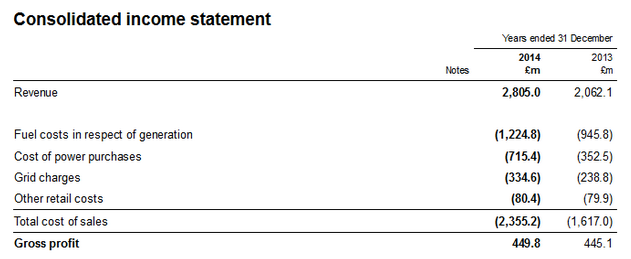
This cost burden has a lot of moving parts, but my reading of the commentary in last year’s results is that the total cost of sales is unlikely to fall in the near term.
Offsetting this to some extent is the fact that Drax is now at the tail-end of its £700m biomass conversion programme. Capex is expected to fall from £201m to £150m in 2015. This reduction should help support a gradual rise in profitability, assuming other costs remain broadly in-line with current levels.
Lacking momentum
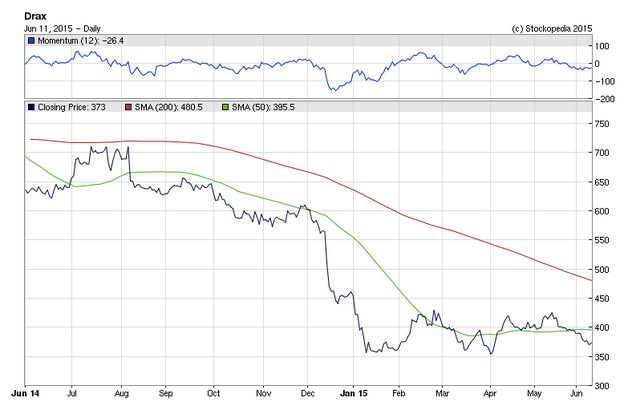
As a prospective investment, Drax’s biggest weakness appears to be its lack of momentum, which is reflected in a MomentumRank of 25. The firm’s share price has failed to find any direction this year and is 50% below its 52-week high.
Although the chart suggests support around the 350p level, momentum is negative and has been generally worsening since April.
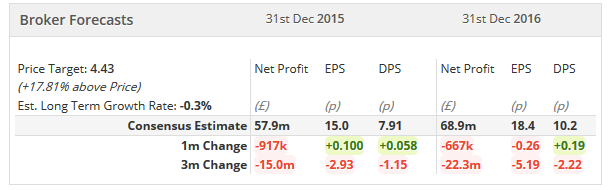
Earnings momentum is poor. Forecast earnings per share for 2015 have been cut by 16% over the last three months, although the decline appears to have been arrested over the last month.
My view
Drax’s high QV (Quality-Value) Rank puts it statistically amidst the group of ‘good, cheap stocks’ that have outperformed the wider market historically. Often these kinds of shares have poor momentum which makes them appeal only to contrarian investors willing to act against the herd.
I believe that profits are probably at a low point, and are likely to rise gradually from 2016. However, the political risks facing Drax seem considerable, and at the end of this year, three of Drax’s six generating units will still burn coal.
I’d really like to hear your views. Whether you’re a bull or a bear on Drax, please feel free to leave a comment below.
Disclaimer
This is not financial advice. Our content is intended to be used and must be used for information and education purposes only. Please read our disclaimer and terms and conditions to understand our obligations.

25 comments
Hello,
DRAX has fallen in the stock ranks, is this a sign to cut losses and invest some place else?
I take it some bad news in the budget today?
@Herbie,
"Yes you are right about population growth but its not just that its the change in diet and lifestyle in countries like China and India"
Agreed - change in diet /lifestyle amongst the upcoming/newly arrived nations is indeed causing significant impact.But what to do? It doesnt help that such countries also happen to be the most populous
"We need more storage as well, I know there are new batteries coming out. There is too much waste in the west. Look at food about 1/3 of it is thrown away."
Absolutely - we also need Desalination plants - there is no way and Island surrounded by water should ever have droughts/water shortages and hose pipe bans. Think of the investment, the jobs created, and being water security assured.Costly - but then if we slashed the foreign aid and spent it on British taxpayers we could have both desalination and improve those storage facilities you mention prior. Far too sensible though - lets just keep subsidising the Ferraris, Rolexes and private jets of all those tinpot African dictators.
Fangorn, herbie47,
Great debate, thanks for expanding on the uncertainty about the sustainability and impact of biomass, this wasn't material I could fit in the article!
What seems fairly likely to me is that biomass usage can only expand up to a certain point, beyond which it will have such undesirable side effects in terms of environmental damage or rising supply costs that it becomes self-defeating.
I've no idea where this will end, but I am reminded of this Bill Gates quote:
"We always overestimate the change that will occur in the next two years and underestimate the change that will occur in the next 10. Don't let yourself be lulled into inaction."
Drax was right to do something to move away from coal, and given the nature of its assets and the commercial framework in which it operates, biomass did make sense and was arguably quite bold. I'm less sure about how it will seem in 10 years' time, though.
Cheers, Roland
Ok, so in addition to sawdust, and other offcucts being used for pellets, it seems,from your linked article
" While many of the trunks went for lumber, the limbs and the smaller trees were loaded on trucks headed to a mill 30 miles away, to be ground up, compressed into pellets and put on ships to Europe. "
Limbs and smaller trees are included. So not the trunks of main trees going elsewhere....ie not for pellets, not for Drax, forests arent being cut down for DRAX - they are using the offcuts and whatever would have been left over anywhere!
""Now that Europe is using all these pellets, we can barely keep up.""
However this would seem to indicate to the contrary as the US logging firms are experiencing bumper business where before they apparently were not..
""We only take the low-value material from the forest," said Nigel Burdett, the environment chief for Drax PLC, a U.K" Many of the pellet-making plants springing up in the U.S.—which include plants planned by Drax and other European power companies—are near pine plantations established long ago partly to serve the now-slumping wood-pulp market
So that's another company person claiming they use the low grade stuff that would be available regardless due to commercial logging activities.
""Young trees absorb more carbon than older trees," said John Keppler, chief executive of the U.S.'s biggest wood-pellet exporter, "
Is this claim true?
Who to believe.
The solution though is clear - less people on the planet. For that to occur some hard realities need to be faced.That , or a good long war.
The problem is worldwide trees are being cut down, look at the Amazon and Borneo. Is it cheaper than coal? Where does coal come from? Trees? So if you burn coal and don't cut down trees for biomass what is the saving on co2? Lets say if China converts all its coal to biomass where will all the trees come from? Drax is just one small power plant yet it needs something like the area the size of Lincolnshire each year in forest. Not sure about the pollution figures, most of that is based on the trees absorbing the co2 but they will for coal? One answer is to stop cutting down all the trees in the Amazon and Borneo.
"One answer is to stop cutting down all the trees in the Amazon and Borneo."
I didn't realise the trees in Amazon and Borneo were being felled to supply Drax's Biomass units? Wasn't the wood coming from US?
Amazon & Borneo surely another issue entirely - namely one of "People!" Too many people requiring food, water,housing, cars, a job, power for their computers,gas for the oven etc etc.
If we take Drax's contribution out of the equation what are you going to substitute it with?
natural gas? Nuclear? Wind/Solar?
No I did not mean that trees from Amazon were supplying Drax, this is a worldwide problem, this is what it is about not just Drax, UK, Europe its the whole world and that is the problem. Yes you are right about population growth but its not just that its the change in diet and lifestyle in countries like China and India.
Some argue that Drax should have been replaced with gas. I think we should have more waste incinerators. No more landfill, very little emissions and power. One council even sends its waste to Sweden I believe at some cost. to be incinerated. Problem with solar is its mostly around midday, I have heard the national grid can't cope in some parts of the country. We need more storage as well, I know there are new batteries coming out. There is too much waste in the west. Look at food about 1/3 of it is thrown away.
So if you burn coal and don't cut down trees for biomass what is the saving on co2? -
surely if you cut down trees use the bulk of the tree as wood, and burn the offcuts and waste, this returns a proportion of the carbon to the atmosphere, say 50% as long as the trees are farmed and replaced each time only half the carbon is released into the atmosphere, effectively reducing co2 in the atmosphere. Trees consume more co2 while growing faster, so as long as the logging is sustainable then surely it makes sense ?
In theory yes but according to some reports biomass produes 2x the CO2 that coal does, that is not including the conversion into pellets. Also much of this wood would have been used in making products such as chipboard, plywood and mdf, apparently prices of these are increasing. Here is a report: https://notalotofpeopleknowthat.wordpress.com/2015/02/26/biomass-emits-double-the-co2-of-gas/
Quite a few other reports say biomass is more polluting than coal: http://www.pfpi.net/trees-trash-and-toxics-how-bio...
"In theory yes but according to some reports biomass produces 2x the CO2 that coal does, that is not including the conversion into pellets. Also much of this wood would have been used in making products such as chipboard, plywood and mdf, apparently prices of these are increasing. Here is a report: https://notalotofpeopleknowthat.wordpress.com/2015/02/26/biomass-emits-double-the-co2-of-gas/"
Actually, that report said "So, on a straight comparison, we get:
CO2 kg/MWh
Coal 1018
Gas 437
Bio 920
While bio is slightly better than coal, it is emitting more than double the CO2 of gas. None of these figures account for the emissions involved in processing or transporting wood pellets. Equally of course, they don’t include these for fossil fuels, although it seems reasonable that the add on emissions for gas would not be as great."
The main reason why the CO2 emissions from gas are about half those from biomass and coal is because Combined Cycle Gas Turbine power stations (which burn gas) are about twice as efficient as conventional power stations (which burn coal, oil or biomass) in converting the thermal energy in their fuel into electricity.
Yes sorry I misread that.
Herbie,
I read the Guardian article - Any veracity to their claim?
"Huge logging operations are devastating the Carolina swamp forests, which are among the world's most biodiverse temperate forests and home to the only wild population of Venus fly traps and other carnivorous plants. The forests are being cut down to make wood pellets, some of which are shipped to the UK to feed the Drax electrical generation facility......Even when they make statements to the effect that "we only burn forest wastes and residues", which critics allege is not the case,"
As in, any substance to the claim the trees are specifically being cut down to turn into pellets?
Why would Pauline therefore lie when she claims if the Guardian link comments truthfully.
" but Pauline insists forests are not being felled to burn at Drax. Instead the station uses by-products of the construction and paper industry."
Such a lie can be easily substantiated surely?
Have to say I'm sceptical when reading anything environmentally focused especially, in the BBC or Guardian, given their erroneous reporting of the Virunga Nature reserve Oil drilling by Soco.All utter tosh.
So I did a search on the author
Charles Eisenstein
Author
Charles Eisenstein is a progressive author and public speaker, and self-described "degrowth activist". He is the author of several books including The Ascent of Humanity, Sacred Economics, and The More Beautiful World Our Hearts Know Is Possible
So an out an out Eco warrior clearly. Hardly likely to be the bastion of truth frankly.
"Also there is the energy and pollution in producing the pellets, then transporting them them to the coast and then shipping them to the UK. Drax may use some by-products but it is certainly importing a lot from USA
Don't dispute most of that...the big question is taking these pellets, shipping them from US to UK, then using them in the Biomass plant cheaper and less pollutive than Coal.
"Drax says it uses wood from thinnings and off-cuts, and that this reduces emissions by 80 per cent compared to burning coal."
http://www.carbonbrief.org/blog/2014/10/is-burning-wood-for-energy-worse-for-the-climate-than-coal/
Ultimately all this green taxation is an utter farce. It wont solv the Eco issue(assuming the global warming, erm climate change is man made)
A far simpler solution exists - one that revolves around the population of the earth.
here is an american article:http://www.wsj.com/articles/SB10001424127887324082604578485491298208114
herbie,
"I have read Drax will need vast amounts of wood more than all the trees in the UK. Many trees that are cut down will take many years to be replaced upto 100 years, some of these are not just pine trees grown for that purpose but ancient woodlands in the USA"
Arent they using the sawdust from woods that were going to be cut down anyway?So its hardly a case of THEM, Drax, cutting down many trees. Better surely if they're using the byproducts(eg sawdust) of felling that was going to occur anyway???
" but Pauline insists forests are not being felled to burn at Drax. Instead the station uses by-products of the construction and paper industry. "
http://www.yorkpress.co.uk/features/features/12976602.Behind_the_scenes_at_Drax/
And there's also this advantage as well apparently - "Biomass allows the power station to increase or reduce output in an instant. Something wind, gas and nuclear plants can’t do."
Great article - thanks for the thought and time put into it Roland.
If you read the 2 links about this above you will see this does not seem to be the case. One area in the USA seems to use 60% of the trees in pellets, hardly just sawdust. Also there is the energy and pollution in producing the pellets, then transporting them them to the coast and then shipping them to the UK. Drax may use some by-products but it is certainly importing a lot from USA. Can you not turn down the gas in a gas powered station?
Here's another article discussing the environmental issues of burning biomass:
http://www.carbonbrief.org/blog/2014/10/is-burning-wood-for-energy-worse-for-the-climate-than-coal/
The problem with Drax is it relies on Govt. subsidies, are these sustainable? The other problem seems to be Drax is importing pellets from the USA so its maybe not that green and future costs? Also I have read it emits more CO2 than coal, which is very cheap at the moment. Thinking about it I'm not sure about this at all, cutting down millions of trees to burn does not make that much sense to me.
Herbie47,
I certainly agree that importing biomass fuel from the US is not intuitively eco-friendly. Haven't read about the relative CO2 emissions but I can imagine the transport adds a nasty hit -- albeit not in the UK. This might be relevent from Drax's perspective.
The risk of subsidy dependence is definitely a risk, as we saw in December last year -- https://woodfordfunds.com/hitting-decc/
It all highlights the UK's need for a committed, coherent long-term energy policy...
Cheers, Roland
I have read Drax will need vast amounts of wood more than all the trees in the UK. Many trees that are cut down will take many years to be replaced upto 100 years, some of these are not just pine trees grown for that purpose but ancient woodlands in the USA. I will attach a link about it: http://www.theguardian.com/sustainable-business/blog/campaign-drax-biofuels-effects-replacing-fossil-fuels
Hi, Thanks for posting this article. I'm a shareholder in Drax at around the current low price. I bought in for the turnaround situation and because Neil Woodford, Richard Buxton and Schroders (is it Andy Brough??) have been buying around the current price. I rate these managers very highly. Did you read this article from Woodford Funds: https://woodfordfunds.com/good-politics-bad-economics/
Cheers.
Hi bsharman,
Thanks for your comment. I have read the Woodford article, which highlights some of the political risk facing UK utility investors, as does this piece: https://woodfordfunds.com/hitting-decc/
It's interesting that Neil Woodford and the Stockopedia StockRanks have a broadly similar view of Drax as offering good value in the medium term.
If we do end up seeing a shortage of electricity generation capacity, as Mr Woodford suggests might happen, Drax could end up benefiting from the UK's lack of long-term energy planning by virtue of its availability.
Cheers, Roland
An interesting article. I have held Drax for a long time and am sitting on a 50% loss.
Whilst Drax produces something essential to modern life it is a hostage to the cost of fuel and the market price of electricity over which it has little control.
It can only minimise its own generating costs
Hi brucepackard,
Drax's ValueRank is so high because the metrics used to calculate ValueRank are mostly based on historic accounts, such as the historic P/E ratio. These provide a less demanding valuation. For example, 2014 P/E is 11.
You can see a full explanation here: http://help.stockopedia.com/knowledgebase/articles/182732
This is a fairly traditional approach to value investing and has considerable value, as it provides a picture of the investment based on proven performance, rather than forecasts. However, when a business is undergoing a fundamental change, as Drax is, then using historic figures only may sometimes be misleading.
Drax looks fairly cheap on the basis of its historical performance. The question for investors is whether it will be able to return to historic levels of profitability. The low MomentumRank suggests that might not happen very soon, but high value and quality scores suggest it is statistically likely.
DYOR as always...
Roland
Hi, if Drax consensus eps is 15p this year, rising to 18.4p next year that puts the stock on more c. 22x earnings. Indeed Stockopedia says fwd P/E is 22.8. Why does Drax have such a high value rating on the stock ranks? ValueRank of 91.
Thought provoking piece - but buying Drax as a "dull utility" might seem a good idea. But dps yield not at all attractive. And 15 years ago buying it to protect against internet bubble valuations did not work. Didn't Drax go bust in 2001-2 ? I seem to remember when I was a banks analyst we were asking UK banks about their credit exposure to it.