Stock in Focus: Will Persimmon climb further in 2016?

I’ve tried hard to steer away from housing stocks over the last six months, I really have!I believe it’s probably too late in the housing cycle to make worthwhile profits from these stocks.But the listed housing sector has continued to perform well. In most cases, profits, free cash flow and shareholder returns are all rising.
The housing sector also provides Stockopedia with some of its highest-ranked stocks. Top of them all is Persimmon, which boasts a StockRank of 99 and qualifies for no fewer than eleven long Guru Screens. That’s more than any other UK stock:

Persimmon’s net profit rose by 40% last year. The group’s shares are up by 5% so far in 2016. That’s impressive given that shares in peers such as Berkeley Group, Barratt Developments and Bellway have all fallen by 5-10%.
I think it’s worth taking a closer look at Persimmon. Why is this firm performing and ranking so strongly?
Political risk
The housing market is a British obsession. No other country in Europe has such high levels of home ownership. As a result, the government has introduced policies which have had a distorting effect on the housing market.
 Help to Buy is a good example. Last year, 42% of Persimmon’s 14,572 sales were to buyers who had taken advantage of this loan guarantee scheme. That’s staggering, in my view. It’s probably fair to say that without Help to Buy, house prices and transaction numbers would both be lower.
This introduces a level of political risk to owning Persimmon and other housebuilders. Help to Buy may one day be withdrawn. I don’t think this is likely to happen very soon, however. The consequences could be quite dramatic. I’m not sure any government will be in a rush to find out how the market would react.
Is Persimmon still cheap?
After rising by 371% in five years, you wouldn’t expect Persimmon shares to be cheap.
At first glance, they’re not. A trailing P/E rating of 12.6 may seem modest, but valuing cyclical stocks against earnings can be misleading. Persimmon’s earnings per share rose by 35% in 2015 and by 46% in 2013. Valued on 2013 earnings per share, Persimmon stock has a P/E of 25!
I prefer to take a more conservative approach. I focus on yield and book value when investing in property stocks. Persimmon scores highly for income, with a trailing yield of 5.2%. However, the stock’s price/book ratio of 2.6 seems pretty rich to me.
All that housebuilders do is buy plots of land, build houses on them, and resell them. Persimmon’s P/B of 2.6 suggests that the market expects the firm to be able to increase the value of its land bank and inventories by 160% when they’re sold.
As it turns out, this isn’t the whole story. Persimmon has also committed to return £2.67bn (900p per share) to shareholders by 2021. Stripping this 900p out of Persimmon’s valuation gives a share price of 1,230p, or around 1.5 times book value. This seems about right for a major housebuilder in a strong housing market.
So far, £733m has been returned to shareholders. The remainder is expected to be returned through annual payments of 110p each year until 2021.
A quality team
Persimmon’s interests have been served well by a general lack of wage inflation, cheap mortgages and government subsidies for house buyers. Management seem to have run the company well in order to maximise shareholder returns.
This is reflected in a QualityRank of 95. Persimmon’s operating margin has doubled in five years, rising from 10.5% in 2011 to 21.6% last year. Over the same period, free cash flow has risen from 38.9p per share to 154.1p per share. This has made the firm’s generous capital return programme affordable.
All of these factors contribute to Persimmon’s high fundamental quality and a Piotroski F-Score of 7:
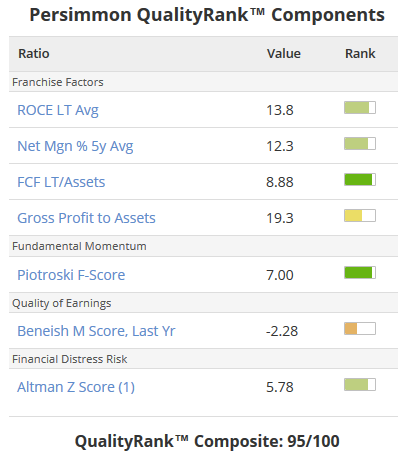
It’s worth highlighting the FCF LT/Assets score. This represents long-term free cash flow versus asset value. What this ratio shows is that Persimmon has generated free cash flow equivalent to 8.88 times the value of its assets over the last five years.
This compares very well to Persimmon’s peer group:
| Company | FCF LT/Assets |
| Redrow | -2.3 |
| Bovis Homes | 0.42 |
| Bellway | 1.46 |
| Taylor Wimpey | 3.38 |
| Barratt Developments | 3.64 |
| Berkeley Group | 3.94 |
| Persimmon | 8.88 |
I’m already warming to Persimmon. Clearly the firm’s management know how to generate cash from their assets. The firm is also disciplined about returning cash to shareholders.
All I would say by way of caution is that the current environment cannot last forever. At some point, rising costs or falling house prices will start to put pressure on margins. Cycles being what they are, these two headwinds may make an appearance at the same time.
Despite this, Persimmon has strong momentum. Now may not be the time to sell.
Is momentum enough?
Momentum isn’t just technical share price action. It’s a combination of price action and earnings forecasts.
This may sound like a fragile and uncertain basis for an investment. In reality, these factors do have a significant impact on medium-term performance. One reason for this is that while consensus forecasts are not perfect, they are a significant guide to likely future performance.
One of the weaknesses of earnings forecast is that they tend to lag reality. When a stock is doing badly, earnings forecasts often suffer from a death by a thousand cuts. Analysts are initially reluctant to make sweeping changes to their cherished forecasts.
When times are good, this lag effect often works in our favour. Forecasts are gradually increased over a period of months, all the while supporting a rising share price. That’s where we seem to be with Persimmon, which has a MomentumRank of 98:
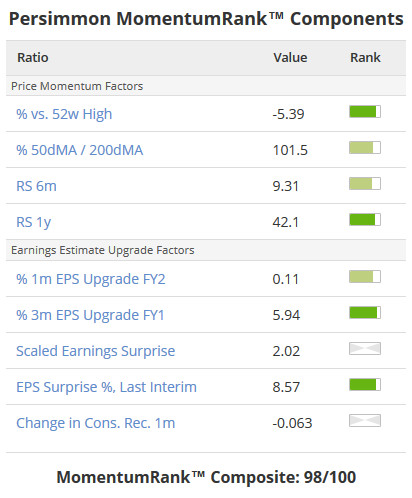
This is a very positive picture. Earnings were ahead of consensus at the last results, after which this year’s forecasts were increased. Earnings growth of around 10% is expected this year.
These changes and the planned increase in capital returns seem to be helping Persimmon shares to establish a new uptrend:
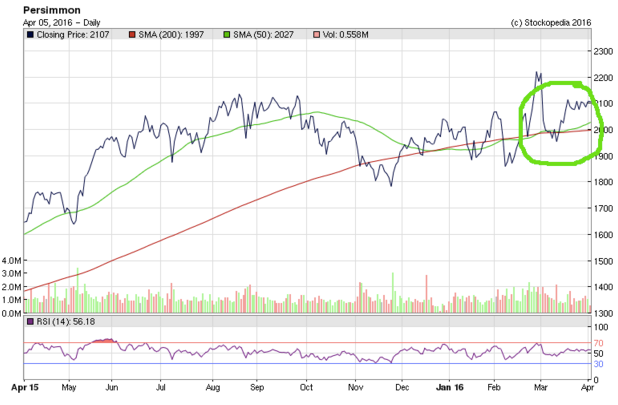
My view is that Persimmon is priced about right, but I suspect this stock could deliver further gains.
What’s your view? Did you buy into the housing recovery early. Are you happy to take profits now, or will you wait until things start to head south before selling?
As always, please DYOR and leave a comment below to let me know what you think.
Disclaimer
This is not financial advice. Our content is intended to be used and must be used for information and education purposes only. Please read our disclaimer and terms and conditions to understand our obligations.

15 comments
The upward trend has well reversed now, shares are down 6% today following falls before as well. In fact they are beginning to look interesting but think I will wait a bit longer.
Good job these prices will be supported by the forthcoming rise in the national minimum wage. That should provide a floor price
In my view there are many factors that no longer support house price growth in the South East.
The upward drive on prices in London and the South East has been from a wave of events outside the UK. Firstly the uprising in the Middle East saw the first lot of money flooding into property followed by Russians and Chinese investors. France's socialists high tax saw London beeing dubbed the fifth biggest French City. These outside factors seem to be drying up. In 2015 Guardian published an article that thousands of off plan flats in London would flood the market in 2016, the reason; foreign investors can no longer afford the full price due to economic conditions in their countries making it too expensive.
Recently an article by in Bloomberg that developers are offering a 20% bulk buyers discount support the fact that the demand and affordability is having a dramatic impact.
Pile all this this on top of Stamp Duty changes for trust or offshore owned properties, changes to buy to let , more properties available, inevitable interest rise and potentially more pressure from the offshore fallout to make ownership more transparent will make London a worse proposition for many overseas investors looking for a safe place to stash their cash.
I think the only factor that would trigger an all out crash is dramatic rise in interest rates which seem unlikely.
I think with all this uncertainty I would probably look at some other sectors.
Hi Vegan.
Not necessarily disagreeing with you but this morning's Telford Homes (LON:TEF) earnings update and commentary is worth a read.
http://www.investegate.co.uk/telford-homes-plc--tef-/rns/trading-update/201604130700069908U/
Given they specialise in selling affordable homes (if £600,000 for an appartment counts as such) in non-central prestige London, this is quite a good reference point for the current state of the market. Note the large proportion of Chinese and HK sales already booked up to three years ahead.
London property is a bit like that old fairground game "whack-a-mouse". If outside pressures appear to squash down on one sector of the market, demand often springs up somewhere else. It may be that given the general macro benefits of living in and around London (stable govt, good, well paid jobs, adequate infrastructure, extensive ex-pat communities already established etc) foreign buyers are avoiding the high end expensive prestige areas but still looking for a foothold close by.
Food for thought.
Gus.
The Telford Homes RNS makes for interesting reading, however I'd be looking at what the Government and the Bank of England are doing in concert.
The Government through Clause 24 of the Finance Bill, 3% stamp duty and reducing Capital Gains Taxes for everybody except property "investors" have shown that they want to stamp out highly leveraged property investment.
The Bank of England, through the just published Prudential Regulation Authority proposals and it's membership of the Basel III committee, has shown that it too wants to stamp out highly leveraged property investment.
Buy to Let loans can still be interest only. They don't have to take into account the borrower's income, only potential rents. Indeed if you read the PRA proposals it seems clear that banks currently don't really need to consider whether current loans will still be affordable as Government changes come in. As BTL demand drops away it will be potential owner occupiers who need to take up the slack. But they are constrained by MMR, so it seems inevitable that prices would fall.
Of course one should always consider that you may be wrong. What happens if BTL demand remains high? Well we've got a Government who are running a large budget deficit. If the current changes (the vast majority of which are still to occur) are not sufficient then the Government would be perfectly happy to raise taxes a bit more, until they did bring BTL demand down.
I did read that the was some doubt whether all the Chinese will be able to buy those properties with the problems in the Chinese stockmarket and slowdown there.
"Persimmon (LON:PSN) is also up by 1,000% since 1999, according to Google Finance." - yep the stockopeadia chart has it closing 1999 at 200p and its something over 2,000p now, plus dividends. If only I'd spent less of 1999 in the pub and bought some shares instead. Would be interested to know how the average buy to let investment compares over the same period, net of costs ...
About half the houses Persimmon build are in what it defines as the North of the country. I reckon that, in my part of Shropshire, real house price inflation has averaged 2.5% over 20 years whereas I calculate average wages inflation over a similar period at around 3.5%. That suggests that house prices have, if anything, become more affordable for not insignificant pockets of the population.
However, the real issue for those of us who remain largely invested in the market through thick and thin is whether, in the current climate, there are better alternatives that having some money in house builders?
My view (and I should at this point admit that I have an uncanny knack of snatching defeat from the jaws of victory) is that house builders might still produce some earnings surprises and whilst the market is likely heading sideways and down then some decent dividends and the odd earnings surprise will probably be helpful to the overall performance of my portfolio. The trick is going to be recognising when the inflection point occurs.
it's on that issue that I don't think the party is over yet.
You could always dilute the pure housing market risk by going for Galliford Try (LON:GFRD), they are a hybrid Housebuilder - Contractor http://www.gallifordtry.co.uk/investors/investors-overview/our-business-model-and-strategy
They have a particular focus on affordable homes and to my mind are much more defensive than a pure play Housebuilder. Yield is c. 6% and they have no net debt. I'm talking my book here as this is my largest holding.
Good article BTW
Prices tend to ripple outwards from London so while price growth can moderate in London while accelerating outside it would be unusual to get an acceleration outside London following an actual fall in London prices. that said the market is so distorted now by government action not just on help to buy etc but also on stamp duty land tax it is harder than ever to predict, and prices can flatten off or stagnate in London without actual falls.
If you look at long term share prices of listed housebuilders and REITs past crashes often look like small glitches compared to the hike upwards in each following boom, on which basis if you drip fed money in on a long term buy and hold basis its arguable you'd make money regardless (particularly with dividends taken into account), whereas trying to time the market means (a) you probably get it wrong and (b) even if you buy in the next crash you might not buy cheaper than current prices.
Must admit I've not had the courage to buy in at this point in the cycle for fear the whole thing is about to tank, but with a nagging suspicion I may be falling prey to my own behavioural defects and will regret it when they all double again. Hey ho!
Hot Socks,
You may be right. Persimmon shares are up 54% plus dividend over the last 10 years, even with the 2007/8 crash! Persimmon (LON:PSN) is also up by 1,000% since 1999, according to Google Finance.
Like you though, I'm unable to bring myself to buy into housebuilders now, even though they could continue to rise.
Regards,
Roland
From where I am sitting I have to ask: "What recovery?" According to my local paper, house prices in Shropshire are 4.4% lower now than they were in 2008. I also own a second home in another part of the country and I am struggling to see any housing recovery there as well. According to a housing information site I've just looked at the price of my house has fallen 15% in the past 12 months and average sales times are 304 days.
I am still therefore invested in house builders as I am not sure the party will be over until the house price recovery is a little more evenly spread.
Andrew,
Thanks for your comment. I agree that the housing recovery has not been evenly spread, but I'm not sure this is a realistic expectation.
Socio-economic conditions outside the south east just don't seem to support this. Too many people cannot afford to buy, and the buy to let market is also now coming under pressure following this month's rule changes. Unfortunately this divide seems to be widening. The latest Nationwide House Price Index comments on this specifically:
http://www.nationwide.co.uk/~/media/MainSite/documents/about/house-price-index/2016/Mar_Q1_2016.pdf
I also don't think that comparing current prices to the peak of an earlier bubble is a good indicator of recovery. If we applied that logic to stocks, many firms' share prices could be said not to have recovered from earlier crashes (in 2000/1 and 2008/9), when of course they have. It's just that they were hugely overpriced at previous peaks. House prices are still pretty expensive now, relative to income.
My view is that the housing recovery has probably completed and that we are now in a new market, being shaped by other factors. I'm not sure where it will end.
But I do agree with you that housebuilders may yet deliver further gains for their shareholders!
And of course I may be wrong about all of this... it takes two sides to make a market, after all.
Regards,
Roland
Houses are expensive now because of low interest rates, if mortgage rates were 7% over the last 10 years I would expect prices would be much lower now. Where will it all end, who knows, but I think there will be a global recession, started by China, how bad that will be no one knows. In the short term I expect builders shares to go down if the leave EU vote is getting close, after we decide to stay in I expect a bounce back, similar to last years election. House prices are usually governed by London, so if they go up then it spreads to the rest of the country, some more remote areas like Shropshire and Lincolnshire are probably the last to react. Looks like London prices have peaked as foreign buyers have vanished. Berkeley Group (LON:BKG) shares are down 5% today.
Herbie,
Not surprised that Berkeley Group (LON:BKG) is down today, based on this article. Berkeley is a player in this market:
http://www.bloomberg.com/news/articles/2016-04-07/london-luxury-apartment-sales-slump-triggers-20-bulk-discounts
This has been coming for a while now, but as Hot Socks says in the next comment, the UK market is so distorted that it's hard to say whether this will have any impact outside London. These flats weren't really being built as homes, more as investments...
Regards, Roland