The Stockopedia Investment Club +82% outperformance YTD

At the beginning of the year we took on a new initiative at Stockopedia HQ. We started an Investment Club for the team. I had a few goals as Chairman of the Club, but the main one was to find a way for the team to kindle a lifelong interest in stock markets and investing... and hopefully profit along the way.
You'd think that working at Stockopedia would be enough - that osmotically everyone would pick up everything you need to know to succeed in the stock market. But experience has shown that this doesn't necessarily happen. We've a strong team of specialists at their chosen profession - with of course investing specialists and CFAs - but for many on the team Stockopedia is the first time they've worked in an investing related firm.
Now anyone who has been an investor for some time knows that the fastest way to learn is to get some "skin in the game" - to get out there and put your savings to work in the stock market. So I tried to encourage staff to start an ISA or open a spread betting account and just get started. But the truth is that first time investing is really quite intimidating. It's hard enough getting the savings together, but then you are faced with platform selection, account choices, dealing forms, security selection, financial jargon and more. And that's before you face the volatility of the stock market - it's no wonder so many shy away from it.
So I thought back to a time when we started a family investment club. I brought all my siblings and cousins into the fold and we met once a month in a pub in the real world. There's something about investing together that gives you confidence - you can practice pitching ideas in a safe environment, and invest a larger collective pot than you might have available personally. My family investment club turned out very profitably with our best purchase, Domino's Pizza (LON:DOM) , more than 14-bagging.
We thought we could make something similar work for the team here. So we got cracking. We set up the accounts, nominated the Chairman, Treasurer, Portfolio Manager and Secretary and got the membership and investment process together. Little did we know we'd be starting the Club in some of the most volatile stock markets seen in a generation with the overall UK stock market falling more than 20% year to date. If we'd known that at the start, I'm sure we wouldn't have gone ahead... but in spite of this we've done rather well.
Starting an Investment Club
It's been a real shame to see the numbers of investment Clubs in the UK drop over the last 20 years. There were something like 10,000 investment clubs in Britain back in 2000, but now I believe the number is more like 1,000. Three nasty bear markets haven't improved the popularity of the stock market, but the growth of tax-free investment accounts (SIPPs and ISAs), which are only available for individuals, hasn't helped. Why can't the government create similar incentives for investing in groups? (If I was in charge I'd launch GIPPs and GSAs - @ShareSoc - maybe we can push for this? )
Regardless of this, everyone has a £12,300 annual capital gains tax allowance - so most people without other assets generating capital gains can invest in an Investment Club without tax liabilities until the club assets grow considerably.
Now I'm not going to give a complete guide to setting up a Club in this article - as I'm sure someone on the team will do so in future - but essentially you need a couple of basic accounts:
- A bank account - we are set up with a Community Bank Account at HSBC.
- A brokerage account - we are using Interactive Investor who are supporting Investment Club accounts. Every club member has to fill out a form for the usual KYC process.
We've also set up documentation around our constitution - i.e.:
- Club Rules - with our governance rules, agreements on the timing of investments & redemptions, meeting agendas and so on
- Investment Process - with our buy, sell and portfolio rules - which I'll outline below.
One of the challenges in running a club is handling the unit valuations of each member. When you have everyone investing different amounts each month, and inflows and outflows, one has to track how much of the portfolio each member owns. This can be tricky but there are a variety of software products to do this e.g. from timetotrade. We chose to do it ourselves and built a unit valuation system in a spreadsheet.
Every month each club member (most of our staff) saves into the club bank account via direct debit. Everyone is saving a different amount and the amount is all pooled in our club bank account and then transferred to the brokerage.
As a result we have investable cash every month, and can either use it to increase position sizes or buy new positions. Regular saving like this is a great way to effectively 'dollar cost average' into volatile stock markets - there's less pressure to market time.
Meeting Agenda
We meet on the first Tuesday of every month although we regularly choose to meet twice per month whenever we have significant cash balances. The meeting format is pretty standard:
- Portfolio Update (Club valuation & cash balances, news and updates on any holdings and interim sales)
- Market Overview (General market briefing since the last meeting)
- Education (An opportunity for someone to teach the club about an investing topic)
- 2 or 3 Stock Pitches (Normally for purchase - noone has yet pitched to sell a holding)
- Wheel of Fortune (If we don't have 2 people put their hands up to pitch a stock at the next meeting, we have a wheel of fortune that selects someone randomly. Everyone on the team has now pitched a stock).
We then have a Voting Process to decide how many and which of the submitted Stock Pitches we should purchase and whether we should sell any positions. We used to do this in the meeting itself, but it is now handled by Google Forms overnight. It's completely democratic - we've had some months where we've all voted to buy zero shares, and some where we've voted to buy three. We need 50% or more for a positive vote. It's evolving into quite a good process - I prefer independent, blind voting processes as you are more likely to get a wise crowd effect.
I know there are many subscribers who run their own investment clubs - if you do, please do comment below this piece. We'd love to hear how you run your club and any process insights you have will be well received.
Buy/Sell Rules
We have some basic criteria for proposing a stock for purchase:
- Only common stocks
- StockRank > 75
- Market Cap > £20m
We also have two automatic sell rules:
- A technical stop loss based on the purchase price according to the risk rating of the stock (Conservative - 12%, Balanced - 15%, Adventurous - 20%, Speculative - 25%, Highly Speculative - 30%). More volatile stocks need more wiggle room.
- A fundamental stop loss - as soon as the StockRank falls below 50.
We do have some portfolio & diversification rules, but we'll discuss this in future. One of the issues of a bottom-up approach to building the portfolio is that we can end up with a portfolio skewed into just a few sectors and also a lot of 'speculative' stocks - so we're trying to encourage some top-down diversification.
The Pitch Template
Normally we have 2 or 3 pitches at each meeting which go to the vote. We've iterated gradually on our 'pitch template' over time - with a range of research questions to be answered under the each of the following general categories:
- Classification
- Business & Model
- Market & Competition
- Ownership & Management
- Recent History & News
- Financial Strength & Valuation
- Catalysts & Trends
- Sentiment & Risks
We'll share our full template in time as this is a moveable feast - we're very happy to hear suggestions to cover any blind spots - perhaps others in the community have research templates they could share.
We aren't targeting any particular style, but the team have a bias towards smaller cap QM/High Flyer stocks. i.e. we're favouring slightly premium growth shares - ideally at a reasonable price. In fact, all the shares we own have very high QM Ranks.
In the next few weeks we're planning on sharing some of the pitches that we've put together for stocks that have made it or not to the portfolio - and each month we're going to commit to a publishing stream from our collective research effort into a new blog - "The Investment Club". If we're doing the research ourselves then the community should profit from it too.
The Portfolio and Results
The portfolio unit valuation has increased by 43.5% year to date on a time weighted return basis, which is an excellent result considering the FTSE All Share is down 21.2% since inception - which is an 82% outperformance. (Oliver has now corrected my original miscalculation of the time weighted return... FYI - TWR charts are coming to the app soon).
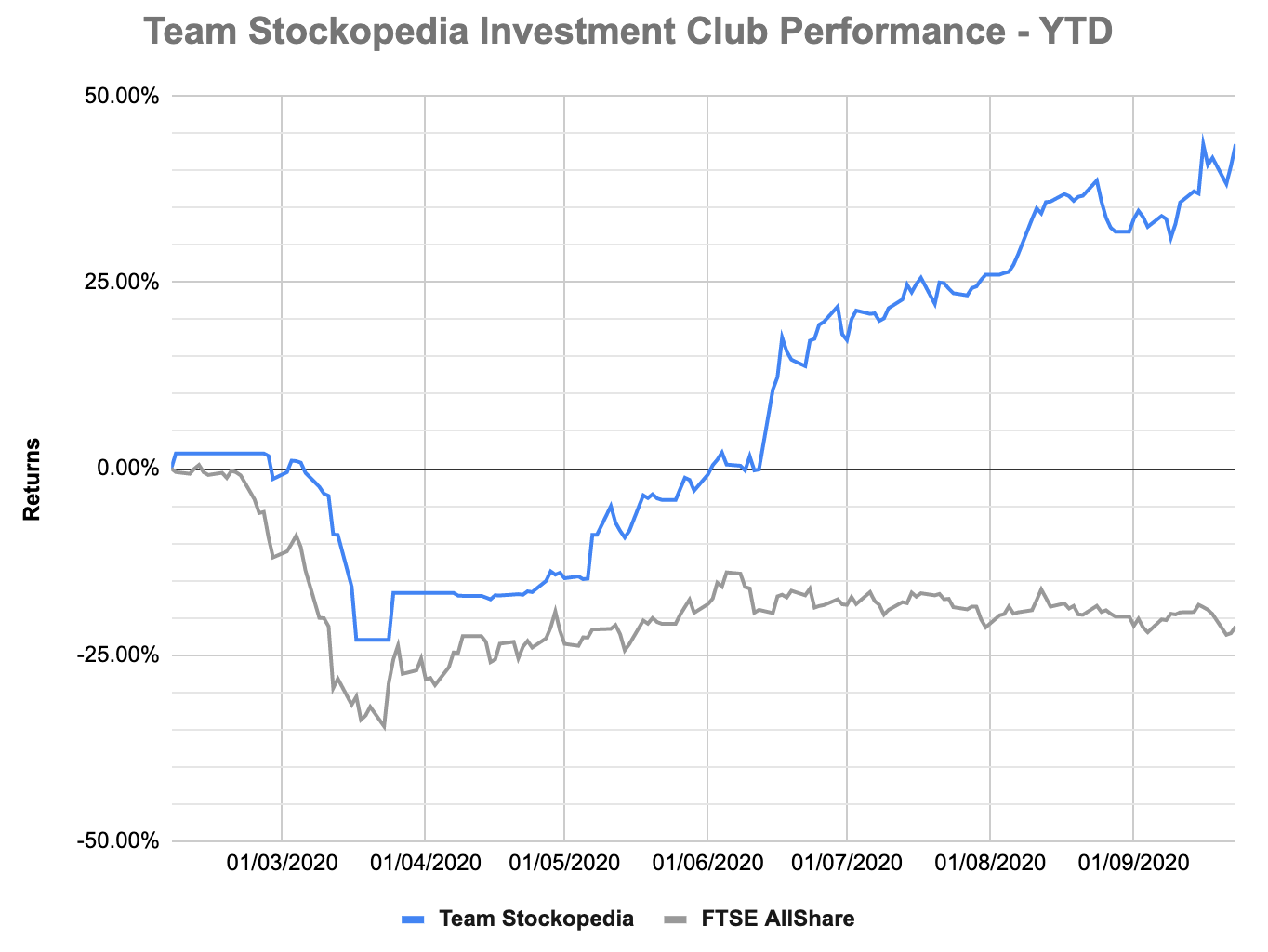
In terms of the holdings, we've had some failures and some great successes. The most notable on the upside is BOTB +334%, as well as SLP and ERGO both up more than 60%. The current portfolio - which is quite concentrated - can be seen below.
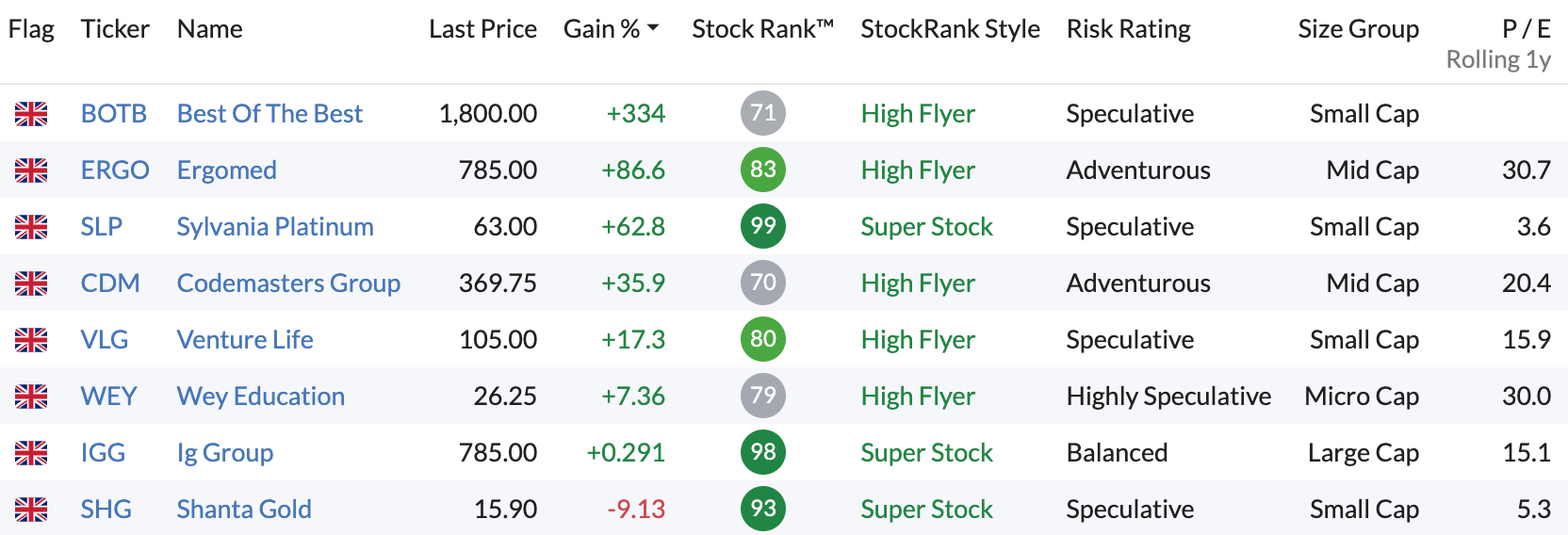
The observant may note that the portfolio Gain % column is showing almost all green - just as we like it. Shanta Gold (LON:SHG) was showing a gain but has had a sharp correction - but the other shares have been holding up very well. We've seen a string of positive announcements recently including Ergomed (LON:ERGO) , Best Of The Best (LON:BOTB) , Ig Group (LON:IGG) and Venture Life (LON:VLG) this morning - which has announced excellent results with a 9% gain.
The stop loss process has seen a few shares sold automatically. During the March decline we cut 4 positions due to stop loss triggers on price declines - Billington Holdings (LON:BILN) , Caledonia Mining (LON:CMCL) , Redrow (LON:RDW) and Ramsdens Holdings (LON:RFX) . Since that date we've also been stopped out of Frp Advisory (LON:FRP) due to the instant sell rule on a StockRank falling lower than 50. Interestingly, other than CMCL the shares stopped out have performed pretty poorly since we sold.
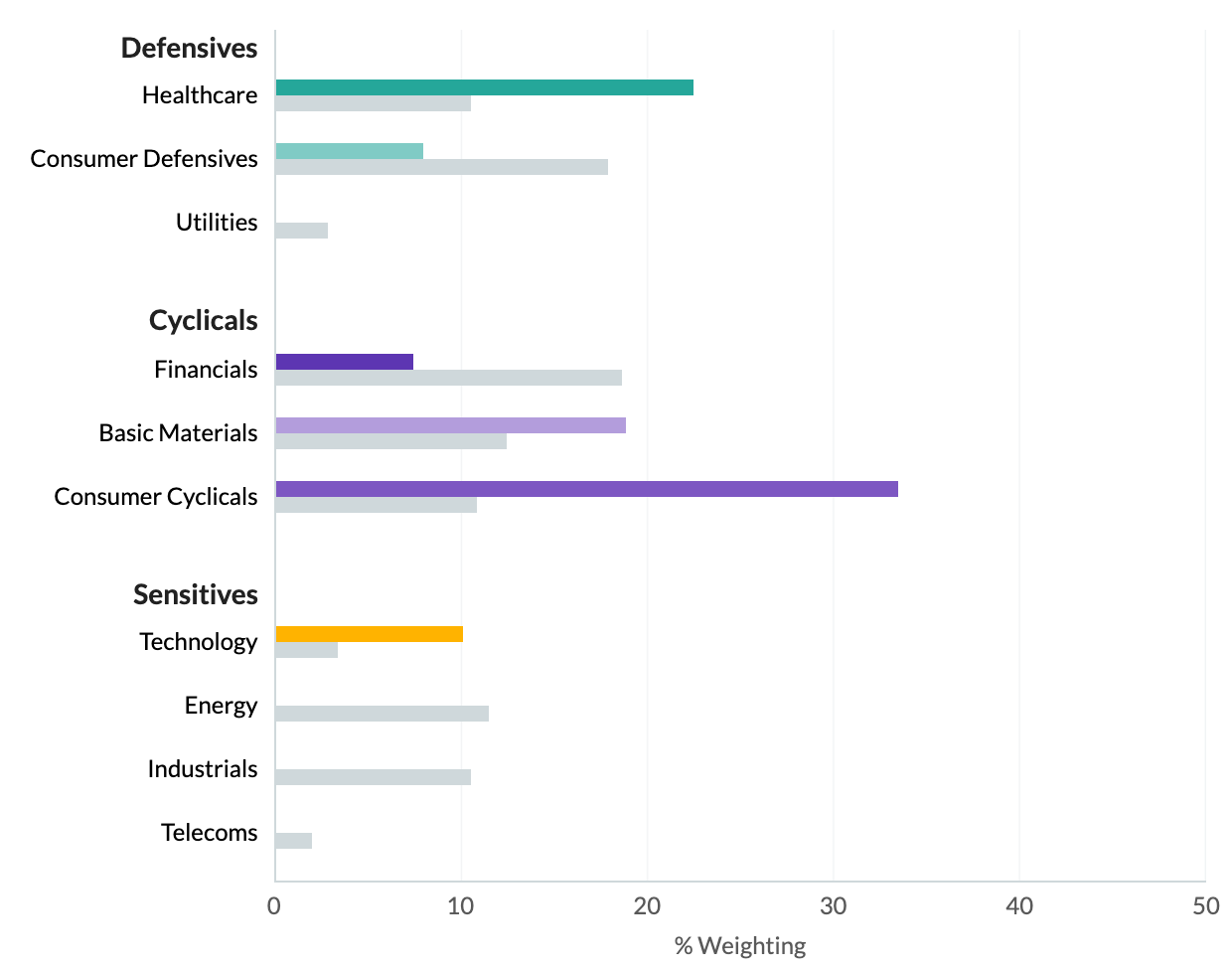
Currently we're pretty overweight in Healthcare & Cyclicals, but that's served us well this year. From a "Style" perspective - we're fully loaded on High Flyers and Super Stocks.
We've been talking for a while about going public with our process and results for the Investment Club. We have had a little luck along the way of course, but the routine and process brings discipline. It will be interesting to see if the team based process can keep the outperformance going. We've realised that all the "pitches" we're doing would be great to put into blogs and possibly some video and podcast content. So we're committing to writing this all up for the wider community. Ben and Jack are going to help on this, and I'm hoping a few others on the team will chip in with comments about the Club.
We're also keen for more people in the community to write up their stock ideas in a brief 'pitch' format . It would be great for everyone using the site to be able to tap into everyone else's research in a more structured format - so there's more to come on this in future. Yes we've got the StockReports - and I do love quantitative data - but stock pickers want the story.
Henceforth
One of the real benefits of starting the club is that now everyone on the team are 'thinking like investors'. I've been delighted to hear stories of staff setting up their own personal ISAs when they've never done so before. Beyond this, one of the ancillary benefits is that everyone on the team are using the site to find stock ideas and thus coming up with great product improvement ideas. I'm reminded of this quote from Antoine de Saint-Exupéry:
"If you want to build a ship, don’t drum up people together to collect wood and don’t assign them tasks and work, but rather teach them to long for the endless immensity of the sea."
I'm looking forward to an ongoing stream of research and product improvements stemming directly from our investment club work and I hope the community can profit from them too.
Please do comment if you run an investment club and let us know how you've got on year to date. I'm sure many on the site would love to have a place to chat and compare notes.
Disclaimer
This is not financial advice. Our content is intended to be used and must be used for information and education purposes only. Please read our disclaimer and terms and conditions to understand our obligations.
94 comments
Stop losses will take you out of losers but may also take you out of big winners.
I did do some studies on NAPs and some years, you would have been taken out of the best performers.
You can look at share charts, if you had bought $TTD in January or February this year, you would probably have been stopped out, but it is now up about x6 from the lows. Or Games Workshop (LON:GAW) is a UK example.
it is too easy to find counterexamples... Globo was once rated 90+ but went down to zero fairly quickly... It would be good to do some more rigorous studies on this to understand the impact on the portfolio performance on a larger sample
Yes some go down to zero but I think Globo was quite obvious one to avoid, there were enough red flags on this site. But even so that is only 100%, if you got stopped out of $TTD it was over 500%. Numerous other examples this year, such as Greatland Gold (LON:GGP), and $TSLA. I did have a look at shares I had been stopped out of and was surprised how many were above the stop price.
We can hand pick examples to argue both ways, but our sample is too small to be conclusive . Would be great if we had access to some proper research based on thousands of shares and several years of data to understand the impact. See the link I posted earlier of a similar research for the US stocks. The paper argues that 15% stop loss improved significantly performance - but that was done for the US market. Also, a small point - the fact the share got stopped out doesn’t mean it cannot be bought again at the next rebalancing cycle, assuming it meets the investment criteria.
All I know is, if I had stop losses on my best performing shares this year, I would have been stopped out of them all. I did top up on several instead of selling them, which worked out very well.
But every year is different, they may work some years, but I rarely use them now.
Looking at my QM folio which I did on 14 Jan 2020, you would have been stopped out of most of the shares, so presume you would have lost around 20% (if stock loss at 20%) but folio is currently + 16%. Two out of the 20 would have been worth having a stop loss on Hyve (LON:HYVE) and Rank (LON:RNK) but they both fell quickly so not sure what price you would have got for them, Hyve (LON:HYVE) is -80 and Rank (LON:RNK) is -46.6 but the top 3 shares are +140%, +125% and +83%, not only would you have lost those profits, you would also have taken around 20% loss on each.
Hi Ed,
I was a member of an investment club many years ago, and my experience prompts me to ask how exactly you value holdings when someone withdraws?
Due to a sudden change in my life, I needed to withdraw all my holdings after 18 months. As we had some modest success by then, I expected a 10% profit on my monthly investments. Like your Club, there was a delay of 3 months before the payout cash was due, which I knew and accepted. But unluckily, there was a sudden downturn in our (very concentrated) portfolio and I actually lost 20% when payment came and my holding was valued at the lower 3-month point.
I can see that there is some logic in valuing at a later date if sales took until then to agree and effect, but it leaves a sour taste and could cause dissension among members. I guess the moral is that settling up asap is the only sound way!
Very new to Stockopaedia. Thanks for sharing your stop loss rules. This is an area in which I have lacked discipline!
The six-month volatility would be about 1/sqrt(2) * annual volatility (i.e. 0.707 * annual volatility).
If you are using 1/2 * annual volatility that roughly corresponds to the three month volatility.
@Nick - you are completely correct. I can't say I'm thinking that straight at the moment!
Hi Ed, I am confused by your statement that "Stop losses do not improve absolute returns (compared to buy and hold) but they do reduce downside drawdowns and volatility."
Please can you tell me a) Why the club uses stop losses if they do not improve absolute returns? Is improving absolute returns not important to the club? b) How can it be true that stop losses reduce drawdowns but do not improve absolute returns ? I would have thought that any method that reduces drawdowns would automatically improve absolute returns.
I am guessing that the answer to my questions lies somewhere in the details of what sort of stop losses are involved & how they are applied.
Anyway please can you elaborate and help clear up my confusion?
Here is an interesting paper on using stop losses to improve absolute returns and also limit drawdowns: Stop Loss Strategy
But it’s based on Momentum strategy and the US stocks.
@Warrantstar - in answer to your questions.
Why the club uses stop losses?
We are using stop losses only on the purchase price primarily to protect starting capital. We don't currently use trailing stop losses on profitable positions.
An example we were stopped out of Loopup (LON:LOOP) for a 30% loss, but saved ourselves from a far worse 65% loss if we'd held. Yes, the LOOP shares may come back, but we've reinvested productively elsewhere. The funds allocated to LOOP have now been recycled into Volex (LON:VLX) where we're showing a healthy 15% gain already.
The LOOP example is just one of several productive stop loss examples from the Club's first year. There have though been some that are irritating to say the least e.g. we were stopped out of Shanta Gold recently and I happen to be very bullish on Junior Gold miners. But we have the discipline and it's been good for us overall this year.
The opportunity cost of holding losers is a very real cost. Most investors don't consider opportunity cost whatsoever as it's not a tangible cost, but it's very real indeed. Private investors are best placed to benefit from positive momentum in the market, why over-expose oneself to negative momentum in the hope of being proven right eventually? We've done plenty of research on negative momentum and profit warnings.
How can it be true that stop losses reduce drawdowns but do not improve absolute returns?
Quite easily. Two strategies can have the same absolute return but one can have lower downside volatility than the other. Stop Losses reduce a portfolio's drawdowns. A portfolio with stop losses might fall 25% in the same market that one without falls 50%. The portfolio without stop losses might snap back faster and harder and thus make up all the losses quickly, while the stop loss portfolio might get back into the market a little more slowly and miss some of the bounce. Both end up with the same absolute return but with lower volatility profiles. The stop loss portfolio though will have the greater Sharpe ratio (risk adjusted return).
Ed Thank you for your reply. Would it be correct for me to summarize your position on this as being: Many of the ways in which stop losses are generally used by others do not improve absolute returns. But the way that the club is using them does improve its overall results?
@Ed I wonder how you decided on the technical stop loss levels - have you got any quantitative analysis you could share that helps to arrive at these levels or were they a pure "gut feel"? I am exploring this very concept myself at the moment and was wondering if you have done any number crunching to put this into context?
@Lucas
I wonder how you decided on the technical stop loss levels - have you got any quantitative analysis you could share that helps to arrive at these levels or were they a pure "gut feel"?
Our stop loss levels are approximately based around the 6 month price volatility of the share which we feel is appropriate for our holding period and time horizon - we would expect to hold on average for 1 year or more. To make it simpler to administer we use some standard stop loss bands based on the Risk Ratings (which are classified based on our volatility measures). Conservative - 12%, Balanced - 15%, Adventurous - 20%, Speculative - 25%, Highly Speculative - 30%). If you compare these levels with the (annual) volatility bands that make up the classifications you can see that they are approximately half the middle of the annualised volatility band.
Thanks @Ed, appreciate the explanation
Shanta Gold (LON:SHG) has this now trigger the stop loss as it's down over 25%?
If any of you want to hear more about the Stockopedia investment Club then do join us for their session at the MelloMonday next week on the 19th October.
www.melloevents.com
There are still tickets available and if you use the code MMStocko21 it will be half price.
Excellent - I commend the detailed organised approach to constructing the Club's framework; much better than our old club, which had a less disciplined (mostly social) way of dealing! I now successfully and happily follow your NAPS format, and despite the March Lockdown have gained 62% YTD. The main contributors were Scottish Mortgage Trust and Tesla (neither on the NAPS radar, but as I own a Tesla it was a no-brainer for me to continually buy while the shares were rising). We are shortly to witness the end of the ICE age - internal combustion engined cars are condemned to extinction by legislation to the point where already no-one wants to buy new anymore; EV battery efficiency and costs are improving rapidly, and Tesla is considered 5-7 years ahead of the competition. Legacy manufacturers have been caught sleeping and still have legacy parts, servicing and distribution outlets to maintain for years to come.
The pleasure one gets driving an EV is such that I will never, ever go back to petrol or diesel, and I understand why Stockopedia hasn't favoured Tesla - too many red flags. However, this is one stock I have bought without th slightest hesitation.
What a brilliant idea!!
Not to spoil the party but I have been in that sort of mood lately!
To suggest that this portfolio has delivered 82% out-performance against the FTSE All Share when only one of the current holdings is in the FTSE ALL Share Index is a meaningless comparison, even if it is factually accurate.
Not criticising the portfolio itself - I hold 3 (4 until I sold VLG on the half year), but the article heading is erring dangerously close to clickbait.
Vivek
@Vivek - we did set out with the FTSE All Share as our benchmark. I don’t believe there’s a good equal weighted, £25m+ UK benchmark available which would be my preference. We are also tracking the 90+ decile as another benchmark to beat. We’re probably 60% above that. What benchmark do you use? FTSE All Share has dominated FTSE AIM All Share for 20 years - we can’t use that. Do offer a better suggestion?
On a more important point - of course the title is click bait. The title of an article is the first point of interest that draws a reader to click. Then the introductory paragraph sells the reader as to why they should bother to read the whole. I make no apology for understanding how reader engagement works. Why would I want to write a boring title if I can write an engaging one instead?
Speechless...
Great idea and performance, well done!
Hi Ed,
Firstly, apologies, I didn't intend to cause any offence. I think the initiative is excellent & the portfolio sound depending on risk tolerance.
However, I did not say anything incorrect and I think this is acknowledged in your comment.
Post heading, the article did not mention any other benchmarks that can or should be utilised, but based on stockranks the best performing benchmarks YTD seem to be the bottom two deciles (at £10m base).
I don't have a benchmark per se - one of the benefits of my work having no value to anyone other than me, but I use a FTSE ALL Share ETF (to reflect fees) with a zero bound so I flatter myself even more!
I am not sure an appropriate "benchmark" exists for investors - I think is a function of risk tolerance & investment objectives. They are however great for compensating fund managers! (Separate bugbear - I am not a fan of the financial services industry - mainly sour grapes!!).
That portfolio would suggest a very high risk tolerance & I clearly cannot compete with your knowledge on this but 10 holdings is in my view pushing the boundaries on appropriate levels of diversification at least as far as the textbooks would have it. (Due to my risk tolerance, its well below the number of holdings I would want).
The article was presented without context to portfolio construction / other benchmarks / limitations in comparison (especially for an institution with such expertise/understanding of data analysis/statistics & sells that expertise).
The reason I was annoyed with the article is that a number of people on Stockopedia are learning to invest (myself included) and perhaps this audience was not given appropriate consideration (pushing them into a higher risk portfolio construction approach).
Again, apologies if I caused any offence & I certainly did not intend to criticise the initiative. I look forward to hearing more about it at Mello.
Best,
Vivek
"The article did not mention any other benchmarks that can or should be utilised, but based on stockranks the best performing benchmarks YTD seem to be the bottom two deciles (at £10m base)."
Why would it be a rational benchmark to select whatever 10% of the market has done best year to date? That doesn't makes sense to me. It would just lead to tail chasing. A benchmark needs to be stable and sensible over time. It's not sensible to target beating 0-20 ranked stocks - it's not exactly a high bar - they are the lowest expectation, highest risk 'story stock' set of shares.
"The reason I was annoyed with the article is that a number of people on Stockopedia are learning to invest (myself included) and perhaps this audience was not given appropriate consideration (pushing them into a higher risk portfolio construction approach)."
This is a DIY site. Everyone who uses the site makes their own decisions and does their own research - just as we do in the Club. There's no advice, and no 'pushing' into anything - it's illustration. To be clear, I've written for years about the use of extensive diversification and 20 stock portfolios in the NAPS series. We thought that chronicling our staff investment portfolio - which is a real portfolio, rather than model portfolio - would be of interest. I do apologise if it's annoying!
Apology accepted :)
Hi Ed Apologies for the delay in responding. I have written to you separately. Love what you have done and there are some really interesting ideas from your club and the way you have set it up. The delayed voting process is good as is the graduated stop loss alert system which I will adopt myself. I will continue to watch with interest. Charles
This is an amazing idea! I wonder if I can get something similar setup at my place of work.. .. hmm...
I would be very much interested in a 'social trading' element if you guys do open this up further in the future, especially considering I'm a bit of a 'newbie' this would be valuble education.
Interesting article, thanks.
I've been a member of an investment club, based in Brighton, for about 12 years, and it's good fun to meet up once a month to discuss investments. There are only about 10 members now, mostly pensioners, who have interesting perspectives on things gained from experience, rather than textbooks, so I enjoy bouncing ideas around with them.
We've had a few multibaggers (especially Boohoo (LON:BOO) which has c.15 bagged, and we still hold).
I got roped into being Treasurer for a few years, and this is the main reason for me posting. We used an excellent software package, called iValuation which only costs about £79 for a perpetual licence. It looks after all the cash and unit accounting, and produces nice reports each month, and at year end, including tax certificates for everyone.
So if anyone is looking for some reliable software for an investment club, then I recommend iValuation (you can download it her4e: http://www.ivaluation.co.uk/ ). I have no connnection with the company or people behind it, other than as a satisfied user.
Our fund has built up to over £100k, despite us only putting in £25 per month, which you don't even notice.
Regards, Paul.
Stocko’s investment club is an excellent development. We all look forward to hearing more about it but only wish we could participate.
Followers may be interested in a little more history of our successful, little, family investment club, Promethean Partners, which we started in 2004.
Ed claims to have founded it, which is not my recollection; a good idea has many fathers, a poor one is an orphan!
Life is rarely perfect and nor was Promethean. Seared in all our memories is the pitch made by my youngest son, Jamie, at our last and final meeting in 2006.
It was short, without analysis and devoid of research. He just took out his IPod and said,
“Look, we all have one of these. We should invest in the company.”
All present agreed, in a patronising way, that it was a good idea but - the shares had gone up a lot - it was only one product - etc. so it was voted down.
This was before the IPad, IPhone, etc. The rest is history.
On a serious note, the Stocko rule that selecting stocks by a secret ballot after the meeting overcomes the problem of the strong characters dominating the vote. We had too many of those in the Promethean Club.
There are two investment lessons from Promethean: -
1. Invest in what you see yourself and others doing. I kick myself for not buying Amazon, despite the number of my purchases rising year in and year out for 20 years.
2. Our best investment was indeed Dominos Pizza; it was a 14 bagger. This exceptional performance was because when the club terminated it was not liquidated. Those who did not withdraw their funds remained invested. It was benign neglect what did it. So, pick well and run your winners.
I wonder out of the approx 1000 Investment clubs in action how many have balanced and diversified their portfolios with Funds , ETFs and Trusts. ? We started off purely in the small to mid cap market. Over the years diversified further into Funds. Now we sit at 24% invested in Funds and Inv Trusts and 74% in Equities. I am aware of another club that piurely invests large sums through each member purely into Funds. They have been going a while and each member contributed a large sum at the outset and £500 monthly to the point where they no longer need to pay in monthly'
Our best investments have in recent times of course been in Technology, ( Polar Cap Tech ) Healthcare ( Worldwide Health ) Renewables and Utilities, with some retail, Hammered of course by Financial stocks
Awesome job guys, well done!
Ed,
Lovely to see somebody else starting an investment club.
I am the chairman of a long established club of some 25 years with eight members, currently, and ~£100 000 under management. The membership ebbs and flows a bit, but the last to retire did so with a redemption of £67 000 for an initial input of £2000 and £100 per month over 15 years. Not a bad return!
We make it clear to new members that the club is NOT for widows and orphans, but for fun and education. Oh, and a good lunch, when we're allowed to (NOT paid out of the club funds!!).
We use an excellent bit of software from http://www.ivaluation.co.uk/ which does all the unit valuation grind and helps out with the tax year. They are extemely helpful and give a free trial run!!
Our experience is to keep it as simple as possible and agree from the outset that democracy rules.
Thanks Jasper - this is very helpful. I used to use iValuation back in the day with my family investment club. It was extremely good. Unfortunately we all use Macs in the office (or remote office !) so it's not possible to use at the moment.
Democracy rules indeed... even in this era of autocrats!
Apologies! For Cow2000 read iValuation, the successor program. in my post below.
I enjoyed reading this and it is interesting how we all differ in our approach. Our club was formed in 1997 using the Proshare manual, for constitution and rules , and a subscription to Company REFS. It rapidly became a social club. We have a wine steward responsible for keeping members suitably refreshed in meetings (sadly not possible on zoom). We have held two meetings in Montreuil-sur-Mer with spouses to celebrate significant milestones in our history.
We do not have a portfolio manager but each of our holdings has a share champion who is responsible for monitoring and reporting at meetings. We have an investment sub-committee who research members's suggestions and circulate recommendations prior to meetings. Yes, stop-loss is a marmite subject. Ever since the dotcom bust we have maintained one, usually 20%.
We use the Cow 2000 software which has coped splendidly throughout and it prints all the tax forms too. I tried the beta for Time-to-Trade, but could not get it to take the Cow data. It was a disaster, probably sorted out now. All the original members have taken out substantial "dividends" over time. We are older and not much wiser now and not inclined to punt as much. Our members don't like zoom and we look forward to getting together again.
I know I don't post very often but I do think this kind of discussion helps us to understand how others are thinking and developing their portfolios. I very much look forward to you developing these ideas. I don't understand what Time Weighted Average means, but does your performance figure discount subscriptions? Oh, and how can we view the competition you started at the beginning of the year, each of us choosing 5 shares, all has gone quiet on this front?
Trevor thanks for getting in touch.
Anyway - in answer to your question - when you say "Time Weighted Average" I think you are referring to both:
Really interesting thread, especially as I am keenly involved in our own Grumpy Old mans Investment club. Really enjoyed the article and impressed by the approach and gains
Just quickly on the stop loss issue , over the years we have had lots of debates about it, and its rather been a marmite issue between us.
We did read interesting research recently that affirmed that a 25% stop loss was a key determining factor, I seldom go that large, but the point was that anything falling in price less than 25% stood a much better chance of recovery, whereas 25% or more and it was virtually goodnight and little hope of recovery. So whilst this is in general a high percentage stop loss, referenced as speculative here, you would save yourself significant amounts on stocks that suffer a big market crash and struggle to survive or return to profit
Incidentally we have been going 15 years and have also introduced Sons to our bizarre world, We invest individual amounts but up to a maximum of £50 per month currently, There are 18 of us who zoom in monthly
@Condor - The trend towards Zooming really has helped matters for investment clubs and I hope raises their popularity.
I hear you on the issues with deep stop loss levels. There is the issue of the compounding maths of recovering your loss - a 10% loss requires only an 11% gain to get back to parity, but a 25% loss requires a 33% gain and a 50% loss requires a 100% gain. The wider your loss, the more difficult it gets to return to parity.
Ultimately - we've chosen a hard volatility based stop rule for simplicity. I'm hoping our average investment has an Adventurous RiskRating ( and thus a 20% stop loss ) rather than a Highly Speculative RiskRating (and thus a 30% stop loss).
We may tighten these over time. I've been teaching the team about chart reading & momentum to improve the timing of buys. Ultimately it's a democratic staff vote - so I can't get my way unless I can bring others to my own way of thinking.
Ed....We are back running a regular MelloMonday but virtually just like the old days but online via zoom and we have over 300 signed up for this Monday. www.melloevents.com
There will be lots of short sessions and a company presentation but I would really like to feature an Investment Club every Monday and get a league table running.....probably in conjunction with Stockopedia or ShareSoc.
So why don't you guys give us a perfect start and tell us your story and the good, the bad and the simply amazing bit which is your stand out performance this year so far....We can book you in for the next one and as many of your team as possible can feature in it.
David
1. Investing is a probability game. Even the great investors like Warren Buffett and George Soros get things badly wrong occasionally.
2. A loss of 98% on Revolution Bars (LON:RBG) is not possible. At the peak it was around 200 pence and now it's 10 pence. Maximum possible loss therefore 95%.
3. Looking at the chart, even allowing for the gap downs, basic risk management such as a stop loss could have cut your loss to a maximum of 50%.
"We've realised that all the "pitches" we're doing would be great to put into blogs and possibly some video and podcast content. ...."
Hi Ed, I really hope the stocko investment club do make a podcast. That would be awesome.
Look forward to listening / reading / watching future updates from the stocko investment club.
Great read, looking forward to more updates.
Hi,
Very new Stocko member and investor here, but already loving the site, its endless features and content.
The investment club is a great idea and very well done on the results so far, super impressive and thanks for sharing, I might well get involved with some of your holdings soon myself.
One question regarding stop losses, I am investing for the long term and as such I fully intend to hold and reinvest in my portfolio throughout both the peaks and troughs. But, I'm sure there will be instances when certain stocks experience a fundamental change that they simply can't recover from, at which point I would cut my losses. What indicators/circumstances would you recommend are best to monitor in falling stocks that should help me decide to cut them loose before the loss gets really out of hand.
Any/all help advice is very much appreciated.
Keep up the great work and good luck in the markets!
Great post as ever, and great initiative.
What are the Sell rules for "Taking Profits"? What is the Plan with the positions bought, the Target Price? Relative Performance between your holdings? P/E targets? These should be "soft rules", as you want to assess the situation before taking profits and perhaps let your profits run past these soft rules if the market is in your favour etc.
Without a target in mind you risk of holding your stock on its way down just because it has not met your Stop Loss rules.
Are you going to rerun your Pitch Template periodically to asses if your holding still meet your buying criteria? So perhaps the Pitch Template should be a scoring card where you can compare scores periodically.
But it is easier said than done! and it takes the gambling excitement away! ahahah
I'm sure they are capable of answering this themselves but I would have thought the 'target' is for an automatic sell as soon as it fails one of the stock rank etc values, failing that I guess they hold 'forever'
67% is a fantastic return. Well done!
That should be 82% - I read the 67 in the URL!
Ed, thanks for sharing this. I really found your investment club set up very interesting, along with everyone’s comments and posts. I realise you asked for posts in relation to other investment clubs but it's very helpful to hear about everyone’s different approaches to stop losses. I am a newbie to full-on investing/trading and had a nightmare when I started, as got stopped out over a two-day period on so many stocks, due to the volatility in the market. I tried trailing stops and stops at 8 - 12%, but all stopped out before rebounding. Reading John2’s post I had exactly the same issue as he did with stop losses kicking in when the market opened and then the price moving swiftly up, it was very annoying and I came up with exactly the same solution as he did of using an excel spread sheet to follow the stock and decide for myself whether to ride the loss or sell. I could see different things in different posts that I could identify with. Doing this in isolation, as I presume most of your members do, it’s helpful to know that this is not happening to just me. So thank you everyone.
I use advfn level 2 data to help identify a tree shake or excess volatility at market open. Once you have seen 2 or 3 of these you become familiar with the market maker tricks. I use soft stop losses and set up price alerts to avoid being spiked out due to early morning volatility or tree shakes. I have managed to avoid the situation you mention with this approach. You have to pay for level 2 data.
My challenge recently is dealing with the recent strong pullbacks in my portfolio - loopup, purplebricks, codemaster, 888, etc (the list goes on) combined with the weak FTSE which looks in the early stages of a downtrend. A good trailing soft stop loss approach I believe will help me with this.
Good luck!
Hi Gus how useful do you find level 2 ? and do you mind me asking which platform you use as I understand some show more trading platform data than others.
Thanks Andy
Hi Andy, I use advfn and I find it helps me with inter day entry and exit points only to obtain marginally better pricing for the hour or so as you can see the backlog of orders and how stacked up they are in the system and therefore assess supply and demand. I think it is limited though and not the full solution as the randomness, signal noise and market maker tricks (flashing screens, etc) does tend to limit the foresight that the order backlog provides. Some investors say they can use the data stream to determine significant momentum coming in but personally I find the data streams too noisy for this and I tend to use the cumulative volume for the day divided by the average volume for the stock to better determine volume based daily momentum coming in and then use the level 2 just to refine the timing for order entry.
But what it does help me with is to identify market maker tree shakes and other manipulations which are not justified by the orders going through. Before I would have panicked when price drops (spikes) within first 10 minutes of market opening but now I make a cup of coffee and just wait for the market to sort itself out.
Thanks Gus any chance of explaining how you spot the shakes I saw Severs drop the other day after a strong run and then pretty much back to open price at end of the day.
Hi Gus, I too am interested how you spot tree shakes on Level 2 please, I use Advfn Level 2 which although I find useful I still fail to spot the tricks you are obviously skilled at, for example I hold Severfield (LON:SFR) which had a sudden 9% fall yesterday afternoon on what I don't know (nothing newsworthy I could locate) but I figured might be the sort of tree shake you mention, at the time it was still at full buy price hence my reason to remain confident, if I could spot a probable tree shake by using Level 2 it would certainly help
Thanks
Why can't the government create similar incentives for investing in groups? (If I was in charge I'd launch GIPPs and GSAs - @ShareSoc - maybe we can push for this? ).
That's a great idea.
Can you tell us more about your allocation of capital?
Is it a fixed amount per idea invested all at once?
If your market analysis is that the sector is overbought, can you start with half a position? SHG Shanta Gold might come right if you apply this sort of judgement.
On the question of trailing stop-losses, a rough estimate of the median likely drawdown in a year is:
"% price chg 1y" / 4 - "1y Volatility %"
(This is based on fitting a regression to simulated stocks with given values for these parameters.)
So for example, a stock with "% price chg 1y" = 28% and "1y Volatility %" = 30% would give
28/4 - 30 = 7 - 30 = -23% as a median estimate.
In real life, the volatility going forwards tends to be fairly close to the historical volatility but the likely value for "% price chg 1y" next year will be a long way from the value this year so it is "safer" to just assume that -Volatility is a reasonable estimate.
The main problem with this though is that for most growth stocks this puts the stop-loss so low that you are already looking at a sizeable loss and it might in fact be the low point after which the price recovers.
Or another way to look at it I suppose is that the volatility always adjusts itself to be just big enough to thwart any attempts to try to work out a new trend for a stock until it is too late - which is a sort of Sod's Law version of the Efficient Market Hypothesis.
Thanks for this. I will take a look at this calculation and back test to see if it can help me let my winners run !
Thanks Ed, an interesting article indeed and the stock picks seem very aligned with my stock preferences. I recently sold my holding in Codemaster due to the recent weak price action which I believe has a chance of becoming yet another regret due to my tight stop losses but what to do when share is demonstrating early signs of a downtrend and one of the brokers downgraded the stock. I'm interested to know if your investment club stop loss %'s that you mention are trailing or just for price entry point? The reason I ask is to reflect on my own wiggle room allowance for my portfolio to generate the same level of returns over the medium term.
Thanks Ed - a great read and sounds like you're setting up a pretty robust process. I wonder if this could be a step towards running a fund? Anyway, keep up the great work at Stockopedia!
Yeah but this is a kick in the teeth, your in house writer eg Scott is plugging stuff like RBG which has lost 98% of my investment. Yet hey presto your club is 80%+ up......
Ouch !? This is a research site with some great writers and in depth analysis.This not a 'tipping" site.They are all opinions ,the decisions are yours...
He also has Best Of The Best (LON:BOTB) which is up over 400% this year.
Paul is a brilliant writer who provides excellent analysis and research. He goes to great lengths to emphasize that you should DYOR, that he is not a tipping service but just giving his personal opinion. He clearly states what shares he has a position in for the purpose of being transparent, pointing out that this should not be the basis on which you make an investment. I feel we are very lucky to have access to his research/thoughts and long may this continue.
@sunny1978
1. Investing is a probability game. Even the great investors like Warren Buffett and George Soros get things badly wrong occasionally. The important thing is to make a profit overall. Not to pick 100% winners.
2. A loss of 98% on Revolution Bars (LON:RBG) is not possible. At the peak it was around 200 pence and now it's 10 pence. Maximum possible loss therefore 95%.
3. Looking at the chart, even allowing for the gap downs, basic risk management such as a stop loss could have cut your loss to a maximum of 50%.
Great idea and article. Look forward to future updates.
Hi Ed (and team)
A really interesting read and great new thread. Many thanks for it.
Out of interest, will the club be considering European or US based shares (or even others such as Canada)? Obviously this introduces extra complexities such as FX costs.
Regards
Howard
Howard - yes we will. We've had MSFT pitched in the club to date but it didn't make the cut.
Automatic stop losses are my biggest nightmare. Firstly because I think they are shamelessly front-run by the HFTs and market makers. Second because every time a pre-set stop-loss has been triggered the share has gone back up way above my sell price before I have a chance to think. It always looks to me like market makers shaking the tree. I no longer set automatic stop-losses which makes going on holiday or being too busy or too ill to watch my portfolio very stressful.
Stop losses work best - or rather, only work - in my opinion, if you are entering the trade at such a point where you expect the price to go up, e.g. buying at a pivot point or breakout in the style of Bill O'Neil or Mark Minervini.
If you're not reading the charts, and entering based on a value judgement, then its really 50-50 as to whether price will go up or down in the short-term.
I have had bad experiences setting up automatic stop losses. There are often enormous share price gyrations at market open which can trigger an automatic stop loss. These days I maintain an Excel spread sheet which contains a column detailing how far the share price is below its high since I bought, and I execute my stop loss sells manually.
For smaller caps, the SP shown can vary from the offer price, to the bid price to the mid price. Hence, sometimes, you take a look at the SP and say to yourself crikey! Your share has dropped 4% in 10 minutes. It might turn out to be that the SP currently shown is the bid price which naturally is lower.
Very impressive idea Ed, I look forward to all the additional research Stockopedia will be producing ;).
I vaguely remember a firm in the USA where every employee became massively rich because the company pension scheme made around 60% p.a. for ages, if anyone remembers what it was called do add it as it is a good read.
Hopefully working at Stockopedia becomes a great way to early retirement!
Could be Renaissance Technologies you are thinking of, the book "The Man Who Solved the Market" is quite a good read about them.
Great post, very informative! Thanks Ed.
I've tried a few different stop loss approaches but they haven't really worked for my investment style. As part of my analysis process, I look at the financials/Stockreport but also try to understand the story of a company to get a feel for how it might develop over the coming months/years. I then assess the probability of that company increasing in value over time. Unless the story or my view of the company changes, I try to stick to my guns and if the opportunity arises, I'll buy more at lower prices.
Using Caledonia Mining (LON:CMCL) as an example, I find the company/opportunity fantastic and wouldn't want to sell because the current market environment is forcing me to do so. In saying that, I do see the benefit of getting out early and reducing risk.
Time will tell whether I'm taking the right approach :)
I love this idea! Never thought about it before. While in Australia, I'd love to here how the process is setup to provide security to all members, that no one can run away with the money.
Ed, Congratulations to you and your team for setting up the club, and for its very good performance! I think it was a terrific idea to do it! You say "I'm looking forward to an ongoing stream of research and product improvements stemming directly from our investment club work and I hope the community can profit from them too." This is great stuff! Everyone should benefit in one way or another.
I used to be a member of an investment club a long time ago, and I learnt a lot from it.
Hi Ed.
Excellent results.
I notice the gain on your chart for #VLG is 17.3% this year but it should say 173%, unless I misunderstand.
It is my largest holding so I know it well, bought in last Sept. I wrote a note on it on your platform after speaking to the CFO on the day of a trading update.
Michael
Michael - we're up 17.3% since we bought... unfortunately we didn't buy as early as you. We did refer to your CFO call in our research notes too - great that you did that.
Ah. I see Ed.
Great advert for your platform.
Hi Ed,
As we've discussed before I'm keen to see investing rolled out to every individual so that they can take control of the finances and feel the benefit of compound interest so I'm delighted to see this post.
Would you also include a discussion on how to liquidate cash if an individual wishes to withdraw their funds?
Thanks in advance
Phil
Phil - thanks for this. We haven't yet had to deal with a redemption yet, but we're providing redemption windows. Ideally we want to deal with redemptions in a batch - in case there are dealing charges incurred. We've agreed that any dealing charges incurred due to trades triggered to facilitate a redemption/withdrawal should be carried by the redeemer themselves.
I was treasurer of an investment club for many years, so can explain how we handled it. Inevitably, at some point members will move on - we had a death, closely followed by the widow's withdrawal, for example, but many members eventually moved on.
We had a 2.5% levy written into the rules, which I think in all cases covered any dealing fees and spreads. We also had a three month window to pay out, following the monthly meeting that a withdrawal request was registered - members knew it might be that long to receive payment, and it gave us a useful window to review which sales to plan. We always sold up and paid out quickly, as it was in everyone's interest to do so. We also had the option to wait for a month or two of subscriptions (all members paid in monthly), as this could be significant in terms of the paid out value.
I think most of this was taken from standard investment club templates when we set up.
I hope that's useful to someone!
Very helpful Will - there are a few points from these comments that we'll add to next month's agenda for discussion.
Hello Ed, re Frp Advisory (LON:FRP), do you know the reason why it fell from around 70 to 35 for about 2 weeks and then back up to the 70s, was this a glitch? Is there any check on the SR scores as we have had glitches in the past. I notice some shares have had 0 scores because information is presumably missing.
herbie - I’ll have to look into this as I hadn’t realised FRPs tank had jumped back. It may be due to the significantly changed broker sentiment recently - but it does seem a large jump just for that.
Are you able to share your research findings that underpin the automatic sell rules? Sell decisions are hard and I would have much greater confidence if I knew there was some evidence to support my decisions, rather than the rules simply being made up.
@Dwit199 - ok 2 points:
I came up with some similar stop loss rules myself, but I think you might be missing an important practical consideration: dealing spreads. For me, if you are using automatic stop losses then you either need to exclude stocks with a spread greater than a certain amount from the portfolio entirely, or a different margin of safety on your buy decision, or more "wiggle room" on your sell decision. Rules in this area will also need to reflect the £ size of your portfolio and so the size of trades generated by your rules. The bigger the trades, the more of an issue this is going to be.
cmpeckham - stock liquidity is considered before purchases as part of the pitch, flagging stocks that have particularly wide spreads and low EMS.
With regards to the stop losses, although these are set on a rules based basis they are currently triggered manually by the portfolio manager. This is to prevent selling out due to any thrashing about in the bid price, preferring to see a 'confirmed' price fall. It does require some extra oversight from the PM, but that is all part of the role!
Hi Oliver whats the maximum basis points you would go up to in the spread ?
Hi Ed,
Deciding when to sell an underperforming share is something of a nightmare in my experience over the last 6 years. I have tried various systems none of which seem to work that well! Despite having stop losses set at 20% (either subject to manual override/investigation or automatically set) excessive volatility of share prices has meant I have sold out of some shares that just 2-3 years later were multi baggers, Avon Rubber (LON:AVON) and Computacenter (LON:CCC) spring to mind. The consequence of this is that I tend to look at shares that have fallen and shy away from selling and crystallising a loss if I can find a reason not to you. A classic example is Keller (LON:KLR) which slumped after a profit warning but had a high Stock Rank which has remained above 85 for nearly a year despite the share price remaining in the doldrums (be interested to know if this is an unusual occurrence on Stockopedia). To try and overcome this behavioural bias I have come up with the following very similar set of criteria for selling a share that isn't part of my buy and hold for ever portfolio:
This last criteria is intended to reflect a situation where the whole market is selling off as we saw in March this year. In the market meltdown most stop losses would have been triggered and the investor would have been out of the market and would probably have missed the subsequent recovery. This criteria might (!) have avoided the thankfully few selling mistakes I made in this period (notably Next (LON:NXT) & Pan African Resources (LON:PAF)) though I haven't backtested it.
If all 3 criteria are met then I will in all probability (can't eliminate all behavioural bias I'm afraid!) sell. Time will tell if this system works any better for me!
On the related subject of running your winners this is surely related to your attitude to risk and your time horizon. If you are approaching your mid sixties (as sadly I am!) then it is perhaps wise to take some profit from your winners. If a share increases by 50% then I sell the enough shares to recover the increase in value and retain the balance. If it increases by another 50% I repeat the process and so on. This will mean that I may miss out on the full value of a multi bagger but I also avoid the risk of a massive fall in the share price wiping out all my gains.
Have to echo your comment about stop losses - Way back when I bought Avon for 90p and winced when it went to less than 40p. I stuck and the rest is history. Personally I am pretty hopeless at stop losses - but I'm getting better. I prefer to ask the questions about what's driving the drop... is it temporary and will they survive - if yes then stick - if no then bail.