The Week Ahead (23 – 27 Nov): Sell-off!, PMIs, US Core PCE & GDP, BoE Financial Stability, US AI Hardware, US Software, CMC Markets

It has been a pretty shocking week for equity markets. As of writing, the FTSE 100 is down 4.9% on the week, and the NASDAQ 100 is down 6.9%. Two factors are weighing heavily on the markets. The first is that the AI trade is unwinding. The drama at Nvidia hasn't helped sentiment, despite strong results from the company on Tuesday.
The second factor is that, after hot inflation data, markets now see a December US rate hike as a near certainty. The Fed minutes show nearly all officials expect a 25bp hike in December. The 10-year Treasury yield is about 5.04%. Then, Thursday added weak economic data on top: the Philadelphia Fed index came in at 6.3 against a consensus of 20. A slowing economy combined with a Fed that wants to tighten is about the worst scenario for stock returns.
Commodities provided no respite. Middle East oil production is recovering, and forecasts point to a wider surplus into 2027, while sentiment improves due to post-election hopes for an end to the Middle East conflict. Higher real yields, the strong dollar and expected Fed tightening reduce the appeal of non-yielding assets, such as precious metals. The AI sell-off is spilling over into copper pricing, given its exposure to power grid and data centre investment. However, copper supply in China remains tight, suggesting the drop is driven more by financial liquidation than by weaker demand.
The FTSE in particular has been pretty much monotonically down, suggesting just a continual loss of confidence amongst equity investors, as well as high commodity exposure:
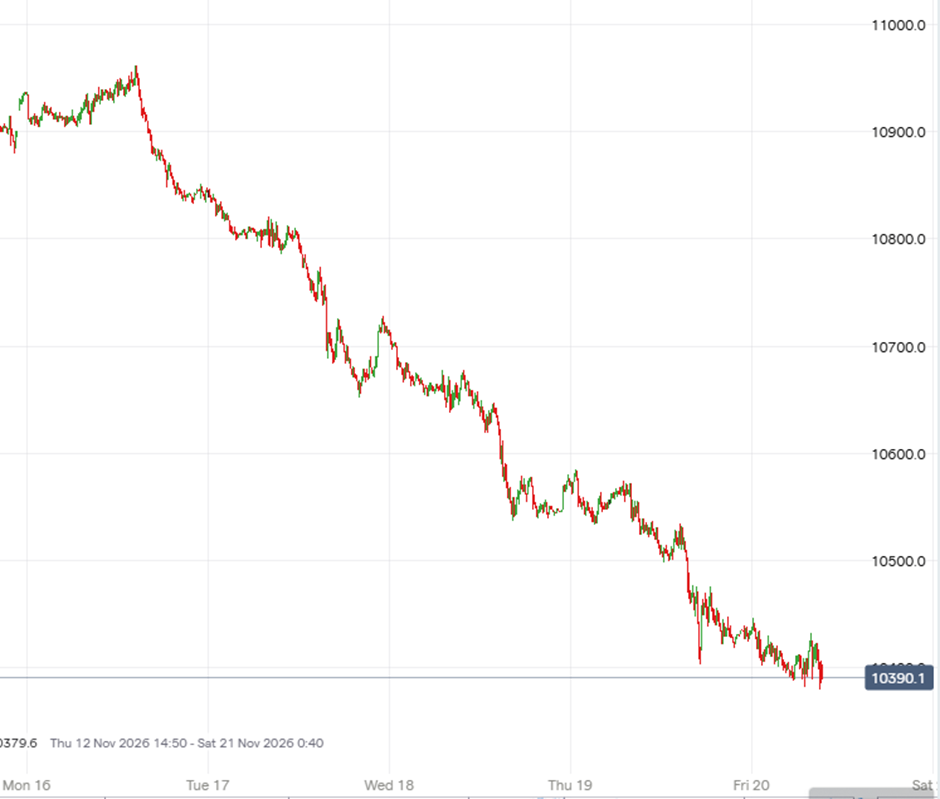
Many of us who hold smaller company shares will have noticed this loss of investor confidence spilling over into our positions, even if we have little direct exposure to these trends.
Here's what we can look forward to next week:
Economic Calendar
Monday 23 November |
||
08:30 |
Germany |
Manufacturing PMI Flash Services PMI Flash |
09:00 |
Euro Area |
Manufacturing PMI Flash Services PMI Flash |
09:30 |
United Kingdom |
Manufacturing PMI Flash Services PMI Flash |
13:30 |
United States |
Chicago Fed National Activity Index |
14:45 |
United States |
Manufacturing PMI Flash Services PMI Flash |
Tuesday 24 November |
||
00:30 |
Japan |
Manufacturing PMI Flash Services PMI Flash |
05:00 |
Euro Area |
New Car Registrations |
09:00 |
Germany |
Ifo Business Climate |
11:00 |
United Kingdom |
CBI Distributive Trades |
13:15 |
United States |
ADP Employment Change Weekly |
14:00 |
United States |
S&P/Case-Shiller Home Price Index |
15:00 |
United States |
CB Consumer Confidence |
21:30 |
United States |
API Crude Oil Stock Change |
Wednesday 25 November |
||
12:00 |
United States |
MBA 30-Year Mortgage Rate |
13:30 |
United States |
GDP Growth Rate 2nd Est Personal Income Personal Spending PCE Price Index Core PCE Price Index Durable Goods Orders Initial Jobless Claims |
15:00 |
United States |
New Home Sales |
15:30 |
United States |
EIA Crude Oil Stocks Change EIA Gasoline Stocks Change |
16:00 |
United States |
Atlanta Fed GDPNow |
Thursday 26 November |
||
07:00 |
Germany |
GfK Consumer Confidence |
10:30 |
UK |
BoE Financial Stability Report |
12:30 |
Euro Area |
ECB Monetary Policy Meeting Accounts |
Friday 27 November |
||
05:00 |
Japan |
Housing Starts |
08:55 |
Germany |
Unemployment Rate |
10:00 |
Euro Area |
Economic Sentiment |
13:30 |
United States |
Goods Trade Balance Wholesale Inventories Retail Inventories Ex Autos |
Purchasing Managers' Index
Next week sees PMI figures released for Germany, the Euro Area, the UK, and the US on Monday, plus Japan on Tuesday.
[This monthly survey-based indicator measures the prevailing direction of economic activity in the manufacturing and services sectors. It's compiled by asking purchasing managers at a few hundred companies a simple set of questions: Is business better, worse, or the same as last month? It tracks across categories such as new orders, output, employment, supplier delivery times, and inventories.
Each of these subcomponents gets compiled into a single PMI number, where anything above 50 indicates expansion and anything below indicates contraction. It is worth bearing in mind that this is a relative index; it tells you whether things are improving, but says nothing about the absolute level of economic activity. However, investors like the PMI because it is fast, forward-looking and globally consistent.]
For all four numbers, the price indices matter as much as the headline figures, because every Central Bank involved is weighing whether to tighten further.
In the Euro area, growth slowed in October to a four-month low. New orders barely grew and hiring nearly stalled. Germany is currently the euro area's strongest economy and could be a bright spot again. France didn't help as activity fell again amid strikes, unrest and political instability. However, selling prices rose at one of the fastest rates since early 2023. A weaker composite with sticky prices would put stagflation in focus and argue for holding in December. Firm activity and hot price indices would bring a hike back into play. The EUR/USD exchange rate is likely to react most to the services price measures.
The UK October PMI was strong. Output grew at the fastest pace since February, firms added staff for the first time since September 2024, and factory output grew at its strongest pace since the same month. However, input costs accelerated, driven by energy, fuel, freight and metals. This month will be the first survey since the BoE rate hike to 4% on 5 November. Strong activity and firm prices would support Lombardelli, Pill and Greene, who see a case for another hike. Sterling and short-dated gilts would likely react most to the services price measures.
In the US, the composite fell in October from 58.4 to a three-month low, and the final reading came in well below the flash. Business confidence dropped to its lowest since May, while selling prices rose at the fastest pace since August 2022. With Wednesday's PCE and GDP data and the December FOMC ahead, a further slowdown combined with still-hot prices would sharpen the "hike into a slowdown" debate.
For Japan, the PMI rarely moves the yen much on its own, and the December call on BoJ interest rates will depend more on the yen, wage data and the Tankan survey. Still, firm services prices and steady activity would reinforce December pricing and support the yen at the margin. Weak services, together with falling manufacturing, would increase talk of a January move instead.
US Core PCE & GDP
Core PCE is the Fed's preferred inflation measure, and October core PCE comes out on Wednesday, alongside Q3 GDP and personal income and spending. It's the last big inflation reading before the Fed's December meeting, where a hike is largely priced in. This release mainly matters for whether the Fed raises rates by 25bp or 50bp.
Core PCE year-on-year expectations are for 3.2–3.3%, up from 3.1% in September. Energy is still pushing up the headline figure, which is forecast to reach 3.8%.
The GDP second estimate comes out at the same time. The advance estimate was 3.4%, and the forecast is 3.4%. Revisions are usually slight, but it's the day before Thanksgiving so liquidity will be thin, and moves could be exaggerated.
If core PCE comes in at 0.4% or more, then the case for a 50bp hike grows. Short-dated Treasury yields would jump, and the dollar would firm. Expensive, debt-financed tech stocks would likely suffer most. If it comes in in line at 0.3%, then 25bp stays the base case, but the 50bp debate stays alive. Attention moves to the GDP revision. 0.2% or less would ease pressure for a 50bp hike, and yields and the dollar should dip, but a 25bp hike on 9 December still looks very likely.
BoE Financial Stability Report
The Bank of England publishes the Financial Stability Report on Thursday, alongside the Financial Policy Committee's record. The FPC's last record, from October, said the risk outlook had "worsened since July" and that linked vulnerabilities were more likely to crystallise together.
The big question is whether the FSR confirms the darker view in the October record, or softens it. A warning about energy prices staying high for longer, or about global bond yields, would get attention given that gilt yields are at multi-year highs and the BoE has just raised rates. It will also likely mention risks from AI valuations, leverage and cybersecurity. However, the FSR rarely moves markets. The most likely effects are on bank shares, through capital and leverage signals, and on gilts.
Companies Reporting
Date |
UK Trading Updates & AGMs |
UK Financial Results |
International Financial Results (S&P 500) |
Monday 23 November |
Conroy Gold and Natural Resources (LON:CGNR) (AGM) Karelian Diamond Resources (LON:KDR) (AGM) Talon Resources (LON:TAR) (AGM) |
Carclo (LON:CAR) (Interims) Cerillion (LON:CER) (Finals) DSW Capital (LON:DSW) (Interims) Partners Private Equity (LON:PEY) (Q3) |
Agilent Technologies (NYQ:A) (Q4) Hewlett Packard Enterprise (NYQ:HPE) (Q4) Jacobs Solutions (NYQ:J) (Q4) Zoom Communications (NSQ:ZM) (Q3) |
Tuesday 24 November |
Coats (LON:COA) (TS) Kingfisher (LON:KGF) (TS) |
AO World (LON:AO.) (Interims) Activeops (LON:AOM) (Interims) Auction Technology (LON:ATG) (Finals) Accsys Technologies (LON:AXS) (Interims) BRCK (LON:BRCK) (Interims) Calnex Solutions (LON:CLX) (Interims) Corilis Digital Infrastructure (LON:CORD) (Interims) Compass (LON:CPG) (Finals) Cranswick (LON:CWK) (Interims) GB (LON:GBG) (Interims) Molten Ventures (LON:GROW) (Interims) Intercede (LON:IGP) (Interims) Londonmetric Property (LON:LMP) (Interims) Marston's (LON:MARS) (Finals) PCI- PAL (LON:PCIP) (Finals) Polar Capital Holdings (LON:POLR) (Interims) Renew Holdings (LON:RNWH) (Finals) Severfield (LON:SFR) (Interims) Supreme (LON:SUP) (Interims) Telecom Plus (LON:TEP) (Interims) |
Analog Devices (NSQ:ADI) (Q4) Autodesk (NSQ:ADSK) (Q3) Abercrombie & Fitch (NYQ:ANF) (Q3) Best Buy (NYQ:BBY) (Q3) Burlington Stores (NYQ:BURL) (Q3) Dell Technologies (NYQ:DELL) (Q3) DICK'S Sporting Goods (NYQ:DKS) (Q3) Dollar Tree (NSQ:DLTR) (Q3) HP (NYQ:HPQ) (Q4) Kohl's (NYQ:KSS) (Q3) The J. M. Smucker (NYQ:SJM) (Q2) Workday (NSQ:WDAY) (Q3) |
Wednesday 25 November |
Abingdon Health (LON:ABDX) (AGM) CVS (LON:CVSG) (TS) Taylor Maritime (LON:TMI) (AGM) |
Cake Box Holdings (LON:CBOX) (Interims) easyJet (LON:EZJ) (Finals) Helical (LON:HLCL) (Interims) Impax Asset Management (LON:IPX) (Finals) Nanoco (LON:NANO) (Finals) Newriver Reit (LON:NRR) (Interims) Pets at Home (LON:PETS) (Interims) Seraphim Space Investment Trust (LON:SSIT) (Q1) Crimson Tide (LON:TIDE) (Interims) VP (LON:VP.). (Interims) |
Deere & Co (NYQ:DE) (Q4) |
Thursday 26 November |
Asiamet Resources (LON:ARS) (AGM) Aura Energy (LON:AURA) (AGM) Avingtrans (LON:AVG) (AGM) Bellway (LON:BWY) (AGM) Celsius Resources (LON:CLA) (AGM) Emmerson (LON:EML) (AGM) Hill & Smith (LON:HILS) (TS) Kr1 (LON:KR1) (AGM) New Frontier Minerals (LON:NFM) (AGM) Safestore Holdings (LON:SAFE) (TS) Seeing Machines (LON:SEE) (AGM) Shearwater (LON:SWG) (AGM) Synergia Energy (LON:SYN) (AGM) FW Thorpe (LON:TFW) (TS) Zinc Media (LON:ZIN) (GM) |
Cardiff Property (LON:CDFF) (Finals) CMC Markets (LON:CMCX) (Interims) First Property (LON:FPO) (Interims) Foresight group (LON:FSG) (Interims) Halfords (LON:HFD) (Interims) HICL Infrastructure (LON:HICL) (Interims) iomart (LON:IOM) (Interims) James Latham (LON:LTHM) (Interims) Mitchells & Butlers (LON:MAB) (Finals) Schroder Real Estate Investment Trust (LON:SREI) (Interims) |
|
Friday 27 November |
Bradda Head Lithium (LON:BHL) (AGM) Craneware (LON:CRW) (AGM) Quadrise (LON:QED) (AGM) Sylvania Platinum (LON:SLP) (AGM) Transense Technologies (LON:TRT) (AGM) |
Beowulf Mining (LON:BEM) (Q3) Foresight Environmental Infrastructure (LON:FGEN) (Interims) |
A quiet week in the US with markets closed for Thanksgiving on Thursday, and a half-day on Friday. UK markets are busier. As usual, let us know in the comments if you think we've missed anything.
US AI Hardware
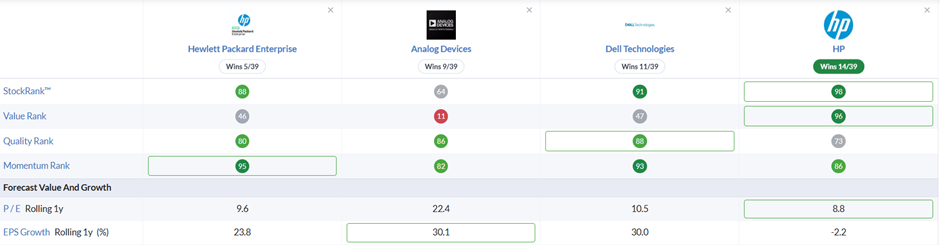
Four AI hardware names report this week. Hewlett Packard Enterprise (NYQ:HPE) kicks things off after the US close on Monday, Analog Devices (NSQ:ADI) reports before the open on Tuesday, and Dell Technologies (NYQ:DELL) and HP (NYQ:HPQ) follow after the close the same day.
Nvidia set the tone last week with strong sales growth. However, it was overshadowed by Jensen Huang's resignation as CEO. The hyperscalers are still spending heavily, too. Amazon, Alphabet, Microsoft, Meta and SpaceX spent $228bn on capex in July to September and have guided to $240–270bn for October to December. Alphabet and Amazon are both signalling more to come in 2027.
Demand isn't the problem; supply is. Global DRAM revenue rose 369% year on year in Q3 to almost $200bn. TrendForce expects contract prices to rise another 10–15% this quarter, and Micron says supply will be tighter in 2027 and 2028 than this year. For server makers, memory limits how quickly backlog turns into revenue. For PC makers, it squeezes margins. Dell is down about 25% since its last report. HPE has fallen from a post-results peak of $73.56 to $48.29.
These risks are reflected in the low rating and high earnings growth for most of these companies, making them interesting for the contrarian investor, despite typically strong Momentum ranks:
These are the things to watch:
Hewlett Packard Enterprise (NYQ:HPE)
- How big the beat: HPE guided to adjusted EPS of $1.12–1.22, but consensus has already moved to $1.28, and the market is probably expecting even more. A result merely in line with guidance is unlikely to be enough.
- Supply constraints: Management said memory and wafer shortages, not orders, were holding revenue back. Networking orders rose 36% and ran at about 3.5 times revenue, but like-for-like networking sales grew just 10%. Investors will want to see that gap start to close.
- Margins: Gross margin hit a record 40% last quarter, but management has warned it will drift back towards historical levels as AI systems make up more of the mix. Keeping inventory moving quickly will be key to avoiding further margin pressure.
- Industrial recovery: Industrial revenue, almost half the group, rose 53% to $1.97bn in Q3. Management expects a further high-single-digit rise quarter on quarter. Any sign this is slowing would hit the investment case.
- Data centre: Communications revenue rose 84%, and data centre now makes up 80% of that segment, with optical and power both more than doubling. The question is whether triple-digit growth can last into FY27.
- Pricing and outlook: ADI has raised prices twice this year, the second time in September, so Q4 should see more of the benefit, with gross margin guided to about 74% from 72.5%. Management has called 2027 "a brisk growth year", so the first look at FY27 and any sign of customers restocking will steer the shares.
Dell Technologies (NYQ:DELL)
- Backlog conversion: Dell booked a record $60.9bn of AI server orders last quarter, taking AI backlog to $95bn from $51.3bn, and raised its FY27 AI server revenue target to $74bn. Memory supply will decide how fast that backlog ships.
- Margins: Infrastructure operating margin reached 15%, up 6.2 percentage points year on year, but management warned some of the mix benefits won't recur. PC margins are guided down to about 6% as Dell chases market share.
- Confidence: Despite Dell having raised its full-year outlook three times and now guiding to about $192bn of revenue, up from $165–169bn a quarter earlier, the shares are down a quarter since the last report; a fourth raise may be what's needed to avoid further weakness.
- Price versus volume: Personal Systems revenue rose 18% in Q3 even though PC units fell 16%, so all the growth came from higher prices and a richer mix. HP has guided to below-seasonal PC revenue this quarter. Further unit declines could signal that buyers are resisting higher prices.
- FY27 outlook: This report closes the year, so the outlook may matter more than the quarter. Investors will want to know how much memory inflation HP expects next year, and whether AI PCs can reach 60–70% of shipments, from 46% in Q3.
US Software
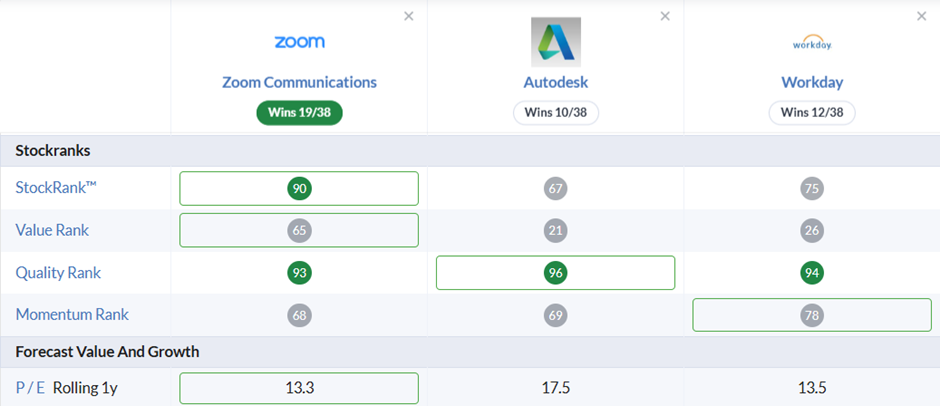
Three software names also report before the holiday. Zoom Communications (NSQ:ZM) releases its Q3 after the US close on Monday, followed by Autodesk (NSQ:ADSK) and Workday (NSQ:WDAY) after the close on Tuesday.
The big question for software all year has been whether AI agents will grow these companies' revenue or eat into it. If an AI agent can do the work, a company needs fewer people, and so fewer per-user software licences. In response, vendors are moving from per-seat to consumption-based pricing for AI agents, and the bull case is that agents work around the clock, so usage-based billing could grow faster than seat counts ever did. Each of this week's reporters tests a different part of that debate. Here's what to look for:
Zoom Communications (NSQ:ZM)
- Enterprise momentum: Enterprise revenue grew 7.8% last quarter, the fastest in three years, and contracted future revenue (RPO) rose 14% to about $4.5bn. However, management flagged churn among white-label partners, who resell Zoom under their own brand, as a growing drag in the second half.
- Online guidance: Management cut its full-year view for the Online business from slight growth to flat, blaming weaker traffic as people move from search engines to AI tools to find products. Any further decline here would be a concern.
- AI revenue versus costs: Licensed AI monthly active users are up 125%, and paid AI features are attached to nine of the top ten contact-centre deals. But non-GAAP gross margin dipped to 79.1% as AI usage and the Common Room acquisition pushed up costs. Investors will want to see AI paying for itself.
- Organic growth versus MaintainX: This is the first quarter including MaintainX, Autodesk's largest-ever acquisition. Guidance includes about $60m of second-half revenue and $70m of billings from the unprofitable business. Management raised its organic billings growth outlook to 9–10% from 8–9%. Autodesk no longer splits out design and make revenue, so commentary on organic billings will be closely watched.
- Margins and renewals: The full-year non-GAAP margin target of about 39% was held, not raised, and free cash flow guidance was narrowed to absorb deal costs. Q4 also brings the largest batch of enterprise contract renewals of the year, so the outlook will matter.
- AI bookings: Management has promised that agentic AI bookings would build in the second half, and this is the first report where that should show. Agentic AI annual recurring revenue is approaching $500m, and agentic new contract value has roughly tripled year on year. Investors will want to see this feed through to overall bookings, and deals on FlexCredits, Workday's usage-based pricing, are growing in size.
- Margins: Workday raised its full-year non-GAAP operating margin target to 30.5% and plans to keep its own headcount flat by using AI internally. The Q4 outlook will show whether the second-half bookings ramp is on track.
The Value case with these companies is less clear-cut, but like many software companies, they score very highly on the Quality Rank:
CMC Markets (LON:CMCX)
CMC Markets reports half-year results on Thursday. The spreadbetters have had a mixed second half. IG Group's shares were down 22% on 2 October after it said Q3 revenue would be about £240m, down 14% year-on-year. The problem wasn't customer growth; it was how much of its clients' trading IG kept as revenue. IG cut its 2026 revenue growth outlook to mid-single digits. However, Plus500's Q3 revenue rose 11% to $203.2m, and it said full-year revenue and EBITDA would beat market expectations.
Calm markets are the common headwind for this sector. CMC's chief executive Peter Cruddas recently noted that the VIX volatility index has been at historically low levels, which he said makes conditions tougher for some peers. CMC argues that its business-to-business platform makes it less dependent on that.
The market has bought that story so far. The shares started the year at 299p before hitting 785p in early September on the back of raising its FY2027 net operating income guidance to at least £550m, up from £460–480m, with EBITDA of £250m. The large operational gearing has seen EPS consensus more than double since the start of the year.
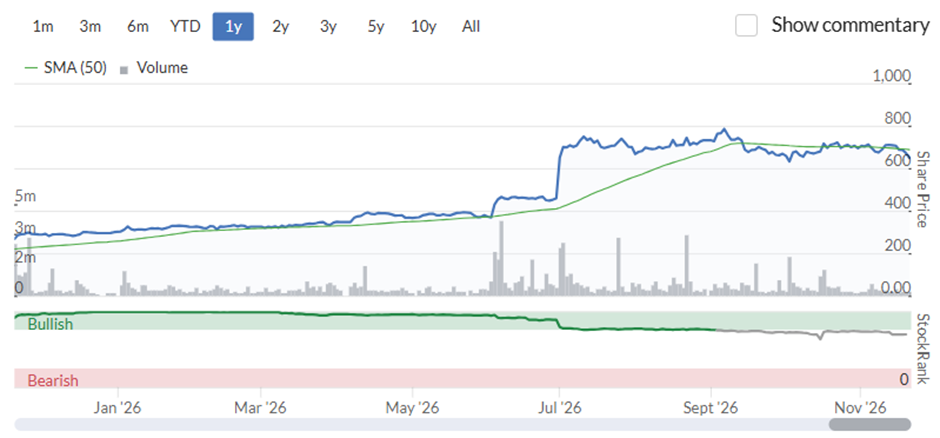
However, long-term shareholders have seen this boom-and-bust cycle before, and operational gearing runs both ways, so these results carry significant weight in confirming a fundamental change in the business.
Here's what to look out for:
- Delivery against the upgraded guidance: Last year's first half produced net operating income of £186.2m and pre-tax profit of £49.3m. Splitting the £550m full-year guidance evenly would mean around £275m in this half, nearly 50% more than last year's H1. Given how soon the upgrade came in the financial year, markets will be looking to see NOI ahead of this simple split. Cost guidance of about £280m, excluding variable pay, was left unchanged in July. A reiteration or another upgrade of the £550m figure is the key number.
- Revenue retention in quiet markets: IG's Q3 showed how quickly revenue can fall when retention slips, even as customer numbers grow. Markets will look for net revenue retention to remain high in all market conditions to justify the company's dynamic hedging strategy.
- B2B partner timing: Cruddas says CMC now powers more than 300 B2B partnerships. Its two big bank launches are still to come: ASB in New Zealand is expected to go live before the end of this calendar year, and Westpac in Australia is on track for early 2027. CMC has also signed a new agreement with Revolut UK. Because the big bank partners aren't yet live, look for any disclosure that separates B2B income from the rest, and for confirmation that the launch dates are holding.
- Dividend and insider signals: Last year's interim dividend was 5.5p, at a 50% payout of after-tax profit. If that policy holds, a big step-up in profit should mean a much bigger interim dividend. Cruddas also says he recently bought around £5m of shares and hasn't sold any since the 2016 float, showing significant confidence in the future. However, the size of his holding raises the risk profile of the business:

Disclaimer
This is not financial advice. Our content is intended to be used and must be used for information and education purposes only. Please read our disclaimer and terms and conditions to understand our obligations.

No comments yet
No one has commented here yet! Why not be the first one?