The Week Ahead (30 Nov – 4 Dec): US Jobs, Euro Area Inflation, OPEC+, Nationwide HPI, US Software, MONY, Future, AJ Bell

A simple chart of the FTSE 100 suggests that it has been a good week to be an UK equity investor:
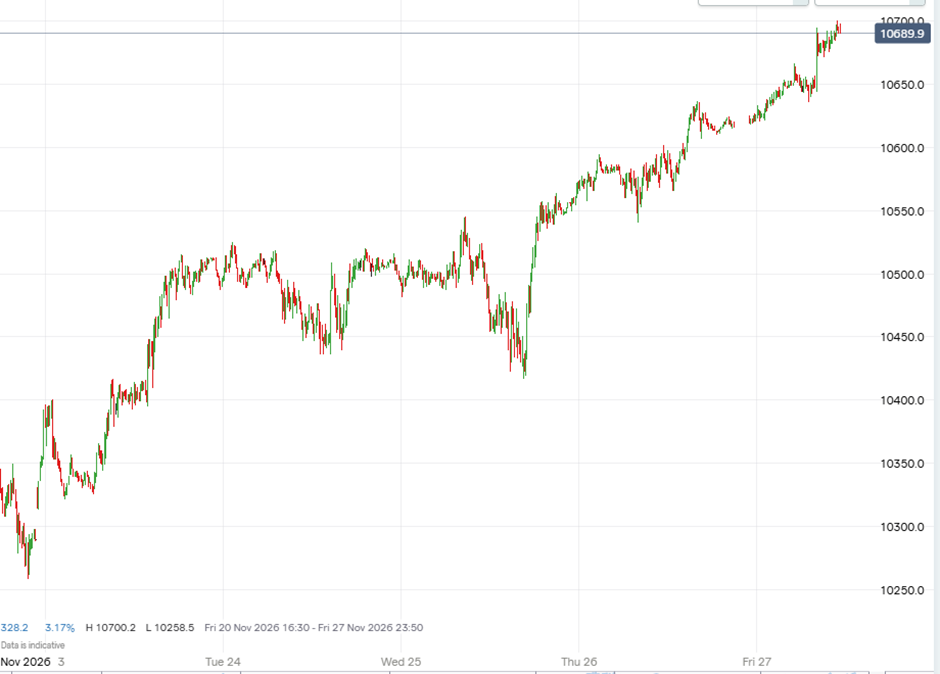
However, it has felt anything but good. At the smaller end, liquidity seems almost non-existent. If I have sold a small number of shares to take advantage of weakness elsewhere, my very modest trades have moved the bid.
The issue appears to be that US tech has been very volatile this week, with the Hokey-Cokey at Nvidia, and new tarrifs pulling in opposite directions:
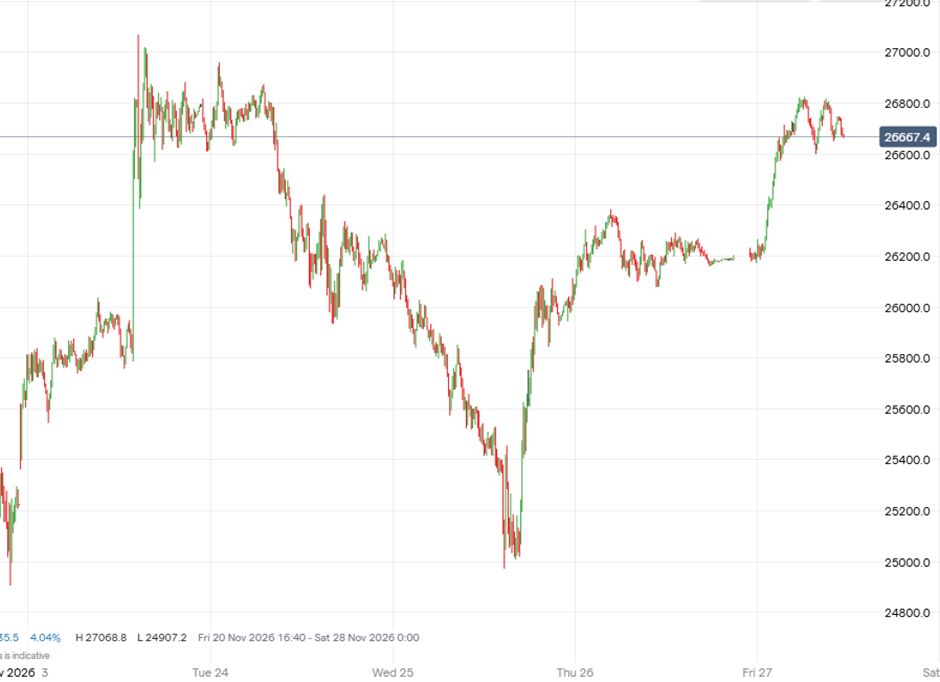
It seems these rapid movements have caught investors off guard and dampened sentiment for equity investment, even where there is little tech exposure.
On the plus side, the 10-year Treasury yield fell to 4.81% on Wednesday, from around 5.04% when I wrote last week, as the AI wobble and a new round of tariffs drove a flight to safety.
Gold was also very volatile in response:
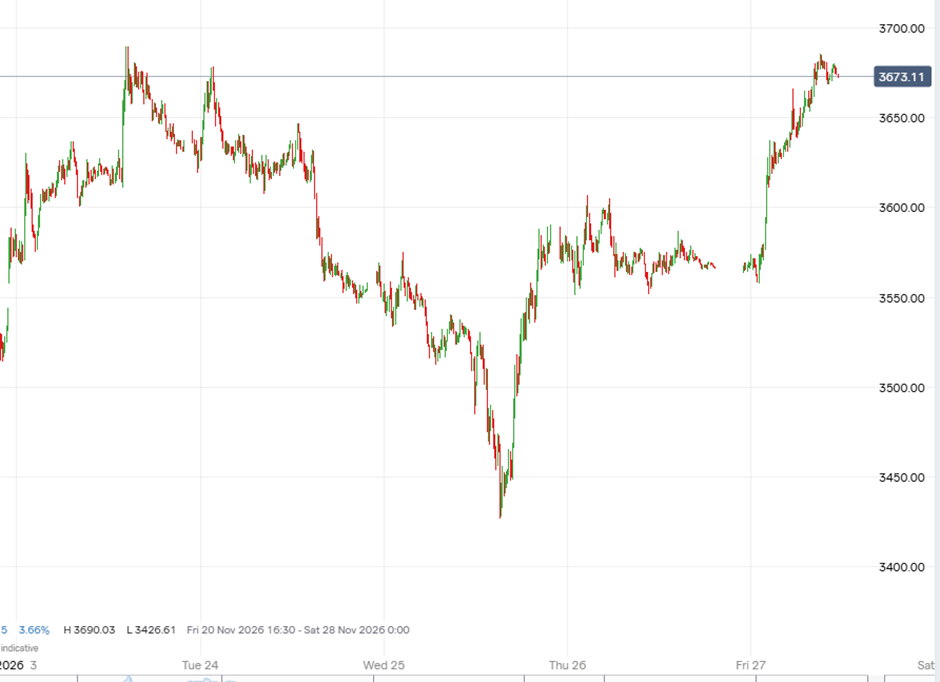
And even though it looks to be ending up on the week, the volatility again appears to have made commodity investors fearful of their exposure.
Here's what we can look forward to next week:
Economic Calendar
Monday 30 November |
||
01:05 |
Japan |
BoJ Gov Ueda Speech |
01:30 |
China |
Manufacturing PMI Non-Manufacturing PMI |
05:00 |
Japan |
Housing Starts |
07:00 |
Germany |
Retail Sales |
07:00 |
United Kingdom |
Nationwide Housing Prices |
09:30 |
United Kingdom |
BoE Consumer Credit Mortgage Approvals Mortgage Lending |
13:00 |
Germany |
Inflation Rate Preliminary |
14:30 |
Euro Area |
ECB President Lagarde Speech to European Parliament |
14:45 |
United States |
Chicago PMI |
15:30 |
United States |
Dallas Fed Manufacturing Index |
23:30 |
Japan |
Unemployment Rate |
Tuesday 1 December |
||
01:45 |
China |
RatingDog Manufacturing PMI |
10:00 |
Euro Area |
Inflation Rate Flash Core Inflation Rate Flash |
15:00 |
United States |
ISM Manufacturing PMI ISM Manufacturing Employment JOLTS Job Openings Construction Spending |
21:30 |
United States |
API Crude Oil Stock Change |
Wednesday 2 December |
||
05:00 |
Japan |
Consumer Confidence |
10:00 |
Euro Area |
Unemployment Rate |
12:00 |
United States |
MBA 30-Year Mortgage Rate |
13:15 |
United States |
ADP Employment Change |
15:30 |
United States |
EIA Crude Oil Stocks Change EIA Gasoline Stocks Change |
Thursday 3 December |
||
01:45 |
China |
RatingDog Services PMI |
13:30 |
United States |
Initial Jobless Claims |
15:00 |
United States |
ISM Services PMI Factory Orders Durable Goods Orders Final |
Friday 4 December |
||
09:30 |
United Kingdom |
S&P Global Construction PMI |
10:00 |
Euro Area |
Retail Sales |
13:30 |
United States |
Nonfarm Payrolls Unemployment Rate Average Hourly Earnings Participation Rate |
15:00 |
United States |
Michigan Consumer Sentiment Prel |
US Jobs Report
Last week, I said that if core PCE came in line at 0.3% month-on-month, a 25bp hike would remain the base case, but the 50bp debate would stay alive. That's more or less what we got. Core PCE rose 0.3% on the month, in line with forecasts, although the annual rate climbed to 3.3%, its highest since November 2023. The bigger surprise was the GDP revision, which jumped from 3.4% to 4.3%, the strongest pace in three years. However, the market odds highly favour a 25bps hike, not 50bps.
That makes Friday's November jobs report the last big data point before the Fed meets. October was strong. Payrolls rose by 165K versus a forecast of 65K, and unemployment eased to 4.1%. The market expects a slowdown, with November payrolls of 90K and unemployment holding at 4.1%. That would still be above the recent trend, but the monthly numbers have been all over the place this year, so a big miss in either direction wouldn't be a surprise:
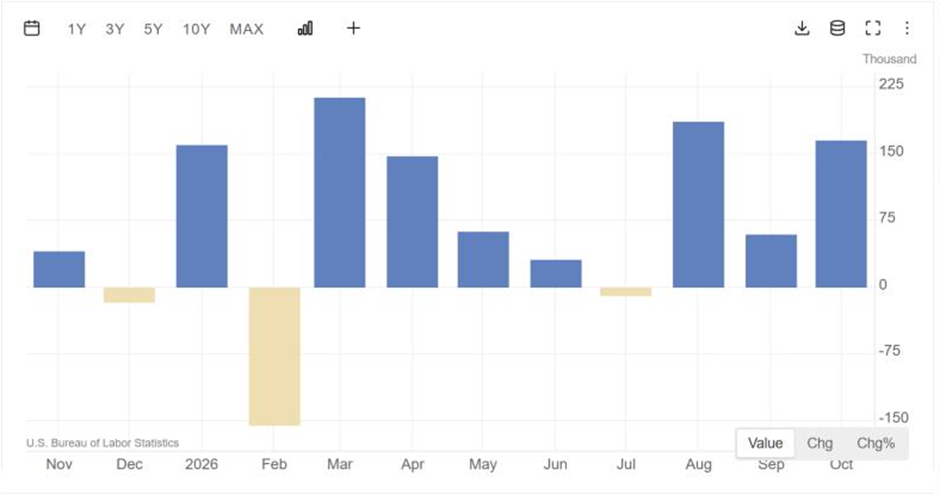
[All charts in this section: Trading Economics]
Wages are the other number to watch. Average hourly earnings rose 3.1% year-on-year in October, above forecasts of 2.9%. A strong payrolls number with firm wages would revive the 50bp debate, and the October FOMC minutes showed a couple of participants already think a hike of more than 25bp could warrant consideration if the inflation data were unfavourable. A soft number with rising unemployment would lock in 25bp and shift attention to whether the Fed hikes again in January.
Euro Area Inflation
Last week, I said that a weaker euro area composite PMI with sticky prices would put stagflation in focus, while firm activity and hot price indices would bring an ECB hike back into play. In the end, we got something in between. The flash composite was unchanged at 51.7, slightly below expectations, and price pressures eased, although input costs and output prices are still rising sharply. Markets have largely made up their minds anyway with the odds of a 25bp hike at the 17 December meeting, a near certainty.
So Tuesday's flash inflation figure for November matters less for whether the ECB hikes in December, and more for what comes after. Headline inflation hit 4.0% in October, its highest since September 2023 and twice the ECB's target, with energy inflation running at 21%:
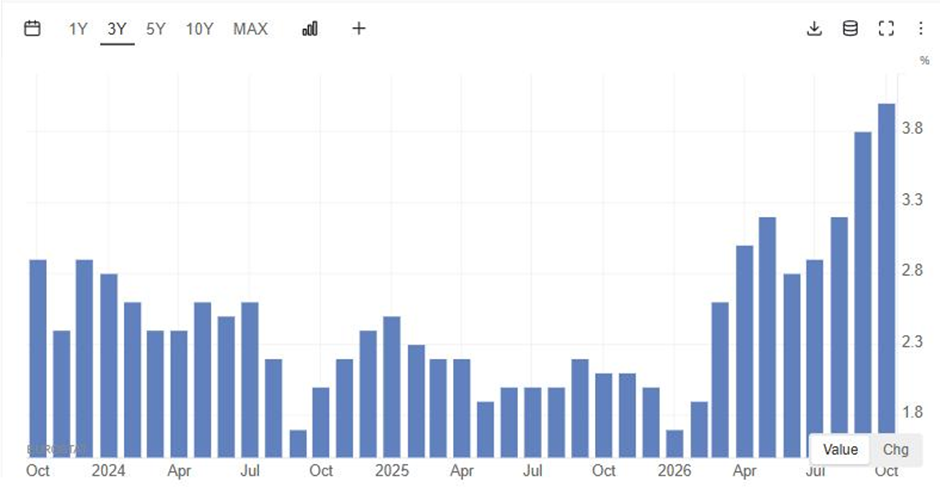
The consensus expects headline inflation to ease slightly to 3.9%, but there is considerable dispersion among individual forecasts. Germany reports its preliminary figure on Monday, after inflation eased to 2.8% in October. However, German inflation has been flattered by a temporary fuel tax cut, which only runs until the end of the year, so there is a sting in the tail for January.
The ECB's line so far has been that underlying inflation is broadly stable, with no significant wage response. Core inflation is the test of that. It rose to 2.6% in October, its highest since May, while services inflation edged up to 3.3%. If core pushes on to 2.7% or above, it would suggest the energy shock is starting to feed through into wider prices. That would likely lift Bund yields and the euro, and increase talk of further hikes in 2027, which over a third of economists in the Reuters poll already expect. A softer core reading would support the view that December is the last hike of this cycle.
OPEC+ Meeting
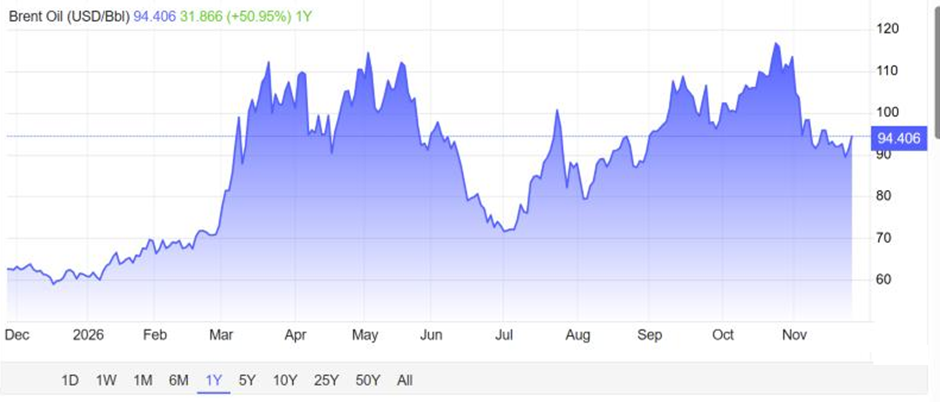
Last week, I noted that Middle East oil production was recovering, forecasts pointed to a wider surplus into 2027, and post-election hopes of an end to the conflict were improving sentiment. This week has been a reminder of how fragile that is. Brent rose back above $93 on Wednesday after Saudi forces intercepted four drones targeting the Ras Tanura refinery and export hub, and Iran reported more tanker incidents involving mines in the Strait of Hormuz. Even so, prices are still well below the late-October peak:
Against this backdrop, all 21 OPEC+ members meet on Sunday to set 2027 production quotas. It's an important meeting because the group has no agreed output framework beyond 31 December. For the first time, quotas will be based on an independent assessment of each member's maximum sustainable production capacity. Unsurprisingly, not everyone likes their numbers. Iraq disputes an assessment that puts its capacity below 5 million barrels a day and claims 5.2 million. Kazakhstan is also objecting, and Russia may follow. The group is also one big producer lighter, after the UAE quit OPEC in May.
The IEA projects a 2027 supply overhang of 3.8 million barrels a day, and OPEC+ still has around 2 million barrels a day of cuts in place for most members until the end of this year. Generous new baselines to keep Iraq and Kazakhstan on side would add barrels to a market that already looks oversupplied, which would be bearish for oil. That would be bad news for FTSE 100, but good news for inflation and, therefore, for the central banks. A deal that extends the cuts would support prices, while a failure to agree would leave the market with significant uncertainty going into 2027.
Nationwide House Prices
I've been saying for some time now that the strength in the UK house price indices didn't seem to match the doom and gloom from the house building and products sector. Although the value investor in me is tempted by a sector on its knees, I have so far avoided it, as I'm not sure the impact of higher rates has yet worked its way through the system.
Monday's Nationwide house price index for November is the first since the Bank raised rates to 4% on 5 November. According to Nationwide, prices were flat in October, and annual growth slowed to 0.5%, the weakest since January 2024, when it was last negative:
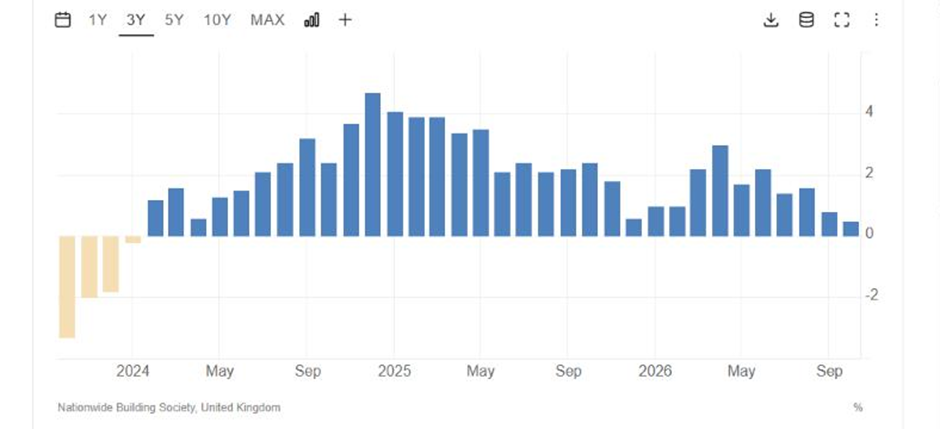
Nationwide's Chief Economist, Robert Gardner, blamed high energy prices, expectations of further rate rises feeding into mortgage pricing, and a dip in consumer confidence. For the November figures, the base effect certainly isn't helpful. Prices rose 0.3% in November last year, so even a flat month would pull annual growth down to around 0.2%. A repeat of September's 0.3% monthly fall would likely tip it negative for the first time since early 2024. Savills expects higher mortgage rates to push annual growth to zero by year-end.
Of course, one reason house price indices may hold up in declining markets is that very few homeowners choose to sell, so the figures are skewed toward the most desirable houses. The Bank of England's October Mortgage Approvals follow at 09:30 on Monday and may give a better read of where the market is going. A weak approvals number would suggest things are worse than the headline HPI numbers suggest.
Companies Reporting
|
Date |
UK Trading Updates & AGMs |
UK Financial Results |
US & International Results |
|
Monday 30 November |
First Tin (LON:1SN) CAP-XX (LON:CPX) (AGM) Feedback (LON:FDBK) (AGM) GEO Exploration (LON:GEO) (AGM) Litigation Capital Management (LON:LIT) (AGM) Time Finance (LON:TIME) (AGM) Vast Resources (LON:VAST) (AGM) Virgin Wines UK (LON:VINO) (AGM) Wellnex Life (LON:WNX) (AGM) |
ECO Animal Health (LON:EAH) (Interims) Foresight Environmental Infrastructure (LON:FGEN) (Interims) Hansa Investment (LON:HAN) (Interims) One Health (LON:OHGR) (Interims) Rockwood Strategic (LON:RKW) (Interims) |
Rubrik (NYQ:RBRK) (Q3) |
|
Tuesday 1 December |
Celtic (LON:CCP) (AGM) Albion Crown VCT (LON:CRWN) (AGM) City Natural Resources Growth and Income (LON:CYN) (AGM) Fidelity Emerging Markets (LON:FEML) (AGM) Schroder Oriental Income Fund (LON:SOI) (AGM) |
Greencore (LON:GNC) (Finals) Mercia Asset Management (LON:MERC) (Interims) Optima Health (LON:OPT) (Interims) On Beach group (LON:OTB) (Finals) Paragon Banking (LON:PAG) (Finals) Pennon (LON:PNN) (Interims) Victrex (LON:VCT) (Finals) Vianet (LON:VNET) (Interims) |
Copart (NSQ:CPRT) (Q1) Credo Technology Holding (NSQ:CRDO) (Q2) MongoDB (NMQ:MDB) (Q3) Marvell Technology (NSQ:MRVL) (Q3) NIO (NYQ:NIO) (Q3) (China) NetApp (NSQ:NTAP) (Q2) Okta (NSQ:OKTA) (Q3) Trip.com (NSQ:TCOM) (Q3) (China) |
|
Wednesday 2 December |
Croma Security Solutions (LON:CSSG) (AGM) MONY (LON:MONY) (TS) New Star Investment Trust (LON:NSI) (AGM) Pristine Capital (LON:PRIS) (AGM) Thor Energy (LON:THR) (AGM) Thor Energy (LON:THR)L (AGM) |
Hollywood Bowl (LON:BOWL) (Finals) Discoverie (LON:DSCV) (Interims) NextEnergy Solar Fund (LON:NESF) (Interims) Solid State (LON:SOLI) (Interims) Theracryf (LON:TCF) (Interims) ZIGUP (LON:ZIG) (Interims) |
Bank of Montreal (TSE:BMO) (Q4) (Canada) The Bank of Nova Scotia (TSE:BNS) (Q4) (Canada) Salesforce (NYQ:CRM) (Q3) Five Below (NSQ:FIVE) (Q3) Industria de Diseno Textil SA (MCE:ITX) (9M) (Spain) Macy's (NYQ:M) (Q3) Snowflake (NYQ:SNOW) (Q3) |
|
Thursday 3 December |
Balfour Beatty (LON:BBY) (TS) Bioventix (LON:BVXP) (AGM) Contango Holdings (LON:CGO) (AGM) VietNam Holding (LON:VNH) (AGM) VinaCapital Vietnam Opportunity Fund (LON:VOF) (AGM) YouGov (LON:YOU) (AGM) |
AJ Bell (LON:AJB) (Finals) Baltic Classifieds (LON:BCG) (Interims) Future (LON:FUTR) (Finals) Fevara (LON:FVA) (Finals) Premier Miton (LON:PMI) (Finals) |
Canadian Imperial Bank of Commerce (TSE:CM) (Q4) (Canada) The Cooper Companies (NSQ:COO) (Q4) Dollar General (NYQ:DG) (Q3) Docusign (NSQ:DOCU) (Q3) Hormel Foods (NYQ:HRL) (Q4) Samsara (NYQ:IOT) (Q3) Kroger (NYQ:KR) (Q3) PVH (NYQ:PVH) (Q3) Royal Bank of Canada (TSE:RY) (Q4) (Canada) The Toronto-Dominion Bank (TSE:TD) (Q4) (Canada) Ulta Beauty (NSQ:ULTA) (Q3) Veeva Systems (NYQ:VEEV) (Q3) Victoria's Secret & Co. (NYQ:VSXY) (Q3) |
|
Friday 4 December |
James Halstead (LON:JHD) (AGM) Alien Metals (LON:UFO) (AGM) UK Energy (LON:UKEN) (AGM) |
Schroder European Real Estate Investment Trust (LON:SERE) (Finals) |
Nano Labs (NMQ:NA) (Q4) (Canada) |
US Software, Round Two
Last week, I said the big question for software all year has been whether the market would view AI agents as an opportunity to grow these companies' revenue or eat into it. We have our answer: software sold off sharply in the run-up to Anthropic's IPO, with Salesforce (NYQ:CRM) falling 9.4% on the day OpenAI's latest model took aim at slides, spreadsheets, and sales document generation.
CrowdStrike Holdings (NSQ:CRWD) gave us an early read on Monday, having brought its results forward from 1 December. It was its best quarter yet, with record net new ARR of $419m, up 58%, and a third raise to full-year guidance. However, it was overshadowed by a $43.9bn all-share deal to buy Zscaler, and the shares fell. Strong numbers alone may not be enough in this market.
Three more names report next week. Okta (NSQ:OKTA) reports after the US close on Tuesday, followed by Salesforce (NYQ:CRM) and Snowflake (NYQ:SNOW) after the close on Wednesday. Salesforce is the classic per-seat business trying to sell agents, Snowflake charges for consumption, and Okta is pitching itself as the identity layer for AI agents. Here's what to look for:
Salesforce (NYQ:CRM)
- Agentforce scale: Agentforce ARR passed $1.5bn last quarter, up over 240%, and combined Agentforce and Data 360 ARR reached nearly $3.9bn. That's fast growth, but agent revenue is still less than a tenth of the group's revenue, so the question is whether it can grow quickly enough to offset the pressure on seats.
- Backlog and acquisitions: cRPO growth accelerated to 14% and is again guided to about 14%. Q3 revenue is guided to $11.42–11.5bn, up 11–12%, with slightly more than 4 points coming from Informatica. Fin and Contentful acquisitions also closed in September, so investors will want to see organic growth broken out.
- Sentiment: The shares jumped about 23% after the last results but have since fallen to around $183, roughly 32% below their 52-week high, despite a positive EPS trend:
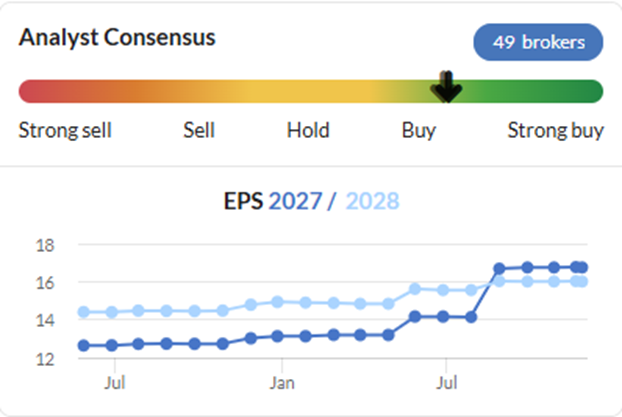
Expectations are now low, with the shares on a forward P/E of 12, leaving room for a relief rally if revenue holds up.
Snowflake (NYQ:SNOW)
- Can growth keep accelerating? The long-term revenue CAGR looks great at over 50%:
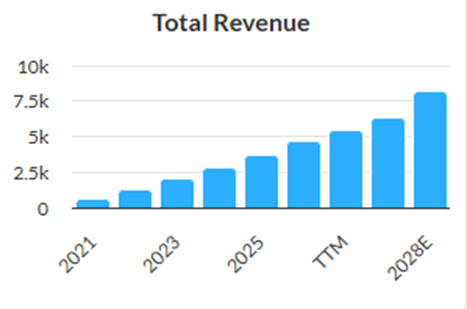
Q2 product revenue grew 37% to $1.49bn, the third straight quarter of acceleration, against guidance that implied around 30%. Q3 is guided to $1.588–1.593bn, or 37–38% growth, so the bar is now much higher.
- AI margins: Management cut its full-year product gross margin guidance to 74% because AI workloads currently carry lower margins, even as it raised its operating margin target to 14.5%. Further slippage in gross margin would be a concern.
- Consumption pricing: Snowflake is the best test of the bull case for usage-based billing. Net revenue retention rose to 126%, the first sequential rise in more than two years.
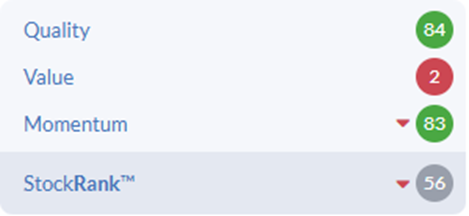
- Momentum: The shares jumped over 20% on the last results, but they can't be described as cheap. When a High Flyer has a declining Momentum and StockRank, this can often be a big warning sign:
Okta (NSQ:OKTA)
- Backlog: cRPO growth accelerated to 14% last quarter, but Q3 guidance of $2.59–2.60bn implies just 11–12%. That looks conservative, and investors will expect another beat and raise.
- AI agents: Okta for AI Agents signed dozens of contracts last quarter, including several million-dollar deals, but the CFO said AI will be immaterial to revenue this year. Commentary on pipeline will matter more than the numbers.
- Consolidation: CrowdStrike's move for Zscaler shows the big security platforms consolidating. Okta's pitch is that it is the neutral, independent identity provider. The shares rose 29% after the last results, so expectations have already moved higher.
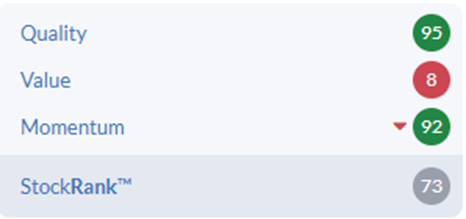
- Momentum: The overall StockRanks look good for this High Flyer, but again, there is work to do to keep that momentum going, and it is a long way down before the Value Rank will start to provide support if things take a turn for the worse:
Comparison Sites
Closer to home, two of next week's UK reporters face the same AI question from a different angle. MONY (LON:MONY) and Go.Compare, owned by Future (LON:FUTR), pay Google for much of their traffic, and AI search threatens to change how consumers find deals. MONY (LON:MONY) issues a trading statement on Wednesday, and Future (LON:FUTR) has results out on Thursday.
MONY (LON:MONY)
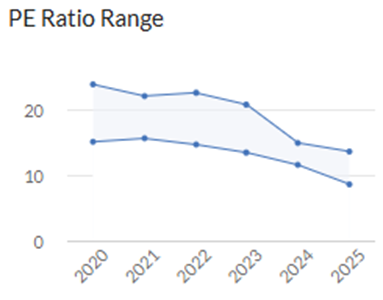
As the pure-play comparison business, MONY has seen a significant de-rating as weaker insurance markets and AI concerns have taken hold:
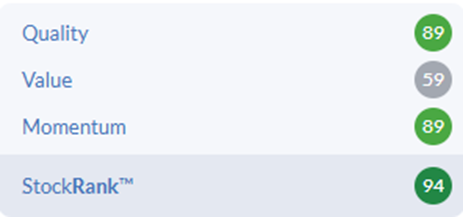
However, continued EPS growth and high returns on capital see this now rated as a SuperStock, despite flat relative share price returns over the past year:
Here's what to look for:
- Car insurance: Insurance returned to growth in the first half, with revenue up 4% to £122.1m, as the fall in average car premiums eased to 5% from 9% in the second half of 2025. Insurance makes up over half of revenue, so any sign of renewed pressure would matter.
- Cost of customers: Gross margin fell to 63% from 66% as pay-per-click costs rose. The company is pushing into AI, with a MoneySuperMarket app in ChatGPT and its own AI-enabled app. The question is whether AI becomes a cheaper or more expensive route to gain customers.
- Guidance: The board is confident of 2026 adjusted EBITDA within the £140–148m consensus range, against £145.1m in 2025. Home Services revenue rose 30% in the first half thanks to energy deals, so investors will want to know whether higher energy prices have closed that window.
Future (LON:FUTR)
For Future, Go.Compare makes up about a quarter of revenue. However, given that MONY is a listed business, there is an interesting read-through valuation exercise that can be done. Here is a summary of Claude's rough attempt:
Approach |
Implied value |
MONY's 7.6x EBITDA, applied to £73m |
~£555m |
15–20% discount to that (about 6–6.5x) |
~£450–475m |
MONY's 2.5x sales, applied to £186m |
~£465m |
What Future paid in 2020/21 |
£594m |
It could be argued that Go.Compare is worth £450m. Future's market cap is £268m, and net debt was £314.1m at 31 March (excluding leases), for a £550m EV. This implies that the rest of Future is worth only about £100m. In reality, Go.Compare should probably trade at a discount to MoneySuperMarket due to its smaller scale. However, the possibility of a much bigger sum-of-parts valuation remains.
However, I sold out of Future in the Summer as the outlook for UK digital advertising just looked terrible, even without the AI threat. These results will be pivotal to determining if I made a prescient move, or became overly myopic:
- Google exposure: At least 60% of revenue comes from brands that rely on Google for traffic. First-half revenue fell 8%, or 6% organically, after a March profit warning that cut the EBITDA margin guidance to 25–27%.
- FY27 matters more: September's pre-close said results will be in line with consensus: £707m revenue, £180m adjusted EBITDA, and 101p EPS. So the FY27 organic revenue outlook will drive the shares.
- Debt guidance: In a particularly embarrassing move, and a sign that things are getting worse, the board paused the buyback after about £24m of £30m to focus on deleveraging. They had only just upped the dividend payment, saying they would focus only on bolt-on acquisitions and buy back their own historically cheaply rated stock. All eyes will be on that debt number and the working capital position.
- Go.Compare: Its revenue fell 6% in the first half but returned to growth in March. Investors will be looking for it to perform at least in line with its larger listed peer.
AJ Bell (LON:AJB)
AJ Bell has been one of the UK's great growth stories:
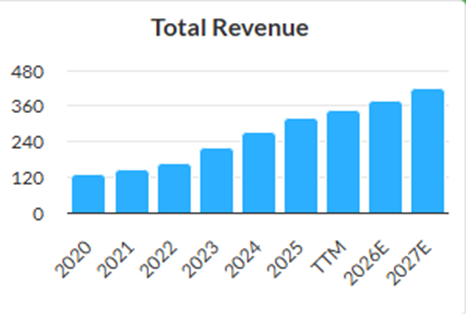
Things show no sign of slowing down as October's update showed record net inflows of £9.7bn, up 37%, customers up 24% to 796,000 and assets of £126bn, all ahead of forecasts. However, when their Finals are released on Thursday, the focus will be on profit and the outlook, not the historical numbers. Here are a couple of other things to look out for:
- Margin guidance: In May, AJ Bell raised guidance and said it expects a PBT margin above 40%. A year ago, the shares tumbled when it guided to a 39–40% margin against 43% consensus because of extra investment, so FY27 cost and margin guidance is the main risk.
- Rates and returns: Revenue margin rose to 33.4bps in the first half from 32.4bps. With the Bank of England now raising rates, investors will look for comments on interest income, alongside capital returns, after a £15m top-up to the existing £50m buyback.
Disclaimer
This is not financial advice. Our content is intended to be used and must be used for information and education purposes only. Please read our disclaimer and terms and conditions to understand our obligations.

No comments yet
No one has commented here yet! Why not be the first one?