The Week Ahead (9-13 Feb): AI agents prompt SaaS extinction fears + US job cuts

Welcome back to The Week Ahead. It’s been a volatile seven days in the market, especially for investors with exposure to software and Big Tech.
I’ve put together some charts to highlight some of the big moves and look at the stories behind them. I’ll wrap up by explaining why investors may also want to keep an eye on the real (US) economy over the coming months, in addition to monitoring the AI story.
Silver & gold lose shine
After falling sharply last week, gold and silver steadied for a few days before resuming their decline with a sharp fall on Thursday:

While many of us (including me) have some exposure to precious metals through UK-listed miners, the massive surge higher in late January had a speculative feel to it. I don’t think it’s surprising to see some of it unwinding.
Identifying whether this is a temporary blip or a turning point in the long-running gold bull market is beyond my pay grade. But for some context, the gold price is still around 70% higher than it was one year ago.
Big tech bets on $655bn AI spend
This week has also seen the AI story evolve in two separate and seemingly opposing directions.
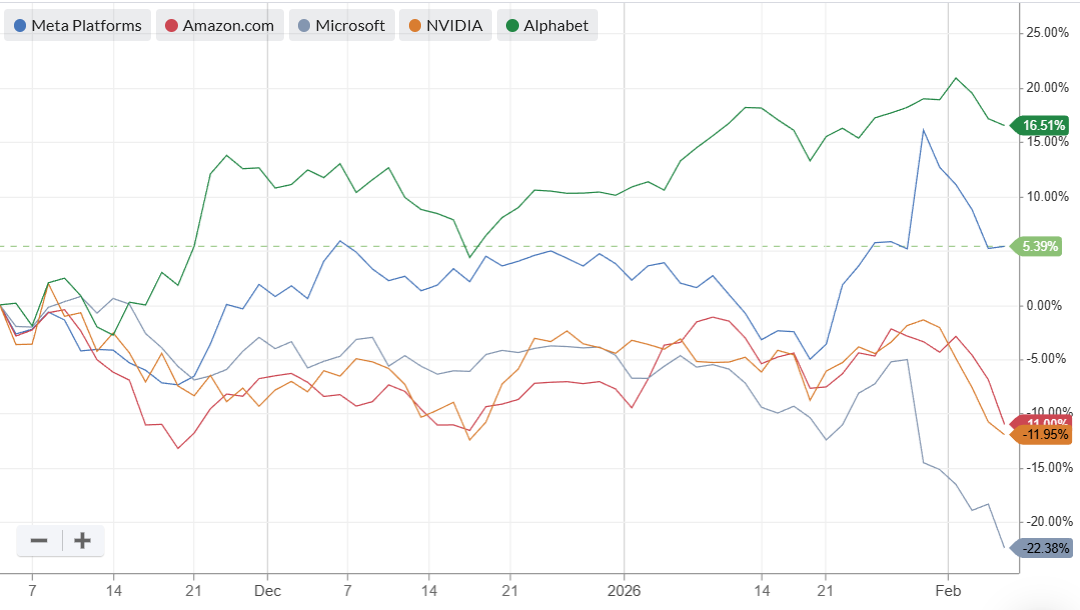
On the one hand, four of the biggest names in tech are now collectively planning to spend c.$655bn on AI capacity during their 2026 financial years:
Amazon.com (NSQ:AMZN) said this week that capex would rise by around 50% to $200bn in 2026, roughly 30% more than market forecasts;
Google owner Alphabet (NSQ:GOOGL) increased 2026 capex guidance to $175-185bn, well above consensus expectations of c.$120bn;
Last week, @Meta Platforms (NSQ:META) said capex would double to c.$135bn in 2026, while Microsoft (NSQ:MSFT) is on track to spend around $140bn in its current financial year, which ends in June.
Markets rightly want to see evidence that these vast spending commitments will drive future profit growth and generate attractive returns. Investors’ views appear mixed, though.
While Alphabet and Meta have largely been given the benefit of the doubt after reporting good commercial progress – for example improved ad effectiveness – Amazon and Microsoft have faced greater scepticism.
Microsoft in particular appears to be under pressure – its shares have fallen by almost a quarter over the last three months:
Anthropic plugins spook SaaS market
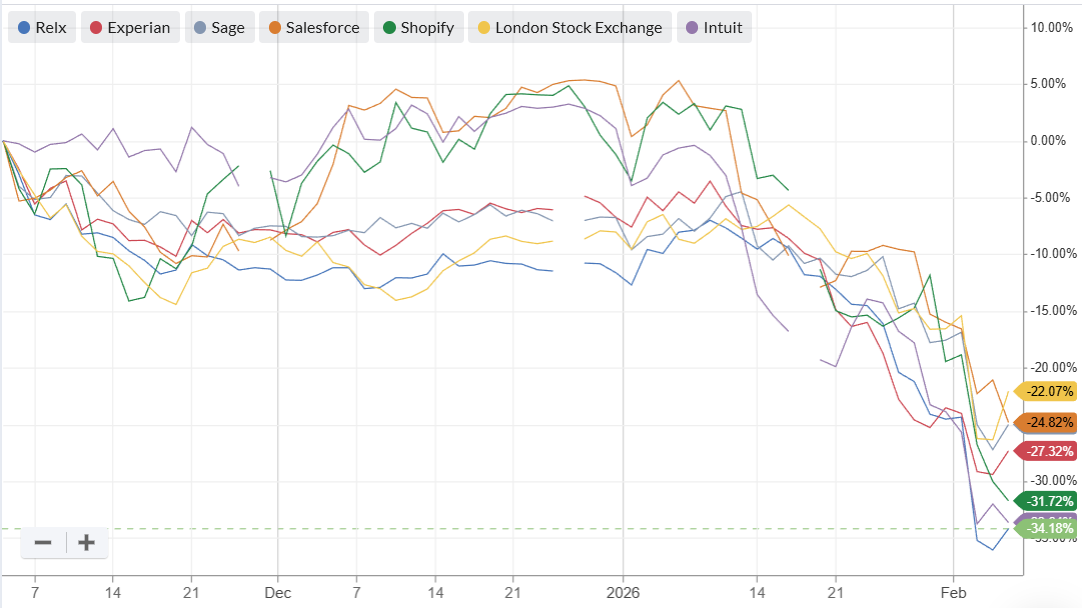
At the same time as investors are questioning the tech giants’ spending commitments, they also appear to be betting that new AI products could inflict severe damage on leading SaaS (Software as a Service) providers.
We’ve recently commented in the Daily Report on share prices declines at Experian (LON:EXPN) and Sage (LON:SGE), despite positive earnings forecasts. This week saw that trend accelerate following the launch of Anthropic’s Cowork plugins. These are effectively AI agents that can perform a wide range of tasks in areas such as law, customer services and finance.
These plugins build on the general productivity capabilities of the Cowork service, launched on 12 January.
Although similar products already exist in some cases, Anthropic’s roll-out of these new features has triggered sudden declines in stocks formerly seen as high-quality, defensive businesses.
Notable losers in the UK included financial data specialists London Stock Exchange (LON:LSEG) and data analytics group Relx (LON:REL), which has a particularly strong presence in law. In the US, Salesforce, Intuit and Shopify have also suffered.
Using a 3-month chart makes it clear that the current sell off started on 12 January, when Cowork launched:
Here in the UK mid-cap market where I spend much of my time, similar declines have also been seen in niche consumer specialists such as MONY (LON:MONY), Autotrader (LON:AUTO), Rightmove (LON:RMV).
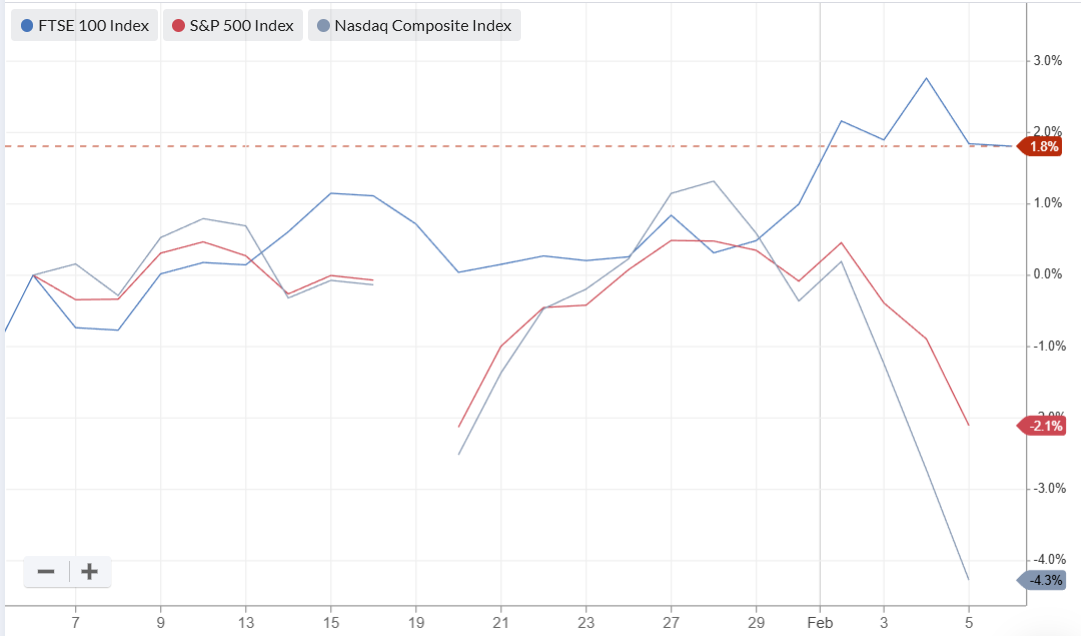
As a result of these big falls in tech stocks, both the main US indices have fallen sharply this week.
In contrast, the FTSE 100 has been buoyed by its broader exposure to non-tech sectors, despite the failure of the proposed Rio Tinto-Glencore mining mega-merger:
Is the SaaS meltdown being overdone?
My feeling is that AI agents (not chatbots) may well prove to be the killer app when it comes to the initial commercialisation of AI. However, I think the risks facing market-leading SaaS businesses are more nuanced than the market is currently recognising.
While these companies do need to create competitive AI tools quickly, many of them are already doing just that. In the UK, for example, LSE Group, Relx and Sage have already integrated generative AI services into their product ranges.
For companies that can stay on top of the new technology, I think customer inertia and other incumbent benefits – such as deep pools of in-house data – should be enough to keep them safe.
The real risk, in my view, is that some of these firms might not deliver competitive products quickly enough to compete with the best of a new breed of solutions from AI startups. In such a scenario, previously reliable customers might go elsewhere.
History suggests that when major new technologies are adopted, some incumbent businesses usually adapt and thrive, while others fall by the way.
In the current situation, I think it makes sense to focus on the following areas:
Software providers whose products are sticky and deeply integrated into existing workflows, such as accounting or transactional systems;
Companies with competitive advantages derived from proprietary data or some other hard-to-replicate asset;
Areas where using a sub-standard product could carry high legal, commercial, or reputational risk.
Perhaps unfairly, I would suggest that writing software code rarely fits into any of these categories. In many ways, it is deeply generic. I wonder if that’s why coding has been the most successful AI application so far.
Looking ahead: beware US jobs slump
Talk of AI productivity miracles and a tech spending boom may grate on the ears of the growing number of US workers who are losing their jobs.
January saw more than 100,000 jobs cut in the world’s largest economy – the biggest January fall since 2009. Last week saw Amazon announce plans for a further 16,000 job cuts in white collar positions, taking the total since October to 30,000.
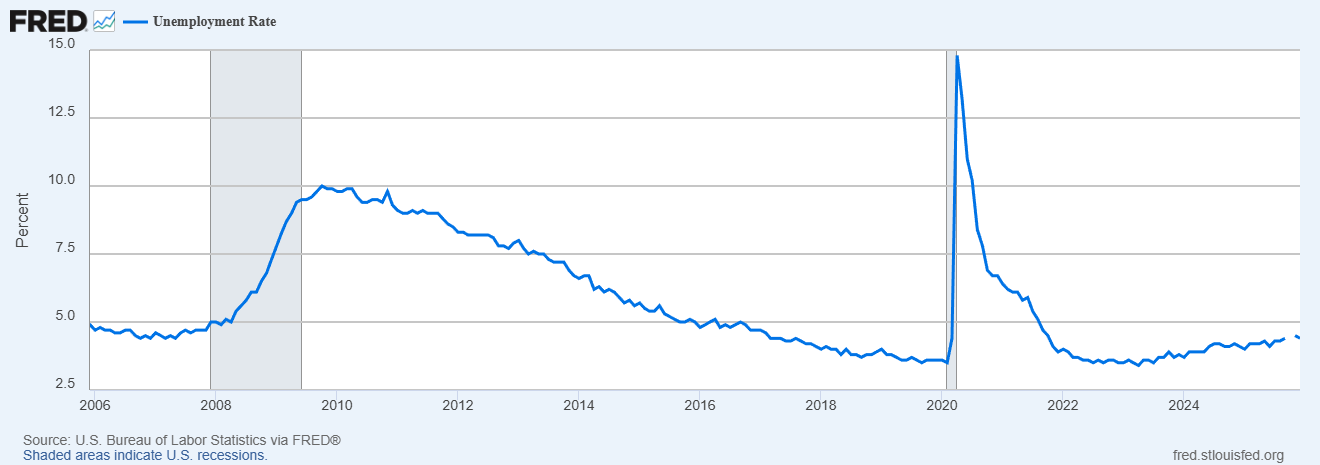
Against this backdrop, I suspect this week’s US unemployment data will be closely watched for signs that the real economy could be slowing. The unemployment rate has now been rising steadily for three years:
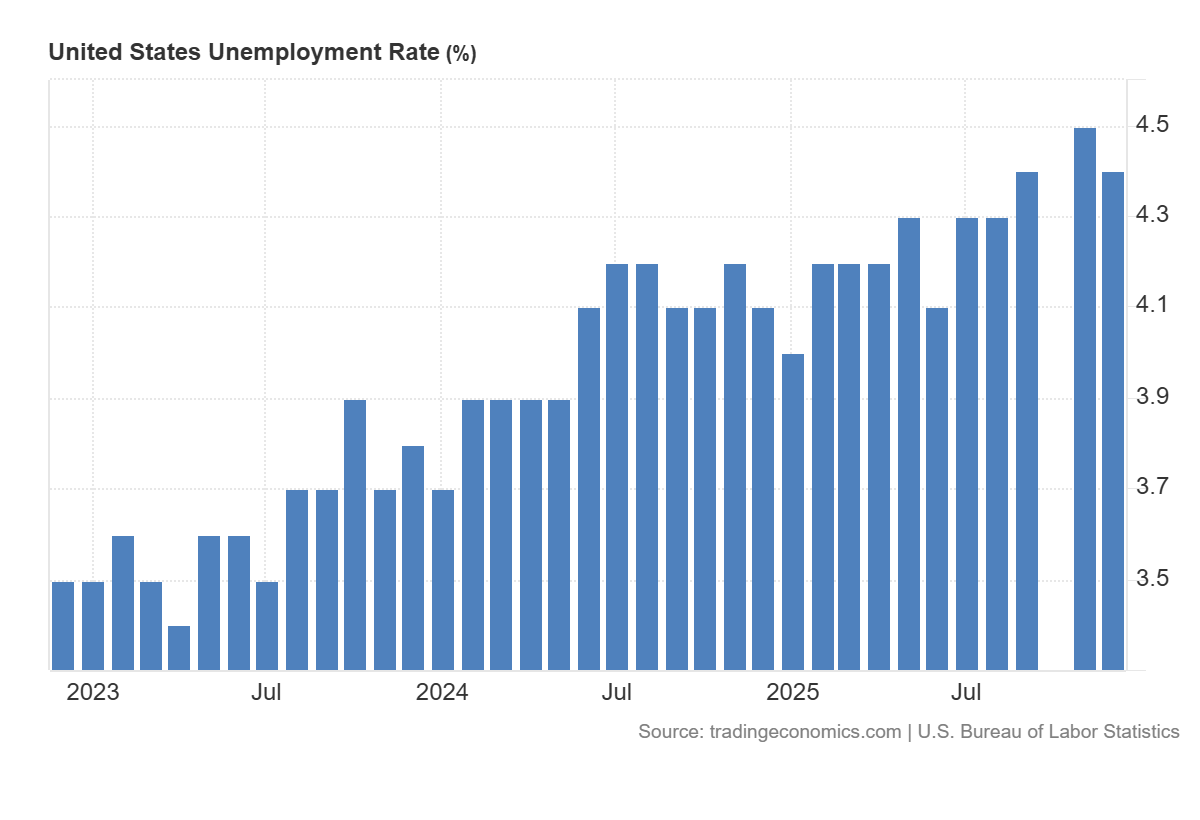
… although unemployment remains relatively low on a longer-term historical view:
Wall Street won’t necessarily remain immune to problems on Main Street, so corporate results from over the coming months could be worth watching for any broader signs of weakness.
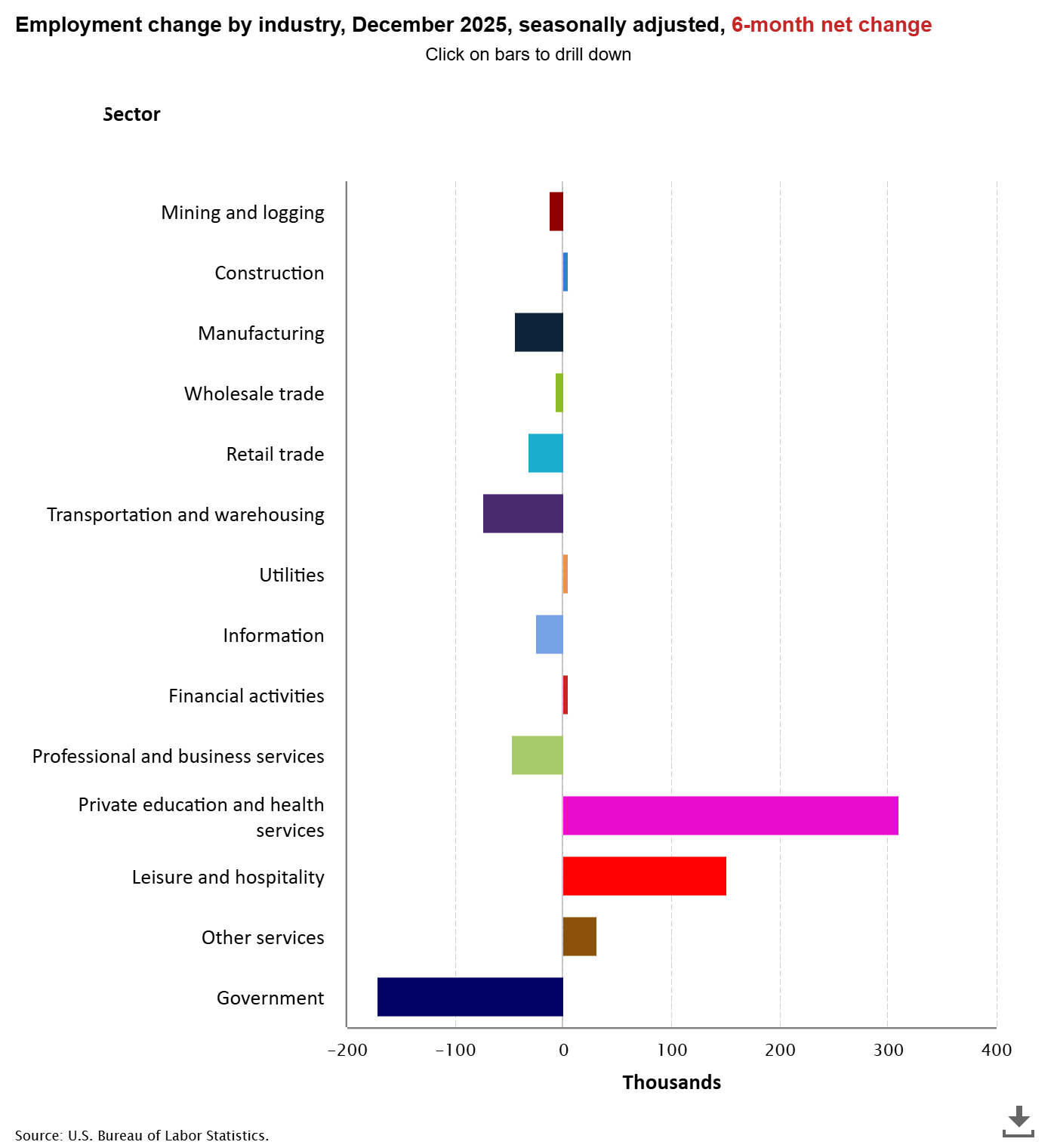
Persistent inflation and rising unemployment could also create political pressure for President Trump. This chart from the US Bureau of Labour Statistics shows post-tariff job cuts in many of the industries Trump had pledged to protect:
Company news
Some of the companies affected by the trends I’ve discussed above are due to report results this week. Shopify and Relx have results scheduled on Wednesday and Thursday, respectively.
For exposure to the broader US economy, updates from Ford, McDonald’s and Coca-Cola may be of interest.
Elsewhere, luxury watchers will be looking forward to statements from Ferrari and Kering, while BP and Duke Energy are due to provide updates from the oil and gas sector.
Here in the UK, housebuilders Barratt Redrow, MJ Gleeson and Bellway are all due to issue statements, as are consumer-focused groups easyJet and Dunelm.
We’ll be covering many of these updates in the Daily Report; as always, please feel free to share your views in the comments and suggest possible topics for us to cover.
Until then, I hope you enjoy the weekend!
Here’s a summary of what’s expected next week.
Economic Calendar
Date / Time (BST) | Country | Event |
9 February | ||
10 February | ||
00:01 | UK | BRC Retail Sales |
13:15 | US | ADP Employment Change Weekly |
13:30 | US | Retail Sales |
13:30 | US | Import/Export Price Index |
17:00 | US | EIA Short-Term Energy Outlook |
21:30 | US | API Weekly Crude Oil Stocks |
11 February | ||
01:30 | China | Inflation |
13:30 | US | Non-Farm Payrolls |
13:30 | US | Unemployment Rate |
15:30 | US | EIA Gasoline & Crude Oil Stocks Change |
12 February | ||
00:01 | UK | RICS House Price Balance |
07:00 | UK | GDP |
07:00 | UK | Manufacturing Production |
07:00 | UK | Goods Trade Balance |
13:30 | US | Initial Jobless Claims |
15:00 | US | Existing Home Sales |
13 February | ||
10:00 | EU | GDP |
10:00 | EU | Trade Balance |
10:00 | EU | Employment |
13:30 | US | Inflation |
18:00 | US | Baker Hughes Rig Count |
Companies Reporting
Date | UK Trading Updates and AGMS | UK Financial Results | International Financial Results |
Monday 9 Feb | Plus500 (LON:PLUS) Porvair (LON:PRV) Wynnstay (LON:WYN) | Apollo Global Management (NYQ:APO) Becton Dickinson and Co (NYQ:BDX) Loews (NYQ:L) Waters (NYQ:WAT) | |
Tuesday 10 Feb | Bellway (LON:BWY) Northamber (LON:NAR) | AstraZeneca (LON:AZN) Barclays (LON:BARC) BP (LON:BP.) Coca Cola HBC AG (LON:CCH) Dunelm (LON:DNLM) | Duke Energy (NYQ:DUK) Ford Motor Co (NYQ:F) Gilead Sciences (NSQ:GILD) Robinhood Markets (NSQ:HOOD) Kering SA (EPA:KER) Coca-Cola Co (NYQ:KO) Marriott International (NSQ:MAR) Ferrari NV (NYQ:RACE) S&P Global (NYQ:SPGI) |
Wednesday 11 Feb | Fevara (LON:FVA) RWS Holdings (LON:RWS) Severn Trent (LON:SVT) | Barratt Redrow (LON:BTRW) MJ GLEESON (LON:GLE) PZ Cussons (LON:PZC) Renishaw (LON:RSW) | CVS (LON:CVSG) Hilton Worldwide Holdings (NYQ:HLT) Kraft Heinz Co (NSQ:KHC) Mcdonalds (NYQ:MCD) Shopify (TSE:SHOP) T-Mobile Us (NSQ:TMUS) TotalEnergies SE (LON:TTE) |
Thursday 12 Feb | easyJet (LON:EZJ) GCP Infrastructure Investments (LON:GCP) | Ashmore (LON:ASHM) British American Tobacco (LON:BATS) Nexus Infrastructure (LON:NEXS) Relx (LON:REL) Schroders (LON:SDR) Unilever (LON:ULVR) | Agnico Eagle Mines (NYQ:AEM) Applied Materials (NSQ:AMAT) Coinbase Global (NSQ:COIN) Loreal SA (EPA:OR) Hermes International SCA (EPA:RMS) Siemens AG (ETR:SIE) |
Friday 13 Feb | Agronomics (LON:ANIC) | Natwest (LON:NWG) | Cameco (TSE:CCO) Enbridge (NYQ:ENB) Moderna (NSQ:MRNA) Safran SA (EPA:SAF) |
Disclosure: Roland owned shares in Sage and Dunelm at the time of publication
Disclaimer
This is not financial advice. Our content is intended to be used and must be used for information and education purposes only. Please read our disclaimer and terms and conditions to understand our obligations.

11 comments
Lyn Alden gives an interesting perspective in her Feb Newsletter..
https://clicks.aweber.com/y/ct...
Mainly macro with a US perspective. Some additional comment on Japan and the usual on precious metals.
Wow,
Lynn Alden, thank you, really edifying.
Great review.
I think no one knows where this is going, so trying to pick winners is a fool's errand.
A strong argument for being as diversified as possible.
I'm out of my depth here but we hold RWS which is surely in the firing line. Not only is AI Data Centre debt roiling markets, how about the implications of Moltbook, or the Deep Fake images of Martin Lewis, Richard Branson and Deborah Neaden extolling fictitious Quantum AI algorithmic trading in posts all over some media sites? Until the sheriffs arrive it's a bit like The Wild West out there.
Those deep fake scam ads featuring Martin Lewis etc have been around for a few years now, so not really new (the fake/ cloned news website with fake celebrity endorsement promoting an investment scam/ magic diet pill etc has been around for over 20 years, so only the fake video part is more recent). If you put the ad images or website links into Google Gemini it instantly recognises them as scams, so why aren't Google, Facebook etc using ai to flag these ads for human review?
Dozens of innocent UK Ltd companies and individuals are having their names hijacked by fraudsters to open 'identity verified by Google ' ad accounts to run these ads. Why should people who are just trying to run a business have their reputation and bank accounts etc put at risk because an enormous tech company with vast resources cannot do basic identity verification? Google have confirmed to the Consumers Association (Which?) that they only verify that the UK Ltd company actually exists and not that the person opening the ad account has anything to do with them (which is such poor id verification that it may as well not exist at all!). Even then, I saw an 'advertiser identity verified by Google ' ad account this week for a UK Ltd company which was dissolved 12 years ago!
Perhaps unfairly, I would suggest that writing software code rarely fits into any of these categories. In many ways, it is deeply generic. I wonder if that’s why coding has been the most successful AI application so far.
I would definitely take a different view here while some patterns are generic, building applications that are genuinely high-performance, scalable, and deliver great user experience remains difficult and highly skilled work. If it was easy SASS businesses won't print such high margins, they would have been eroded away due to competition.
What AI has changed is the tooling. The performance of Claude Code and other agentic development platforms such as Warp is genuinely altering the game. Most software that creates real economic value is still complex and highly specific. The fact that AI can now contribute meaningfully in this space is a smoke signal for the rest of the economy. The world we know is going to change radically. e.g. I would take the direct opposite view if AI can produce software systems which is an engineering skill, then the change it can bring elsewhere is going to massive.
I also think software professionals have adopted AI faster simply because we’re used to high-velocity technical change. We’re culturally primed for it. Perhaps this is turkeys voting for Christmas — but it’s also one of the most exciting and progressive shifts the industry has seen in decades.
The SaaS sell-off, in my view, is largely about licensing models. Per-seat pricing breaks down when each human operator can suddenly do far more work. Fewer seats will be needed, and pricing models will have to evolve accordingly.
One caveat: I’ve found agents tasked with open-ended execution to be unreliable. They tend to hallucinate outside their knowledge boundaries and can produce inconsistent results from identical inputs. However, agents used to generate fixed software that automates processes are far more promising. That’s where SaaS platforms can drive dramatic productivity gains per seat.
If software production continues to get cheaper — which I believe it is — then new SaaS entrants with lower cost bases may start to nibble at the heels of incumbents. That said, brand power still matters.
If software production becomes cheaper (which I believe is happening) then perhaps new SASS platforms can chew the heals of those with high costs. I'm not sure here... but time will tell. The brand power of Salesforce (NYQ:CRM) Adobe (NSQ:ADBE) ServiceNow (NYQ:NOW) etc. is significant.
Ultimately, nobody knows how this plays out. Given that uncertainty, being selectively “out” of the SaaS sector probably makes sense for some investors. I’m staying close to the space — waiting for the trend to turn.
Any improvement on the average coding is welcome. In the last decade or so of my IT career, I noticed I was 'called out' at night more often as the standard of code went downhill for whatever reason - possibly due to management thinking throwing cheap bodies at it would improve the software or possibly the lip service paid to Agile rather than doing it right did not help. LOL.
I feel your pain, driving speed over quality often leads to success so you can see why that happens. In my experience first to market is the ultimate long term winner. I always remember the early iphones, no mobile internet, patchy phone connectivity but the ultimate long term winner.
Difficult circle to square. I definitely do not think that AI will increase software quality and there will be a lot more of it, so the number of bugs will scale out.
"The SaaS sell-off, in my view, is largely about licensing models." that's the issue, for sure. But, I think that the existing vendors will be able to adapt their licensing models pretty quickly to convert to pricing based on transaction volumes or other (theoretical) models of value add. The ones that have a strong core software product and deep integration into a wider ecosystem may well even benefit. As the majority of code in every software product is never used - because humans don't know about or have the skills to exploit them - an intelligent licensing model that uses transactions rather than seats as the basis of pricing could potentially yield higher overall revenue
I concur, the P/E and stock market very much value fixed recurring revenues over variables, in a deal I was involved in recently the P/E house pretty much ignored the variable and commission based revenues, going for 5.5x ARR, that said the EBIT valuation was 20x so it seemed fair. However there was some talk about discounting the variables into bundles to shift the valuation up for the next deal, I think that's wrong as I agree with your view that usage based charges are a way to increase profitability as people adopt new functionality.
Thoughtful analysis, software is easier to write with AI and I can see the demand for custom written software tailored to a business needs will increase as it is more more affordable and cheaper to own and maintain.