Three ways to generate higher total returns without reaching for yield

In recent weeks I’ve been experimenting with a year’s worth of market data to figure out which factors combined have produced the best total returns in dividend investing strategies. It’s fair to say that 12 months is a very limited test period, but what I have wanted to do is validate some ideas. With evidence of recent success, I’ll at least have a more confident starting point for putting theory into practice for the next few years.
The investigation began by tracking the shares that have both a high yield and a high StockRank. The StockRanks are Stockopedia’s system of scoring and ranking companies based on their Quality, Value and Momentum. Over the past two years, baskets of high StockRank shares have delivered some stunning capital returns, but it wasn’t clear whether these stocks would suit a dividend strategy. As it turned out a 25-strong portfolio ended up with one-year capital growth of 11% and an overall yield return of about 5%. A 16% total return in from this strategy was very promising.
Could we improve it? Well we wondered whether the concept of ‘dividend achievers’ could boost this strategy further. Dividend achievers are stocks that have consistently grown their dividend payouts over a period of 10 years. In the US, the official Dividend Achievers index demands a continuous, uninterrupted growth streak of 10 years, but across the smaller UK universe of stocks this is harder to find. So we settled on screening for seven years of dividend growth out of the last 10 - with no dividend cuts allowed.
Here are the rules that we tested:
- A market cap greater than £100m.
- A StockRank greater than 85.
- A yield above 3%.
- A record of paying a dividend for the last 10 years.
- A dividend per share that is forecast to grow.
- No dividend decreases in the past 10 years.
- At least 7 dividend increases in the past 10 years.
As I mentioned last week, a year ago there were 33 companies that passed these rules. The top 20 of them sorted by the highest StockRank generated a capital gain of 16.9% and a yield of 3.1%. Clearly this 20% total return is significantly better than the 16% we achieved using high yield and high StockRank alone… but it did come at the expense of a lower dividend yield.
Hang on… a lower yield? That sounds like we’re getting away from the entire point of this exercise, which is to chisel out an income strategy.
High yield, worse returns?
Well the interesting finding is that when you filter for the best 20 stocks out of our original list of 33 qualifying stocks, the total return achieved was heavily dependent on how that list was sorted. In fact… picking the 20 highest yielders from the list generated the worst returns.
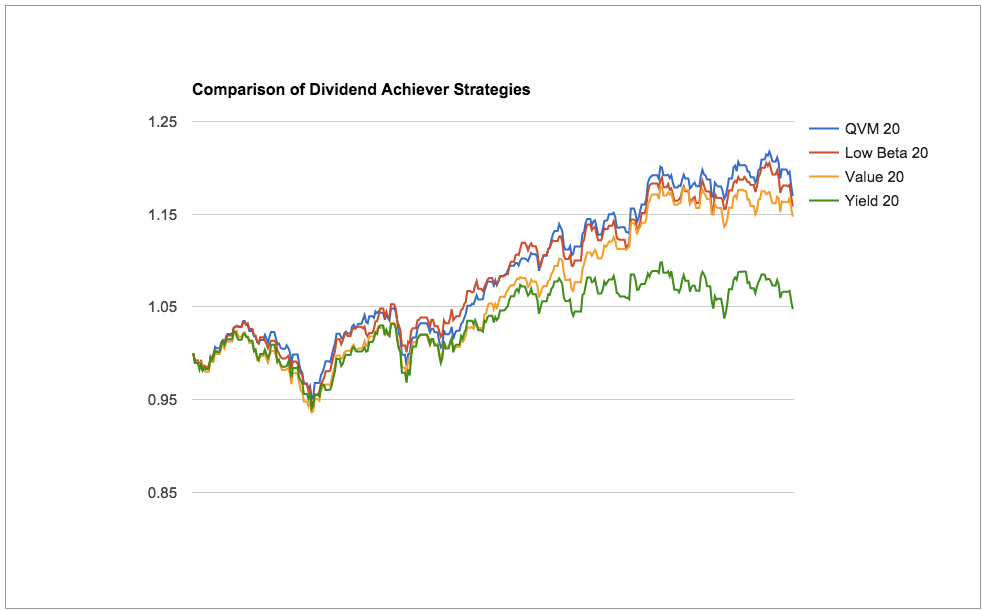
This chart above shows the divergence between overall returns when you sort for the top 20 stocks using either the StockRank, Low Beta, Value or Yield. Here is the total return chart for each of the four sorting parameters.
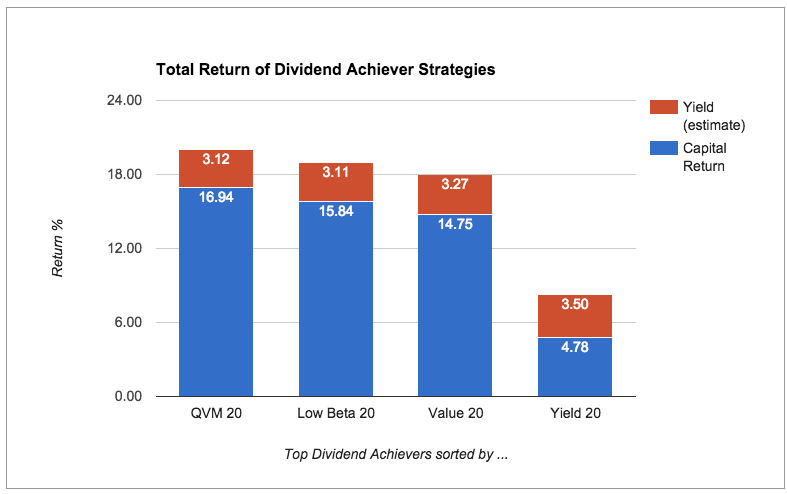
The standout result from the backtest is that the 20 highest yielding stocks in the original list of 33 generated by far the lowest total returns. Moreover, opting for the highest yielders wouldn’t have actually given you a much higher average yield than the other strategies. In fact it was just an average 0.3% improvement. But it came at the cost of a huge underperformance in capital gains. Chasing high yield just didn’t pay!
Don’t forget the other payoffs
The most important lesson here is that hunting for a single factor in the stock market (like yield) is narrow minded. If an investor is looking for a higher return from the stock market it can be more profitable to hunt for it in a roundabout fashion - by looking for less high yielding shares that may be ‘cheaper’ across some other dimension - such as quality, value or momentum.
- Quality: Low beta stocks (which have share prices that are on average less sensitive to the movement of the wider market) dramatically outperformed. Picking the 20 lowest beta stocks, which are generally higher quality stocks, returned 18.9% overall, 10.7% above the yield sorted strategy.
- Value: The ‘cheapest’ 20 stocks in the list, using the blended Stockopedia Value Rank outperformed the yield sorted strategy by 9.74%. Hunting for value in other ways but the yield clearly brought significant benefits.
- Momentum: But best of all was a blended approach that also incorporated the use of momentum. The Stockopedia StockRank sorted approach - which blends quality, value and momentum - outperformed the pure yield strategy by 11.78% for a total return of 20%.
So the main finding when building a high yield strategy is that in the hunt for the highest total return any method of secondary sorting should take priority over yield. It turns out that if you do that, you won’t be giving up much in the way of yield anyway. I’ll reiterate that this was a one-off, one-year period so the evidence is certainly limited but the results are pretty clear nonetheless. I’d be fascinated to hear your thoughts… should you stretch for yield directly or should you find your yield in a more indirect way?
Disclaimer
This is not financial advice. Our content is intended to be used and must be used for information and education purposes only. Please read our disclaimer and terms and conditions to understand our obligations.
2 comments
Have to agree with pka, interesting analysis, but 1 year's data - is far too short to produce any meaningful conclusions.
Peter
Ben,
This is interesting, but the sample size is far too small and the test period is far too short to reach any statistically valid conclusions.