Time Finance: when preparation meets opportunity

Here’s another brief stock pitch for you! Time Finance (LON:TIME) (StockRank: 82) is another stock that could have made it onto my annual watchlist this year, and is a company that has made a consistently positive impression on me, so I’m happy to lay out the case for you here!
Disclosure: At the time of publication, I do not have a position in Time Finance.

Source: timefinance.com/clients
The Pitch
Time Finance, known as 1pm plc until 2020, is a Bath-based independent finance provider with two main categories of business: invoice finance and asset finance.
They previously offered loans that were less well secured, such as ordinary business loans and consumer loans, before making a strategic shift into lower-risk categories. The hard assets against which they lend include construction equipment, printing equipment, manufacturing & engineering machinery, tractors, cars and vans.
After suffering some weakness during Covid, they have enjoyed considerable growth from a low revenue point of £22.5m (FY May 2022) to an expected £38.5m in FY May 2026 (source: Cavendish). This represents a compound annual growth rate or CAGR for revenues over this four-year period of 14%.
What makes this all the more meaningful is that it has been achieved during a period of strategic change, with a major evolution in the composition of their lending portfolio. More on this below.
The Big Picture
The broader company profile is as follows:
£235m lending book (as of November 2025), up 12% year-on-year.
Strategic focus: the core products, focused on “hard” lending categories, have reached 87% of the total lending book. This is up from 78% in November 2024. Back in 2021, they were only 50% of the portfolio.
Low arrears: at the most recent interims, arrears were only 4.5% of the lending book (down from 5.3% a year earlier). Bad debt write-offs were only 1% of the average lending book (down from 1.2% a year earlier).
With 98% of new lending by TIME focused on their core categories, their lending book is only going to continue becoming more concentrated in them.
Committed, long-standing management: CEO Ed Rimmer has been with the company since 2017, and has been CEO since 2020, overseeing the company’s successful evolution. CFO James Roberts has also been with the company, as CFO, since 2017, which I believe is an exceptionally long tenure for the CFO of an AIM-listed company. I also believe that it says something positive about the culture of the company, to have kept the same CEO and CFO for such long periods.
What The Brokers Say
The stock is covered by Cavendish and earnings forecasts have been steady:
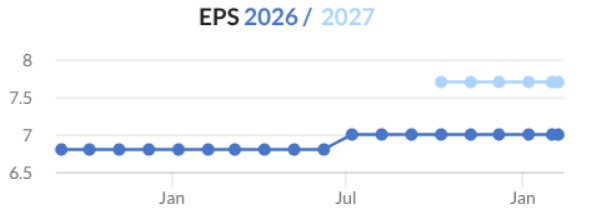
Looking ahead, we have the following forecasts for the next two years. The company has reiterated that its outlook is “at least in line” with expectations.
Courtesy of Cavendish:
FY May 2026: revenue £38.5m (up from £37.1m), adj. PBT £8.6m (up from £8m), adj. EPS 7p (up from 6.5p).
FY May 2027: revenue £40.6m, adj. PBT £9.5m, adj. EPS 7.7p.
Their current three-year plan, which is in place until May 2028, targets a lending book of £300m+ and “mid teens” return on equity.
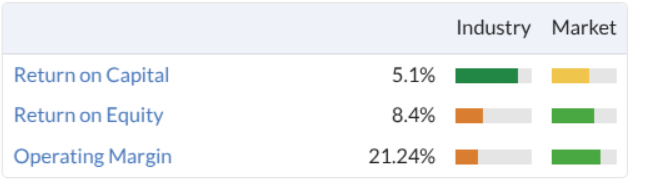
Stockopedia’s calculation of historic ROE matches up perfectly with my own (8.4%), leaving the company with plenty of room for improvement when it comes to this metric. If mid teens ROE can be achieved, even on some adjusted profit measure, it could be transformational both to the company’s bottom line and to the market’s perception of the business:
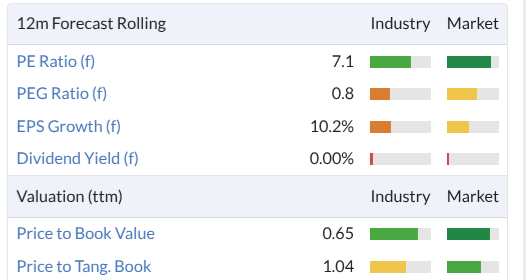
Valuation: at 53p, the shares trade at 7x projected earnings for FY May 2027 (the financial year that starts in 5 months), or 8x projected earnings for the current year, FY May 2026.
Relative to balance sheet equity of £47m, the market cap (£49m) is only a small premium to this level. If the market cap does not increase, projected profits are expected to convert this into a discount over time.
The Bear Case
Economic risks: the company does attempt to diversify its exposures to particular debtors and to particular sectors, but it can’t fully protect itself from a downturn in its chosen sectors or in the economy as a whole. Sectors it lends to include manufacturing, construction, transport, agriculture and retail.
Generic lender risk: all lenders are inherently risky and difficult to assess. We have learned this the hard way in the past, with the likes of PCF Bank. There may be risks that are impossible for outsiders to understand.
Key man risk: while I believe that a long-standing management team is a positive feature of the business, the counter-argument is that the company may have become overly dependent on a small number of individuals. The CEO and CFO own only modest stakes in the business (1.4% for the CEO, 0.7% for the CFO).
The Bottom Line
I like to find small, growing lenders where management appear to be trustworthy and where there is the potential for the performance of the business to qualitatively improve over time. That appears to be the case here, and indeed rising quality of returns is one of the company’s key ambitions and KPIs over the next 2-3 years.
If targets are hit, then not only will earnings per share increase, but the market’s perception of the quality of the business should also improve, leading to multiple expansion (from the current 7x) and/or to the market cap commanding a premium to book value.
Also, if you’re interested in a catalyst: this company has not paid a dividend since 2019, and is not forecast to pay a dividend any time soon. While this means that a dividend declaration is unlikely to be a catalyst in the short-term, it also means that the stock may be under the radar for the large pool of investors who do prefer dividend-paying shares.
If the business hits its targets, then perhaps we’ll see a small dividend declaration in 2028 - and I feel confident in saying that would attract attention!
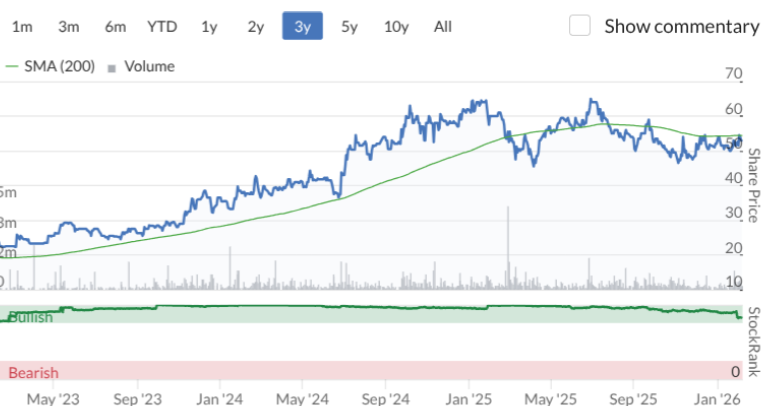
For now, the shares continue to trade at a level they first reached in August 2024:
Disclaimer
This is not financial advice. Our content is intended to be used and must be used for information and education purposes only. Please read our disclaimer and terms and conditions to understand our obligations.

7 comments
Proceed with caution. The world has been littered with failed specialist loan companies most especially invoice lenders. Almost by definition the cash flows of their clients are poor. And as for safer loans to finance 'solid' capital purchases the rate of real - as opposed to accounting - depreciation varies enormously as the overall and specific business outlook changes.
That's true, also. We've been bitten before in this sector. I would never allow any single lender to be a very large piece of my portfolio. G
Time Finance are on the Mello show this Monday evening
PROGRAMME
5:00pm Interview with Dr Paul Jourdan and Gregor Paterson, Amati Global Investors
5:30pm Company Presentation from Time Finance
6:00pm Company Presentation from The Alumasc Group plc
6:40pm Company Presentation from Sulnox Group
7:00pm Company Presentation from Seeen
7:20pm New series...Mello Insights: Leon Boros' 2026 Investing Strategy & Stocks To Watch
Next MelloMonday coming up on the 9th Feb: Paul Jourdan, Gregor Paterson of Amati Global are keynotes! | By carmensfella | Stockopedia
The 8.4% return on equity is below the cost of capital. So they are effectively losing money for shareholders.
How exactly are they going to move this up to a mid teen ROE? Without a realistic plan they are not a viable investment proposition.
Tremendous point!
This is clearly not true. If the company was losing money then it would have to plug the shortfall by either raising money from shareholders or taking on more debt. Since the current executives took over in 2021 the share count has remained flat and company debt has remain negligible (which is separate to the group debt which has grown in line with their loan book as you would expect for this type of business).
That's fair enough Epitychia. They aren't currently generating an attractive ROE, I accept that of course.
Despite not being a "growth investor" as such, I am personally willing to look past the current ROE, on the grounds that they are growing at a decent pace and have a stated ambition to grow the lending book by 28%, by 2028. If they do that, then perhaps they can achieve mid-teens ROE, as is their intention. It's clear that the investment case is built on this idea: that they will grow the lending book and grow ROE as costs are spread out across a bigger portfolio. At the current P/E multiple (7x) and with the market cap roughly equal to tangible value, I don't think the market is currently pricing in a very high probability that they will succeed.
All the best
Graham