UK takeovers: The outlook for private investors in 2025

The UK stock market has emerged as a fertile hunting ground for takeovers in recent years. This has largely been driven by the steep discounts available on UK equity markets when compared to the rest of the world. After all, why wouldn’t you buy a £1 coin for 50p when presented with the chance?
This hasn’t happened by chance. A series of events, starting with Brexit uncertainty and progressing through political instability and a poor macroeconomic backdrop, have led to a structural undervaluation of the UK stocks. And while other global markets rebounded post-pandemic, the UK has failed to mirror such a performance.
One of the primary drivers of the market’s perennial discount is the fact that UK pension funds have significantly reduced their exposure to UK equities, instead choosing to reallocate their assets to bonds and global equity markets. Astonishingly, the percentage of UK equities in pension portfolios plummeted from over 50% in 1997 to just 6% in 2021.
To add salt to the wound, retail investor sentiment has been inconsistent, at best. There were substantial inflows in 2013-2015 and 2020-2021, followed by record outflows in recent years as UK investors have clamoured to access the mega returns on offer in international markets.
Consistent record highs being set in the US, Germany and Japan, to name a few, and the improving access to these markets has made it a far easier decision for UK investors to put their money elsewhere. Indeed, the MSCI UK index, which tracks the performance of most of the UK’s largest businesses, has seen less than half of the returns of the MSCI World index since 2009.

Source: MSCI
The result is a market that trades at a perennial discount to its international peers. If we add in the relative weakness of the pound against the dollar in recent years, UK assets become even more appealing to foreign acquirers.
Takeover central
Private equity (PE) firms and industry players alike have taken note of the discounts on offer when shopping on the UK equity markets. The allure of buying high-quality assets at a discount has proven too good to resist.
This has all led to a recurring theme of takeover premiums, with acquirers typically offering 30-70% above the prevailing share price on the day of the offer.

Source: FT
But while lofty premiums may appear generous on the surface, they are often still well below the intrinsic value of the target company.
For private investors, takeover offers can be very frustrating, especially when combined with a disappointing lack of IPO activity. This also adds pressure on institutions to offload holdings which are offered a takeover at a sizable premium.
There are plenty of examples where institutional investors now view takeovers as an easy exit route with quick returns and prefer to do this rather than endure prolonged periods of undervaluation and uncertainty for their holdings.
Opportunities in disguise
For private investors, the under-appreciated market is characterised by a number of ratios. For example, the median forward PE ratio of stocks listed on the FTSE All Share is roughly half that of the S&P 500. This means investors are willing to pay nearly twice as much for the earnings potential of US rivals.
UK stocks tend to pay out much higher dividend yields than their US or international counterparts, signalling that investors have to be compensated for the perceived risks of holding the stock with more generous dividend payouts.
This environment has created somewhat of a dual opportunity for private investors. On the one hand, there’s the potential to capitalise on the acquisition premiums being paid for undervalued stocks. You can see the level of premiums being paid out for UK businesses from the table below.
So while private investors may be disappointed to not realise the full value of their investment, identifying such takeover opportunities can offer significant advantages. They can provide swift returns through premium payouts, enabling investors to effectively redeploy capital to other opportunities.

On the other hand, the broader structural discount in the UK market offers long-term investors the chance to build positions in quality companies before the market fully re-rates their value. For those brave and patient enough to take a contrarian stance, the UK stock market offers a unique opportunity to possess some deeply discounted companies with the potential for significant revaluation over time.
How to spot a takeover candidate
Identifying potential takeover candidates is easier said than done. It requires fundamental analysis, general market awareness and a knack for understanding the intricacies of sector dynamics. However, with a bit of training, investors can significantly improve their odds of spotting takeover opportunities.
Low valuations vs peer group: One of the most common traits of takeover targets is significant undervaluation compared to peers. Companies trading at low price-to-earnings (P/E), price to free cash flow, (P/FCF) or price-to-book (P/B) ratios can be attractive to acquirers seeking to extract maximum value from a company’s assets.
For UK-listed companies, this is particularly relevant, as the UK stock market trades at a structural discount compared to global markets. Acquirers often see these discounts as opportunities to acquire valuable assets at a fraction of their intrinsic worth.
Strategic Fit: Companies that operate in high-growth sectors, are experts in a particular field or niche, have access to key resources, or form a fundamental part of a supply chain are much more likely to get bought out, irrespective of price.
Think about the number of times you’ve seen a large tech company acquire a peer which has some exciting new proprietary technology under its possession or a mining giant that acquired a smaller rival to gain access to a lucrative new asset.
It’s always worth keeping in mind how a firm’s assets or market presence align with potential acquirers’ objectives.
NB: Size doesn’t always matter. Takeovers in the UK occur across the size spectrum, from microcaps to companies worth more than £1bn. While smaller companies may offer outsized premiums, undervalued large-cap stocks are also attractive targets.
Sector Trends: Certain industries are simply more prone to consolidation. For example, we often see mergers and acquisitions take place in the financial services, tech and energy industries.
These waves of mergers and acquisitions take place as players seek to enhance market share by taking out the competition or streamlining their operations through vertical integration of the supply chain.
Monitoring sector trends and the level of takeover activity within those sectors can help investors anticipate which companies might be more likely to be in line for a bid.
Market Signals: Takeover rumours, increased institutional involvement, management announcements, or significant share price movements in companies can signal potential M&A activity ahead. News about activist investors, shareholder discontent, or strategic shifts within a company can also indicate that a takeover bid may be looming.
Remember that rumours are often just rumours, though, so take what you see across the web with a big pinch of salt. A more reliable indicator can be looking at a surge in volume, for example, once takeover speculation has commenced.
What to do if you stock gets a takeover offer
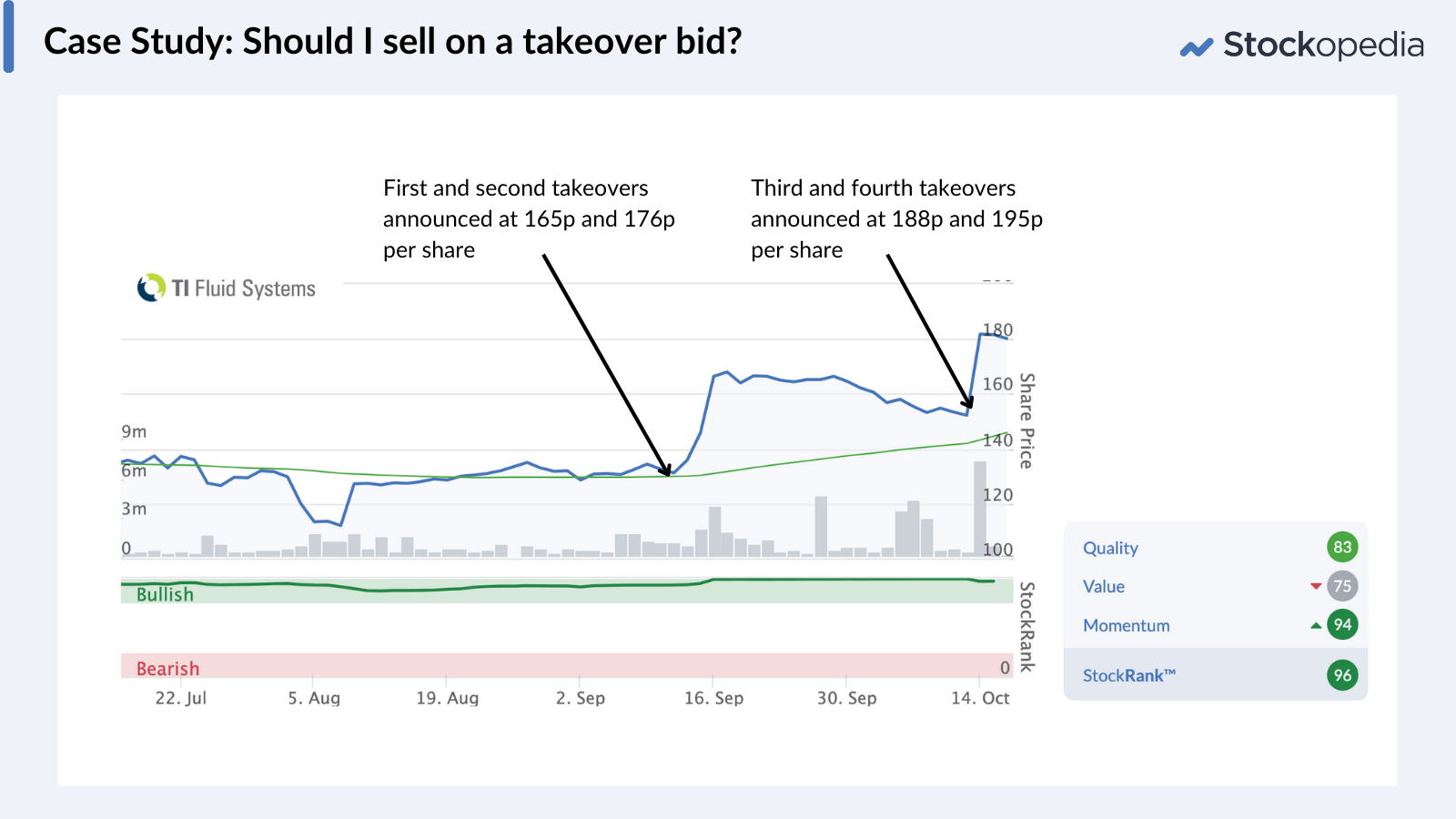
When an offer is made, the options for investors are usually fairly simple: accept the offer via their broker (or, for a Scheme of Arrangement, wait for this to be approved) or sell in the market when a takeover is announced. The benefit of selling immediately is that an investor makes a gain immediately, even if the takeover fails. However, other shareholders may do this, and investors are unlikely to get the full offer price. They also miss out on further gains if there is a competing bidder or an enhanced offer. The variety of possible outcomes makes deciding what to do in response to a takeover offer difficult, and no investor always gets it right.
Mark has put together a comprehensive guide to takeover offers which you can read in the Academy here.
The undervaluation of UK equities, coupled with institutional selling and retail flight, has created a ripe environment for takeover activity. In 2024, UK M&A deal value far surpassed levels seen in Europe. Indeed, a value of over $300bn exceeded the takeover totals of Germany and France combined.
For private investors, the scale and frequency of M&A present both risks and opportunities. By focusing on undervalued, high-quality companies and understanding the mechanics of takeovers, investors can position themselves to benefit from either acquisition premiums or long-term market re-ratings.
Disclaimer
This is not financial advice. Our content is intended to be used and must be used for information and education purposes only. Please read our disclaimer and terms and conditions to understand our obligations.

6 comments
PZ Cussons (LON:PZC) is your typical takeover candidate - good brands laid low in the short term by unfortunate overseas developments .
Interesting thread - hopefully it will keep ticking over as subscribers post their own takeover ideas.
Marston's (LON:MARS) was a possibility a couple of years ago but I think that ship has sailed.
My takeover target is Centrica (LON:CNA) may seem a strange one but look at the cash it has got and future cashflows.
A possible takeover target might be Yu (LON:YU.) with Centrica (LON:CNA) a possible bidder, using some of their huge cash pile!
Hi davidallen77,
Centrica (LON:CNA) is definitely an interesting one. Huge cash pile on the balance sheet, as you say, and the management team have been carrying out some pretty intensive buybacks. There's also a potentially stronger market backdrop given the improving natural gas price environment.
However, I would say that when I'm hunting for takeover targets, I tend to avoid businesses that are essential to domestic energy supplies, the defence industry, or critical technologies. The simple reason being that these are more likely to see government intervention in the event of a takeover. Given the government's lack of intervention in recent years regarding the takeovers of UK plc, I certainly wouldn't rule this out though.
I believe blue-chips such as ITV (LON:ITV), BP (LON:BP.), Tate & Lyle (LON:TATE) and Vodafone (LON:VOD) could also be prone to bids over the next 12-18 months . The valuations vs international peers might eventually become too good to ignore, especially as the pound continues to plummet.
Best,
Keelan
Hello Keelan, the returns and valuations are even worse as is based in £, which has fallen against most major currencies from before Brexit. Japanese Yen has fallen even against the £, so their market maybe at a high, but if you based abroad, your investment is likely to be down still, l have some Japanese funds, still well down.
Compared to US companies, the UK stocks appear very cheap.
Although they do tend to have more debt and less growth.
I tend to sell straight away on the news unless it is low offer. Quite a few do not happen. Yes can loose out if there is a higher bid, but waiting for the full pay out, often takes a long time and the upside is very limited. I did wait on a couple, last year, but feel it was not worth it, better to take a few % less and reinvest it.