Vanquis Bank - Seemingly benign guidance changes postpone recovery, and lead to some huge earnings downgrades

Analyst’s view:
Last time I reviewed Vanquis following the Interim Results, I reduced our view to AMBER, saying:
With current-year EPS forecasts cut by 63%, this no longer looks like good value on earnings unless you believe the FY28 forecasts. Given the scale of today's downgrades, the idea that this is just a recovery delayed must be taken with a pinch of salt. The discount to TBV suggests there is value here if that recovery comes. However, with earnings being the difference between several large numbers, I wouldn’t be brave enough to forecast exactly when that is.
However, having called the outlook credibility issues correctly, I clearly wasn't negative enough in our view, as the share price is now half what it was back then.
The now-large discount to TBV gives some hope to very long-term holders. However, with the desired recovery repeatedly pushed further out and capital ratios potentially restricting shareholder returns and raising risk if further losses ensue, I will correct last time's oversight and take a more negative stance today. AMBER/RED
Down 35% at 47p - 3rd Quarter Trading Statement
First off, let me again caveat this by saying I am not a banking sector specialist (and don't have much desire to be one!). It was clear when I wrote the summary of this morning's Q3 trading update from Vanquis that this was a profit warning, with some small cuts to guidance. However, as with the last warning, the scale of the share price drop has surprised me.
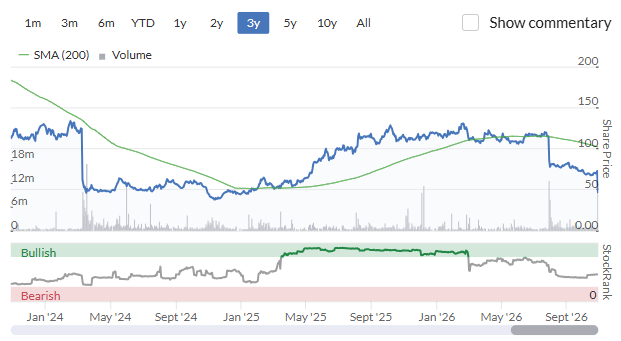
This takes the share price back to the level of late 2024, before the market started pricing in a recovery following a previous large profits warning in March 2024:
Guidance changes:
The short-term guidance change is relatively slight:
Gross customer interest-earning balances for FY26 go to c£3.3bn from >£3.3bn. The impact for the following year is bigger, going to c.£3.4bn from the previously guided >£3.7bn. However, this still represents modest growth for the year.
Net Interest Rate Margin (RAM) guidance remains the same for both years but was already forecast to decline going forward.
However, risk-adjusted margin guidance is cut by 50bps for each year. (RAM is what a lender earns on its loans after taking off expected credit losses, shown as a percentage of the loan book.)
However, there are some reasons why this update has been taken so badly by the market:
Lack of credibility: This is now the second downgrade in a row, following a similar change in the H1 results released in July. Even before these warnings, the previously targeted mid-teens ROTE had been pushed out. It now drops off the guidance horizon altogether. Each reset has pushed the payoff further out. Understandably, the market is now discounting the 2028 numbers too.
The problem has shifted from margin to credit: July’s downgrade was mostly about yield, as spending caution and a mix shift toward second-charge mortgages compressed NIM. Today’s update is about credit losses. Card charge-offs rose because of individual insolvencies. With an insolvency, balances are charged off immediately rather than first appearing in arrears. That makes losses harder to see coming. A lender can look fine on arrears and still take a hit, so investors trust the company model less.
Short-term losses: Today the company said the IFRS 9 expected credit loss provisions led them to report a small loss for the quarter. With thin profit margins, the company's bottom line is highly sensitive to small changes in guidance.
Broker forecasts:
These factors come through in changes to broker forecasts. Panmure Liberum say:
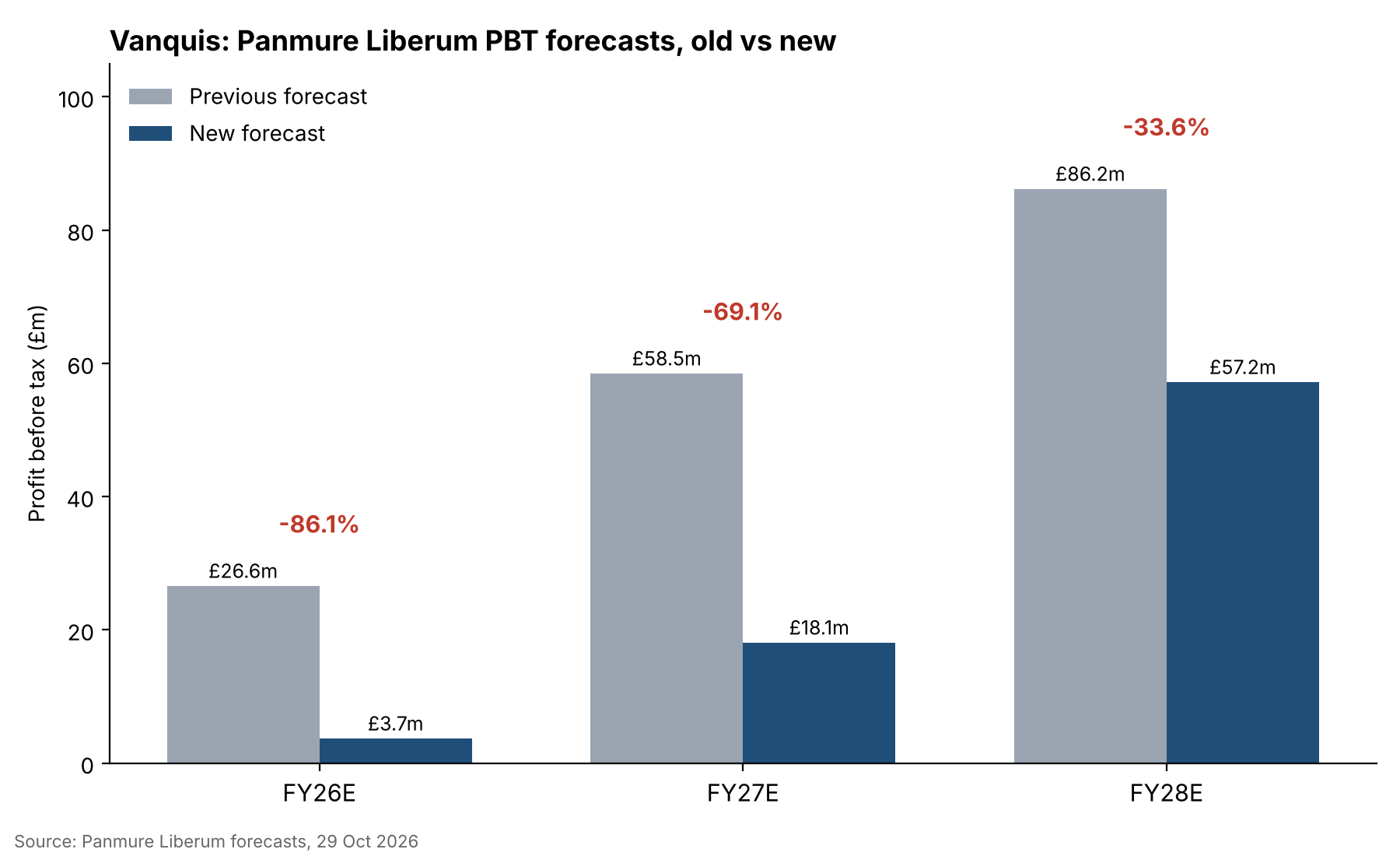
PBT becomes £3.7m in FY26E, £18.1m in FY27E and £57.2m in FY28E, from £26.6m, £58.5m and £86.2m.
Calculating these in percentage terms, the current mid-30s percentage drop in share price actually looks light compared to the scale of the downgrades:
Balance sheet:
One of the attractions here is that Book Value will only be slightly impacted by short-term losses. Even prior to today's share price fall, the company traded on a large discount to TBV:
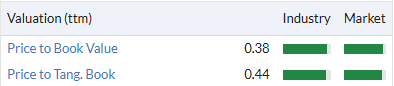
The discount will now be much larger and may mean there is value for investors with very long-term investment horizons.
However, in the short term, I see little ot be enthusiastic about. CET1 is down 260bps year-on-year to 14.8%, and 2026 guidance has been lowered to >14%. On the Basel 3.1 basis, the ratio is 12.8%, only 80bps above the >12% floor. With this figure relatively tight, it is unspurprising that Panmure Liberum now don't expect a dividend paid this year, saying:
With earnings attributable to shareholders slightly negative this year after the AT1 coupon, we now assume no FY26 dividend, with an assumed 20% payout resuming from FY27E.
Management actions:
Management certainly aren't just lying down and letting the losses wash over them. Panmure Liberum say that:
Growth, underwriting and costs remain in management control. All three levers are being pulled. New card lending at the riskier end has been pulled back, Vehicle Finance new business is measured until the new platform lands, and mortgage flow comes through partners whose taps can be turned down. Tighter acceptance criteria give up some yield but improve the cost of risk. The organisation has been simplified again, with the Gateway technology build nearly complete; £30m to £35m of cumulative transformation savings come through to FY28E.
However, credibility here is perhaps undermined by the CEO leaving, while his successor still hasn’t been named.
Disclaimer
This is not financial advice. Our content is intended to be used and must be used for information and education purposes only. Please read our disclaimer and terms and conditions to understand our obligations.
Discussion on Vanquis Banking (0)
Comments here are also visible in the Daily Stock Market Report
No one has commented here yet! Why not be the first one?