Virgin Money UK (LON:VMUK) - finally, a successful challenger bank

Summary
After some difficult years, last year’s results from FTSE 250 challenger bank Virgin Money UK (LON:VMUK) were characterised by improved profits, top-line growth and a new confidence.
Cyclical risks can’t be ignored, but the bank’s shares continue to trade at a wide discount to book value. This suggests a potential opportunity, if existing momentum can be maintained.
Bull points:
Recent results show continued growth and a strong capital position
Rising interest rates are contributing to improved profitability
Trading at c.50% discount to tangible book value; cheaper than peers, despite similar profitability
Newly-established dividend provides attractive 4%+ forward yield
Bear points:
Economic slowdown raises the risk of elevated losses from bad debt
Virgin Money has not yet established a long-term track record of profitable through-cycle lending
Company still lacks scale against the big four high street banks
Profile
About the stock
Virgin Money UK operates in the Financials sector and is part of the Banking Services industry group.
The group’s shares currently trade at 192p on the LSE Main Market. Virgin Money is a member of the FTSE 250 and has 1.4bn shares in issue, giving a market cap of £2.7bn. Free float is 79%, so liquidity should be excellent.
The StockRanks are favourable for Virgin Money, with particularly strong ValueRank and MomentumRank scores. However, a weak quality score is a reminder of recent loss-making years and flags up the group’s turnaround status.
The shares are classified as a Speculative Large Cap Turnaround by Stockopedia’s algorithms.

Recent share price action has been positive, probably helped by November’s solid full-year results and recent bullish market conditions.

About the opportunity
Virgin Money is classified as a Turnaround, highlighting strong value and momentum scores. The stock seems to have the wind in its sales at the moment, supported by last year’s results.
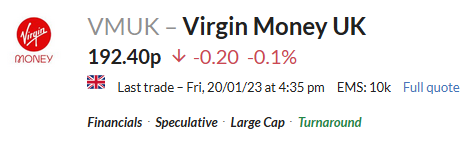
If the bank can maintain recent improvements in its quality metrics, then the shares could potentially benefit from a further re-rating and perhaps achieve Super Stock status.
Business & Model
What is the company’s history and what does it do?
Virgin Money is a full-service retail bank that operates online and through a branch network. However, the brand has iterated through several different business models since its original launch by Virgin founder Sir Richard Branson in 1995.
The business originally sold various personal finance and investment products. It only got involved in retail banking in 2007, when Virgin Group made an unsuccessful attempt to buy Northern Rock.
Virgin continued to pursue an opportunity in banking and was eventually able to buy Northern Rock from the government in 2011, having previously acquired a banking licence by buying a small private bank.
Virgin Money floated on the London stock market in 2014, but this isn’t the stock investors can buy today.
In 2018, the company agreed a £1.7bn takeover offer from CYBG (Clydesdale and Yorkshire Bank), which at that time was also a listed business. Since the completion of this deal, CYBG operations have gradually been rebranded under the Virgin Money brand.
Virgin Money’s combination with the Clydesdale and Yorkshire banks has made it one of the largest challenger banks, improving its ability to compete with high street stalwarts such as Lloyds Banking (LON:LLOY) and Natwest (LON:NWG).
However, unlike digital challengers such as Starling Bank or Monzo, this is not a new business.
Key business segments and revenue breakdown
Virgin Money operates in four main segments:
Unsecured lending, primarily through its MBNA credit card offering
Mortgages (approx. 75/25 split between residential and buy-to-let)
Business banking
Personal banking
The company does not report a segmental breakdown of the income from each of these commercial lines.
However, 92% of income (revenue) came from interest payments last year, with just 8% from non-interest items, such as fees. So it seems fair to assume that mortgage and credit card lending drive the vast majority of Virgin Money’s income.
For comparison, both Lloyds and NatWest generate around 30% of their income from non-interest items. This might point to a more diverse business model, with perhaps slightly less sensitivity to bad debt and interest rate changes.
What is the business model? How does it make money?
Virgin Money UK operates as a traditional lending bank, offering mortgages, business loans and unsecured lending through credit cards.
This lending is funded through a mix of customer deposits, wholesale funding, and funding from the Bank of England’s Covid-era Term Funding Scheme. TFS provides funding “at or very close to the Bank Rate” and was made available for four years from 2020.
Here’s a breakdown of Virgin Money’s loan book and funding at the end of September 2022:

As mentioned above, more than 90% of the bank’s total income is net interest income. This is interest earned by the bank, minus interest paid out to savers. The profitability of this lending is measured using net interest margin (NIM).
Virgin’s NIM improved last year from 1.62% to 1.85% as interest rates rose, supporting a 13% increase in net interest income.
The majority of Virgin Money’s profits come from interest payments on lending.
Markets & Competition
What is the state and size of the company’s market?
The UK retail banking is large but mature. The vast majority of UK adults already have a personal current account. Because the majority of these accounts are free in normal use, inertia means that switching activity remains fairly limited.
Gaining market share in current accounts tends to depend on providing improved digital services compared to high street banks, or the use of switching incentives.
In recent years, the main opportunities for growth have been found in lending, including mortgages, buy-to-let and consumer credit.
Business banking is another area where challengers have had some success. As this is typically fee-based at the big incumbent banks, greater opportunities exist for digital innovation and price differentiation.
However, competition is tough across the whole market. With the UK housing market and the economy now seemingly starting to slow, recent growth rates may be harder to maintain. An increase in bad debt losses is also possible, if not likely.
Who are the company’s key competitors?
Virgin Money faces competition in retail banking from the big four incumbent banks and from small digital challengers, which operate solely online.
Last year’s retail banking review by the Financial Conduct Authority suggests that the scale challengers may be losing this battle, at least in aggregate. Although the big four banks saw their share of the current account market fall between 2018 and 2021, so did the scale challengers.
All of the lost market share was picked up by the digital challenger banks:

Source: FCA
The FCA found a similar picture for business current accounts, with digital challengers emerging as the aggregate winners, albeit from a low starting point.
Two areas where digital challengers are not yet present in significant scale are mortgage and credit card lending.
However, as with current accounts, the UK mortgage market is also fairly concentrated. Over 60% of the market is held by the five largest lenders. While mortgage lending is certainly important to Virgin Money, its overall market share was only 3% in 2021:

Source: Statista
The mortgage market remains highly competitive. Unlike with current accounts, customers are willing to switch regularly to secure the best deals.
For Virgin Money and other scale challengers, one potential advantage over digital challengers may be that they retain a relatively comprehensive branch network.
What is the company’s strategy?
Against this market backdrop, I’d suggest Virgin’s combination with CYBG was a logical decision. The combined group would not have been likely to achieve its current scale without a big merger or takeover. Its enlarged size should help to drive economies of scale and further opportunities for incremental growth.
The bank’s medium-term strategy is to focus on growth in unsecured consumer lending and business lending, while maintaining its mortgage market share.
Alongside this, management aims to improve profitability by cutting costs, moving more transactions online and focusing on higher-margin lending activities.
How does it derive its competitive advantage?
Virgin Money might be said to have a slim competitive advantage in several areas, by virtue of its position as a scale challenger in the banking market. Here’s how this looks, though our economic moat framework:
Intangible assets: Virgin has a more modern brand and digital offering than the big four high street banks. It isn’t tainted by past misconduct scandals, and the brand association with Virgin Group and Sir Richard Branson gives instant name recognition across the majority of the UK population. Smaller digital challenger banks do not yet have this level of brand recognition.
Switching costs: Switching costs for UK retail banking personal customers are far lower than they used to be, thanks to the current account switching scheme. However, there’s still limited incentive to switch.
Business customers and those with mortgages, credit cards or investment products experience greater switching costs, but may also enjoy greater benefits from switching.
By focusing on these areas, Virgin Money may be able to gain some lasting competitive advantage over digital challengers, which tend not (yet) to offer these services.
Network effects: As a scale challenger, Virgin Money is significantly larger than the digital challenger banks. However, it remains small compared to the big four high street banks and does not have sufficient scale to be a ubiquitous brand.
The bank’s branch network might conceivably provide a moderate network effect that discourages switching among customers who value this service. However, on balance, I don’t see much strength here.
Cost advantages: It’s not clear to me that Virgin Money has a cost advantage over other pure retail banks. For example, Lloyds’ most recent cost-to-income ratio was 51.2%, while Virgin’s was 52%.
Greater scale: by combining with CYBG, Virgin Money has gained a more attractive level of scale. This provides some economies of scale and has made it more viable for the group to offer a full range of lending and other products.
Customers seeking an alternative to the big four banks may be drawn to Virgin by virtue of its scale, product range and well-known brand.
Digital-only challenger banks may be at a disadvantage to Virgin as in general they do not (yet) provide a full-service offering, which some customers will seek.
Is the competitive advantage durable?
Not necessarily. Although Virgin Money’s increased scale and recognisable brand seem to be performing quite well at the moment, the bank will always face competitive pressures. The uncertain economic outlook in the UK means that cyclical risks could increase, too.
The bank has only just emerged from three loss-making years. While profitability is on an improving trend at the moment, that is broadly true for the whole UK retail banking market.

Virgin Money’s trailing 12-month return on equity of 7.9% is comparable with Lloyds (8.5%) and NatWest Group (6.8%) but remains well below the levels achieved by some specialist lenders. There’s no clear evidence of a durable competitive advantage, in my view.
Financials & Ownership
What is the record of growth & profitability?
Virgin Money’s income (revenue) growth has been inconsistent over the last few years.

Profitability has been even more rocky. After the CYBG takeover, the combined group had to deal with legacy PPI problems as well as the impact of loan impairments during the first year of the pandemic.
However, Virgin Money now has two solid years of profitability under its belt:

As a result of this improved performance, the bank’s book value per share has stabilised and started to rise. This is a useful measure of value creation for shareholders, in my view:

Dividends are also expected to be restored this year, providing a forward yield of more than 4%.

This resumption of dividends and share buybacks reflects the bank’s CET1 ratio of 15%, which is significantly above its target range, supporting shareholder returns:
Is there evidence of historic share dilution?
CYBG’s takeover of Virgin Money was an all-share deal, which resulted in a significant increase in the combined group’s share count. However, apart from this there has been no other dilution in recent years.

What is the ownership structure of the company? Do management have stakes?
Richard Branson’s Virgin Group reduced its stake in the business as part of the CYBG takeover, but remains the bank’s largest shareholder. There’s no management shareholding of note.

Valuation
How does the relative valuation compare versus industry and sector?
According to Stockopedia, Virgin Money’s valuation compares reasonably well to its industry group and the wider market:

It’s a little harder to compare the bank directly against specific peers, because mid-sized rivals TSB and Santander are both part of much larger banking groups. Similarly, building societies Nationwide, Coventry and Yorkshire can’t directly be compared.
Metro Bank is directly comparable but remains loss-making and somewhat distressed, so isn’t a very useful comparison either.
In this context, I think it probably makes most sense to compare Virgin Money with Lloyds and NatWest, both of which have the same sole focus on the UK retail banking sector.
Virgin Money | Lloyds Banking | NatWest Group | |
StockRank | 92 | 89 | 93 |
Rolling P/E | 6.3 | 6.6 | 6.5 |
Rolling div. yield | 4.5% | 5.6% | 5.6% |
Price/tangible book | 0.44 | 0.88 | 1.02 |
Source: StockReports
Virgin Money shares do not seem especially expensive in themselves. But they do seem fairly priced relative to peers. This probably reflects the uncertain economic outlook and the risk that elevated credit losses could offset the benefit of rising interest rates.
Trends & Catalysts
Are there any significant macro trends that the business is benefiting from?
Rising interest rates are generally seen as positive for UK banks. They are allowing lenders to expand their net interest margins by increasing lending rates more quickly than the interest rates on savings.
The bank also expects to benefit from continued growth in the demand for unsecured consumer lending, through credit cards and a planned new buy-now-pay-later (BNPL) offering.
One other potential area of growth is wealth management. Products such as investment accounts and pensions would increase the bank’s fee income. Demand for such products in the UK is generally growing, but it’s an increasingly competitive area.
Are there any catalysts that could drive a rerating in the medium term?
One opportunity is for Virgin Money to use its increased scale and high-profile brand to take market share from the big four high street banks. It’s not clear if this will be possible, but it could drive economies of scale and a rerating over time.
A second opportunity is for the bank to shape its product mix to focus on higher margin areas of lending. If the group could achieve a higher return on equity than mainstream rivals, a re-rating might be justified.
Risks, Threats & Hurdles
Economic/credit risks: a UK recession could lead to an increase in bad debt losses and a prolonged slowdown in demand for mortgage lending, including among the company’s higher-margin buy-to-let borrowers.
Economies of scale: a key hurdle will be whether the bank can find ways to continue increasing its market share to gain further economies of scale. Managing the balance between having a branch network and moving more operations online could also pose challenges that will affect customer acquisition.
Recent Trading & News
Recent trading summary
Full-year results (21 Nov 2022)
“We have good momentum while delivering a strong performance and improved returns for our shareholders.”
Virgin Money’s latest results covered the year to 30 September and showed a reduction in restructuring costs and other acquisition-related items, boosting profits. This increase was partially offset by a small increase in impairment charges and an increased tax bill, but the end result was still quite strong:
Statutory net profit: £537m (FY21: £474m)
Statutory return on tangible equity: 10.3% (FY21: 10.2%)
Tangible net asset value per share: 383p (FY21: 289.8p)
Common Equity Tier 1 (CET1) ratio: 15% (FY21: 14.9%)
Net interest margin: 1.85% (FY21: 1.62%)
Dividends and share buybacks announced: £267m (FY21: £14m)
However, management did sound a cautious note about the macro risks facing the business:
"While we have solid credit quality across our lending, we are aware that some customers will have to make difficult decisions in this environment, and we are proactively offering them help and support."
Outlook: despite this note of concern, rising interest rates prompted the bank to increase its net interest margin guidance for the current financial year to between 1.85% and 1.9%. Statutory return on tangible equity is expected to improve to 11%.
What do the brokers currently think and are they upgrading estimates?
Broker consensus is fairly positive, with minor upgrades since November’s results:

Based on current forecasts, the stock has a rolling P/E of 6.3 with a forecast yield of 4.5%.
What would the person selling to us be thinking and who are they?
I can only see two likely reasons to sell at this point. The most likely would be due to concerns that economic headwinds will outweigh the benefits of higher interest rates and the bank’s successful restructuring.
The other possible reason is that an investor might conclude that mid-sized banks with branch networks will be continually squeezed between the big four high street banks and digital-only challengers.
Conclusion
Like a number of other UK banks, Virgin Money appears to have resolved its legacy problems and be well-positioned to benefit from rising interest rates. It appears to have a strong balance sheet and is now achieving a competitive level of profitability.
The stock’s valuation remains fairly modest and the shares are now expected to provide an attractive dividend yield.
The flipside to this attractive picture is that UK banks are now facing the risk of a cyclical downturn. That could lead to elevated bad debt losses and reduced demand for new lending.
Virgin Money’s turnaround status reflects its good progress to date, but also some uncertainty about whether the bank can maintain and extend its improved performance.
If the bank is able to continue progressing, which I believe is likely, then the shares could be attractively valued at current levels.
Disclosure: At the time of publication, Roland owned shares in NatWest Group.
Disclaimer
This is not financial advice. Our content is intended to be used and must be used for information and education purposes only. Please read our disclaimer and terms and conditions to understand our obligations.

5 comments
Return on equity < 8% but stock rank > 90. Something wrong there. Cost of capital implied by ptb > 15%.
I watch this institution- which I refuse to call Virgin money- closely. They don't consider their branch network as an asset though, they cynically ran down the Yorkshire Bank branch in Skipton before closing it despite the- assumed- opportunity to mop up Lloyds, Barclays, "HSBC" and TSB customers who were being left high and dry by branch closures in Settle, Barnoldswick and the Bentham's as well as Skipton itself. Our attempt to open a clubs and societies account for our Quaker meeting was stalled again and again and then lo and behold they closed. Methinks staff had been told to discourage new accounts in preparation for pulling out of the community.
I'm surprised you consider the Virgin name an asset Rowland, but perhaps it depends on where you live. Virgin West Coast blocked the revival of Skipton-Carlisle-Glasgow train services and then walked away from their Virgin East Coast obligations on 2018 leaving Joe and Imelda Taxpayer to foot the bill. The existence of "Beardy" as major shareholder makes it a no-no for me.
I had/have a bit of a punt on this one - wish i had loaded the boat when the shares got dirt cheap but i had already doubled up on the way down so couldnt over commit when price carried on its downward progession. For once doing nowt wasnt a bad idea.
My thought process was virgin is a reasonably respected brand - main big banks are shockingly bad at customer service and p/e was dirt cheap. (not convinced p/e ever work for banks that are always prone for huge provisions to turn up out of nowhere.)
Note they have been spending money closing down branches and the like - merging the brands etc - so i suspect one of costs over the last 5 years have ben larger than we can expect going forward - i think they had quite abig legacy estate of old buildings they simply needed to get shot of.
They seem to be ticking over - must admit i havent really paid much atention - havent opened an acount so not sure how good their app is.
I guess the danger is that the younger generation will probably be more likely to go with challenger app bank - if they dont make the app based banking as good as starling and revolut ? has anyone tried then virgin app?
I was kinda hopinmg for quick 50% gain that never turned up although it has done for the top up, i did on the way down.
Possibly a nice boring portfolio type play for some who want something simple. Only thing with bank shares is that in the past its only been a matter of time to the next financial armageddon - has that changed now they are better capitalised - i kinda suspect probably not - black swans are never dead and buried.
I agree with lucky dip. Small cap articles make up too much of the info posted from stockopedia. My investment interests are in larger cos with potential growth and/or strong yields.
I’m likely not to continue after my sub is up for this year for that very reason
excellent article Roland. I am a holder of Virgin Money and prefer reading this sort of analysis as most of my holdings are not in Aims or small caps.
On balance I think I intend to add to my holding.