Vodafone: momentum + improving fundamentals

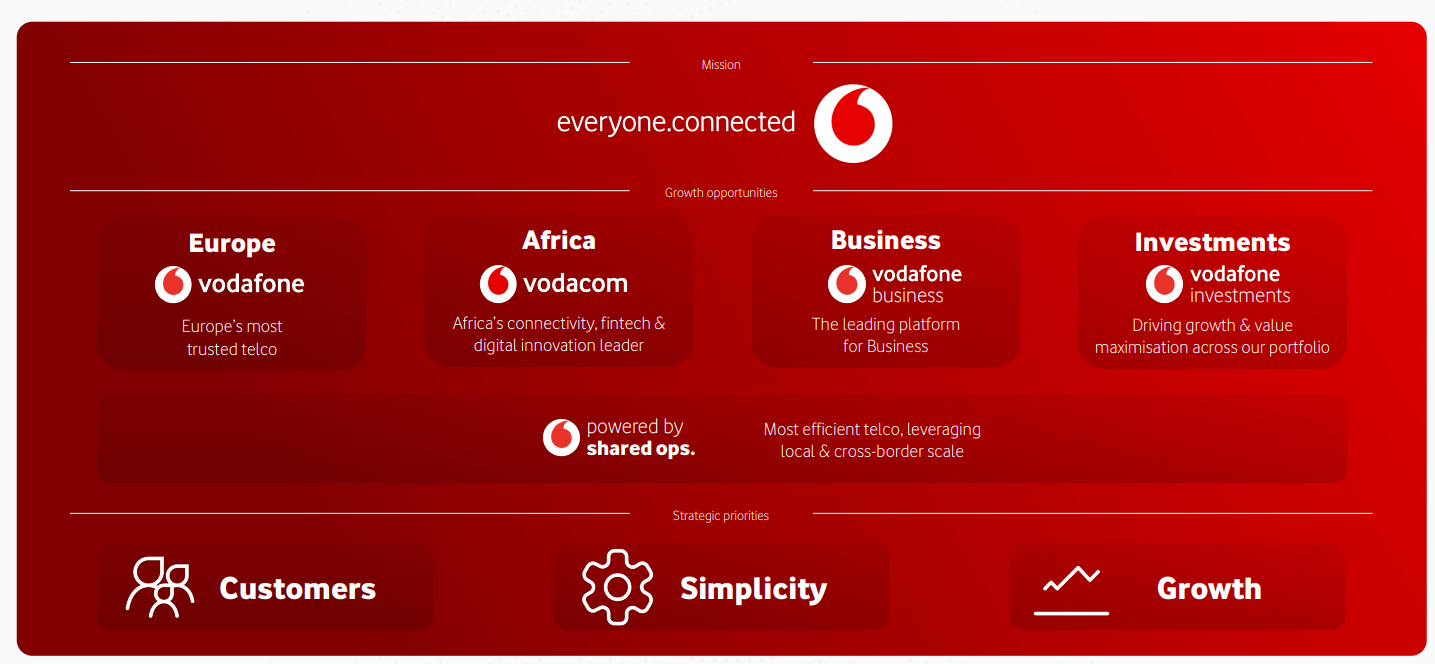
Source: Vodafone FY25 presentation
Welcome back to our Stock Pitch series. We’ve covered several small caps recently; today I’m zooming out to take a look at a FTSE 100 heavyweight that’s comfortably outperformed the wider market over the last year.
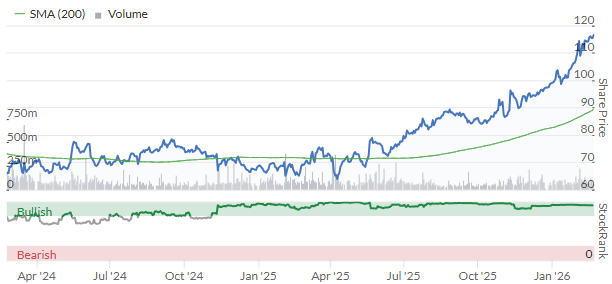
Shares in telecoms giant Vodafone (LON:VOD) have now risen by nearly 70% since the start of 2025. This rally appears to have gathered pace so far in 2026:
The Pitch
Vodafone has been steadily shedding its reputation as a value trap since CEO Margherita Della Valle became CEO in early 2023.
Revenue has returned to growth, debt has fallen and last year saw the first dividend increase in seven years. Earnings forecasts suggest double-digit EPS growth over the next year.
Ms Della Valle has achieved a long-held sector goal by reducing the number of network operators in the UK from four to three through the merger of Vodafone UK with Three. Elsewhere, a number of divisions have been sold, raising cash and creating a more coherent and manageable portfolio with plausible growth prospects.
The StockRanks view this as a Turnaround, with strong value and momentum scores:
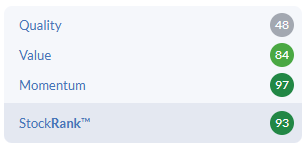
The focus is now on delivering long-needed improvements in quality metrics. Success could justify a sustainble higher rating and support a return to progressive dividend growth.
The Big Picture
Vodafone’s attractions as an investment fall into three main categories:
Europe: it’s one of the largest telcos in Europe, with 112m mobile customers, 19m fixed line customers and 14m TV subscribers. Vodafone is well positioned to become a major broadband supplier in the UK and expects to return to growth in Germany – its largest market – this year.
Africa: organic service revenue rose by 11.3% in FY25, a growth rate European operators can only dream of. Vodafone has 227m mobile customers and 92m financial service customers in Africa, but smartphone penetration is still only 64% and demand is growing fast.
Dividend & buybacks: the dividend returned to growth last year following a cut in 2024. Vodafone is also returning cash through buybacks and has repurchased €3.5bn of stock since May 2024, reducing the share count by 15% and supporting EPS and dividend growth. Shareholder returns are now more affordable as leverage has been reduced to c.2.0x EBITDA, from 2.5x in FY23.
Going Deeper
The holy grail for Vodafone is to improve its profitability, measured by return on capital employed. ROCE for directly-controlled operations was 7% last year, close to the 8% level I’d use as an estimate of the group’s cost of capital.
With capital employed of €107bn at the end of September 2025, even small increases in ROCE can have a big impact on profit. A 1% rise in ROCE could equate to a c.€1bn increase in operating profit, with a sizeable increase to free cash flow as well.
I’d highlight four areas of particular opportunity for improving profitability:
Return to growth in Germany: regulatory changes have hit the group’s broadband and television business and revenue fell by 6% last year. But a new management team is in place and a return to growth is expected this year. Germany generates nearly a third of total revenue and has historically had the highest EBITDA margin in the group. A return to growth could drop through to a useful increase in profits.
Vodafone Three UK: the integration of the Vodafone and Three networks in the UK is said to be on track and provides the company with the opportunity to become a 5G market leader, while generating expected synergies of £7bn over time. Reducing the number of networks from four to three in the UK is widely seen as an essential step to improve returns on capital in the group’s home market.
Digital Services: Vodafone had 4.7m business customers last year. While total business service revenue rose by 4% in FY25, customer spending on digital services rose by nearly 14%. Management believes there’s a significant opportunity for further growth in this market in areas such as cloud, security and Internet of Things. Success could help to support margin improvements.
Africa mobile banking: financial services penetration in the company’s African markets is just 54% and many people use Vodafone’s M-Pesa mobile money service to provide access to financial services and payment facilities. M-Pesa revenue rose by 21.7% in H1 26 on an organic basis and the company handled $451bn in transactions in FY25, a 15% increase on the previous year. There’s still plenty of scope for growth in this market.
What The Brokers Say
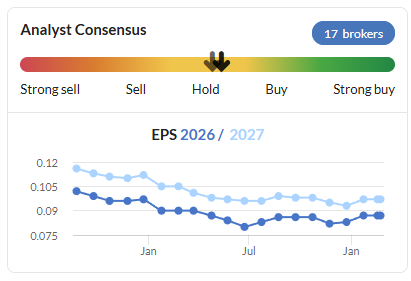
Brokers are relatively cautious about Vodafone, but the recent trend has been positive. Earnings are expected to rise by 14% in FY27.
Both earnings estimates and the brokers’ consensus recommendation have been upgraded recently:
I think a couple of other points are worth noting about the current institutional view of this business:
Shares trading above target price: Vodafone stock is trading above broker’s average target price of 102p. Checking back shows that the target price has been rising steadily, following the share price higher. Back in September 2025, the target price was around 85p. Analysts often follow trends with their forecasts, so in this scenario I think that trading above the target price is a sign of positive momentum.
Broker views are mixed, with eight holding buy recommendations but six holding sell or strong sell views. There’s still plenty of scope for broker sentiment to improve, driving further institutional buying and a further re-rating.
The Bear Case
Vodafone hasn’t entirely escaped its troubled history. I think there are a number of risks investors should consider before buying:
Returns on capital aren’t yet high enough but annual capex remains high, with capital additions of over €7bn last year. The combination of competition and regulatory pressures is likely to create a ceiling on profitability – and we don’t yet know where that will be.
Growth remains weak in Germany and the UK. These are the group’s two largest markets and they accounted for over half of group profit last year. If performance doesn’t improve here, gains elsewhere may not be enough to move the needle on group results.
The ambition to increase sales of digital services to Business customers may be logical, but this is a complex market where Vodafone doesn’t necessarily have any competitive advantages. Investment in digital services growth may not deliver hoped-for returns and could prove to be a money pit.
The Bottom Line
Vodafone has cut leverage, returned to growth and slimmed down its portfolio to a coherent and manageable group of businesses. Core European markets are stabilising and positioned for a return to growth, while the long-term growth potential of the African business could be huge.
The company is currently benefiting from a period of stable strategy, with decisive and effective leadership.
While there is still some doubt about how high returns on capital will be able to rise, management can argue plausibly that there is room for improvement from current levels. Even a small improvement could have a big impact on the bottom line, given the group’s large asset base.
There’s evidence of momentum through recent upgrades, while the valuation remains reasonable. If key quality metrics improve, a higher valuation could be quite achievable.
Disclosure: At the time of publication, Roland has no position in Vodafone Group.
Disclaimer
This is not financial advice. Our content is intended to be used and must be used for information and education purposes only. Please read our disclaimer and terms and conditions to understand our obligations.

4 comments
Thank you Roland for an encouraging piece on Vodafone (LON:VOD) which I hold.
I bought my first tranche on the opening day of the trading year and have added twice since.
I think the New CEO has got a grip on things after 3 years in the role and the Company is something of a juggernaut with £26 million Market Cap compared to £20 million for BT (LON:BT.A)
I have a target of £1.50p but as usual only time will tell.
I well remember it was an informed "suggestion" made by Stockopedia and taken up by me after following a webinair or article similar to this excellent study by yourself Roland, which led to me ditching my holdings in BT and doubling up on my exposure on VOD with their massive additional potential market in comparison. Looking at the comparison now and the 60% growth since I did, makes me sure to read through these articles with your proviso that they are not intended as investment advice, but please keep them coming..(:-))
Thanks for this update. I recently decided to sell half of my holding after such a strong rise, but the rest I'll hold for long term growth.
Nice write up. I hope you're right. Bought in recently having dithered when it was 85p.