Webinar Discussion: Phil Hoffer shared the investing rules that grew his portfolio 767%

Thanks to the nearly 800 of you who joined last night's subscriber special webinar with Phil Hoffer. A year ago, the post-webinar discussion became one of the busiest discussion threads we've had, with 240 comments. This is the home for this year's conversation.
Last year was very instructive about Phil's investing process, and this year we dug deeper. But I also wanted to probe the audience. Phil has written down all of his investing rules, shared widely both here and on his Youtube channel, and it's a great part of his success story - so why do so many of us struggle to do the same?
Watch the replay and Download the Slides: Academy Video Link. (We had a technical difficulty 70 minutes in - apologies. We will be changing webinar platforms).
In a live poll we asked: How much of your investing process is written down? Only 11% could say all of it. That means most investors are either carrying their process in their heads, or using total discretion - and very few have a clear way of knowing "when to sell".
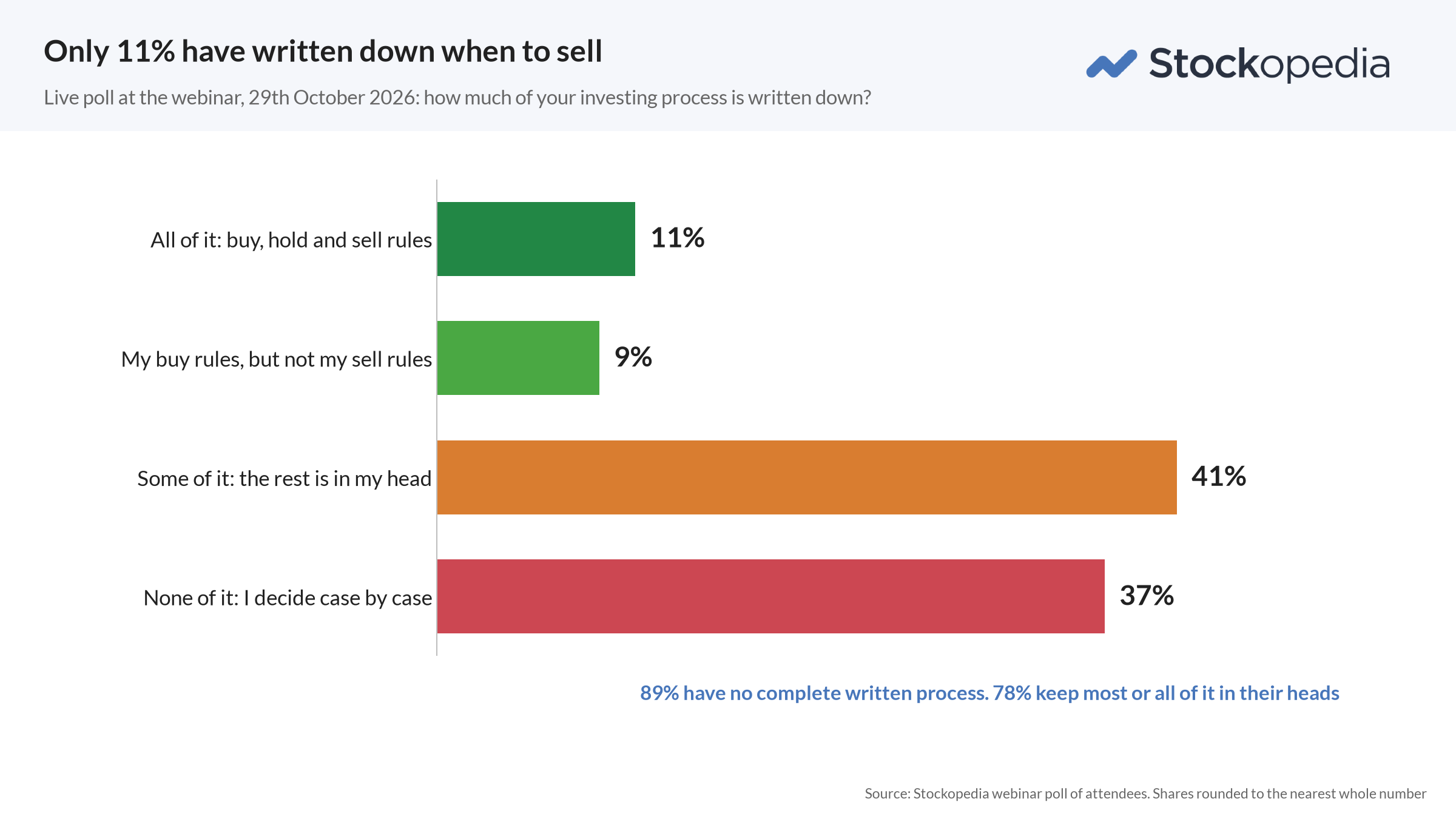
Phil had shared his rules in a conversation before the webinar and we put them up on screen - and the poll surprised him. He said: "If you're going into a trade and you don't know how you're going to get out, of course you're going to be indecisive when something happens. Would you give £1,000 to a nice chap who's a bit vague about what he's doing? If not, why manage your own money that way?"
What following his rules has returned
Phil tracks his portfolios on Stockopedia, and he let us aggregate them into a single transaction history to audit his record. Since November 2012, Phil's portfolios have returned +767.6%, or 16.8% a year. Of course generating returns like that is rarely a smooth ride. He had three losing years in the thirteen and a 43% drawdown between 2018 to 2020.
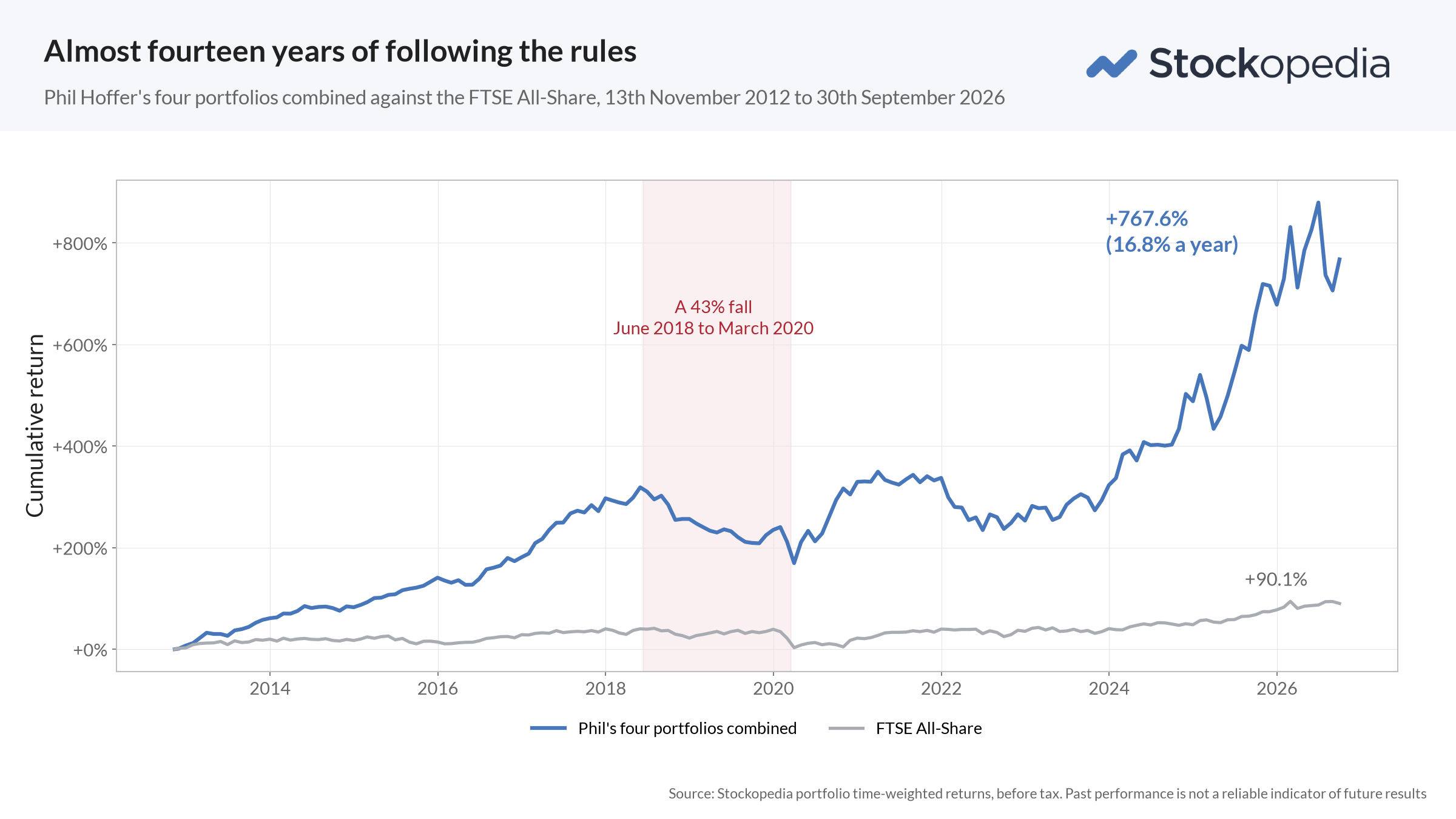
Phil closed 368 positions in that time. Only 54% made money, but the average winner made almost 3x the average loser. +50% vs -17%. He's had 20 multibaggers of which Celestica (NYQ:CLS) has been the standout. It returned +1,693% - but even so, he never really knew what the company did. He lets the rules get him into the trade - high quality, high momentum - not the story of the company - that's what has paid off.
This year he's had quite a volatile ride - which is to be expected in high momentum strategies. Phil runs the same screen and the same rules across his four portfolios - but gets very different results in each. To 30 September this year they had returned from ~0% to almost +30%, after peaks of up to 54% at the mid year mark. Why so different?
Well he runs ten shares in each portfolio but doesn't replicate the holdings across them, so the same rules can give very different results, and we talk through why in the replay. This is where a process that lives in your head can cause such trouble. A portfolio that's flat while a twin based on the same rules is up 29% makes you want to tinker. If the rules aren't written down, there's nothing to stop you.
Write down your own rules
Phil's core buy starting list is his QM Growth Blueprint stock screen and it hasn't changed since last year - but the screen is just a starting point. The graphic below is a summary of his core principles in a slide he shared in the Webinar.
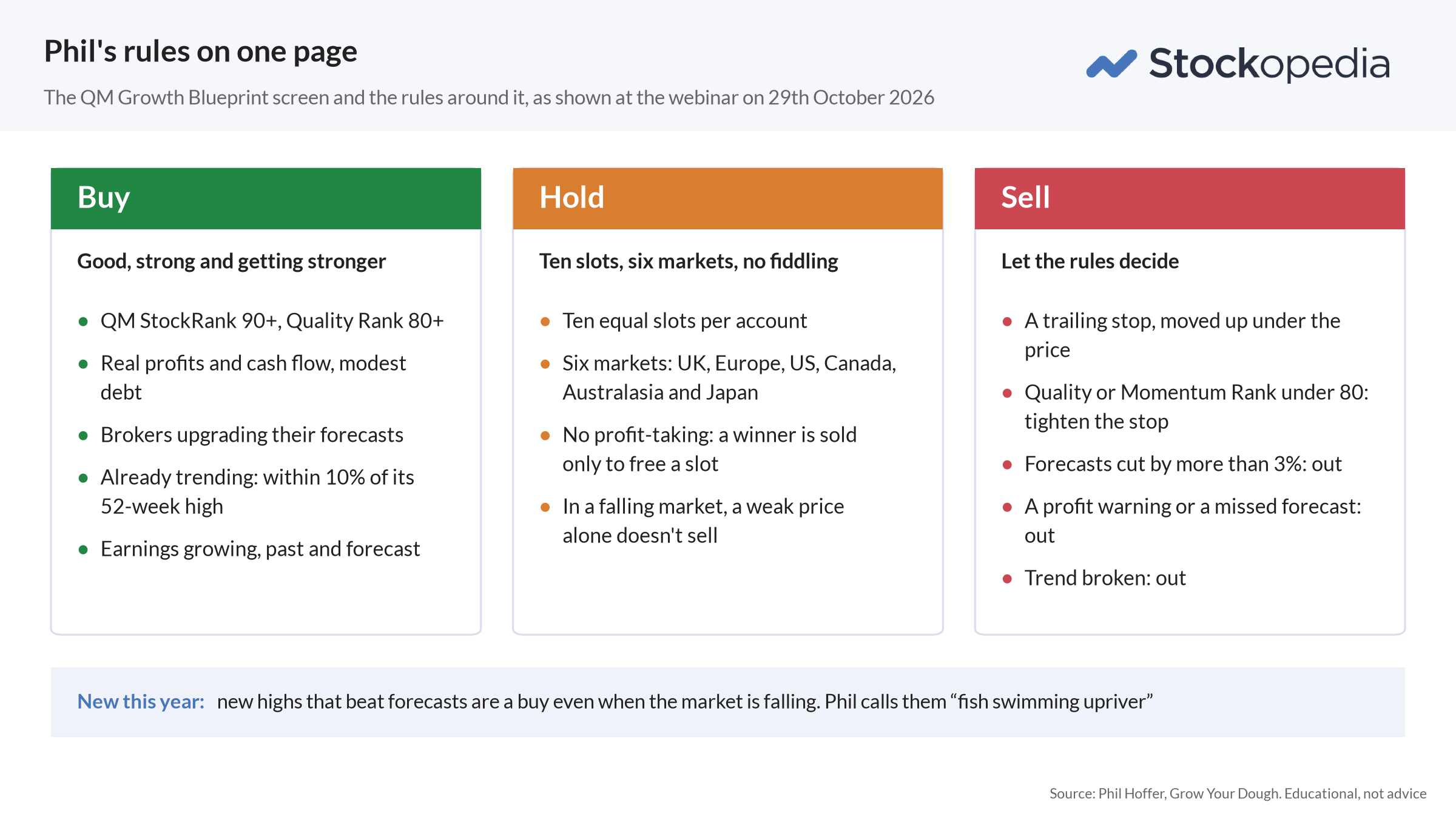
- Buy shares that are good, strong and getting stronger. That means a QM StockRank of 90+ and a Quality Rank of 80+, real profits and cash, and brokers upgrading their estimates. The shares must already be trending and growing earnings.
- Hold ten equal slots per account, across six markets, with no profit-taking. He tested trimming winners on his own trades and binned it.
- Sell when the rules say so. That means a trailing stop he keeps in a spreadsheet, not with his broker, plus an estimate cut of more than 3%, a profit warning or a broken trend. In his words: "Just bin it and move on."
One rule around the screen did change. Phil now buys new highs that beat estimates even when the market is falling, which he calls "fish swimming upriver". His bear-market caution now only governs exits.
Discipline is what you decide not to do
One of the slides we didn't display but discussed conversationally, was Phil's list of things he deliberately doesn't do:
- He doesn't read the news or company statements, and doesn't need to know what a company does.
- He doesn't act on opinion, including his own.
- He doesn't buy when nothing passes the screen - and he doesn't loosen his rules to find more candidates.
- He doesn't use leverage or hedge any more. Every hedge he tried lost money.
- He doesn't panic. In 2022 he didn't trade at all.
Phil has a remarkable understanding of what Warren Buffett might call his "circle of competence" - and he doesn't step outside it. He knows what drives stock returns, and doesn't feel he needs a CFA - he discussed the perils of the Gambler -> Follower -> Researcher traps, and designs his system to avoid falling into them.
A classic example of his discipline is how he doesn't bend his screening rules. When we ran Phil's screen live there were only a couple of UK stocks on the list Renishaw (LON:RSW) and Beauty Tech group (LON:TBTG).
This is where so many go wrong. When a stock screen at home runs dry, we loosen the rules to find something to buy. Phil keeps his rules and widens the market instead, which is why his book today holds 19 shares across six countries, eight of them Japanese. But as Phil says, you have to be careful - when you add a market, check that your broker can trade it, the FX cost, and any minimum deal sizes.
What Phil is testing now
In the last ten minutes (which I had to screen record due to a technical glitch), Phil asked himself a question many of us should: "Am I working too hard here?" He's now running three families of strategy side by side, in public, across regions:
- Light Touch uses the top 20 VM-ranked UK shares, with at most two per industry group. He rebalances every three months, with no stops and no news. It's up about 25% since January.
- Merit buys at a QM or VM Rank of 95+ and sells below 85, checked daily, and nothing else. He launched it on the day of the webinar.
- Blueprint comes in Core and Growth versions, and adds trend, market regime and exits on news.
The aim is to find out how much each layer of complexity actually adds. It's the right question, and only someone with written rules can test it. You can follow along on his YouTube channel, @GrowYourDough247.
Over to you
I left you with a few takeaways - but most importantly by encouraging everyone to write your investing rules down. Especially let those rules make the decision we're all worst at -when to sell. We have a webinar on when to sell here.
Watch the replay: Academy Video Link · Download the slides: Slides Link · Phil's rules as a screen: QM Growth Blueprint link · Follow Phil on Stockopedia
Which of the four poll answers is you? If you've written your sell rules down, what's the one that has saved you the most? If you haven't, what's stopping you? I'd love this to become a thread where the community share their investing rules - so please do comment.
Huge thanks to Phil for his time and his openness, and many apologies to anyone caught by the technical problems at the end!
Disclaimer
This is not financial advice. Our content is intended to be used and must be used for information and education purposes only. Please read our disclaimer and terms and conditions to understand our obligations.
9 comments
Like everyone else, I experienced the glitch problems on the webinar and am pleased to see that Ed has decided to change webinar platforms, as it happens on virtually every single time there is a webinar. This is not the first time I have experienced such an issue. Aside from that, I found it a very interesting and informative discussion about how Phil goes about his investing, especially that he's not that interested in what the company does, doesn't read much financial news or do a lot of analysis. He has a simple method backed up by his rules and is very rigid about sticking to them. That was the biggest thing I took away from the talk, that he stuck to his rules come what may and has no problem with selling his holdings when the indicators are telling him to do so. That discipline to Sell, be dispassionate and not allow emotion to enter his investing is a very difficult discipline to master, but it appears, he's managed to do that. That's very commendable, because I struggle with it and I'm sure others do too.
Had problems with the feed glitching & skipping to the start - as well as sound and mouths not matching so gave up. Had to give up. Hopefully there will be a recording which has worked so can watch
Very interesting indeed. Phil is clearly a lot more successful than I am but I'm never going to move to 'doesn't read the news or what a company does', for me it's part investing enjoyment to read analysis here, and watch market moods, they're definitely moody right now. Thank you Ed for the efforts you put in to helping your subscribers.
Shambles at end. I gave up when it showed below 200 left trying to reconnect other than back to the beginning. Very pleased you won't be using that platform again.
Ah, not just me then.
Any comment from Stockopedia on the problem please and any fix for the future.
Yeah - we had a problem with the WebinarJam software when I did a webinar with Roland, where it crashed after 4 minutes. The next webinar was glitch free... but then again last night - after 1h 6m it had problems.
But also there's always (even without a major glitch) a small (vocal!) set of people that seem to have "jumping" issues where the webinar goes back to the beginning.
So we're going to shift platforms.
It's frustrating as we have integrations across the site with the webinar platform - but they've just lost us as a customer.
Thanks for your patience all - we're as frustrated as you are.
I'm not sure if the problem was just specific to me but the feed kept skipping back to the start. I gave up after a few times. Was I viewing it on the wrong media ?
It's not you Helvellyn, the skipping back happened to many of us. It's a glitch with the site software, if you do nothing else it is fine but any action such as switching tabs or toggling between full screen and normal view tends to re-set the video stream, either back to a random point or even (as happened after about 1 hour) right back to the start. Ed's decision to change providers is the right one.
Helvellyn, it's not just you! I've had a similar problem, too. If I click to another browser tab, the Stocko webinar stream rewinds. I've had to stop watching the webinars live and wait for the recordings instead. I don't have this problem when on Zoom / Teams calls for work.