Why Do Punters Love AIM so much? Mid-Caps are so much better...

OK, so I am misleading you - in the title of this post, I ask the question "Why do punters love AIM so much?", when I know the answer. It is like lottery gambling, where you are hoping to strike it rich by unearthing a multi-bagger of an investment!
And clearly there have been some notable successes chalked up, like ASOS (LON:ASC) (before its recent travails) which has been a very impressive multi-bagger if you got in early on.
But for a "real" investor who does his or her own spadework and has a well-defined investment process that they use, does it make sense to invest much cash or time on AIM companies? Let's look at some very basic statistics:
Exhibit 1: Price Performance of UK Indices since the AIM 100 index started in late 2005

In this chart, the black line is the benchmark FTSE-100 index, the soaring blue line the FTSE Mid 250 index, the green line the FTSE SmallCap ex investment trust index, and the purple line bringing up the rear is the FTSE AIM 100 index.
Looking at these 4 indices, it is apparent that the FTSE Mid 250 index has more than doubled since late 2005, while in contrast the AIM 100 index has nearly halved, with both large- and small-caps somewhere in the middle, both with relatively modest gains. That means a near four-fold difference in performance between mid-caps and AIM stocks over 9 years!
The basic point is this: the AIM market is NOT the same as the main LSE market - the listing rules are not anything like as stringent, and the failure rate for young companies is, as we all know, high. So the risks inherent in investing not just in stocks, but in AIM-listed stocks in particular, are clearly very high. This means that investors venturing into the murky AIM waters need to do even more due diligence in their research than they would for a larger, more established company which has a longer track record and typically more mature products and services.
OK, I understand, you don't just want to invest in the largest, boring UK-listed companies like Vodafone (LON:VOD) and GlaxoSmithKline (LON:GSK), which in any case are arguably not very British as companies these days given their global footprints.
What is interesting is even if you invested instead in the average UK stock within the MSCI UK index (a collection of FTSE 100, FTSE Mid 250 and the largest FTSE SmallCap stocks), you would still have done substantially better than the market-cap weighted FTSE 100 index!
Exhibit 2: Equal-Weight UK Index vs. FTSE 100, FTSE Mid 250 from 1999 on
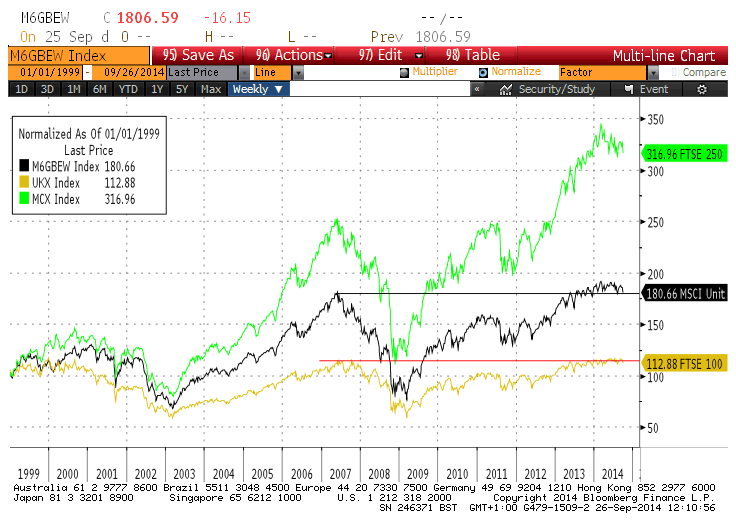
While the FTSE Mid 250 index (in green) still did much better than the FTSE 100 index (yellow line), the equal-weight MSCI UK index still gave you a cumulative 81% price gain from 1999, as opposed to only 12% from the FTSE 100. Yes you would have gained slightly more in dividends from the large-caps, but nothing like enough to start bridging this enormous gulf in performance.
Morals of this story:
1. The AIM market should come with a strongly-worded health warning, only experienced investors should venture in, and even then they should tread very carefully.
2. All other investors wanting to get exposure to UK stocks would be far better off investing in either the FTSE Mid 250 index (yes there are low-cost FTSE 250 index ETFs available from both iShares and Deutsche Bank's x-trackers), or in a broad range of UK stocks drawn from the FTSE 100, Mid 250 and SmallCap market segments, weighted in equal proportion in the final portfolio.
Disclaimer
This is not financial advice. Our content is intended to be used and must be used for information and education purposes only. Please read our disclaimer and terms and conditions to understand our obligations.
11 comments
Not sure if this will add anything to the debate, but here's a picture of the stockmarket, according to Stockopedia. If you could do those Magic Eye books in the '90s you might be able to work this, you just have to go cross-eyed and wait for inspiration The colours are the firm size, red=big.
Not sure if it will display big enough, here goes.
There's the knot of AIM miners at the back, and then empty space as you move to the lower front corner, before you pass through a cloud of generally larger firms. There are a lot of not-cheap quality firms settling to the floor. But few make it to the qmv corner.
Now have an aspirin.
Given that many AIM stocks are blue sky resource stocks or from countries with a dubious culture of corporate governance, why is the government encouraging investment/speculation by giving such decent tax advantages (no stamp duty, ISA inclusion, IHT relief etc)? If they want to encourage a culture of share ownership, it seems an odd thing to do.
I was going to say that people invest in AIM because it's like the lottery, but you covered that in the first paragraph!
So perhaps somewhat more enlighteningly, it's probably to do with culture and random historical quirks.
In the UK people think that property is investing, a pension pot is investing, but buying shares is gambling. So almost nobody buys individual stocks.
In Canada I have been told that it's the other way around to some extent. Essentially nobody invests in property, a lot "invest" through a pension and quite a lot pick stocks because they're seen as investments rather than a way to gamble and get rich quick.
In the UK private direct ownership of shares went out the window a long time ago, so until the mainstream UK investor gets back into stock picking (which I doubt they will) the FTSE 250 and especially the FTSE 100 will be left primarily to professional funds, and those few private "investors" who do stock pick will to a large extent want to take a punt on the wacky world of AIM.
Interestingly, i have already built my own custom screen using P/Bk and 6m price momentum, then added the QV rank and Piotroski F-score for good measure... A good starting point.
Another good value screen that backtests very well is low EV/EBITDA; I have seen claims that this is the best single value measure when backtesting over the long-term...
http://www.aaii.com/journal/article/quantitative-strategies-for-selecting-stocks.touch
http://www.millennialinvest.com/blog/2014/9/15/searching-for-deep-value-stocks
SO I have built a custom screen a little like the Greenblatt magic formula screen, but using EVEBITDA and Gross profit margin (after Novy-Marx), and adding in short-term price momentum too...
Ed
Personally I like the mid cap space but I think the article is a little simplistic. AIM looks terrible in the chart at the top but to a great degree that is because it is stuffed full of speculative resources stocks. You could have called the article "why do punters love small resource stocks?". Outside the resource stocks there have been many many successful AIM companies; I would love to see a chart of AIM ex resources. I bet it looks a lot better!
Quite possibly John, but those are exactly the types of stocks that many novice/beginner investors are putting money into, which frankly they should not be allowed to go near. So yes simplistic, but the point is only relatively experienced investors have any chance of sorting the wheat from the chaff in this market. That was my point...
As for the composition of the AIM 100: of the top 20 constituents by size, representing 46% of the index today, only 3 are Resource stocks amounting to only 5.5%. So I think you are wrong to characterise this index as Resource-heavy, at least when looking at the index weightings of the sector.
Heaviest weightings are in:
Songbird Estates
ASOS
Optimal Payments
GW Pharmaceutical
Hutchison China MedTech
Monitise
Amerisur Resources is the 1st resource stock by cap. at number 7...
The real problem is that AIM gets dominated in market cap. terms by 1 or 2 stocks at any time typically, like Quindell or ASOS... My suspicion is that too many punters get on the momentum train too late when much of the gain has already been had, but suffer in the sharp fall afterward... as in these 2 stocks...
Edmund
Yes Ed, my point exactly... Did you see the recent quant research looking at multiple factor investing with price/book - price/book + 6-month price momentum came out best!
I haven't seen it - can you email me a copy?
Value + Momentum = :-)
Likewise, I would be interested in reading this too.
Here you go, the link to follow:
http://www.quant-investing.com/strategies/PB-PI-6m
Edmund
Yep the 250 is a good index... has had a terrific run for many years. I'll pull out some bubble charts...
If one buys the argument that 'good, cheap' stocks outperform then better investments should be in the top right of the bubble chart... here's the 250 (in general - good quality not too expensive):
And here's the AIM All Share - very very dense in that bottom left corner full of expensive junk.
The AIM 100 isn't that much better:
As a hunting ground the FTSE 250 is a good place to start - better odds than other parts of the market for random stock pickers.