Why UK AIM stocks are taking a battering

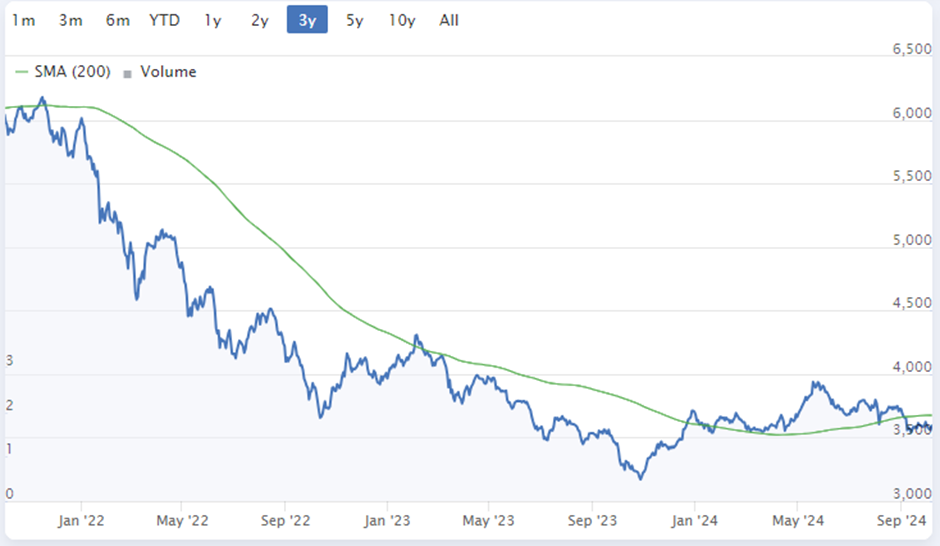
There is no doubt that AIM Stocks have suffered recently. In early summer, the expectation was that inflation had been tamed and the interest rate cycle had turned. This led to some optimism returning to the market, which had been beaten down for so long. Here is what the AIM100 index looks like over three years:
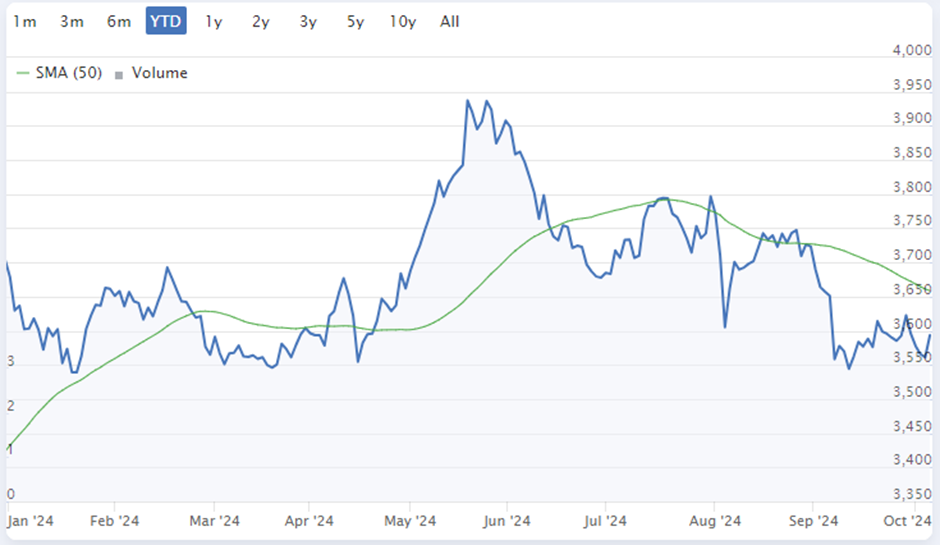
However, that optimism has proven short-lived. The surprise election in July led to an increased focus on what an incoming government would look like and what impact this would have on investors:
The effect on the smallest UK stocks from this uncertainty has been two-pronged. Firstly, it appears to have caused a dip in consumer sentiment. The GfK Consumer Confidence index dropped to -20 in September from -13 the previous month. Expectations for personal finances over the next 12 months, the 12-month outlook for the economy and the major purchase index all fell significantly. The blame has been put on worries about what will be in the Autumn Budget that will be announced on 30th October. The message from the new government has been that public finances are in dire straits. The view is that the lack of investment in recent years needs to be corrected, and this needs to be funded by tax rises rather than borrowing.
We've seen the impact of this reduced consumer confidence already, with many smaller UK companies warning of challenging market conditions and a number of profit warnings recently. Even companies that haven't warned are saying they expect to be very H2-weighted. In many cases, the market is calling this hope misplaced and marking the shares down anyway.
The second impact is that investors have been getting ahead of what they see as the most likely tax changes. The two that seem to be the most talked about are changes to capital gains tax or the removal of inheritance tax relief on AIM shares. In addition, there may be changes to ISA or SIPP rules and how Oil & Gas profits are taxed.
Capital Gains Tax
The principle of Capital Gains Tax is that any gains made in a tax year above a threshold and outside of tax shelters such as a SIPP or ISA are subject to a tax rate, but investors can offset any losses (outside of tax shelters) against those gains. The previous government had already reduced the threshold above which tax is due:
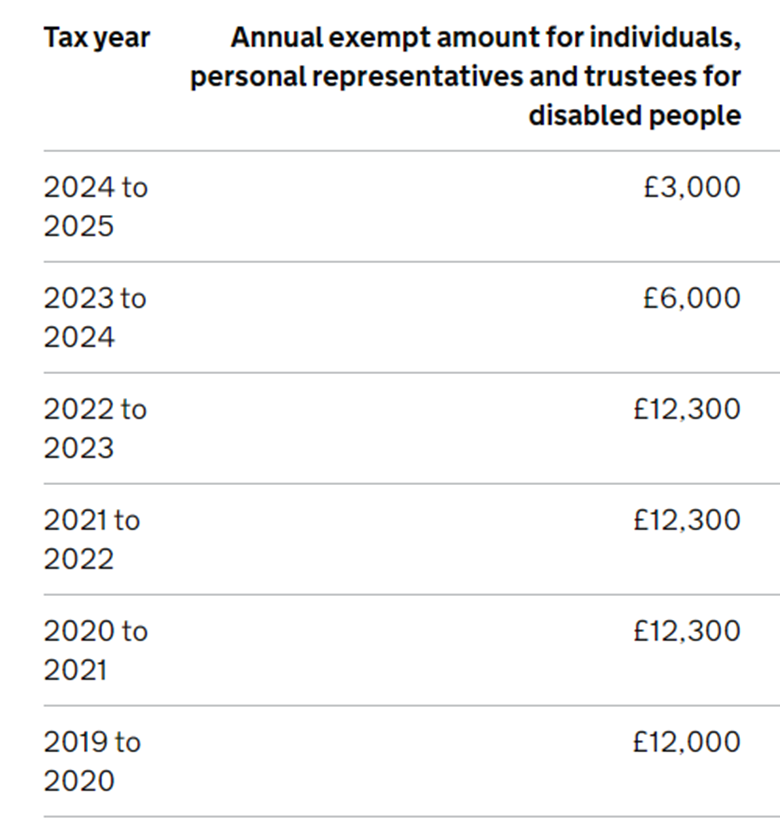
However, the tax rate remains favourable compared to income tax, at 10% for Basic Rate taxpayers and 20% for Higher Rate taxpayers. Investors will not welcome any move to bring these more in line with income tax. However, these won't necessarily cause investors to realise gains and add to the selling pressure on stocks now, as any tax rate changes will likely come in the new tax year in April at the earliest. This change is unlikely to unduly impact small stocks as sales would likely be uniform across all companies.
ISAs & SIPPs
Various possibilities are under consideration, including limiting the tax-free gains in ISAs or reducing the tax-free amount available from SIPPs upon retirement. The other SIPP change some are proposing is to limit higher rate tax relief on pension contributions. While all of these may impact individual investors, they are more likely to limit flows into equities in the future rather than cause outflows now.
AIM IHT Relief
A quirk in UK tax law makes AIM shares held for more than two years exempt from inheritance tax. They are treated the same as unlisted companies, and the will's executors can claim Business Property Relief (BPR) on these holdings. This is the case even if they are held in an ISA, which makes this a particularly good deal for investors and one that many take advantage of in their later years.
The strength of this tax break has also made it a popular one; some estimates put upwards of 30% of money invested in AIM shares for this reason. Unfortunately, the popularity of this strategy also makes it ripe for a change in legislation. The original idea behind BPR is that it allows family-run companies to be passed on to the next generation without having to be broken up or sold to pay death duties. This encourages entrepreneurship and individuals to take equity risk and drive economic growth, which will fund corporation tax payments and payroll taxes over the long term. Although not all AIM companies fall into this category, the idea of supporting smaller companies with growth capital kept this relief in place for AIM shares. However, investors in AIM stocks purely for IHT purposes often do not want to take the risk associated with growing smaller companies. Indeed, they often try to have a highly diversified portfolio in the most boring dividend-paying stocks which are unlikely to need fresh equity. Their primary aim is not to lose money rather than generate market-beating returns. This mismatch is why a change of legislation may make sense to an incoming government.
The popularity of this strategy also makes it attractive for change. It seems to be this fear that is specifically impacting AIM stocks. The following chart clearly shows the divergence between the AIM100 index and the FTSE SmallCap Index since the election as called:
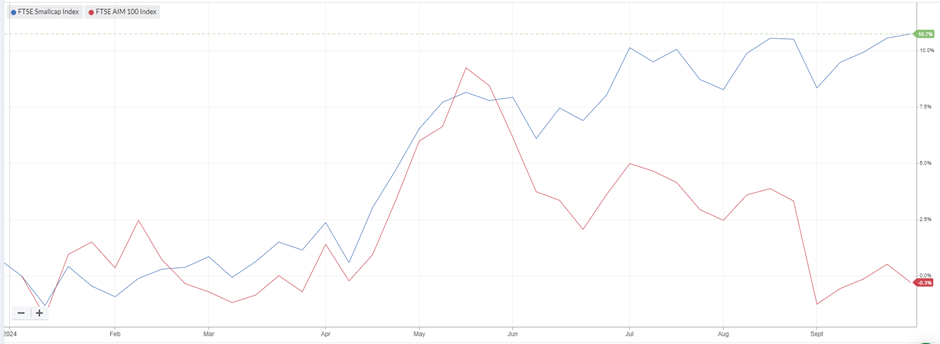
Of course, no one will be selling AIM stocks for this reason today since that would immediately nullify the tax break they fear will be removed in the future. However, the possibility of this change may have stopped investors from investing fresh capital into AIM stocks. Given that there is a natural flow of money out of these stocks as AIM IHT investors die and their descendants reposition themselves into assets that more closely fit their financial situation, this may explain some of the AIM weakness we are currently seeing.
The other big cause of the sell-off is investors anticipating this change and the flow of capital out of this part of the market. Many don't want to run the risk of owning anything that could be exposed to this. It is certainly possible that the immediate removal of BPR would cause a 30%+ crash in the value of the type of stocks that AIM IHT funds prefer.
Will these changes happen?
Many of these changes are rooted in sensible adjustments to the tax code. The problem is that the secondary effects will likely overwhelm any real tax gains. Changes to the Capital Gains Tax would likely encourage the emigration of the most asset-rich. The changes to ISAs and SIPPs mooted would add significant complexity. Removing BPR from AIM stocks would immediately reduce Capital Gains Tax receipts as many of the losses would be tax deductible, and it would be some years before the Inheritance Tax increase came through. However, investors should be wary about assuming that this logic will stop these changes from happening. This government has already shown it is prepared to put idealogy above economics when it comes to North Sea gas production, for example.
The reality is that significant changes are likely to happen with a sufficient lag for investors to take action on any legislative changes. However, this won't stop the secondary effects we have seen already impacting AIM stocks. On the plus side, if these changes don't happen, expect cash that has been sitting on the sidelines into stocks that now appear very cheap by historical standards.
Are commodity stocks safe?
One of the aspects of BPR that investors need to consider is that certain types of stocks are excluded. These come from the original aim of the 1976 Act, which was to allow family-owned trading businesses to be passed on without Inheritance Tax. In order to do this but not provide an obvious tax avoidance measure, the legislation needed to prevent incorporating non-trading assets for this purpose. Hence, the following types of stocks are excluded from BPR:
– those mainly investing in shares;
– those mainly investing in property assets;
– those dual listed on a recognised foreign stock exchange.
HMRC does not publish a list of BPR-qualifying companies. Entitlement is assessed once a claim for relief is made. This lack of clarity means that investment managers for IHT funds are conservative and invest in companies where they are certain relief can be claimed. AIM-listed housebuilders may be considered as investing in property assets due to their land banks, and resource companies can be viewed as owning property on any non-producing assets. IHT funds simply avoid these sectors rather than risk an adverse HMRC ruling after BPR relief is claimed.
So, in a turn-up for the books, the small cap resources companies on AIM may be some of the safest stocks in the short term. They are unlikely to have attracted IHT fund flows, making them immune from this effect. However, some resources companies face a tax challenge of their own - higher taxes on North Sea Oil & Gas production. It is this that has made Serica Energy (LON:SQZ) one of the worst-performing larger stocks on AIM this year:
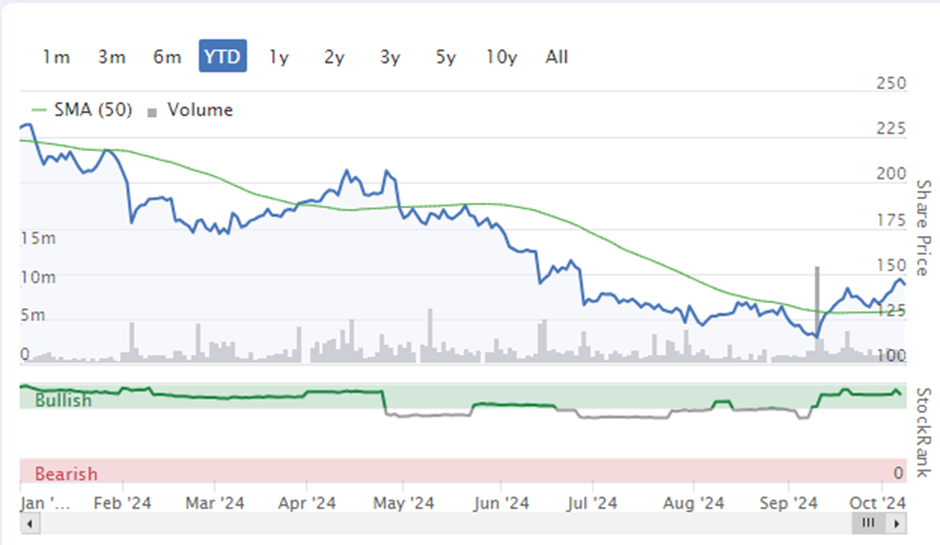
The big risk here is not the expanded Energy Profits Levy but any changes to the treatment of capital allowances. Currently, companies can reduce their near-term tax bill significantly through large capital expenditure. Something Serica has been taking advantage of, perhaps to get ahead of the possibility of changes in this area. However, in their last presentation, Serica estimated that they would generate their current market cap in cash in four years, even under the most pessimistic assumptions for tax changes. So it is possible that there has been an over-reaction by the market within this sector.
Which stocks are at risk?
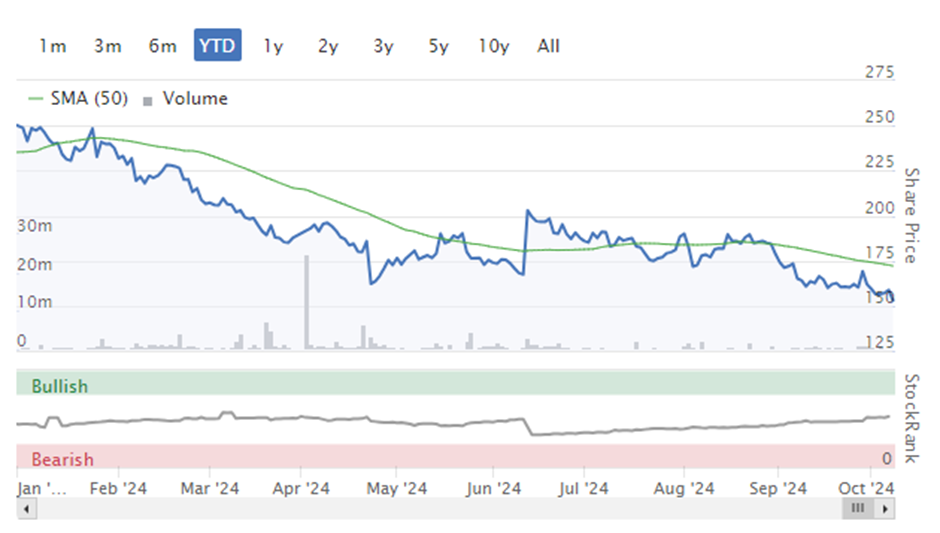
The easiest way to find out the type of stocks most at risk is to look at the IHT funds. The longest-running and largest is the Octopus AIM IHT fund. This has £1.5b under management, so it is certainly not insignificant in its scale or impact on the market. Unfortunately, they don't publish their holdings, and Octopus have a total AUM of over £13b, so we can't use holdings announcements alone to work this out. However, we do know that they aim to hold 20-30 holdings, and these have an average market cap of around £600m. This scale severely limits their choice of stocks. A quick screen for AIM100 stocks with a market cap of >£300m and not dual-listed/resources/housebuilders produces just 48 stocks. I wouldn't be surprised if the Octopus AIM IHT fund owned at least half of these names. Take RWS Holdings (LON:RWS) as an example. It is likely that the majority, if not all, of Octopus's 5% stake here is in the AIM IHT fund:

The RWS Holdings (LON:RWS) share price weakness this year may be as much down to the fear of BPR removal as worries about the impact of AI on the company's business model:
Some other IHT funds are more open. For example, the Downing AIM Estate Planning Service ISA is much smaller, with AUM in the £130m range, but it has quarterly factsheets giving details of its holdings. Here is June's:
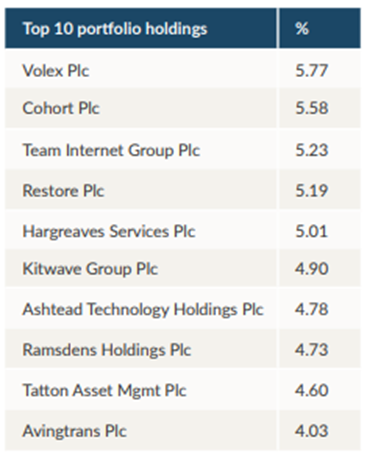
In the latest two factsheet commentaries, they also mention Flowtech Fluidpower (LON:FLO) Loungers (LON:LGRS) 1Spatial (LON:SPA) James Latham (LON:LTHM) Inspecs (LON:SPEC) Tracsis (LON:TRCS) Marlowe (LON:MRL) Frenkel Topping (LON:FEN) Eagle Eye Solutions (LON:EYE) Frp Advisory (LON:FRP) H & T (LON:HAT) Gateley (Holdings) (LON:GTLY) and Sigmaroc (LON:SRC) . Despite a claimed value bias, the Value Rank is not particularly high for many holdings. Few of these stocks are SuperStocks, and there are a number of High Flyers and Falling Stars in there, perhaps reflecting that stocks have to be held for two years to get BPR; hence the turnover is low even when the value may have outed.
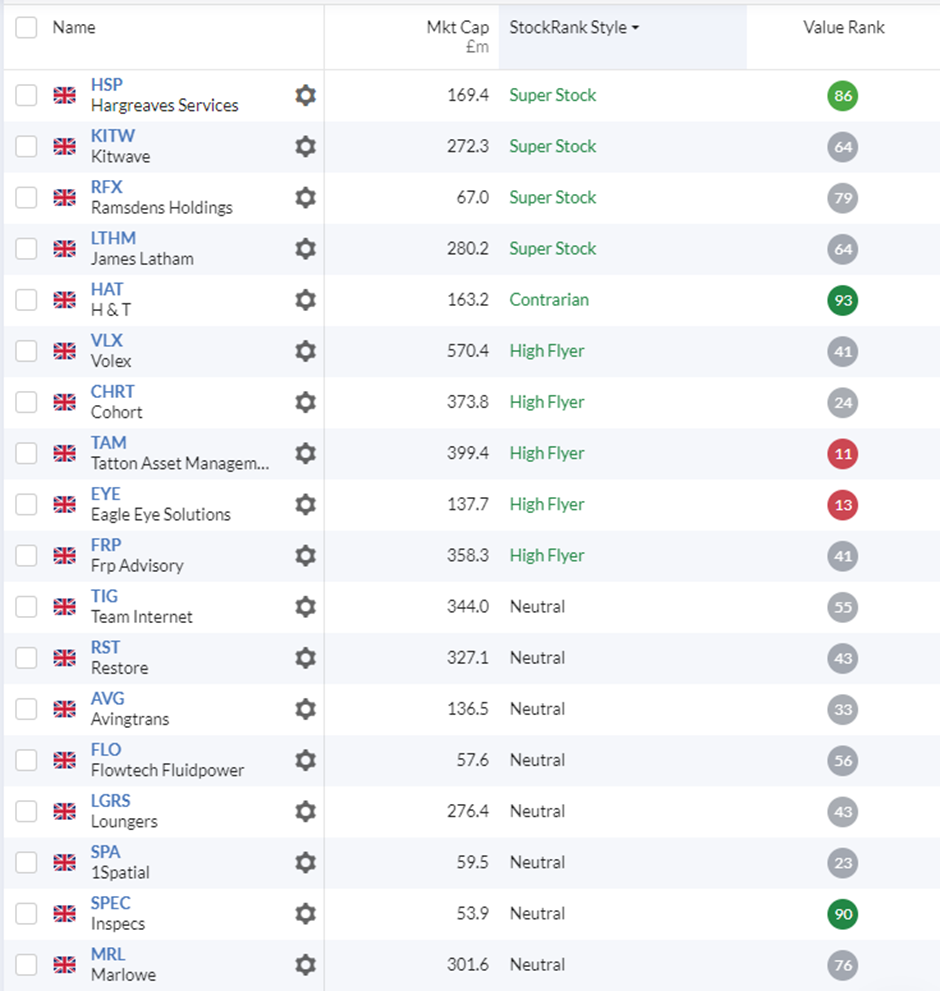
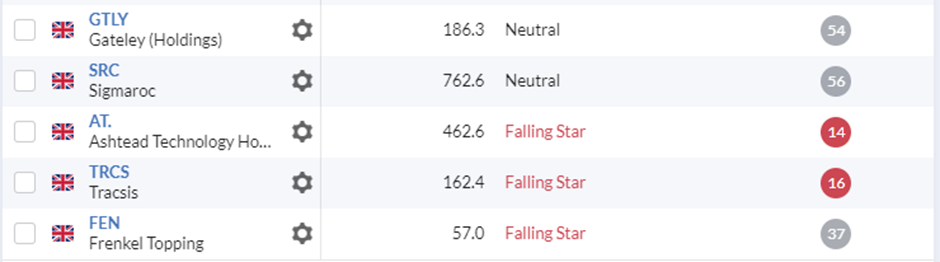
Many of these stocks look at the risk of large falls if BRP is removed from AIM shares.
The other well-known IHT fund is the Puma AIM IHT ISA, with around £230m AUM. Again, they don't give a breakdown of holdings but simply say they invest in:
A diversified portfolio of larger AIM companies. The Puma AIM IHT Service intends to invest only in quality companies that are considered to be profitable and cash-generative.
Here is the breakdown of the portfolio by the market cap of the constituent:
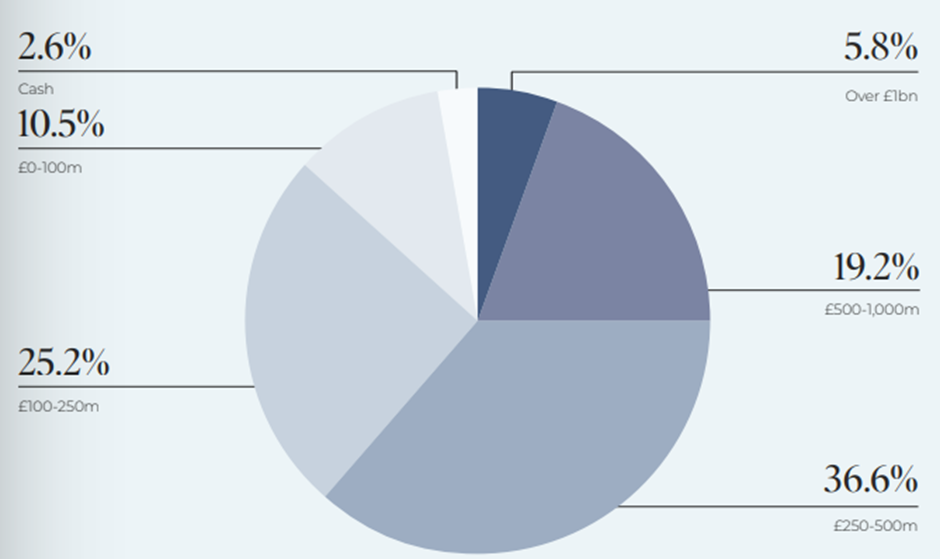
The only company they specifically mention in their brochure is Tracsis (LON:TRCS) , but I think it is safe to say they own very similar companies to Octopus, along with some of the smaller companies that Downing owns. It is this concentration in the same stocks across all managers that adds to the risk for these types of companies.
What should investors do about this?
Benjamin Graham famously said:
In the short run, the market is a voting machine but in the long run, it is a weighing machine.
Graham loved it when the market's voting got out of step with the weight of a business since this gave a favourable risk-reward ratio. If these changes in tax and all the associated impacts happen, they will certainly change the short-term voting of the market. However, the weight of these companies will not be changed by this. After all, a company is worth the net present value of cash flows returned to shareholders via dividends or capital returns in the future. Therefore, long-term investors may want to simply sit tight and ride it out, aware that nothing fundamental has changed in the companies they have invested in.
Indeed, if changes to BPR are implemented for AIM stocks, it could be a once-in-a-generation opportunity to pick up quality assets at a significant discount to their intrinsic value. At least for those who have cash on the sidelines or a regular income.
More cautious investors may want to minimise their exposure to the stocks held by IHT funds. However, the problem is they may already be behind the curve and be selling stocks where the market has already priced for a worst-case scenario. If the change to BPR doesn't happen, then capital will likely flow back into AIM rapidly. They will have sold low and bought high. One way may be to consider selling the AIM stocks that have bucked the trend and risen over the last few months, particularly if they don't look cheap. Here are some of the AIM stocks that likely qualify for BPR sorted by their 6m relative strength:
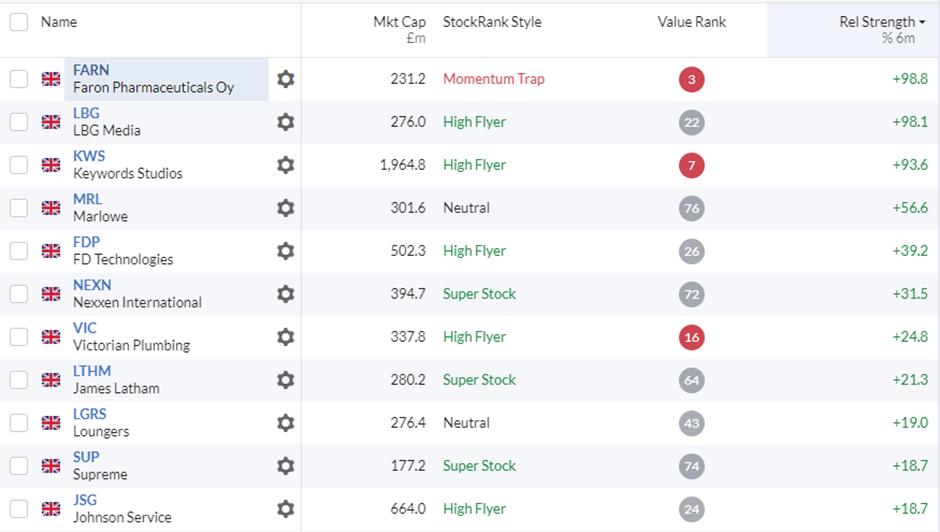
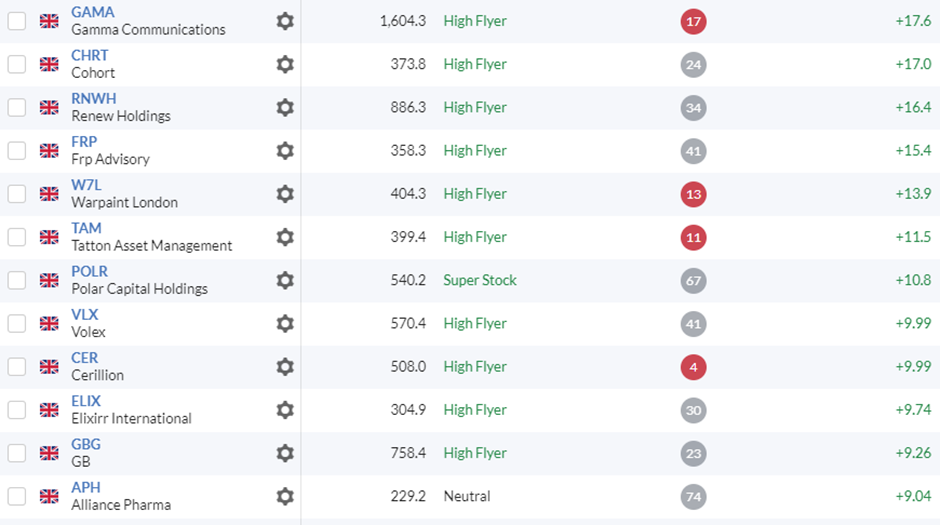
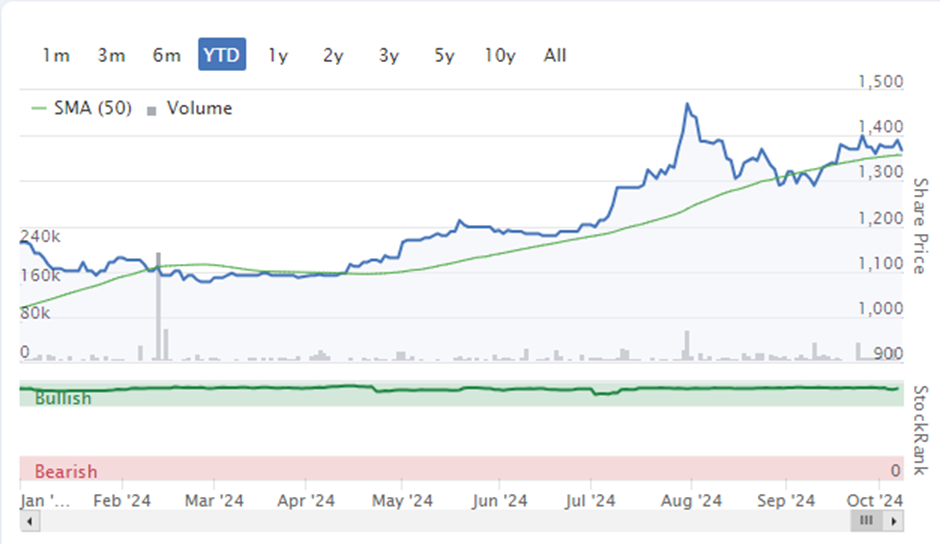
Some of these are special situations. However, many of these look like they could face a severe correction if BPR is removed. For example, as good as James Latham is, and despite being a SuperStock, it is exactly the sort of company that many IHT funds will own and is surprisingly illiquid for its size. There is little sign that the increased risk has been priced into the stock:
Another factor that investors may want to consider is how the companies themselves will react to significant falls in their share price. In this environment, I prefer any AIM stocks I own to be cheap, have net cash, pay large dividends, and either buy back shares or have the capacity to do so. A high dividend yield will likely act to limit the downside from any sell-off. Companies that are able to take advantage of any falls in the share price to buy back their own shares at bargain prices will generate above-average returns over the long term, whatever the short-term outlook. This will not mitigate the short-term pain of any drop, but it will lay the foundation for a more rapid future recovery.
[Disclosure: Mark owns shares in Ramsdens Holdings (LON:RFX) RWS Holdings (LON:RWS) ]
Disclaimer
This is not financial advice. Our content is intended to be used and must be used for information and education purposes only. Please read our disclaimer and terms and conditions to understand our obligations.
71 comments
And to think the Labour government claims "growth" is it's number 1 priority. Growth in what I wonder?
I would be more in favour of AIM than many here although I have no difficulty in agreeing with Yiannos and others that there is some dreadful dross in the market. The original intention that there should be a market with a less onerous entry, in both cost and regulation, is a very good one and I would be sorry to see that lost.
If it has gone awry it seems to be derived from three reasons:-
1. The market has been allowed to fill up with too many start up speculative resource stocks, giving it an image as a wild west gambling casino. It is a familiar way in which small lightly regulated markets seek to grow ( usually unsuccessfully ) to eventual respectability (hello Vancouver).
2. The Nomad fee basis encourages 1. above as there is a clear incentive to float new shares either in an IPO or in a placing. The fees available when managing cash generating smaller companies are much less attractive.
3. Amazingly, somewhere out there are enough buyers who are willing to invest their hard earned money on complete rubbish. You take some care over this dear reader, and so do I, but somebody is doing investing without a smidgen of understanding. The evidence from the meme stock craziness in the US suggests that actually some people want to look on this as gambling, where they think they get better odds than in the casinos.
As I said above I believe there is great value in having a junior market, but I think that it will only work if the Nomads can be remunerated sufficiently to retain their ability and willingness to prevent clearly recognisable chancers from mucking up the market. They must also be able to promote and facilitate the liquidity which prevents larger investors buying in. To this latter point there might be some way to enable larger investors to buy in without having to make a takeover bid, either by stated commitment or by having a parallel non-voting class. I don’t have a complete solution but I still think it is worth trying to find one.
Forgive me for missing the information if it’s available elsewhere on Stocko, but do we have a list of quality companies whose share prices have been battered already by CGT/IHT concerns. They are easy to spot on the chart. Just look for companies whose SP has fallen by around 20% (often) from 52 week highs, starting on or around the beginning of September, not before.
Here is a selection from my fund. And they all look great value already and could be better value still after the 30th, or deliver a good bounce if fears are not met.
Advanced Medical Solutions (LON:AMS)
Tristel (LON:TSTL) (new position)
Alpha International (LON:ALPH)
Ashtead Technology Holdings (LON:AT.)
Cerillion (LON:CER)
Journeo (LON:JNEO)
FW Thorpe (LON:TFW)
Tracsis (LON:TRCS)
Volex (LON:VLX)
All the above are down substantially on no news. Certainly a buying opportunity either before or after the 30th. I just can’t tell which it is!
I’d be grateful for other contributions. Just the good stuff, please.
Hi BnB,
Paul came up with a list of 20 such companies in the SCVR on 20 September.
He introduced the list with this comment: "My thinking being that we could be seeing some irrational, fear & tax-driven selling in UK small caps, whilst US markets rise to new all-time highs, which should be good for UK shares in due course, once the end Oct budget is out of the way"
Hopefully this link will take you there: https://www.stockopedia.com/co...
The before/after question would be a nice one to have an answer to!
do we have a list of quality companies whose share prices have been battered already by CGT/IHT concerns. They are easy to spot on the chart. Just look for companies whose SP has fallen by around 20% (often) from 52 week highs, starting on or around the beginning of September, not before.
Well, seeing as it’s a wet Sunday morning here, and I’m at a loose end, below is a list of the worst AIM 100 performers relative to the index since 1st September. You’ll have to make your own mind up which of these are “quality” companies! I agree with you though and recently re-started a position in Tracsis (LON:TRCS):
Super thanks. Certainly a couple more good firms with first rate balance sheets in that list whose price has sunk on no news. I’m drawn to GlobalData (LON:DATA, high PER but very reasonable on a FCF yield basis, and noting the delisting risk inherent in the founder’s 60% stake, Keystone Law (LON:KEYS) - PER has halved from its heyday as a stock, but is it still growing? Bioventix (LON:BVXP) - much more reasonably priced now, but will Troponin or Alzheimer’s provide the spark to lift the SP out of its range-bound trading?
Actually, what strikes me from the list of worst performers is how little overlap there is with the companies Mark mentions in the main article. Maybe we are all looking for something that hasn’t actually started yet with relation to AIM BR at least?
Agreed. In relation to the potential withdrawal of BPR, I’d concentrate attention on names whose valuation is high both relative to the growth rate and also in comparison with other firms in the same sector. James Halstead (LON:JHD) would seem to be the model. And that has hardly slipped at all. From my own list, perhaps FW Thorpe (LON:TFW) would be the best candidate. Meanwhile, it could be that the falls we’ve seen to date are all about CGT planning.
Further to my previous post, GlobalData (LON:DATA) I see a huge spike in volume on Friday, consistent with a large insti seller or the founder himself. It certainly isn’t CGT or BPR-related selling. Looking at the register, I can’t see much in the way of insti ownership, so perhaps it’s the founder. He sold 10m shares in August at 2.25. These have gone for 1.73. Something to ponder.
Some clarification for those asking about the structure of the AIM IHT services. Providers such as Octopus don't run OEICs or unit trusts. Each client will typically be referred through an IFA and have their own ISA and/or GIA wrappers with Octopus. Octopus then invest those wrappers directly in a range of AIM stocks which they expect to qualify for BR. Like a DFM arrangement, as a previous poster mentioned. So the clients won't have identical holdings and portfolio weights. But you can imagine Octopus' selection of AIM stocks won't be huge and most portfolios will look very similar. Ditto for the other providers.
If the BR rules are changed, those portfolios will continue to exist, but it will be up to each client (most often in consultation with their IFA) to decide whether to sell up or continue with it. My 2019 post on this topic suggested that the impact may be similar to the Woodford wind-up, in this case with a gradual stream of outflows as clients re-assess things over the next 6-12 months.
This is assuming AIM BR is scrapped completely. I wonder if they could just tweak the qualifying rules to make it difficult for the larger AIM firms to qualify.
Anyone got any thoughts on the optimum time to pick up bargains here?
For someone in their late 70's/80's with millions of pounds in an AIM IHT fund, if immediate removal of BPR from AIM shares is announced on 30 October (which I think it will, and have freed up cash in expectation), I imagine they will contact their Financial Advisor to ask what next course of action is straight away. The Financial Advisor wouldn't advise keeping that money in an AIM IHT fund, so the money gets moved to something else more IHT efficient (or just "safer" shares).
But how quickly could the money realistically be withdrawn from such funds and moved to something else? How would funds manage all the redemptions?
Are we looking at a quick snap down then back up over a couple of weeks, or a slow and steady drip decline over a year? Thoughts welcome.
Are we looking at a quick snap down then back up over a couple of weeks, or a slow and steady drip decline over a year? Thoughts welcome.
Nobody knows and anyone who says differently is either guessing or leaking.
However, if you are elderly and using BPR for IHT relief and it's withdrawn immediately then you will probably need to act quickly. The new Duty of Care regulations would also imply that the fund managers should be ready with their messaging asap.
Changes to BPR look nailed on, from the leaks coming from the Treasury, but we don't know whether they will be retrospective, delayed, or will involve full removal of the relief or some phased approach. A limit on the size of estate that can be protected by BPR (at, say, £2 million) is my highest probability outcome, but even that's not as much as a 50/50 bet. Some form of CGT relief for people who hold smaller cap stocks for the long term might be a possible compensatory change.
But that's all guesswork. As usual it's best to invest on the numbers rather than speculation, especially when it comes to tax breaks.
timarr
Pertinent questions, but as ever, the best approach will be to stay open-minded, avoid outside influence, stick to your process, and concentrate on valuation and the business outlook of individual companies rather than share price movements - the “timing” will take care of itself. Avoid the shooting fish in a barrel approach!
As Mark points out, liquidity will be a serious issue for anyone wishing to dump AIM shares in volume and so there will be no need to rush to buy if the worst expectations are met. I suspect that any change to BR on AIM would be phased or capped rather than a cliff edge to try to avoid a disorderly market anyway.
I do think that there is an overreaction occurring with respect to AIM. To quote from yesterday's Times, 'increasing the rate of capital gains tax on the sale of shares could still generate billions for the Treasury as the bulk of revenues — just over half — come from the sale of unlisted shares in private companies, which enjoy an average gain of just over £120,000. By comparison, the average capital gain on the sale of listed shares is £18,000'.
So just over half comes from unlisted private companies, not AIM.
I do think that there is an overreaction occurring with respect to AIM. To quote from yesterday's Times, 'increasing the rate of capital gains tax on the sale of shares could still generate billions for the Treasury as the bulk of revenues — just over half — come from the sale of unlisted shares in private companies, which enjoy an average gain of just over £120,000. By comparison, the average capital gain on the sale of listed shares is £18,000'.
It’s a political decision though, so it’s all about the optics. Removing illogical tax breaks which have been misused by the rich will go down very well with the vast majority of voters. That’s all you need to know. It doesn’t matter how much additional tax it raises. And for the record, I’m all for the removal of BR on AIM shares. It’s an anomaly that is being used contrary to its original intention and it needs to be abolished.
I'm not disagreeing with you - the original idea of the relief was that owners of small private businesses could pass them on to their children. I just think that people are exaggerating the effect that removal of the relief would have on AIM shares.
I'm not disagreeing with you - the original idea of the relief was that owners of small private businesses could pass them on to their children. I just think that people are exaggerating the effect that removal of the relief would have on AIM shares.
My approach is more simplistic - I don’t know or care whether people are exaggerating or not, although this is what you would expect to happen with social media whenever there is little or no real information available.
What we do know is that there is a “known unknown” coming on a certain date and to prepare accordingly. In my case, that means having a filter ready to sort the wheat from the chaff and to top up existing positions based on valuation only.
The part that concerns me though , is that not only do you have the selling from the wind up of the IHT funds, but also you permenantly lose the future stream of purchases from that source... hopefully there are no companies on the margin that go out of business...certainly it's not a pro growth policy change...
The part that concerns me though , is that not only do you have the selling from the wind up of the IHT funds, but also you permenantly lose the future stream of purchases from that source
This is my biggest concern with holding AIM shares beyond any short term noise around IHT. Who is the marginal buyer going to be? I don’t know the answer to that if the worst happens. Liquidity is already bad enough on AIM without it reducing further. And when liquidity reduces, spreads generally increase.
... hopefully there are no companies on the margin that go out of business...certainly it's not a pro growth policy change...
If these companies can only survive because of IHT flows then they would be better off put out of their misery. There's a decent report out by the Tony Blair Institute looking at what needs to be done to reinvigorate the UK markets:
Put bluntly, [the UK's] public markets are not fit for purpose. Bold reform is needed – and needed now. Every day, the global race to discover and bring to market the innovations of the future gathers pace. If the UK does not revitalise its markets, invention and talent will go elsewhere.
However:
Europe now has more than 1,500 startups that are each generating over $25 million in annual revenue. More than 250 of these are generating $100 million to 500 million in revenue – almost half of which are UK-based. If London plays its cards right, it can become the place of choice for this next generation of scaling European tech companies while providing a platform and financing pathway for the UK’s first trillion-dollar tech company.
And:
... the public-listing environment is unfavourable for smaller firms. Low liquidity and insufficient professional-analyst coverage – mid-sized AIM firms have on average a quarter of the analysts covering their US equivalents – are making small and medium-sized listed companies unattractive investment propositions. UK defined-benefit pensions are not only investing less in public markets but are also withdrawing from equity funds, reducing participants and capital in new, innovative companies. This results in lower liquidity for smaller listed firms, making them less appealing to investors and making it harder to raise funds.
Among the recommendations:
Close down AIM and create a rapid route to listing on the LSE’s Main Market with similar, but time-limited, tax and regulatory benefits. AIM has failed in its stated purpose of providing a home for scaling businesses. It should be fully merged with the LSE’s Main Market, with a special route to listing specifically for high-growth firms in emerging technology sectors. In this way, London can differentiate itself from other global exchanges and attract a pipeline of high-quality, innovative companies. Tax benefits for investors, similar to those currently available for AIM-listed companies, should be retained for firms using this route.
https://institute.global/insig...
Well worth a read.
timarr
I do think that the original premise of Mark Simpson's article is good, looking at the holdings of the IHT specific funds. As for the AIM shares not included in his list, I think there is far less reason to worry.
And do you really want to be invested in a company which is only being kept alive by a tangential tax relief?
I was merely thinking of the real world effects for job losses etc ... hopefully Stocko and its readership point us away from the more tenuous companies....
If i was a fund manager of a non IHT fund and those funds were doing well and had the money i would arrange to buy blocks of shares i like at a lovely valuation off market at a nice discount.However sadly with the UK based fund managers experiencing redemptions that might not be a choice they have.I'm treating it like all the worry in the US (yen carry unwind trade etc..) as in this isn't a fundamental 2008, pandemic type event and we'll just have to see what happens.I understand why people get worried though, but without any firm data it's all a coin toss.Hopefully Reeves' team has actually consulted fund managers, financial instituions etc.. and wargamed/thought this all this all through in advance.If she hasn't labour are losing by a massive swing next time, so they better get a move on making any shorter term changes they want now, as they'll all be reversed in a few years time imo.
Maybe if AIM enforced their own rules people would have more confidence to invest there.
Mark,
Excellent and well-rounded article Mark highlighting the enormous uncertainty the govt has allowed to grow unhindered around the removal of BPR from AIM shares.
In short, we hope any change in BPR in the budget, is made considering informed economic reasons and not political or uninformed ones. If BPR is removed, and I can see reasons for this, it is important that another form of support replaces it. Afterall, removing BPR won't be a revenue generator or an engine for growth but a detractor.
I don't invest in companies on the basis of IHT advantages. My investment case is solely based on whether I consider a share to represent good value based a wide range of metrics, including director buying, outlook, management and to a lesser extent the charts, but only insofar as the volume and direction of travel are concerned.
My portfolio of 25 shares includes 17 that are AIM listed, six of which appear in the Downing IHT portfolio shown in Mark's article. Avingtrans (LON:AVG) and Volex (LON:VLX) are my largest positions.
I have no idea what the budget will bring other than an increase in taxes, but in what form who knows, I suspect that even Rachel Reeves isn't quite sure at this stage. On top of which many good quality shares have already sold off and remain cheap on current forecasts, Volex (LON:VLX) being an example.
Then there are shares that are unloved despite the company performing well. Ramsdens Holdings (LON:RFX) put out an ahead of expectations update recently, yet the share price today is not materially different from that on the day of the announcement, despite the gold price remaining above £2000/ounce.
So failing any company specific banana skins I shall stick with my approach and remain invested.
I'm personally hoping this will be a "sell the rumour, buy the fact" event with a relief rally upon the budget announcement, whatever it may contain.
Apologies to those who have already read it, but here is a link to my 2019 post on this very subject of AIM and BPR.
Inheritance Tax: The Exposure of AIM to Business Relief
Great article, principles are still relevant, even if the stocks have changed.
Hi Chris
That was, and remains, an excellent post. I have a couple of observations and one question.
Firstly Gamma Communications (LON:GAMA) is headed for the main market so that's not going to be subject to BPR for much longer.
Secondly the new Consumer Duty rules means there may be a rush for the exit if the rule change is abrupt. I'd be surprised if there isn't some form of transition process, but given how much IHT is being sheltered by large estates that isn't a given.
Thirdly, I don't understand how the large stakes in AIM companies by the likes of Octopus etc al relate to IHT protection. My understanding is that the shares must be held by the individuals seeking IHT protection, not by the investment company? I had assumed the declared holdings were a combination of ISA and VCT proxy holdings (where the manager can hold the shares on behalf of the individuals) but wouldn't include individual share holdings managed through the holding companies.
Or to put that another way - I had imagined that the declared stakes were an understatement of the actual IHT protected holdings? And if so the stampede for the exit if the rules are changed may be very entertaining, if viewed from the outside ...
timarr
' given how much IHT is being sheltered by large estates that isn't a given'
But how many large estates own significant quantities of AIM shares? I do think that this whole threat is being greatly exaggerated.
Hi John2
Depends on your definition of "exaggerated":
"A small group of the UK’s wealthiest estates were able to shelter £1.8bn of assets from inheritance tax in 2020-21, new data has revealed, reigniting a debate over which types of businesses should receive the lucrative relief."
https://www.ft.com/content/637...
timarr
A large proportion of that £1.8bn will be unquoted companies.
A large proportion of that £1.8bn will be unquoted companies.
The Institute for Fiscal Studies suggests the majority is on AIM:
We estimate that the removal of business relief for AIM shares could raise around £1.1 billion in the current tax year, rising to £1.6 billion in 2029–30. This could be an underestimate, since business relief on AIM shares is used very heavily by trusts, for which no direct statistics are available.
https://ifs.org.uk/articles/ra...
Octopus alone have stated they have £1.5 billion in IHT avoidance funds with most of their declared holdings in a limited number of AIM 100 stocks.
The AIM 100 is worth about £36 billion in total.
timarr
Hmm, you're still not convincing me that there is not a massive over reaction going on. The AIM 100 is worth £36bn. The FT reckons £1.8bn is being sheltered from IHT. It is undeniable that a large part of this consists of unquoted companies (there are a lot of these about). So why do people suggest that AIM shares will decline by 30%? £1.8bn is 5% of £36bn.
The IFS reckons £1.2bn is being sheltered next year. If BPR was to go all AIM funds being sheltered are at risk, not just one year's.
Enough.
timarr
In his preamble this morning Paul said £6 billion of assets were in IHT funds so it's not insignificant. When you pair that with the less liquid nature of most AIM stocks price moves could be large even without lots of activity. Then you add a buyers strike on top and it certainly has potential to be a large threat imo.
To address another query about how these stocks have to be held to qualify, I'm sure I read these funds manage stocks in every individuals account rather than it being a 'fund' they invest in. More akin to discretionary fund management I think. I have no idea if this is true but it might explain why they are so expensive.
Yes, actual AIM IHT threat probably overrated - but this doesn't mean that the market won't have a fainting spell if it is introduced !
Scores of companies take AIM at Reeves over tax threat
Musicmagpie (LON:MMAG)
(Don’t fully understand why someone is acquiring this crap!)
Mothercare (LON:MTC)
Intelligent Ultrasound (LON:IUG)
Union Jack Oil (LON:UJO)
Comptoir (LON:COM)
Revolution Beauty (LON:REVB)
Staffline (LON:STAF)
Tasty (LON:TAST)
Virgin Wines UK (LON:VINO)
No need to mention more………
Should concentrate on how to survive rather than worrying about the IHT relief.
All the best
Very useful article, thank you Mark.
I have a handful of Aim stocks in my portfolio that are good quality companies and the shares have performed well. I think one of the issues with the AIM market as a whole, compared to the FTSE Small Caps at least, is that AIM has a large amount of junk companies. With careful selection though (and nerves of steal to cope with the volatility), I think you can do well.
The question of whether to sell now or hold to ride out the wave, is a difficult one. I'm in it for the long term, so am going to hold my nerve, but am setting some stop losses as a safety net (and fingers crossed, there'll be enough liquidity to sell if it does all goes pear shaped).
Looking forward to getting this damn budget out of the way!
Mark, thank you for this very informative article which has helped me understand the CGT (which it appears the previous government has already ripped our areas and legs off) and the potential IHT issue.
It is totally unacceptable to delete a post of mine that expresses the serious issues regarding the AIM.
These are two separate graphs of the AIM and one can see where this is going and has nothing to do with taxes.
Last 3 years graph AIM.
All time graph of AIM.
All the best
Looking at the above, i am amazed i have ever made any money trading Aim stocks, in my fledgling investing career.
Have always held about 90% AIM in my portfolio, though going forward that may change...performance of the index has been truly dreadful.
What’s really eye opening is that poor quality AIM Companies can persuade professional investors to support one fund raising after another, even after multiple years of that Company making losses and draining cash, and failing to deliver on their promises .
Classic examples of this are the likes of Vast Resources (LON:VAST) Reabold Resources (LON:RBD) 80 Mile (LON:80M) and Eden Research (LON:EDEN) .
Using Eden Research (LON:EDEN) as an example. They have what look to be superb products but have failed for over 20 years to get meaningful sales. Yet as the cash ran out yet again they again managed to get a placing and open offer away late last year , helped by somehow persuading the MIDAS tipping column in the Mail to tip the share ahead of that fund raise.
80 Mile (LON:80M) promised that their key Dundas mine project in Greenland would be in full production by 2019. It hadn’t even started to be built when a year or more ago they abandoned that project!
And these shares are often very popular with small investors even when as with the above examples they have fallen 99% from their peaks! .Why once it becomes patently obvious that it’s a Company that promises so much, but time after time fails to deliver on those promises?
Look at Rosslyn Data Technologies (LON:RDT) today.
How are they allowed to raise more money?
Suggesting that the problem and the recent fall of AIM companies is down to a probable change of taxation is simply misinformation especially when the same issue is ongoing over in the US, where the markets are recording all time highs every week!
I am very concerned that our opinions are deleted.
All the best
You have deleted my post after more people gave the thumps up than any other post.
Just because I have expressed the reality about the AIM.
Well done!
yiannos1.
This is my first look at this thread as I’m not really interested in AIM shares. I see that whatever you posted was removed. As I didn’t see your post I’ve no idea (and nor will others who didn’t see your post) why it was removed. Surely it wasn’t because you posted the reality that too many AIM shares are rubbish companies? The AIM index performance is terrible. It’s gone nowhere for multiple years. It was around 1000 in 1996 and now is down to around 730!
Hi Ken
Unfortunately exactly what you are thinking.
I have said that about 80% of AIM companies are mostly crap ones and that the spread is criminal. Also I have suggested that the ongoing fundraisings of failed companies makes me sceptical. I have also said there seems to be a sell by date of the AIM. Finally I have clearly indicated that the liquidity and the quality of most of the companies and the people managing these are just not good enough for investment.
Very much appreciated Ken.
All the best
Hi ken
I did read yiannos' post and while it was expressed in their normal forthright fashion there was nothing in it to require moderation.
AIM has been a badly managed market for an awfully long time. As far back as 2007 Roel Campos was describing it as a "casino". It's one thing to support capital raising for small companies in a light touch regulatory environment, it's entirely another to sponsor listings of companies that are poorly disguised mechanisms for transferring money from the gullible to the greedy.
Meanwhile AIM has a bunch of companies that should have transferred to the main list years ago. Why are companies that would easily drop into the FTSE 250 still listed on AIM?
If our government truly wants to stimulate the small market it should take a look at what Nasdaq has done in Stockholm. And removing the distorting effects of BPM, which is funnelling liquidity towards a crowded group of companies that don't need it and away from the handful that do, can't be anything other than a good thing overall.
timarr
Thanks timarr
Unfortunately my English writing skills make things look worse than they are.
I agree 100% that AIM should just basically be abolished and the good companies (probably about 20%) move to the main market.
Much appreciated.
All the best
yainnos1
Forcefully expressed views and on this occasion I can see no reason why they should be deleted.
If it is the post I think it is, I am not sure why the mods should consider your post inappropriate.
I actually disagree that AIM itself is the problem, though. I think all markets attract bad actors and the incentive systems often leave shareholders worse off. However, we are all responsible for our own investment decisions and can't blame others if we are taken in. Part of the Stockopedia way is to give investors the tools to filter out the worst offenders (usually Sucker Stocks).
I actually prefer AIM versus the main market, and it is because of the NOMAD system. A fully listed company can publish untruths in an RNS, and no one is checking it; it is meant to be the reputation of the company and the power of the regulator that keeps them in check, but I rarely find that bad behaviour is investigated and punished.
On AIM, it is the NOMAD's reputation that is on the line, and they often have much more at stake - the potential loss of all of their clients or the inability to raise money for them. In many cases, I think that this is more effective at making sure what we read in RNS matches reality.
That said, I've developed a natural scepticism over the years that keeps me well clear of the most promotional stocks! And I also bear in mind the quality of the NOMAD in whether I consider a stock investable or not.
Dear Mark,
I believe that you hold Billington Holdings (LON:BILN) and their NOMAD is Cavendish if I am not mistaken. Ex holding of mine and a good company.
I am sure between us we can name more than 10 companies from the same NOMAD that have no future.
All the best
More than happy to trust the Stocko guys on this. They seem a good and decent bunch. Maybe ask them why ?
An excellent and comprehensive article Mark. Very informative and helpful.
RWS Holdings (LON:RWS) I hold
This stock is one which I think could be taken over if BPR is abolished completely. I once met Andrew Brode, the founder and he told me that he had two daughters (IIRC) to whom he would pass on his holding in the company when he died. Now that makes sense if he could do so without a large IHT liability. If BPR is abolished IHT would be due whether he passed on his shares or if he agreed to a takeover and passed on the proceeds. He is 82 and I think he still holds about 21% of the company so his agreement to a takeover would be important which is probably why it hasn't happened so far.
Yes, it is interesting that the Learning Technologies (LON:LTG) board is minded to recommend an offer, and not a particularly generous one at that, with Brode as the largest shareholder. I note that shareholders have the option to remain in the unlisted equity, tho, so that may well be the attraction for him.
Dr W G Barb was the founder and was not someone to be messed with!
Thanks for this article it is very helpful in the current circumstances. I have to say that the current government is producing some very unnecessary stress to the markets and to the people who have actually contributed the most to the UK economy over the years. I think it will potentially have very negative long term consequences if they go in hard they could easily neutralise the gains that they expect to make. With this in mind I have made some adjustments to my own portfolio, selling AIM shares that have been loss making or ones that have been profitable but running flat over recent months. This has been cash neutral overall but has taken a lot of volatility out of my portfolio - although this could be a coincidence.
Thank you for the analysis, for me at least it is the level of uncertainty created by the labour government has led me to sell many of my small caps largely AIM stocks taking profits where I can, for the time being re-investing into large caps. After the smoke has settled I expect many good AIM companies to be bargains.
Can someone tell me, are overseas based companies such as Somero Enterprises (LON:SOM) Spectra Systems (LON:SPSY) etc excluded from BPR?
I think the only criteria is whether the shares are traded on a "recognised" exchange. Aim is not in the HMRC list of such exchanges and so long as other criteria such as it must be a genuine trading company not just an investment vehicle, I would expect BPR to apply.
Thanks for this really excellent and thought provoking article Mark
I think it’s important to distinguish between stocks that are held predominantly for their IHT BPR characteristics and those that qualify, but are also more generally held for their growth prospects. Compare James Halstead (LON:JHD), a high quality, low growth dividend champion to Volex (LON:VLX), a medium quality, high growth industrial with strong drivers for further growth. It would be logical to expect the former to suffer if the rationale for holding were compromised. The latter, meanwhile, may not escape in the general panic selling, especially by IHT funds to meet redemptions, but the shares are already exceptional value and would, I imagine, be quickly bid by smart investors.
Hu BnB
Just a point re "redemptions".
To qualify for BPR, the shares must be held directly by the investor, not via any sort of fund - so people like Octopus are not actually running an AIM fund. They have a large number of accounts, one for each investor, which hold a selection of AIM shares.
So, if an investor decides to bail out in view of budget changes (or otherwise), Octopus et al have no choice as to which shares to sell - they sell the shares held in that investor's name. I'm sure this could trigger all sorts of distortions.
And, potentially, trigger difficulties in treating all clients equally - if liquidity is poor, they may need to juggle which investor's shares they are actually selling.
When I looked into AIM funds for my mother 10 years ago, it seemed that most managers ran similar accounts for all their investors; a minority tried to keep the accounts as close to identical as possible.
Hi Mark - this is a very useful summary for calming pre-budget nerves. I hold a handful of AIM stocks and was aware of the possibility of the BPR removal. I hadn't realised that only a subset of stocks on AIM are eligible for BPR. Would you put Polar Capital Holdings (LON:POLR) (I hold) in the category of companies mainly investing in shares and hence they are excluded from BPR and so should not be overly affected if the govt do remove the relief?
Great stuff, Mark. Listening to the recent IC podcast with Lord Lee, he says he's not selling his ISA AIM stocks for the very reasons you give, but has sold non-ISA stocks to crystallise capital gains and take the (presumed lower) tax hit. That's given him a war chest to move into the AIM market if the IHT changes fo take effect and there's a sell-off.
That's one strategy. But there's another thought: CGT changes could be relatively mild. That would be a pretty shrewd tactic by Rachel Reeves - she'd have reaped a CGT windfall ahead of the budget and at the same time, proved her more extreme critics wrong...
I agree with you about RWS (I sold but am tempted to repurchase) - a forward PE of 7 and a yield of almost 9%. The jury's out about its AI claims but the price does look ridiculously low.
Excellent article, I own some of these quality long term winners like Latham, will definitely buy more if they do dip. Concerned the government are going to create some adverse unintended consequences.
I hope you're right about the changes taking effect from 6 April 2025, but remember that George Osborne increased the rate of CGT in June 2010.
Yes, good point. Thanks dodge1664. A mid-year tax change is certainly possible, although it massively increases complexity and surely is a worst-case scenario? I can see why some investors may want to get ahead of the chance of this. Although, I don't think this would unduly effect AIM shares versus any others, it will certainly be causing some selling across Uk assets. It means that there may well be random bargains available over the next few weeks, even in non-AIM stocks.