First Drill Assay Results from Tirzzit Project
RNS Number : 7536ZTalisman Metals PLC21 October 2026RNS Number: 7536Z
Talisman Metals PLC
21 October 2026
Talisman Metals PLC
("Talisman" or the "Company")
First Drill Campaign Assay Results from the Tirzzit Project, Morocco
Talisman Metals PLC (“Talisman” or the “Company”) announces initial assay results from the first four reverse circulation (RC) drill holes of the Company’s 2026 exploration program at the Tirzzit Project, Morocco. The findings include consistent copper (Cu) mineralisation within the Late Precambrian basal series sedimentary strata as expected.
Highlight intercepts (see table below) include 1.56% Cu and 64 grams per tonne (gpt) silver (Ag) over two metres (m) from 8m down hole for TRC01, 0.31% Cu over 10m from 2m downhole in TRC02 and 0.31% Cu and 7 gpt Ag over 5m from 83m down hole in TRC04 (including 1m at 1.05% Cu and 19 gpt Ag).
Drill Assay Results
Hole ID
From (m)
To (m)
Length (m)
Ag (gpt)
Cu (%)
TRC01
8
10
2
64
1.56
TRC02
2
12
10
<6
0.31
Incl.
11
12
1
15
2.08
TRC03
51
55
4
6
0.18
TRC04
83
88
5
7
0.31
Incl.
87
88
1
19
1.05
*True width is expected to be 90 to 100% of down hole thickness due to vertical holes into flat lying strata
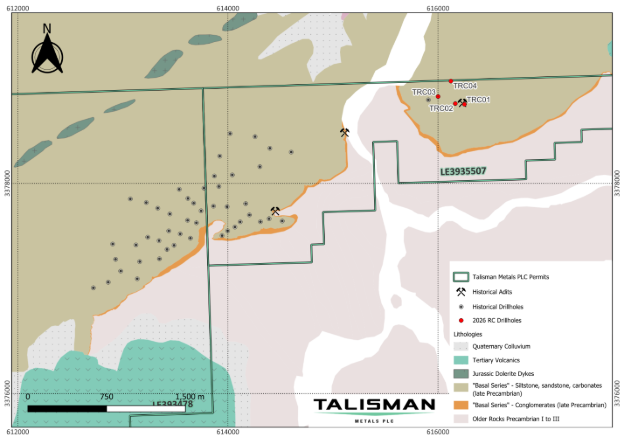
The current drilling program (see press release of September 2, 2026) aims to better understand the extent, grade and geometry of the Late Precambrian basal series strata at Tirzzit and to support a future resource estimate. Drilling is ongoing at Tirzzit, with exploration targets across the project slated to be completed in 4 – 6 weeks. Assay results from the current program are expected throughout Q42026.
“These initial results from Tirzzit confirm the existence and location of copper-bearing sedimentary strata and we believe that as we complete the drill program, we will uncover stratigraphic folds within the basal series that bear wider zones of mineralisation, as is common in analogous deposits from around the region,” said CEO Tim McCutcheon.
Drill Hole Map
Methodology and QAQC
A quality assurance and quality control (QA/QC) program has been implemented throughout the RC drilling campaign to monitor the accuracy, precision, and reliability of the RC chip assay results. The QA/QC protocol included the systematic insertion of blank samples and field duplicates at regular intervals. Certified reference materials (“CRMs”) were inserted at randomly selected intervals within mineralised zones. The systematic insertion of blanks and field duplicates represents 10% of the sample stream, with additional CRM insertions increasing the overall QA/QC proportion.
Samples were submitted to the Labomine laboratory (Certified under ISO/IEC 17025 in 2025) for sample preparation (drying at 105°C, crushing to <2 mm, splitting, and pulverizing to <75 microns) and multi-element analysis using a four-acid digestion (HCl-HClO₄-HNO₃-HF) with ICP-OES finish. The analytical method has a lower detection limit (“LOD”) of 11 gpt (parts per million) for copper (Cu) and 6 gpt for silver (Ag).
Blank samples showed no evidence of contamination above three times the detection limit for Cu or Ag. Certified reference materials returned values within acceptable ranges. Field duplicates showed good agreement with their corresponding parent samples; however, the limited number of duplicates (four in total) was insufficient to conclusively assess analytical precision.
RC samples were collected at consistent 1m intervals. Reported mineralized intercepts comprising multiple samples were calculated using length-weighted average grades, which, given the uniform sample lengths, are equivalent to the arithmetic mean of the individual assay results.
About The Tirzzit Project
The Tirzzit Project is a Late Precambrian sediment-hosted stratiform Cu-Ag system, located 225 km east of the city of Agadir, Morocco. The acquisition transaction of the Project was announced February 16, 2026 (see press release) from a wholly owned subsidiary of Aya Silver & Gold Inc. (TSX: AYA; OTCQX: AYASF) (“Aya”), the Company’s 4.7% shareholder. The Project consists of two mining licenses covering a surface area of 16.5km2. Historic drilling results, as reported by Moroccan Government agency Bureau of Research and Mining Participations (BRPM) between 1972 and 1976 (“BRPM Reports”), include drill intersections of 3.16% Cu over 2.5m and 0.60% Cu over 11.4m. Talisman continues to process with Aya the formal transfer of the Tirzzit licences on the back of the sale agreement announced February 16, 2026.
Qualified Person
The information in this news release was compiled, reviewed, verified and approved by Mr. Michael Dufresne, M.Sc., P.Geol., P.Geo., a "Qualified Person" as defined in JORC 2012. Mr. Dufresne has more than 35 years' experience in exploration for metals and minerals of this mineralisation type, style and geological setting and is an independent qualified person as defined under the JORC code and the AIM Rules for Companies. Mr. Dufresne consents to the inclusion in this announcement of the technical matters based on his information in the form and context in which it appears
End
For further information:
Talisman Metals PLC
Tim McCutcheon (Chief Executive Officer and Director)
Tel +353 (0) 1 525 6710
contactus@talismanmetalsplc.com
Beaumont Cornish Limited (Nominated Adviser)
James Biddle / Roland Cornish
Tel: +44 (0) 207 628 3396
CMC Markets UK Plc (Broker)
Thomas Smith / Thomas Curran
Tel: +44 (0) 20 3003 8255
BlytheRay (Financial PR)
Megan Ray / Said Izagaren
Tel: +44 (0) 20 7138 3204
Technical Glossary
Ag
Silver
Argentian chalcocite
Argentian chalcocite is a silver-bearing variety of chalcocite (Cu₂S) in which minor Ag substitutes for Cu in the crystal structure. It typically forms in Cu–Ag sulfide systems, particularly under reducing conditions and during supergene enrichment or low-temperature hydrothermal alteration.
Basel Series
A stratigraphic layer within a sedimentary basin that has properties
conducive to hosting mineralisation.
Cu
Copper
gpt
Grams per tonne (metric system, or 1/1,000,000)
ICP-OES
Inductively coupled plasma optical emission spectroscopy (ICP-OES), is an analytical technique used for the detection of chemical elements.
Reverse Circulation (“RC”) drilling
A fast, cost-effective method for collecting rock samples. Compressed air is pumped down the annulus (the space between inner and outer drilling tubes), while pulverized rock cuttings are forced back up through the inner tube to the surface. This “reverse” flow is what gives the method its name and ensures dry, uncontaminated samples suitable for analysis.
Nominated Adviser Statement
Beaumont Cornish Limited ("Beaumont Cornish"), is the Company's Nominated Adviser and is authorised and regulated in the United Kingdom by the Financial Conduct Authority. Beaumont Cornish's responsibilities as the Company's Nominated Adviser, including a responsibility to advise and guide the Company on its responsibilities under the AIM Rules for Companies and AIM Rules for Nominated Advisers, are owed solely to the London Stock Exchange. Beaumont Cornish is not acting for and will not be responsible to any other person for providing the protections afforded to customers of Beaumont Cornish nor for advising them in relation to the transaction and arrangements described in the announcement or any matter referred to in it.
Distribution
This announcement has been notified via a Regulatory Information Service and it is not authorised for distribution into North America or any other jurisdiction where to do so would constitute a violation of the relevant laws or regulations of that jurisdiction.
JORC Code (2012) – Historical Exploration Results Disclaimer
The information in this announcement that relates to historical reported exploration results is based on, and fairly represents, information and supporting documentation prepared by previous operators and/or extracted from historical reports.
The historical exploration results referred to in this announcement were reported prior to the introduction of the JORC Code (2012) and have not been reported in accordance with the JORC Code (2012).
A Competent Person has not done sufficient work to disclose the historical exploration results in accordance with the JORC Code (2012). It is possible that following further evaluation and/or exploration work, the accuracy and reliability of the historical exploration results may not be confirmed.
The Company has not independently verified the historical exploration results, and no assurance can be given that future exploration work will result in the confirmation or upgrade of the historical results to JORC Code (2012) compliant Mineral Resources or Ore Reserves.
The Company considers the historical exploration results to be relevant as they provide an indication of the potential of the project. However, the information should not be relied upon as a representation of the current mineral resource or exploration potential.
This information is provided by RNS, the news service of the London Stock Exchange. RNS is approved by the Financial Conduct Authority to act as a Primary Information Provider in the United Kingdom. Terms and conditions relating to the use and distribution of this information may apply. For further information, please contact rns@lseg.com or visit www.rns.com.
RNS may use your IP address to confirm compliance with the terms and conditions, to analyse how you engage with the information contained in this communication, and to share such analysis on an anonymised basis with others as part of our commercial services. For further information about how RNS and the London Stock Exchange use the personal data you provide us, please see our Privacy Policy.ENDDRLBLBDGRUDDGLG