3 FTSE 250 contrarian stocks to consider

I recently explained why I’m still buying UK shares despite the lure of 5% risk-free returns. In that piece I said that one segment of the market that looks particularly attractive to me at the moment is the FTSE 250.
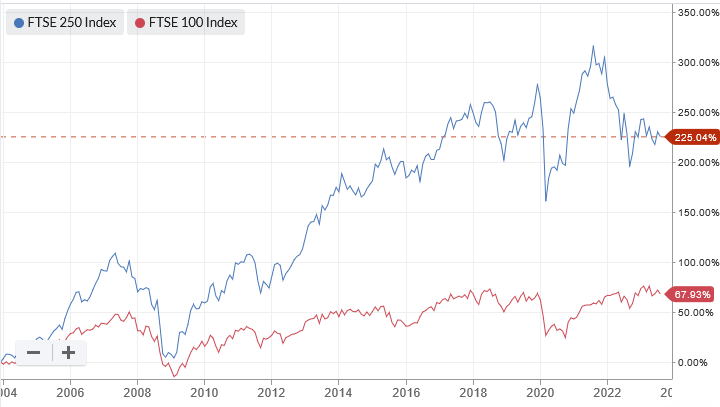
The UK’s mid-cap index is traditionally home to faster-growing companies than the FTSE 100. For much of the last 20 years it has also outperformed the FTSE 100 and been more expensive:
However, that picture has changed. The FTSE 259 has lagged behind the 100 over the last couple of years:
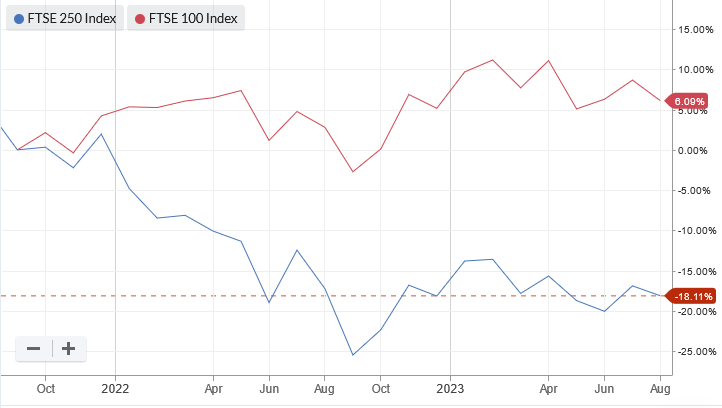
As a result, the FTSE 250’s valuation premium has disappeared.
According to Stockopedia data, the FTSE 250 now trades on just 12 times forecast earnings and offers a prospective dividend yield of 4%.
The equivalent figures for the FTSE 100 are 13 and 3.7%.
This matches up with my personal experience. A lot of the stocks that are catching my interest at the moment are FTSE 250 shares. Very few are in the FTSE 100.
I think it could be a good time to look for unloved but good quality companies in the FTSE 250. In the remainder of this piece I’m going to take a look at three stocks from this index with Contrarian ratings that I think look interesting today.
#1: CMC Markets (LON:CMCX)
This online financial trading firm has had a difficult year as trading activity (and profits) have come back to earth with a bump after the pandemic boom.
CMC warned on profits in March and the firm’s shares have fallen by 50% over the last year:
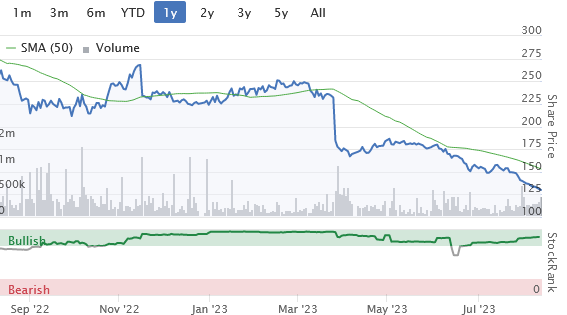
I reviewed CMC’s latest results in this SCVR in June, while Graham covered the firm’s Q1 update in July here. Both of us took a favourable view of the stock and suggested it could offer value at current levels.
While profits from the core leveraged trading business are down at the moment, this won’t last forever. CMC says that the level of client money and active client numbers “remain robust”, suggesting that clients are simply waiting for more favourable market conditions to return.
In the meantime, CMC is enjoying a sharp rise in interest income on client and own cash balances. The group is also continuing to expand its stockbroking business, with new offerings for both retail and institutional clients.
Operating margins have averaged 31% over the last six years, highlighting the profitability of this business. Even after last year’s profit slump, CMC’s quality metrics still look good to me:

For a business with this level of profitability and a solid balance sheet, I think CMC looks decent value at current levels. There’s also an attractive 6% dividend yield to reward patient shareholders:

One final attraction is the presence of founder-management. CEO Peter Cruddas has a strong incentive to create more value for shareholders:

So what could go wrong?
One risk for me is that the group’s stockbroking business is competing in crowded markets and may fail to achieve a profitable scale.
Another potential concern is that the core leveraged trading business will always face a degree of regulatory risk. Most recently, regulatory changes in Australia have caused a reduction in client trading activity in that market.
However, on balance I think that both of these risks are probably already reflected in the stock’s current valuation.
I think CMC could deliver attractive returns from current levels, on a medium-term view.
#2: C&C (LON:CCR)
Companies that produce branded drinks are a classic defensive play. Diageo (LON:DGE) is the poster child for this sector in the UK market, but I think there’s probably better value elsewhere at the moment.
One firm that’s caught my eye after steep falls is Irish firm C&C. This vertically-integrated group produces Tennent’s beer and Bulmers cider, along with a host of other smaller brands.
The group also acts as distributor for a number of other well-known international brands, and owns the Matthew Clark and Bibendum drinks wholesale businesses, giving it a direct route into the foodservice and hospitality sectors.
Unfortunately, the last few years haven’t been kind to C&C, which has suffered a number of problems in addition to the impact of Covid on the pub trade. As a result, the firm’s shares are still 60% below the peak levels seen before the pandemic:

However, most of these issues seem to have been contained and are now moving into the rear-view mirror. The company’s core brands remain big sellers in their main markets – Tennent’s has a 29% share of the Scottish beer market.
I think C&C could be a classic contrarian pick at current levels. A defensive, steady business that’s encountered a run of bad luck but should be able to get back on track.
Financially, the company’s performance also gives me hope that profits could improve.
Margins: C&C’s group level operating margin of c.5% is always likely to be held back by the distribution element of the business.
But the company says its branded business generated margins of 11.2% (UK) and 19.6% (Ireland) last year.
Return on capital employed: Conversely, return on capital employed from the group’s distribution business was high, at 28%. In my experience, distribution businesses with high ROCE can be attractive cash generators.
I’d hope to see group ROCE return to double-digit levels over the next year or so:

Valuation: C&C shares look reasonably valued to me based on forecast earnings:

Broker forecasts suggest a net profit of €38m this year, rising to €58m next year. However, this business has generated annual profits close to €80m in the fairly recent past. If profitability can return to this level, then the shares could still be cheap.
One way to take a multi-year view on valuation that encompasses peaks and troughs is through the CAPE 10y ratio, which uses 10-year average earnings.
According to Stockopedia, C&C currently has a CAPE 10y of nine. That looks potentially cheap to me, if you believe C&C profits can return to past levels:

On balance, I think C&C shares look like a decent contrarian choice at the moment, given the group’s defensive characteristics.
#3: SThree (LON:STEM)
I wrote about recruiters more generally in my Stock Pitch on PageGroup last week, so I won’t repeat myself here. But as with PageGroup, I think STEM specialist SThree looks quite interesting at current levels.
SThree’s half-year results were more resilient than either PageGroup or Robert Walters, with profits down by around 20% instead of c.45% (PAGE) or nearly 70% (RWA).

SThree H1 2023 results
I think that one reason for this may be SThree’s lack of exposure to finance and accounting. Technology and engineering specialisms account for almost 75% of recruitment and net fee income from these sectors actually rose during the half year, despite widespread tech layoffs.
Another factor in SThree’s favour may be a greater weighting to contract recruitment, which accounted for 81% of net fees during the half year.
The equivalent figures for Robert Walters and PageGroup were 60% and 26%, respectively.
By focusing on providing highly-skilled technical specialists, SThree says it’s operating in a market with more reliable structural growth characteristics. I think this could be true.
In its half-year results presentation, management said that the group’s order book remains flat versus 2022:

Cash generation was also good. The net cash balance rose to £72.4m, which represents 15% of the market cap:

Valuation: SThree shares trade on less than nine times forecast earnings, according to Stockopedia, with a useful 4.6% yield. There’s also an attractive price/free cash flow ratio of six:

However, I think we need to consider the cyclicality here. It’s entirely possible, if not probable, that SThree may experience some weakening of demand over the next 12-18 months.
Broker forecasts show a mixed picture. Earnings estimates have been cut, but earnings are still expected to rise this year:

One easy way to look at a company’s valuation across a broader period is with the CAPE 10y and CAPE 6y ratios that are available in the Value view when looking at sector listings:

SThree’s valuation on 11 times six-year average earnings doesn’t look unreasonable to me, for a business with such a strong balance sheet and strong profitability metrics:

I don’t see too much wrong with SThree’s business model or execution.
On a near-term view, I think that results may be influenced by external conditions that the firm can’t control. However, on a medium-term view, I think there’s a good chance the business (and the shares) could perform well from current levels.
Disclaimer
This is not financial advice. Our content is intended to be used and must be used for information and education purposes only. Please read our disclaimer and terms and conditions to understand our obligations.

2 comments
One thought on CMC Markets (LON:CMCX) It looks likely to be dumped from the FTSE250 at the end of this month so Id be careful until trackers are out (maybe some of that happening now). Id also wait for it to close above the trendline of truth :)
Dear Roland
Thank you for your thoughts.
Whilst this year, well since September last year has seemed to be a constant challenge, I continue to look at future prospects, and appreciate that you are acknowledging that there are short term challenges, but at the same time there are some really good businesses out there that we can own.
Tommy