5% risk free? Why I’m still buying UK shares

Rising interest rates have created new choices for UK investors. It’s now possible to earn a 5% return on cash, risk free.
Recent data from the Hargreaves Lansdown (LON:HL.) website suggests to me that many of the firm’s investment clients are embracing this opportunity. Nearly 15% of the cash invested in individual securities (not funds) by HL clients last week was used to buy UK government bonds. From what I can see, these typically offer a yield-to-maturity of about 5%.
Hargreaves has a market share of about 40% in the UK, so I reckon this is probably a reasonable barometer of how private investors with share dealing accounts are allocating their cash.
In addition to this, there are plenty of cash savings accounts on offer at the moment offering 5% interest, backed by FSCS guarantees.
It’s not too hard to see why investors are happy to accept a capped upside in exchange for protection from losses.
Many of the small-cap and mid-cap stocks favoured by private investors have performed badly over the last couple of years, with the AIM market down nearly 40%:

With the economic outlook remaining uncertain, I can see the temptation to lock in a guaranteed return.
This approach probably makes sense for anyone who expects to withdraw cash from their investments in the near future. The short-term outlook for share prices is always uncertain.
But for investors like me with a focus on long-term returns, I think the cost of staying out of equities looks too high.
With valuations down almost across the board, I can see plenty of buying opportunities. I’m continuing to buy UK shares and have no intention of switching to cash.
Why buy UK shares?
There are several reasons for my continued focus on equities.
First of all, a 5% return isn’t enough to beat inflation, which remains over 7%. So saving in cash may still mean accepting an annual loss, in real terms.
More importantly, history tells me that it’s possible to do much better than 5% from shares.
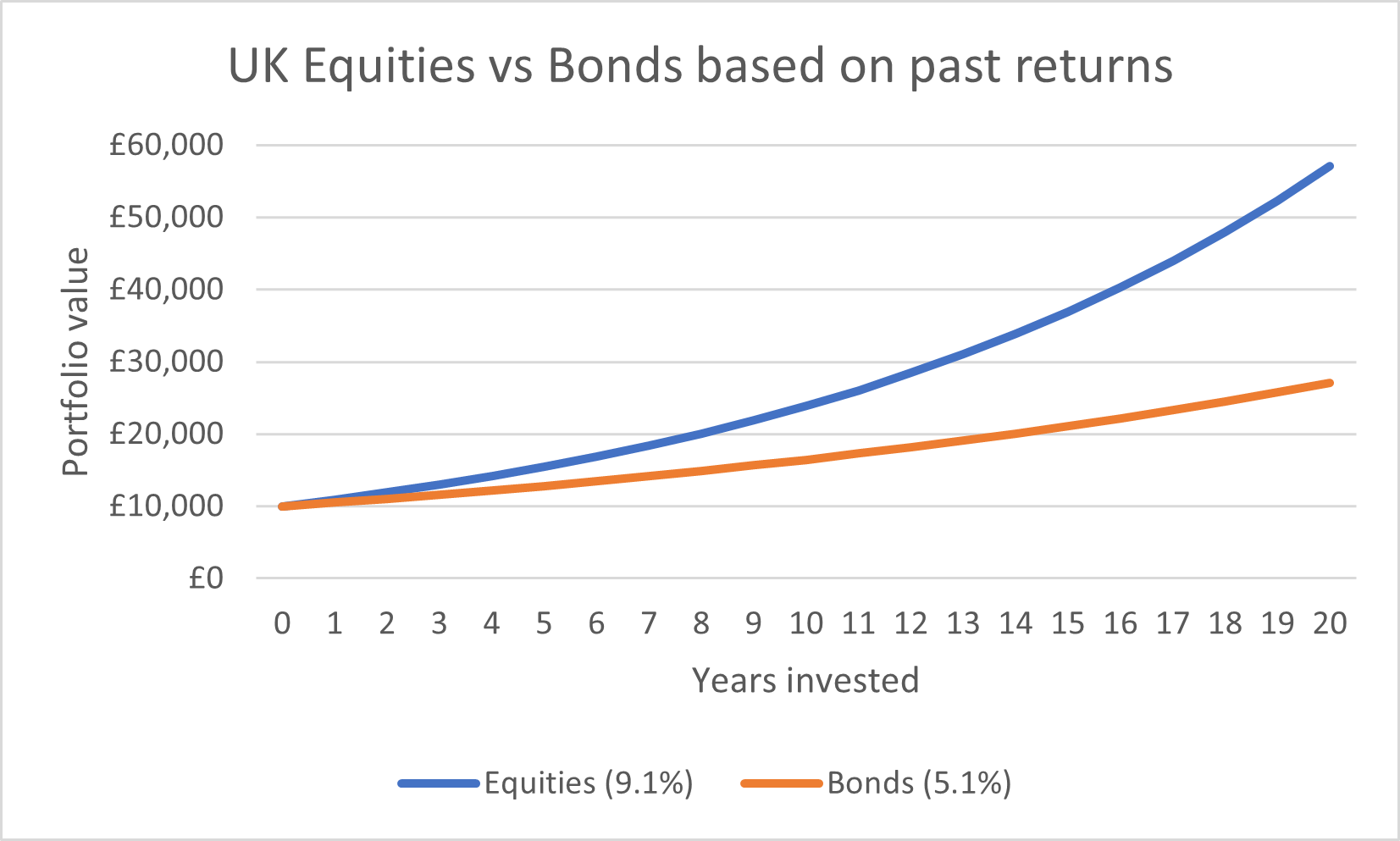
Since 1900, UK shares have delivered an average annual return of 9.1% per year, according to the 2023 edition of the Credit Suisse Global Investment Returns Yearbook. That’s equivalent to a real return of 5.3%, after inflation.
Over the same period, bonds have delivered a nominal return of 5.1%, or just 1.4% after inflation.
These numbers tell me that UK equities have outperformed bonds by about 4% per year over the last 120 years.
An extra 4% annual return over a 20 years is equivalent to an additional 120% gain. In other words, the extra return from equities would double your money, in addition to any other gains. Here's how £10k equity and bond portfolios would perform over 20 years, based on these historical rates of return:
These are long-term averages, of course. But I can share a couple of real-world examples of similar returns that have been generated in Stockopedia model portfolios over shorter periods.
Ed’s systematic NAPS portfolio has delivered a 12% annualised return since its inception in 2015.
My own rules-based SIF portfolio has delivered an annualised return of about 8% since its launch in April 2016.
These returns have not been delivered in a straight line. Both strategies have had good years and bad years. But I believe the portfolios’ consistent time in the market has paid off. When the good times have come round, we’ve benefited.
Although past performance is no guarantee of future returns, accepting some risk and uncertainty is a fundamental part of equity investing.
In return for this, we get the opportunity to invest in businesses that can create wealth for shareholders through long-term earnings growth. This has the potential to deliver returns far ahead of inflation – and much greater than 5%.
The market looks reasonably priced
Stock markets always attempt to look forward. While we’re worrying about the risk of a real-world recession, a fair amount of bad news has already been priced into many stocks.
While it’s certainly true that conditions could still get worse, my feeling is that there are plenty of good quality companies trading at reasonable prices, on a long-term view.
I think the valuation of UK stock indices also supports the view that the market is reasonably valued.
The FTSE 100 is trading on a forecast P/E of 14, which looks okay, but to my mind the real opportunities probably lie in the FTSE 250 and small-cap indices.
According to Stockopedia, the FTSE 250 is trading at a level first seen in 2017:

The valuations of some FTSE 250 firms are so depressed that the mid-cap index is now trading on a forward P/E of 12 with a dividend yield of around 4%, according to Stockopedia.

It’s a similar story for the FTSE SmallCap and AIM All-Share indices.
On balance, I don’t think this valuation is a fair reflection of the value of the companies in these indices.
If I wanted to buy a tracker fund today, I’d probably start with the FTSE 250. But as a stockpicker, I think there are better and more interesting opportunities on offer among individual shares and sectors.
Where are the opportunities today?
There’s no one single answer to this question. The best opportunities depend partly on what you’re looking for.
A good starting point for anyone seeking to clarify their investing strategy is our recent Strategy Map series. Ed’s opening piece includes a summary of investment styles and timeframes across the spectrum of quality, value and momentum.
In the final piece of the series, Ed pulled all the threads together and explained how the StockRanks use a balanced mix of quality, value and momentum – a combination that has outperformed since the system was launched in 2013.

For me personally, my interests lie across value, quality and income. I aim to hold shares for long periods. At the moment, I’m interested in taking advantage of any opportunities that have been created by the wider market weakness.
In recent months, I’ve covered a number of sectors and specific stocks where I think investors may be able to buy value and quality at attractive prices. In many of these examples, I think the short-term outlook remains uncertain, but the longer-term opportunity is very attractive.
REITs: last week I took a look at UK REITs and explained what I’m looking for in this sector and why I think there’s value on offer for selective investors.
Housebuilders: I covered this sector in May, but valuations have edged a little lower since then. In my view, recent news flow from the big housebuiders is no worse than expected. I continue to see medium-term value here and the potential for attractive income.
Containers & Packaging: another unloved sector right now. All the big names look good to me and score well with the StockRanks.

I took an in-depth look at Mondi in June and covered rival DS Smith a few months earlier.
Distribution: I think there are some good (and underrated) companies that operate as distribution specialists in various sectors.
I recently covered small-cap Kitwave in a Stock Pitch. This founder-led business continues to look attractive to me.
Among mid-sized and larger firms, I think DCC (LON:DCC) and increasingly Bunzl (LON:BNZL) are worth a closer look. I also think that automotive distributor Inchcape (LON:INCH) (which operates globally) is attractive at the moment.
Industrials: this may seem counterintuitive, given the risk of a recession. But I think there are some interesting opportunities in this part of the market. I explored the wider investment case in a recent piece.
In terms of specific stocks, I have previously reviewed Bodycote and also quite like Vesuvius (LON:VSVS) and (in an adjacent sector) construction group Morgan Sindall (LON:MGNS).
Mark Simpson recently covered small-cap steel specialist Severfield (LON:SFR) together with two other highly-ranked industrial firms that might be worth a look.
5% yield, low risk? Circling back to where I started this piece – the search for 5% returns – I’ve created a very quick stock screen to highlight shares with the following characteristics:
5% forecast dividend yield
StockRank > 80
Market cap over £50m
-> You can view this screen here
This is certainly not a list of stocks to buy. But I think the results of this screen include some interesting stocks that are worthy of further research. It could be a useful starting point for new ideas.
As always, please let me know what you think about the issues I’ve discussed in this piece. Are you tempted by 5% risk-free returns, or are you staying put in stocks?
Disclosure: Roland owns shares of DCC, Kitwave and Inchcape.
Disclaimer
This is not financial advice. Our content is intended to be used and must be used for information and education purposes only. Please read our disclaimer and terms and conditions to understand our obligations.
22 comments
The market (FTSE All-Share) is down about 4.3% since this was written. There is alsolutely nothing wrong in a stock selection of this, pretty conservative, nature. What I don't agree with is statements like 'a p/e of x14 seems pretty reasonable to me'. I see such comments all the time, they are based pretty much on recent experience - which is of overvalued markets from inane monetary policies for which we are now paying in tighter money and higher interest rates. . They are purely subjective statements and should be qualified. Price earnings ratios are a very imprecise guide.
I was looking to park some cash in something less risky than just stocks - getting close to retirement I feel like I need to diversify a bit more.
I've put some into HL Active Savings at 4%ish (easy access), but have noticed that you can get a 1year fix for 5.95% - I am pretty sure this was over 6% at the weekend.
I have some money in a bond-fund, but TBH I am not 100% convinced I fully understand it and some comments on here highlighted it had some pretty ropey poor quality corporate debt included which probably means its high-risk CQS New City High Yield Fund (LON:NCYF) .
Therefore I am inclined to be much more risk averse currently in my non stock PF (only about 5%) and go for some of the fixed rate savings offers instead. I appreciate I may not get the returns that bonds offer if the market moves, but for the risk/reward side of things it might be safer. 6% is not to be sneezed at, but as Roland highlighted I am much more drawn to the opportunities in stocks currently.
With regards to the US, I recently put some money into a S&P tracker (x-trackwrs S&P 500 equal weighted) - by being equal weighted I felt the risk of the Big-7 dropping (or not growing at the same rate) might also be correlated with a recovery/catch-up in the other 493. Time will tell. It seems to be working well, but very early days.
HL rates don't look so competitive now and many of the longer term fixed rate bonds are not available. There were a few over 6%, not on HL, when I looked last week. You should check elsewhere before choosing HL.
Just checked and rates have fallen since last week, 6% is about now. Paragon rates have fallen considerably.
A great article . I always find your contributions to be interesting and informative. Equities are the way to go for me, but I only put in what I can afford to lose. Thanks to Stockopedia, I am doing ok this year. I will be taking a look at Bunzl and Inchcape
The UK looks like a Banana Republic with Debt to GDP >100%.
From the Office Of National Statistics website (Source):
Perhaps Lyn Alden summed things up correctly this week:
Source: https://twitter.com/LynAldenCo...
On the subject of UK stocks it seems that the market is not just negative on AIM & mid cap stocks but almost irrational on FTSE 100 stocks. This morning Compass (LON:CPG) reports good results with solid organic sales growth (+15%)and reaffirms year end forecasts for margins yet its shares are hit with a fall of over 5%. Meanwhile Unilever (LON:ULVR) reports results slightly ahead and the market send their share up more than 5%! It seems that you meet expectations and get stuffed and a slight beat gets everyone excited - crazy markets!
Yet so stocks with profit warnings go up, such as Forterra (LON:FORT), very weird. I think a lot of it is to do with expectations, not just forecasts. There is a lot of profit taking going on.
Compass (LON:CPG) has been my watchlist for some time, got close to buying it several times but did not. A fall after good results is often a good entry point, I will have a look.
I have been buying gilts for family members. Evenly spread between low coupon bearing issues for max emphasis on (no) capital gains (tax)
T26
TN28
TG31
TG35
TG50
This delivers a combination of interest-rate-risk-free short dated bonds and then some duration risk/reward. Short term this could go wrong, but I do not see interest rates staying this high for a decade. I could be wrong of course.
Personally I'm just buying stocks. I'm a business owner and recycler, not a saver.
A very interesting and thought provoking article Roland, as usual. I may take a look at the packaging sector.
I am one of those investors who have switched a chunk of cash into short-term gilts for the guaranteed yield, so I am only c65% in equities. I do agree with your long-term analysis on the UK, but its not really the UK I am worried about...... it's the bubbly US.
Here are my somewhat more bearish thoughts...
The US - it's a totally crazy c69% of the MSCI World Index versus c15% of world GDP. This has been driven by Index Funds buying more and more of the 'magnificent 7'. Whatever UK valuations are, if the US crashes so will the UK. It's difficult to see high equity returns in the US from this starting point with the 'magnificent 7' being the problem. The yield curve has been inverted for nearly 13 months and is at -1% which is a massive inversion. Once savings are depleted, and its taking longer than normal given excess liquidity, I still expect a global recession... unless this time it really is different and a yield inversion of this size doesn't lead to a big recession!
Maybe someone else can comment, but I believe that shares make a bottom once interest rates have fallen at peak recession, rather than when rates are still being raised (because of an inflation spike and an overheated labour market and economy).
So, my view is that I'm retaining significant firepower until the US bubble finally pops: both Bitcoin and the magnificent 7. I am hoping to invest my 35% liquidity as and when we have a proper bear market which must be led by the all important US market. Of course, I may well miss out this rally, but I can't get over the inverted yield curve which has successfully predicted every recession since World War II.
Thank you Roland an interesting article as always.
I hold 6 Shares in your Screen namely Smiths News (LON:SNWS) Sylvania Platinum (LON:SLP) ITV (LON:ITV) Serica Energy (LON:SQZ) Redde Northgate (LON:REDD) and Gulf Keystone Petroleum (LON:GKP) Four are on my watch list Morgan Sindall (LON:MGNS) Polar Capital Holdings (LON:POLR) Hargreaves Lansdown (LON:HL.) and Wickes (LON:WIX)
SLP is down 33% in the last 6 months and GKP crashed 4 days after I bought back in March when the pipeline was shut down! No Divi for some time I suspect.SQZ is down 17.5% but I continue to hold.
I have been investing for 20 years and this really is a very difficult market but I keep telling myself this is when Warren Buffett would buy it is just a case of making the right choices which is why I find Stockopedia so useful!
Hello Roland,
NAPs did well until around 18 months ago, last year it lost about 15%, this year it is down around 2% I think.
You can easily get 6% interest on savings, if you do 1 or 2 year fixed rate bonds, with inflation falling, I see saving rates could be higher, in a few months time, with household energy prices falling this month.
Re bonds, why is the TREASURY 0.25% 31/01/2025 (TN25) GILT, the most popular, it only has a yield of around 0.268%? Why not invest in the higher yield gilts?
With HL, many clients will have cash locked in their ISA's.
I see the UK markets being unsettled for some time, we have an election in the next 18 months and high interest rates could push us into a recession, so 6% risk free looks attractive, to me at the moment.
You're looking at running yield, i.e. coupon / most recent price. If you take into account the fact that between now and 31.01.25 the price will also go up from ~£93.2 to £100, your total return (i.e. yield to maturity) goes up significantly. to that 5% level.
If you take into account the fact that between now and 31.01.25 the price will also go up from ~£93.2 to £100, your total return (i.e. yield to maturity) goes up significantly. to that 5% level.
And, of course, capital gains on gilts are tax free, while coupons are taxable as income.
timarr
OK thanks. But what happens if I sell say in a years time, what sort of yield will I get?
Is the TREASURY 6% 07/12/2028 (TR28) not a better choice?
OK thanks. But what happens if I sell say in a years time, what sort of yield will I get?
The coupon is fixed and the running yield and potential yield to maturity you get is therefore fixed at the time you buy it.
What isn't fixed is the capital value in the intervening period, as the price will vary dependent on interest rates and the appetite for the risk free asset. However, a 2028 gilt is more likely to see capital appreciation as interest rates fall, than a 2025 gilt, where the bond will tend towards its par price as it closes in on its redemption date.
As to whether equivalent bonds with high or low coupons and the same yield to maturity dates are better or worse it depends on your tax situation.
However, iif what you want is the risk free asset without concerning yourself with potential capital gains or losses (if say interest rates were unexpectedluy hiked due to persistant inflation or some kind of bizzare pre-election tax cutting spree) then the shorter dated one is the better option.
timarr
Hi timarr and Rusty2 - I quite liked TN24 - you buy it for c97p and get 100p back on 31 January 2024 with a 0.125% coupon. Virtually no capital risk and only 6m until maturity. I also went for some TN25 and T23, the former having a bit more capital risk. I wanted very short term maturity, so I can either hold to maturity (if markets don't crash) or sell at a profit (if markets crash, interest rates drop) and I can then reinvest in mostly UK equities. As you say, longer duration has more capital risk unless you hold to maturity which may not be wise, as Roland points out.
Thanks. TN24 is £97.64 now. I see there is a management fee if 0.45%.
If I reduce my cash in HL, then the interest rates drop.
I will have to do some calculations.
I will be holding them in an ISA, so tax is not a concern. At the moment have some cash in HL ISAs earning around about 3% interest. Considering moving some into gilts or to a different platform.
I will be holding them in an ISA, so tax is not a concern. At the moment have some cash in HL ISAs earning around about 3% interest. Considering moving some into gilts or to a different platform
Then short dated gilts would be the ones to go for because that limits the risk of something going wrong (although it also removes the possibility of a windfall gain). Whether you go for a gilt with a high coupon or not depends on whether you intend to hold to maturity. If there's a possibility you might sell before the redemption date then probably something with a higher running yield might be preferable (although you may find it's much of a muchness, as the price will fall to compensate for the payout as you move closer to maturity).
timarr
Actually TR28 has fallen considerably, this last year, down from £126 to £107.70 now.
Maybe a good time to buy?
So at maturity will it be £100?
It's fallen because interest rates and interest rate expectations have risen. There's no opportunity here to beat the market, this is the market. As individuals we're only ever price takers.
All gilts mature at their face value of £100.
If what you want is a guaranteed 6% or so then short dated gilts held close to maturity are the way to go. This is the equivalent of a fixed interest, fixed term account with no capital risk (or opportunity).
If you want to take some risk then go for longer dated gilts, perhaps sold in the interim. But the latter are not a replacement for interest on cash in an account, you're taking capital risk unless you hold to maturity - but doing so only guarantees you a relatively feeble return compared to those we might expect if equity markets recover.
timarr
Not beating the market as such, but to me buying gilts closer to their maturity value, is a better deal than 27% above it, although I would have missed 6% yield, over the last year. That is how I view it at the moment.
Still not convinced it is worth it over 3% interest on cash.
As for the UK markets. I think we could be in for a rough ride over the next 2 years or more. The US looks over valued. I may look elsewhere, any views on India, I have an ETF that is doing quite well, at the moment.