Beating the FTSE 100 with Dividend Dogs: portfolio update

A year ago, I noticed that Stockopedia’s Dividend Dog screens had been outperforming the market by a comfortable margin since late 2022 – broadly speaking, when interest rates started to rise.
I created a model portfolio to test whether this outperformance would continue – and to see how much income it could generate in a market where risk-free yields were over 4%.
One year later, the initial results are in. This simple high yield strategy has almost matched the FTSE 100 on share price gains…
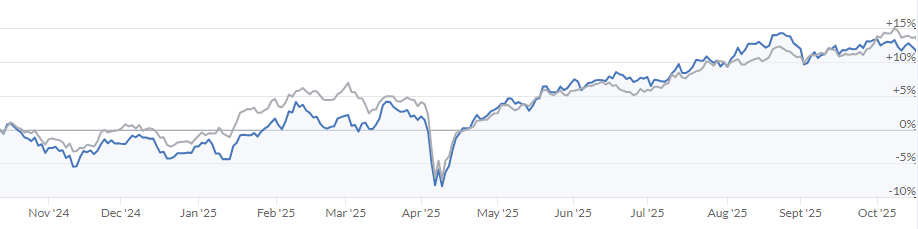
… but it’s beaten the index when dividends are included:
| Period: 15/10/24 - 15/10/25 | Share Price Return | Total Return (share price + dividends) |
|---|---|---|
Dividend Dogs | 12.4% | 19.8% |
FTSE 100 | 14.2% | 18.3% |
While the total return outperformance is only 1.5%, it’s worth remembering that the Dividend Dogs portfolio generated an income of 7.4% over the year, compared to just 4.1% for the FTSE 100.
For investors interested in generating a natural income from their portfolio – withdrawing dividends without selling stocks – I think this could be an attractive result.
Certainly I am sufficiently encouraged to refresh the portfolio and keep it running for another year. Before I look at the updated stock selection though, here’s a snapshot of how my selection from last year performed.
2024/25 Dividend Dogs review
To create the portfolio, I merged the results of Stockopedia’s two Dividend Dog Guru Screens:
Dividend Dogs: uses trailing 12-month dividend yields
Dividend Dogs (Forecast): uses rolling 1-year forecast yields
I chose to do this mostly because it provided a larger and more diversified result set than relying on either screen alone.
In terms of historic performance, the historic Dividend Dogs have outperformed the forecast Dogs since the screens’ inception, but the pattern of performance has been fairly similar.
I ended up with 13 stocks in last year’s portfolio. While this is below the 15-20 I’d ideally target, I think it was enough for a useful experiment. Here’s how they performed last year:
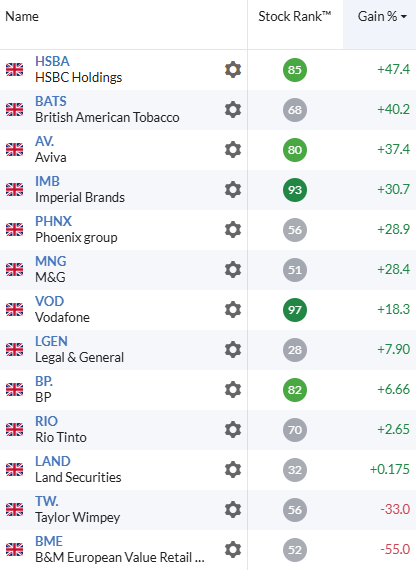
I would not have predicted this set of outcomes at the start of the year (I was relatively bullish about the biggest loser, B&M European Value Retail SA (LON:BME)) – but that’s the nature of this kind of investing. Shares qualifying for a Dog-type strategy have typically underperformed for a period of time and are often due for a recovery – but not always.
As I’ve noted before with other screening strategies, implementing a 25% stop-loss rule would very likely have improved my overall returns, assuming I’d been able to find suitable replacements mid-year.
Alternatively, I might have chosen to sell any stocks that dropped out of the FTSE 100 – the two biggest losers, Taylor Wimpey (LON:TW.) and B&M were both ejected from the big cap index during the year, thus going against one of the core principles of this strategy:
It's main safety net is that blue chip stocks tend to be large, mature and well financed companies with long histories of weathering economic turmoil.
We’ve discussed both B&M and Taylor Wimpey in the DSMR in recent months:
Taylor Wimpey: 30 Jul 25 - AMBER (profit warning)
B&M: multiple times, most recently 20 Oct 25 - AMBER/RED (profit warning and accounting error)
At the top end of the performance scale, I don’t follow HSBC Holdings (LON:HSBA) in any detail as it’s hugely complicated. But in short, while profits have fallen this year, the bank has continued to upgrade expectations:
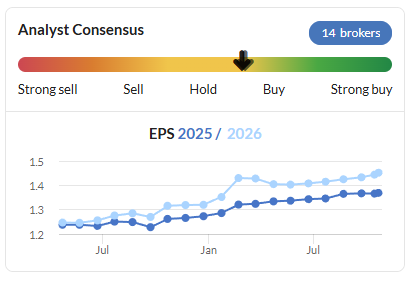
My impression is that the market also seems quite confident in the ability of newish CEO Georges Elhedery to reshape this big bank.
While HSBC may still not be too expensive at 1.2x book value, the stock’s 5.2% yield means it no longer qualifies as a Dividend Dog, so will be replaced in my new portfolio for the year ahead.
Dividend Dogs: 2025/26 portfolio
In keeping with the spirit of running a natural income portfolio, I am going to disregard last year’s dividends and update and rebalance the portfolio using its capital value alone.
In an effort to avoid big losses, I am going to introduce one new rule:
Sell any stock that is demoted from the FTSE 100, replacing with a new stock if possible.
As previously, all positions will be equally sized and I’ll build a list of stocks to include by combining the results of the Dividend Dogs and Dividend Dogs (Forecast) screens.
Once again, there’s a lot of overlap between the two Dividend Dogs screens’ results:
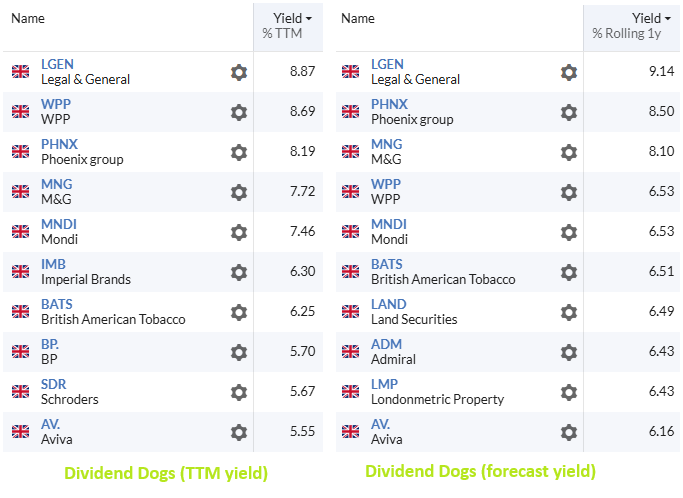
Combining the historic and forecast screens gives me 13 shares. Once again, that’s fewer than I’d like in an income portfolio – especially as some come from the same sectors and overlap heavily.
Doubling up in this way (e.g. two tobacco stocks) provides some protection from company-specific problems, but none against sector or market issues – which are arguably more likely in the FTSE 100.
However, this concentration is a feature of the Dividend Dogs strategy, which specifically selects the 10 highest-yielding shares from a big cap index.
The lack of diversification means that this approach won’t suit all investors. I could improve on this by extending the screen to include lower yields or smaller market caps. But the key principle of Dividend Dogs is that it is a big cap, high yield strategy – and I’m keen to stick with this closely for the purposes of this model portfolio.
Here’s how my updated Dividend Dogs portfolio looks for the year ahead, ordered by StockRank:
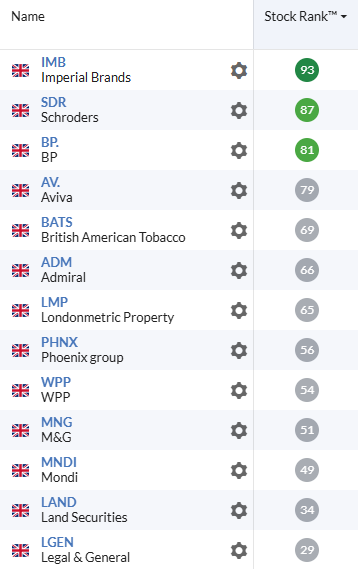
At the time of publication, the stocks in this updated portfolio have an average forecast yield of 6.8%. That’s lower than the 7.4% realised last year, but the lower yield reflects the fact that the FTSE 100 has risen by 15% over the last year. Higher share prices mean lower yields.
Within the portfolio, there are five new stocks this year. Let’s wrap up with a brief look at each of these.
WPP (LON:WPP)
The global advertising group has been through a multi-year decline, as cuts to marketing spend have coincided with the growth of AI. More broadly, WPP’s role in the world has been squeezed by the long-term growth of internet advertising platforms, leaving WPP in the squeezed middle.
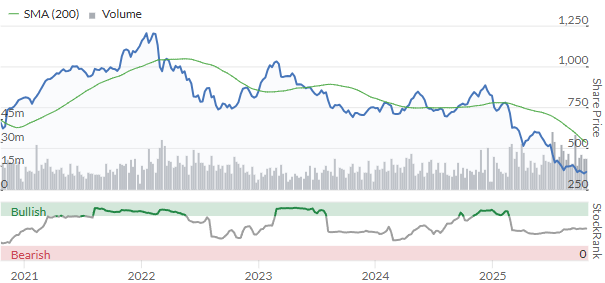
However, the company now has a new CEO (a former senior Microsoft exec!) and my feeling is that both sentiment and earnings may be close to the bottom.
While consensus forecasts have been cut by 30% over the last year, I think this business may be starting to look too cheap for a profitable FTSE 100 firm:
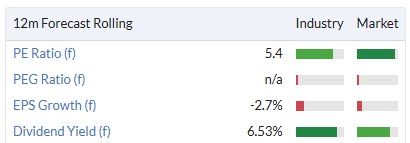
The algorithms also see opportunity, styling WPP as a Contrarian stock.
Schroders (LON:SDR)
Blue chip financial Schroders is one of the UK’s largest asset managers, with £817bn of AUM at the end of September. The business remains under family control and hasn’t cut its dividend for over 30 years. I don’t think it’s likely to start now.
While profits have come under pressure in recent years – as seen across this sector – the business has reported positive inflows this year and profits and appears to be on track for a recovery in profits under CEO Richard Oldfield.
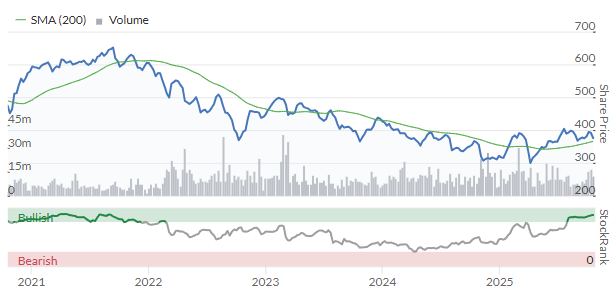
Trading on a P/E of 12 with a 5.7% yield, Schroders looks reasonably priced to me and has shown improved momentum recently:
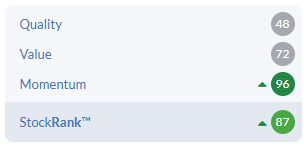
If this progress continues, I think the stock could continue to recover from a multi-year slump (a value scenario Ed highlighted in his recent piece):
Londonmetric Property (LON:LMP)
This commercial property REIT is a relatively new arrival in the FTSE 100, as a result of its merger with LXi REIT in summer 2024. Since then, Londonmetric has continued to expand and reshape its portfolio through the acquisition of Urban Logistics REIT and Highcroft Investment, and some sizeable property transactions.
The stock currently trades at a premium to its last-reported book value – not an obvious sign of cheapness. However, the March 2025 NAV of 4,071p per share is probably a little stale at the moment, due to those recent acquisitions. November’s results will include an updated figure providing a fresher view.
Another factor behind the premium valuation may be Londonmetric’s 55% portfolio weighting to logistics property – this remains a fairly hot sector.
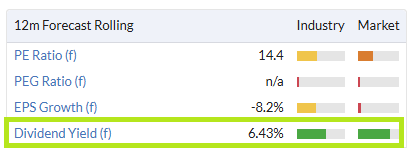
In the meantime, a forecast yield of 6.3% puts Londonmetric close to the top of the FTSE 100 income table and appears to be comfortably covered by forecast earnings.
Admiral (LON:ADM)
Unlike most of the stocks in this portfolio, insurer Admiral’s share price is not remotely depressed. Quite the opposite – shares in this £10bn company are close to all-time highs:
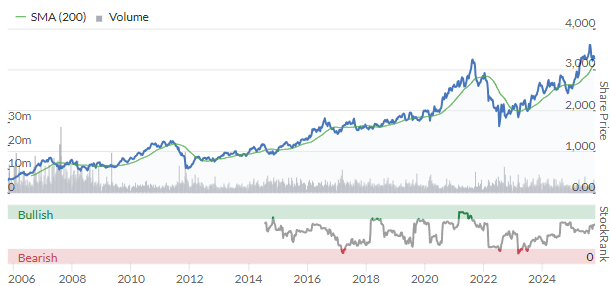
Admiral’s inclusion in the Dogs is driven by its high forecast yield, which currently stands at 6.4%.
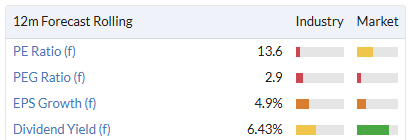
In turn, this is driven by strong profitability – in particular, high returns on equity:
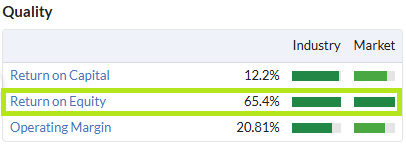
These quality metrics are a function of Admiral’s scale and its well-designed business model, which keeps capital requirements under control and supports strong cash generation.
The upshot is that the company routinely pays out a very high proportion of its earnings in the form of dividends. This supports an attractive yield, even when the valuation isn’t at bargain basement levels.
This is a business I admire greatly – I’m keen to see if it will keep performing in this portfolio over the coming year.
Mondi (LON:MNDI)
This packaging group has been through a challenging few years. It sold its high-margin Russian business following the outbreak of war in Ukraine and has faced difficult cyclical market conditions more recently.
Heavy capex should theoretically leave the business well positioned for the next upturn, but it’s not yet clear how soon momentum will recover.
In the meantime, profits and margins are depressed and debt levels have risen.
A forward P/E of 13 may not seem especially cheap, but these are expected to be trough earnings, with the potential for operating leverage to drive a recovery in profits if cyclical conditions improve.
This is another stock that’s being styled as Contrarian by the algorithms. Solid quality and value ranks are paired with a rock-bottom momentum score:
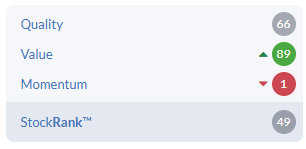
Investing with such a low MomentumRank may carry some extra risk, as Mark has discussed.
But my feeling is that Mondi is a typical example of a Dividend Dog. The 6%+ yield reflects poor sentiment and a lack of interest in this cyclical sector of the market. But it’s not so long ago that profits – and the dividend – were substantially higher than they are today.
Disclosure: at the time of publication, Roland owned shares in Imperial Brands, Aviva and Legal & General.
Disclaimer
This is not financial advice. Our content is intended to be used and must be used for information and education purposes only. Please read our disclaimer and terms and conditions to understand our obligations.

15 comments
WPP (LON:WPP) just got a lot cheaper. I've held SAA and should of sold when they spiked, I have at least sold 75% at a decent return. Its a long long road I suspect for WPP
WPP (LON:WPP) yes, the EPS forecasts make for sorry viewing, even prior to today’s warning. It will be a long road..
Yes, it looks like I may have been premature on WPP (LON:WPP)! Although one possibility is that new CEO Cindy Rose is taking the opportunity to reset expectations while she can do so without any reflection on her own performance.
We will see... I think there probably is still a role for this business, but it's definitely changing. It will be interesting to see how a longtime tech exec (Ms Rose previously worked at Microsoft) decides to change the business.
However, the Dogs is a systematic approach. So, as per the new rules, I will keep WPP in this model portfolio unless (until?) it is ejected from the FTSE 100.
Roland
Thanks for the update Roland - what are your thoughts on the debt level at WPP (LON:WPP) ? It puts me off investing.
Thanks Roland. These type articles are always thought provoking and draw attention to aspects of Stocko that many may not use.
Out of interest, why the Dividend Dogs Guru Screen over the Large Cap Dividend Attraction, which has beat the Dividend Dogs screen on 5,3,2,1 years?
I can see the yield is c.3% less on the Large Cap screen and taking this into account it looks like it may still have beaten the Dogs screen over time.
The point of the Dogs is income though… it’s a screen for people to live off, yes you may make more money doing other ones overall or even way more, but they don’t provide the regular income that someone fully retired usually needs imo
Thank you for replying, WTT.
Everyone should have some Dividend Dogs in their portfolio the reason being that, especially in a ISA, the regular dividend payments make investing life more interesting in finding new homes for them.
A good article on one option for longer term investing. The Stockopedia five year figures for both screens are given as..
Dividend Dogs Forecast 34%
Dividend Dogs 62.68%
This suggests some divergence for the two strategies which has not been fully picked up in the article? Also, I assume that the Stockopedia figures (34 and 62.68) here are not total return and exclude dividends.
A final question of the subject of screens - how exactly does a screen have a performance? I assume that a screen is simply picking up the shares at that time which qualify for the screen. This implies that there is portfolio in the background which is being constructed from the screen and from which the performance is measured. In which case, this portfolio must have some rules for buying and selling over a five year period?
It would be interesting if Stockopedia could generate more articles on the merits of simple low maintenance long term investing. I suspect that the results would be quite startling.
Hi intuitive6191,
The Guru Screens are rebalanced quarterly, in effect forming a simplified model portfolio. These quarterly selections are the basis for the performance records shown.
However, the stocks shown in the screen results are updated daily, so always represent the most valid current choices for the screen.
As you say, the screen performance doesn't include dividend income. This will have a more significant impact on some strategies than on others - it will certainly have had a material impact on the Dividend Dogs' returns over time.
While it's true that the historic Dogs have outperformed the forecast Dogs over time, I've opted to use them both in order to (hopefully) benefit from the additional stock choices and diversification this approach provides. That's a subjective choice though, which may not be backed by results.
Roland
Thank you for the response.
Looking at the Dividend Dogs Forecast over a 3 year period a rough and conservative calculation suggests a CAGR of circa 17.5%. Over the same period, a FTSE 100 etf tracker will have risen by about 14.5%
So the actively managed Dogs looks to have a persistent paper advantage over the FTSE 100 tracker and I would suspect that your portfolio will also have a similar advantage over a longer timescale.
In the real world, costs have to be considered and stamp duty and dealing charges will have a drag on the active management if rebalanced every quarter - as with the Dividend Dogs Forecast. It is a small factor but worth mentioning.
Overall, however you look at the figures, this suggests a good result for longer term investing with very little intervention. It is a pity that Stockopedia is not able to present a screen performance with dividends included as this weighs against the dividend screens compared to more growth orientated screens.
It takes an article like this to highlight the anomaly.
CTY has certainly had a good run, although it's yield says only 4.1% and so it's no match for the income requirement that is the aim of the dividend dogs. Thank you for doing this Roland, it's great to see and every dog has its day! It's been a good period for dividend shares, I imagine due to them being severely undervalued and the high uncertainty of late. I think for people in retirement who want a minimalist strategy this works well. I do something similar myself but with more positions (incl. trusts) to smooth the return volatility a bit and am happy to accept a lower return to sleep better.
Thanks, as always, Roland, for another thought provoking article.
I am always keen to keep things as simple as possible and your article made me think about whether there may be an alternative, simpler way to have outperformed both your screen and the FTSE 100 this last year, whilst still generate a decent income and gain greater diversification.
One that sprung to mind along the same lines - namely large cap, broadly UK based, high income shares - was that if you had simply held the City of London Investment Trust (CTY) then you would have managed a 22.4% return this last 12 months, not including income.
If you include dividends then the total return would have been a mightily impressive 27.5% this last year.
Yes there are fees involved but I would consider them pretty reasonable at only 0.358% and you would have gained far greater diversification with 80 large cap holdings, and almost a 10% boost in performance over the FTSE 100.
All the very best and keep up the great work that you and the team do. It is very much appreciated.
Richard
TEM (Temple Bar Investment Trust)
this one has done better than CTY, MRCH and it seems a better choice for capital and income over short and longer term.
Hi Yadi,
Thanks for flagging Temple Bar IT - it has had a great year hasn't it. I will do some more research into it as a possible holding.
Richard