Burberry: buy now for a recovery?

I’m a Burberry (LON:BRBY) shareholder and have held the stock for a number of years.
My decision to invest was based on the traditional resilience of the luxury market, and my view that Burberry is a valuable and durable heritage brand. I paid a weighted average of just over £15 per share for my personal holding and believed -- at the time -- that this represented an attractive long-term entry point.
I think that's potentially still be true. But it’s fair to say my view on the company has been tested by developments this year. The luxury market has slowed and Burberry has suffered additional self-inflicted problems.
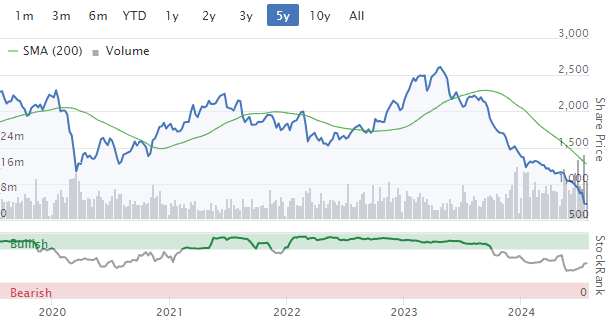
The share price is down 45% year-to-date and the dividend has been suspended after a second profit warning in seven months.
This Stock Pitch is an effort to clarify my thinking on Burberry. Are the shares as cheap as they might seem right now?
Summary
Pros:
Luxury heritage brand with 168 years of history
Shares trading at a post-2010 low could be very cheap if business recovers
Burberry could attract bid interest at this level
Cons:
The company has struggled to elevate its offering and may have to sacrifice margin to undo the damage
China’s slowing economy means consumer spending has weakened; buyers’ tastes may be changing
Burberry shares are only cheap if profits recover
Profile
About the stock
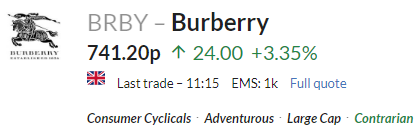
Burberry is a luxury British fashion brand. It’s listed in the Consumer Cyclicals sector, within the Specialty Retailers industry group.
The company floated on the London market in 2002 and is currently a member of the FTSE 100, with a market cap of £2.6bn and a recent share price of 747p.
As the smallest company in the index at present, I imagine it’s quite likely Burberry will be demoted to the FTSE 250 in the next index reshuffle.
The StockRanks show high quality and value scores but an extremely low momentum score.
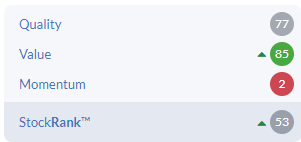
A high QV score fits the classic profile of a contrarian stock and this is reflected in the company’s current StockRank Style rating:
I am instinctively attracted to the idea of buying contrarian stocks, especially if I believe they’re good businesses suffering temporary problems. The medium-term returns from a successful turnaround at Burberry could be very attractive, in my view.
After all, this is a stock that’s traded above £15 for most of the last decade.
However, it can be a mistake to anchor on past performance. I’d be remiss not to highlight the risks I can see here.
Burberry’s value metrics could deteriorate rapidly, if the company cannot quickly halt the current slump in sales and profits. That could leave the stock looking like a Falling Star – statistically, a losing style.
About the opportunity
The luxury market has suffered a widespread slowdown. There are some exceptions, mostly at the ultra-high end. Hermes International SCA (EPA:RMS) , for example. But even larger brands like Gucci have been suffering.
Much of the blame is being attached to the Chinese domestic market, where sales have fallen sharply as China’s economy has slowed and consumer confidence has slumped.
Burberry’s Asia Pacific sales fell by 23% during the 13 weeks ended 29 June, prompting another profit warning.
Gucci owner Kering SA (EPA:KER) also issued its second profit warning this year on 24 July, while LVMH Moet Hennessy Louis Vuitton SE (EPA:MC) reported sales and profits that were lower than expected. In the mid-market, Hugo Boss AG (ETR:BOSS) also recently warned on profits.
Shares in many of these listed companies have fallen. But Burberry is by far the biggest loser. It seems clear from this share price action that the market believes Burberry has its own problems, beyond wider sector headwinds:

I’m not a luxury expert and am never likely to be a Burberry customer. But from what I’ve read in the trade press and heard anecdotally, the company seems to have two particular problems right now:
Burberry has been too aggressive in trying to move the brand upmarket – known as brand elevation. It has failed to win enough new customers, while alienating some of its traditional customer base.
New product ranges in areas such as handbags and shoes may have caused Burberry to lose focus slightly on its distinctive core identity as an outerwear specialist.
I believe there’s an opportunity to profit from a turnaround at Burberry, as the business refocuses on its core markets and looks critically at its positioning. Highly-rated chief designer Daniel Lee has a strong pedigree, even if he hasn’t quite hit the sweet spot with Burberry customers yet.
Comments in the firm’s first-quarter trading update suggest to me that this repositioning process may already be underway:
We are taking decisive action to rebalance our offer to be more familiar to Burberry's core customers whilst delivering relevant newness.
Also:
Refining our brand communication to emphasise more of the timeless, classic attributes that Burberry is known for. Our refocused marketing plans include a dedicated outerwear campaign to be launched globally in October, building on the established resilience of our house icons.
New chief executive Joshua Schulman seems a decent hire. The American’s previous roles include being CEO of Michael Kors and Coach (both owned by Tapestry (NYQ:TPR)) and Jimmy Choo.
The normally-reliable Sky News is also reporting that Burberry is now looking for a new chairman to replace Gerry Murphy, who has been in the role since 2018.
In parallel with the company fixing its own problems, I would hope to see a gradual recovery to more normal levels of demand in the wider luxury market.
Finally, there’s always the possibility that Burberry will attract an opportunistic takeover bid.
Business & Model
What is the company’s history and what does it do?
Luxury fashion retailer Burberry was founded by Thomas Burberry in 1856.
In the late 1870s, Burberry invented gabardine. This was possibly the first breathable, lightweight waterproof fabric.
Gabardine became popular with high-profile explorers and other early brand ambassadors. The firm gradually built its reputation around a range of comfortable, well-styled waterproof outerwear.
Burberry’s hallmark trench coat was developed when the company won a contract to supply the British Army during WWI. The brand’s other distinctive hallmark – the Burberry Check™ – was introduced in 1920 as a lining to the trench coat.
By 1965 the company exported one in five coats from the UK, and was holding fashion shows in all the major European capitals.
When design legend Christopher Bailey joined the firm in 2001, he kicked off a new phase of growth. His popular designs helped move the company further into the luxury market, erasing the ‘chav’ reputation that had led to an association with football hooligans in the 1990s.
Progress since Bailey’s departure in 2018 has been rather more mixed. The company has had two CEOs and two design heads since then, but hasn’t yet recaptured the success of the Bailey era.
How does the business model work?
Luxury business models are built around branding, quality and distinctive design – ideally paired with limited supply. The model relies on value over volume to support high margins and sustainable growth.
For example, during the year ended April 2023, Burberry generated a 21% operating margin and a 68% gross margin, illustrating the pricing power of its products.
Products are sold through Burberry’s own stores and online. The company also has a wholesale operation, but this is being scaled back to maintain tighter control over the brand and pricing.
One further area of high-margin income is licensing – Burberry reported an operating profit of £59m from £63m of licensing revenue in its 2023 financial year.
Markets & Competition
What is the size and state of the company’s market?
Burberry is a relatively small player in luxury fashion. Estimates on Statista suggest the global luxury fashion market is expected to generate revenue of $115.90bn in 2024.
In terms of direct peers, Burberry is the smallest by sales of the six companies in the chart I showed earlier:

Burberry’s revenue is lower than many of the individual brands that are contained within the Kering and LVMH groups. For example, Gucci’s 2023 revenue was €9.9bn, more than three times that of Burberry.
Arguably, Burberry’s position as a single-brand, independent business may also mean its results are more volatile than the diversified profits generated by Kering and LVMH.
Who are the company’s key competitors?
Opinions seem to vary about where Burberry sits in the luxury brand hierarchy, but what is clear is that it’s not at the top. Most experts seem to place the brand in premium fashion or aspirational luxury categories.
A random sample of menswear pricing suggests to me that Burberry sees itself competing with Gucci and Prada, but my non-expert feeling is that the brand actually sits slightly below this level – albeit above brands such as Coach, Michael Kors and Ralph Lauren.
How does it derive its competitive advantage?
Luxury fashion brands’ competitive advantages are based on factors such as brand heritage, design language and skilled marketing, including through fashion shows.
Burberry’s unique characteristics are built around its British heritage and reputation for outerwear. These factors help to differentiate its offering from European luxury houses.
Brand & intellectual property: Burberry’s brand is backed by a number of trademarks relating to the Burberry Check and gabardine fabric.
But in reality, intellectual property is of limited value – what matters is the reputation, exclusivity and desirability of the brand. These factors dictate its pricing power and longevity.
Switching costs: there are not really any switching costs for discretionary luxury purchases.
Economies of scale: a certain level of scale is required to maintain a global network of retail stores with associated manufacturing and distribution. With annual sales approaching £3bn, I think Burberry has probably reached this point.
However, I think economies of scale are not a primary objective for this business – successful investment in branding, marketing and design are key to driving pricing power and margin.
Unlike mainstream retailers, extensive discounting – as seen recently in the luxury sector (FT paywall) – is a sign of desperation, rather than an integral part of the business model.
Is the competitive advantage durable?
Burberry has been in business for 168 years. This longevity suggests it has developed a durable premium consumer brand. I believe this advantage will remain.
However, I think there’s a small but measurable risk that shopper preferences will change in a way that Burberry might fail to accommodate.
One particular concern might be that Chinese shoppers will come to prefer domestic luxury brands, rather than western names. This has, after all, happened in many other sectors of the Chinese economy.
Financials & Ownership
What is the record of growth & profitability?
Long-term growth has been fairly impressive. Burberry’s annual sales have risen from £676m in 2004 to £3,968m in the most recent financial year. However, sales growth has slowed over the last decade and profit growth has been inconsistent, even prior to the pandemic.

Furthermore, broker forecasts suggest Burberry’s sales are likely to fall by around 20% this year, while profits are expected to fall by around 60%.

Profitability has also been mixed. But I think it’s fair to say that ROCE and margins have generally been well above average throughout the last decade, highlighting the group’s quality credentials:

Is the balance sheet in good health?
Until recently I would have answered this with a resounding yes. But Burberry’s financial position has deteriorated over the last 18 months and the group’s leverage rose above its target level of 1.0x EBITDA last year:

It’s worth noting the sizeable level of lease debt here. This mainly represents the group’s worldwide store portfolio, which has expanded and seen heavy investment in remodelling in recent years.
Excluding leases, Burberry did still have a small net cash position at the end of March.
I suspect that the need to operate well-specified stores in popular locations means the company may not have benefited from the rent reductions reported by mainstream retailers such as Next (LON:NXT). If sales at these expensive stores fail to recover, some could potentially become loss-making.
On a related note, the introduction of IFRS 16 lease accounting rules in 2019 means that the Burberry net debt figures shown in the StockReport prior to 2020 are not comparable with those shown for 2019 and earlier, which don’t include lease obligations.
Even so, this quick chart from the StockReport does highlight the recent increase in leverage:

On balance, I don’t see any serious cause for concern at this point. But the fact Burberry has suspended its dividend in order to protect its balance sheet highlights the risks involved and suggests some concern in the boardroom about rising leverage.
Is there evidence of historic share dilution?
As far as I can see, Burberry has not issued any shares since its IPO in 2002.
Indeed, I estimate that regular buybacks since the IPO have reduced its share count from 500m to around 360m today. That’s a total reduction of 28%, or around 1.5% annualised.

As a result of this continued reduction of the equity base, my sums suggest Burberry’s 2023/24 reported earnings of 74p per share were about 18% higher than the 61p that might have been reported if there had been no buybacks since 2014:

What is the ownership of the company? Does management have stakes?
Burberry’s shareholder register is dominated by institutions. There’s a mix of mainstream fund managers like BlackRock and active fund managers with a reputation for more concentrated positions, such as Lindsell Train and Baillie Gifford:

Management shareholding is limited. The last annual report showed recently-departed CEO Jonathan Akeroyd holding 166,987 shares at the end of March 2024 – a holding worth about £1.3m today, although significantly more at that time.
The report shows that most of the non-executive directors have modest shareholdings. Chairman Dr Gerry Murphy held 15,000 shares at the end of March 2024, worth around £110k at the time of writing.
However, July’s profit warning does appear to have prompted a round of synchronised non-exec share buying. I don’t place too much value on such signals personally, especially when the amounts invested are relatively modest for the individuals involved, as here:

For context, Dr Murphy was paid a total of £445k last year, while most other non-execs pocketed around £100k each.
Dr Murphy also chairs FTSE 100 supermarket Tesco. I think shareholders might want to question whether chairing two FTSE 100 companies allows him to give these large, complex businesses the attention they deserve.
These overboarding guidelines from major institutions suggest to me that by some standards, Dr Murphy could be seen as overboarded.
Valuation
How does the relative valuation compare versus industry and sector?
Despite a 65% share price fall over the last year, Burberry’s earnings crash means the stock does not necessarily look cheap.

The only metric that flags up potential value to me is Burberry’s price-to-sales ratio. The stock currently trades at less than one times sales – the second-lowest in the listed peer group, behind struggling Hugo Boss:

The attraction for me of a low price/sales ratio is that a modest increase in profitability could quickly justify a higher valuation. The current low P/S appears to reflect market scepticism about this prospect.
What is the stock’s intrinsic valuation?
Burberry’s profit crash and the firm’s decision to suspend its dividend means that steady-state valuation models such as the dividend discount model are more difficult to use than usual. I cannot simply extrapolate the recent past – we don’t know when, or at what level, dividends will be reinstated.
Nor do we really have any idea what profits might be like in FY26. Current poor trading and the arrival of a new chief executive could mean that FY26 estimates will be revised sharply.
Analysts covering Burberry have an average target price of 826.11p, implying around 10% upside from the last-seen share price of 747p.

This price target seems to suggest that Burberry offers little upside from current levels. City analysts appear to be betting that the company’s profits are unlikely to return to past levels and that realistic recovery prospects are mostly priced in already.
In the absence of predictable dividends, I’ve taken a slightly different approach to making my own estimate of intrinsic value.
I’ve used the earnings power value (EPV) method to estimate a valuation range. This is an approach that calculates a fair value share price based on a constant level of profit and a fixed cost of capital (or interest rate).
If the EPV value is above the current share price, then the shares may be undervalued.
Naturally, I cannot be sure what level of sales or profit will be generated in the future, given the current problems and lack of forward visibility.
What I’ve done instead is to look at average revenue over the last decade and then calculate various EPV values, based on different levels of operating margin. This is based on my underlying view that Burberry will remain a sustainable premium brand with a fairly stable customer following.
Operating profit* | Operating margin* | EPV per share |
£267m | 10% | 661p |
£402m | 15% | 994p |
FY14-24 avg: £442m | 16.5% | 1,094p |
£535m | 20% | 1,325p |
*Average revenue 2014-2024: £2,677m
I do not want to be too optimistic about Burberry’s recovery. But I think that if the business remains broadly as it has been in the past, then when luxury market conditions stabilise, it should be able to generate a 15% operating margin.
This would be similar to the average margin achieved by Tapestry (NYQ:TPR), the owner of Coach and Michael Kors and the previous employer of Burberry’s new CEO.
On this basis, my working assumption at this point is that a fair value for the shares would be around 1,000p. I would view this as a fairly conservative valuation. I believe the business is potentially worth a lot more than this.
However, at this point, I’d need to see some evidence of improving performance to justify pricing in stronger prospects.
Trends & Catalysts
Are there any significant macro trends the business is benefiting from?
It’s hard to identify any macro trends in Burberry’s favour right now. Global luxury sales have eased. China, in particular, is a concern. The rapid growth in middle-class spending power that helped drive luxury growth over the last two decades appears to have slowed sharply.
Are there any catalysts that could drive a rerating in the medium term?
History suggests the current slowdown will ease at some point, perhaps aided by a more positive economic backdrop in China. That could support a recovery in luxury demand.
However, Burberry also needs to fix its self-inflicted problems. I think that evidence of progress here could drive a modest rerating, even without a more supportive external environment.
To identify turnaround progress, I’d probably be looking for a couple of trends in the company’s reporting:
evidence of volume growth in core categories such as outerwear
stabilisation in like-for-like store sales
In addition to this, the reinstatement of the dividend could provide some support for the shares.
Risks, Threats & Hurdles
The main risks I can see facing Burberry are:
The global luxury market has suffered a reset in demand and will take longer than expected to return to broad-based growth
Burberry has lost market share and will struggle to recapture this; luxury buyers may prefer newer or regional brands, especially in Asia.
Weaker consumer demand could leave Burberry with loss-making stores in some locations, placing a drag on the profitability of its overall retail business
With a new CEO just starting work, there’s also the risk that earnings guidance could be cut again before investors can hope for any more positive news to emerge.
Recent trading & news
15 July 2024 - Q1 update & profit warning: Burberry reported a 22% fall in retail sales for the three months to 29 June 2024. This included an 18% reduction in like-for-like sales.
Store sales fell sharply relative to the same period last year in all regions:
Asia Pacific: -23%
EMEIA: -16%
Americas: -23%
Wholesale revenue is expected to fall by 25% in H1 and by 30% across the full year.
Profit warning: management expects to report a half-year operating loss and full-year operating profit “below current consensus”.
Burberry has also suspended its dividend for the current financial year.
Sentiment & Outlook
What do the brokers currently think and are they upgrading estimates?
Brokers have a consensus rating of hold. This view hasn’t changed in recent months, despite a series of earnings downgrades:

In total, consensus earnings estimates have been cut by 50% over the last month (to 27 July 24) and have fallen by 63% over the last three months:

What would the person selling to us be thinking and who are they?
Sellers may be choosing to dispose of the shares due to the suspension of the dividend, previously an attractive and reliable feature of this stock.
Another reason to sell would be the valid concern that Burberry’s problems are only just beginning and may prove slow and difficult to resolve.
In my view, the shares are not obviously cheap unless a recovery can be engineered. It is entirely possible that the outlook and share price could deteriorate further.
Conclusions
Investing in Burberry at this point involves taking a view on the likely future of the business. Has something fundamental changed, or will Burberry recover to deliver similar results to those seen in the past?
My view is that this remains a valuable premium brand with decent scale. If well managed, I think Burberry should be able to return to past levels of performance over time.
For this reason, I think the shares are likely to be undervalued at current levels, with limited further downside and significant recovery potential.
However, I could be wrong.
After all, no one needs to buy luxury goods, and consumer tastes can be fickle and fast-changing.
As always, this isn’t a recommendation. I intend to continue holding my Burberry shares, but may change my mind if the facts change, or if my perception of the situation alters.
Disclosure: Roland owned shares in Burberry at the time of publication.
Disclaimer
This is not financial advice. Our content is intended to be used and must be used for information and education purposes only. Please read our disclaimer and terms and conditions to understand our obligations.

16 comments
Roland - excellent note.
A couple of comments from me:
1. An important element of fashion valuations is growth in the top line and a corresponding or greater expansion in the operating profit.
2. For instance looking at Stockopedia I see that LVMH has grown its topline by 13% CAGR, Operating profit by 18% CAGR and Net Profit by 19% with EPS 19.2%. Obviously not all of it is organic.
3. This brings me onto the next point. LVMH has grown by acquisitions where it has kept 'front of office' but stripped out logistics / fulfilment and various central costs. The typical LVMH acquisition is a medium / small sized brand where the brand's gross margins will expand rapidly under LVMH due to reductions in the costs I mention; at the same time LVMH can immediately help with third party distribution (eg into department stores etc) and over time with site acquisitions for shops etc - so revenue growth. Some of the cost savings are also reinvested into marketing and design / new products. (In some ways the Tiffany acquisition was unusual by LVMH). So the result is that LVMH delivers revenue growth with margin expansion.
4. The Americans (ie US Investors) have only relatively recently discovered 'luxury fashion' leading, I would argue to the acquisitions that built up Tapestry and Capri. However in both cases it will be seen that sales growth, operating profit and margins have not been particularly impressive. This leads to some anxiety re the new CEO of Burberry. (Additionally there is an issue of % of future profits that will end up in his pockets rather than that of shareholders).
5. In the LVMH case I discussed stripping out costs by sharing logistics. I think it is important to understand that the term 'luxury' contains many subsectors. LVMH owns drinks brands (Champagne), luggage to clothes etc. Cross sub-sector joint logistics is hard and sometimes nonsensical eg a handbag or coat should not be distributed in a chilled lorry carrying champagne to a supermarket. I think this is one of the key issues that Tapestry and Capri did not understand initially (eg shoes and handbags do not necessarily get sold in the same venue or the same team in the same venue - obviously less extreme than the champagne and handbag example. Also delivery cycles are different for shoes (lots of sizes and different rate of stocking) vs eg handbags - more seasonal).
6. Fashion brands are often described by analysts as reliant on their heritage. I think that really misses the point - a lot of fashion today is built on INNOVATION in the past. Shackleton, Amundsen and Mallory did not wear Burberry because of 'branding' but because Burberry provided differentiated and innovative products that suited a purpose. In a similar way people forget that Louis Vuitton was an innovator in travel with the flat-topped trunks (the flat-top allowed stacking - may sound obvious now!). Innovation requires R&D, risk and difficult problems to solve. Pure 'design' may be reproducible. As an aside, though 'designers' reached a pinnacle with Sir Jony Ive at Apple it is worth remembering that Apple has made a number of innovations along the way (or bought in / licensed / partnered innovations).
7. I was an avid follower of Superdry and indeed at one time an investor. (And have also invested in Capri in the past etc). Historically I have been always tempted by assets trading 'cheap'. However as I have grown older I have realised that turnarounds can take years - and during that time one has to wear a lot of restructuring costs.
8. Superdry is also instructive for another reason. Hired in 'management' / 'professional management' is often a 'coupon collector' rather than focussed on longer term value. In the Superdry case they overdistributed the brand and overexpanded out of its niche (eg too much wholesale and too much extension to other customer segments). As a result of the short term sales benefit, they assumed this was sustainable and overstocked - leading to massive inventory. (Of course, in the short term an increase in inventory allows you to spread cost and make it appear that your gross margin is expanding). Similar comments to overexpansion in retail outlets (really you want the stabilised sales and sales growth of a venue after the initial excitement has faded).
9. Thus getting to Burberry, I think the jury is still out. It will be interesting to see if the new CEO undertakes any major writedowns of inventory, stores or big headcut cuts.
10. Anyway - thank you for an excellent writeup
(Minor niggle - I think you inadvertently put £3,968M rather than £2,968M for the 2024 revenue number.)
So what does the chart tell us?
Steep rise, steeper fall.
If there is a bounce, those trapped will sell. Not much short interest so not much hope from covering.
Thanks to Rol and everyone else for the fundamental arguments.
Neat reply.
When I walked through a Chinese City based luxury brand shopping malls in the 'good days', it never seemed that full, with lots of store staff looking at their phones, but now I would imagine it must be virtual tumble weed blowing through. Many normal general shopping malls are quieter, apart from the food outlets which are ever popular and well attended. Food is always generally affordable for the insatiably food orientated Chinese citizen, luxury goods are something that can be put on the back burner.
Do you want to buy when a cyclical company is doing great with all cylinders firing or when it is in the downturn where demand is "on the back burner"?
Brilliant article Roland. What a detailed analysis. It’s a delight to read even when the company doesn’t interest me.
As you said, the luxury market is down and all the fashion houses are suffering.
Burberry maybe tempting and definitely the one for traders or those interested in special situations.
For me I rather add to my holdings in L’Oreal which reported today. The share is up 2% despite missing expectations. This tells me it may have hit the bottom.
IMO there is likely to be takeover interest for Burberry (LON:BRBY) from either one of the big luxury stables or from Private Equity.
So maybe the investment thesis here is... at what price could a takeover offer be made and accepted?
Certainly a strategic takeover by a luxury fashion house makes sense. There's cost synergies to be had. Problematic store leases can be reassigned to another luxury brand in the portfolio. Debt can be refinanced with cash or at cheaper rates. Also it would be an ego thing for the founders of those luxury houses to own the Burberry trophy.
Great commentary Roland, as ever. I'm quite surprised to see you have just bought Burberry, it seems against your usual style of purchase if I may say so....(unless maybe you have held it all along). For me, I will be waiting to see it bumping along the bottom and then finally showing some green shoots before I consider it.
Agree. Why not just wait until there is clearer evidence of a turnaround either at Burberry (LON:BRBY) or among luxury stocks more generally? Sure we might miss the bottom but given how much the share price is down there should still be very decent upside at the point of more positive newsflow.
He’s long from £15 so not a recent purchase. If one waits until the turnaround is evident or underway you’ll have missed it potentially or at least 20/30% of the price recovery, you may also miss an opportunistic bid. I don’t see it going the way of Superdry, there's too much history and cache to the brand but it will definitely take time and investment to realign the product offering. Thanks very Roland for a very in-depth and interesting read.
Thanks, doctor dave,
I've held Burberry (LON:BRBY) for a while - I bought the shares during the pandemic, when its valuation and dividend record seemed attractive to me.
I also averaged down at around £10 in May. This recent purchase seemed clever at the time, but possibly less so with hindsight!
Roland
Chinese consumer trends appear to be changing, consumer confidence is awful. Last 3 or 4 days I've read
The Federal Statistical Office said on Friday that German exports to China dropped 14 per cent to €7.5bn in May from a year earlier, underlining how what was once a major source of growth for Europe’s largest economy has become a source of vulnerability."
The fact this is regular news, and I've paid attention to it (haven't before) may be signalling the bottom is close, but Id prefer for the trend to change first.
WOWS,
I’ve heard it said before that when Chinese companies suffer with sales, they don’t cut production. They just find new markets and sales, even if it means discounting and other dubious means, no doubt backed by the state. Might explain why Apple and Tesla are losing market share and Chinese products are overtaking them. That’s why a trade war with China would be very dangerous and highly distructive to the world economy.
Graham.
Another super helpful and insightful article - thanks Roland. I recently threw in the towel simply because I believe there are better opportunities for my greatly diminished cash pile than trusting in the turnaround potential here.
I believe things will get worse before they get better here. I'm concerned that they have invested such an enormous amount of Capex and brand capital into the elevation strategy that it will be difficult to unwind even if they do wish to target a lower value consumer.
The last report if I recall correctly indicated that they were only around 50% done with the store upgrade programme and if they pivot now, many of the upgraded stores may not be in the best locations for a revised strategy (are Michael Kors customers shopping on Bond Street?). If they double down and continue with elevation then they need to continue uprating the remaining store estate at significant Capex cost whilst suffering from declining revenues.
In short, they seem to be stuck between a rock and a hard place at exactly the wrong point of the cycle and also at a time where social media has accelerated the fickleness of consumer tastes. I'm not so sure that "heritage" counts as strongly as it once did. The likes of Nike and Adidas are starting to see this too with challenger brands taking market share.
I can absolutely see the investment case here but the likes of Ted Baker, Superdry, French Connection and a slew of others demonstrate that fashion can be brutal and I'm not sure how valuable the brand is anymore especially since it has left behind one audience and failed to really gain traction with its new target audience.
For me, this is one to wait and watch from the sidelines. I'd be happy to miss out on any early recovery gains until it becomes clear that a turnaround is truly underway. In the meantime as you say, it may well get subsumed into one of its larger competitors but being frank, I see this ending up in Mike Ashley's stable long before LVMH come knocking!
An excellent thought provoking article Roland Burberry (LON:BRBY)
This article also seems insightful https://www.theguardian.com/bu... about the challenges…particularly when trying to mine the golden seam that is high priced bags & shoes…when your brand heritage is all about coats.
Your point about China growing their own luxury brands is obviously a critical one…see the auto industry as an exemplar
The evidence from recent company statements (e.g. Macdonalds alluded to difficulties) suggests a continued decline in the Chinese economy. One for the long term on value grounds but not in my time horizon. Macro arguments dissuade me from this share.