Can you beat the market reading stock market bulletin boards?

If you are anything like me, when you started investing in the stock market you read furiously to generate ideas. I subscribed to every newsletter I could get hold of. I hunted high and low for stocks that had the capacity to change the world. I searched the web for proof that other investors were buying them. This led me to the big bulletin board websites.
As a UK investor, I found advfn, iii and lse where there seemed to be thousands of investors bantering on almost every stock imaginable. I lurked for months, intimidated by the apparent expert knowledge of all the loudest voices before gradually contributing myself. It was the most expensive mistake I’d ever make.
I’ll explain why it was so expensive for me in a short while, but it wasn’t just me. Reading bulletin boards may be the most expensive mistake that anyone makes.
Since my own calamities in 2008, I’ve taken a huge interest into how and why bulletin boards are able to so deceive us into losing money. A few years ago I decided to start tracking the performance of the 100 most discussed stocks on the most popular online bulletin boards. I first revealed this chart at the UK Investor Show and haven’t updated it since, but even so, the results are damning.
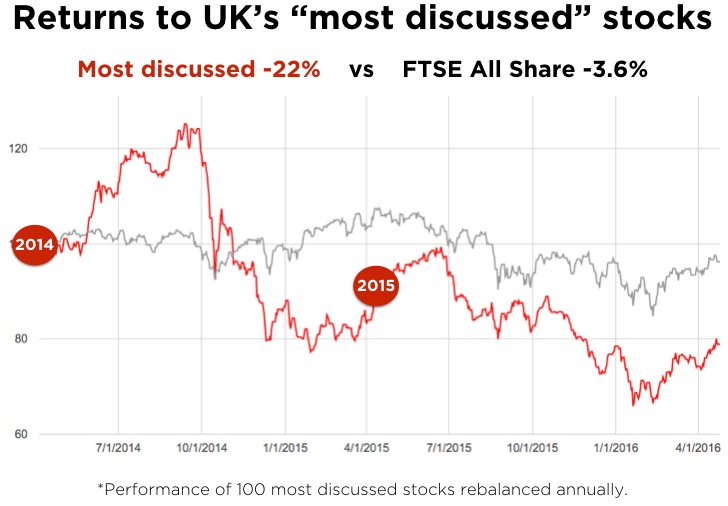
It’s a picture of heart-wrenching ups and downs and consistent underperformance. For every story of someone who paid off his mortgage and sent his kids to private schools by ten-bagging on Rockhopper, there are hundreds of others whose crowd following have led to serious capital losses.
The typical punter investing in a collection of the most discussed stocks online would have been zeroing in on failure. A 10% average failure per year. So much for the wisdom of crowds !
Why do we get pulled into mob thinking?
It was the bull period between 2003 and 2009 that I used bulletin boards the most. I had some savings from my time as a wealth manager and had bolstered my funds with an inheritance after my mother passed away. Being Scottish, I had very good discipline ‘on the buy’. I never liked to overpay. At the time I used a strict rules-based purchase criteria that was very Jim Slater inspired, and for much of the period my exit rules were solid.
But Bull Markets create their own logic. Having initially purchased a sizeable position in a biometrics and RFID stock called RCG quite soon after its IPO in 2004, I gradually pyramided up my position as it kept breaking out to new highs. I grew increasingly confident till at one stage it was as much as 50% of my portfolio.
Now this was a profitable, growth stock. It actually had earnings, sales growth and a viable product. As I ventured online, I became part of a community of investors that were quite vocal about the company’s prospects. The summary of the story was…
“RFID chips are going to replace bar codes. Biometrics are going to be on every device in the world. This company is growing profits at 75% annualised and can keep growing at this rate for a decade. It’s only on a P/E of 8 and a PEG of 0.1. The brokers aren’t onto the story yet. Buy, buy, buy.”
Our community of investors online ventured offline too. About 30 of us met the management at the Mandarin Oriental Hotel in London. Everyone I met appeared extremely intelligent. Business analysts, successful business people, accountants, full-time investors. We were making big profits, I’d almost quadrupled my stake…
But what happened next was the worst of groupthink…
Why are bulletin board crowds dumb ?
One of the best books on mobs is titled “The Wisdom of Crowds” by James Surowiecki and it holds some great lessons for online investors.
Surowiecki talks about the four conditions that need to be in place to form a wise crowd:
- Independence - where people’s opinions aren’t impacted by the opinions of those around them.
- Diversity of Opinion - where every individual in the crowd makes decisions based on their own private knowledge.
- Decentralisation - where every individual is located separately and able to draw on different local information.
- Aggregation of Results - where there’s some mechanism to bring individual perspectives to a collective decision (e.g. a market).
The problem with bulletin board crowds is they break the first three of these rules.
Firstly, the initial frames for a stock pitch are often made by just a few very vocal, highly intelligent and confident people. People often defer to authority figures (known as authority bias) and so these ideas are shared and accepted by a growing number of people without critical thinking. This creates an information cascade that denies independence of thought, especially amongst time poor private investors. It also leads to over-confidence.
Secondly, diversity of opinion on bulletin boards is not welcome. Time and again when a critical, bearish thinker appears on a bulletin board he’s blasted as a ‘deramper’ or a ‘troll’. Often he’s banned from the thread. Investors only seek confirmation and confidence that their decision to stay long is correct, they seek to silence challenging or contrary opinion.
Thirdly, while most investors may sit in their home offices or at work, they often aggregate in a single forum to think and share all information together. This is the antithesis of decentralisation.
All these factors are completely contrary to wise crowd formation - and they tend to lead to groupthink.
In the cacophony of voices in a bulletin board the best storyteller with the best story wins. Funnily enough, the stocks most discussed rarely display the classic profile of winning stocks before their runs - in fact, on deeper analysis - they normally display the profile of losers !
As an illustration of this fact, I’m sharing a bubble chart of the 100 most discussed shares online (from the 2015 set) using the Stockopedia Value Rank and Quality Rank. These bubble charts show Value on the horizontal axis (from expensive to cheap), and Quality on the vertical axis (from junk to good). Good, cheap shares (which historically have outperformed the market) are in the top right corner, while expensive junk shares (which historically underperform the market) are in the bottom left corner.
As we can see, only four of the 100 shares in the list can be classified as “good, cheap” shares. The majority are worse than average and heavily leaning towards “expensive, junk”. The only reason to buy expensive, non profitable shares is because they hold the promise of exceptional future returns… a future that can only be sold in a great story by an authoritative storyteller.

How to use bulletin boards successfully
RC Group - the biometric share previously mentioned - was found out as a fraud. But the fraud took quite some time to unravel. The psychology of those who were long the share while the fraud unraveled was very telling.
It became a typical DABDA grief sequence… first the stock plummeted and most were in denial, then came anger but most stayed long. Then came the bargaining phases which is when I managed to sell out - a 50% loss from the peak, but thankfully still a profit on my original investment. But I know plenty of others who held on only to see a share that was once at a high of 144p fall to under a penny.
Since that rather painful experience, I’ve learnt that the simplest secret to making money reading bulletin boards is simply don’t ! As many Stockopedia subscribers may know, the site’s investment philosophy is to align with the historic payoffs available in the market and try to act contrary to the emotional crowd. It’s a philosophy that has worked and ought to continue working until the market is a lot more efficient than it is today. To do this one doesn’t need to read bulletin boards… one needs to understand what works in investing, and read, analyse & use company data.
To understand the amount of performance that bulletin board investors are missing out on, it is useful to look at the differential between their performance and a statistical benchmark. If you compare the performance of the 100 most discussed bulletin board stocks, to the top 10% of shares ranked by their Stockopedia StockRank (which is a simple model based on quality, value and momentum factors) we see a huge 96% differential over a 2 year period (see the chart below). As James Montier, the famed analyst and fund manager, has said “the evidence suggests that quant models tend to act as a ceiling rather than a floor for our behaviour… there is plenty of evidence to suggest that we tend to overweight our own opinions and experiences against statistical evidence.” The chart below is a few months old, but again serves to illustrate the point.

Frankly, the above analysis ought to put everyone off reading bulletin boards, but that would be short sighted. We’re social animals, we seek and crave validation, and the internet is an awesome vehicle to discover new information, more quickly than we could otherwise.
The key to using discussion boards successfully is to avoid using them as a primary source of ideas but use them for testing ideas, to keep Surowiecki’s comments in mind and to structure your thinking to counter our inherent behavioural biases.
Here are a few pointers to prepare one’s mindset whenever reading a bulletin board:
- Frame your reading with a sound understanding of what statistically works - when one understands the typical attributes of winning shares it’s much easier to spot a blatant, low probability story or ‘sucker’ stock.
- Avoid confirmation bias. If you find yourself reading bulletin boards just to back up your own opinion… don’t.
- Seek out contrary opinion - especially if it comes from intelligent “trolls”. Experience generally shows that they are more right than wrong.
- Beware of intelligent consensus - consider the opposite side of an argument if one side is in the ascendancy.
- Beware of Authority Bias - be skeptical of trusting the authority of any self-proclaimed ‘guru’, especially if hides his real world identity behind a pseudonym.
- Read Blogs rather than Forums - blogs are often written by independent thinkers who come to decisions from their own research rather than groupthink.
- Don’t buy stocks just because people are talking about them. Buy stocks when people aren’t talking about them. Sell them when they are.
And just to sign off, here’s a great parable that rather sums this all up…
A group of medieval scholars were debating how many teeth were in a horse's mouth. To answer the question, each person stood up and cited their favourite authority--but there was still NO agreement. A junior member of the group, then suggested that the group should go outside and simply "COUNT" a horse's teeth--to resolve the question once and for all! Upon hearing this, the rest of the group became so alarmed that, according to the manuscript, they "fell upon him, smote him hip and thigh, and cast him from the company of educated men."
Safe investing !
Disclaimer
This is not financial advice. Our content is intended to be used and must be used for information and education purposes only. Please read our disclaimer and terms and conditions to understand our obligations.
57 comments
Brilliant article. Thank you so much for posting this.
Nice article,Ed.Re these frauds,you tend to find that they are always a bit cheaper than one would expect if they were genuine,except for the occasional price spike.I'm guessing that this is because insiders sell into strength.
Very good article. But it basically states what I've realised for many years now. The worst example of this herd-like behavior are found with many AIM penny stocks. You'll see the BBs populated by a few 'know-it-alls' dominating, making ridiculous positive claims for such stocks, and the other contributing PIs regarding their pearls of wisdom as gospel. If any BB member challenges their views they are quickly turned on with no shortage of abuse.. When these stocks bomb as most inevitably do the know-it-alls make a quick disappearance from such BBs never to be heard from again.
I couldn't agree more. I used to be one of those know-it-alls on a few stocks on advfn back in 2004-2008. It turned out pretty badly for me too at the time. It led to a complete re-assessment of everything I thought I knew about investing, and ultimately led to the development of the tools at Stockopedia. We're only a fraction of the way there though.
This experience really drives my approach to markets and investing now... I'm fascinated by behavioural investing and how to put processes in place to avoid being afflicted by over-confidence, over-optimism, authority bias, herding etc etc.
Good article - I've reached much the same conclusion from my own experience, which is why I rarely bother posting these days. Some examples of investor herding that spring to mind are:
(1) the High Yield Portfolio board on TMF
(2) the army of commodity bulls a few years ago here on Stockopedia.
(3) the Economy board on TMF for poeple who think we're going to hell in hand basket
(4) Bert's refuge on TMF for people who think everything's great
I think the thumbs down feature on Stockopedia is a bad idea because it facilitates exactly the behaviour you describe. Many posters will give a post the thumbs down when it doesn't act as a confirmation of the conclusion they want to hear. Often they will be unable to articulate any logical counter argument, but will give you the raspberry anyway.
Bulletin boards can be a useful source of information about a particular stock - along the lines of Paul Scott's excellent posts. But the challenge is to read posts without getting sucked in. If poster after poster is singing the praises of a stock, its only human to start viewing it in a more favourable light.
Yes -interesting article, and undoubtedly there is plenty of evidence of groupthink on active bulletin boards.
I've contributed to bulletin boards now for some 17 years, mostly on a handful of stocks, and have from time to time been thought of as a "guru" of sorts on one or two of them.....not that I've ever styled myself that way - the debates about the merits of a stock were always a matter of the quality of the arguments for and against for me, rather than a question of who was making those arguments.
I would observe that the quality of discussions has deteriorated markedly over the last ten years, especially since financial crisis of 2008. The most active contributors nowadays seem to be strongly motivated to drive the share price up or down on a short term basis, rather than making assessments that deal with the stock's merits over normal investment timeframes. The result is, in essence, lots of hot air and smoke - but not much light!
Disappointingly, also, there seems to be a sub-culture of negativism and a willingness to denigrate other posters with the aim of discrediting them and dissuading them from posting. This can apply to either bulls or bears. Its a sort of Gresham's Law for bulletin boards - the bad drives out the good.
I'd also observe that two sectors have, from time to time, dominated discussion boards - namely oil and gas stocks (other than the majors) ....and what I might loosely call "tech" - which basically encompasses all stocks that might be considered to have high growth potential based on some novel aspect of their business. Widget-makers and other companies that make their money from day to day trading activities are far less interesting to speculate about than those which appear to have transformative growth potential.......
.....and these same two sectors have had specific issues which can lead to the sort of investment disaster referred to in the article:
In the case of "tech" there is the issue of fraud (as you mention) as well as the technical failure of the proposition - or the failure to commercialise it properly. Such failures (other than frauds) often have at their root the fact that such companies are led by techies who love tech - and not by hard-nosed accountants or business people. Such tech companies also attract techie groupies on bulletin boards - and it can be tough to cut through to establish whether there is a viable business there or another Betamax opportunity to lose cash.
In the case of the oil and gas sector.....which has been widely discussed and speculated over throughout my time on bulletin boards.....it is impossible to escape the fact that commodity prices are a massive driver of investment returns. Broadly, 1999-2008 was highly positive for commodity prices and returns, and 2008-2016 has been neutral to negative (especially the last two years). I would argue that virtually all oil and gas stocks have been bad to disastrous investments for the last two years - quite independently of the amount of discussion on bulletin boards!.
I'd be interested to see what conclusions would be drawn from the same set of data if the results of the oil and gas sector were excluded (for reasons of the commodity price influence which dominated stock-specific factors in the returns). I doubt it would be as clear-cut.
.
Yes it's true that the majority of 'most discussed' stocks are Energy / Mining shares. About 65% are in the latest batch. But even stripping them out you find the same general theme.
It's late on Sunday, so I'm not doing a full analysis... but using my April 2015 collection if you remove the Energy and Basic Materials sectors from the set and analyse the last 12 months here's what you get:
That's an 11% worse performance than the FTSE All Share which is flat in the same timeframe. You'd probably find that the Energy & Basic Materials stocks did better than that.
The list that makes this charts is full of household name stocks (like the major banks, supermarkets, airlines) and speculative biotech and tech names. Frankly, that sums it up... people love to chat about things others know about too (availability bias) or lottery tickets. Both are expensive traits.
Thanks Ed.
.....but your closing point just reflects reality - you can't have a discussion unless there are sufficient willing participants, and that generates the bias towards high volatility stocks or the FTSE100 stocks that many people have in their portfolios. The interesting bit from an investment perspective is often the Bit in the middle.....
rgds
Hi emptyend
I agree with much of what you say. However, with regards to O&G stocks (and for that matter resources in general and gold in particular), there has been quite a marked turn around since the lows in early February 2016. Albeit from a very low base level, there have been some real gems in these sectors. I alluded earlier in this thread to an alternative non-Naps portfolio I have been running since the start of the year which includes several natural resources stocks which is now up over 60% YTD including Pantheon Resources (LON:PANR) Ithaca Energy Inc (LON:IAE) and more recently Sound Energy (LON:SOU) (as well as miners Lonmin (LON:LMI) and Glencore (LON:GLEN) ). I suspect several, if not all of these have been pretty active on the BBs (although this is not the reason that I am invested in them).
Best,
Gus.
Hi Gus,
Yes they generally are well off the lows - but if you look at the boards you will find sibstantial negative sentiment and total disengagement with the great majority of contributions being from people who were long from much higher up - and bitter about it.
Accordingly I think the volume of posts to currently be a very poor guide to stock-specific sentiment.
My clear and strong view is that most investors continue to avoid the sector, even as industry players are taking greater interest and M&A dicussions seem on the increase.
rgds
....ps.....I see that Sound Energy (LON:SOU) has nearly quadrupled in the last six weeks after flat-lining for months. I dare say there will be others that have decent prospects but have lain unloved in a sector few with fresh money are following
Cheers, rhomboid1. Are you my fellow PEG investor on ADVFN, or is that a different unequal parallelogram?
Yup ..
Uncharacteristically, Ed has produced an article that, although interesting, is rather incomplete. The focus he chose is on the most discussed stocks on one site's bulletin boards. That's not what he asked though. He moved seamlessly to the specific from the general.
The answer to his question is without a shadow of a doubt yes, as two colleagues have proved over 15 & 12 years respectively.
I also, like Ramridge, read the better posters output. I would not be surprised to find that many discerning investors do likewise.
Of course, Ed's not going to produce an article that suggests using Stockopedia rankings and/or stock reports is inferior to another method! I'm not actually disagreeing with the thrust of his article by the way, I just felt that he was selecting an obviously flawed strategy to examine.
Scm.
Scm.
Hi EC
You're bang on the money imho , I always check BB activity the less it is or the more despairing the better...but only if the numbers stack.
I don't get the plaudits for this article. Yes, 95% of posters on bulletin boards are clueless. However, used intelligently, bulletin boards can be an extremely valuable source of information and ideas for investors. Used stupidly, by contrast, they will cause you to lose money. I find it hard to think of a stupider way of using bulletin boards than investing in the most discussed shares. All the author has done is taken an obviously foolish approach to investing and showed that it lost money. Big deal. Further, he seems to entirely miss the point that (as Paul Scott indicates) the methodology he has applied could potentially form the basis of a powerful shorting strategy.
LOL. The downvoters might want to think a bit more about this part of the article:
"Firstly, the initial frames for a stock pitch are often made by just a few very vocal, highly intelligent and confident people. People often defer to authority figures (known as authority bias) and so these ideas are shared and accepted by a growing number of people without critical thinking. This creates an information cascade that denies independence of thought, especially amongst time poor private investors. It also leads to over-confidence.
Secondly, diversity of opinion on bulletin boards is not welcome. Time and again when a critical, bearish thinker appears on a bulletin board he’s blasted as a ‘deramper’ or a ‘troll’. Often he’s banned from the thread. Investors only seek confirmation and confidence that their decision to stay long is correct, they seek to silence challenging or contrary opinion.
Thirdly, while most investors may sit in their home offices or at work, they often aggregate in a single forum to think and share all information together. This is the antithesis of decentralisation.
All these factors are completely contrary to wise crowd formation - and they tend to lead to groupthink".
Surely the acroynm DYOR has never been more apt?
By all means use the bulletin boards - but don't simply believe what you read, research it for yourself
Simple as that imo
I'm not trying to promote the Motley Fool, but, as an owner of Arm shares, I think there are some excellent posts about the recent takeover offer on Motley Fool's Arm bulletin board:
http://boards.fool.co.uk/arm-holdings-plc-arm-50124.aspx
There are also, of course, many excellent posts on Stockopedia's bulletin boards.
So it is not true that all posters on all bulletin boards are idiots. But one has to be discerning in one's choice of bulletin boards!
Here is how you can profit from BBs. I will use advfn as an example.
- there are, believe or not, a few good posters who genuinely add value and deep knowledge. Yes, it is rare.
- make a note of these posters and follow their posts.
- on advfn, you can do this by simply doing a search on posters. This brings up all current and past posts by this poster
- browse the companies he comments on
- do your own research on those that attract you
From memory, I found two companies in the past year in this manner that turned a good profit.
I would emphasise that this method is just another way of identifying potential companies, and the heavy lifting of doing your own research remains your responsibility.
Ed,
Great article and builds on the comments you made at the UK Investor Show (I still think it was brave of you to show the bubble chart with all the the companies participating plotted!).
When I started investing, I looked on bulletin boards for information sources as did many others and was quickly put off by the general unpleasantness as dissenting views were shouted down and I developed doubts as to the qualifications of those who expressed strong certain opinions. There is a great quote I came across today:
"The whole problem with the world is that fools and fanatics are always so certain of themselves, and wiser people so full of doubts." Bertrand Russell
Perhaps this explains both the allure and folly of bulletin boards in one!
By contrast, I enjoy the blogs and columns on Stockopedia because a variety of views are exchanged, dissenting opinions expressed and debated, and uncertainty acknowledged. As a result I have learnt a huge amount. Keep up the good work!
Thank you Ed. for a great article that has generated excellent commentary. Next up, broker 'buy' recommendations and the City as a savings skimming machine. I can't wait.
I wrote down two points I read in an investment article some while ago (cannot remember the author) which are fixed to the side of my screen....
1 Do nothing is the best advice for everyone almost all the time.
2 Market sentiment and fundamental values are completely different parts of the decision making process.
I think your article is great and bang on the money, I like that there is solid data here to prove the point, it is possible to make money on BB stocks with iron discipline and exquisite timing - on the other hand you could just take up poker.
I set up a test portfolio 6 months ago with the 20 most discussed bulletin board stocks in it. Currently it is down 23%. In contrast after 6 months my real life diversified stockopedia portfolio is up 0.5% (excluding dividends).
Excellent article. Those graphs are fascinating.
There is one bulletin board that I find occasionally has some useful comments, which is the Investment Trusts and Unit Trusts board on the Motley Fool website:
http://boards.fool.co.uk/investment-trusts-unit-trusts-50097.aspx
If one followed some of the posters on that board's tips on buying certain high-quality investment trusts that happen to be on higher than average discounts to their Net Asset Values at the time of the post, I expect one would beat the market by a few percent a year over the long-term.
thought this was a great article. there has been a lot of talk of the wisdom of crowds recently, for example following the failure to predict the referendum result, and I've not seen as clear an analysis as your four criteria for identifying wise/not wise crowd. Seems really perceptive to me - although that could of course be my behavioural bias wanting to agree with all the authoritative previous comments saying how good the article is ...!!
If I could have the temerity to add one thought my own (admittedly easier said than done) first rule is simply don't get greedy - find some decent companies to buy and hold until they stop being decent companies, avoid doing too much and avoid doing anything really dumb. that should beat the market by a few points each year and keep compounding. Learn to love watching the dividends come in!
Let someone else chase the ten baggers - if they get lucky good for them, when I get to lie on a beach in the sun with a cool beer I enjoy it I don't begrudge the guy sailing past in his yacht ...!!
I'm interested in this don't get greedy concept.
You don't have to chase ten baggers and you don't have to settle for beating the market by a few points each year.
I want to smash the market and I think you can do that with low risk by searching for ten double baggers rather than chasing ten baggers.
Since 2013 I have cashed in on five double baggers (Kentz, Cellavision, GFT Technologies, Let's Gowex & Sprue Aegis) and I hold several stocks that are currently up over 75% (Corteceira Amorim, Meet Me, Adesso, Trigano) and my average gain for current holdings is 36%.
Sprue Aegis was a triple bagger and Meet Me has doubled in under 3 months.
PhilH - Good for you, maybe a slight alteration to my maxim is needed. Don't get greedy unless you're definitely smart enough to get away with it.
I don't think Sprue Agis has ever doubled in price let alone tripled since it was listed on AIM and its now trading well below its 2014 float price so you must have super timing and traded it on ISDX before it transferred to AIM, and Meet Me is a US micro cap I think? That's a lot less risk averse and a heck of lot smarter than me, and I've no problem admitting it. You keep going and I'll keep not getting greedy ...
Yup I had Sprue on the ISDX.
And I bought into Meet Me in early May as it broke out. High Quality and Momentum scores.
It's not really being clever it's just timing the purchase of stocks that fall out of my screens.
P.S. I'm quite transparent about my performance ... my fantasy fund mirrors my personal purchases with the exception that unfortunately I didn't have a starting fund of £1m. See http://www.stockopedia.com/fantasy-funds/philhs-fu...
Excellent article Ed. Of course it applies to the traditional mainstream printed press as well.
Your piece should be required reading for every investor.
As always Ben Graham got there first when he said that in the short term the stock market is a voting machine.
PS - just wait till you see what we've got lined up for next week ... on whether you can beat the market buying Broker "Buy" recommendations... it's even worse !!!
For me, the most interesting nugget in this entertaining article is that Ed was able to amass savings as a wealth manager despite not being a particularly good investor. That's the financial services industry in a nutshell!
nigelo - absolutely ... "Where are the customer's yachts?"
The City is a savings skimming machine. I'm going to be blogging about a friend's portfolio and coming to precisely the same conclusion next week. Everything i've learned about successful investing I've learned SINCE leaving the City.
Touché !
Ps the last comments were seriously tongue in cheek before I get accused of being a Troll or whatever !
Thanks Ed, interesting thoughts.
For those that are wondering about LEAST discussed stocks, they tend to be those in the FTSE100, regarded as boring and with more perfect information embedded in their shareprices. On the contrary, the most discussed tend to be small mid caps, as Ed points out - "Story" stocks. Its also because these shares are less well covered by City analysts, so the educated (or even uneducated) investor can find out a few facts that are others dont know and can feel part of the debate.
Most of my investment and SIPP portfolios have core holidngs in large and mid cap companies, typically 'boring' cash compounders with the odd smattering of interesting small cap growth or recovery positions added in. Like most I read SCVR to get a few ideas. You just have to have your antenna up for when you feel shares are over hyped. Where then does the marginal buyer come from then? It reminds me of the famous anecdote of Joe Kennedy (or JP Morgan, no-one seems to know) who sold their entire holdings of equities right before the 1929 crash after they received investment tips from the shoe shine boy.
I think a rules based portfolio is good for some investors as it makes the investor become more dispassionate / rational, however I try and combine the 2 approaches. I screen for cheap good quality shares with proven 'moats'. But then, unlike a rules based approach, I investigate the companies and pick only c15 which I hold for the long term and dont rebalance much as this involves frictional trading costs. These shares eg Imperial Brands, BAT, Sage etc have all compounded way ahead of the market. Occasionally they do get expensive but i tend to hold for years. I also look for seriously mispriced small cap companies - recovery or growth. The dangerous ones tend to be growth where everyone gets carried away. There are real herds here. I prefer to look at recovery situations which are seriously unloved, especially where they have some asset backing or where there is a proven business going through a tough time or just been hammered by the market eg CLS Holdings at the moment, Bovis a couple of weeks back at 0.8x net tangible assets, Cambian.....Higher risk certainly
As with everyone, there is no "Right" approach. See what suits you personally.
If a rules based approach is the only way forward then logically Ed should close down the discussion page as it is losing investors money. But he wont do that because he knows most of his paying members like the discussion pages and avidly read SCVR. They would go elsewhere and his business profits would fall. So Ed, what are you going to do ? close it down in all of our interests ....Go on I dare you !
I did say this...
This is a blog isn't it?
;-)
Thanks for an interesting article. I did subscribe to ADVFN when I first started investing (I liked all the flashing figures and colours) but I never got sucked into the boards as could not (and still don't) understand how they work. I stopped using ADVFN after a year and cancelled after two. They make cancelling very hard (it has to be done by letter) which says a lot about ADVFN. I would urge any newbie to avoid ADVFN, III or LSE.
As for Blogs I read SCVR, JIC, John Kingham and when I remember (he does not email or tweet) Naked Trader. But I use these mainly for education and a bit for ideas for further research. I have learnt not to try and match trades as I think that is futile.
Finally on books I have just read "Deep Value Investing" by Jeroen Bos and "There's Always Something To Do" about Peter Cundill by Christopher Risso - Gill. Both fantastic value investing books which I think are well worth reading and show the benefit/advantage of ignoring the crowd.
Excellent article Ed.
A couple of observations to throw into the mix - not least in the interests of disrupting the emerging "Group think" that BB's are in all cases bad and deleterious to your wealth!
The article implicitly assumes that activity on a bulletin board is necessarily "pro" the underlying stock. While I suspect this generally is the case (people gravitate towards and comment favourably on stocks they already hold), I have come across a few bb's where a well thought through counter argument has made me reconsider and decline a possible investment (must have been one of Grindertrader's before he stopped posting!). I agree sensible commentary is the exception rather than the rule but if you can be bothered to plough through the pantomime villain stuff there is the odd gem.
Over time, I have found one or two posters to be knowledgable and able to provide insight or indeed new information that has been beneficial in evaluating a position. Unfortunately, it takes time to weed out the few good from the many bad (as well as a pretty good memory) but for certain non-mainstream stocks I have found one or two posters whose opinions I value.
In a post earlier this year, I set out a comparison between two shadow portfolios; one a NAPs based factor portfolio, the other I characterised as a "guilty pleasures" portfolio. I provided a YTD review in mid-April here:-
http://www.stockopedia.com/content/a-tale-of-two-portfolios-127289/
While the latter portfolio was not entirely a product of bulletin board scuttlebutt, I will admit that one or two of the stock investments certainly had an element of "story stock" to them and were in some cases conceived from the germ of an idea from a bulIetin board or blog. I plan to do a further update later this year, but as of today the NAPs portfolio is down about 0.5% and the GP is up 52%. Obviously this is only a tiny sample, but either through luck or some monkey brain algorithm that I can't de-code, at least one distillation of story based stocks seems to be storming ahead.
Flippancy aside, I wholeheartedly agree with the sentiment of your article. To the unwary, BB's can be a minefield. At best full of the well intentioned but misguided story stock evangelists. At worst full of parties with a vested interest in pumping and dumping story stocks for personal gain.
Best,
Gus.
I've only been trading a couple of years however this is exactly what happened to me. Started researching ideas through the chat boards, got caught up in the emotion of what, in hindsight, was clearly a ramping exercise - Clean Air Power, now delisted - and vowed never again. I now don't post on those boards and only chuck a glancing view to their direction to ascertain if there may be something I've missed and even then will conduct further research rather than listen to the 'expert board members'.
You quickly learn to weed out those who are only there for quick gains, rampers/dreamers and those that actually appear knowledgeable.
The irony is though, that had I not read one of the boards which happened to mention a guy called Paul Scott, I wouldn't have followed up my curiosity into why this person was supposedly the bee's knees in small cap investing and would never have found Stockopedia!
Probably most long term investors have their story of how they were suckered in. Mine was the dot com boom around 2000 when I made a fortune and then lost it. Taught me the benefits of diversification and not to be greedy.- and to use Stockopedia!
Hi Ed - on the wisdom of crowds & Stockopedia users who are obviously a wise crowd! If you are able to have you ever thought about ranking the most searched for stocks in the search box at the top of the site or the most displayed Stock Report pages to see if this showed the same pattern as bulletin boards or if high ranking stocks are more often searched for / displayed?
Hope that makes sense, if it is possible it might be interesting what do you think?
Regards
Jamie
I love this article and I myself have been very vocal on the psychology effects of the bulletin boards on my own blogs and on you tube. My concerns go further than those who actively participate in the bulletin boards, but of those web sites like the London South East who seem to actively promote this community in order to drive traffic to their website. With their 'Today's Hot Chat Topics', 'Latest Share Chats' and the past few discussion posts easily visible on each share price page it's no wonder how many private investors get attracted to them.
I myself used to chat regular on London South East (disclosure : username, mogie) and ended up being involved in many abusive and down right horrible exchanges to the point I was banned after a few warnings. At least London South East have some sort of moderation and I accept their decision was probably correct.
But what I found in not only their bulletin boards but those on ADVFN was being up against the crowd. I would be accused ( and in terms of LSE - warned ) of 'upsetting the board' because of my contrary views on many of the story stocks that I would warn against. There was no point giving this opposite view. It did me no good and only caused myself stress and ill health.
I still read the bulletin boards now and again but my use of them has changed. I always check the 'hot chat topics' on LSE because I want to try and measure the 'excitement or fear' currently in the markets. I may actually buy into the excitement, but that is not an endorsement of the quality of the stock or the views of the people discussing it. I put in short term trades to jump on the band wagon, because I know the effects of excitement to the share price of a story stock. My feeling is usually that the stock is still crap. i place in stop losses for the inevitable drop after the spike up and make money from the 'foolish' behaviour of the 'punters'. But I never post anything about these trades...ever.
Unfortunately I think most private investor's will go through the expensive mistake of bulletin boards before venturing across to respectable educational sites like Stockopedia.
I hope this article gets shared many times over. It is one of the most eye opening for the new private investor to read who are currently trapped in the psychology of bulletin boards.
I was one of the Rockhopper etc. investors. The irony was that I joined to ride the momentum of the trend for junior oil stocks, rather than fall in love with them. As I participated in the bulletin, I lost sense of my strategy, and my substantial gains. I had a lot of entertainment but poor returns.
I am cowardly by nature, so didn't bet the banks on these stocks, but it could be said participation took up a lot of the mindspace that would have been better devoted elsewhere. So there was an opportunity cost too.
I enjoy reading Paul Scott's commentary, and other bloggers too. Credit to Paul he has admitted his past losses, and I look forward to reading his book on that period, but there isn't areal sense of what's in his portfolio (which sounds substantial) and how its performing overall. So again, I think we have to read these things for ideas, and then substantiate them against our own risk measures.
Ed. There is an important lesson about failure in life. I would suggest innate conservatism is the natural outcome of that, for successful investing, and perhaps life. The upsetting thing is when someone has taken a wild or thrilling bet, and won the 10 bagger. It looks like skill, but it is more likely to be a statistical anomaly, but it hurts to know that having abandoned that youthful abandon we have left something of hope behind.
Would be interesting to compare the performance of "least discussed" (mirroring whatever the "most discussed" criteria is) with the index and stock ranks.
Great article Ed. Just wondering where you got the data for the most discussed stocks on bulletin boards? Is this available on ADVFN?
A very interesting presentation of the data and probably experienced investors would have broadly guessed that type of outcome. However, it would be interesting if it was possible to filter out the small/micro cap shares being discussed and and see what the performance is with regard to the larger mid-caps and above. I would expect a much better overall performance.
As regards Paul's SCVR it is in some ways a self-fulfilling prophecy. If Paul says buy/sell in regard to a very small cap/illiquid share then his opinion carries some weight and others will adhere to his suggestions thereby increasing or decreasing the share price accordingly. I would also think there is an element of that going on with with the NAPS portfolio selections.
Having rule based selections is definitely sensible in my opinion (certainly when it comes to making a sell decision).
I do not have the tools (or the time) to substantiate my beliefs so I could be wholly incorrect.
Hi Carcosa,
As regards Paul's SCVR it is in some ways a self-fulfilling prophecy. If Paul says buy/sell in regard to a very small cap/illiquid share then his opinion carries some weight and others will adhere to his suggestions thereby increasing or decreasing the share price accordingly
I don't think there's any evidence of that at all.
For a start, I NEVER say buy or sell! My reports are just giving a personal opinion on whatever results or trading statements have been issued that day. So it's very different from a tipping site.
Also, the shares I report on are already moving in price, because it's their results day. Plus I focus on the biggest price movers of the day. So people might think it's me moving the price, but actually I'm only writing about it because it's already moved a lot in price.
Smashing article Ed! I'm sure we've all had plenty of bulletin board nightmares.
I would add that bulletin boards are very useful to short sellers. When I shorted Afren, after working out that the equity was toast, due to bond obligations, I amused myself by reading the utter garbage that bulls were writing about the shares on advfn. It soon became readily apparent that these people were completely unsophisticated, and had no idea what they were doing - they didn't understand the basics of investing, or company accounts. So it was easy money.
Same with Globo, and Quindell. The bulls were utterly clueless, which they amply demonstrated on bulletin boards.
Whereas a totally silent bulletin board is very often a wonderful confirmation that you've found a hidden gem, if your fundamental research points to it being a gem. What it means is that, over time, other people will discover the gem, and they'll be buyers. So that pushes the price up.
A busy bulletin board full of muppets is a serious bear signal in my view - usually the stock will collapse in price sooner or later.
Regards, Paul.
When I first arrived here I was tracking Paul Scott's selections and as per the good old days I was celebrating his successful picks as my successful picks and getting annoyed with him when his selections went pear shaped as he danced in/out and changed his mind with some selections.
The single biggest successful development in my investment strategy has been to switch to a rules based approach supported by evidenced research and to stop paying attention to the opinions of others. It's forced me to take responsibility for my own investment decisions.
As my approach has restricted the number of suitable stocks that pass my filters I've moved into first Europe, then the US and now Australasia and the benefit has been that no one is talking about the stocks I own on this site.
I think it would be interesting to draw a performance chart of:
- The most talked about stocks on Stockopedia
- The most discussed stocks on SCVR
Hi Phil
Currently I only invest directly in UK stocks (and use investment trusts and ETF's for international diversification), since I am reliant on the RNS service to give me current, on-going information on the UK stocks in which I am invested or in which I am interested.
Given your international investment experience, do you know if there are any similar information services to the RNS service, covering any or all of the European, US or Australian markets?
Many thanks
Hi David,
This is quite challenging for some but I don't tend to listen to every missive from a company. When I look to buy in I read the last two announcements and I'm looking for positive news and an absence of negative news.
I think ideally I would be tracking the company news on a regular basis for the stocks I hold and looking to sell if bad news occurs but actually if I'm honest I tend to let either:
- the price momentum to take me out OR
- a significant markdown in the broker estimates for FY1 & FY2 OR
- Beniesh or Altman concerns on the StockReport
It is true that is it hard to find a centralised source of company news for European, American and Australian companies but to be honest I haven't looked that extensively.
I guess my view is that:
- I'm not 'talented' enough to assimilate all of the information that's out there about a business
- I don't know enough about how businesses in diverse industries/sectors operate
- I don't have the time to stay on top of it all
So I don't try to kid myself I simply surrender to my limited abilities and find a strategy that plays to my strengths.
Best of luck
Phil
Professional Services: Sunflower Counselling.
It's true that I have seen some sad looking sunflowers, but Is there a market for that?
great piece Ed, can't agree more. I'd add to the reading list with Daniel Kahneman's Thinking Fast and Slow as a must read. Bulletin Board's not only influence a great many biases but can also operate on a more subconscious and subliminal level. Kahenman outlines two main decision frameworks: the more visceral System 1 which is prone to biases, fears and instincts and System 2 which is the more rational and structured.From an evolutionary perspective, System 1 thinking used to be good at preventing us getting killed: it is also a good framework for getting killed in the markets.
As for RFID, I was one of the evangelists back in the day of IoT 1.0 , though I had a healthy scepticism: I made a good bit out of Intermec shares on the back of the smart tag madness
@dscollard - thanks. I love Thinking Fast and Slow... I considered throwing in a lot more behavioural biases info into the article, but there's only so much you can add before it ends up unreadable !
It's amazing that biometrics are now part of the security on every iPhone.
The funny thing is that I actually bought RC Group's iris-recognition security product and installed it on my PC. I never managed to login ever again !!! That's the main reason I sold when I did... otherwise I would probably have held it to 1p.
Thought you might be a Kahneman advocate. Thankfully I was paid to buy digital devices as I was running a Digital Futures Lab in the US in the early 2000s . As with RC, much of this was a bit flaky. I did however buy into that APPL thing at $14.. mind you selling at $200 was a bit early : both my best and worst investment decisions in one.."time in" the markets versus "timing" the market
Excellent ! This is a very sensible piece of research and i think we all might have had some similar either greater or lesser experiences. Thanks Ed.
Nice article but, alas, the intellect of the average PI these days makes it entirely pointless!