Contrarian opportunity? Here’s what the StockRanks are saying about recruiters

A year ago, I’d have suggested that many UK recruitment stocks could be attractively priced. Here’s what’s happened to a basket of these stocks since then, compared to the FTSE All-Share index:

Buying into a falling trend too soon is a mistake I’ve made more than a few times in my investing career.
My article next week will take a data-driven look at the influence of momentum on UK stock market returns over the last decade.
However, this week I’ve been taking a more focused look at what the StockRanks are saying about the recruitment sector. Are contrarian opportunities emerging – or is it still too soon to consider buying?
Recent progress has certainly been cautionary. The chart above represents the aggregate performance of the following UK-listed recruitment firms:
Hays (LON:HAS)
Pagegroup (LON:PAGE)
SThree (LON:STEM)
Robert Walters (LON:RWA)
Staffline (LON:STAF)
Gattaca (LON:GATC)
Empresaria (LON:EMR)
Only one is in positive territory on a three-year view, with others seeing share price falls of up to 65%:

Of course, recruitment has always been a cyclical sector, where profits are leveraged to the health of the economy.
In good times, employers are hiring and job hunters have negotiating power. Candidates also have the confidence needed to walk away from established jobs and take a chance on something new – something that has reportedly not always been true over the last 18 months.
Profits can rise quickly as busy recruitment agents are able to drive higher volumes.

[PageGroup]
When conditions become less favourable, these dynamics can go into reverse. Profits can slump as employers slow hiring and would-be candidates hesitate to give up secure positions with their current employer.
This is a sector of the market where investors need to have good timing to maximise profits. The chart below shows the performance of PageGroup, Robert Walters and SThree over the last 20 years. Note how their share prices have all moved largely in lockstep throughout this entire period:

Unsurprisingly, most of these companies have some common characteristics. Using PageGroup as an example, we can see that profitability can swing wildly between very high and very low levels:

Cash generation tends to be strong during boom times, allowing companies to build a cash buffer for when times are less good.

Workforce flexibility is another feature – companies are often quick to let recruitment consultants go when volumes fall.
Pagegroup’s average headcount has fallen by nearly 20% in two years. Robert Walters cut its headcount by 17% in 2024 alone.
This flexibility has allowed these firms to protect their balance sheets and maintain dividends supported by net cash, if not by earnings. Here’s PageGroup again:

The combination of a flat dividend and falling share price mean PageGroup shares offer a tempting forecast dividend yield of 6.5%.
Similar metrics apply to other companies in this sector:

High yields may give the impression that these shares are cheap, with recovery potential. This is a tempting narrative, but is there a data-driven hypothesis to back it up?
In the remainder of this piece I’ll consider the quality, value and momentum credentials of these stocks.
I’ll also comment on Empresaria and Staffline, to explain why these companies currently need to be viewed slightly differently.
StockRank overview
Let’s start with a look at the StockRanks and the individual factor ranks for each company:
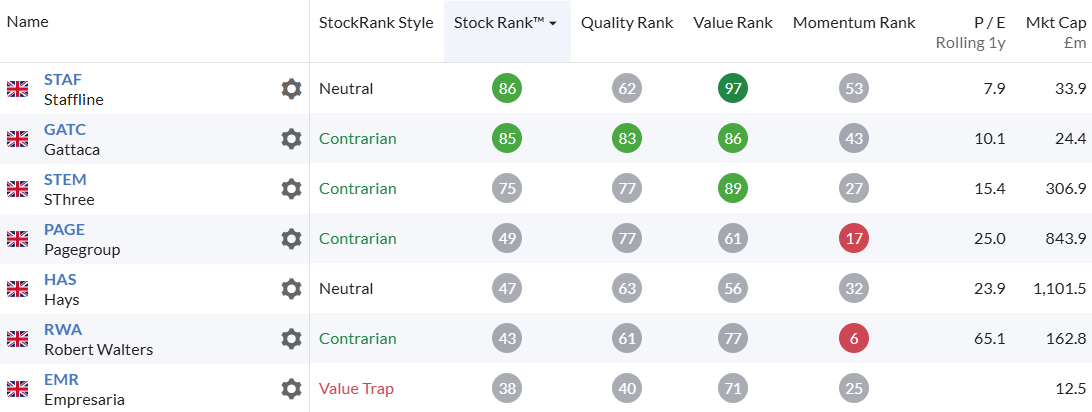
I’m not surprised to see four Contrarian-styled stocks in this list. These stocks’ ValueRank and QualityRank scores are fairly high in most cases, but their MomentumRanks are almost uniformly low.
The exception to this is Empresaria, which also has a low QualityRank. In contrast to most of the other companies on this list, this group has a substantial net debt position and is currently unable to pay a dividend. Debt service costs have also exacerbated a severe decline in profitability. Mark discussed Empresaria’s recent results and risk profile recently here.
I’ll exclude Empresaria from any further discussion. I don’t see much logic in considering this micro cap (£12m) as a potential investment, given the alternatives available in this sector.
Quality
A more detailed view of this portfolio’s quality metrics reveals a very mixed picture on profitability, supported by somewhat average fundamental health (F-Score).
I’ve sorted these shares by return on equity in the table below, although sorting by operating margin would give a near-identical result:
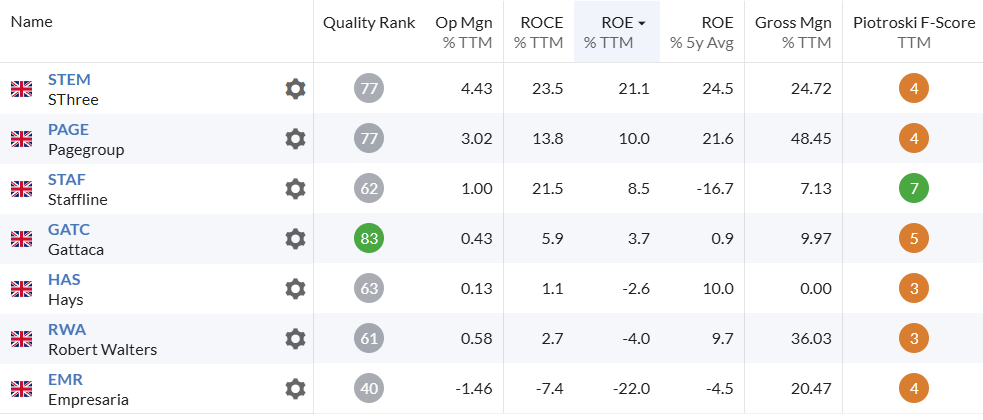
SThree and PageGroup have remained the most profitable so far, with double-digit returns on equity last year.
Elsewhere, Staffline and Gattaca look potentially interesting, for reasons I will touch on in the next section.
However, looking at these metrics, I would argue that with the possible exception of SThree and PageGroup, none of these shares are exhibiting signs of true high quality at the moment.
Value
Switching to the Value view highlights some more impressive metrics.
It also provides us with a chance to see if these stocks could be cheap based on 10-year average (cyclical) earnings – the CAPE 10y. I find this a useful measure for heavily cyclical companies such as recruiters and commodity producers:
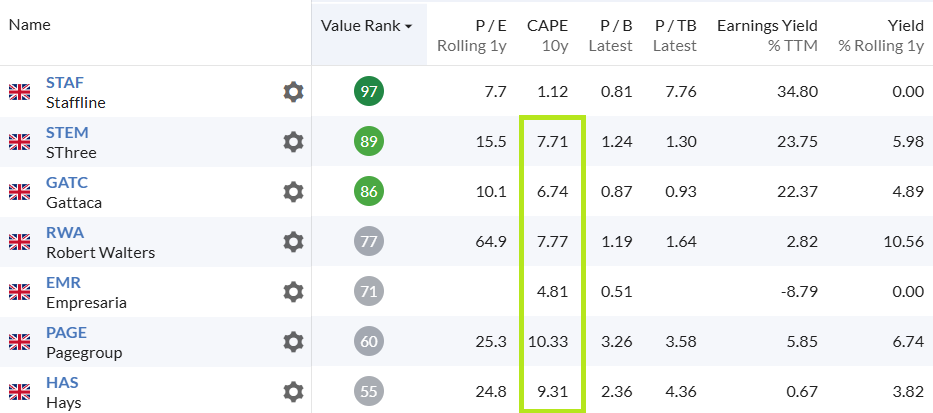
SThree, Robert Walters and Gattaca all trade with CAPE 10y ratios of around seven. To me, this suggests they could be affordably priced, relative to their historic through-cycle earnings power.
Elsewhere, Staffline trades on a remarkable 1.1x 10-year average earnings, but this needs to be seen in context.
This UK-focused business specialises in providing “flexible, temporary and permanent workforce solutions”, placing more than 40,000 staff each day. Broadly speaking, these are blue collar roles. Staffline has a mixed track record and suffered a near-terminal experience a few years ago, requiring a massive shareholder bailout:

This business now seems to be leaving its problems in the past, but I think Staffline’s rolling P/E of 8 is more representative of current profitability than any of the other metrics.
Finally, Gattaca deserves a standalone mention here for its apparent discount to tangible book value. Mark covered this group’s latest results in some detail in the Daily Report on 2 April:
In summary, they are significantly outperforming their sector while still trading on a material discount to listed peers. Their superior balance sheet strength means that they will be around to benefit from the sector recovery when it arrives. This makes them continue to be GREEN, in my opinion, and I am in no rush to sell, despite some caution over reduced FY26 forecasts.
Unfortunately, the final part of Mark’s comment also highlights the risks facing investors in this sector. Will profits start to recover over the next 12 months – or could they fall further?
To round out this quantitative review, I need to consider the issue of momentum.
Momentum
This is where the real problem is, in my view. Look at this sea of red:
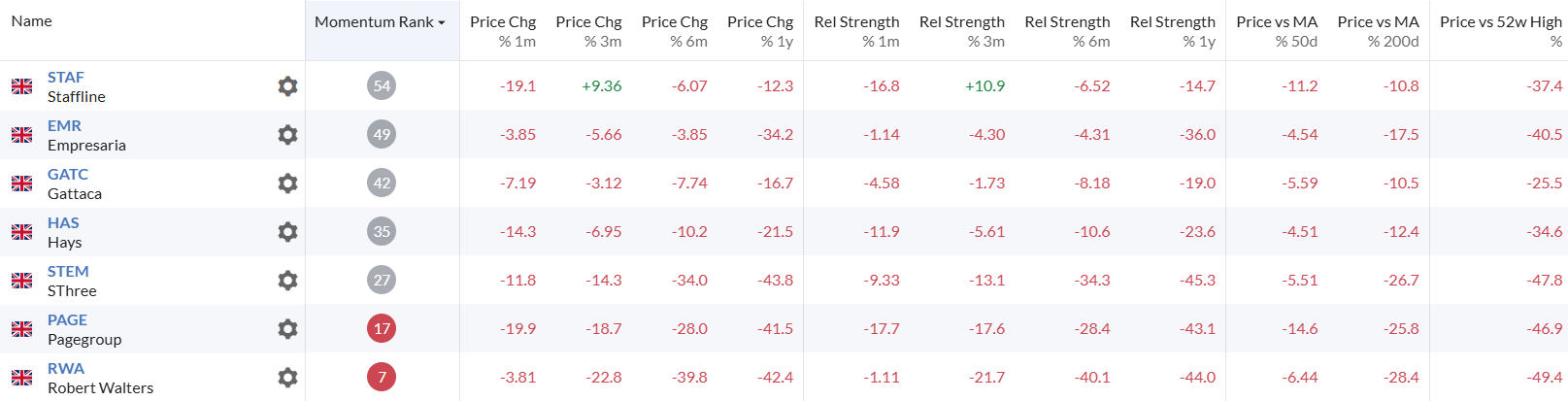
Using technical measures of price momentum, all of these shares look weak.
Broker earnings estimates – the other key element of the MomentumRank – have also been trending lower across the board.
For example, FY25 earnings estimates for PageGroup have been slashed by 75% over the last 12 months:

At SThree, estimates have been cut by 68% since April 2024:

Are recruiters at a turning point?
In most cases above, FY26 earnings estimates are higher than those for FY25. In other words, if forecasts can be believed, the 2025 period could be the low point for earnings at many of these firms.
This could signify a contrarian opportunity for investors who can stomach the current economic uncertainty and apparent US recession risk. The valuation of companies such as PageGroup and Robert Walters broadly supports a positive contrarian stance, in my opinion.
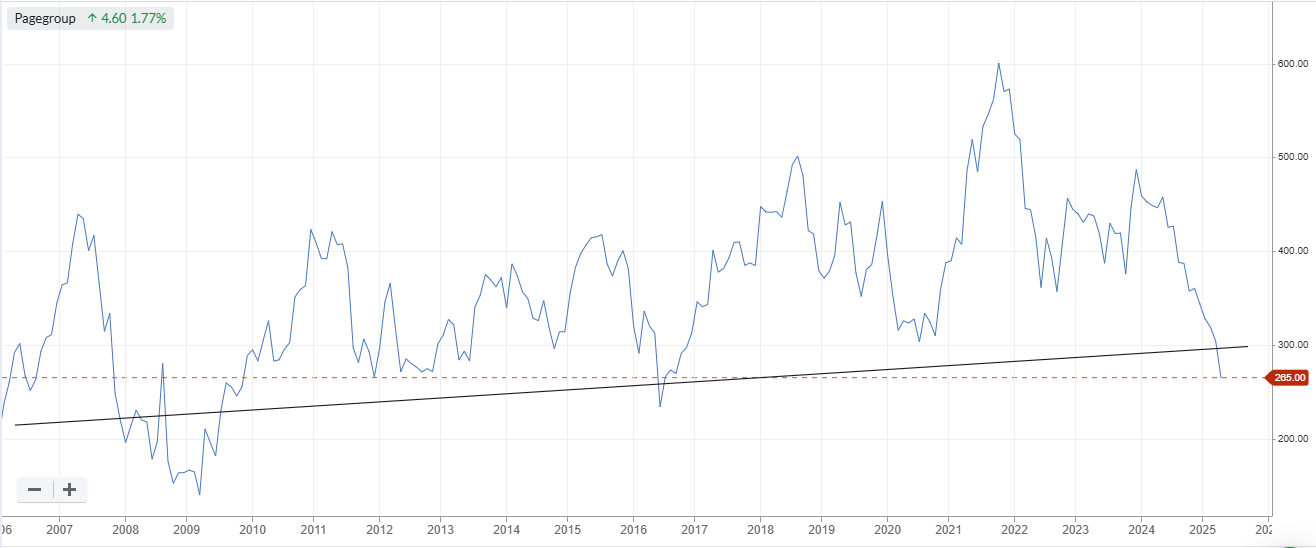
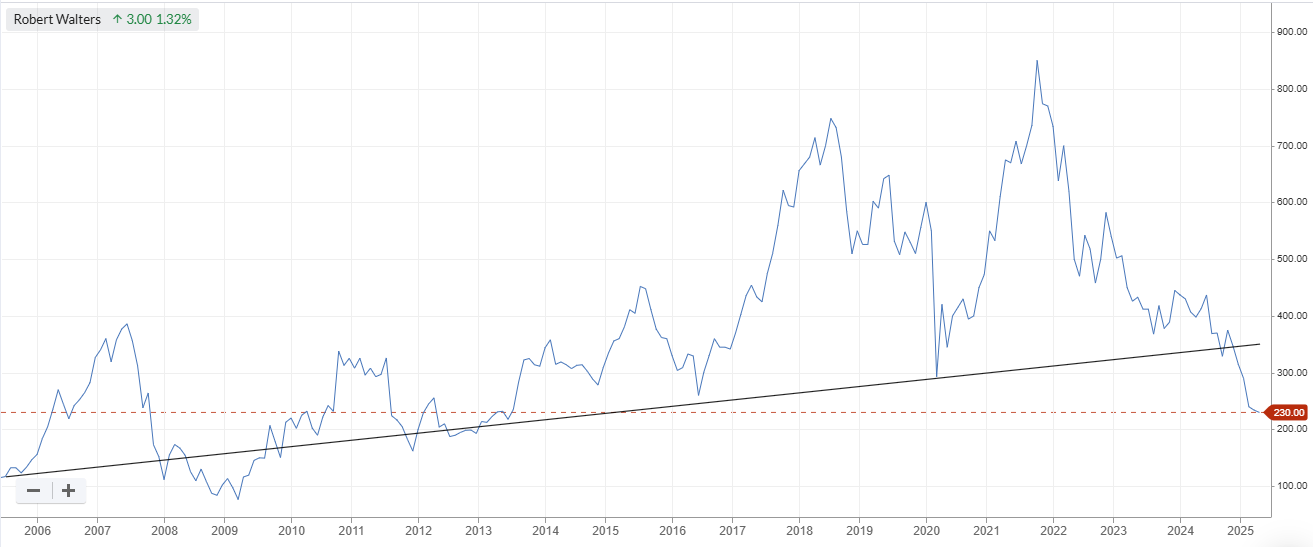
From a chartist’s perspective, it’s also possible to make the case that some of these shares are trading at 20-year support levels only previously breached in 2008/9. Here are a couple of examples.
Pagegroup:
Robert Walters:
Outlook: risks to a recovery?
My view on this sector has always been that cyclical demand will recover over time, as it always has done previously.
On that basis, I think it’s reasonable to suggest that some opportunities could be emerging among listed UK recruiters. I think Gattaca, SThree, Robert Walters and PageGroup could be worth a closer look.
However, I’d also argue that this situation isn’t without risk, for two main reasons:
Cyclical risk: the timing could still be wrong – economic conditions could be set to worsen in western markets.
For example, while many experts are predicting a recession in the US, aggregate earnings forecasts for the S&P 500 are still predicting double-digit growth this year:

The endgame on US tariffs is impossible to predict right now, in my view. But I think it’s fair to suggest there’s still some scope for a further slowdown in the US and other developed markets.
Are recruiters about to be disrupted? What could happen if my comforting assumption about an inevitable cyclical rebound is wrong?
At the top end of the market – high-level executives and technical experts – I expect that referrals, relationships and recruiter-led searches will remain the primary methods of recruitment.
But I’m starting to wonder about the outlook further down the pile. Will recruitment be another casualty of AI and the internet?
Sifting, sorting and shortlisting can increasingly be done by semi-automated services that can match requirements, trace candidates’ histories and review their personal profiles by drilling into LinkedIn profiles and other online sources.
LinkedIn also provides employers with direct access to a vast database of suitable candidates and allows job hunters to apply directly for roles.
In the future, I wonder if we’ll see recruitment firms needing to spend more on IT, while also suffering a possible loss of pricing power in some markets.
Final thoughts
Momentum can often persist for longer than investors expect. This applies to both positive and negative trends. For this reason, I’m trying to train myself to be more patient when waiting for signs of a turnaround in cyclical sectors.
Buying too early can carry a hefty opportunity cost, even if the trade eventually works out as hoped.
In my experience, it’s can be better to wait for a sign that momentum is improving before considering a purchase, even if it does mean missing out on some early gains.
You are looking for the first glimmer of a change - the first hint of good news after the gloom. You will pay a little more this way but look upon the extra cost as an insurance premium - Jim Slater, The Zulu Principle
Right now, I can’t see any clear evidence in the numbers that the trend is about to turn for recruiters. True, earnings forecasts for FY26 are (mostly) higher than those for FY25. But I can’t help feeling that repeated cuts to broker estimates over the last 18 months have weakened the credibility of consensus numbers. City analysts appear to be following the news, not anticipating it.
If I wanted to open a position in this sector, I might be tempted to buy a basket of shares in stages over the coming months in order to protect myself from any company-specific problems that might emerge. I'd only really want to take a higher-conviction view if we start to see the leading recruiters reporting in-line trading and stabilising levels of fee income. For now, I can’t help feeling there may be better opportunities elsewhere in the UK market.
Disclaimer
This is not financial advice. Our content is intended to be used and must be used for information and education purposes only. Please read our disclaimer and terms and conditions to understand our obligations.

18 comments
Really interesting article - thank you.
Personally, I am not a fan of this sector. This is particularly due to as Timar said 'internet disruption'.
In the long term, I feel that there are better opportunities in other areas.
Thanks Roland - another really interesting and thought provoking article. Would be great to see similar articles on other sectors - fund managers perhaps?
Definitely
Great article suggest revisiting approaching the next budget. Labours NI hike is very damaging to confidence, it loses trust in a Chancellor just what will she do next eh ?
All about as dumb as changes being made to property letting, its just driving up rents and reducing choice
Perhaps one day a goverenment will reward the hard working risk takers rather than pandering to the lazy. The reason we are bust and taxes never so high is the welfare bill
Interesting, AI the guillotine of recruiters. I hold SThree (LON:STEM) and Robert Walters (LON:RWA) . I once top-sliced Robert Walters, wish I'd been one to guillotine it there and then.
Your article is a great example of how to research companies to explore investment ideas. Many thanks!
Interesting article Roland. I hold Robert Walters (LON:RWA) more out of hope than expectation, although I would expect some form of recovery at some point.
Alex Sweet wrote an interesting article on recruiters a while back - focused on Robert Half from the US, but the conclusions seemed international: https://sweetstocks.substack.c...
This is what LinkedIn and Indeed have achieved over the past decade or so.
This is a double whammy for traditional recruiters - firstly this must be taking revenue away from them as companies use these tools to move recruitment in house, plus the recruiters need to pay for access to LinkedIn and Indeed themselves.
I fear that the recruiters are trying to push water uphill. At these levels there probably is some recovery value in them but I struggle to see the long term opportunity. This looks like another market that the internet has disrupted to painful effect.
timarr
This is a double whammy for traditional recruiters - firstly this must be taking revenue away from them as companies use these tools to move recruitment in house, plus the recruiters need to pay for access to LinkedIn and Indeed themselves.
Forgive me for pointing this out, but I’m pretty certain you are wrong on both counts. LinkedIn (amongst a range of online tools) has simply replaced traditional advertising channels on which clients and recruiters used to lavish huge budgets. Do you remember the jobs section of the Sunday Times? It cost 10 grand to advertise one job - and that was in old money. Now it’s so much easier to right size your spend, while the website as a whole is a headhunters charter - and free of charge!. Additionally, LinkedIn is not making a hole in recruiters’ incomes. It helping them to make more money, more efficiently. Of course, the market isn’t helping at all right now and everyone is struggling. When it picks up again assumptions by industry outsiders that LinkedIn is eating recruiters’ lunches will be shown.to be way off the mark.
Apologies for the slightly irritated tone of this post. I’ve commented several times on this matter in great detail and in a far more measured tone.
AI is a different matter, but I think its impact is more likely to be on the whole employment universe than it is on the continued demand for recruiters’ services
Hi BnB
Apologies for the slightly irritated tone of this post. I’ve commented several times on this matter in great detail and in a far more measured tone.
Irritated is fine. I get a lot worse at home.
timarr
I agree with BnB in that LinkedIn and Indeed are the replacements of job listings at the back of the printed newspaper. Just the "marketing channel". When those went from Newspaper to LinkedIn, recruiters didn't disappear.
AI is an interesting one to follow. On the one hand - it makes direct recruitment harder. Now candidates can spam multiple versions of a CV, and many more CVs sent in via AI Agents to apply on your behalf. If a HR team is getting 1000 CVs now instead of 500 before, how will they cope?
On the other hand, internal HR can use AI to sift through CVs. However, how many of them are savvy enough, and have the budgets, to do so? Plus once the sifting is done, there is still the time-consuming process of emails, calls, interviews, etc with candidates.
HR departments have always outsourced to recruiters for two reasons:
I hold Robert Walters (LON:RWA) like timarr. This article hit home hard - I definitely jumped in too early. 295p in Jan25, 219p in Mar25. Also one of my top 5 positions, so has been a drag on my portfolio performance, now that it is at 180-190p.
But I keep doing the sums, and even with a modest recovery of 10% of revenues from current lows, a 4% operating margin (they easily can do 5%+), and taking half the cash pile as excess, I struggle to see less than 30p EPS as a conservative earning potential in the years ahead. The current SP is assigning a PE of 6x, which is crazy.
The company has demonstrated that it is in no balance sheet danger; with its cash pile, but also the fact that it can be operating profit neutral by being nimble in slashing headcount and costs.
I am very tempted to have a bit of a top-up at the current levels!
Hello Boon. I think the other point that is not grasped by industry outsiders is that in the vast majority of agency activity (ie temps and contractors), the bulk of the agency’s work is not in locating the candidate and processing the application, it’s in managing the payroll function and all the associated employment regulations and taxes as an external supplier to an employer that usually does not welcome the hassle or sometimes lacks the headcount budget to take the worker on its own payroll.
If someone can explain how AI will disintermediate that most valuable (to the end user) of functions, then I’ll start to question the agency model.
Even then, however, in high end recruitment and in areas of acute skills shortage, the skilled headhunter stands head and shoulders above any in-house administrator in finessing the offer and associated negotiation. It isn’t an admin valued-added they provide, it’s a complex deal intermediation that starts with the first contact with the candidate. Again, AI can add nothing - in fact it would be disastrous to try!
Your problem with RWA however is that it does very little temp/ctr work, where STEM is now 88% contracting. So you are reliant on this second point to save the day.
The current global malaise in hiring is a bit of a head-scratcher. My best explanation is that employers are so unsure of the imminent impact of AI on their hiring intentions that it just feels safer to not hire at all, irrespective of discipline.
'managing the payroll function and all the associated employment regulations and taxes as an external supplier to an employer'
Have you read The Coming Wave by Mustafa Suleyman? He was one of the founders of DeepMind, the company that built an AI that beat the world Go champion. He reckons that in a couple of years you will be able to say to an AI program, 'Here's a million dollars, go and turn it into 10 million'. The AI will look at what's selling on Ebay, design a product, negotiate with manufacturers and sell it from a web site that it creates. Dealing with payroll is pretty pedestrian in comparison.
Is the hiring malaise global? I used to work in IT contracting and many UK jobs were being outsourced to India. Plus of course AI can code these days.
Is the hiring malaise global?
Yes. Absolutely it is.
As for dealing with payroll. Yes AI could potentially make it simpler. But that doesn’t mean employers will want the extra liability of hundreds of extra employees and the associated taxes.
In the insurance sector specialist recruiters seem to use linked in to find candidates. It is quite possible for companies to move the process in house and do the same thing themselves in a cost effective manner. The question is if an employer would want to take this on themselves - using a recruiter does (hopefully) solve various regulatory hurdles and avoid favouritism etc.
Also for many technical roles we seem to be in a skills shortage gap in the UK which should be a plus for recruiters.
Interesting comment from MPAC in their Finals this morning. They talk about reducing recruitment costs by managing more in house. Precise comment, under People: 'We made improvements to our recruitment process, reducing the cost of recruitment through the introduction of an internal recruitment function in key regions' Don't know exactly what that means and whether they are using external recruiters less. Presumably so. How many other companies taking this unusual 'disruptor-type approach?
Elsewhere in your article, Roland, I don't think that the recruiters are going to come back in the same way, because of the other changes in the marketplace you mention. I'm pleased to say that I am not invested, and wont unless there is much more encouraging data coming out.
Incidentally, don't know whether there is a major difference between East and West in these respects, which could be more important to those which have a wider geographical spread.
Interesting article Roland, (I hold some STEM). At least one other company in my portfolio has stopped using recruitment companies to fill its vacancies. It advertises directly, and screens applicants in house. It's quicker, cheaper, more targeted and eliminates a lot of chaff that recruiters may speculatively send along which just wastes your time.
There was a good article in the Times the other day explaining why all recruiters have been seeing a prolonged downturn. it's worth a read
https://archive.ph/thjWv
Hi rwh3ue,
Thanks for the link (especially as it's not paywalled!). Interesting article.
Roland
I think the ai angle points to a long term declining market from two perspectives. Fewer jobs available and more automation around the recruitment and thus less need for recruiters. At the high end (executive level) it prob won’t change much but at every other level I suspect it will. I’ll not be putting my money into recruiters any time soon. I may miss out but as I miss out on a million opportunities daily I’m not too bothered.
An interesting article - thank you