Croda International is down 50%: high quality at a reasonable price?

Summary
Pros:
Croda has a long track record of innovation and high-margin growth
Opportunity to buy a proven quality compounder after a sharp sell off
Business benefits from broad exposure to market sectors such as beauty and crop protection, which are expected to have long-term growth potential
Cons:
Three profit warnings in 12 months suggest a possible failure of financial guidance
Any failure to rebuild margins could trigger a further de-rating
Croda may be at some risk of losing volumes to competitors as market conditions normalise after a sharp slump
Profile
About the stock
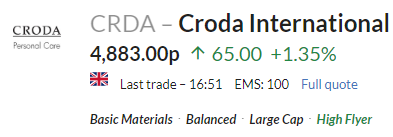
Croda International (LON:CRDA) is a chemicals business with specialisms in Consumer Care and Life Sciences. It’s classified in the Basic Materials sector, within the Chemicals industry group.
Croda floated on the London market in 1964 and is currently a member of the FTSE 100, with a market cap of £6.7bn and a recent share price of 4,800p.
The StockRanks show above-average quality and momentum scores for Croda International, with a rather low score for value.
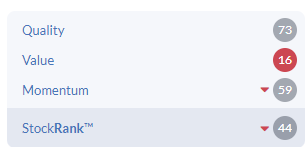
This mix of factor ranks is reflected in Croda’s High Flyer style rating. This is a winning style in the Stockopedia classification system that’s used to describe shares that are good (high quality) but expensive.
Croda’s StockRank Style rating has moved from Falling Star to High Flyer in recent months, perhaps suggesting that the worst of the company’s earnings slump has now passed.
While these style ratings are not intended to be used as an investment strategy, in my experience they can provide useful context about a company’s situation.
About the opportunity
Croda has issued three profit warnings over the last year (June ‘23, Oct ‘23, Feb ‘24) as the company appeared to repeatedly underestimate the scale of a slowdown in demand across its main businesses.
unprecedented destocking and demand weakness in Beauty, Crop and Industrial markets
In addition to this, an exceptional surge in profits from selling a chemical used in COVID-19 vaccines has dropped out of Croda’s numbers over the last 18 months.
Finally, the divestment of some of the group’s industrial products resulted in the loss of £191m in revenue in 2023.
This difficult period has seen Croda’s share price halve from the all-time high of over £100 seen at the end of 2021.

This share price slump has been reflected in broker earnings estimates. 2024 forecasts have been cut by 45% since late 2022:

Of course, Croda’s revenue has not fallen by 45%. 2023 results showed a fall of 19%, or 11% on a pro forma basis excluding disposals.
The real problem has been that falling volumes have led to reverse operating leverage. This is when fixed costs account for a higher proportion of sales, depressing profit margins. This factor alone reduced the group’s adjusted operating margin by 5% last year:

Source: Croda International FY23 presentation
The good news is that these headwinds are now well understood by the market and should be priced into the stock. Although analysts expect another weak result in 2024, 2025 is expected to deliver a decisive return to profit growth.
If this happens, then a return to volume growth could deliver revenue growth and positive operating leverage, as utilisation of the company’s factories improves.
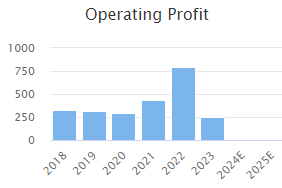
If Croda’s operating margin can return to its pre-pandemic norm of c.24%, then I estimate operating profit could rise by around 65% from 2023 levels, based on 2023 revenue.
I believe the opportunity here is to buy into a proven compounder at an attractive price, ahead of its next phase of growth.
In a best-case scenario, I think there’s a possibility Croda could outperform forecasts in 2025 and 2026, as its historic strengths of innovation and direct sales come to the fore again and help to drive high-margin growth.
Business & Model
What is the company’s history and what does it do?
We were founded in 1925 to create lanolin from wool grease, a by-product of the textile industry
Croda International can trace its roots back to Rawcliffe Bridge in East Yorkshire, where founders Crowe and Dawe (hence Cro-da) produced lanolin. This was initially used as a rust preventative in the growing steel industry.
New products followed during WWII, after which the company began its pivot into the consumer market with the discovery that lanolin could be used in personal care products.
Over the last 80 years, Croda’s business has diversified and expanded internationally thanks to a culture of innovation and a long chain of acquisitions and disposals.
Today the company’s business is primarily focused on two main divisions, Consumer Care (beauty) and Life Sciences (crop protection, pharma). Each of these produce proprietary chemicals that are typically used by its customers to create branded products for sale to end users.

Source: Croda International 2023 annual report
How does the business model work?
Croda is a vertically-integrated business with a strong focus on margin over volume.
The company operates its own research facilities, manufacturing plants and direct sales force. Unlike many rivals, Croda does not typically sell through distributors, instead building direct relationships with its clients.
We are a B2B company that sells small, but valuable, quantities of ingredients to customers of all sizes. These ingredients deliver vital functionality at low inclusion levels, giving us a strong competitive advantage.
The group has a strong culture of in-house innovation. This is paired with regular acquisitions to add new capacity and develop high-margin niche products where the company can benefit from intellectual property rights and pricing power.
Croda actively avoids selling products that are high volume or commoditised. When it has inherited such products in the past through acquisitions, the company has typically divested them or else increased pricing to the point where they are no longer saleable and can be discontinued.
Consistent application of this strategy over the last 40 years or so has created a large business that was – until last year – consistently generating operating margins of c.24%, paired with high returns on capital and strong cash flows.
Markets & Competition
What is the size and state of the company’s market?
We have a broad base of customers, large and small. This high number of customer/product combinations reduces our exposure to any specific customer, market or geography.
Croda’s end-user markets are large and diverse. Measuring the group’s market share in these markets is beyond the scope of this Stock Pitch.
However, I think that reviewing the identities of the company’s main customers does provide a useful overview of the size and breadth of its main markets. The charts below were taken from Croda’s 2023 results presentation and suggest its customer base includes most of the main players in its key markets:
Consumer care:

Agriculture (crop protection):

As I’ll discuss, Croda’s strategy is to focus on products where it can benefit from pricing power and intellectual property rights, supporting high margins.
Who are the company’s key competitors?
There is no one big competitor that spans all our markets; instead, there are different competitors in each of our niches.
Croda’s broad offering and focus on differentiated and IP-protected chemical ingredients means that identifying competitors is not as straightforward as with, say, J Sainsbury (LON:SBRY), which I looked at recently.
However, there are some well-established listed companies that I think are likely to compete in some way with Croda in its various market segments:
Ashland (NYQ:ASH) - agriculture, pharma, consumer care
BASF SE (ETR:BAS) - agriculture, consumer care
Givaudan SA (SWX:GIVN) - fragrances and flavours (consumer care)
Corteva (NYQ:CTVA) - agriculture
Evonik Industries AG (ETR:EVK) - agriculture, pharma, consumer care
Nissan Chemical (TYO:4021) - agriculture
DSM-Firmenich AG (AMS:DSFIR) - consumer care
In addition to this, there may be privately-owned companies competing with Croda that are beyond the scope of my research.
How does it derive its competitive advantage?
Croda’s competitive advantages are derived in several ways, but perhaps most directly from its intellectual property and customer relationships.
Brand & intellectual property: Croda has a long history of innovation and well-targeted acquisitions. At the end of 2023, the group held more than 1,600 patents across 275 patent families.
Targeted and differentiated products aimed at growing markets provide pricing power and growth potential.
Croda’s brand is well known in its market segments. This may make it a supplier of choice due to its long track record and proven reliability.
Switching costs: Croda’s proprietary products are directly integrated into its customers’ own products. These will often need to undergo regulatory or consumer testing before being approved for sale.
While a commoditised ingredient may be easy to switch, Croda’s more differentiated products are often harder to replace without costly testing and reformulation activity.
Thus, I believe users of Croda’s products may face significant switching costs if they want to change suppliers.
Economies of scale: Croda’s broad product range and large size allows the company to maximise utilisation of its manufacturing facilities by producing multiple types of product in one location.
This may allow the group to benefit from some cost advantages relative to much smaller or less diversified suppliers.
Is the competitive advantage durable?
On balance, I think Croda’s competitive advantages are likely to persist for the foreseeable future.
One caveat to this might be that the company’s somewhat aggressive focus on margin over volume means it could be vulnerable if cheaper suppliers emerge – perhaps in China – or if its innovation pipeline falters for some reason.
Financials & Ownership
What is the record of growth & profitability?
Croda’s long-term growth record is impressive. Revenue has risen from c.£300m in 2004 to £1.7bn today. That’s a 20-year compound average growth rate of around 9% per year.
However, progress had slowed in the years prior to the pandemic. The chart below shows the flat pre-pandemic trend, followed by the dramatic spike in profits from supplying lipids used in COVID-19 vaccines.
Remarkably, Croda was able to acquire the business that produces these chemicals in August 2020, just three months before it was awarded a major contract to supply lipids for the Pfizer (NYQ:PFE) vaccine.

Croda’s focus on margins rather than volumes has given the business an enviable track record of profitability and high returns on capital. Again, this performance faltered last year, but I do not see any obvious reason why it can’t be regained as external market conditions normalise.

While Croda International’s dividend yield is rather low, at 2.3%, the company has an impressive 30-year track record of unbroken dividend growth:

I think this performance underlines the consistent and profitable delivery of the group’s strategy over this time.
Is the balance sheet in good health?
Croda carries some debt, but not enough to be of any concern, in my view.
Net debt rose from £295m to £538m in 2023 due to the £232m acquisition of Korean “beauty actives” specialist Solus Biotech.
This left the group’s reported net debt/EBITDA multiple at 1.3x (2022: 0.5x), but the increased level still looks comfortable to me. I’d expect the net debt figure to gradually reduce over the next few years.
Although free cash flow was relatively weak last year due to the profit slump and an increase in capital expenditure, I don’t see any reason for concern. In my view, Croda’s balance sheet is in good health.
Is there evidence of historic share dilution?
As far as I can see from Stockopedia data, Croda has hardly issued any shares in the last decade.

The only exception in recent years was a £600m placing in November 2020 used to part fund the £736m acquisition of Spanish fragrances and flavours business Iberchem. At the time, this represented 8% of Croda’s share capital.
Against the uncertain backdrop of the pandemic, issuing equity rather than loading the company up with debt looks like a prudent decision to me. I don’t see this as a concern.
What is the ownership of the company? Does management have stakes?
Croda’s ownership is largely institutional. The shareholder register is led by Norway’s sovereign wealth fund and also includes noted sustainable investment specialist @IPX.

Management share ownership: Croda’s board appear to be keen sellers of stock options. They do not appear to have significant shareholdings or to have taken advantage of the share price fall of the last two years to buy shares.
One exception is long-serving CEO Steve Foots. According to the 2023 annual report, he has a material owned shareholding of 205,438 shares, in addition to various unvested bonus scheme shares.
In total, Foots’ share interest was reported at 297,719 shares at the end of 2023, worth nearly £15m at the time of writing.
Boardroom changes: one point that may be worth noting is that chief financial officer Louisa Burdett is due to leave in June 2024, after just 18 months with the company. She has resigned in order to take up the CFO post at FTSE 100 industrial group Spirax-Sarco Engineering (LON:SPX).
At the time of writing, Croda and Spirax-Sarco both have near-identical market caps, similar annual profits, and illustrious track records. It might be interesting to know why Ms Burdett chose to move on from Croda so quickly, given that this is arguably a sideways move.
Valuation
How does the relative valuation compare versus industry and sector?
Stockopedia data shows a median PE ratio of 19.7 for the global chemicals industry group, with median forecast earnings growth of 17.3%.
Thus Croda International’s valuation looks quite steep, relative to its wider industry group:

A comparison with some potential peers suggests a wide range of valuations in this sector that might be worthy of further research:

Overall, I think Croda’s valuation is probably reasonable if – as I expect – the group can return to past levels of profitability and growth. If this doesn’t start to happen in 2025, I suspect Croda stock could be at risk of a further de-rating.
What is the stock’s intrinsic valuation?
Analysts covering Croda International have an average target price of 4,978.6p, implying less than 5% upside from the last-seen share price of 4,771p.

The implication here seems to be that the current price already reflects an expected return to higher levels of profitability and growth. My calculations support this view, too.
The dividend has risen at a compound average rate of 4.1% per year since 2018:

(I’m using dividend growth as an approximation of sustainable earnings growth, although this isn’t necessarily accurate.)
Based on the current valuation, I estimate that a sustainable dividend growth rate of about 7.5% would be needed to give an expected return of 10% per year.
I don’t think a sustainable earnings growth rate of 7% is necessarily unrealistic, but it clearly hasn’t been achieved in recent years:

At the current share price of c.4,800p, my sums suggest the current valuation implies an expected return of just 6.4% per year.
I'd imagine that is below what most equity investors would hope for.
In the absence of stronger growth or profitability, I estimate a significantly lower share price might be needed to generate attractive annual rates of return:
8% expected return: share price of c.2,850p
10% expected return: share price of c.1,900p
Trends & Catalysts
Are there any significant macro trends the business is benefiting from?
Croda’s fortunes are to some extent dependent on the health of its major customers in the consumer care and agriculture sectors.
In turn, these businesses are dependent on economic activity in developed markets (consumer care) and other macro factors such as climate and commodity market conditions (agriculture).
2023 was a difficult year for many chemical companies as their customers both destocked and suffered weaker demand.
I think it’s reasonable to assume that volumes will return to some kind of normality over the next 18 months. If this view is correct, then I’d expect the benefits from this normalisation to flow through to Croda’s order book and profits.
Are there any catalysts that could drive a rerating in the medium term?
Croda’s shares are not obviously cheap based on current performance. In my view, a re-rating will be dependent on two catalysts emerging:
the company showing that it can reclaim its historically high profit margins
Croda continuing to deliver differentiated new products to support growth.
Acquisitions may also play a role in any re-rating. Croda has a good track record of using small and mid-sized acquisitions to drive growth. I expect CEO Steve Foots to continue with this strategy when opportunities arise.
Risks, Threats & Hurdles
Given the inflationary background of the last couple of years, one possible risk is that some of Croda’s customers may have found alternative, cheaper ways to meet their chemical requirements.
I don’t have any hard data on this, but reformulation is one of the tactics that’s used by consumer goods companies to help combat cost inflation.
There’s also the risk, perhaps, that some of the company’s competitors may simply be prepared to undercut Croda to win market share as volumes recover.
Croda’s low-volume, high-margin strategy is designed to mitigate against these risks by focusing on products that benefit from IP protection and clear differentiation. But I can’t rule these risks out completely.
As I have mentioned already, I think Croda’s current valuation already assumes that the business has retained its historic strengths:

If investors start to believe that there has been a structural change to the group’s growth potential or profitability, then I think the shares could fall significantly further. Another profit warning for FY24 or FY25 would be a serious concern.
Recent trading & news
Q1 update to 31 March 2024: “On track to meet previous Group guidance for FY24”
After February’s third and (hopefully) final profit warning, it was reassuring to see Croda issue an in-line statement for the first quarter. Having said that, some of the numbers remained poor and profits are still expected to fall this year.
Group revenue fell by 14% to £409m during the first quarter of 2024, compared to the same period last year.
Life Sciences was the standout loser in Q1, with revenue down by 29% compared to the same period last year, mainly reflecting weaker performance in Crop Protection.
Croda’s first-quarter performance was more encouraging when compared to the fourth quarter of 2023, with revenue up 8% on a sequential, underlying basis.
This growth was largely driven by a 12% increase in consumer care sales in Q1 vs Q4 2023. There were also early signs of recovery in the group’s remaining industrial business.
The group expects to report a 2024 adjusted pre-tax profit between £260m and £300m (FY23: £308.8m).
Sentiment & Outlook
What do the brokers currently think and are they upgrading estimates?
City analysts appear to have left their forecasts largely unchanged after April’s first-quarter trading update. Broker sentiment has also remained unchanged over the last three months. Following last year’s run of profit warnings, this seems encouraging.

Consensus earnings forecasts on Stockopedia show 2024 earnings of 149.5p per share, rising by 22% to 183.5p per share in 2025.
These forecasts price Croda shares on a 2024 P/E of 31.5, falling to a P/E of 25.7 for 2025.
What would the person selling to us be thinking and who are they?
After such a long period of underperformance – Croda’s share price started to fall in December 2021 – I would expect that most long-term holders have either been shaken out or decided to continue holding.
However, sellers at this stage may be questioning Croda’s ability to return to its historic level of profitability, or they may be reallocating capital to opportunities where they see more compelling near-term upside.
Conclusions
Croda International has a long and impressive record of innovation and growth. The group has a clear strategy that’s been consistently executed by long-term management.
An unprecedented slump in demand caused this business model to misfire last year. But Croda was not the only large chemicals group exposed to these problems and it seems reasonable to expect that the businesses historic strengths will re-emerge as conditions in its end-user markets improve.
The main risk I can see is that the disruption seen over the last 18 months may have led to a shift in the dynamics and competitive landscape of some of the markets in which Croda operates. If this happens, the group’s structural profitability and growth potential could be affected.
On balance, I think this is relatively unlikely. With the shares trading under £50, I think Croda shares provide an attractive opportunity to buy into a proven compounder with long-term growth potential.
Disclaimer
This is not financial advice. Our content is intended to be used and must be used for information and education purposes only. Please read our disclaimer and terms and conditions to understand our obligations.

14 comments
Hi Roland,
I've just stumbled across this excellent (as ever) article and notice that Q3 2024 trading statement is due this coming Monday, 11th Nov.
I wonder if we might look forward to a brief update in Monday's DSMR? I note forecasts and share price continue their downwards trajectory, though the PE remains stubbornly high...
Thanks and regards,
Jon
Now at an even more reasonable price for quality??!!
Thank you Roland for a very comprehensive analysis of CRDA. It is on my longer term watch list.
Thank you for your really well researched article I have also taken it on board as to how much more diligent my own research should be
I am normally a buy and hold investor and had made my original purchase of Croda at less than £10 My sale was because I was very unsure of what was happening in the market at the time. With hindsight ( the cleverest devil in the market) I should have stuck to my long term investment philosophy.
Thank you Roland
Very thoughtful, well written and structured. Thank you. Pleased I took the time to read it carefully.
Thank you Roland! Very insightful indeed! I have held for approx 12 years and I still feel that this is a great business though highly dependent on a power selling culture based on innovation. I was particularly interested in this comment referring to volume/commodity products;
“When it has inherited such products in the past through acquisitions, the company has typically divested them or else increased pricing to the point where they are no longer saleable and can be discontinued.”
I was interested to know how you made or derived that observation with regard to increasing pricing to the point a product can be killed off as it is something so succinct and I had completely missed it!?
I do feel that Croda have to be careful not to out-price their customer base going forward as inflation has already ravaged some sectors and resulted in destocking.
I'd be interested to know why 2023 operating costs are so much higher than 2018. Is this raw material and wage inflation? couldn't find an answer in the 2023 annual report.
Could be gas prices? Chemical companies were hit badly by the increase in cost of gas.
In addition to the factors suggested, I think the operating costs have also increased as a result of Croda's strategic decision to focus more on life sciences. In its most recent 2024 Q1 sales statement Croda said it was " accelerating conversion of our exciting pharma pipeline" and as we all know, developing pharma pipelines (be they drugs or Croda's lipids used for mRNA based vaccines and drugs) is an expensive process. Whilst Croda is clearly still mainly a chemicals company, it now has significant biotech-related interests and some of its future success will depend on how widely mRNA vaccines and drugs using the company's lipids are used. As the company rightly suggests this is indeed "exciting" but I think it adds up front costs and an element of "jam tomorrow" for the company.
thanks for the replies. So perhaps the big question is whether this life science development is "exciting", or whether Croda is expanding outside its zone of competence.
Cheers Roland great post - always nice to have stuff like this on record - perhaps when the trend of earning estimates starts to tick up that will be when the shareprice persk up - albeit pe doesnt seem amazingly cheap anyway but that should be expected with cyclical stocks if the good times are coming but they arent flagged up to the market.
You only have to look at Synthomer (LON:SYNT), which has doubled in thelast 10 weeks, to see how the share price can take off, Croda International (LON:CRDA) does not look that cheap.
Very detailed and thoughtful analysis, thank you.
Very informative Roland. I am not too sure whether this interests me at the moment and will take a look at the numbers and more importantly the commentaries in the last annual report. This may be one for me to add to watch list for the future especially as there seem to be quite a few more likely candidates for the short term.
Nevertheless thank you!