Daily Stock Market Report (Fri 13th March 2026) - BKG, SRAD, STB

Good morning! It's a fairly quiet day for results today, as usual for Friday.
That's all for today and for this week. Thank you for all your comments - see you on Monday!
Spreadsheet accompanying this report: link.
Companies Reporting
| Name (Mkt Cap) | RNS | Summary | Our view (Author) |
|---|---|---|---|
Berkeley group (LON:BKG) (£3.5bn | SR75) | Reiterates guidance for FY26 pre-tax profit of £450m “and a similar level for FY27”, together with target net cash of c.£300m. Trading has been constrained by consumer confidence. The situation in the Middle East “is weighing heavily on risk sentiment” and “we await to see the impact of this on the market”. | AMBER = (Roland) London brownfield specialist housebuilder Berkeley says profits for the year to 30 April 2026 should be in line with expectations, but warns of a hat-trick of headwinds: planning delays, cost inflation and the impact of the Middle East conflict on interest rates are all cited as current issues. With the stock now trading at around book value, Berkeley is cheaper than I can remember seeing this stock. I can imagine that value could emerge at this level. However, profit guidance reiterated today suggests the business is only likely to generate a return on equity of c.9% in FY26 and FY27. With no sign of improving momentum, the price looks fair to me against the current backdrop. I am going to leave my neutral view unchanged today. | |
Glenveagh Properties (LON:GLV) (£959m | SR72) | Revenue up 7%, with partnerships growth (+61%) offsetting a 14% fall in homebuilding revenue. Home completions up 11% to 2,568. Pre-tax profit up 10% to €125m, EPS up 18% to 20 cents. Forward order book up 41% to 1,252 homes (+15% to €1.3bn). Outlook: “strong momentum”, guiding for EPS of up to 21 cents. Expect completions of c.2,750 units. | ||
VAALCO Energy (LON:EGY) (£441m | SR82) | Production of 21,160 working interest boepd (16,556 net revenue interest). Full-year net loss of $41.4m, positive EBITDAX of $173.4m. Declared quarterly dividend of $0.0625 per share. | ||
CLS Holdings (LON:CLI) (£233m | SR54) | EPRA earnings down 17% to £30.2m, EPRA EPS -17.4% to 7.6p. Dividend of 4.0p per share. EPRA NTAV per share down 6.7% to 200.7p due to falling property values. Vacancy rate increased to 14.5% (2024: 12.7%) due to lease expiries in London and Paris plus two insolvencies in Germany. LTV was 50% at year end (2024: 50.7%). | ||
Stelrad (LON:SRAD) (£170m | SR79) | Revenue down 3.8%, adj operating profit up 3% to £32.5m. Adj EPS up 0.2% to 13.08p with total dividend up 3.9% to 8.09p. Outlook: “Trading in the early months of the financial year has been in line with management expectations”. End markets are stable but demand remains subdued. | AMBER = (Roland) Last year was difficult and saw a 4% decline in volumes due to soft conditions in the UK and Europe. However, Stelrad has now completed various restructuring activities and appears to be able to support margins if sales don’t worsen further. Cash generation was also impressive last year, in my view. With the stock trading on a forward P/E of 9 and offering a 6% yield, I am tempted to upgrade to AMBER/GREEN today. I’ve added the stock to my watch list, but Stelrad’s relatively high debt levels and the uncertain timing of any market recovery mean I’ve opted to leave my neutral view unchanged today. | |
Atlantic Lithium (LON:ALL) (£122m | SR18) | Awaiting ratification of mining lease for Ewoyaa Lithium Project in Ghana. Continued exploration in Côte d'Ivoire with “new spodumene pegmatite occurrences discovered”. Company has entered into a £28m financing arrangement to support the Ewoyaa project, plus an £8m share placement agreement (£4m raised so far) and a “committed equity facility” for up to £20m. Company has ceased discussions relating to a potential corporate transaction. | ||
EnSilica (LON:ENSI) (£47m | SR49) | Proposed equity funding to raise up to £10m (12/3 4.35pm) & Result of oversubscribed Placing and Subscription | Raised gross proceeds of £9.7m at 47p per share in an oversubscribed placing that was announced after markets closed on Thursday. Funds will be used to “progress user-terminal Application Specific Standard Product (“ASSP”) chips to accelerate potential supply revenues and unlock approximately £2.0m in matched funding from the previously announced £10.38 million non-dilutive UK Space Agency Award.” Also running a £0.3m retail offer at 47p that is expected to be open until 4pm on 17 March 2026. | Roland: 47p represents a fairly modest 4% discount to yesterday’s closing price of 49p, suggesting decent demand from investors. |
Digital 9 Infrastructure (LON:DGI9) (£44m | SR n/a) | Funds managed by IFM Investors (a minority shareholder in Arqiva) have agreed to sell their 14.84% interest to Polus Capital Management for £8.9m. This implies a valuation of c.£60m for Arqiva. “D9 and Polus are aligned in their commitment to work actively with Arqiva’s management”. D9’s 51.8% economic interest in Arqiva is unchanged. | ||
Zenith Energy (LON:ZEN) (£30m | SR43) | Acquired two agrivoltaic development projects in Piedmont, Italy, with an expected installed capacity of 23 MWp and 5MWp. Has also secured sufficient land to install a 5MW BESS. Total consideration for acquisitions is €2,016,000. | ||
Atome (LON:ATOM) (£25m | SR5) | Signed debt financing documents with lenders for the $420m total debt package that forms part of the $650m fertiliser plant project at Villeta, Paraguay. Equity documents are in the final stage of negotiations and will set out details of the project's $244m equity funding. | ||
Jangada Mines (LON:JAN) (£17m | SR27) | 1,100m 10-hole programme completed targeting TP2, a 1km anomaly that is one of six potential targets identified. Gold mineralisation intersected in all holes, with a minimum of 0.5g/t AU. | ||
Transense Technologies (LON:TRT) (£10m | SR43) | Secured new contract as part of “DriveSense” project supported by the APC R&D programme being led by Cummins to develop next-generation smart electric drive systems for heavy-duty vehicles. The project is expected to complete in December 2026. Transense’s element of the project is valued at c.£0.6m. | ||
Reabold Resources (LON:RBD) (£10m | SR60) | An investor group has agreed to subscribe for £1.9m of new shares at 0.1p per share, conditional on Reabold raising a further £1.1m by 12 May 26. This funding is expected to be used to progress the West Newton project, including the company’s share of the recompletion of the A-2 well. |
Backlog: Secure Trust Bank (FY25 results on 12/03/26)
Roland's Section
Berkeley group (LON:BKG)
Down 3.5% at 3,608p (£3.4bn) - Trading Statement - Roland - AMBER =
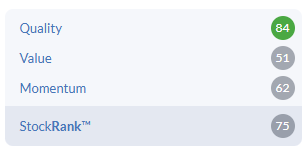
In my recent piece on housebuilders I highlighted high-end developer Berkeley as the most profitable UK-listed housebuilder (over the last 12 months) and one of my picks from this sector, in terms of quality.
Berkeley has deep expertise in redeveloping large brownfield (former industrial) sites and is mainly focused on London. It has an impressive track record, but today’s update makes clear that the business isn’t immune to the pressures facing housebuilders generally and London developers in particular.
Here are the key points from today’s trading update, which covers the period from 1 November to 28 February and comes ahead of the group’s April year end:
Reiterated guidance for FY26 pre-tax profit of £450m, with “a similar level for FY27”.
Expected net cash of around £300m, following settlement of £250m of land creditors and £190m of shareholder returns.
Trading has been “constrained by the impact on consumer confidence of geopolitical events and macroeconomic uncertainty”. However, “sales enquiries remain good and the value of underlying reservations has been recovering towards the levels seen over the summer (2025) prior to the pre-Budget hiatus”.
While this year’s financial results are expected to be in line with forecasts, these comments suggest that sales have not yet recovered to the level seen prior to last November’s Budget.
Margins are still under pressure. Most of Berkeley’s developments are high-end flats, but average sale prices for flats fell by 6% last year according to Land Registry data. While Berkeley may have fared better than this (although we don’t yet know), cost inflation is an issue that appears to be threatening the viability of some developments:
We are working hard to counter the challenges we face and we are reviewing our planning consents to enhance and restore margins to the appropriate level to enable moving them into production.
Delays to planning are a further issue, particularly the “very complex” process required by the Building Safety Regulator for building control approval:
The poor initial implementation of the BSR has severely impacted the supply of new homes in London and other urban areas and we fully support Government's aspiration that the BSR becomes an enabling regulator as soon as possible.
Berkeley says it’s working with the BSR and that “good progress” has been made over the last six months, but approvals within the expected timeframe are still the exception to the norm.
Outlook
The impact of planning delays and cost inflation may now be compounded by the possibility that the conflict in the Middle East will result in higher inflation and mortgage rates, creating further affordability issues for buyers:
The emerging situation in the Middle East is weighing heavily on risk sentiment and we await to see the impact of this on the market. While reaffirming guidance, we are aware of the risk of a further deterioration in macro conditions with the potential for higher inflation in the near term and for interest rates to remain higher for longer.
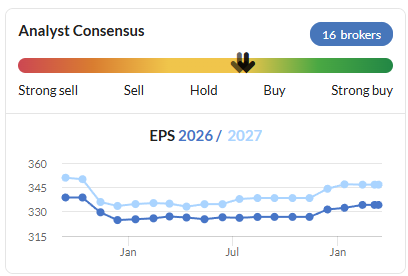
Broker forecasts have actually trended higher over the last year, but my impression from today’s update is that there’s a risk FY27 expectations could be moderated if the Middle East conflict continues to escalate:
Roland’s view
Berkeley is relatively unusual among UK volume housebuilders for its focus on complex, long-term projects. To take just one example, the group is currently working on a project to redevelop 24 former National Grid gasholder and industrial sites in London and the South East.
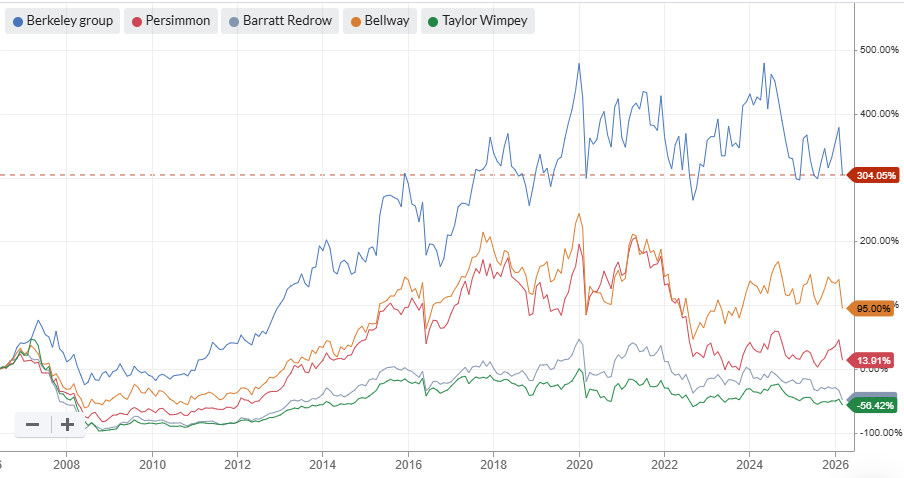
This brownfield strategy has generated terrific value for shareholders over the last 20 years:
However, executive chair Rob Perrins recently commented in an interview with the FT (paywall) that current obstacles to London homebuilding mean that “my biggest competitor for land is Big Yellow” (the self-storage group). Discussing the company’s Regent’s View gasholder development with the FT journalist, he said that if the site went on the market today, “a residential developer would not buy it”.
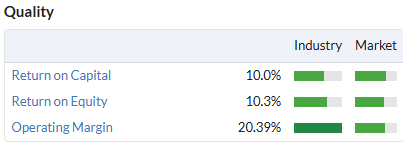
Admittedly, Berkeley’s trailing 12-month operating margin of 20% doesn’t immediately suggest the business is struggling to maintain the viability of its developments. But I think it’s notable that Berkeley – unlike many rivals – has maintained its profitability at a level where it’s able to support shareholder returns and cover its cost of capital:
In evidence of this, the company’s book value per share has grown by an average 5% per year since 2020:
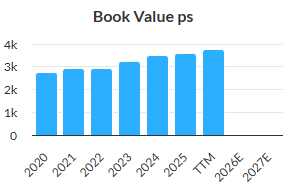
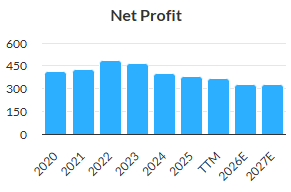
This has been achieved despite regular dividends and declining profits, highlighting the quality of the group’s capital allocation decisions:
I’ve always seen Berkeley as a classy operator and this view is unchanged today. Broadly, I also share the company’s view that the long-term outlook for London (and London residential property) is positive.
The question for me is whether the current valuation reflects the near-term risks, which appear to be growing.
One point in the company’s favour is that Berkeley shares are currently trading in line with or slightly below book value. That’s very unusual for this business, which has historically traded at a premium to book value:
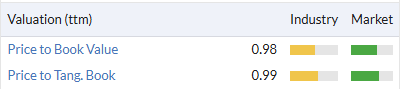
However, at current levels, forecasts suggest the business will only generate a c.9% return on equity in FY26 and FY27. For that level of profitability, I’d argue that 1x book value is probably a fair valuation.
I think value could emerge at current levels, but hope is not an investment strategy.
With no sign of any improvement to momentum (and perhaps the risk of a downgrade) I am going to remain consistent with our system and leave my previous neutral view unchanged.
Stelrad (LON:SRAD)
Down 2% at 131p (£167m) - Preliminary Results - Roland - AMBER =
Central heating radiator specialist Stelrad warned on profits in November, but today’s full-year results appear to be in line with revised guidance.
I can see some things to like about this specialist manufacturer, which could be strongly geared to any recovery in demand. I’m interested to see whether today’s results and outlook justify an upgrade to my previous neutral view.
2025 results summary
Stelrad’s headline figures for 2025 do not look too terrible if you’re willing to overlook some large adjustments – more on this shortly:
Revenue down 3.8% to £279.6m.
Adjusted operating profit up 3% to £32.5m.
Adjusted operating margin 11.6% (2024: 10.8%).
Adjusted earnings per share up 0.2% to 13.08p.
Reported earnings per share down 95% to 0.66p.
Net debt reduced by 14.3% to £51.2m.
Dividend up 3.9% to 8.09p.
I’ll come back to the company’s profits in a moment, but first I think it makes sense to review the trading environment Stelrad has faced over the last year.
Trading commentary: sales volumes fell by 4% last year, reflecting “well-documented market conditions” in the UK and Europe. Subdued conditions in housing and construction more generally are indeed well recognised. See my earlier comments on Berkeley Group.
Softer demand was reflected by the 3.8% drop in revenue, which breaks down as follows:
UK & Ireland: revenue down 4.4% against a volume decline of 6.9%, increase in average size of radiators sold.
Europe: revenue down 3.9%, primarily due to softer conditions in France.
Turkey & International: revenue rose by 3.9%, with improved market conditions.
The increase in adjusted profits was driven by cost-cutting and a continued shift towards a higher-margin sales mix, with the average profit contribution achieved from each radiator rising by 2% to £20.50 per unit.
The company says its On Time In Full (OTIF) delivery in the UK remained at 98% last year. Following a range of restructuring activities, including the exit of a loss-making contract in its Italian subsidiary, management believes the business is well positioned for a return to growth.
Profits - big adjustments: today’s results highlight a large gap between adjusted and reported profits:
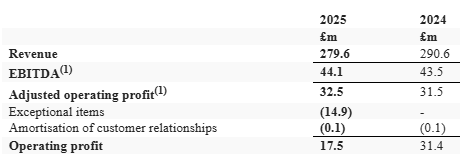
Exceptional items of £14.9m need explanation, but I’m reassured to see that none are listed for last year – perhaps these really are one-offs.
Checking the accounts reveals that the bulk of last year’s exceptionals relate to impairment charges on the Radiators SpA business in Italy, where Stelrad exited a loss-making contract to produce steel panel radiators, having failed to renegotiate an acceptable new deal.
Unfortunately, this has resulted in a laundry list of impairment charges totalling £12.2m:
The main elements of the non-cash exceptional items relate to impairment of goodwill of £2.7 million, impairment of customer relationships of £1.4 million, impairment of property, plant and equipment of £5.8 million and a provision against inventories of £2.3 million, all within the Radiators SpA business.
These are described as non-cash, but some, if not all, of them relate to past cash expenditure.
According to AI, Stelrad acquired Radiators SpA in 2022 for around £24m. Today’s impairments suggest that a sizeable proportion of that original expenditure is now being written off.
The decision to exit the problem contract is expected to lead to a shortfall in revenue and volume in the near term. But the company plans to use this as an opportunity to focus on “the electrical and designer product ranges which are unique to this division and were the key strategic rationale for acquiring the business”.
Cash flow
Today’s cash flow statement is one of the highlights of these accounts for me.
Stelrad reports free cash flow of £20.5m today. My calculations produce an estimate of £19.8m, so I’m happy to use the company’s methodology in this case.
Free cash flow of c.£20m would give Stelrad shares a free cash flow yield of around 12% at current levels – potentially good value.
One caveat to this is that working capital movements were moderately favourable last year, mainly due to shrinking inventories. Forecasts from broker Singer Capital suggest this situation could reverse in 2026, reducing free cash generation. However my hope would be that if this happens, it signifies an improvement in trading (demand), so could be positive for medium-term returns.
On balance I’m quite impressed by Stelrad’s cash generation and don’t have any concerns here.
Balance sheet
I would be remiss not to comment on Stelrad’s balance sheet, which carries quite a lot of debt.
Today’s results show year-end net debt of £51.2m. The company says this equates to leverage of 1.16x EBITDA, which looks quite comfortable.
Personally, I prefer to look at leverage based on an estimate of how long it might take a business to repay its debt, rather than just service it.
Based on last year’s adjusted net profit of £16.7m (which was supported by free cash flow), I would look at Stelrad as having leverage of around 3x. That’s below my preferred limit of 4x, but I would ideally like to see this multiple fall further.
While I think Stelrad can probably afford this level of borrowing, it’s not without risk and is relatively expensive. Debt costs accounted for around a quarter of adjusted operating profit last year.
As far as I can see, the main reason why Stelrad’s debt levels don’t fall more quickly is the group’s generous dividend – last year’s payout will cost around £10m.
At current levels, the dividend provides a tempting 6% yield. While this is covered by free cash flow, it’s hampering debt reduction.
We might speculate that one reason the payout hasn’t been cut may be that CEO Trevor Harvey has a c.9% shareholding in the company. This means he’s in line to receive a dividend income of c.£900k this year in addition to his contractual remuneration.
Quality - return on capital employed
I am all in favour of companies focusing on return on capital employed as a key performance metric. But I always like to look closely at how this is calculated. In some cases, it’s calculated using non-standard measures that provide a more favourable view than the standard ROCE calculation used in the StockReport (which I also prefer).
Stelrad appears to be a case in point.
The company reports a very impressive adjusted return on capital employed of 30.1% for 2025 (2024: 27.1%).
My calculation of 2025 return on capital employed is 24% (using adjusted operating profit) or 13% using reported operating profit.
While Stelrad’s strong free cash flow means that I could be persuaded to use adjusted operating profit in this instance, I’m not entirely comfortable with the company’s definition of capital employed, which it terms Business Capital Employed.
If I’ve understood it correctly, this measure excludes cash held on the balance sheet, lease liabilities due within 12 months, and a deferred tax asset.
In a strictly narrow sense, I agree that this definition more closely reflects the actual capital directly employed in the manufacture and supply of its radiators.
From an equity perspective, I think the company’s definition is overly narrow.
In my opinion, it’s not realistic to suggest that a manufacturer with £76m of debt does not need to have any cash on hand to operate, for example. Nor does it seem realistic to exclude lease payments due within the current year from a view of the capital required to operate the business.
Despite this quibble, I think Stelrad does generate attractive returns on capital employed and could be a reasonably good quality business.
Outlook
Trading in the early months of the financial year has been in line with management expectations. The Group's end markets are stable, but market demand remains subdued, and we expect this to continue for at least the first half of 2026. In the meantime, the Group continues to leverage operational opportunities to optimise future growth and profitability.
Stelrad says it’s well positioned for a market recovery, but highlights that the timing of any improvement in conditions remains uncertain.
I don’t have access to any updated broker forecasts today, but I would guess that most broker estimates will remain largely unchanged following today’s results.
Consensus forecasts have moved significantly lower over the last year, but have stabilised since November’s profit warning:
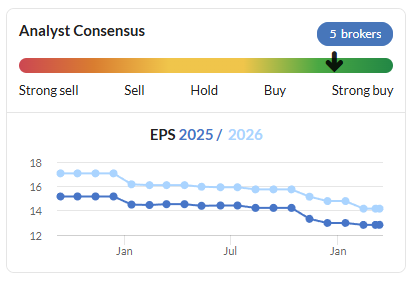
FY26 forecasts suggest adjusted earnings of 14.2p per share. That would put Stelrad on a P/E of 9.2x at current levels, with a 6% dividend yield.
Roland’s view
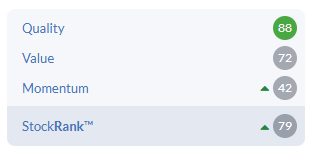
Stockopedia’s algorithms were styling Stelrad as a Contrarian pick ahead of today’s results, and I am inclined to agree. The StockRanks highlight strong quality and value metrics and momentum has been improving recently:
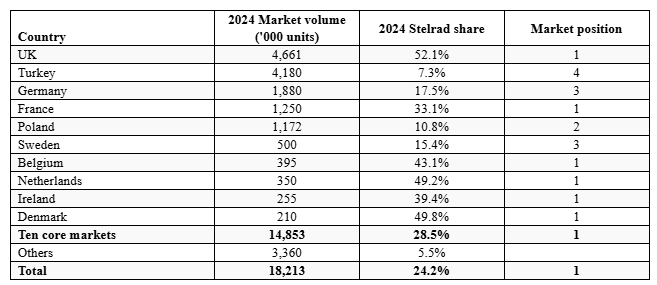
While I have some reservations about the level of debt in this business, I’m quite impressed in some other ways. Stelrad claims to be the market leader in six of its 10 core markets and has shared some quite impressive market share figures today (note that these relate to 2024):
The main risk I can see is that demand could continue to fall this year. If that happens, it could lead to further downgrades and pressure on the group’s profitability. In that kind of scenario, the debt could become more of an issue.
However, if I adopt the view that last year was likely to be a low point for earnings, then I think there’s a strong case to be made that Stelrad shares could offer good value at current levels.
I’m tempted to turn positive today, as I was for similar reasons with Berkeley Group.
However, given the uncertainty over the outlook and the recency of Stelrad’s last profit warning, I think it might be more consistent with our methodology to leave my neutral view unchanged for a little longer. AMBER.
Secure Trust Bank (LON:STB) (Backlog)
Down 6% since market close on 11/3 at 1,320p (£252m) - 2025 Annual results (12/03/26) - Roland - AMBER/GREEN ↓
This specialist lender and bank issued results on Thursday, which I’m looking at today in response to a reader request.
Let’s remind ourselves of what this business does (and what it no longer does).
Secure Trust now reports its operations under two divisions:
Business Finance: real estate and asset-based lending.
Retail Finance: consumer credit for retailers and other businesses, under the V12 brand.
Savings bank: Secure Trust takes deposits through a range of consumer savings products to support its lending.
Secure Trust was also previously involved in motor finance, but this business was sold in December. However, Secure Trust does remain responsible for any redress due under the FCA’s motor finance commission redress scheme. Following October’s update from the FCA, Secure Trust’s motor finance provision stands at £21m.
2025 results summary
Continuing pre-tax profit down 0.2% at £59.3m
Return on average equity: 14.3% (2024: 14.6%)
Net interest margin: 4.7% (2024: 4.7%)
Net lending balances up 8.1% to £3,295.8m
CET1 ratio 12.9% (2024: 12.3%)
Pro forma CET1 ratio: 14.7% (following motor finance sale which completed on 25 Feb 26)
Balance sheet: The CET1 ratio is a regulatory measure of surplus capital, so it’s immediately clear that the sale of the motor finance business has materially strengthened Secure Trust’s Balance sheet.
Underlying lending growth has been achieved at stable net interest margins and the group’s return on equity was also stable.
Today’s results provide an updated net tangible asset value of 1,973p per share. This means that at c.1,350p, the bank’s shares are trading at a useful 30% discount to their tangible book value.
For a bank generating double-digit returns on tangible equity, I think that’s potentially an attractive valuation.
Dividend: Secure Trust’s dividend has now returned to progressive growth after being cut in 2022 and 2023.
For 2025, the total payout was increased by 5% to 35.5p per share, giving a trailing yield of around 2.5%. The yield is somewhat lower than in the recent past, following the stock’s impressive re-rating over the last 15 months:

Outlook
Clear guidance is provided for 2026, with management noting that 2026 will be “a transitional year to launch new products and reduce cost”:

I have often found that when companies talk about transitional years, it’s sometimes a euphemism for near-term underperformance.
Sure enough, broker Shore Capital notes that this guidance implies continuing pre-tax profit of £63m, “below our prior c.£75m expectation due to temporary stranded costs” that were reallocated following the motor finance disposal.
If this view is reflected in updated consensus forecasts, then I think there’s a chance the EPS estimates in the StockReport may fall in the coming days.

I think it’s also possible (although I’m not certain without updated forecasts) that Secure Trust’s 2026 guidance can be seen as a mild profit warning.
FY27 onwards: the profit shortfall in 2026 should genuinely be a temporary issue, as far as I can see.
Prior to the sale of its motor finance business, Secure Trust had planned to wind down these operations and thus remove £25m of costs by 2030.
Having sold the business instead, these costs are expected to be removed by 2028, “incurring additional costs of £12m”.
There’s almost certainly a net gain here by accelerating the cost reductions, but again the implication seems to be that 2026 and perhaps 2027 may see extra costs as the restructuring is completed.
Roland’s view
If management can deliver on their guidance for 8-10% lending growth and maintain or improve returns on equity, then I think it’s fair to suggest that Secure Trust probably does offer good value at current levels.
The stock’s c.30% discount to book value and single digit P/E look low enough to me to justify a further re-rating, assuming that the company continues to deliver on its strategy.
Having said that, I would flag a few potential caveats:
Further provisions – or exceptional costs – may yet emerge from the motor finance business. Secure Trust remains liable for these despite the sale of its motor finance loan book. Consumer redress processes can sometimes be lengthy and costly.
The bank also still has a substantial restructuring to complete. The £25m of costs being targeted for removal equates to 25% of total operating expenses reported for 2025. That’s a big chunk of the cost base to remove, potentially creating some disruption.
The other caveat is simply that as with all small, specialist lenders, I believe there will always be a heightened measure of regulatory risk when compared to larger, more diversified banks.
Graham was GREEN on Secure Trust in February. I also have a positive view. But given the potential downgrade to earnings forecasts for 2026, I am going to move down one notch to AMBER/GREEN - at least until we have more information on the outlook and/or evidence of further progress.
Disclaimer
This is not financial advice. Our content is intended to be used and must be used for information and education purposes only. Please read our disclaimer and terms and conditions to understand our obligations.

27 comments
Secure Trust Bank (LON:STB) thanks for the excellent analysis Roland
My second company to benefit from the current situation is an old favourite of mine – SNOX:AQSE. In many ways, the story is very similar to QTX:LSE in an earlier posting today. Right around the world, variable costs for logistics is rising sharply, and guaranteed to stay at an elevated level even if the war stopped tomorrow. I am reminded of the recent Iranian statement that the war will end when they say so, not the US. They will control the key Straits of Hormuz and what passes through it when they permit it, and not the US.
Back to SNOX:AQSE. What are the key selling points of this unique patented (100 countries and counting), fuel conditioner? Immediate savings up to 8% on HGV fleets in the UK (optimizing at c. 3 months); meets all fuel regulations so no impact on manufacturer warranties; reduced maintenance and parts replacements; especially the greater savings on diesel users i.e. the greatest logistics users on sea and land; significant reduces emissions, including particulates, NOx and SOx, and especially CO2 ; and no, repeat no capex, just a simple pour in at the next fill with fuel; super concentrated, 1:2000 per litre of diesel; and last but not least, 100% organic and 100% biodegradable; non-toxic and non-inflammable. (The conditioner has the same properties for petrol engines, though the fuel savings will be less because the dilution is 1:1,000. The other very important benefits for us, people and the environment, remain the same.).
Have a really good look at this British company’s website sulnoxgroup.com for better understanding of how this all works, examples of successes across different industries/applications/geographies. You can even buy it at the Shop (top right), prices include p&p.
I have been using it in my VW Golf for years and still going strong at nearly 100k miles. It is not widely available in stores yet because the company over time has been ‘laser focussed’ using its limited resources on R&D; patents; shipping companies; distributor/shareholders, and key distribution hubs around the world. Now it is turning to complementary land-based logistics – mining, railways, road fleets - as well as shipping. The greatest opportunities will tend to be in emerging countries where fuel quality is poor (yes, it varies enormously apparently), where equipment and vehicles are older (and benefit from the greatest improvements), but we will see wider availability over time in countries like the UK, Europe and North America too. There may be a welcome move to renewables (target C) but the distance between now (A) and (C) – let’s call it (B) - will be long and as we see right now, arduous. A product like Sulnox Eco has a significant part to play in softening the economic effect of that transition for all of us, directly or indirectly.
If you want to buy /trade shares, the AQSE exchange is less predictable than LSE stocks, but the apparent gap – currently 50p-56p, actually narrows when traded (I can actually buy 6000 on HL right now at 54p). Remember, the price depends on balanced trades on the day. Too much demand in a single trade may well widen the gap paid/received. I trade mine on Interactive Investors but there are a number of other high profile platforms like HL .
Maybe I'm just grumpy from a difficult week in the market, but could we give it a rest on pushing this stock for a while? Stocko rates it a 'sucker stock', it has tiny sales, big losses and looks to me like it needs a fund raising pretty soon. Sure the sales are starting to grow quite rapidly but this is still a very speculative stock. Maybe let anyone interested go and do their own research from here?
Friday, even Friday 13th, is not a bad time to review a couple of my stocks which should benefit from increased focus on world petroleum prices, even though they have nothing to do its production or direct effect from the ME war. The first is QTX: LSE. This relatively small telematics company is once more on the up, even if the SP has fallen back by around 25% in the last few months. Finals will come out on Monday week, 23rd March so we all have a week to decide whether this is an opportunity to buy (more) or not.
Looking at the metrics on Stockopedia the stock ranking trends do not impress. The Q ranking couldn’t be much higher; the V rank is red, surprising since the divi is due to rise to near 4% in the next 2 years (including 2025 Fins); the M figure and direction is not good, even though the detailed Trading Update on the 8thJan shows significant growth across all company financial and numbers metrics for yet another year. It will be interesting to see how things are going in Q1 2026. Its capex is steadily falling; the latest equipment has much higher performance, and costs less – not a regular happening for any company in inflationary times. The cost of fuel has no significant impact on QTX costs. The PER is high, because of a glitch when the founder temporarily left the company, but he has been back for 2 years, and it is coming down with significant growth restored (always a good sign for the Cockney Rebel!). Earlier this year, there was a discussion with the FRC – uncertainty always a concern for markets - on treatment of financial results. However, an RNS on 11.2.26 confirmed that it had been resolved to the satisfaction of both parties, and production of Final Results would be 23.2.26.
All clear to go…. but why is this stock’s future opportunity so significant now? Well, telematics companies ‘sell’ better control of variable costs – and their most important achievement (see the ‘successes’ on the company’s website) is significant improvements in fuel usage efficiencies, i.e. savings. The data and training offered by QTX can lead to savings of mid teen %s, and these are ongoing savings, year after year. For logistic companies with fuel being around 30% of total costs, that is a lot of money, especially when fuel prices are going through the roof. Not something that concerns Mr Trump who even boasts to his domestic audience (at a time when they are paying 20% more at the pumps already) that because the US is the largest exporter, it is even making profits out of the trend he has initiated.) So that is QTX – worth a punt (or top up)? I will be topping up next week.
Any thoughts anyone on Stelrad (LON:SRAD) ? They were marked down on results today but margin per radiator is up, market share is good and the housebuilding market across Europe is in the toilet and must eventually recover. Despite this, they are paying a decent divi and they are paying down debt. Steel costs in Turkey (main manufacturing centre now) might go up but a(nother) big oil price spike will surely push more people towards solar and thus electric electric and focus the govt on reforms to reduce electricity prices (many are easily possible!).
On a 2 year basis Stelrad (LON:SRAD) look a steal to me.
Breedon (LON:BREE) I hold
Any chance you could include coverage of the Finals issued onboard Wednesday?
Hi Roland, I wonder if you could take a look at Trainline (LON:TRN) ? If they complete their existing buyback programme at current prices and hit the Stocko 2026 net profit target, this puts them on a PE of 7x (having reduced shares outstanding by 26% in one year). It's a pseudo-monopoly business with 8% expected revenue growth and high operating leverage. The government is threatening to eat their lunch, but if you look into the details of the project it is highly unlikely to deliver on time, if ever. I'd be interested to know what you think, thanks.
The Government irrespective of political hue couldn't organise the proverbial p*ss up in a brewery!
In these turbulent times I wanted to share what has worked and works for me. As a trader I follow the market and let it decide when to or not to invest. As an example I use the 21 ma on indices as one of the guides to whether the market is showing signs of weakening. Looking at the graph of the All Share Index you can see how the 21ma and 50 ma are supported as it keeps rising, indicating that stocks in that index are on the whole positive. Note how this changes ( with volume ) on the 50 later on. Subsequently that now becomes a ceiling. Coincidentally it was on that break that I more or less exited all of my positions and banked profits. My experience over time having learned brutal lessons in the past by not selling is that Mr Market is fundamentally driven by emotion and not necessarily the balance sheet. These are greed, fear, panic. We can accept that or not. Dont get me wrong fundamentals are important as they are the fuel that makes stocks rise but in challenging times, often sentiment rules the day. There will be a time when this war ends and we may see even a V shaped recovery. At that point I may miss the initial surge but will have plenty of time to still take advantage as stocks do not recover in only one day. The way I look at it is Id rather sit on cash to deploy and miss an initial rise than try to recover any losses before seeing profits or maybe not recovering losses at all in some cases. Good luck to everyone.
You make some good points, momentum trader. I'd only add that the ASX has tested the 100-day moving average, which has so far offered support. One interpretation of the recent share price action since that test is that the index may be trying to establish something of a double bottom built above and on the the support of the 100-day.
I share your optimism that a v-shaped recovery may be on the way. Or perhaps a tick-shape with a long, gradual ramp back up after the elevator drop we've experienced. The shock of the start of the war could easily morph into the ecstasy of relief if the war somehow ends.
Meanwhile, the costs of selling a 20-stock portfolio (like NAPS, for example) and re-buying later can be considerable, especially when including the opportunity cost of missing the start of any rally, as you mentioned. The lower we drop, the less appealing selling out seems to become in some ways -- I've been tying myself up in knots over such dilemmas for years.
I have no special insight about which way to jump this time. In the past, I've sold early and preserved previous gains, as you describe. This time, I've been caught with my trousers down and they're still flapping around my ankles...
I'm learning that there's not much point looking at multi-year metrics if I'm going to sell out on a short-term rank or price movement. If the company strategy breaks down or external influences cause a rethink I sell. Otherwise, I hold and wait for the strategy implementation to deliver. I exited Central Asia Metals (LON:CAML) due to the change in story. I'm holding Bodycote (LON:BOY) to see how this year plays out
I take on board your comments and I think the only obvious conclusion is that predicting the market is not an exact science and is essentially a form of gambling. I tend to use the 21, 50 and 200 as they tend to be the main ones that most traders follow. I take your point regarding drops in portfolio, but be also aware that the mathematics of recovering losses demonstrates that a percentage gain needed to break even is always higher than the percentage loss incurred. As losses increase, the required recovery gain grows exponentially, not linearly, making it crucial to manage risk. From my personal experience what has made the biggest difference to my portfolio is sticking to rule number 1, which for me is to make money by initially not losing money, and as such my average loss tends to be 3-4 %. Of course some of those losses I cut will reverse and become profitable had I held on to them, but also some conversely some will become even bigger losses.
There are many ways to skin a cat, and I have over time evolved almost the opposite of this system. I used to trade more like this but I found that it became inefficient with a larger portfolio, and having a lifestyle which meant I couldn't guarantee I could be available every trading day. (For example, it is much easier to do this on a portfolio of £50k and 10 positions, than a £1m portfolio and 20 positions. )
On the chart that you have shown, I would've prevaricated at the middle of November pull back and been okay. Or I could've sold out only for it to reverse and carry on the trend. The recent pullback was very rapid, I would've hoped for bounce off the 50 day, not got it and potentially ended up selling at the low. And I have found in recent years that pullbacks and reversals can be very rapid.
What I have tended to do in the last year or so is to actually do nothing when the entire market is pulling back. I personally find the aim 100 to match the ebs and flows of my portfolio and I tend to look at the weekly chart, the MACD, and a fast and slow moving average. If the MACD and moving averages are negative than I tend to do nothing. Rapid spikes down I think of buying opportunities. This is a simplified version of what I do. I might take some money off winning positions if I think the market is rolling over which is closer to your system but more applicable to me, my lifestyle and portfolio size. I never go to 100% cash.
I'm obviously not saying there is a right or a wrong system, but I have found for me this means I am less likely to be whipsawed, sell at lows, or even try to be selling when there is no market available at all.
I always enjoy reading and discussing the wide variety of ways that people approach the market.
Hi Matt, essentially what is right is what works for you. I should clarify that the indices are only one of the markers I use as indicators. I use a triangulation method of various markers as well including the performance of individual stocks: eg are more breakours failing? are more stocks starting to hit lows etc. My most important rule is and will always be to manage risk even if that means I miss a few winners.
The only time I ever did this was at the start of Covid when I was confident that the market had not reacted with sufficient fear. Other than that time, which worked well, I try to sit tight through falls and pick up cheap stocks if I have any spare cash. Trying to sell out of a fall and then rebuy lower requires a lot of courage and conviction!!
I suppose I trade the way I do as my primary strategy is to preserve the profits I have and to fight anther day. I suffered the opposite in the past by holding on to stocks hoping they would rebound. Some did and others not. I also lost out by not having cash to deploy when they rebounded. On a personal level changing years ago to a risk averse policy has worked much better for me. In effect if it works for you and you make a profit then nobody can argue its wrong whatever method you use.
Hi re the 21 ma is that daily or weekly and do you sma or ema ?
Thanks
All my MAs are daily and use SMA except fot the 21 where I use an EMA
Thanks Momentum out of interest which moving average do you find most reliable ?
I find that on a good run with a stock the 10 and 21MA will initially be the one it hits the most then the 50 will become the resistance as it gets extended, as volatility increases. A good example is saga. Note it hitting the 50 before one of the breakout points. Thats a good entry as it will have shook out holders, making a run with less resistance more likely. It then surges amost parabolically respecting the 10, 21 and then crashing through the 50 on volume. A nice run and good profits.
meant crashing through 21 with volume
Any chance you could take a look at Adobe (NSQ:ADBE) ? It has been disrupted by AI in quite a big way and there are probably implications to other software companies, especially in the UK. Would be helpful to get your view.
Morning marc,
Thank you for the suggestion re. Adobe (NSQ:ADBE).
In general, we only cover current news from UK stocks in this report, so Adobe falls a bit outside our remit for the DSMR. I don't think I know the business well enough to comment, but I agree it's an interesting area to consider.
Roland
Re Adobe
The Wall Street Journal had a brief Headline in the news flow..
CEO Shantanu Narayen to step down. The WSJ also reported that quarter revenue was up but AI revenue disapointed.
Not one that I hold.
Can you look at Secure Trust Bank (LON:STB) results announcement from yesterday if there is not much going on today? Thanks
Morning Nurzel,
Thanks for the suggestion, I'll do my best to take a look at Secure Trust Bank (LON:STB) this morning.
Roland
Thanks Roland!