Planning applications just hit a 10-year high! Time to buy housebuilders?

Back in September 2025, I published an article on the UK’s listed brick producers, noting how brick deliveries had risen sharply from the lows seen in late 2023.
At the time I highlighted recently-increased volume guidance from several big housebuilders, but suggested that brick producers looked the better play to me at that time.
One reason for this was that an increase in brick shipments would provide a rapid lift to profits for brick producers as capacity utilisation rose. In contrast, housebuilders’ profits came later in the day and are more vulnerable to political and macroeconomic pressures.
My plan was always to follow up with a look at housebuilders and my attention was recently caught by the news that planning applications for new housing in England hit a 10-year high in 2025.
Is it time to take a closer look at housebuilders?
Refilling the pipeline?
It’s no secret that new housing starts have plummeted since 2023, reaching a post-pandemic low ahead of the Autumn Budget in 2024. But recent data do give me some hope that a gradual recovery might be underway.
Last year saw a sharp rise in new housing orders for construction (contracts signed to build new housing). These rose by 14% sequentially during the final quarter of last year and were also 12.6% higher than the same period one year earlier:
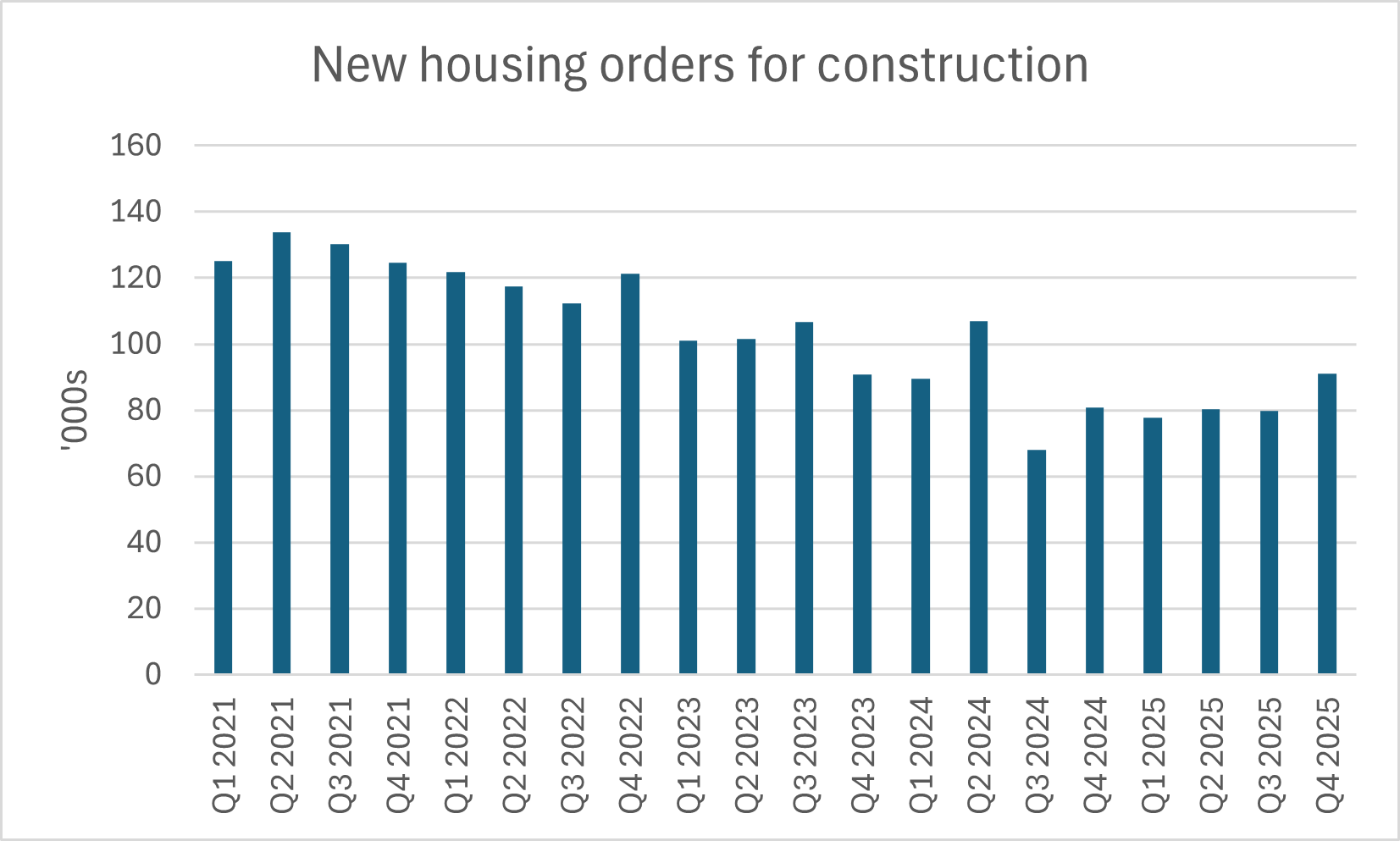
Data source: ONS
There are also signs the medium-term pipeline of planned housebuilding might be improving.
Planning applications for new homes in England reached a 10-year high during the final quarter of last year, according to planning services specialist TerraQuest:
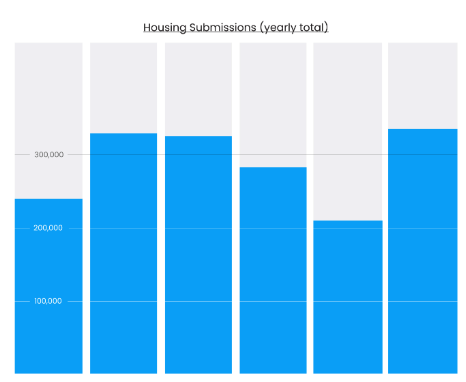
Source: TerraQuest (l-r 2020 - 2025)
TerraQuest’s data shows that planning permission was sought for 335,387 new housing units in 2025, more than 50% above the level of applications seen in 2024.
There is a caveat here, of course. Planning approvals in England have fallen in each of the last four years:
| Year ending | Units granted planning | Percentage change |
|---|---|---|
30 Sept 2021 | 325,000 | |
30 Sept 2022 | 290,000 | -11% |
30 Sept 2023 | 254,000 | -12% |
30 Sept 2024 | 245,000 | -4% |
30 Sept 2025 | 208,000 | -15% |
Source: Ministry of Housing, Communities & Local Government
Regardless of the cause of this decline – planning delays, policy uncertainty or housing market conditions – we don’t know if approvals will accelerate in 2026.
Commentary in January from industry body the Construction Products Association is also downbeat, highlighting a difficult balance between affordability and viability:
For house builders, there is an increasing trade-off between buyer affordability and development viability. In areas where demand has been sustained, properties are affordable, but site viability has been affected by a growing list of additional costs imposed by the government, especially for smaller house builders. In areas where site viability has been maintained due to higher house prices, demand and affordability remain the key constraints.
Of course, trade bodies like the CPA are not impartial observers. They are hoping (and probably lobbying) for a new government stimulus scheme to improve demand (my bold):
An increase in current house building volumes would require a sharp rise in demand during the key Spring selling season for the major house builders, and at this stage, this appears unlikely in the absence of demand-side stimulus. Private housing output is forecast to grow by only 1.5% in 2026, revised down from a forecast of 4.0% in Autumn.
Does this downbeat view mean that there are no opportunities in housebuilders? Not necessarily, in my view.
Ultimately these are property stocks. History tells us that good buying opportunities in property can often be found when securely-financed businesses are trading below the book value of their assets.
My research suggests a number of possible opportunities right now.
Housebuilders: where's the growth?
I think the first point to make is that most of the largest listed housebuilders are reporting an increase in completions for the current or most recent financial year. The most notable exceptions to this are those focused on London (Berkeley) or partnership/affordable housing.
This suggests to me that conditions for mid-market volume housebuilders are not too terrible, albeit profitability remains subdued due to margin compression.
| Company | Latest completions | Current year guidance |
|---|---|---|
Barratt Redrow (LON:BTRW) | H1 26 up 4.7% to 7,444 | FY26 guidance for 17,200 - 17,800 (+c.6% vs FY25) |
Persimmon (LON:PSN) | 2025 completions up 12% to 11,905 | FY26 completions of 12,043 homes |
Berkeley group (LON:BKG) | H1 26 deliveries down 4% to 2,022 | |
Taylor Wimpey (LON:TW.) | 2025 completions up 6% to 11,229 | Not yet provided, but has started the year with a lower opening order book and expects lower margins in 2026, with greater H2 weighting. |
Bellway (LON:BWY) | H1 26 completions up 3% to 4,702 | FY26 guidance of c.9,200 (+5% vs FY25) |
Vistry (LON:VTY) | 2025 completions down 9% to 15,658 | Expects year-on-year revenue and volume growth, but lower margins overall. Our view is that earnings are likely to be below previous expectations. |
Crest Nicholson Holdings (LON:CRST) | FY25 completions down 9.7% to 1,691, due to a fall in bulk and affordable home completions. Open market sales rose slightly. | FY26 guidance for 1,625 completions, slightly below FY25. |
MJ GLEESON (LON:GLE) | H1 26 homes sold up 6% to 848 | FY26 guidance not yet confirmed. |
Springfield Properties (LON:SPR) | H1 26 completions down 12% to 316. | FY26 broker forecasts suggest c.730, down 9% vs FY25. |
Book value bargains?
As I mentioned above, when it comes to property I think the balance sheet is king.
Even prior to the recent market wobble, a number of housebuilders were trading comfortably below their tangible net asset value. Some were even trading cheaply enough to qualify for our Benjamin Graham NCAV Bargain Screen – a deep value strategy.
This weeks’ falling share prices mean that these discounts have widened further in several cases.
Here’s a summary of the situation at the time of publication. I’ve ranked companies by the size of their discount to tangible book value – i.e. with the cheapest at the top:
| Company | Mkt Cap | Price/tangible book ratio | Latest net cash/(debt) | ValueRank |
|---|---|---|---|---|
Crest Nicholson | £353m | 0.5x | £(38.2)m | 72 |
MJ Gleeson | £195m | 0.65x | £(22.5)m | 67 |
Vistry | £1.5bn | 0.7x | £(144)m (FY25 daily average £733.7m) | 66 |
Barratt Redrow | £4.8bn | 0.8x | £174m | 65 |
Springfield Properties | £140m | 0.84x | £(39.6)m | 87 |
Bellway | £3.0bn | 0.84x | £(72)m | 61 |
Taylor Wimpey | £3.7bn | 0.89x | £343m | 71 |
Berkeley Group | £3.9bn | 1.09x | £342m | 46 |
Persimmon | £4.4bn | 1.33x | £116m | 64 |
In investing as in life, the cheapest choice isn’t always the best buy.
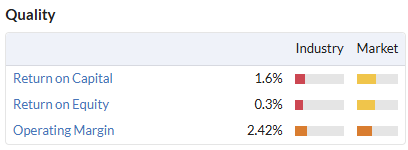
Crest Nicholson’s 50% discount to tangible book value is unusual by any standards and suggests investors have a degree of concern about the company’s ability to generate satisfactory returns from its assets.
The material ongoing net debt position is not ideal and the business generated a return on equity of less than 1% last year – not a sustainable result:
In our most recent DSMR review, Graham noted a going concern warning relating to interest cover on debt and flagged up multiple recent profit downgrades:
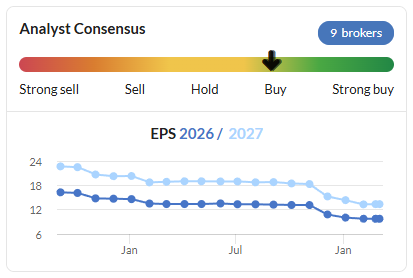
He took an AMBER/RED view on Crest to reflect our preference for financial discipline and balance sheet strength.
Large discounts to book value at MJ Gleeson and Vistry also reflect concerns about performance, in my view, albeit to a lesser extent. See here and here, respectively, for our most recent DSMR comments on these shares.
Why buy? The appeal of these heavily discounted stocks is that if volumes and house prices do improve, these shares could be in the best position to deliver rapid price gains. The flipside of this is the additional risk of problems when compared to more highly-rated peers.
For these reasons, I would probably opt to select a basket of the cheapest stocks if I wanted to invest in the most heavily discounted housebuilders. This would provide decent upside exposure, while also giving me some protection against company-specific problems.
Pay more for quality? If I was looking for a stock with fewer challenges and more sustainable profitability – perhaps also a reliable dividend – then I would be more tempted to go fishing in the middle of this list.
My pick would probably be Bellway, thanks to a combination of its attractive valuation and stable outlook for earnings.
The other two obvious candidates – Taylor Wimpey and Barratt Redrow – have both suffered declining earnings forecasts over the last year. And while Taylor Wimpey’s 8.5% dividend yield seems tempting, it’s not covered by earnings and is reliant on the group’s declining net cash balance for support:
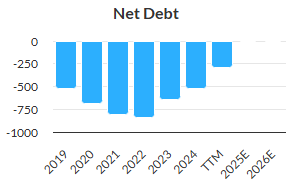
Scottish small cap Springfield Properties also looks potentially interesting to me and is well-regarded by the StockRanks. However, I would want to do a deeper dive into this business before taking a conviction view, given its small size and regional focus.
Quality & Momentum
In my table above, the only stocks trading at a premium to their tangible book value were London-focused brownfield specialist Berkeley Group and Persimmon.
There is a reason for this – they’re among the most profitable builders in the market at the moment. They’re the only two companies that have achieved double-digit operating margins over the last 12 months. They have also generated two of the three highest returns on equity over the last year.
As in banking, property firms that generate higher returns on equity earn higher price/book ratios.
The table below provides a summary of the profitability of each of our listed housebuilders over the last nine months:
| Company | Operating margin (TTM) | Return on equity (TTM) |
|---|---|---|
Berkeley Group | 20.4% | 10.3% |
Persimmon | 11.0% | 7.4% |
Bellway | 8.5% | 4.5% |
Springfield Properties | 8.3% | 8.6% |
Vistry | 6.0% | 4.0% |
Barratt Redrow | 6.0% | 3.2% |
MJ Gleeson | 6.0% | 4.8% |
Taylor Wimpey | 4.5% | 1.9% |
Crest Nicholson | 2.4% | 0.3% |
As a general rule, I would say that a return on equity of less than 8% will make it difficult for a company to generate sustainable value for shareholders.
It’s not a surprise to see that the most heavily discounted stocks are also among the least profitable. In my experience, stock market valuations often reflect these factors more accurately than we might like to think. When considering a potential bargain, it’s worth asking whether the market might be right to be cautious.
The profitability of housebuilders was distorted for a long time by the Help To Buy scheme. Now that this has dropped out of the numbers, we’re seeing the best housebuilders generate returns of around 10% on their equity value.
In a strong housing market I’d hope to see this ceiling rise (without government aid) to perhaps 15%. We’re not there at the moment, but I think this rough estimate helps to illustrate the re-rating that could be possible for some of the more unloved housebuilders.
Of course, the potential timescale for such a recovery remains deeply uncertain. That’s why it can be useful to consider momentum too, even with a focus on value and quality.
What do the StockRanks say?
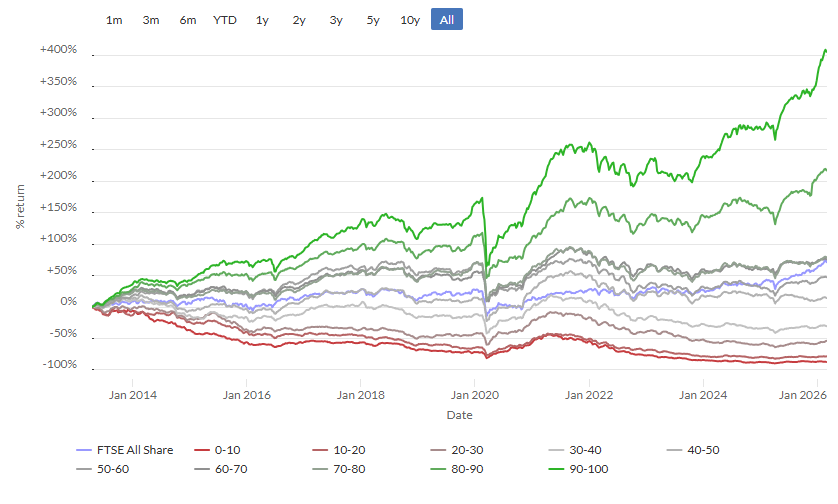
One of the most powerful features of the StockRanks is their ability to meld quality, value and momentum into a meaningful overall score. Baskets of higher-ranked stocks have consistently outperformed baskets of lower-ranked stocks over the last decade:
Here’s how my list of housebuilders is viewed by the StockRanks at the time of writing (note the Vistry StockRank is stale and almost certain to be revised when this week’s interim results have been digested by the algorithms.):
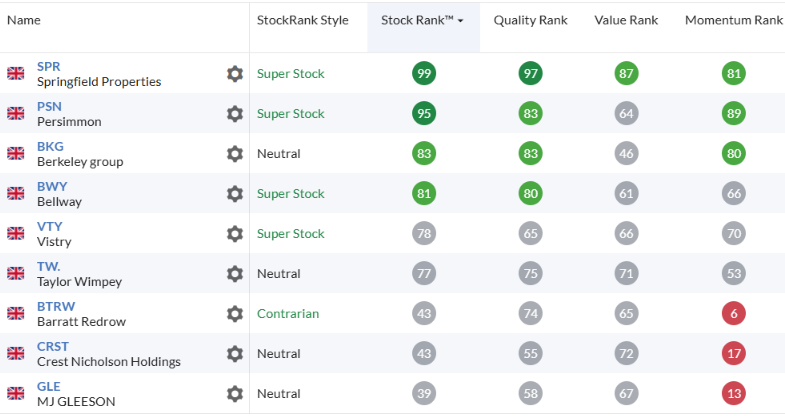
I think it’s worth noting that the two stocks trading at the largest discounts to book value – Crest Nicholson and MJ Gleeson are also among those with the lowest MomentumRank. This score reflects a combination of earnings estimates and recent price action.
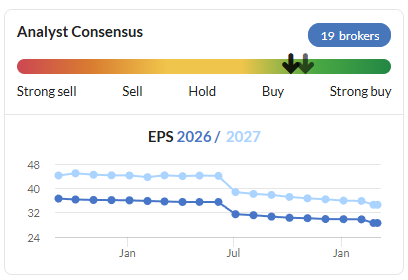
The other is Barratt Redrow, where profit estimates have fallen by 20% since last summer:
In our experience, a very low MomentumRank is often a sign that patience will be required, even if the apparent value is real.
What I’d do
The best approach to playing the housebuilding sector depends on an investor’s chosen style, risk tolerance and timeframe. It may also be that this area of the market simply isn’t all that attractive at the moment, relative to other opportunities.
For me personally, there are a few options I might consider if I was looking to invest in this sector (I’m not, currently, but I have done and may do again):
Value: a basket of the cheapest housebuilders, hoping that improved market conditions will drive a recovery in margins and resulting valuation re-rating;
Quality: Berkeley Group, Bellway and perhaps Persimmon and Springfield look interesting to me as longer-term holds with decent StockRanks.
Momentum: I’d focus on stocks with a MomentumRank of 80+, probably choosing two or three from among Springfield, Persimmon and Berkeley.
As always, these comments reflect my views and are not investment advice or stock tips. These choices won’t be suitable for everyone (or even anyone else). In all cases, I’d also want to do some additional research before committing to an investment.
Patience needed?
I’ll finish with this thought. On Wednesday 4 March, two of the UK’s most experienced housebuilder CEOs both announced their retirements.
David Thomas, CEO of Barratt Redrow is retiring after 11 years on the role and 17 years at the UK’s largest listed housebuilder.
Perhaps more surprisingly, Vistry’s executive chair and CEO Greg Fitzgerald announced his retirement after almost nine years in the role and 45 years in the housebuilding sector.
Fitzgerald started his career as an apprentice and is widely respected as one of the most capable managers in the UK housebuilding sector. I suspect that the news of his retirement may have contributed to Vistry’s shocking 25% share price slump on Wednesday.
Although Mark concluded that Vistry’s revised full-year guidance was probably a profit warning, it didn’t look serious enough to us to justify such a big cut to the group’s valuation.
Until this week, investors generally believed Fitzgerald was committed to completing the challenge of transforming Vistry into a capital-light, high-return partnership homes specialist. I think it’s fair to say Fitzgerald's reputation formed part of the investment case for many investors.
Of course, it’s worth pointing out that personal factors may be involved in both men' s decisions. They both also have 12-month notice periods and won’t be rushing out of the door just yet. But I can’t help wondering if either of them would have chosen to retire now if they believed the UK was on the cusp of a new housing bull market.
I wonder if a more likely explanation might be that a certain amount of patience will be needed to reap the rewards that could be on offer in the UK housebuilding sector.
Disclosure: Roland does not have positions in any of the shares mentioned.
Disclaimer
This is not financial advice. Our content is intended to be used and must be used for information and education purposes only. Please read our disclaimer and terms and conditions to understand our obligations.

14 comments
I agree that a good deal of patience is required in the house building sector. The war against Iran has meant that the UK's 10 year gilts have increased and the effect of increased oil prices on the inflation rate has yet to be determined.
There are so many adult children still living with their parents into their late thirties that house building appears to be particularly ripe for expansion.
However the Labour Government only appears to have addressed the issue in respect of planning applications and seems to have done little in other respects e.g. lowering mortgage rates, improving the supply chain, addressing labour shortages and using help to buy. Another aspect of failed policy is the massive increase in the minimum wage which has helped to increase the number of neets in the UK which I understand is the highest in the G7.
In their first year in power the Government has built 186,600 homes which is over 110K short of their own target of 300K, clearly some improvement is needed.
In cyclical areas such as this one I think timing and patience is essential, and further monitoring of the economy and housing market is required at this juncture.
I think potentially the increase in applications is down to the government relaxing rules for building on greenbelt land. Housebuilders are likely taking a view that they get the applications in now before a future government reverts on this policy.
There are 4 or 5 applications going in around where I live, all on green belt land despite there being plenty of available brownfield land, in some of the cases the builders have had an option on the Green belt land for a number of years waiting for policy to change so this may be their only chance to give it a try .
Before the recent events in the Middle East, I was thinking that lower interest rates might get the property sector moving again. But it looks more like another energy/inflation shock is on the cards now. See today's comments from Qatar's energy minister.
I hold Taylor Wimpey and Persimmon - both in the green but recognise that TW is a bit shaky on maintaining the dividend. I do think the time to own housebuilders is now whilst they are unloved. There is I understand a consultation happening around a stimulus package for young buyers. Not a return to Help to Buy or as generous and this government knows it has to do something more on cost of living to survive and property is the big one.
Sadly and mostly down I own nearly all of them and many brick makers, I gradually added some 2-3yrs ago anticipating that interest rates would fall, then building gets going and then house prices rise. Alas a combination of Gov policy putting labour costs up and crazy energy policy pushing brick prices up has resulted in a bogged down sector. Just read the builders RNS's going back a year or two, except Cairn Irish their very positive. Patience is a virtue who ever thought SAGA and JUP would come back from the dead. Its a buy at bargain prices the moment
Following the logic expressed in the article (unless I have misunderstood it suggests brick manufacturers front run the housebuilders), wouldn't you buy the brick manufacturers first? Then when their share prices have started to move, look at the house builders.
This is a sector with potential for delivering significant growth to the UK and I was enthusiastic at the start of 2025. However, the lack of progress versus the governments alleged commitment, has impacted my confidence that there will be a swing. It isn't hard to get this sector going, it has been done in the past, the lack of action given the commitment is extremely weak. I think the same is true for infrastructure (rail, roads, electric network and water) and defence. Grouping these three together has caused me to loose confidence and they aren't been held accountable.
Confused why they are not making huge profits, The Crest Nicholson ROE is pathetic. New houses are expensive and the quality is low. Is the high cost of building down to the difficulty in getting skilled workers due to the collapse in the apprenticeship system?
Maybe others with knowledge of the industry can answer this?
The odds are stacked against house builders for many reasons. I’ve worked on sites and also on rail for the last 15 years now. There are young people entering the industry but not enough. Most would rather go to uni as this was always seen to be the wisest decision financially ( I do think the tables are turning on this one and we will see an influx of young people slowly turning to trades again. It’s cyclical and ive seen it first hand in some professions, when the money flows back into them so do the workers) Apprenticeships aren’t paid well enough so most would rather start as labourers and operatives taking home an extra £100 per day.
Materials keep rising yoy more than house prices are. This alongside the fact everything so expensive young people are struggling to get on the housing ladder.
Stamp duty increased last year, so for a 450k house it’s roughly around 13k.
Without been too political this government has rinsed the working people and savaged them with more and more taxes.
If they ease planning constraints and offer Incentives especially for first time buyers the industry could be easily kickstarted.
I do hold Barratt Redrow (LON:BTRW) and do believe there’s a decent upside potential within the next year or 2
Barratt Redrow (LON:BTRW) has dropped through the 1,5 and 10 year lows, is currently at the 13 year low price, with no sign of levelling out (heading for another 1.5% drop so far today). It has won my 'fastest loss on purchase' prize as I nibbled at 360 on 27/2, and again at 330 this week, incredibly bad timing. I'm not sure where the floor is, but while it is a great bargain it is likely to be even more so in the future so holding off on adding more for now. I fear it will be a while until we see a recovery.
Excellent analysis of an interesting sector. The housebuilders are most cyclical. After the financial crisis the Barratt was under £1 , a few years later it was over £7.
I do hold many housebuilders listed above and I am underwater on many. I think they may fall further but we are not far from the bottom. Maybe we are at the bottom now and looking at 2-3 years ahead they are more likely to be up than down. I topped up my Vistry holding today after the 4th profit warning. Persimmon and Bellway are my choice. I put Berkeley in the luxury category and that sector currently is out of favour!
Is Cairn Homes a better option?
Excellent article, thanks. As someone who used to work as a Land Director for two housebuilders and in the property industry for 32 years, its a sector I'm always interested in, sometimes too biased for my own good. At the moment, there isn't any reason to buy housebuilders given the headwinds, although due to my bias, I did have a small punt on Vistry this morning! Certainly a sector to watch and £ to be made in due course like in the GFC in 2009/2011
I think the issue is often that if you wait till the green shoots of recovery are obvious you often find with shares the clever money has already entered and the price is well up from lows - on the flip side finding the bottom aint easy - i hoped vistry and already kitchen sinked stuff last year after their acounting issues - but clearly despite the green shoots - margins are a worry so they clearlyn have to run to stand still.
what is clear that the government need to get houses built - it reflects bad on them if they dont deliver promises - and that demands that more planning should be granted - hopefully once planning is granted the rest takes care of itself.
overall i would agree that finding portfolio of builders right now - at or around book value or less seems like the time might be right. As to which ones to buy thats tricky so perhaps selction of a few with slightly different profiles makes sense.
If one wants to be negative perhaps - its clearly becoming more expensive to build homes - and if house prices arent rising - well is it harder to make good margins if house pricies are just bumbling along - hoepfully peak toughness is right now though - ie buiolding efficiency gains and getting cost inflation under control - that seems a struggle for some and in particualr for vistry.