Brick deliveries are rising - is it time to buy into these unloved stocks?

You might not guess this from market sentiment or recent press commentary. But new housebuilding starts have risen by more than 50% from the lows seen in late 2023:

Source: Building Cost Information Service
Government data on brick deliveries also shows a very similar pattern, with monthly brick deliveries around 25% above the low point seen in late 2023:

Source: Department for Business & Trade statistics Aug 25
It’s clear that deliveries are still a long way below the levels seen when the Help to Buy boom was in full swing. But even so, the trend seems positive.
Recent guidance Industry forecasts suggest this recovery could continue into 2026.
A selection of listed housebuilders expect to see their new home completions rise by 5%-6% in the FY26 financial year (although beware, most others have not yet provided guidance):
Persimmon (LON:PSN): expect completions to rise by 6.7% to “c.12,000”
Bellway (LON:BWY): recent guidance for volumes to rise by 5.2% to “around 9,200 homes”
Barratt Redrow (LON:BTRW): expects FY26 home completions in a range of 17,200 to 17,800 – taking the mid-point gives an increase of 5.6%
These firms accounted for around 40% of UK homes built in 2024, so should be a reasonable guide to expectations for brick demand – albeit I think they’re among the best-performing listed companies in this sector at the moment.
More broadly, recent industry forecasts from the Construction Products Association suggest total construction output could rise by 3.7% in 2026, with a 7% increase in private housebuilding.
Why brick producers - and why not housebuilders?
Brick producers carry high fixed costs but can benefit from strong operating leverage – reflected in peak profits – when demand rises and they can run their factories close to capacity.
If volumes do continue to recover as we head into 2026, then I think these businesses could be well positioned to benefit. In the remainder of this article I’ll take a closer look at the three companies I’ve mentioned above.
Before that, I just want to offer some brief comments on housebuilders – after all, in the scenario I’m suggesting, they could also be poised to do well.
Why not housebuilders?
Housebuilders can be good cyclical recovery buys and this is a trade I’ve made myself in the past.
If I can buy a large portfolio of land and property for less than its book value, without any risk of financial distress, then I tend to think a decent result should be possible.
A number of UK builders now fit this description and might be worth a closer look, in my view.
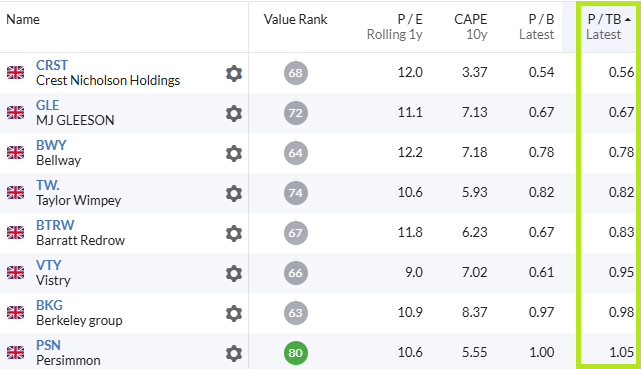
What’s discouraging me from investing in housebuilders at the moment is their political exposure and reduced profitability, now that market conditions have returned to something like normality ((positive interest rates and the removal of Help to Buy).
I’m also a little concerned by the ongoing cash outflows relating to building safety remediation at many of these companies – and by the internal issues some are facing. For some examples, see our recent DSMR commentary on Taylor Wimpey and MJ Gleeson
Just one of the eight firms on my list below has managed to generate a return on equity over 10% over the last 12 months:
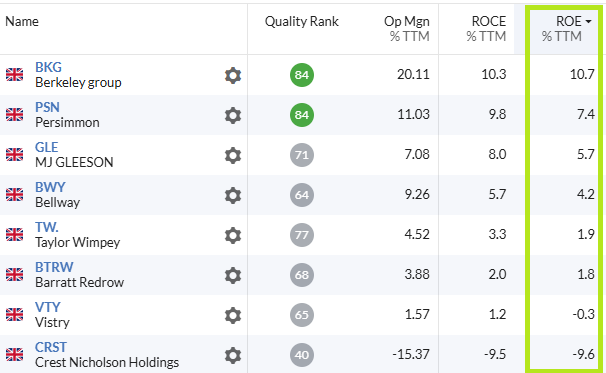
A recovery in volumes won’t necessarily fix this problem. Unlike a brick producer, a housebuilder is unlikely to benefit from the same level of operating leverage as volumes rise. To produce more homes, they need more building materials, more land, more infrastructure and more skilled labour.
Persistent twin pressures from cost inflation and affordability mean it’s harder to guess when pricing power – and margins – might improve.
Finally, I reckon one further factor in favour of brick producers right now is that they should be a leading indicator of a potential recovery in housing completions. Bricks deliveries must be booked fairly early in the construction cycle, well before a house is likely to be sold.
I may return to housebuilders in a future piece; many have seen big share price falls this year.
Brick producers: well invested and poised to perform?
Based on the cautiously optimistic outlook I’ve described above, I’d be hoping for a chorus of upbeat commentary from brick producers. But the mood music has been more mixed in recent months.
Of the three big producers listed on the London market, Forterra (LON:FORT) recently upgraded its guidance, but Michelmersh Brick Holdings (LON:MBH) and Ibstock (LON:IBST) both issued profit warnings during the summer (here and here, respectively).
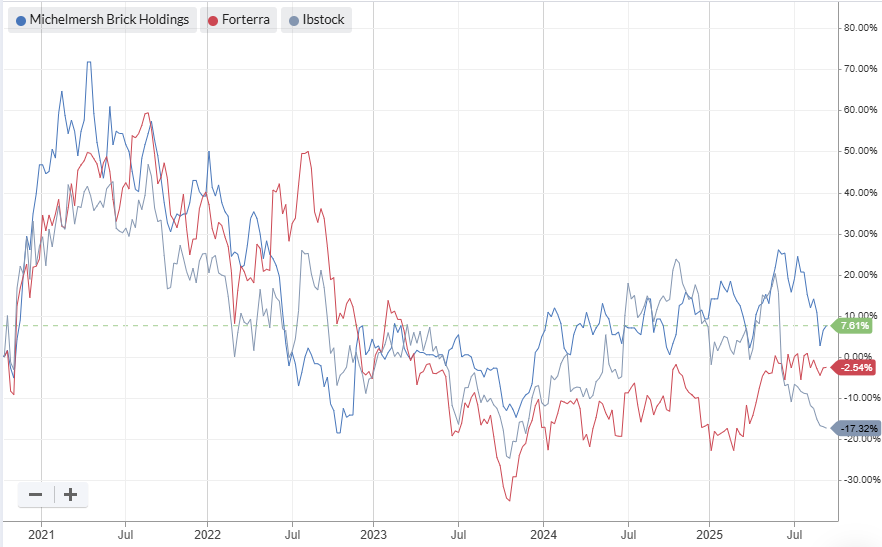
The share price of these three companies have all risen from their 2023 lows, but they remain well below 2021 highs:
Forterra (LON:FORT)
If there’s an obvious opportunity in this sector right now, I think it’s Forterra. The StockRanks have a broadly favourable view, styling one of the UK’s top two producers as a High Flyer:
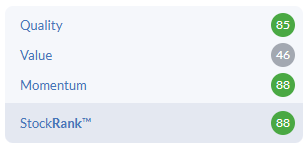
Does this positive view stack up, despite some obvious weakness on value?
Quality
Forterra’s quality metrics are relatively good for the construction material sector but look more average when compared to the wider market:
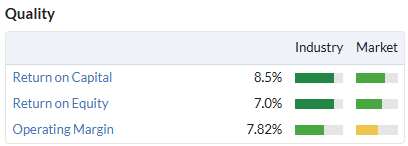
However, focusing on current metrics might be missing the point. I mentioned operating leverage earlier – ramping up the company’s factories to full capacity could yield an impressive increase in profitability.
For some historical context on this, operating margins peaked at over 16% during the pandemic period:
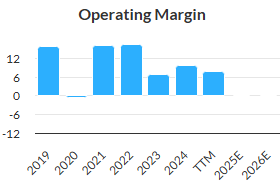
If Forterra could return to a 12%+ operating margin with 5%-10% annual sales growth, I estimate that profits could rise by 50%+ from current levels within a couple of years.
Value
The StockRanks are flagging poor value metrics here, with a ValueRank of just 46. At first glance, it’s easy to see why this might be.
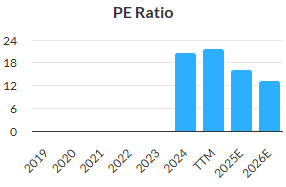
Forterra is trading on c.20 times trailing earnings…
… and at 1.8 times book value:
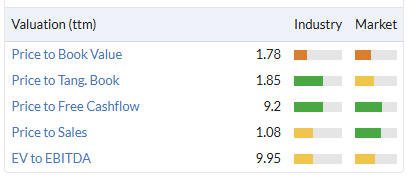
However, the trailing Price to Free Cash flow ratio of 9.2x hints that greater value might be on offer. Checking the half-year results, this reflects falling capex, good working capital management and a cash inflows from a reduction in inventories “as a result of demand driven destocking”.
Forterra has taken advantage of the industry downturn to invest in its facilities:
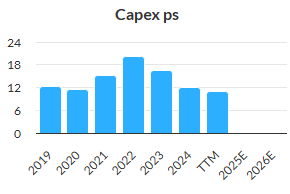
But capital expenditure has now peaked and net debt remains at sensible levels:
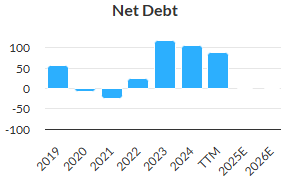
If demand continues to improve, cash generation may also remain favourable.
The value appeal of this stock hinges on what happens next – how strong is momentum?
Momentum
A MomentumRank of 88 is Forterra’s highest factor score and suggests a positive picture to me.
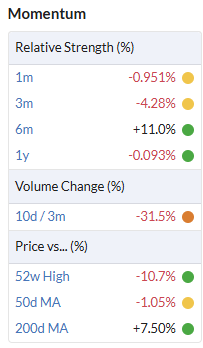
Momentum is scored based on a blend of price strength and earnings estimates. Forterra’s Price Momentum metrics do seem to have eased in recent weeks and are not wholly favourable:
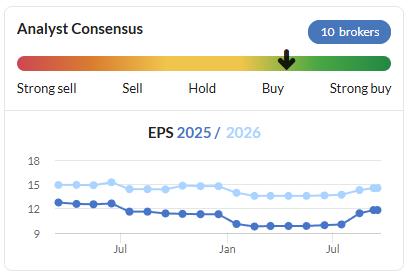
However, July’s half-year results prompted a decisive 20% upgrade to FY26 consensus estimates, meaning the stock scores more strongly in this area:
I would hazard a guess that poor sentiment towards the housing sector has probably hit Forterra’s share price in recent weeks.
Another consideration is that the shares aren’t necessarily all that cheap. Double-digit earnings growth is needed for the stock to meet forecasts in 2025 and 2026. Even if it does, a rolling forecast P/E of 14 is not exactly in bargain territory.
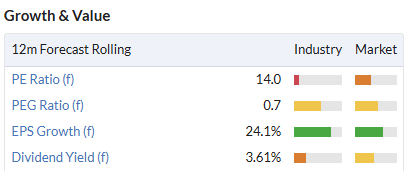
Recent trading: focusing too closely on valuation may miss the point here. Forterra is in good shape with a comfortable balance sheet and well-invested facilities.
Forterra flagged rising brick industry volumes in May and followed this up in June with an upgrade to full-year expectations. The half-year results showed 20% revenue growth against a 14% increase in UK brick industry volumes. Management confirmed Forterra had outperformed the sector thanks to its weighting to housing.
My view: investing in more expensive stocks with good momentum can sometimes be more profitable than trying to time a turnaround that’s starting from a weakened position.
I think Forterra is worth considering and look forward with interest to the company’s next trading update.
Ibstock (LON:IBST)
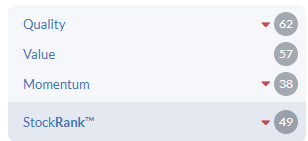
Ibstock ought to be benefiting from the same trends that are aiding its peer Forterra. Unfortunately it’s not quite that simple. A StockRank Style of Falling Star and low StockRank hint at some possible issues:
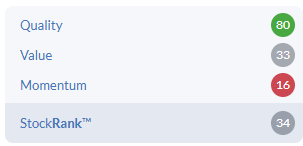
Recent trading: In June, the company echoed Forterra’s comments on market conditions, reporting activity levels “well above the prior year period” thanks to increased demand for residential construction.
However, this improvement in conditions wasn’t enough to allow Ibstock to avoid issuing a profit warning. CEO Joe Hudson provided two main reasons for the expected shortfall:
Increased fixed costs from ramping up production in Ibstock’s factories
Tough competition on prices and a lower value sales mix
Let’s review the factor scores to see if there are any reasons to consider Ibstock right now.
Quality
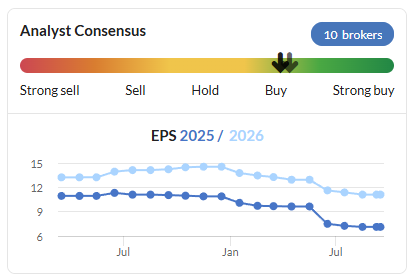
Consensus forecasts for 2025 were cut by 22% following June’s warning, when Graham flagged up the additional risk posed by relatively high levels of debt.
The subsequent half-year results confirmed leverage at 2.2x EBITDA (net debt: £145m) which is also above my comfort level for a company with sub-par profitability:
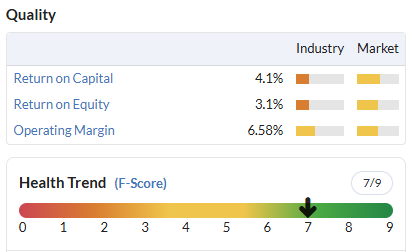
While Ibstock’s F-Score is reassuring, the only reason I might consider Ibstock in favour of Forterra would be if its shares were much cheaper.
Value
Sadly, that doesn’t seem to be the case. The story on valuation is broadly similar to Forterra.
Ibstock’s trailing P/E ratio is in the 20s, while the forecast P/E ratio is in the mid-teens, built on strong EPS growth expectations:
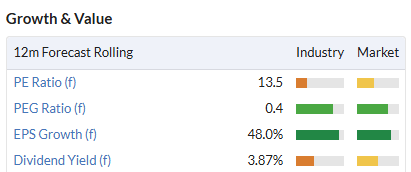
While Ibstock trades at a lower multiple of book value than Forterra, I think this is a fair reflection of its inferior balance sheet and profitability.
Momentum
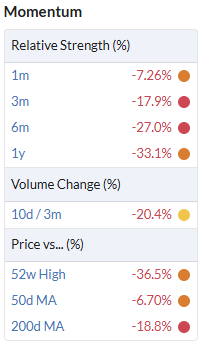
All of that leaves only one conceivable reason to consider Ibstock – powerful, trending momentum. Unfortunately, there’s no sign of this.
All of the stock’s Price Momentum metrics are negative, which I think must be one of the worst readings I’ve seen for a FTSE 250 stock in some time:
As I’ve already mentioned, earnings forecasts have been cut too, for 2025 and 2026:
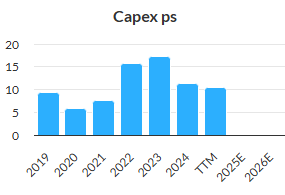
My view: Ibstock appears to have attempted the same strategy as Forterra, having ramped up capex during the sector slump in the hope of emerging stronger:
But unlike its close peer, it seems to have failed to execute on this strategy so successfully and is emerging from the sector downturn on the back foot.
Graham took the unusual step of adopting a RED view on this profitable FTSE 250 business following June’s profit warning.
While I think it might be fair to increase this to AMBER/RED following August’s interim results, I share his view that higher leverage adds an unappealing risk to the equity.
In addition to this, our research has found that a longer period of underperformance often follows an initial profit warning.
Unless Ibstock gets much cheaper, I’d rather buy another brick producer.
Michelmersh Brick Holdings (LON:MBH)
Until recently, I would probably have confidently picked small-cap premium brick specialist Michelmersh as my top choice from this sector.
Unfortunately recent news has tempered my enthusiasm for this stock somewhat. You can read my full review of September’s half-year results here, but in short the company issued a profit warning due to:
A two-week overrun on a maintenance shutdown at one of its main factories
“Highly competitive” pricing and tough market conditions, including in Belgium (where Michelmersh owns the Florens business)
The second half is expected to bring stronger results, but 2025 results are now expected to be “broadly in line” – i.e. slightly below – 2024 results.
Following this recent downgrade, the algorithms have adopted a Neutral view on Michelmersh:
Quality
Stepping through the ranks once more, we can see that Michelmersh’s quality metrics still compare reasonably well to industry peers, but the H1 decline in profitability has contributed to a decline in the stock’s Piotroski F-Score (a useful measure of fundamental health):
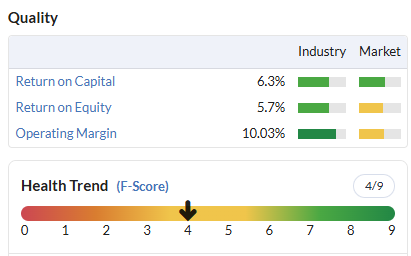
From 2015 until 2024, Michelmersh’s operating margin ranged between 14% and 20%. So the current level of profitability may be a cyclical low, with the potential for operating leverage to drive a strong recovery.
The balance sheet remains relatively strong too, with net debt of just £1m at the end of the half year.
Value
Michelmersh scores more highly for value than either Forterra or Ibstock.
It’s not too hard to see why. The shares trade in line with book value and on a relatively modest mid-teens trailing P/E:
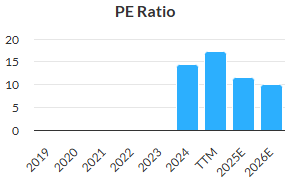
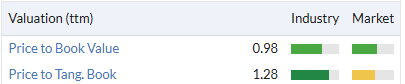
A trailing EBIT/EV yield of 7.6% could also be decent value, if we assume profits are close to cyclical lows. (The equivalent figures for Ibstock and Forterra are 3.5% and 6.0% respectively.)
Are there any signs momentum might be recovering?
Momentum
Unfortunately there’s not much good news. Price momentum metrics are dire, with one exception – Michelmersh has clearly attracted a lot of buying since its profit warning:
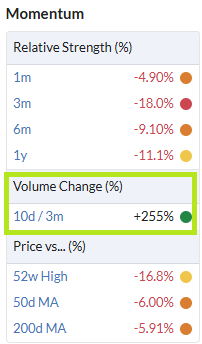
We can see this on the price chart too:
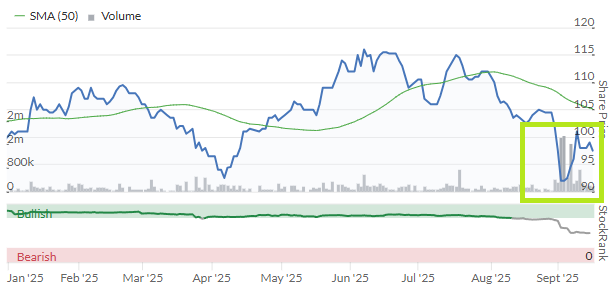
However, the picture on earnings forecasts is very poor, with seemingly multiple downgrades since August:
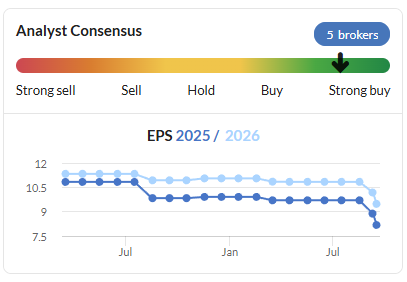
If I was searching for a positive here, I might argue that there have already been three distinct times when earnings estimates have been downgraded over the last 18 months. Based on the adage that profit warnings come in threes, perhaps we’re close to the bottom!
My view: I still have a fairly high regard for Michelmersh, whose portfolio of premium brick brands provides genuine differentiation and – theoretically – a little more pricing power.
Like Forterra and Ibstock, earnings growth forecasts for 2026 are bullish, with analysts pencilling in a 17% rise from 2025 earnings.
Michelmersh’s valuation also looks relatively reasonable to me:
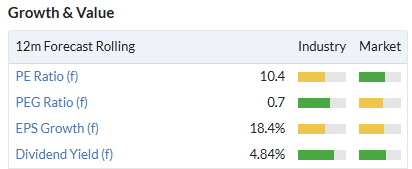
I can see some logic in buying at current levels. But on balance, I think it might be more prudent to wait for November’s trading update to see if there’s any further change to expectations.
One additional concern I have here relates to the recent change of management. The company is now being led by accountants rather than by lifelong industry experts, as was the case previously.
For this reason too, I might be inclined to wait a little longer before opening a position.
Disclaimer
This is not financial advice. Our content is intended to be used and must be used for information and education purposes only. Please read our disclaimer and terms and conditions to understand our obligations.

17 comments
Thank you for the article.Some of the mentioned shares may be overvalued ,others maybe undervalued.Its a tough economic climate.What I have noticed in my experience the housing market has a series of boom and bust episodes often linked to manipulation of interest rates.However now the interest rate is carefully controlled to avoid this scenario. I also looked at the housing market thinking that it will be oversubscribed because of inflation and everybody would like to hedge against it.Its correcting it self.Maybe wait a little bit as you mentioned in your article.
I've never owned a brick manufacturer but agree the sector could be attractive.
One thing I'm nervous about is some companies seem to have built up quite a bit of inventory plus I'm also wondered how imports play into this. Does anyone know whether imports are a big factor in competition and whether import competition is getting stronger or weaker over time?
Interesting macro theme - good article! I like it when the industry comes before the stock, it makes for more interesting comparisons...
Roland
Brickability is better positioned for a recovery in brick demand given it can sell a wider range of bricks including imported bricks, heating equipment, solar panels, towel rails etc., timber, cladding and contracting services for fire remediation. It is capital light and has better Returns on Capital than the brick manufacturers.
Why leave it out?
Brickability (LON:BRCK)
i think its left out for obvious reasons that a decent % of income is not from bricks - so the lfl comparison is less important and not as easy to calculate and cross reference.
as an aside brick sales were up 8% last year i think - but the associated stuff lumped into the same heading hasnt been doing as well.
note i dont think they take the trouble to split bricks from other building materials sales - so they dont help if its just into the pot ref numbers with only a slight passing reference ref brick volumes.
In summary i cant work out the revenue of profits generated from the bricks side of the business. that to me makes comaprisons hard if i dont know what teh totals are
Hi Yusuf Samad,
I think Brickability (LON:BRCK) could also be interested, but space constraints mean I chose to limit my selection to pure-play brick producers.
Brickability is primarily a distributor, not a producer and does not make all of its money from bricks as it sells a wider variety of construction materials as well.
I do rate Brickability CEO Frank Hanna (formerly of Michelmersh) quite highly though, so this is definitely a company I'd research in more detail if considering an investment in this sector.
Roland
great article and comments
one question here - where should we see the trend in brick comsumption going over the next 5-10 years ?
i noted that vistry recently said the following in their update
The Group has successfully completed the factory trial of the Mauer brick cladding system. This alternative cladding system which has c. 50% less embodied carbon than bricks, will support and complement our timber frame construction
In the first half, Vistry Works manufactured 1,650 timber frame units, up c. 20% on the prior year and expects to deliver c. 4,500 units in FY 25 (FY24: 2,900).
Would the above suggest that vistry will use less bricks going forward ? and if so is that likely to be replicated by others?
There's an analyst question on the impact of timber frame construction on Forterra (LON:FORT) (I hold) in the webinar from their FY25 interim's available on their website. The CEO downplayed the impact. They also covered imports. May be worth you watching that. The available capacity and potential operational gearing were the key take away's for me.
Hi Roland. Thank you for a well considered piece. Use of the Stockopedia share comparison tool shows Forterra (LON:FORT) to be the winner. Personally I would never invest in anything that has an EPS forecast chart as dreadful as that of Michelmersh Brick Holdings (LON:MBH) !
But Brickability (LON:BRCK) is the winner, between it and Forterra (LON:FORT).
Hi Rusty2. Yes, if Brickability (LON:BRCK) is included, it is the winner on the comparison tool. I was only comparing the three shares that Roland was considering. I excluded Brickability (LON:BRCK) because it describes itself as "a construction materials distributor" rather than a brick manufacturer. Brickability (LON:BRCK) might well be a good investment, but feel that it should not be included in the comparison because it's business model is different.
Excellent thought-provoking article (although I remain unconvinced!)
Going back 18 months or so I bought into rates must fall soon, stubborn or what and yet again wages and food inflation are spoiling the party. I actually have every single share mentioned save Ibstock so i'm well positioned if down a tad on a few. Lets hope 2026 sees a reduction in inflation, rates etc. Salaries are much higher now than pre covid and being a BTL owner all the banks seem to worry about is what you earn today so folk are well positioned. Historically out of these lows comes a bounce but we need sentiment to change. No11 have their part to play having crushed what little positivity there was in the last budget and doing their best to dampen the mood aided by the press.
Then its time to sell up and give the cash to the kids before No11 take it all way in inheritance
I remain hopeful
A good summary and lining up the three companies using the comparison tool scores them as you have above - Forterra (LON:FORT) 17, Michelmersh Brick Holdings (LON:MBH) 15 and Ibstock (LON:IBST) much lower in single digits.
As a long term holder of MBH I read this with great interest Roland, thank you. The PW was very disappointing and I was going to sell and buy back into Luceco and Eurocell again as they're tempting at their current levels, however I noticed the increased volumes in MBH moving the shares steadily upwards so my dilemma is ongoing!
Brickability (LON:BRCK)
Hi Roland, not a brick manufacturer, bu an importer of bricks, which from memory contribute about 50% of its revenue. A low capex operation. It also supplies a broad spread of other building products. Given yesterday's in line up date, do you have a view?
Interesting timing! Interesting data