Daily Stock Market Report (Mon 15th June 2026) - BKS, LUCE, TMG, PEEL, AEP, IQE, TIG

Good morning. Markets are expected to rise today, as it seems the TACO trade (Trump Always Chickens Out) is back on again.
The US President announced a deal with Iran on Sunday that will extend the current ceasefire by 60 days and see Iran reopen the Strait of Hormuz for toll-free commercial traffic. In return, Iran will receive some sanction relief and undertake not to develop nuclear weapons.
The thornier topic of the Islamic Republic’s 9,000kg stockpile of enriched uranium has been kicked down the road for future talks, according to press reports.
Iran’s regime has also survived this conflict intact and we might argue that Trump’s original pledge to deliver an “unconditional surrender” appears to have been watered down somewhat. Even so, this looks like good news for markets and for the wider global economy. Assuming traffic gradually starts to flow from the Strait, we should hopefully see commodity bottlenecks and inflationary pressures ease over the coming months.
Of course, to date the ceasefire has seen numerous military acts by both Iran and the US, so the current deal may not bring complete peace. There could be a period of uncertainty before commercial activity in the Strait and the wider region returns to normal.
It may also be worth noting that while the deal is said to support a broader peace across the region, Israel is not signing.
Finally, it would be remiss of me not to mention that SpaceX closed up by nearly 20% on Friday, at $160.95!
Overnight market movements:
The FTSE is set to open up 0.7% at 10,542
S&P 500 is set to open up 1.3% at 7,524
Brent crude is down 4.4% at $83.50/bbl
Gold is up 1.7% at $4,288/oz
Bitcoin is up up 2.1% at $65,698
Spreadsheet accompanying this report: link.
Today's report is now complete. Thanks for reading and commenting, we'll be back in the morning.
Companies Reporting
AstraZeneca (LON:AZN) (£209bn | SR79) | Truqap will be the first targeted treatment for PTEN-deficient metastatic hormone-sensitive prostate cancer, based on trial results which prospectively defined PTEN-deficient disease and showed Truqap combination reduced risk of radiographic disease progression or death by 19%. | ||
Frasers (LON:FRAS) (£3.55bn | SR88) | Frasers owns 22.9% of Australian retailer Accent (ASX:AX1) and has made an offer of A$0.65 per share (nil premium to Friday’s close) for the remainder. This would be equivalent to a consideration of A$316m (c.£166m). | ||
Big Yellow (LON:BYG) (£1.7bn | SR38) | Sale of industrial estate in Harrow, London for £38.4m. Proceeds will be used to build out 11 new stores and one replacement. The new stores are expected to generate £35m net operating income, representing a return of 16.5% on the £212m cost to complete. | ||
AEP Plantations (LON:AEP) (£631m | SR97) | Own FFB production -2.7% YTD, with CPO production -1.8% and PK production unchanged. Positive contribution from recent acquisition. Outlook: “... we remain confident of achieving market expectations” | AMBER ↓ (Mark) The similarities with MP Evans (reviewed last week) are striking. Both companies have delivered strong shareholder returns recently due to a recovery in production volumes and better commodity pricing. However, brokers are now forecasting EPS to fall due to forecasts for Palm Oil prices to peak. I have no idea if that is realistic or not. My reduced view is not a judgement against the company operationally, just that my neutral view reflects that the major multiple re-rating has already occurred and any future returns will be entirely dependent on where we are in the commodity cycle. As a commodity-price agnostic investor, I think we simply have to take a neutral view, despite the algorithms still liking the historical numbers. | |
Iqe (LON:IQE) (£607m | SR33) | Multiyear agreement with Tower Semiconductor (NSQ:TSEM) to supply InP epiwafers for “optical connectivity solutions serving AI-driven data centre infrastructure”. Under a separate agreement, Tower will also provide a broad and royalty-free licence to IQE for porous silicon patents, settling an ongoing IP dispute between the companies. | RED = (Roland) Today’s supply agreement sounds promising but includes no financial details. Given the group’s long history of operating losses and recent declines in revenue, my feeling is that the current valuation (5x FY27E revenue) is more than adequate to cover any potential upside from increased sales for AI data centre applications. I’m maintaining our negative view to reflect the lack of any updated trading guidance and the stock’s Momentum Trap styling, which I think is probably justified. | |
Luceco (LON:LUCE) (£466m | SR93) | CEO John Hornby is retiring after 21 years leading the business. He will take a sabbatical until late August 2026 and remain CEO until 31 December. The search for a replacement is underway. Trading for the year to date remains consistent with commentary on 19 May. | AMBER ↓ (Mark) | |
VAALCO Energy (LON:EGY) (£425m | SR50) | Successfully completed and placed on production the Ebouri-5H development well in offshore Gabon. Achieved excellent initial flow rate of 8,000 gross bopd (4,700 net to Vaalco). Completed HE-9 well in Egypt, initial flow rate of 529 gross bopd. | ||
Metals Exploration (LON:MTL) (£379m | SR67) | This is a 440-hectare licence area in Barangay Balatoc, Northern Luzon, Philippines. Management believes this area is highly prospective, with previous exploration drilling showing “at least two porphyries”. | ||
Henry Boot (LON:BOOT) (£226m | SR43) | Arcadis has taken the whole 1st floor (10,300sq ft) of the Island office project in Manchester, at £48/sq ft. Including space under offer, Island is now 66% leased, with only three floors still available. | ||
Seeing Machines (LON:SEE) (£204m | SR22) | Has secured contract awards to supply its Driver and Occupant Monitoring System to two separate Japanese car manufacturers. In total, these programs are expected to generate an estimated lifetime value of c.$11m. | ||
Invinity Energy Systems (LON:IES) (£176m | SR23) | Sale of a 32 MWh battery system to Pacific Steel Group, a leading reinforcing steel fabricator in the United States, for installation at their Mojave Micro Mill project in Kern County, California. Delivery of the batteries is expected to commence in Q1 2027, with associated revenues recognised at that point. No figures given. | ||
Phoenix Spree Deutschland (LON:PSDL) (£157m | SR32) | €23.1m of condominium sales were notarised in the five months to 31 May 2026. Activity continued throughout the period and is tracking in line with the Company's full-year 2026 target of €55m. | ||
Beeks Financial Cloud (LON:BKS) (£137m | SR20) | Has secured a five-year software contract with an existing analytics customer for the deployment of Beeks Analytics and Market Edge Intelligence, with a total contract value of $3.0m. | AMBER = (Roland) Beeks’ share price has now retraced the losses seen in March, when the company’s half-year results left us speculating on the likelihood of an H2 profit warning. That risk now seems to have receded, although there’s no explicit mention of meeting FY26 expectations in today’s update. With the stock now trading on a P/E of >20 and no change to forecasts today, I’d like to see evidence of improving profitability before considering a more positive view. | |
Peel Hunt (LON:PEEL) (£119m | SR69) | Revenue +57% to £143.5m, PBT £21.1m (FY25: £2.5m LBT), Adj. PBT £32.0m (FY25:£0.8m). Capital base remains comfortably in excess of minimum regulatory requirements. “While markets remain supportive of high quality transactions, renewed global inflationary pressures, the volatile outlook for benchmark interest rates and increased domestic political uncertainty have all weighed on UK market confidence and therefore transactional activity since the start of our financial year." | AMBER/GREEN ↓ (Roland) Peel Hunt’s FY26 results look very strong and support Graham’s previous positive view on the company’s performance last year. However, the outlook for the year ahead remains uncertain. While we don’t have access to updated forecasts today, FY27 broker estimates prior to today suggested a big drop in earnings is possible this year. While market conditions may improve, visibility seems poor and I am not sure Peel Hunt can decouple itself from wider market conditions. On balance, I think a slightly more cautious view may be appropriate at this stage, so I’ve moved our view down by one notch today. | |
Brave Bison (LON:BBSN) (£102m | SR40) | Professor Mark Ritson, has exercised his full option for a total consideration of £2 million at 49 pence per Share. Now owns 7% of the company. | ||
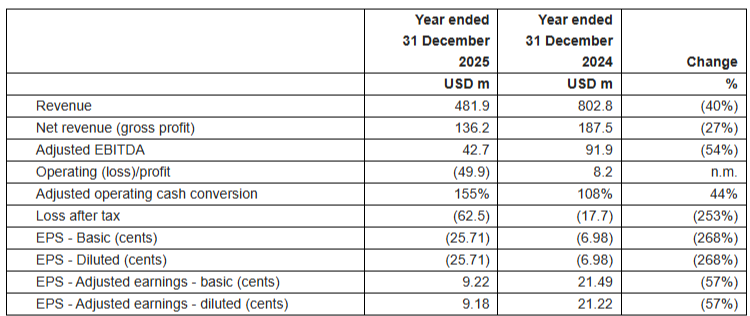
Team Internet (LON:TIG) (£97.2m | SR58) | FY25 revenue -40% to $482m, Adj. EBITDA -54% to $42.7m, Operating Loss $49.9m, in line with or above analyst expectations. FY26 remains in line with expectations. Completed a renegotiation of its existing debt facilities with wider covenant headroom. Still engaging with a range of debt providers. | RED ↓ (Mark) | |
Intercede (LON:IGP) (£67.4m | SR34) | An extension of its partnership with Swissbit to begin active development of an end-to-end FIDO2 Passkey offering the ability to utilise post-quantum cryptography. | ||
Zambeef Products (LON:ZAM) (£28.9m | SR94) | Basic Earnings per Share for the period ending 31 March 2026 is expected to be approximately 112% higher than last year. No change to the most recent market expectations. | ||
Rome Resources (LON:RMR) (£25.7m | SR24) | Commencement of a small-scale tin mining programme at its Kalayi project in the Democratic Republic of Congo. Mining operations are anticipated to generate modest revenues. | ||
Sealand Capital Galaxy (LON:SCGL) (£16.4m | SR-) | Revenue +12,700% to £1.55m, LBT £1.45m (FY24: £350k LBT). £9 million raised post period-end | ||
Mission (LON:TMG) (£16.1m | SR60) | Trading in the current financial year remains in line with the Board's expectations. | AMBER/RED ↓ (Mark) This is an inline update but it also seems we didn't get the chance consider our view once the FY results were released. Having now reviewed the FY numbers, I don’t think we were negative enough in the past. A large EPS miss, even on very heavily adjusted figures, and worrying working capital movements, leave me with little confidence that today’s in line statement will reflect underlying economic reality when the true figures are revealed. | |
Fusion Antibodies (LON:FAB) (£15m | SR3) | UK Research & Innovation has agreed to extend the project from its originally targeted completion date of 31 October 2026 to 31 December 2026. Total Grant funding is over £808K of which up to £545K of direct non-dilutive funding available to Fusion | ||
Quantum Helium (LON:QHE) (£11.2m | SR12) | Extended Production Test confirms helium-bearing gas of 2.5%, reservoir connectivity and commercial oil production from the Leadville Formation. | ||
Bradda Head Lithium (LON:BHL) (£10.7m | SR29) | Surface sampling assay results at the Whistlejacket Lithium Project: 18 samples exceeding 0.59 % Li2O out of 60 samples |
Roland's Section
Beeks Financial Cloud (LON:BKS)
Up 12% at 225p (£154m) - Third Market Edge Intelligence contract win - Roland - AMBER =
On Monday last week, I commented that it had been a tight race to meet FY26 revenue forecasts for the year ending on 30 June.
On Wednesday, Beeks announced further contract wins and I noted the broker’s view that Beeks was “largely on track” to meet FY26 revenue forecasts.
Today’s last-minute contract win will bring a further unspecified amount of revenue into FY26. However, at the risk of sounding cynical, the wording of the announcement does make me wonder if this is largely a renewal, with Market Edge Intelligence bolted on (my emphasis):
The customer, a leading North American exchange operator, has expanded its deployment of Beeks Analytics and will also deploy Market Edge Intelligence® in New York. Revenue recognition is expected to commence immediately.
A five-year deal with a total value of $3m implies $0.6m of revenue, annualised. Actual revenue recognition may not be on a straight line basis, but we aren’t given this information.
Indeed, given the proximity to the year end on 30 June, I can’t help wondering if the customer may have been offered favourable terms in order to bring some revenue forward into FY26.
Outlook: there’s no mention of FY26 expectations in today’s update, perhaps surprisingly at this stage.
In general, I would expect a company to reiterate its confidence in full-year guidance in a contract win announcement late in the year.
Roland’s view
Beeks’ share price has now retraced the losses seen in March, when the company’s half-year results left investors (including us) speculating on the likelihood of an H2 profit warning. That risk now seems to have receded:
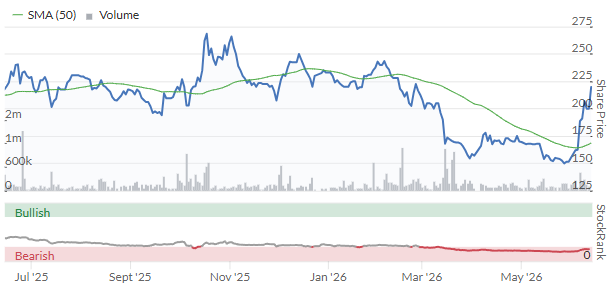
Investors also seem excited about the prospect that Beeks’ new Market Edge Intelligence product could help the company become a higher-margin and more SaaSy business, potentially justifying a higher valuation multiple.
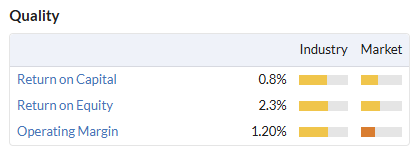
I can see this picture too, but I would like to see some concrete evidence first – Beeks has consistently been a low-margin and capital-intensive business in the past and we don’t yet have much information on the contribution Market Edge Intelligence is expected to make.
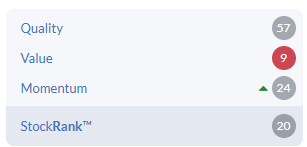
With a forward P/E of c.22 and no change to forecasts today (that I can see), I am leaving our neutral view changed. The StockRanks also remain cautious:
Peel Hunt (LON:PEEL)
Up 3% at 99.4p (£122m) - Full-Year Results for the year ended 31 March 2026 - Roland - AMBER/GREEN ↓
This City broker is on Graham’s watchlist. He took a positive view on the company’s trading update in March when Peel Hunt upgraded its FY26 guidance – albeit seemingly at the expense of FY27:
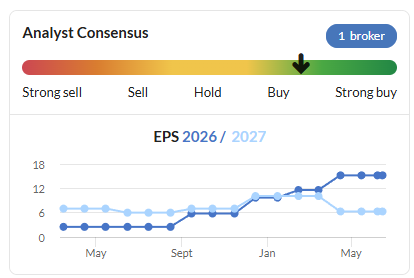
Today’s full-year results confirm an impressive recovery in revenue and profitability last year, but strike a more cautious note about the year ahead.
Of course, the company’s outlook commentary was probably written before news of an Iran peace deal was confirmed. It’s possible that today’s geopolitical news will encourage animal spirits among would-be acquirers and IPO candidates. This could boost demand for Peel Hunt’s services, particularly in its recently-opened Abu Dhabi office.
Results for y/e 31 March: key points
Peel Hunt’s financial performance improved dramatically last year:
Revenue up 57% to £143.5m
Pre-tax profit of £21.1m (FY25: £(3.5)m
Adjusted pre-tax profit of £32.0m (FY25: £0.8m)
Earnings Per Share: 12.9p (FY25: (2.3)p)
Dividend: 4.9p (FY25: none)
The balance sheet also remains strong – asset backing and strong cash generation are notable attractions here:
Net cash up 136% to £26.9m (exc. leases)
Net assets up 22.3% to £108.5m
Balance sheet assets are almost all tangible and largely consist of securities held for trading and very large debtor/creditor positions (clients and market counterparties):
Market and client debtors: £642.3m
Market and client creditors: £575.3m
I would argue that Peel Hunt’s balance sheet strength and liquidity are an integral requirement of this business model, so the group’s net cash isn’t all surplus to requirements.
For businesses of this kind, I generally see dividends and buybacks as a more useful indicator of truly distributable cash.
For example, the 4.9p dividend declared today will cost around £6m, or about 40% of last year’s earnings.
One exception to this might be if Peel Hunt was acquired by a larger peer, when it might be possible to free up some additional distributable cash by combining two companies’ assets.
Profitability was very respectable – a characteristic of this type of business in good years:
Operating margin: 16.3%
Return on equity: 13.7%
Trading commentary
The biggest winner of the year was Peel Hunt’s investment banking business:
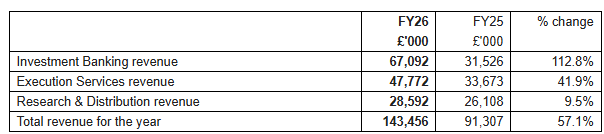
Investment Banking: although the company’s client base remains unchanged at 147 companies last year, the average market cap of its clients rose by 30% to £1,130m. This reflected the addition of one FTSE 100 firm and seven FTSE 250 clients to its roster, taking the total number of FTSE 350 clients to 62 (FY25: 52).
A number of clients appear to have been lost through the impact of M&A activity, although Peel Hunt also benefited from such activity, with “exceptional performance in our M&A advisory franchise”.
IPOs also made a positive contribution. While general IPO activity remains “relatively subdued in the UK”, Peel Hunt acted on the UK’s largest IPO last year (I think this may have been Princes (LON:PRN) ) and sounds confident about its ability to win future opportunities:
We are confident that our deep relationships with relevant private companies and their owners, as well as our ability to connect with a broad range of UK and international investors, will enable us to play a leading role in the revival of the UK IPO market over time.
The upshot of the company’s involvement in fee-generating corporate activity was a 153% increase in investment banking fee income to £57.9m. Much of this appears to have cascaded through to bonus payments for employees, despite a reduction in headcount:
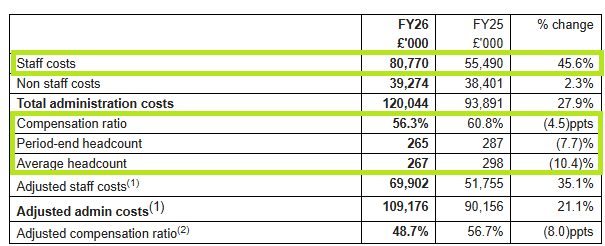
Execution Services: this business also performed well last year “despite ever-increasing competition”. Management says its focus is on using technology to strengthen connectivity and unlock incremental liquidity for clients.
Given that revenue from execution services rose by 41.9% last year, I am not sure this commentary really explains the full scale of the increase. I would hazard a guess that the macro backdrop and associated market volatility over the 12 months to 31 March also made a large contribution.
In FY25, for example, revenue from execution services only rose by 13.6% despite very similar management commentary.
Even so, it’s good to see Peel Hunt continuing to compete successfully in this market.
Research & Distribution:
Our business remained resilient in FY26, with moderately increased revenues. This is a good outcome given wider economic turbulence that included unpredictable US policies and market uncertainty in the run-up to the UK government's 2025 Autumn Budget.
A number of changes were made to Peel Hunt’s Research and Equities teams last year “including key internal leadership positions and a new management group”. These changes are said to have increased collaboration and also made it easier to retain “top talent”.
Peel Hunt opened a new office in Abu Dhabi in November to help expand its international distribution and liquidity reach. Commission revenue across its international offices is said to have risen last year, perhaps suggesting this is a more prospective area for growth than the mature UK market.
Strong relationships in Research and Distribution may also help Peel Hunt win other more lucrative business:
We saw this advantage in action in FY26, with the strength of our Research & Distribution division pivotal to us acting on the largest UK IPO of 2025. It also underpinned several capital markets transactions, including a significant capital raise for Coats Group plc.
Outlook
While markets remain supportive of high quality transactions, renewed global inflationary pressures, the volatile outlook for benchmark interest rates and increased domestic political uncertainty have all weighed on UK market confidence and therefore transactional activity since the start of our financial year. A sustained recovery in UK ECM, IPO and M&A activity will inevitably depend on greater macroeconomic stability and the pace at which confidence rebuilds.
Peel Hunt’s own broker is a subsidiary of Stifel and doesn’t make its coverage available on Research Tree. This means I don’t have access to any updated broker forecasts for Peel Hunt today.
However, the outlook commentary and the lack of market reaction today suggests to me that current expectations are largely unchanged.
On this basis, our consensus forecasts indicate earnings could fall sharply this year unless transactional activity improves:
FY26 actual EPS: 12.9p
FY27E adj EPS: 6.3p
These estimates leave Peel Hunt shares on a FY27E P/E of around 16x.
Roland’s view
Peel Hunt’s share price has not been very strong recently, perhaps reflecting subdued expectations for the year ahead. As I write, the stock is actually trading below the level at which Graham took a positive view on 31 March:
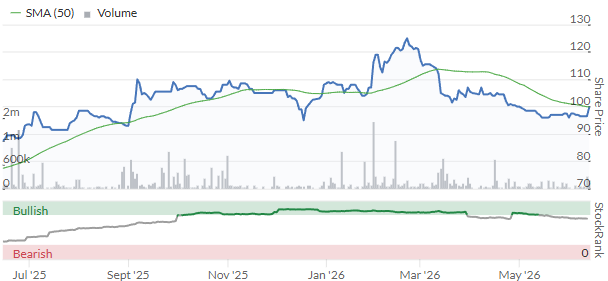
I think the outlook and valuation at this point are dependent on whether any of the momentum seen last year can be maintained.
Graham has rightly flagged up previously that broker forecasts were stale and too low. It’s possible that this is the case for our FY27 forecasts too, but I don’t see any way to evaluate this at present.
A look at Peel Hunt’s record since its 2021 IPO suggests the company has not yet managed to decouple its results from wider market conditions:
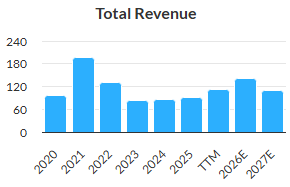
I think an AMBER/GREEN view could be more appropriate at this stage, to reflect the lack of earnings visibility and apparent double-digit valuation.
Iqe (LON:IQE)
Up 23% at 57p (£762m) - Tower Semiconductor InP supply agreement - Roland - RED =
IQE shares have 10-bagged so far this year, as investors have speculated that the AI data centre boom could drive a surge in demand for the company’s optical data products:
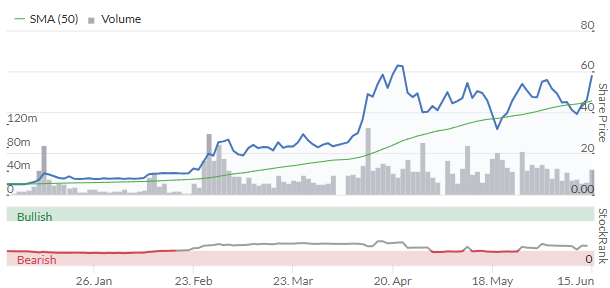
Today’s supply agreement with US analogue semiconductor specialist Tower Semiconductor (NSQ:TSEM) sounds positive, but the near-total lack of numbers (and surprise litigation news) leaves me thinking that this agreement doesn’t necessarily justify a 20%+ jump in IQE’s market cap.
Here are the key points:
IQE's InP epiwafers will be used in several of Tower's advanced silicon photonics platforms for next-generation optical technologies, providing a high-quality supply base for Tower's product roadmap. IQE and Tower's collaboration includes technology for the production of 200Gbs/lane for pluggable transceivers and the prototyping of next-generation 400Gb/lane modulators, as well as other critical applications including optical-circuit-switches for deployment in datacentres.
Without further research into Tower Semiconductors, it’s not clear to me whether what proportion of this agreement relates to current products and which might still be under development. I think it’s a mix of both.
The agreement does include some volume guarantees, but we aren’t given any idea of how this might translate into revenue:
The agreement provides for a minimum purchase commitment by Tower in the first year, a reciprocal supply commitment from IQE, and minimum volume commitments thereafter.
Finally, there’s a surprise twist – in a separate settlement announced today, IQE and Tower have also settled an ongoing legal dispute:
Under a separate agreement, Tower will also provide a broad worldwide and royalty-free license to IQE for porous silicon patents which have been the subject of an IP dispute between the companies, settling all litigation in the matter.
I can’t find any mention of this litigation in last year’s annual report, so I’m not sure if it has been reported to shareholders previously or not. Again, we have no way of knowing how material this agreement might be for IQE in terms of financial impact.
Overall, I think it’s quite difficult for anyone to assess the likely commercial impact of this supply agreement without access to much more information than is provided today.
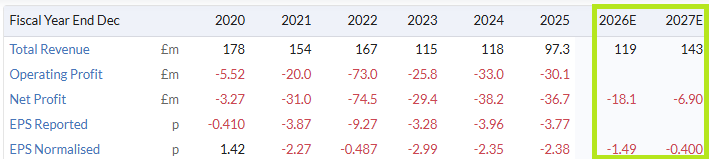
Outlook: there’s no comment on full-year expectations today, even though we are approaching the half-year mark. However, consensus forecasts prior to today have suggested continued losses in both 2026 and 2027 despite a recovery in revenue:
Roland’s view
IQE’s history of losses leaves me with two options for valuation, price-to-book value and price-to sales. Neither seems very appealing to me for a loss-making business:
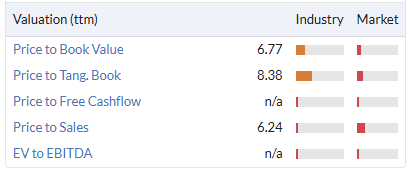
Even on a forward-looking basis, IQE’s increased market cap of £762m leaves the business trading on 5x 2027 forecast revenue. With no profit.
In fairness, my understanding is that forecasts suggest IQE will return to (a small) profit in 2028.
Personally, I’d want something more than this to justify taking a positive view on this business.
While the recent investment from long-term customer MACOM seems positive, it was carried out at 19.8p (today’s price 59p) and also included an issue of secured debt and various other protections. In my view, it’s possible that MACOM simply wanted to secure its supply chain rather than invest in the long-term growth of IQE – the company’s debt levels looked worrying to me prior to the fund raise.
Ultimately, I can’t help feeling that we’ve been here before with IQE. The company’s stock has been through various boom and bust cycles in its 25 years as a listed business:
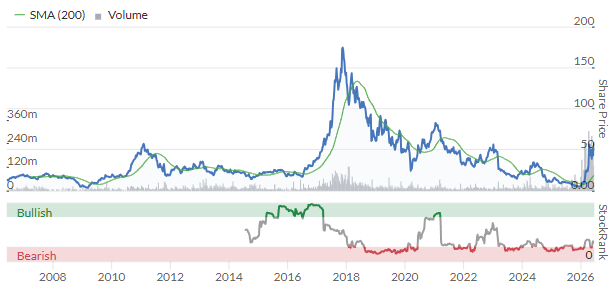
IQE’s profits peaked at c.£20m in 2015/16. The current market cap represents a multiple of around 38x those historic profits – more if recent share issuance is factored in.
While the past isn’t necessarily a guide to the future, the group’s revenue also remains below the peak levels seen in the past, meaning profit margins may need to be higher than previously to set a new benchmark for earnings:
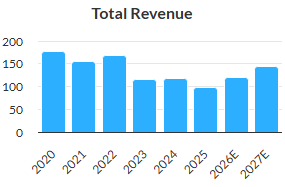
In my view, IQE’s £760m market cap already prices in any likely upside for the next few years. The StockRanks style this as a Momentum Trap and I share this view.
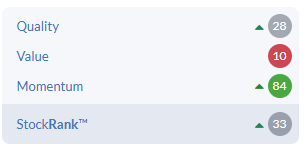
I don’t see any reason to change our previous negative view today. RED
Mark's Section
Luceco (LON:LUCE)
For a share price to drop 11% on the planned departure of a CEO seems a little harsh:
…following 21 years of leading the business, John Hornby has decided to retire from the Group, with effect from 31 December 2026…John will be taking a sabbatical until late August 2026, and will remain as Chief Executive Officer and as a Board Director until 31 December, following which he will be available to the Group in an advisory capacity.
However, it is worth understanding that John Hornby has been a driving force behind Luceco over the years.
He originally joined British General as Operations Manager in 1997, before leading a MBO in 2000. He became group CEO in 2005 after a secondary buyout, with Luceco eventually listing in 2016. At IPO, he and his wife held a combined 20.8% of the equity, worth around £43m. Today that is around 15%, but he remains a multi-millionaire based on his successful running of the company.
Since listing, the revenue has doubled:
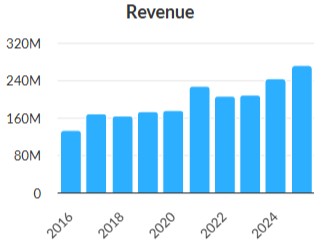
However, the group has been highly acquisitive, so you would have expected it to grow.
It is the combination of an impressive 20% average ROCE, together with the ability to show positive operational gearing that marks this company out as having delivered great shareholder value during this period. With operating profit for FY26 confirmed in today’s update (and recently upgraded):
The trading momentum described in the Group's Q1 Trading Update published on 19 May 2026 has been sustained through Q2-to-date. The outlook for the year ending December 2026 remains consistent with the commentary provided in that announcement and accordingly, the Board continues to expect Adjusted Operating Profit to exceed £40m, with the potential for further significant outperformance dependent on Demand Flexibility.
This means that operating profit has grown by 4x since listing. Unlike many acquisitive companies, this hasn’t come at the cost of a greatly expanded share count:
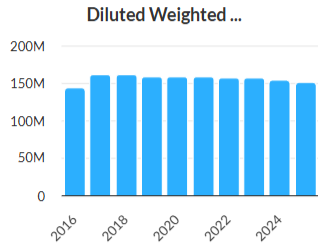
Despite fairly consistent delivery, the share price has been on a volatile ride (not helped by COVID, Russia invading Ukraine and UK housing market challenges):
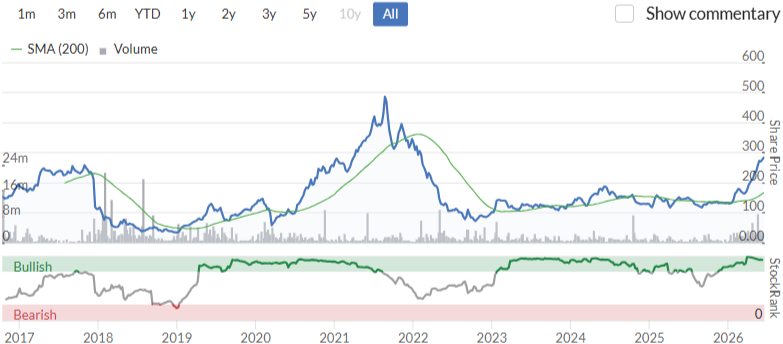
Hornby, together with other management stakeholders have not been shy to take advantage of excessive market enthusiasm or pessimism for the company.
Sizeable trades for Hornby include:
Selling at 235p in 2017
Buying at 40p in 2018
Selling at 300p in 2022
Selling at 269p last month
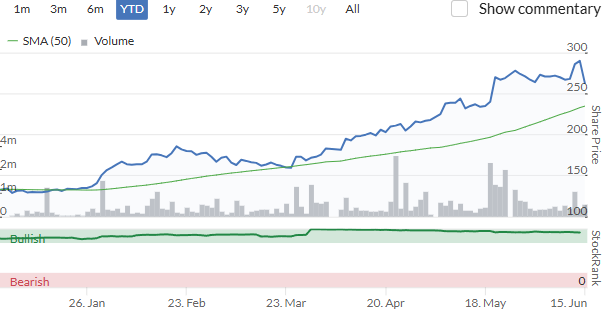
Zooming in to this year, the share price has doubled:
Driven by multiple upgrades in EPS:
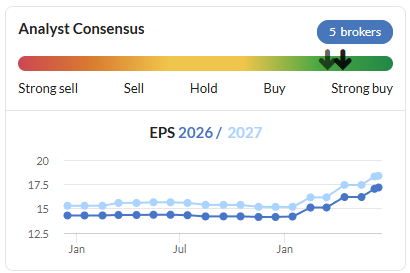
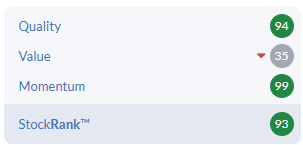
However, it is worth noting that the actual increase in EPS forecasts is only around 20%, meaning that the Value Rank is now only 35. This remains a high flyer, given the recent trends, but remains vulnerable to any mean reversion is share price:
It is also worth noting that when I reviewed their FY25 trading update in January, all of the strength in trading was concentrated in the EV charging part of the business and their core RMI market sales appeared to be flat.
Mark’s view
I’m not generally a fan of investing (or selling) purely based on one’s view of management quality. However, Hornby has been a clear driving force behind Luceco (or its predecessor) for almost 30 years. His history of correctly calling the short term trajectory of the share price, combined with his recent sale of £3m worth of shares, makes me think that his resignation at this time is signalling something. Perhaps not that the share price is materially overvalued, but that it is at least now up with events.
In January with a share price of 148p, I was happy to keep our broadly positive view based on the undoubted quality of the business and modest rating. However, following a material re-rating, driven by upgrades in only one very specific part of the business, it is hard to argue that the shares are cheap. The algorithms still rate this as a High Flyer. However, this is exactly the sort of designation that investors will usually benefit from exiting on any sign of Momentum reversal. I’m not certain that Hornby’s resignation will be that trigger. However, there is enough uncertainty (as reflected by the share price drop today) that I think we should take a more neutral view of AMBER.
Mission (LON:TMG)
Up 3% at 19p (£16m) - AGM Trading Update - Mark - AMBER/RED ↓
This is a fairly short update, but may be re-assuring, given that they warned in January for their results that were announced in March:
Trading in the current financial year remains in line with the Board's expectations. Against an ongoing backdrop of wider macroeconomic uncertainty this has been driven by continued strong Client retention, new Client wins and the benefits of the strategic actions completed earlier in the year to simplify and strengthen the Group's operating platform.
It is pretty bad form, in my opinion, to warn by a material amount after the period has ended. It suggests to me either a lack of management access to the numbers, or an unwillingness to share them in a timely manner. So this makes me a little wary at taking today’s statement at face value.
We didn’t get a chance to look at the FY numbers on the DSMR, so I’ve taken the opportunity to review the figures today. Headline EPS came in at 2.0p, but printing the historical StockReport suggests that around 3p was forecast, with over 5p forecast before the January profits warning. So that was a material miss in my book.
Not only that, but there was a huge difference between statutory and adjusted figures. The bulk of these were non-cash intangible write downs, but few of the rest look like they are one-off:
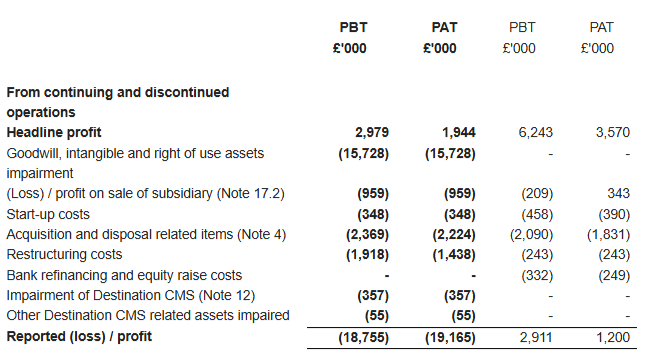
Then we get to the supposed good news, that net bank debt was down £0.5m to £9.0m. This is a key figure as high debt levels have been a major concern in the past. However, again I have to question how much the figures at the balance sheet date reflect economic reality. Payables increased by almost £8m with flat receivables. Seeing these figures rise on heavily declining revenue is particularly worrying:
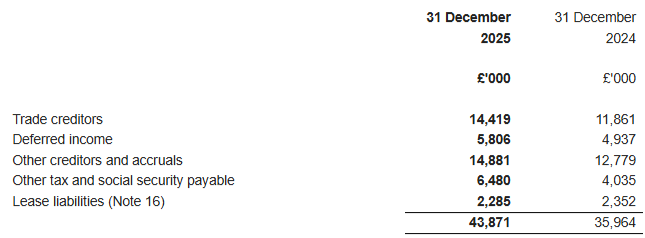
A more normalised working capital profile would see net debt significantly higher than the reported figure. Today’s update doesn’t contain any update on financial position.
It is not surprising that the market didn’t like these results. However, the share price seems to have inexplicably recovered recently, perhaps as investors look to the future. The rating here looks very cheap at a forward P/E of around 3 (presumably for the 18 month period following a change of accounting reference date), if you believe that they are trading in line, the adjustments reflect economic reality, and the debt is under control. Sadly, the recent results make me doubt all of those.
Mark’s view
Graham downgraded this to AMBER following the January profits warning. Having now reviewed the FY numbers, I don’t think he has gone far enough. An EPS miss, even on very heavily adjusted figures, and worrying working capital movements, leave me with little confidence that today’s in line statement will reflect underlying economic reality when the true figures are revealed. AMBER/RED
AEP Plantations (LON:AEP)
Up 2% at 1684p (£631m) - AGM Trading Update - Mark - AMBER ↓
AEP report a similar 5 month update to MP Evans did last week, and to me the recent story is remarkably similar. First they address the recent proposed changes impacting the industry:
Following the Indonesian Government's May 2026 announcement to centralise strategic commodity exports under PT Danantara Sumberdaya Indonesia ("DSI"), subsequent statements and a phased transition period have provided greater clarity. Exporters may continue direct overseas sales during the transition while meeting new reporting requirements to DSI, with full implementation expected from 1 January 2027. It is reported that DSI will serve as an intermediary facilitating and overseeing exports rather than acting as a trader; and that its mandate is to strengthen data-based supervision, not disrupt normal trading activities.
This policy does not directly impact the Group's business as the Group sells its CPO only to domestic refineries.
Again, minimal expected impact.
Then we get an update on production and pricing:
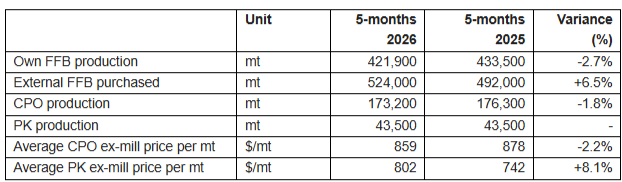
This includes a month of the Pinago acquisition, where they paid $162m for a 98.3% share.
This complicates matters slightly but I can make a guesstimate based on these trends to forecast the full year.
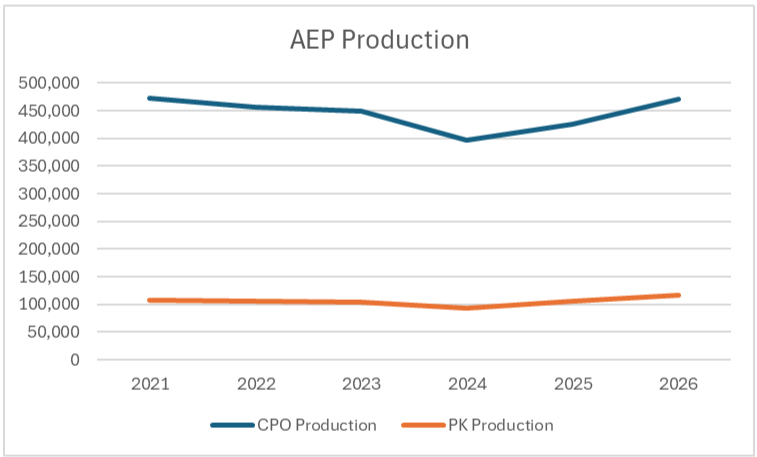
Like MP Evans, we are really seeing recent production growth as a recovery from a recent dip and the effect of the Pinago acquisition:
The recent strength in financials is mainly due to stronger pricing, particularly amongst the more volatile Palm Kernels:
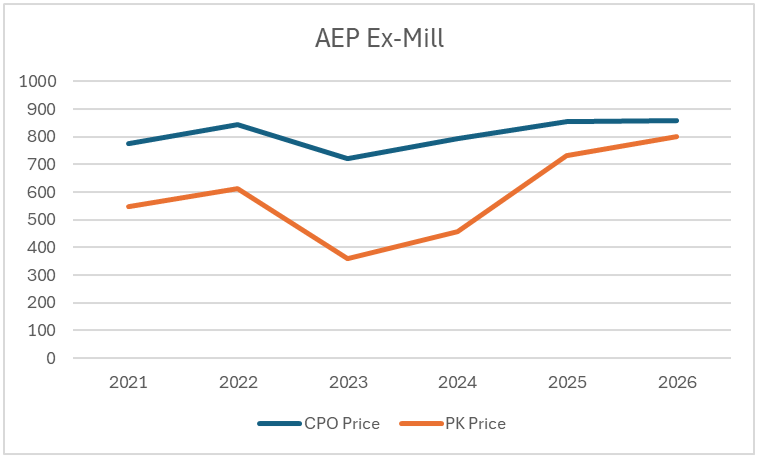
[Note: AEP report Ex-Mill Prices versus MPE who report Mill-gate, the difference being who pays for transport.]
Costs continue to rise as you’d expect due to inflation. They don’t report separate PK costs but treat it like a by-product:
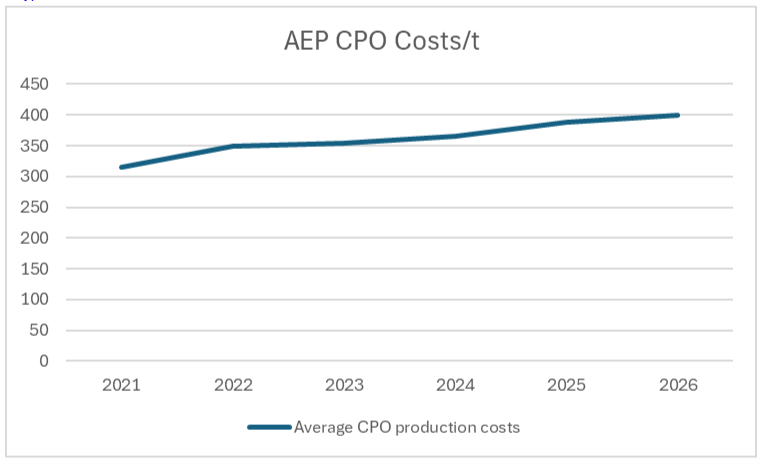
They don’t give us cost figures in today’s AGM update, so I’ve had to estimate based on an inflationary rise, offset by some scale advantages from the acquisition.
This still enables us to calculate an effective contribution and margin (a sort of operating profit without central costs):
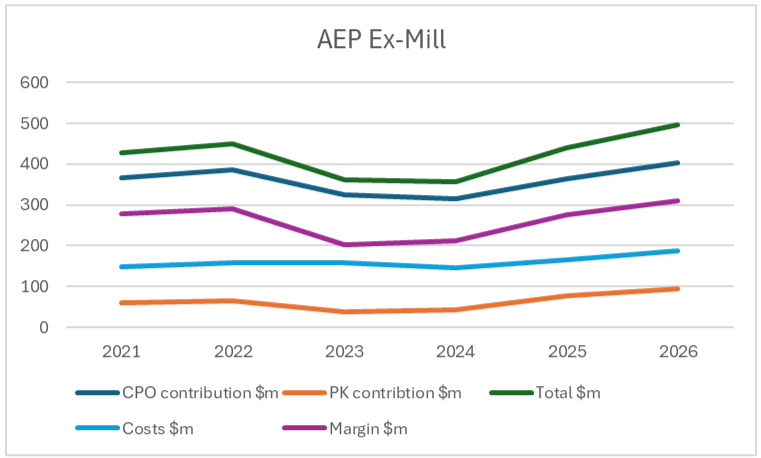
So again, we see the margin recovering strongly, but only really back to 2022 levels, despite an acquisition this year.
However, the share price is now double where it was at the start of 2022, making the recent rise largely a re-rating by the market rather than a fundamental change in prospects:
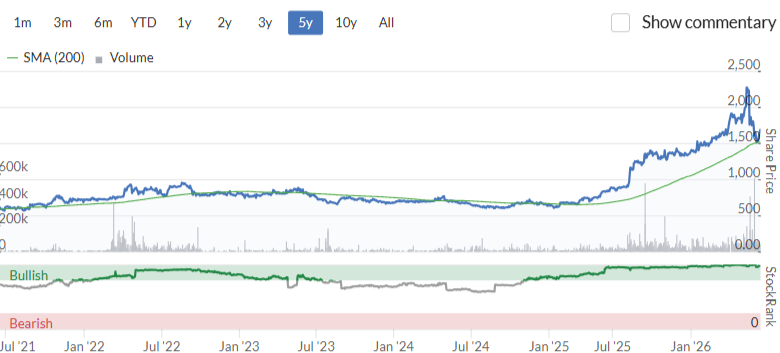
There are some reasons to think that this isn’t entirely irrational. The company has become more shareholder friendly in recent years, with increasing dividends and an ongoing share buyback. Plus they have forecasts in the market, which they never used to. However, I would prefer if they’d been buying back their shares at £6 not £16. After all, the operational fundamentals of the business don’t appear to have changed much during this time.
This is an in-line update from the company, which means that the rating remains modest with a forward P/E of around 8. However, like MP Evans, analysts are expecting profitability to decline in future years based on lower commodity pricing. I’ve no idea if that is realistic or not, but there are good reasons to think commodity pricing for Palm Oil will always be cyclical.
Mark’s view
The similarities to MP Evans are striking. Investors have enjoyed strong gains here recently, but these are almost entirely down to positive moves in commodity prices, particularly the volatile PK pricing. While there are reasons for the AEP re-rating beyond simply commodity pricing - they have become more shareholder friendly of late - there is no escaping that future returns will almost entirely be dependent on where Palm Oil pricing goes from here. Personally, I have no idea whether Palm Oil prices will rise, fall or stay the same over the long term, so I just think we have to take a neutral view of AMBER.
We’ve been positive here most recently, so this feels like a big downgrade. However, that view has largely been driven by the algorithmic Stock Rank and recent upgrades. The Stock Rank remains high, but the last EPS forecast move was down, but a in many ways it feels like I should be positive on a 97 StockRank company:
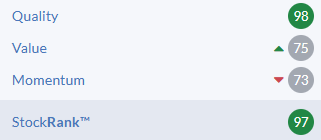
However, I don’t think the StockRank can predict commodity pricing, and with the Momentum Rank starting to fall, the reasons for the commodity-agnostic investor to stay on board for purely technical reasons are starting to wane. I think consistency with MP Evans is also important as both companies are valued on similar multiples with similar outlooks. Palm oil bulls will want to own both for diversification; Palm oil bears, neither.
Of course, if any readers have done a detailed analysis of the global supply and demand characteristics of Palm Oil and feel they have a more informed view into where we are in the commodity cycle, I’d love to hear it.
Team Internet (LON:TIG)
Down 1% at 39p (£m) - FY25 and 2026 YTD Trading Update - Mark - RED ↓
This is a slightly strange RNS title, as it appears to be the FY25 results. A quick scan reveals why they may want to gloss over that. Huge falls across the board:
We don’t get any notes to the accounts, nor the Annual Report, of which it is said:
The Company will publish its audited Annual report for the financial year ended 31 December 2025 during the week ending 26 June. In advance of the publication of the audited Annual report, unaudited financial data is provided below.
The timing allows the Company and its auditors to fully reflect the impact of the favourable amendments to the covenants and maturities of the Company's borrowing arrangements described above.
It seems that without the covenant amendments the auditor may not have been willing to sign off the accounts on a going concern basis.
The result is we don’t really know what has gone into producing the adjusted figures, beyond a basic summary:
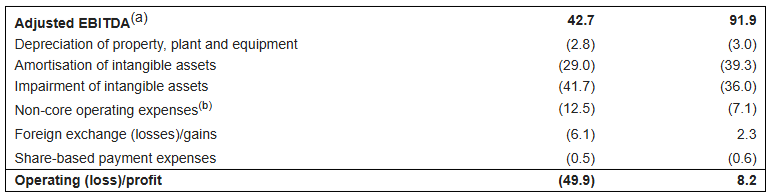
Non-core operating expenses are said to be:
Non-core operating expenses include items related primarily to restructuring, strategic review, and acquisition and integration costs, which are not incurred as part of the underlying trading performance of the Group, and which are therefore adjusted for.
I think it is safe to say that I will disagree with these being non-core for this type of business when we finally see them.
We do get to see a balance sheet, but I kind of wish I hadn’t. Current assets go down from $181m to $152m, while current liabilities go from $174m to $339m. Partly this is because the debt has become current, but even without this, net working capital is -$70m from -$41m last year. This would appear to be a highly stressed balance sheet even if they had no net debt.
It is good news that they have renegotiated debt facilities:
The Company is pleased to confirm it has recently completed a renegotiation of its existing debt facilities with our lenders, securing wider covenant headroom and aligning maturities in October 2027, which materially strengthens the Group's financial position and flexibility. The amendments also align the facilities more closely with the Group's current funding requirements and are expected to reduce commitment fees and financing costs, on a like-for-like basis….
We are still engaging with a range of debt providers albeit mindful of our renegotiated facilities and potential disposal of our DIS business, do so very much from a position of strength.
However, it strikes me that the banks had to “pretend and extend” as there are no tangible assets to speak of and they would not get repaid if they forced any action. Instead, their hope is surely that the company sells the Domains part of the business for enough to save their skin. This is the only part of the business that has any real long-term value, in my personal opinion.
The strategic review to unlock shareholder value is progressing well. Discussions continue with selected parties regarding a potential disposal of the DIS segment, which the Board will pursue where it delivers fair value. While there can be no certainty that any transaction will be agreed, or as to its terms, the Board expects the outcome of the strategic review, including any agreement relating to a potential disposal of DIS, to be announced in the first half of Q3. Subject to customary conditions and regulatory approvals, the Board expects any resulting transaction to complete during 2026. The Board confirms its guidance on quantum[1].
The footnote reveals that the company previously expects this to be worth more than $160m. If they achieve this this would largely repay the bank debt and their bankers would presumably breathe a big sigh of relief. However, any deal may include a working capital adjustment, which is likely to be negative in this case..
The update includes some details about FY26:
The Group's earnings performance in 2026 to date continues to progress in line with expectations. For the five months ended 31 May 2026, Gross revenue of USD 148 million, Net revenue of USD 50 million and Adjusted EBITDA of USD 16 million have been delivered.
The DIS and Comparison segments, unaffected by the Search transition, have delivered strong mid-teens net revenue growth and approximately 40% EBITDA growth year-on-year.
Which sounds reasonable, until I do some basic maths. In H1 last year Domains + Comparison did $16.1m EBITDA, pro-rata over 5 months this would have been $13.4m. If this is now up 40% year-on-year, these did $18.8m EBITDA, which means Search generated somewhere close to $3m LBITDA so far this year. Even if you consider EBITDA a valid metric here (I don’t), Search appears to have performed even worse than FY25 so far.
Mark’s view
This appears to be an example of diworsification, as a profitable, cash-generative but steady Domains business has been used as a springboard to acquire much lower quality businesses where changes to search trends and algorithms at major tech companies has meant large write downs in value. The cost of making these acquisitions has left them with a large debt, and a stressed balance sheet. The solution of selling the Domains business will leave the underperforming low-quality parts. Presumably, this will enable them to repay the debt and save their bankers' blushes. I’m not sure that shareholders will be able to say the same. RED
Disclaimer
This is not financial advice. Our content is intended to be used and must be used for information and education purposes only. Please read our disclaimer and terms and conditions to understand our obligations.

25 comments
Keen to get your take on AEP Plantations (LON:AEP) trading update today, in particular following the Indonesian Prabowo announcing export controls a few weeks back.
I got out and took the profits but it was such a good stock I’m debating getting back in….
IMPORTANT NOTICE FOR NANOCO PLC SHAREHOLDERS
IF YOU HOLD SHARES IN NANOCO PLC MAKE SURE TO VOTE AGAINST DELISTING TODAY. FOR MANY BROKERS THIS COULD BE THE LAST DAY TO VOTE. Nanoco PLC is mostly owned by retail investors (people like you and me) and the board have no business to take it private especially when the company still has 10 million in cash.
The delist proposal alone has wiped two thirds off the market cap. It's already proven to be one the most capital destructive thing they could have done. It benefits no shareholder to hold an illiquid private instrument without accountability. For insiders on the other hand, the benefits are many. No interim accounts. Massive lag between reporting periods. Zero visibility on admin costs breakdown.
The Luceco (LON:LUCE) announcement this morning is not only about the CEO retiring.
There is also a positive Trading Statement as follows:
“The trading momentum described in the Group's Q1 Trading Update published on 19 May 2026 has been sustained through Q2-to-date. The outlook for the year ending December 2026 remains consistent with the commentary provided in that announcement and accordingly, the Board continues to expect Adjusted Operating Profit to exceed £40m, with the potential for further significant outperformance dependent on Demand Flexibility.”
Luceco (LON:LUCE) Shares are down 6.9%. 2 massive director sales at the end of May, looks like insider dealing now. The CEO has around 15% of the shares, so coukd be more director selling soon.
Morning QARPY, thanks for flagging this up. I have added a line to the summary to reflect the trading update.
We'll be covering Luceco (LON:LUCE) in more depth this morning, too.
Roland
With Luceco (LON:LUCE) its worth noting that the board are flagging a conditional upgrade, with language that repeats the previous 19th May update i.e. "potential for further significant outperformance dependent on Demand Flexibility".
Todays -10% drop could be a useful buying opportunity?
The concern I suspect for the market is not the retirement it's the immediate sabbatical he is taking. Seems a bit fishy to me.
Luceco (LON:LUCE) founder departure deems to me more likely that it might be for personal reasons…I’ve never seen an immediate & lengthy sabbatical feature in such an RNS before …as such I’d be more inclined to wish Mr Hornby all the v best
Luceco (LON:LUCE) share price now down nearly 11%. Seems a massive overreaction to this mornings statement. Regarding director share sales these were admittedly very significant at a price of 268.5 - 269.25 with value of £6.055m (Giles Brand, chairman) and £2.96m (John Hornby) . According to Investor Chronicle data as reported in FT Money at the weekend these deals were executed on 26/27 May (also shown on Stock Report) and were conducted by spouse/family/close associate. (The two individuals continue to hold at least 25% of the shares) . I’m not sure how long it takes for such deals to become in the public domain but this deal was nearly 3 weeks ago so why the hit to the share price today? Also the CEO retiring after 21 years alongside a positive reaffirmation of recent trading statement doesn’t seem enough negativity to send the share price down c. 11%.
Hornby was effectively the founder of Luceco when it was a private company and is very much its guiding light. I wouldn’t read too much into the director share sales, both do this on a fairly regular basis and whilst chunky in £sd are small in comparison to their share ownership. There is a valid question about whether Hornby will seek to unwind his possition, which may account for the drop, but (if at all) it will surely be done in a structured way to cause a minimum of disruption. I hold.
I don’t follow Luceco (LON:LUCE) but if I did it I would definitely have sold on the update today on my so simple sell tactic of “sell if there is a bad news update.” It’s a tactic that works. Many investors don’t do that and instead look for silver linings as justification for continuing to hold.
Big Director sells and the loss of Hornby count imo as significant bad news.
The share price has gained 90% in just six months, so presumably those holding Luceco (LON:LUCE) have big paper profits? So the decision is whether to continue holding and to try and find reasons to hold, and ignore the warning signs today, or to take the profits. An alternative compromise decision is to sell part of the stake.
I've held Luceco (LON:LUCE) for a while. I did sell half, after the directors sales. Yes it has had a good run recently. I may sell the rest later this week.
Only held for 4 weeks so no significant profit or loss to realise. I am following a systematic process and even after today’s fall Luceco (LON:LUCE) does not meet the rules for a sale. Should the data change then I will change my mind and sell. I don’t regard today’s news as ‘bad news’. The Chairman & CEO still hold close to 30% of shares and the statement reaffirms the recent positive trading update so no profit warning which would be ‘bad news’ and a sell signal. Not looking for justification to continue to hold just following my systematic rules.
I’ve just checked the Luceco (LON:LUCE) updates. Wasn’t the obvious buy opportunity the “better than expected” update on January 29th and positive analysis that day from Mark rather than after the huge gains, since then, and only 4 weeks ago?
Is buy low ahead of good chance of share price gains, and sell high a better tactic than buy high after those gains and (IF the update today is a warning sign) sell low after heavy losses?
Also is it worth checking market reaction to the Luceco (LON:LUCE) update today? The share price is down 12%. Does that perhaps suggest that the market doesn’t agree with your “I don’t regard today’s news as bad news” conclusion today?
This reply is NOT to annoy you, but because you are admirably honest about your wrong decisions and resultant big losses, and my suggestions are simply trying to help you try methods that could improve your portfolio performance big time.
If you disagree, then another angle is to check out the update today again, and try and find reasons why there is a lot more upside to come,
Well unless the CEO wrote the future plans for the company on a Post It Note kept in his back pocket that was only revealed on a week by week basis to the Board at their Monday morning planning meeting then one would hope the board is more than capable of executing the current plan which I imagine extends at least a year and probably longer.
Personally, like ACounsell, I'd rather have a strategy for investing with clear entry and exit rules, that I know and stick to, rather than waiting on the opinion of a 3rd party ... that might never materialise.
Who knows what will happen with Luceco (LON:LUCE) over the next 6 months but it holds the qualities of a high quality, high momentum stock. Time and again people are surprised when I buy a stock at a recent high only to confound them by going further on a massive run.
Perhaps revisit this thread in six months time for a fairer comparison of the hindsight you have offered. By the way the stock gained in early Feb and then returned to late Jane levels before taking off after the next set of announcements.
Your approach works very well. So does my very different approach. What matters is whether we are successful. There are so many ways to invest successfully and unfortunately not too. If it works do it but if it doesn’t don’t.
I respect ACounsell because he has been so open in his posts here about his lack of success with shares and Trusts that with better timing would have been big winners. So my post focused on that timing angle. Obviously anyone disagreeing with opinions in a post is free to ignore them.
Also so many posters here say how when and whether to sell is much harder than buy decisions. I used to think that too. Now I find selling decisions to be easy with my sell on the first iffy update news tactic, unless it’s clear that the reasons for a profits warning might be temporary. That tactic really really does work most of the time.
Yes. It will be interesting to see when Luceco (LON:LUCE) next update whether selling now was the right decision.
An interesting thread! Unfortunately I'm a 'glass half empty' sort of guy so I have a tendency to only post comments on situations where I have made an investing mistake, held on too long or sold out too soon. However, I can assure you that these 'failures' represent a relatively small part of my portfolio and the last two years have seen a pretty decent return overall. As always for a pessimist (!) things could have been better but that comes with the territory of investing and maintaining a diversified portfolio.
The government also announced that it's considering a reduction of its 2030 EV sales target. Probably an additional reason for the slump in the share price today.
https://www.theguardian.com/bu...
Beeks Financial Cloud (LON:BKS) - 3rd contract win...on a roll
Its coming up to the end of the year and a lot of "software" companies backload their orders to the last month/week of the year. While good to see I will be happier if the momentum carries into the new year for them. Note: Long term holder
Agreed. It's obviously important companies meet targets, but it feels like the commentary has been obsessed with a 30th June cut-off vs a longer term, multi-year view. Stuffing contracts into June might appease people with a very short-term view but open the door for last-minute shocks and profit warnings due to customers unexpectedly not renewing etc.? I'd rather they just revised down guidance and let the wins run into next FY creating a smoother profile.
Re: the consistent commentary on low margin + capital intensive, I'm curious about the balance between upfront capex to install equipment after a contract win vs ongoing maintenance. Presumably a rapidly growing co with upfront capex associated with contract wins will always look low margin/capital intensive looking backwards - isn't it more investor-relevant to try and take a view on what the model might look like on a more mature version of the company? (i.e. greater % of established contracts with lower relative growth p/annum)?
Beeks Financial Cloud (LON:BKS)
a lot of "software" companies backload their orders to the last month/week of the year.
When you say backload - do you actually mean bringing forward timing of orders that would not naturally conclude this year without some affermative action? . Must admit stuff like that never inspires me with confidence - particularly if their customers know that beeks are desperate to book such revenue - that kinda suggests beeks may need to be giving some discount to get deals over the line. Perhaps its so natural it just becomes standard fare so might not be as big a deal as it looks if they have stanbdard incentives at this time of year only i suspect many companies may prevareticater given the choice for so long they never actually go ahead with a purchase they could have been "persuaded" to take with a nice kickback. imho if you gonna give the discount well why not just get on with the job of offering it sooner rather than later.
Perhaps its just natural timing here - eg its beek been working hard behind the scenes to have stuff ready for keen customers waiting to sign up rather than product being ready waitring for customers to sign.
Would be great if you had time to have a look at AEP Plantations (LON:AEP) team, its had a hell of a run like most of the palm oil producers but the chart seems to be saying that's now over, interested in your thoughts time to bale or is there still mileage in holding it ?
Thanks Mark for taking a look at it much appreciated.
Last call for AGAINST voters: Nanoco PLC (NANO).
Folks as we know we are rapidly closing in on the GM day now. Broker deadlines kick in much sooner. I've just noticed IG have a voting cut off today.
Other brokers will have a deadline of tomorrow at the latest. Key to get those votes in. HL shareholders alone hold 21% of the shares here. Imagine the difference that makes to the outcome. We can easily defeat this.
To vote with HL, just go to Investor Inbox or this link when logged in https://online.hl.co.uk/my-accounts/investor-mailbox If anyone isn't sure about how to vote with their own broker, please ask I'm sure somebody can help.
Vote against to stop this heist and keep these shares listed.
Nanoco PLC are trying to delist their company and take it private when it is more than 90% owned by retail shareholders. The market has voted about it by slashing its market cap to less than half its account balance. Nanoco PLC still has a cash balance of £10.1 million as at 19 May 2026. Hargreaves sent a note to its clients yesterday alerting them about this but they didn't tell them about the cash balance so some could have been frightened into selling. Please help us get the word out - if you have a following I would appreciate you tweeting this message.
IF YOU HAVE SHARES IN NANOCO YOU ONLY HAVE A FEW MORE DAYS TO VOTE. DON'T MISS THE DEADLINE. THE DELIST PROPOSAL ALONE HAS WIPED TWO THIRDS OFF THE MARKET CAP. IT'S ALREADY PROVEN TO BE ONE OF THE MOST CAPITAL DESTRUCTIVE THINGS THEY COULD HAVE DONE. It benefits no shareholder to hold an illiquid private instrument without accountability. For insiders on the other hand, the benefits are many. No interim accounts. Massive lag between reporting periods. Zero visibility on admin costs breakdown.
The board of directors barely hold any stock so retail shareholders can easily block this delisting. In a private company, with limited reporting requirements, nobody outside the company would have a clue what's really going on. It's funded for years on end. Countless ways they could cut costs without going nuclear like this. They could opt for an AIM listing for example which would slash listing costs.
Nanoco’s latest circular says there are 195,543,816 ordinary shares, each carrying one vote, as at 26 May 2026. The delisting/cancellation resolution needs not less than 75% of votes cast to pass. Abstentions/“vote withheld” are not counted in the for/against calculation.
Assuming 50% vote turnout
Total shares: 195,543,816
50% turnout: 97,771,908 votes cast
To pass, the board needs 75% of votes cast:
97,771,908 × 75% = 73,328,931 votes FOR
So the maximum “against” vote they can tolerate is 25%:
97,771,908 × 25% = 24,442,977 votes AGAINST
Therefore, to block the delisting, shareholders need at least:
24,442,978 shares voted AGAINST
That is effectively 12.5% of the entire company plus 1 share, assuming exactly 50% turnout.
Board 1.5% 2.93m
Nanoco Group PLC Employee Benefit Trust 6.7% 13.10m
Combined 8.2% 16.03m
If the board and Nanoco Group PLC Employee Benefit Trust votes are cast FOR, they would represent about 16.03m FOR votes. But that does not change the blocking number under the 50% turnout assumption - you still need 24.44m+ AGAINST because the 75% test is based on total votes cast.
At 50% turnout, around 24.45 million shares voting AGAINST should be enough to block Nanoco’s delisting.
Every “NO” vote matters because abstentions do not count.
Someone check the maths above - with 50% vote turnout we need 24.45 million shares voting AGAINST to block delisting.
THE BIGGEST ENEMY FOR US RETAIL IS PASSIVITY - INACTION - MAKE SURE TO VOTE AGAINST THE RESOLUTIONS SO THE COMPANY IS FORCED NOT TO DELIST. THEY CAN LIST ON AIM IF THEY WANT TO SAVE MONEY.