Daily Stock Market Report (Mon 8th September 2025) - JNEO, GMR, TET, PHNX, IQE, CER, SRC

Good morning!
I hope you had a nice weekend. Our spreadsheet is now fully up to date.
All done for now, thanks!
Spreadsheet accompanying this report: link (last updated to: 5th September).
Companies Reporting
| Name (Mkt Cap) | RNS | Summary | Our view (Author) |
|---|---|---|---|
Phoenix group (LON:PHNX) (£6.7bn) | Op. cash generation +9% to £705m, CSM +10% to £3,567m. Outlook: “firmly on track”. | AMBER/GREEN (Roland) These figures look fine to me from a high level review. In my experience, Phoenix has a long track record of delivering on its guidance for cash generation and these results support current 2024-26 targets. In my view, the main risk here is that the company’s gradual pivot towards writing more new business and selling direct to customers may end up underperforming in terms of profitability and growth. However, there’s no sign of this yet, as far as I can see. With an 8.5%+ dividend yield covered by cash generation, I think this stock remains worth considering for investors seeking high yields. | |
Pan African Resources (LON:PAF) (£1.43bn) | FY26 production in line. Believes moving to Main Market would raise profile and attract new investors. | ||
| Sigmaroc (LON:SRC) (£1.29bn) | Interim Results | SP +6% Pro forma rev -1.1%. adj EPS +9.1% to 4.66p. Core volumes -3%. FY outlook in line with expectations. H2 to be similar to H1 in terms of underlying market conditions. Management focused on operational efficiency, with synergies set to exceed guidance given in May. A cyclical recovery in construction and steel markets (when?) will reverse current volume weakness, along with an expected increase in European defence spending. An encouraging start to the seasonally stronger second half. Panmure Liberum estimates: FY25 earnings forecast unchanged, small upgrades for FY26 and FY27 (0.8% increase for FY26, 1.4% increase for FY27). EPS estimates are 9.5p (FY26), 10.5p (FY26), 11.5p (FY27), vs. current share price 122.8p. | AMBER (Graham) [no section below] This "lime and minerals" Group has published another complicated set of results tables where I'm inclined to focus on the proforma results (for continuing operations). These tables show a mild decline in revenue but 1.6% underlying EBITDA growth (to £118m). Scrolling down to the actual financial statements I again - as last time - find that the actual profit figure is rather slim compared to the market cap: only £27m of after-tax profit from continuing operations, although this is a huge improvement on the £5m generated in H1 last year. The P/E multiple is modest but I'm not sure how much I can trust it, given the extent of the adjustments at play here. £26.5m of "non-underlying items" in H1 included some items I would be very reluctant to exclude from analysis, in particular share options expenses (£5.5m) and restructuring expenses (£1.7m), but there are seven other categories of non-underlying items! The balance sheet is also an issue: there are £670m of borrowings, over £600m of which is a "syndicated term facility" led by Santander and BNP Paribas. The rate here is reasonable (2-3.5% above EURIBOR) but it's a heavy debt load, no matter which way you look at it. The leverage multiple is officially 2x which is not distressed, but nor is it a level that I would consider to be particularly comfortable. Overall, therefore, I'm inclined to leave our AMBER stance unchanged. There's a lot that could go right for the company: a cyclical recovery in its end-markets, further synergies after the large acquisition it made last year, and a reduction in "non-underlying items" all spring to mind. But I'm inclined to think that the current market cap might be a fair one, when all is said and done. The StockReport agrees with me, awarding it a StockRank of 60 and a "Neutral" style |
Grainger (LON:GRI) (£1.42bn) | Expect improved shareholder returns, forecasting 50% EPRA EPS growth by FY29. | ||
Domino's Pizza (LON:DOM) (£824m) | Trialling new chicken sub-brand in 187 stores in NW Eng/NI. Will fulfil through existing supply chain. | ||
Cerillion (LON:CER) (£416m) | With existing customer, support existing consensus market exps - no change to forecasts today. | AMBER (Graham) This company has grown into a nice success story on AIM, and today’s news is positive, although the contracts were already expected and baked into forecasts. So there are no changes to forecasts at Panmure Liberum: EPS of 57.7p in FY Sep 2025, and then 63.5p the following year. Valuing it on next year’s earnings gives a P/E multiple of about 23x, in line with what you’ll find on the StockReport. The CEO top-sliced around current levels in Juneand therefore I’m inclined to leave our AMBER stance unchanged for now, given the fairly rich valuation. It does have impressive quality metrics and has grown steadily over the years, so if you can get comfortable with what it does (CRM solutions for telecoms companies), you might find that it’s worth investigating further. | |
Foxtons (LON:FOXT) (£165m) | To be funded through existing cash and RCF. Will continue to acquire lettings portfolios. | ||
Concurrent Technologies (LON:CNC) (£162m) | Rev +26%, PBT +17% to £2.3m. Order intake +25% to £17.8m. FY25 outlook ahead of exps. | ||
Gaming Realms (LON:GMR) (£149m) | Rev +18%, driven by brand licensing. PBT +19% to £4.2m. FY25 outlook in line with expectations. Canaccord Genuity revised estimates: FY25E EPS: 2.9p (prev. 3.0p). | AMBER (Roland) Today’s results are marred by a big hit to UK-derived revenues from a regulatory change in April. However, progress outside the UK was strong, with 19 new partners added and US revenue up by 22%. Profitability remains strong and the balance sheet is also in good health. While I feel that the capitalisation of software development costs does flatter profits, I still think this looks like a decent business. I’ve turned neutral today to reflect a declining trend in earnings and the risk that a UK recovery will take some time. But I think the shares could start to offer some value if they get much cheaper. | |
Treatt (LON:TET) (£132m) | Trade buyer Natara (owned by Exponent Private Equity) has offered 260p per share in cash. | PINK (Graham) | |
Avation (LON:AVAP) (£106m) | FY June 2025 revenue approx. $110m (cons: $102m). Exec Chair: AVAP is strongly cash-generative. | ||
Iqe (LON:IQE) (£84m) | SP -9% Macro uncertainty, market weakness, funding delays. FY25 revenue now expected at £90-100m. (StockReport: £118m). Exploring the sale of the entire company now in addition to the sale of its Taiwan operations. | PINK/BLACK (RED) There’s a lot happening here today with a profit warning and news that they have expanded the scope of their strategic review to include the possible sale of the entire company. It looks to me as if they may be in need of a bailout and so I’m as bearish on it as I’ve ever been. | |
Journeo (LON:JNEO) (£79m) | Crime and Fire Defence Systems: framework agreement valued at up to £5m with UK utility company. | AMBER/GREEN (Roland) [no section below] A promising-sounding start to Journeo’s ownership of CFDS, which it acquired last week. As I discussed at the time, the CFDS deal looked reasonably priced, but this new business is slightly outside Journeo’s core markets and has delivered inconsistent performance over the last few years. If Journeo can deliver broader-based and more consistent growth for CFDS, I think the acquisition could create attractive shareholder value over time. No change to our view today. | |
Fiinu (LON:BANK) (£58m) | Made an £8m acquisition in August. Results to June: zero revenues. | ||
Works co uk (LON:WRKS) (£33m) | LfL sales outperforming wider market. Confident in delivering FY26 exps (adj. EBITDA £11m). | ||
Tissue Regenix (LON:TRX) (£21m) | H1 revenue -6%. Uncertain economic conditions. 2025 adj. EBITDA to be in line with 2024. Estimates: Cavendish withdraw forecasts. | ||
Chill Brands (LON:CHLL) (£9m) | Chill is SYP’s brand expansion partner. Facilitating route to market via Chill’s distribution network. |
Graham's Section
Treatt (LON:TET)
Up 18% to 264p (£156m) - Statement re Recommended Acquisition of Treatt Plc - Graham - PINK
Another day, another acquisition.
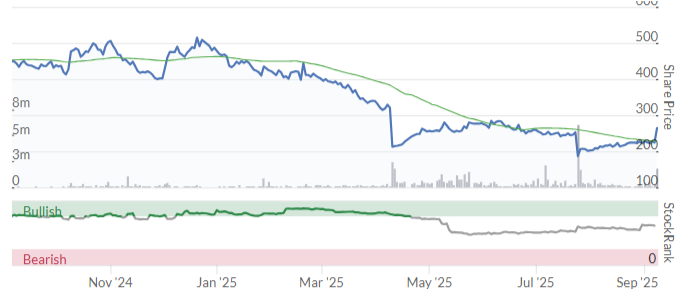
The stock has been a very poor performer in 2025, down over 40%:
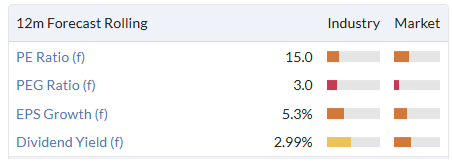
The previously high-rated ingredients business has drifted into “value” territory:
Exponent Private Equity, a mid-market private equity firm, have noticed the value on offer and they arrive today with an offer of 260p per share, through one of their investee companies.
I’m glad to see that the Treatt share price is currently above this level, suggesting that at least some shareholders expect a better offer than that.
260p is only a 16% premium, which I consider to be a very poor level. What is the opposite of “generous”?
Equity investors, particularly those of us who take single-stock risk in small-caps and mid-caps, should be targeting annual returns of greater than 10%, in my view. The effort and the risk involved in buying into these types of shares must come with a suitably large reward. So 10%+ should be a normal target, to make it worthwhile.
Therefore, if we are going to hand over our best ideas to new owners in exchange for a one-time cash injection, I would expect a 20-25% premium to the existing share price at a minimum, and even at that level I wouldn’t necessarily agree to it. For example, I’m not in favour of the takeover offer at International Personal Finance (LON:IPF) (I hold), where a 25% premium was offered.
But Treatt has struggled this year, and this has opened the door for an opportunistic approach, hoping to take advantage of stale bulls in the stock.
Our most recent coverage was in July when Mark (who held shares in Treatt at the time) was neutral on it following another profit warning.
That profit warning was blamed on “high citrus oil prices affecting buying patterns” and the US economy (consumer confidence plus geopolitical and tariff uncertainty).
It’s rare that companies will explicitly acknowledge when they are failing under pressure from competition - but my understanding is that there are newer and cheaper alternatives to Treatt’s ingredients in the market. A period of higher prices may have accelerated a transition to these cheaper alternatives.
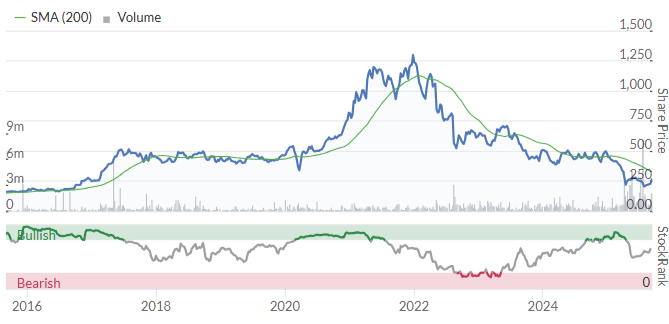
The company has been plodding for some time: it had a terrific growth spurt from 2015-2018, but has made limited progress since then in terms of profitability or share price. Its valuation became particularly overheated in the bull market of 2021-2022:
But that doesn’t excuse a low-ball offer, or excuse management for recommending it.
The proposed buyer is Natara, another ingredients company serving the flavour and fragrance industry, which is owned by Exponent Private Equity.
Natara’s perspective is that competitive pressures are indeed a factor, and they mention this prominently:
Given the macroeconomic headwinds affecting the industry, including competitive pressures, subdued North American consumer confidence, a weaker US dollar and volatility in citrus prices, combined with Treatt's specific trading challenges, Natara believes Treatt is at a critical inflection point. To restore performance and unlock long-term growth, Natara believes the required investment, capital commitments and operational measures can be more effectively achieved under private ownership, allowing the business the flexibility to execute its strategy away from the uncertainty and ongoing costs associated with public markets.
Treatt’s directors seem to agree:
While the Treatt Directors recognise that improvements in market dynamics and Treatt's execution of its evolving strategy should support a recovery in Treatt's operating and financial performance, they also acknowledge that this could take some time and remains subject to significant uncertainty as to the external factors affecting Treatt's business and the delivery of internal systems and organisational improvements.
Graham’s view
While I’m not particularly excited about Treatt’s future, I would be inclined to vote against this takeover as a matter of principle. A takeover premium of 16% should be seen as a negotiating tactic by the potential buyer, not the final offer. I hope that Treatt’s shareholders resist this 260p offer, and today’s share price suggests that many of them are not.
I note that at the last full-year results, the company reported net assets per share of 232p, almost fully tangible, with land and buildings held at historical cost (no revaluation to their actual current values).
Net debt was negligible.
So there is no question of the company being in any financial distress.
If Treatt's shareholders accept this offer, it could embolden more private equity firms to swoop in and attempt to take shares private at similarly ungenerous premiums. Let's see what they do!
I can find no mention of "irrevocable undertakings" to support the deal in today's announcement, besides from Treatt's directors who hold barely any shares in the company. So the major shareholders are still free to make up their minds on this one.
Iqe (LON:IQE)
Down 8% to 7.9p (£77m) - Graham - PINK/BLACK (RED)
Feeling vindicated with my scepticism towards this one - most recently RED in May when the share price was about 10p.
It continues to trade poorly:
As previously noted, trading in H1 2025 was impacted by macroeconomic uncertainty and as a result, some end customer demand was fulfilled with existing inventory. The Group has continued to experience weakness in wireless markets, largely as a result of softness in mobile handset sales, and this is expected to persist through 2025. In addition, delays to federal funding cycles in US military and defence sectors are resulting in the deferral of orders into 2026.
New guidance: revenues of £90-100m (StockReport suggested £118m) and adjusted EBITDA of between minus £5m and plus £2m.
Strategic Review: they continue to explore the sale of their Taiwan operations, as they have done for some time. They are “progressing negotiations with multiple parties”.
…it is expected that the proceeds from such sale will be used to fully repay the Group's Revolving Credit Facility with HSBC Bank and Convertible Loan Notes issued in March 2025, as well as providing IQE with cash to invest in its core operations.
But there’s more to it than that: IQ now looking to explore “the potential sale of the Company and is seeking buyers”, i.e. they are looking for a takeover of their entire business, and at least one potential buyer is open to this idea:
IQE is in receipt of an approach from a potential offeror at the time of this announcement. There can be no certainty either that an offer will be made nor as to the terms of any offer, if made.
Graham’s view
While IQE operates in the technology sector, it seems to be a low-margin manufacturer at its heart.
With manufacturers in any industry, EBITDA is not a metric that I think adds any value: the “D” (depreciation) is too large.
But if a manufacturer is unprofitable even at the EBITDA level, I do treat that as a serious red flag.
When it comes to possible takeover talks, my working assumption must be that the company is now looking for a bailout. The sale of Taiwan operations, if it occurs, will be used to repay debt. But if that doesn’t work out (and it has been in the works for a long time), then a takeover of the entire business might be the next best thing.
Results for last year showed the company finished with net debt of £19m, up from £2m the prior year.
The depreciation charge was £20m, underlining my view that EBITDA is meaningless.
While I have to colour this “PINK” as it’s now technically in an offer period, my view remains firmly RED - this is a poor-quality investment and I suspect that management are increasingly desperate for a solution to their problems.

Roland's Section
Gaming Realms (LON:GMR)
Down 11% to 44p (£129m) - Roland - Interim Results - AMBER
Today’s half-year results appear to be in line with expectations and broker estimates from Canaccord Genuity are unchanged today. So it’s not immediately obvious why shares in the owner of Slingo (a mix of slots and bingo) have fallen so sharply this morning.
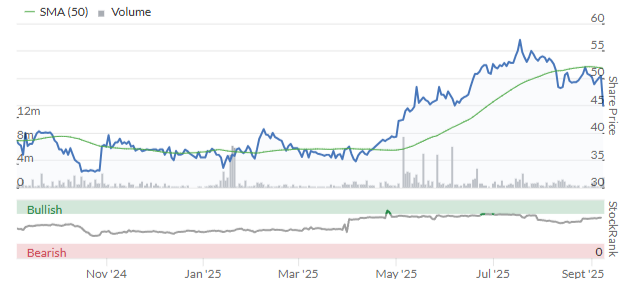
My guess is that a big hit from regulatory changes in the UK may have spooked some investors, especially as it’s masked stronger growth elsewhere:
For some background on this business, Graham was GREEN following the company’s 2024 FY update in February.
I moderated our view to AMBER/GREEN in March following the release of the company’s 2024 results, when I noted unchanged earnings estimates and capitalisation of development costs (which tends to flatter earnings).
Let’s take a look at today’s results.
H1 results summary
Today’s figures cover the half year to 30 June 2025 and include some seemingly strong headline numbers:
Revenue up 18% to £16.0m
Adjusted EBITDA up 30% to £7.5m
Pre-tax profit up 19% to £4.2m
These figures highlight the group’s attractive profitability, with an operating margin of 25% and a trailing 12-month return on equity of 22.6%.
The only caveat I’d add to this is that as previously, profits were significantly flatted by the capitalisation of software development costs. While this is a common industry practice, the impact is material.
Gaming Realms only amortised £2.2m of intangible assets in H1, but capitalised £3.4m of development costs (mostly software developers’ salaries). If the company had followed the more conservative practice of expensing all costs as incurred, then pre-tax profit for the half year would have been around 28% lower, at c.£3.0m.
As a result, the stock’s P/E ratio would be significantly higher – perhaps in the low 20s, prior to today’s drop.
Happily, we don’t have to worry about the balance sheet here. Net cash rose by 28% to £19m in H1, aided by c.£2.3m of favourable working capital movements.
Trading commentary - UK takes a regulatory hit
The company continued to expand its reach in H1, adding 19 new partners globally. These included the US, Canada (BC), Brazil, Colombia and Europe. Six unique new Slingo games were also released, taking the total distributed games portfolio to 95.
According to a Canaccord Genuity note available on Research Tree this morning, the company now has a total of 244 partners.
I think we can understand today’s fall more easily if we drill into today’s revenue numbers. These show a more mixed performance for the half year:
Content licensing revenue: up 4% to £11.7m
Brand licensing revenue: up 623% to £2.4m
Social publishing down 7% to £1.9m
Content licensing: Gaming Realms’ core business is distributing games through partners (typically gaming operators) into regulated markets. The first half of this year saw a mixed performance.
According to the commentary, UK content licensing revenue fell by 13% in H1 due to staking limit changes introduced in April 2025. This trend is said to have reduced to a 9% decline by August, as updated games were certified and released.
Ex-UK content licensing revenue rose by 18% during H1, with the US up by 22%.
Brand licensing rose by 623% to £2.4m due to the “completion of a significant brand deal during the period”. The geographic market for this deal wasn’t disclosed, but as I’ll explain below, I am guessing it may have been the USA.
Geographic breakdown: you’ll notice I’ve used percentages above when discussing content licensing revenues in different markets, not monetary amounts. So it’s not entirely clear how much revenue the UK contributes.
There’s a reason for my vagueness. Although Gaming Realms’ results do include a segmental breakdown with revenue generated by geography, these numbers don’t add up in the same way as the percentages I’ve listed above. The licensing column also appears to include both content and brand licensing:
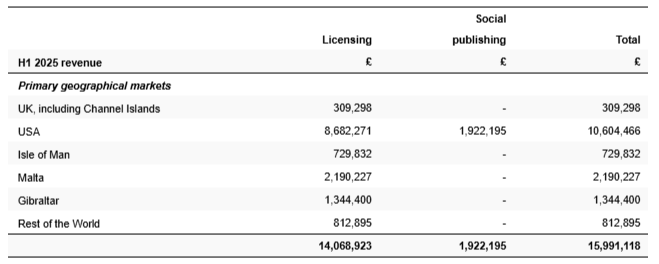
I believe this split reflects the company’s use of operations in Malta, Gibraltar and the Isle of Man. Gaming Realms generated 30% of its licensing revenue in these markets in H1, but these locations are obviously unlikely to be home to 30% of the company’s end-users.
Use of these offshore locations is pretty standard in the UK online gaming sector due to the tax and regulatory benefits they provide. My best guess is that most (but not all) of the revenue from these three markets is effectively UK revenue.
In corroboration of this, today’s note from Canaccord Genuity indicates that “c.29%” of content licensing revenue is generated in the UK – so that would have been around £3.4m in H1.
I am also going to speculate that the “significant brand deal” that closed in H1 was in the US – that would explain the mis-match between 54% growth in US revenue to £8.7m and the reported content licensing increase of 22% for the US.
Social Publishing: this part of the business is described as “B2C freemium games to the US”. I assume this means Gaming Realms’ own online operations in the US, rather than those of its licensing partners.
Revenue fell by 7% to £1.9m in this division in H1, which we are told is due to a 44% reduction in marketing spend during the period. It looks like this is a business where churn is high, and consistent promotion may be required to maintain user growth.
The company says this is a timing issue and higher marketing spend in H2 is expected to support “stronger revenue levels”.
Outlook
Today’s management outlook statement seems pretty clear to me:
Trading in the first half of 2025 was in line with expectations, and the Board remains confident that the Group will maintain this positive trajectory through the remainder of the year.
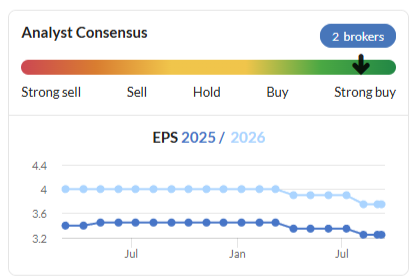
Canaccord Genuity has left its revenue forecasts unchanged today but has trimmed EPS estimates slightly:
FY25E EPS: 2.9p (prev. 3.0p)
FY26E EPS: 3.5p (prev. 3.7p)
As I’ve commented in March, these estimates are lower than the consensus figures shown in Stockopedia of 3.25p and 3.75p for FY25 and FY26 respectively. However, the consensus view has been declining in recent months, so perhaps Canaccord are right to be more cautious:
Roland’s view
Gaming Realms’ business model appears to be continuing to deliver attractive growth outside the UK. But today’s results provide a useful reminder that businesses of this type are often vulnerable to regulatory change, sometimes unpredictably so.
Progress remediating the impact of April’s changes seems positive, but we don’t yet know if UK revenues will return to pre-April levels in the near future.
Another concern, for me, is that the company’s habit of capitalising development costs means that its shares may be more expensive than they might seem, on a cash-earnings basis.
Finally, we can see that at least one broker covering this stock has trimmed its earnings estimates today.
My overall impression is that the impact of April’s UK regulatory changes may have been a little more severe than expected. But on balance, this still looks like a highly profitable and cash-generative growth business to me.
In terms of valuation, applying a reduced share price of 44p to Canaccord’s FY25 earnings estimate of 2.9p gives a P/E of 15 – broadly unchanged from the stock’s pre-results valuation.
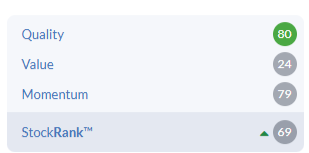
Stockopedia viewed the stock as a High Flyer ahead of today’s results, but I suspect this could change when today’s results and updated estimates are digested by the algorithms. The ValueRank is already weak and I expect a drop in MomentumRank following today:
I am inclined to trim our view to AMBER today, given the negative reaction to today’s figures and the recent declining trend of earnings estimates. However, I think any further weakness could leave this stock attractively valued and worthy of a closer look.
Phoenix group (LON:PHNX)
Down 6% to 625p (£6.3bn) - Roland - Interim Results - AMBER/GREEN
Life insurance and retirement specialist group Phoenix has become a popular choice for investors seeking high yield investments. The stock is up by more than 20% year-to-date, despite this morning’s 6% drop:
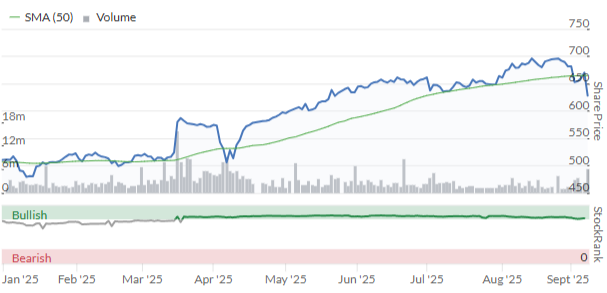
However, today’s half-year results appear to have disappointed the market, despite the company’s clear statement that Phoenix is “firmly on track to meet 2026 targets”.
The company has also taken this opportunity to inform the market that it will be changing its name to become Standard Life plc in March 2026. Phoenix already controls this brand and uses it within its operating businesses.
Half-year results summary
I should start with a caveat – I’m not an expert in life insurers, whose accounts are deep and complex. However, I do have some interest in Phoenix and its various UK peers, which all offer very high and seemingly sustainable dividend yields.
In my view, a few key points can give us a flavour of the strengths and any weaknesses in today’s numbers, without requiring actuarial training to understand!
Phoenix helpfully provides a table with most of the key metrics at the top of its results. These are the numbers I normally focus for an initial review – the company reports on each of them in more depth further down.
Dividend: the first point many shareholders will check is the dividend:
Interim dividend up 2.6% to 27.35p per share
This looks fine to me. It’s in line with the company’s commitment to a progressive payout and – as we’ll see shortly – the c.£275m cost is comfortably covered by surplus cash.
Cash: surplus cash is a key output from this type of business. It’s used to support the dividend, meet regulatory requirements and help fund organic growth. Phoenix reports two measures:
Operating cash generation up 9% to £705m
Total cash generation down 17% to £784m
Operating cash generation represents money remitted to the group from the ongoing operations of its subsidiaries – effectively recurring cash generation.
As is common across this sector, this comes from a mix of “surplus emergence” generated by its insurance policies (e.g. when they mature) and so-called “management actions”.
Management actions are basically activities carried out to optimise returns from the assets that underpin its insurance policies. They might include changes to asset allocation and other such activities.
Surplus emergence generated £411m in H1, with management actions contributing £294m.
The important point I always check here is that operational cash generation is covering the group’s operating costs, dividends and debt interest.
In this case, cover looks comfortable – these recurring outgoings totalled £459m in H1, leaving £246m of surplus operational cash generation. One caveat to this is that Phoenix says the timing of new bulk annuity business means that the H2 surplus is likely to be lower.
Total cash generation includes operating cash (recurring) and non-recurring items such as one-off returns of capital from group companies and “non-recurring management actions”. These are inherently likely to be lumpier, so I don’t think today’s drop in total cash generation is a major concern.
Phoenix notes that it has already cumulatively generated £2.6bn of cash since the start of 2024, more than half its 2024-26 target of £5.1bn.
Capital: this is a complex area, but the factors are surplus capital generation, coverage of regulatory requirements and leverage.
Surplus capital generation is a close relative of cash generation, but not an exact match!
In this case, the group’s “Solvency II” capital position improved slightly, with surplus capital rising by £0.1bn to £3.6bn, after allowing for the 2025 interim dividend.
This is a regulatory measure of capital and this increase improved Phoenix’s Solvency II coverage ratio by 3% to 175%. That’s towards the top end of the company’s target range of 140% to 180%.
The group’s leverage ratio reflects debt usage and some other factors. It improved (i.e. fell) to 34%, from 36% at the end of 2024.
Phoenix is targeting a 30% leverage ratio by the end of 2026. Management says it remains on track, “albeit the path will not be linear”.
For contrast, Aviva (disc: I hold) recently reported a 32.3% leverage ratio, while Chesnara reported 31%. So the Phoenix figure does not seem unusual for this sector, but is perhaps slightly above average.
Earnings & Shareholders’ Equity: the final element of the accounts worth checking is the profit and loss statement and the resulting impact on shareholders’ equity on the balance sheet.
IFRS accounting rules mean that the statutory figures here are often not that meaningful as comparisons, as they can be skewed by large mark-to-market valuation changes.
In this case I think the most useful measure is probably adjusted operating profit, which rose by 25% to £451m. This was driven by growth in the group’s main operating businesses, Pensions and Savings and Retirement Solutions.
This fed through to a 10% increase in Contractual Service Margin (CSM) to £3,567m. This reflects expected future profit from the group’s portfolio of (long term) insurance contracts.
This business model entails carrying a huge body of assets and liabilities on the balance sheet, which should be evenly matched. Phoenix has reported £310.0bn of assets today and £308.2bn of liabilities.
The various movements in the value of these assets (mostly on paper) resulted in a statutory loss of £156m during the period.
This contributed to a 6% fall in adjusted shareholders equity fell by 6% to £3,443m. This was slightly below JPMorgan forecasts, according to the Reuters newswire.
Obviously we wouldn’t want to see equity continually falling. But IFRS accounting means there will be some volatility in equity that won’t necessarily reflect real-world cash generation.
I tend to share the company’s view that surplus cash generation and capital generation are the key measures to follow.
The main risk with equity, in my view, is that it could be wiped as a result of some long-term miscalculation or change in expectations of future cash flows and liabilities. I see this as a long tail risk with this kind of business; unlikely, but not impossible.
Trading commentary: Phoenix was historically a closed-book specialist, buying existing portfolios of insurance policies from other companies and running them to completion. The group did well at this, but was starting to struggle for growth.
As a result, recent years have seen an expansion in the group’s new business operations, in an effort to generate sustainable growth.
Progress in H1 included FCA approval for “our own in-house Retail advice proposition”, supporting planned product launches. This will presumably include pensions and other retirement savings and investment products.
Another growing area of new business is individual annuities. The company launched “Annuity Desk” for Standard Life customers in H1 to help digitise this service.
Bulk annuity premiums are a key source of earnings, too. New deals were low in H1, at just £0.8bn. However, this is a lumpy market and £2.9bn of new deals are said to have been completed or gone exclusive since the end of June, somewhat redressing the balance.
Outlook
CEO Andy Briggs sounds confident:
Firmly on track to deliver all our financial targets which support our progressive and sustainable dividend policy
I don’t have access to broker notes for this business but expect forecasts to remain broadly unchanged. On that basis, Phoenix shares are trading on a forward P/E of c.10x, with an 8.8% dividend yield.
Roland’s view
Phoenix has proven expertise at running closed book portfolios and has done well in this business. I’ve followed this company for several years and guidance for cash generation and dividends have been consistently met or exceeded.
I think it’s fair to argue that there’s more uncertainty about new business growth and profitability, but I’m encouraged by progress so far and don’t see any reason to change that view today.
I think a moderately positive view makes sense today. This is a large, complex business and the shares are not as cheap as they were. But I think there’s a good probability Phoenix will be able to maintain and extend its attractive dividend record, which I would see as the main reason for holding the shares.
Disclaimer
This is not financial advice. Our content is intended to be used and must be used for information and education purposes only. Please read our disclaimer and terms and conditions to understand our obligations.

47 comments
Morning, Gaming Realms (LON:GMR) smacked this AM, interims looked fine, maybe budget weighing?
Gaming Realms (LON:GMR) (I hold) totally agree it looks fine and a drop of 14% seems excessive for a "meets expectations" with 18% increase in profits and 28% increase in cash! The revenue fluctuation in the UK is probably the main reason for this but they seem to be fixing it and a 22% increase in the USA should really deliver a more positive view for the future. Typical AIM response, I'm becoming increasingly concerned about the AIM Market.
Gaming tax potentially?
Gaming Realms (LON:GMR)
Typical AIM response, I'm becoming increasingly concerned about the AIM Market.
I would agree with the consensus here that broadly speaking they are on target. Lets be frank though if prior expectations were 3.25p eps and that has slid to 3p and then 2.9p. even though they are on track in the now - things have clearly slightly worsened a tad - so lets not beat about the bush there.
At present i think there is perhaps just too many moving parts for the maket to say this is worth a premium. Thats without thn elephant in the room of possible extra taxation in the budget.
Do we need a conspiracy thoery here about the AIM market not being fir for purpose i would say no.
Holders have to appreciate that the shares had a great run up from sub 40p based on pretty much the same news as now. higher than current forecasts existed before the uplift from 40p to the recent highs - so the share is pretty much back where it was on very similar news - possibly higher even now than then.
I dont think current valuation is particularly cheap or expensive so imho its up to each holder to say what they think its worth. I got lucky with this one having sold out when price went over 50p - i did that with caution more to do with slighty worry they would miss targets than anything else. I think i am perhaps not alone in thinking that over 50p wasnt a bad spot to cash in one chips - the share having had a great run up.
so perhaps for now holders may need to wait to see what initital thoughts are ref 2027 numbers are initially pencilled in before they can expect highs to be reteted.it would surprise me though if it was either 35p or 60p on no new news - this is the kinda share that is likely to potentially "do its own thing".
The good news for holders though is that at present prior expectations are roughly being held for this year and next - i understand the market reaction is frustrating - but this isnt really the kind of share where one should really be expecting price premium to exist while there are niggling minor uncertainties.
Gaming Realms (LON:GMR) Unfortunately, companies on the AIM market are getting hit any time there is any slight negative news. Much of the news today was well flagged. Peel Hunt have dropped their EPS figures as they have started including tax - as the company had losses to offset taxes before. We also knew that the changes to stake limits in the UK would mean some rejigging of their games here. The fact that the figures are in line despite this temporary headwind to UK revenues is remarkable.
It's amazing that a company that has to do almost no marketing and can grow EBITDA at over 30%, despite a period of headwinds, is on such a low multiple, with a huge cash pile on the balance sheet.
There are some temporary UK headwinds here; however, the reality is that this is a stock that might only just be getting started and the UK is becoming a smaller part of the business. US states are becoming increasingly strapped for cash and therefore regulating online casino will feel like an increasingly attractive option. 6 US states have regulated igaming so far; however, the opportunity is potentially enormous - although we are unlikely to see a new state regulate until 2027. Even without a new state, Gaming Realms has grown its US revenue by over 30% year on year. In addition, Alberta in Canada will follow Ontario's successful regulation of igaming in the spring next year which could potentially double Gaming Realm's Canadian revenues in fairly short order.
I can't help but feel that this company would be double the price if listed in the US where growth is valued. Sadly, the business will probably be bought out, like many others before it, before it can reach its full potential.
I note that Stockopedia now show a much larger drop in EPS forecasts than was originally picked up on by yourself/Roland. Has another broker updated? The behaviour of the share price on the day was more akin to that of a profit warning (rather than a slight miss on EPS estimates) and this could explain why.
Just a reminder....
We have five investment trust/funds joining us for this webinar from 1pm tomorrow
Mello's Trust & Fund shows are back following the summer break with a jam packed schedule.
Here is the FREE webinar for investors to tune in to:
Join us on the 9th September from 1pm for an excellent Trust & Funds show.
https://www.melloevents.com/mitf090925
1:00pm Introduction and keynote with Jonathan Davis of Money Makers podcast 'Are investment trusts on the way back?'
1:30pm Company Presentation from Law Debenture (LON:LWDB)
2:00pm Company Presentation from Capital Gearing Trust (LON:CGT)
2:30pm Company Presentation from Jpmorgan Indian Investment Trust (LON:JII)
3:00pm Educational Presentation
3:15pm Company Presentation from Smithson Investment Trust (LON:SSON)
3:45pm Company Presentation from Harbourvest Global Private Equity (LON:HVPE)
4:15pm Annabel Brodie.Smith The AIC
4:30pm Panel Session
You can register HERE
Phoenix group (LON:PHNX) Not the most exciting stock I know but a great income play. Interim results look pretty strong with profit up 25% vs. prior year and outlook comments positive. This combined with intention to rebrand as Standard Life has seen 5%+ fall in share price which appears surprising. Profit taking after some good momentum as has dipped from peak or something hidden in the small print? Interested to hear any comment from Graham, or Roland.
Phoenix group (LON:PHNX) numbers were mixed to say the least and given the market’s mood at present - especially given Labour’s need for more of our money - a markdown was inevitable. It will rise again (ouch!), as Standard Life.
The change of name is old news, but as I said at the time, it makes good sense and it’s an open goal for the marketing team.
Phoenix group (LON:PHNX) As far as I can tell the only figure below analyst estimates was the total cash generation, which appears to be due to hedging against the US Dollar. The rest of the results look ahead of consensus, in many cases well ahead, the 5% fall looks massively overdone to me. The results and outlook appear "firmly on track", as described, in my opinion.
Looks a good opportunity for those that want to get in and maximise the dividend yield for Phoenix group (LON:PHNX) .
Is there a possibility that despite the fine words the dividend was only increased by 2.6%
Original growth expectations on Stocko were for over 2.8%.
This may not seem much, but the expected dividend for 2026 was 57.4p only a few weeks ago.
If we get 2.6% growth over 2 years from 2024s 54.0p, then 2026s number will be 56.8p
A downgrade of 10%
Phoenix is a very complex equity to try and understand the moving parts. The best thing the management can do to demonstrate how well the business is doing, is to at least match market expectations on the dividend.
The first half dividend is what they said it would be, the same as the final dividend of last year. Come the end of this financial year, they will raise it again. That has been their policy for some time and is set out in the report. They are on track and doing fine. I must assume this is some profit-taking from those to bought below 550p in the last 6-12 months, for whom this will have been a good trade. And maybe 8.3% and rising isn't quite the bargain they hope for with rising gilts. But the gentle upward slope looks quite satisfactory to me. If people want this to remain sub 700p , I guess they must be hoping for inflation. I'm don't see a need to sell at this price.
Roland's section on Phoenix group (LON:PHNX) is spot on, especially for someone that claims to have little knowledge of Life Insurers. Probably slightly less optimistic than my view, but absolutely understanding the parts of the accounts that are important going forward.
I wish some of the so called analysts at the larger firms had anywhere near this much grasp of the way Life Insurers make money, you only have to look at some of the historical analyst notes and estimates to see how wide of the mark they can be.
I agree completely. I find these releases really difficult with the presentations and especially vocabulary so different from other sectors. Light was shed on these matters this morning, many thanks.
Treatt (LON:TET) . David Shannon was appointed CEO on 3rd June 2024 when the share price was 480p. Fifteen months later he is recommending the business be sold for 260p. I am not generally a conspiracy theorist, but you could be forgiven for speculating that he was a 'plant' by Natara! Also, what has the long serving Chairman been doing letting this implosion happen on his watch? This is supposed to be a stable and attractive business to be in!
Its a Private Equity cash bid (money proably borrowed from a Bank).at a steal price.Shareholders shoud vot to reject it.Lets hope for a counter bid.
Appearances would be differenent if the takeover was from a trade buyer. In those circumstances I'd speculate it was one of those situations where trading conditions are worse than it appears. Take the money and run on a recommended offer. (Think of XP Power (LON:XPP) and De La Rue (LON:DLAR^G25) for example.
As it is my guess is private equity have in mind gearing up Treatt (LON:TET) from its current low debt position, running it for cashflow and flipping it back into a new float or trade sale in a few years time. So if I was a shareholder I'd be voting a firm 'no' to this offer.
Treatt (LON:TET. Not a holder of this, but I might have been. I am staggered that such a low offer could be recommended. This is a high quality business which, like other big exporters, has been badly damaged by government policy. Will there be any left by the time it becomes government policy to stop penalising British-owned businesses?
No idea what you mean re gov.t
policy.
Treatt (LON:TET)
The company continues to see sustainable long term growth as a result of the focused strategy".. Errmm so let's sell it all at half price to a competitor? Cognitive dissonance in action. Confused.
Often the market ignores long term potential and looks at the short term (this year and next) - particularly if the fortunes have gone into reverse - thats exactly what has happened here.
Its obvious an opportunistic bid - and management may very well be doing the dirty - but the damage here is due the near term prospects - which managemnt have flagged up as being pants.
I doubt many mangement are going to say they dont see good long term propsects - if they are in the distant future though they are simply aspirational until they turn up on broker forecasts.
perhaps there is hope here that some of the majority shareholders may feel the same way as PI's - i supect though they may look at near term prospects and say - well that offer for company with worsening financials is at least an end to this sorry tale.
Must admit makes one wander if they knew about the bid prior to the trading update 24/7/2025. from transpareny point of view it would be interesting to know if they did. Obviously the tone of any update released by managment can be somewhat in the eye of the beholder.
thanks rmillaree ; yes I can see how you can go bust in the short term whilst having good long term prospects...
My point is more in line with the old Nomad investment partnership of Nicholas Sleep and Qais Zakaria; who I think never met with management on principle-- and focussed instead on fundamentals.
My beef is that narrative (from management/investor relations) is often at odds to the reality/numbers and yet share price is often a function of both esp. momentum stocks.
I guess pessimistic execs don't last long but what is needed is 'Energeia' ; greek for 'facing the bright unbearable reality'. I don't hold Treatt but I wish all holders well.
Its for others to say/comment on but invariably Private Equity will usually offer rollover incentive terms to incumbent management (though some may go) in the acquiring vehicle, thus tempting management to see future upside for themselves in recommending what might be considered historically a low stock market price. Either that or they are just grateful to get off the market and away from constant scrutiny it necessitates.
Treatt (LON:TET) strictly speaking you’re right Graham the buyer is a trade buyer but it’s actually Private equity masquerading as a peer. Exponent Private equity ltd is actually pulling the strings behind this move as they own Natara having bought them in 2023. Im sure this is why the offer is so derogatory! Hopefully for long suffering shareholders someone with deeper pockets will be flushed out!!!
Treatt (LON:TET)
Well the experts were right in the end, somebody did come along and bid for it, just happened to be at a price that must make existing holders recoil at and it's recommended as well!
Business must be really bad.....
An ignominious ending to a former market darling.
Treatt (LON:TET) They were doing alright until they built the new factory.
Re Treat
I recall the day when the new factory was announced and how there was some investor comment that it might not be the right time.
The company seems to have more problems than a usual business..
Furthermore, there seems to be some ad hoc comment to investors that it has product mix which includes lower quality commodity products.
A business consultant would have their work cut out here to determine if there is an underlying problem with the business that cannot be rectified as an independent company. Is this all tariff related? Probably not but there has to be some explanation.
My gut feel is that the market ( probably US market) must have changed faster than the management could identify and respond. If I was an investor I would press management on this point.
It would seem that the management have given up the fight to keep this business independent. There has to be a reason, and one which the management apparently feel that they cannot rectify.
I am an angry holder here. I spoke to the new CEO a couple of months ago and he described the profit warning as a 'perfect storm'. He did explain that parts of the business were fairly low quality and commodity like, but he also indicated that other unfortunate circumstances had aligned to produce the warning. I believed that the medium term outlook was still encouraging.
This is a ridiculously lowball offer and, unless the business has become financially distressed, it should be rejected.
It looks like the hedgies are in buying above the derogatory offer from Exponent, 2 or 3p premium over their offer at the moment, we’re all hoping a higher bid can be cajoled from somewhere.
I am a more recent shareholder and it should have been a red flag that the directors have so little invested in the business. My poor judgement. I asked ChatGPT to look at the current holdings of the principal institutional shareholders amounting to ~30% and calculate the average weighted price of their holdings using TR1's and share price info over the relevant timescale and, subject to E&O, they each appear to be sitting on a sizeable loss. The chart shows a range for each under two pricing scenarios and a mid-point. All estimates of course. It will be interesting to see how they vote
Hi Graham, The ticker for Grainger (LON:GRI) is incorrectly shown as GRI Bio (NAQ:GRI) Easy mistake to make.
Fixed it, thanks Peter.
Avation (LON:AVAP) looks very good. Revenue will be $110m vs prediction of $102m. Given that their margins are 90%, that’s a big uplift. The share price reflects a balance between debt on one side and revenues on the other. But they’ve paid back half the debt and will be accelerating that as profits grow. And the more they repay, the less interest accrues. At some point it reaches a tipping point where the ultra-profitable nature of the core business gets more attention than the debt. But it seems a well run company at a good price to me.
As I read it this morning I earmarked it for a pullback buy... do you think they suffer with the airlines in a growth scare ?
It's a fair question but they hire planes into a global market (last week announced deals with airlines in Korea and Cambodia) so it would need to be a worldwide recession and even then, that might lead to a reduction in new planes being built, so could even support rentals. But that's me thinking aloud!
Hi RDH
A good question but Avation (LON:AVAP) are in a different niche to the major airlines and their lessors. Avation (LON:AVAP) fleet is largely small aircraft used by regional airlines in countries where they are trying to build out cheap(ish) routes and with very cost effective new aircraft.
It's good that they are trying to pay down debt because that may be the first thing that investors look at. But that debt is secured on new and new(ish) aircraft. Unfortunately the values of said aircraft may go up and down. Having a lot of options for the small ATR aircraft weighs in their favour.
NAV well ahead of the share price so it's a waiting game.
I hold - as if you hadn't guessed
Surprised that Sigmaroc (LON:SRC) doesn`t feature in the above list, especially after being mentioned in `The Week Ahead` on Friday. They`ve come in with an interesting set of Interim Results. AIM stock with a tight spread.
I agree, SRC ought to be looked at as todays interims demonstrate how successfully this company is managing unhelpful markets with underlying ePS increasing by over 50%. We need more coverage of these under the radar companies, not less.
My thoughts too
Morning Stop Loss,
Sigmaroc (LON:SRC) will be added shortly - for some reason the results were not published until 07.25 and missed our original sweep of the RNS feed.
Roland
"Sigmaroc (LON:SRC) will be added shortly"
but it's still not even on the agenda, a missed opportunity to draw attention to an interesting and profitable company imo. By tomorrow no-one will bother looking back I suspect.
Yep disappointing
I've looked at Sigmaroc (LON:SRC) now, better late than never I hope! Also I do apologise that it didn't made it into the table until later in the day.
Recommended offer for Treatt (LON:TET) from private equity owned Natar Global at 260 pence per share seems to me to be a grotesque and opportunistic undervaluation of a fallen angel. I am not a holder, but it is another sad day for UK-listed companies. It will be interesting to see if this flushes out any other bidders like Kerry Ingredients or maybe Robertet. The moat at Robertet is considerably wider and deeper than the puddle surrounding Treatt though.
Whatever the board know about the businesses future must be dire to bail out at that price. What will remain on LSE with the current run of buy outs and no IPO’s?
To be fair the Co has highlighted the deteriorating trading situation alongside their “recommendation” hopefully a peer co will recognise the Co is getting stolen away at this price.