Daily Stock Market Report (Thur 25th June 2026) - HFD, ING, MOON, VLX, III, EZJ, AMS, TIME

The big overnight mover is the oil price which officially returned to pre-war levels. The spot price for Brent crude has fallen to $72.50.
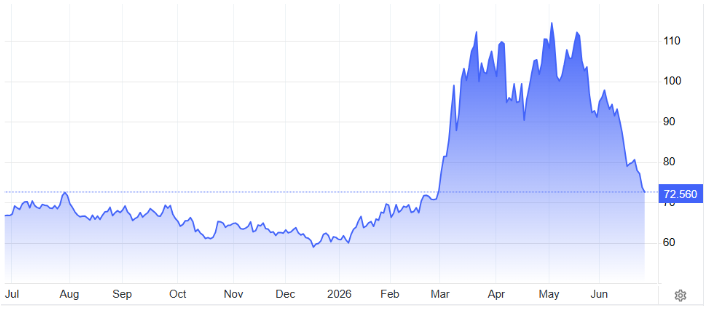
Although talks between the US and Iran still have a long way to go, the reopening of Hormuz has massively increased supply. I think we’ll be able to refer to the Iran situation and the oil price much less frequently in these preambles from now on!
Overnight market movements:
The FTSE is set to open down 0.3% at 10,425
S&P 500 is up 0.6% at 7,405
Brent crude (August) is down 1.8% at $72.50/bbl
Gold is down 0.3% at $3,987/oz
Bitcoin is up 1.2% at $61,700
Roland Head joins me today.
Signing out now, thank you.
Companies Reporting
| Name (Mkt Cap) | RNS | Summary | Our view (Author) |
|---|---|---|---|
3i (LON:III) (£23bn | SR54) | Action LFL sales growth was 3.3% year-to-date (21 June). New store openings of 105 are on track for 2026. The remainder of the PE portfolio “continues to demonstrate good momentum in line with our expectations”. | AMBER/GREEN ↑ (Roland) [no section below] 3i previously reported Action LFL sales growth of 3.6% for the year to 29 March and of 2.4% for the year to 10 May. If year-to-date growth on 21 June had risen to 3.3%, then I estimate Action may have seen LFL sales growth of c.6% from 10 May to 21 June. This is encouraging as it appears to have reversed the declining LFL trend 3i reported for Action earlier this year. The concentration risk still applies here – value retailer Action accounts for the vast majority of 3i’s portfolio and is valued by 3i at a premium to many other comparable retailers. However, investors who are confident in the growth story for Action may argue this is justified, given the lacklustre performance of many sector peers. 3i shares are still trading at a c.15% discount to book value after this morning’s gains and also offer a 3.7% yield. I think this investment trust might be worth a closer look, so I’m moving our view up one notch to mirror the stock’s Contrarian styling. | |
Balfour Beatty (LON:BBY) (£4.2bn | SR73) | Two-year contract from SSEN to deliver the Netherton Hub in Aberdeenshire, Scotland. This is a facility to improve transmission of renewable energy nationwide. | ||
easyJet (LON:EZJ) (£4.1bn | SR42) | Rejection of Possible Offer for easyJet and Extension of PUSU | SP +7.5% easyJet has rejected a further proposal from Castlelake of 650p per share but has decided to give Castlelake access to “limited commercial information” in the hope of producing “a more attractive proposal”. The PUSU deadline has been extended to 5pm on 5 July 2026. | TAKEOVER (AMBER/GREEN =) (Graham) [no section below] |
Serco (LON:SRP) (£2.3bn | SR83) | H1 revenue +3%, with adj operating profit of c.£155m delivering a margin above 6%. Over £2bn of contract awards and extensions, with order intake of over £500m in AsiaPac. FY26 guidance unchanged for revenue of c.£5bn and adj operating profit of c.£300m. | ||
Sirius Real Estate (LON:SRE) (£1.57bn | SR74) | Sale of two business parks near Sheffield for £5.3m, a 3% premium to book value. Also exchanged contracts to develop three self-storage locations in the UK, with a total cost of £12.6m. The balance will be funded by further planned UK disposals this year. | ||
Chemring (LON:CHG) (£1.32bn | SR35) | Signed agreement with US DoW to resume sustained manufacturing at the Alloy Surfaces business, which was previously classified as discontinued. Contract value of up to $300m over five years, with a minimum of $35m/yr for the first three years. No change to FY26 or FY27 guidance. | ||
Resolute Mining (LON:RSG) (£1.09bn | SR64) | Resolute will receive a payment of A$77 million (approximately US$54 million), representing full repayment of the outstanding principal and accrued interest under the Vendor Financing Promissory Note. | ||
Volex (LON:VLX) (£1.08bn | SR81) | Preliminary Group Results FY2026 & Update on Move to the Main Market | Revenue +14.4%, adj operating profit +19.9% to $127.3m. Adj EPS +19.8% to 43.5c, in line. Net debt reduced to $152m. Growth led by strong Complex Industrial division, including Data Centre demand “from a leading hyperscale customer”. FY27 outlook: trading in line with expectations. Move from AIM to Main Market scheduled for 24 July 2026. | AMBER ↓ (Roland) Today’s results look strong but with sales falling in two of the group’s five divisions last year, it’s clear to me that last year’s gains were largely driven by Data Centre demand. I’m a little surprised to see that this appears to have been driven by a single customer, raising some concentration risk. Today’s outlook guidance is in line and the move to the main market raises the possibility of further share price weakness as AIM IHT funds become forced sellers. I still think this is a decent business, but earnings growth is expected to slow this year and my feeling is that the valuation is largely up with events. To reflect this I’ve decided to move our view to neutral, albeit perhaps overcautiously. |
Spire Healthcare (LON:SPI) (£894m | SR57) | Remains in talks with Toscafund. Deadline for a bid has now been extended to 5pm on 9 July 2026. | TAKEOVER | |
Moonpig (LON:MOON) (£677m | SR69) | Revenue +6.5%, adj pre-tax profit +13.4% to £76.5m. Adj EPS +19.5% to 18.0p. Order growth of 2.1%, average order value +5.7%. Plans £65m buyback in FY27. Outlook: trading in line with expectations. | GREEN ↑ (Graham) I’ve been a little nervous about the balance sheet at Moonpig, and that’s the main reason I’ve not been fully GREEN on it yet. However, the company reports £73.5m of free cash flow today - that’s enough to fund the year’s £60m buyback while still having enough left over to fund 4.5p of dividends (the actual dividends for the year are only 3.75p). Meanwhile, balance sheet equity is minus £180m. This is due to the the combination of a) financial leverage; and b) a “negative working capital”. | |
Advanced Medical Solutions (LON:AMS) (£529m | SR59) | SP +16% | TAKEOVER (Graham) [no section below] | |
Halfords (LON:HFD) (£394m | SR95) | Preliminary results for the 53-week period ended 3 April 2026 | Revenue +2.9% with LFL sales +4.8%. Adj pre-tax profit +4.1% to £50.0m with 53-week adj EPS of 17.4p. On a 52-week comparative basis, adj EPS is up 0.6% to 15.7p (FY25 restarted: 15.6p). Net cash of £19m. FY27 outlook: expect adj pre-tax profit to be towards the top end of the consensus range. | AMBER/GREEN = (Roland) Today’s results are flattered by a change to the group’s accounting policy that boosts its profit calculation. Even so, I think it’s a fairly solid performance in a difficult year, with good cash generation. Today’s outlook guidance suggests double-digit profit growth over the coming year, but this remains a low-margin business in a competitive market. On balance, I think our AMBER/GREEN view is a fair reflection of the risk/reward balance here. |
SDCL Efficiency Income Trust (LON:SEIT) (£364m | SR n/a) | NAV -14.1% to 77.8p per share. Portfolio valuation -10% to £1,078.4m. Total dividend paid 4.8p (FY25 6.32p), no fourth dividend to be paid. Intends to pursue a managed wind down or portfolio sale. | ||
Avacta (LON:AVCT) (£342m | SR8) | Platform-Validating Data with Faridoxorubicin & FDA Agreement on Pivotal Trial Design for AVA6000 | Seen robust tumor responses in patients with salivary gland cancer (SGC) for patients treated with faridoxorubicin. Has agreed the pivotal trial design for faridoxorubicin (AVA6000, pre|CISION-enabled doxorubicin) with the U.S. Food and Drug Administration (FDA) for a potential full regulatory approval. | |
Tharisa (LON:THS) (£333m | SR99) | Secured new ZAR750m (USD45.5m) revolving facility from Nedbank. Includes an option to increase the facility to ZAR1.25bn. Ensures underground mining fleet is now fully funded. | ||
B.P. Marsh & Partners (LON:BPM) (£252m | SR72) | Agreed $5.1m investment for a 17.9% interest in Autonomy, which is a newly formed investment vehicle. Autonomy has been established in partnership with XPT and will invest in US insurance distribution businesses, including XPT. BPM will receive a $12.1m payment from XPT for redemption of preferred units and debt as part of the transaction. | ||
Cornish Metals (LON:TIN) (£144m | SR19) | Has signed and concluded a new mineral lease in the mineral rights area at South Crofty. The Dudnance Lease is valid for 25 years. TIN owns 50% of the mineral rights and has agreed the lease with the family that owns the remaining 50%. | ||
Mercia Asset Management (LON:MERC) (£122m | SR52) | Warwick has completed an equity funding round of £6.4m, with additional funding of up to £1.1m anticipated. This will underpin the next phase of growth including the recent partnership with Jaguar Land Rover. Mercia has invested £0.7m from its balance sheet, with the remainder coming from a Mercia-managed fund and other co-investors. | ||
Aptitude Software (LON:APTD) (£112m | SR38) | New Fynapse contract win with a leading Canadian financial services group managing over C$100bn in assets. 3yr contract has a value of US$5.54m. | ||
Braemar (LON:BMS) (£76m | SR90) | Richard Heading appointed as CFO. He will join on 29 June 2026. He was most recently CFO at Record plc and was previously at IG Group. | ||
Clean Power Hydrogen (LON:CPH2) (£68m | SR n/a) | The parties have agreed to enter into definitive documentation relating to a Convertible Loan Note alongside a nine-month exclusivity period to negotiate and agree a Strategic Partnership and Manufacturing and Technology Development Agreement. “Hidrigin acknowledges the recent failure at final testing of the technology by CPH2 but continues to believe in the global potential for this new category of electrolyser and are investing to bring it to market.” | CPH2 shares have been suspended from trading since 29 May 2026. | |
Seascape Energy Asia (LON:SEA) (£62m | SR34) | Significant progress on Temaris field development with all key FEED (engineering) contracts awarded and well design completed. Initiated a process in Q1 to introduce a strategic partner into Temaris. Now broadening the scope to consider a wider range of participants and structures. | ||
Caspian Sunrise (LON:CASP) (£47m | SR32) | Deep Well 803 has been deepened to 3,927m. On the basis of the encouraging results to date at Deep Well 803 three further deep wells are to be drilled on the Yelemes Deep structure with Deep Wells 701 and 707 expected to be spudded in July 2026. | ||
Time Finance (LON:TIME) (£46m | SR76) | Gross lending book +15% to £250.9m. Adjusted PBT +8% to £8.5m. Statutory PBT £8.4m. Net arrears and net bad debt write-offs are both “relatively stable”. “We have a proven, simple model that continues to deliver and the Board is confident that the Group remains appropriately positioned on its growth strategy…” | GREEN = (Graham) [no section below] No reason to change my positive stance here. If I was being very fussy, I could zoom in on the very slight increases in net arrears. But the change of 0.2% is just a rounding error, and net bad debt write offs have improved. The big picture is that the lending book is up 15% and net tangible assets are up £6m, exceeding the market cap. According to Cavendish, we can look for EPS to improve from 6.8p (FY May 2026) to 7.6p (May 2027). With the current share price of less than 50p, I continue to find this one attractive in terms of both the value and the growth that it offers. | |
Zambeef Products (LON:ZAM) (£29m | SR81) | Revenue +2.3% (measured in Zambian Kwacha), +29.2% (measured in USD). Material appreciation of the Kwacha during the period. Kwacha PBT +58%, USD PBT +99% to $3.8m. “Looking ahead to the second half of the financial year, the completion of the summer crop harvest in June is expected to materially improve the Cropping division's contribution and provide a favourable internal raw material base for Stockfeed and Milling.” | ||
Rome Resources (LON:RMR) (£27m | SR25) | Raised £1.6m in H1 2026. 2026 has seen the completion of a further 3,250m drilling programme at the Bisie North Project. Broader Kalayi intercepts from 2026 drilling have verified the geological model. Material uncertainty re: going concern. | Slow to publish FY25 results. | |
Petro Matad (LON:MATD) (£21m | SR17) | Mid-2026 Update: Production from Heron-1 has continued as forecast and production from Gazelle-1 has exceeded expectations post the period end. Average production year to date is 233 bopd. Block XX farm-out discussions are continuing, and with the significant rise in the oil price, an uptick in interest has been shown by a number of potentially interested parties. | Slow to publish FY25 results. | |
First Property (LON:FPO) (£20m | SR65) | PBT +12% to £3.4m. Cash £6.95m. Total AUM £189m (FY25: £220m). "The economy and markets remain challenging, but we are identifying some interesting deals and taking the opportunity to buy them where possible.” Positive outlook. | ||
Cleantech Lithium (LON:CTL) (£19m | SR21) | CTL had expected ratification of the CEOL to take place in Q2 2026, however, the administrative process with the Comptroller General's Office is taking longer than anticipated as it works through all the CEOL decrees put forward by the previous Government. CFO’s consulting agreement extended to September. | ||
Aptamer (LON:APTA) (£18m | SR8) | Aptamer has initiated its AI development programme, representing a significant step towards building an AI-enabled Optimer® discovery engine. Capital expenditure has been deployed to purchase new automation equipment, and the company has made significant progress across its internal therapeutic development pipeline: | ||
NAHL (LON:NAH) (£18m | SR76) | “...the positive trading momentum recorded in the first quarter of 2026 has continued into the second quarter of 2026. As a result, the Board remains confident in delivering a full year outturn in line with management's expectations.” | ||
Manolete Partners (LON:MANO) (£15m | SR63) | Realised revenue £27.9m in line with expectations. Adjusted realised PBT £0.1m. Two debtors did not pay when anticipated… the total net exposure to these debtors is £4.7m. The adjusted realised PBT figure is after taking a £1.8m provision against these debtors. Outlook: a positive start to FY27. Case signings and completions ahead of the prior year. | ||
Block Energy (LON:BLOE) (£14m | SR15) | The 3D seismic programme, covering the highly prospective Martkopi Terrace prospect within the XIQ PSC area (Project IV), is scheduled to commence in July. | ||
Ingenta (LON:ING) (£13m | SR97) | “...the Company is expecting to deliver increased revenues in 2026 compared with 2025… additional costs being incurred by the Company will result in EBITDA for the current year being a little lower than in 2025, despite the increased revenues.” | AMBER ↓ (Graham) | |
Orchard Funding (LON:ORCH) (£12m | SR92) | Final results for 18-month period. PBT £6.59m. Borrowings £33.6m. "...a strong set of results for an 18-month period that has reshaped our business. We have continued to grow our lending in our core market of insurance premium finance while carefully managing our costs and margins.” | ||
Mind Gym (LON:MIND) (£10m | SR21) | Revenue -23%, like-for-like revenue -7%. Adjusted EBITDA £0.6m, pre-tax loss £5.2m. Outlook: “...in FY27 we anticipate a return to modest revenue growth alongside positive EBITDA and a strengthened cash position.” Going concern warning. |
Graham's Section
Ingenta (LON:ING)
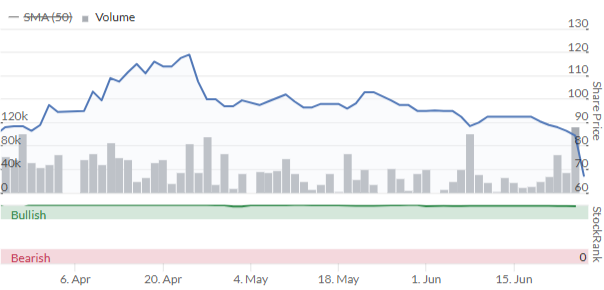
Down 17% at 69.98p (£10m) - AGM Statement - Graham - AMBER ↓
This is a “leading provider of software and services to the publishing and media industries.”
It looked cheap to me in April, but unfortunately it has only gotten cheaper since then, with the market cap falling from £15m to £10m since then:
A quick summary of this AGM statement:
Over £2m of new business wins this year (context: historic annual revenues of c. £10m).
Encouraging pipeline of further opportunities across core markets.
The £2m figure relates to a 3-year period, so this is really just £700k p.a.
New guidance is not great in terms of profitability:
As a result of this new business momentum, the Company is expecting to deliver increased revenues in 2026 compared with 2025. The management team is continuing with previously announced plans to invest in building our sales and marketing resources, and the additional costs being incurred by the Company will result in EBITDA for the current year being a little lower than in 2025, despite the increased revenues.
Adjusted EBITDA last year was £1.6m.
Estimates: I am going to record today’s news as “BLACK” for profit warning, as the market is clearly disappointed by the news that 2026 EBITDA will be lower than the prior year.
However, for completeness, I should note that there were no 2026 forecasts for Ingenta as of yesterday. So it could be argued that it’s not a real profit warning, as there were no official consensus estimates.
That changes today with the release of forecasts from Cavendish:
2026 revenue £10.6m (up £0.3m)
2026 Adj. PBT £1.4m (down £0.2m)
2026 adj. EPS 8.8p (down 1.4p)
Further ahead, there aren’t any 2027 estimates and the company included the following paragraph in today’s statement:
Looking beyond the current year, as previously noted, there is ongoing attrition of some longer-term customers currently on our legacy platforms who have been seeking to move to global whole-enterprise software platform providers. Some of the larger customers in this group have requested to move to shorter term contracts, which reduces our visibility over future revenue streams, and introduces a greater risk level to 2027 revenues and beyond. As a result, we are prepared for the new business wins described above to be subject to an offsetting impact from reduction in revenues from these customers in 2027, although some degree of mitigation will be achieved in future years by reducing costs related to the servicing of these customers.
Graham’s view
I have to downgrade our stance on this for a few reasons today.
Firstly, the news that profits will be lower this year than last year has clearly disappointed the market.
The Cavendish forecasts are helpful but in P/E terms the stock is now trading at 8x 2026 earnings, which is a little higher than the StockReport’s trailing 7x figure.
Also, the note that there’s less visibility and a higher risk level around 2027 revenues leads to the conclusion that we can’t expect growth here in the short-term.
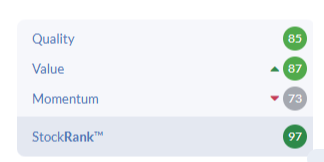
Ingenta is considered a Super Stock by the computers but I think that a neutral stance is the right call for me today, downgrading just one notch from my previous view.
Software companies at this small scale are vulnerable to lumpy, contract-driven revenues and management here has explicitly warned us that they can’t predict their 2027 results with much certainty. It says something that Cavendish waited until now to give us 2026 estimates.
All of that being said, I still think that deep value arguments could be made here. The cash balance at December 2025 was £5m. Cavendish are forecasting that the closing net cash figure for 2026 will be £4.9m.
So my position is as follows: I am neutral on Ingenta due to the lack of visibility and the downward pressure on its earnings.
At the same time, I think that it would easily be worth more than its current market cap if it was acquired in its current condition, due to the cash balance. But I can't guess at the likelihood of this happening.
I am therefore AMBER on it today, reflecting the pressures it is likely to face in the short- and medium-term.
Moonpig (LON:MOON)
Up 7.5% at 240.8p (£728m) - Final Results - Graham - GREEN ↑
I’ve gradually come round to the idea that this might be a QARP-type of share (quality at a reasonable price). The reasons are clear enough: it’s a well-known consumer brand earning high gross margins in a niche where it controls the majority of the market (online cards).
FY April 2026 was a good year:
Revenue +6.5% (£373m)
Gross margin down 1.2 percentage points to 58.4%
Adj. PBT +13.4% (£76.5m)
Actual PBT £68.9m.
Lots to like here, with profits growing faster than revenues and revenue growth itself quite good. The Moonpig brand grew 8.6% while the Dutch brand Greetz was slower at 1.5%.
The main driver of revenue growth was order value (5.7%) rather than the number of orders (2.1%).
Dividends and buyback: the total dividend for the year is 3.75p, covered well by earnings per share of 18p.
There was also £60m of buybacks, with another up to £65m planned this year.
CEO comment:
"These results demonstrate the strength of Moonpig Group's brands, customer proposition and business model. The Group delivered good growth in revenue, profitability and cash generation whilst continuing to invest in the capabilities to support our future ambition.
Outlook: expectations unchanged.
Graham’s view
I’ve been a little nervous about the balance sheet at Moonpig, and that’s the main reason I’ve not been fully GREEN on it yet.
However, the company reports £73.5m of free cash flow today - that’s enough to fund the year’s £60m buyback while still having enough left over to fund 4.5p of dividends (the actual dividends for the year are only 3.75p).
In the company’s words:
We maintain high gross margins, operate with negative working capital and manage capital expenditure within a disciplined return-on-investment framework. Combined with low inventory risk and operational leverage across fulfilment and technology, these characteristics enable the Group to consistently generate strong Free Cash Flow. This Free Cash Flow exceeds the reinvestment requirements of the business and provides flexibility to invest in organic growth, maintain leverage within our target range and return capital to shareholders.
The leverage multiple for the end of the financial year was 1.03x, which is modest.
And as the leverage multiple uses adjusted EBITDA as the denominator, it’s worth pointing out that the company has done a great job of converting adjusted EBITDA into real profits - or at least, it did in FY26. £105m of adj. EBITDA was converted into pre-tax profits of £68.9m.
Last year, the company suffered a very large impairment charge (£56.7m), which dragged down the statutory profit numbers.
Checking the balance sheet, I see that there are still £130m of intangibles. If we remove them from the picture, this leaves balance sheet equity of minus £180m. This is due to the the combination of a) financial leverage; and b) the “negative working capital” business model referred to above.
I’m leaning towards the view that it’s time for me to be fully positive on Moonpig now. I usually don’t look past balance sheets with such deep negative equity, but in this case I think it’s probably ok, and I’m willing to break one or two of my rules if I perceive that I’m looking at a very high quality business.
For some history: this is a 2021 IPO where the offer price was 350p.
With the share price at 240p today, it’s clear that a great deal of optimism has been squeezed out of the valuation over the past five years.

Some of that is the company’s own fault: it overpaid for buyagift.co.uk in 2022, and has taken the hit for that now. But given where it stands today, perhaps it’s time for the market to look at it a bit more optimistically?

Roland's Section
Halfords (LON:HFD)
Up 16% at 209p (£458m) - Preliminary results for the 53-week period ended 3 April 2026 - Roland - AMBER/GREEN =
Some headlines this morning have suggested that Halfords has beat FY26 profit forecasts, but I don’t think this is correct. In my view these results are in line with FY26 expectations; I will explain why below.
What is true is that the company has nudged its FY27 guidance higher this morning, triggering a round of euphoria from investors:
We now expect FY27 underlying PBT to be around the top end of the consensus range, with performance weighted towards the first half of the year.
Shares in this motoring and cycling products and services group have now risen by 50% this year, thanks to rising forecasts and growing investor confidence:
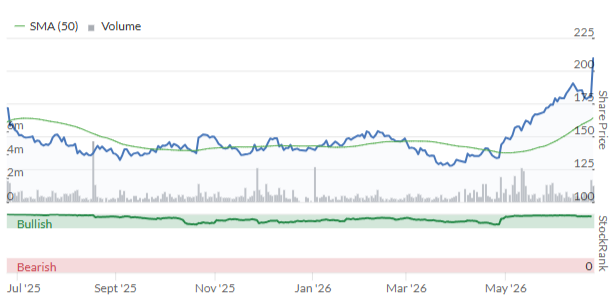
However, the stock remains a long way below its historic highs – 10 years ago, the share price was 342p.
Can CEO Henry Birch engineer a durable renaissance for this business? Let’s take a look at today’s results.
FY26 highlights
Warning - confusing accounts: the year-on-year percentage change figures I use below reflect 52-week comparative figures provided by the company, but the financial figures I’ve quoted are for the 53-week year reported today, unless I specify otherwise.
In addition, FY25 profits have been restated today to reflect a new accounting policy, so they do not map onto last year’s results.
Rising employment costs and subdued consumer spending form a tough backdrop for consumer-facing businesses such as Halfords. Sales growth remained relatively weak last year:
Revenue of £1,801.7m (+2.9% YoY)
Retail revenue: £1,062m (+3.4% YoY)
Autocentres revenue: £739.7m (+2.1% YoY)
Gross margin: 52.9% (FY25: 50.7%)
Underlying pre-tax profit: £50.0m (+4.1% YoY)
Underlying EPS: 17.4p (the 52-week EPS figure is 15.7p, which is +0.6% higher than the restated figure FY25 figure of 15.6p)
Dividend per share: +2.3% to 9.0p
Have earnings beat forecasts? Consensus forecasts for FY26 were for adjusted EPS of 13.9p. At first glance today’s results suggest a strong earnings beat, but I don’t think this is correct.
The new accounting policy introduced with these results now excludes the amortisation of acquired intangible assets from the calculation of underlying profit. Although I’m not always a fan of this approach, it is quite a common approach and has its merits.
However, in this case the impact is quite significant, as Halfords has made a number of mid-sized acquisitions in recent years:
Applying the new policy transforms FY25 adj EPS from 13.8p to 15.6p.
FY26 52-week adj EPS provided today of 15.7p is only a 0.6% increase from 15.6p.
Adding 0.6% to 13.8p gives me a figure of 13.9p – in line with FY26 consensus expectations.
When companies change their accounting policies I think it’s always worth asking why – and what would have happened if they hadn’t.
In this case the revised policy has the effect of lifting the headline measure of profit, making Halfords shares look cheaper on the most commonly used metric of adjusted P/E.
When brokers incorporate the new accounting policy into their models, this change will also feed through to a nice bump in FY27 forecasts. Happy Days!
While I can see the appeal of this change for Halfords management, I don’t think it offers much benefit for shareholders. This revised view of earnings does not reflect any underlying improvement in the performance of the business.
Trading commentary: sales growth was minimal last year and was offset by a 7.6% increase in operating costs, reflecting higher labour costs and cost inflation.
What drove the increase in underlying pre-tax profit last year was a 2.1% increase in the group’s gross margin, to 52.8%. Management says this reflects a number of factors:
This very strong performance reflected the continued success of our Better Buying programme, improvements in pricing and promotional effectiveness, and an FX tailwind as movements in the US dollar rate over the last 18 months benefitted the hedged rate coming through in cost of goods sold. Changes to our contractual arrangements with suppliers also resulted in a 30bps YoY increase in Group gross margin with a corresponding increase in operating expenses.
It would have been nice to see the improvements in gross margin split out so we could see, for example, the contribution made by FX. But it’s good progress all the same.
Looking across the group’s two divisions, performance seems to have been stronger in the Autocentres division than in retail:
Retail: revenue rose by 4.1% to £1,039m, with motoring sales +2.9% and cycling sales +6.4%. But the increase in gross margin was much smaller than in the Autocentres business and was not enough to offset a 7.6% increase in operating costs. Retail underlying operating profit fell by 3.8% to £37.5m.
Autocentres: revenue rose by 5.8% to £725m, while underlying operating profit rose by 20.1% to £18.9m. Gross margin improved by a full 3% to 55.6%, driving a £30m increase in gross profit – sufficient to offset the £27m increase in operating costs.
As far as I can see, both sides of the business are delivering some incremental improvements in difficult market conditions. However, while retail will always face tough online competition, that’s less true for Autocentres. There’s no online substitute for a physical workshop and trained mechanic. Perhaps this side of the business has a more durable future?
Profitability: these improvements translated to a modest increase in margins for the group as a whole:
Underlying operating margin +0.2% to 3.4%
Reported operating margin: 3.1% (FY25: n/a - statutory loss)
The returns being generated by the business also improved:
Company-reported return on capital employed (ROCE) up 1.6% to 14.2%
Cost of capital: Halfords says its cost of capital last year was 10.6%. It’s very rare for companies to report this figure in my experience. For anyone building a DCF model for Halfords, it would make sense to use 10.6% as the required rate of return. A figure of 10% might also be a good estimate for many other small/mid caps.
The figures provided by the company suggest Halfords is generating returns in excess of its cost of capital.
However, the more standardised and statutory approach that I prefer (and which is used in the StockReport) suggests the situation is more borderline:
Return on capital employed: 7.7%
Return on equity: 6.4%
One key difference between the two approaches is that Halfords excludes goodwill from its ROCE calculation. The issue I have with this is that goodwill reflects capital allocated to past acquisitions. In my view, it’s important to gauge whether companies are generating attractive returns on acquisition spend. I think the evidence here is mixed, so far.
Cash flow & Balance Sheet: Halfords ended the year with £19m of net cash, excluding lease liabilities. That’s a strong result, although it’s worth noting that this figure received an £8m boost from the 53rd week, due to timing effects. On a 52-week basis, net cash was £11.2m (FY25: £10.1m).
With so many profit adjustments floating around, I’m keen to see how much cash the business generated last year:
Free cash flow: £33.3m (FY25: £43m)
The company says that the decrease last year “was due in part” to the payment of performance incentives for FY25 in early FY26, but doesn’t provide any detail on this.
On the assumption that performance incentives might be due in the future, too, I am inclined to see the £33m figure as a fair representation of last year’s performance.
Applying this to today’s increased market cap of £458m gives me a free cash flow yield of 7.3% – potentially decent value.
Outlook
The company says it has not yet seen any changes to customer behaviour due to the situation in the Middle East, but believe there’s still a risk this could happen in the second half of 2026.
FY27 guidance: Halfords has restated its FY27 profit guidance to reflect the change in accounting policy:
The change in accounting policy outlined above will increase company-compiled consensus for underlying PBT in FY27 from £45.3m (with a range from £42.0m to £48.6m) to c.£49.0m (with a range from £45.7m to £52.3m). There will be a similar increase in FY28 and FY29.
FY27 underlying pre-tax profit is now expected to be “around the top end of the consensus range”, with a weighting towards H1.
I don’t have access to any broker notes today to see how analysts are addressing the 52/53-week issue. But assuming this guidance is for comparable 52-week years, then this suggests Halfords underlying PBT could rise by c.14% this year, to perhaps £52m.
Prior to today, consensus forecasts suggested a 12% rise in earnings for FY27, so this seems like a relatively modest upgrade – not necessarily enough to justify today’s 15% share price gain.
Roland’s view
Based on today’s guidance, I estimate Halfords could be trading on <12x FY27 forecast earnings.
However, without the change to accounting policies, I estimate this would be >13x.
I can’t help feeling some of today’s share price bounce may have been driven by the market revaluing the stock based on its revised formula for earnings.
Despite this, I think the current valuation could be reasonable if Halfords can continue to improve profitability and deliver above-inflation sales growth.
However, I wouldn’t personally want to pay much more than this. After all, this remains a slow-growing, low-margin business whose longer-term chart suggests continued structural pressure:
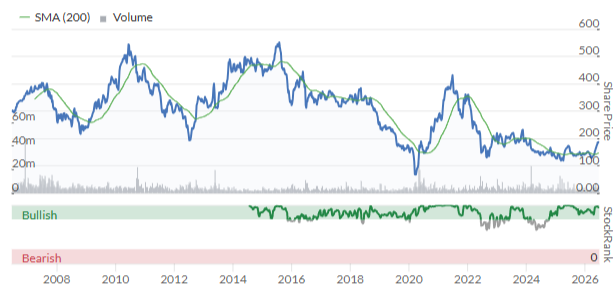
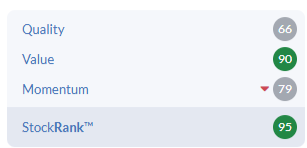
The StockRanks are fairly positive here and view Halfords as a Super Stock:
On balance, I think it’s fair to leave our previous moderately-positive view unchanged today. AMBER/GREEN
Volex (LON:VLX)
Down 2% at 573p (£1.06bn) - Preliminary Group Results FY26 - Roland - AMBER ↓
Volex has been one of the AIM market’s stronger performers in recent years as CEO Nat Rothschild has built a decent-sized industrial group and benefited from strong demand, notably for data centre cabling.
However, today’s full-year results have met with a measured response from the market, perhaps because there’s no change to FY27 expectations today.

FY26 highlights
We covered Volex’s full-year update in March and today’s figures appear to be consistent with the guidance provided then. The numbers themselves look fairly strong to me, with the caveat that much of last year’s revenue growth was driven by a single part of the business – and possibly a single customer.
Revenue up 14.4% to $1.242.6m
Underlying operating profit up 19.9% to $127.3m
Reported pre-tax profit up 45.3% to $93.4m
Underlying EPS up 19.8% to 43.5 cents
Dividend per share up 6.7% to 3.2p
Net debt excluding leases down 4.6% to $121.5m
This is a capital-intensive business, but checking my preferred profitability metrics suggest Volex’s performance improved slightly last year, probably due to operating leverage and strong sales of higher-margin products:
Operating margin: 9.7% (FY25: 7.6%)
Return on Capital Employed: 15.4% (FY25: 13.8%)
Trading commentary: as I’ve flagged previously here and discussed at Mello in November, Volex has been one of the UK-listed beneficiaries of the AI Data Centre boom.
My impression is that this drove the vast majority of last year’s profit growth, offsetting declining revenue in two of the group’s five divisions:
Complex Industrial Technology: revenue rose by 56.3% to $382.9m, “including strong Data Centre demand from a leading hyperscale customer”. The $139m increase in revenue from this division last year largely covers the $156m increase in group revenue for the same period. While it’s great to see Volex benefiting in this way, demand may not remain this strong indefinitely. I’m also intrigued and slightly concerned by the reference to a single customer – my assumption had been that the company was selling to a number of data centre customers.
Off-Highway: this was the only other part of the business to deliver material growth. Revenue rose by 20% to $279.3m, “supported by a significant defence vehicle programme” and a ramp-up of activity in North America.
EV & Electrification: revenue +4.8% to $181.8m, supported by a major charger programme “with a European manufacturer”.
Consumer Electricals: organic revenue fell 7.8% to $242.4m, against a strong prior year performance and “intensified Chinese competition in Europe”...
Medical: revenue fell by 10.5% organically to $156.2m, “reflecting some anticipated customer destocking”. New programme wins offer the potential for a return to growth.
Cash flow & Balance Sheet: free cash flow was actually quite poor last year due to a $55m increase in working capital, reflecting a large increase in inventories. The company says this was largely due to investment to support the growth in Data Centre demand:

However, stripping out working capital movements suggests to me that underlying cash generation was still strong.
I don’t have any serious concerns about the balance sheet. Net debt excluding leases looks manageable, at 0.8x EBITDA despite last year’s outflows.
Outlook
Trading to date in FY2027 has been strong and in line with the Board's expectations
Volex says demand “across key end-markets remains robust”, with good forward visibility and continued strength in Data Centres.
The medium term targets set out in April also remain unchanged, as I’d expect:
The Board is confident that the Group is well positioned to deliver the medium term targets set out at the Capital Markets Day in April 2026, including revenues of $2 billion and a 12% underlying operating margin
Broker update: as far as I can see, broker forecasts are unchanged today.
The latest note from Singer Capital (in late April) included the following EPS forecasts:
FY27: 43.4c
FY28: 46.6c
These forecasts put Volex on a FY27E P/E of around 17.
Main Market listing: Volex has confirmed the details of its move from AIM to the Main Market today – the relisting is expected to happen at 8am on 24 July 2026.
One risk is that the stock could see some short-term volatility as AIM IHT managers are forced to sell their holdings in the fifth-largest AIM-listed company. Our shareholdings page suggests some of this selling has already been underway, with two large IHT fund managers showing recent sales:

In a note on 27 April, Singer estimated that £120-180m of shares might need to be sold by AIM IHT funds – potentially c.15% of the total share capital.
Although some of this selling may be offset by the ongoing £40m share buyback, any boost from potential index fund buying could take a little while to feed through: as far as I can see, Volex could potentially join the FTSE 250 in September.
Roland’s view
I’ve been AMBER/GREEN on Volex for some time now. I think this has been is a fair reflection of the stock’s High Flyer status and solid profitability:

However, several parts of this business saw declining revenue last year and there’s no doubt in my mind that last year’s results were primarily underpinned by strong Data Centre demand. Without this (seemingly from a single customer), the picture would have been much weaker.
Today’s outlook doesn’t suggest to me that there are any near-term catalysts to support a more widespread increase in profit. I wonder if another acquisition might be in the offing. Volex has handled these successfully in the past, but increasingly big deals will always carry some risk.
While the recent share price pullback from 700p has eased some of the pressure on valuation, the share price still looks up with events to me.

I still think Volex is a decent business, but I’m going to cut our view by one notch to AMBER (neutral) today to reflect my view on valuation and the potential for some further near-term weakness in the share price.
Disclaimer
This is not financial advice. Our content is intended to be used and must be used for information and education purposes only. Please read our disclaimer and terms and conditions to understand our obligations.

60 comments
Expect a good pullback/correction in the U.S. markets before we see new all-time highs in the lead-up to the midterms.
Strategy (NSQ:STRC) trading at $77 offering a yield around 15% suggests that Michael Saylor’s ponzi scheme is over. Anything under $60 and he will be close to bankruptcy.
All the best
Enjoyed the analysis today on Moonpig (don’t own but might look at it after today’s review) and Halfords (formerly owned but sold today)
Thanks a lot for your work as always Graham & Roland.
I don’t know if you’ll read this as late in the day but if you have any time tomorrow, a little bit of commentary on the shit show that is Strategy (NSQ:MSTR) and what has happened there would be of interest to me! As I wrote some time ago on this forum, it has never been the high valuations of Nvidia and others that concern me in the market, but the madness of people like Saylor running a Nasdaq listed company in the way he has does concern me!
Thanks for the comment, Chess! I have scheduled in some time to study Strategy (NSQ:MSTR) soon, watch out!
Volex (LON:VLX) I expected the market to like this better. Margins are improving and move to Main Market should offer buying pressure. I wasn't convinced that they meant that the "hyperscale" customer was necessarily so dominant.
If I was indirect, I think many others have been quite specific about the undercurrent in full term ownership cost of EV’s in their responses. Expensive main dealer costs and no options in vanilla service and repair garages including Halfords.
I was trying to say that a sky high, or no option to insure just illustrates that at the front end. Many very young EV’s are apparently being written off due to uneconomic repair
I have driven brand new rental EV’s and Hybrids that have major intelligent electronic and mechanical aids, they are great for driver comfort on long journeys and most impressive. I ask myself if I would want a 5 plus year old one if the “aids” start to play up. I’m not talking about your company or finance lease driver who has a new one every couple of years, but the millions who run them as second hand. Where can you go to sort it and can someone who owns a car of that age afford to repair it
Built in economic obsolescence is already distorting the car market - The cost of insurance is the bell weather
the trade does like them
Thanks ezlifeme - all clear now. That was what I was trying to ascertain - "vanilla" service (eg Halfords) out of the question and too much tech which is bespoke not commoditised (eg Halfords) to repair.
On Halfords (LON:HFD) .... I remember hearing some time ago that the increasing share of electric cars will cause pressures on their business.
Because of two things. First, electric cars have more "connected" components to the electronics. So the mechanical parts are somewhat proprietary, and can't be replaced easily by a generic autocentre like Halfords. Only by the licensed brand dealers. The second is that with less mechanical parts and built on completely new, modern chassis/platform, the parts are breaking down less often?
I don't know whether either statement is true or not, so would welcome thoughts from those more in the know about electric cars!
How about asking someone about insuring the popular (Cheap) Chinese EV's Boon?
Or like I did ask an AI Q? You might find it's an Interesting response
I don't understand what you're trying to say? Can you be more direct?
I'm talking about EVs in general and repairing.
You're talking about Chinese EVs and insurance. And something about AI?
Yes I think very long term electric cars will be negative for the car service industry, they require very little maintenance and when they do, its usually something specialist. But I think the impact is probably beyond the time horizon of any DCF.
That said, never underestimate the car industries ability to engineer 'essential' maintenance into cars and fluids that need changing that don't even exist today, if that's what they need to do to create long term profits from what they sell...
Servicing of EVs is definitely NOT cheaper than ICE vehicles in my experience. I think it's a popular misconception that as it has fewer parts (does it? no oil change that's all?) and therefore needs less maintenance or even some suggest no maintenance - the latter is certainly total nonsense
My wife has an EV, bought it at 1 year old, two services so far have been more expensive than her old petrol car. What's more, her EV is a modest Renault Zoe.
We do use the main dealer, perhaps it's cheaper at an independent.
I’ve got 2 and been driving various EVs for around 6 years now. The main dealers charge extraordinary high fees for doing almost nothing on the service, the real cost to service is almost nothing. Since owning EVs I spend almost nothing at places like Halfords.
Main dealers get away with murder as usual on fees but I don’t think that was the spirit of the question. For Halfords there is very little to make from them and very little need to go to Halfords as an EV owner. Just cleaning products essentially.
From the top of my head: no engine oil, less brake discs that last much longer due to regen braking doing most of the work, no clutch, no spark plugs, no exhaust… I think an EV has like 10-20 parts that move vs thousands in a traditional car. Just much less that can go wrong in general and when it does, it’s usually something complicated and for a specialist.
their second value is where it hurts
Yes they lose value steeply first few years but my comments are only related to what impact EVs may or may not have in Halfords! Not trying to push EVs altho can imagine it looks that way out of context. I’ve no skin in the game and own them personally as for my individual circumstances they’re good but for many they would be rubbish.
EVs should cheaper to service, oil change is about £70-100 now. Some don't require annual servicing either. Brakes should wear less but tyres more. Independents are usually cheaper for petrol/diesels. Not used a main dealer, since they tried to rip me off, with changing the timing belt, that was about 20 years ago. Do EVs have timing belts?
Nope, no timing belts… they have very little to be honest. Brake discs, brake fluid, tyres and windshield wipers are all I’ve replaced in the years of driving them, as far as I can recall. The brake discs last forever though because you hardly use them as the regen system does a big % of the braking for you to take power back to the battery.
Once you’ve got one in my experience an EV is cheap as chips to run afterwards
Join us for our next MelloMonday show on Monday 29th June 2026, at 5pm, hosted by Jamie Ward who has been on our BASH panel on numerous occasions..
The programme for the evening is as follows (subject to minor change):
5:00pm Fireside Chat with John Goold, CEO at Kelso Group plc
5:30pm Company Presentation from Oxford Metrics
6:10pm Company Presentation from Accsys Technologies
6:40pm Company Presentation from Pathos Communications
7:10pm Company Presentation TBC
7:40pm BASH (Buy, Avoid, Sell, Hold) Panel
For more information, click here: www.melloevents.com/mm290626
There are lots of interesting sessions and all members and individual ticket holders will be sent a recording of the show within 48 hours. For half price tickets, use code MMSTOCKO50.www.tickettailor.com/events/melloeventslimited/2022799
Closing my Halfords (LON:HFD) position today with an average buy price of 129p
One of my last UK retail positions. I do not particularly like retail (especially UK retail) but am willing to buy when they seem genuinely too cheap. I am selling because it feels somewhat fairly valued today given general structural issues still remain.
With UK valuations now mostly being just a bit 'cheap' rather than 'very cheap' as they were just 1 or 2 years ago, I prefer to put money in higher quality businesses incl in US. In the UK I have my eye mostly on IG group (LON:IGG), AJ Bell (LON:AJB) , and Games Workshop (LON:GAW) as possible destinations for the freed up cash.
Time Finance (LON:TIME) a puzzler today. FY trading update. In-line with broker forecasts. Dropped quite a bit at the open, but now back to even.
FWIW I held before, and then sold. Went back in recently as it had drifted to a low price (40-45p) and think it naturally should be at least 60-70p.
At the current price:
Everyone's off chasing growth stocks in the USA, but IMO we've got a nice growth one here. Obviously, its not for everyone - lending businesses have their inherent risks. And this should trade at a discount to the large banks (Lloyds 10x PE, Natwest 9x PE).
IMO give then growth on offer here, a PE of 8-8.5x looks about right. That's a +30% from the current SP...
(I hold in the Boon Fund)
Time Finance (LON:TIME)
whats the puzzle ? - is it simply that it dipped and rebounded or the miserly rating
I am newly here with a punt so i have been suckered in with the modest rating - as a money lender i know i am venturing into the wild west - but this seems a fairly dependable plodder for this sector on my very billy basic research.
Note i prefer companies that have more stable order books with regard to risk - i always worry that its easy to "book profit" - around the time you lend the money - the real proof of the pudding is the later repayments . So i actually look at a quickly growing lending book as more risky that stable. Note i am fully aware that they have a wad of deferred revenue here so at least it looks they are somewhat spreading out income over the term.
Note dont get me wrong here ref revenue growth - if you want to move the business forward you have to increase sales - so its good that they are moving forward in that regard.
i used to own Cattles back in the day - that was also a reliable plodder back then doing invoice financing too. Well it was a reilable plodder till it all below up that the bad debt was nothing like what had been declaring for years , luckily i exited shortly before it blew up - that was very tried and tested brand back in the day - i would like to think the FCA and the auditing comunity have moved on in the last 15 years - but i would hve zero coinfidence that any specific company "wont have hidden skeletons in the cupboard" - this is one of those business types where it really is in the companies interests for everything to look as rosy as possible - that must help with their financing etc - not convinced that "need" of showing you are doing well and the need for "conservative accounting" always fit well together - they have been around a while and some i think and the lack of anyone flagging up specific issues is also somewhat a comfort - would be interested on thoughts of anyone with specific sector experince as to "how conservative" they think this company is? - for money lender i want uber conservative policies and delivery - copilot hasnt flagged anything of concern when i asked it.
AEP Plantations (LON:AEP) price out by a factor of 10? I hope so!
AEP 10 for 1 share split effective this morning, Neither Stocko nor Google Finance have taken it on board yet.
Richard
TYVM! Was just about realising as you messaged!
Will Stockopedia automatically update folios including AEP's 10 for 1 stock split, or do we need to adjust the figures ourselves?
You'll need to do that yourself
DIY, that is why folios go wrong, because no one updates share splits. Doing share splits, can go wrong also, check the figures, l've had several that needed Stockopedia to correct.
I've just realised why the stocko calculated performance this year in my folio has just dropped by 20%. I owned AEP Plantations (LON:AEP) at the start of the year and the Stocko calculations must have failed to take the 10 for 1 into account. At least this is the only reason I can think that the calculation has gone wrong between yesterday and today. They need to sort this out.
Might also explains why my historical performance on Stocko is nonsense. (A different stock or stocks must have done similar).
It has always been necessary to to alter the holdings info ourselves. Stocko can change the share price but changing the number of shares held would involve accessing your personal portfolio and changing the info which, since stocko is not a dealing platform, could only be an assumption based on your original inputs.
Just the principle of accessing your personal info would be a huge red line anyway?
Sorry if I've misunderstood your point though.
Happens all the time. Share splits, consolidations and delistings, that is why Guru folios and other folios are unreliable. I have given up reporting obvious errors. There was a major error on the VM figures, a while ago, which took a lot of effort, by various members, to get corrected.
I don't think Stockopedia performance figures suit members, who trade shares, as soon as you buy and sell and then rebuy, your performance will drop, buying and holding a share will always outperform trading, even if you make more money trading.
Still can't get a quote on Hargreaves Lansdown and holding on Interactive investor showing near 90% loss as not updated yet.
I'll open my account in ii and because they reliably update share splits etc I'm able to put the new figures into my Stocko portfolios from there. Too much Big Brother stuff leaning on us IMHO. Simply Wall St is also trying to muscle in and get me to link my portfolios with them and those I have with ii. Going on like this will cause investing in shares to become a game where big AI is the Banker.
easyJet (LON:EZJ) This Saga seems to be continuing. Whats everyone's thoughts on this? the board seem to be easing their position slightly as extending the deadline now...
It's an interesting situation that's for sure. I think Castlelake also probably not the only shop/consortium that could do something so could end up with competitive tension too
easyJet (LON:EZJ)
i think you cant ignore ever increasiong offers forever can you - at some stage they are forced to look at the offer "seriously" - that point is probabaly now. the plan to use 2 irish dues to get around eu regulation seemed nonsensical though - can anbyone explain how that would work without risking the entire future of easyjet. Perhaps thats the point they extract the value in the routes/ planes/cash on hand - and leave a trading entity that would fold at the first crisis point - creditors would lose out and they could probably rinse are repeat.
If anyone is interested in Barratt Redrow (LON:BTRW) or housebuilders in general.... Phoenix Asset Management yesterday published a 430-slide investment thesis in Barratt. It also contains a very good primer and compelling thesis for why housebuilders are good investments.
They are obviously talking their own book though, as they've been a long-term shareholder in Barratt and it is one of their top holdings.
You can download the report here: https://www.buybarrattback.com...
Barratt shares have shot up c10% over yesterday and today so far...
I recently invested in Taylor Wimpey (LON:TW.) , partly for their dividend (currently 8.46%). They have gone up by 10% since I bought.
Long term holder of both Barratt Redrow (LON:BTRW) and Taylor Wimpey (LON:TW.) - recently been buying at what I consider to be bargain prices and averaging my book price down.
I've not looked at the Phoenix thesis yet (I will - thanks for posting the link) but I know they have been advocating vast increases in buy backs for some time ... personally I agree Barratt Redrow (LON:BTRW) and Taylor Wimpey (LON:TW.) should be doing more of this at these prices instead of waiting till shares go up to their old heights again.
Taylor Wimpey (LON:TW.) have changed their dividend policy so it will be interesting to see where the yield finally lands ...
Personally keeping the faith on both of them!
Forgot to mention... for those that want to skip all the detailed information in the 430 slides deck on Barratt Redrow (LON:BTRW).... page 362 has Phoenix's "intrinsic value range" of 771p to 1671p (compared to the 295p current SP). Crazy, I know. But... also makes sense, having gone through the first 361 pages analysis and rationale of how they've built their model.
Thanks Boon. I would not have been aware of this had you not posted about it.
You're welcome!
A good heads up Boon
Ingenta (LON:ING) bit of curate's egg. Revenue up, ebitda down. Grateful for a review of this NAP.
Getting hammered by the market. Very much being treated as a bad profit warning. Only nap stock I bought as well!!
No surprise that Ingenta (LON:ING) is falling on that statement. Revenues a bit higher for 2026 but additional costs that will lower EBITDA. The real sting in the tail though is certain large customers wishing to reduce contract lengths so that they can potentially move to a 'global platform provider' in 2027. This looks like a dangerous case of a bathtub with the taps on at one end as they win the odd new customer, but the plug out at the other as existing business moves away. Ouch!
Halfords (LON:HFD)
Hi Graham, I am not sure where you are taking your figure for adjusted EPS from? Adjusted EPS for FY26 was forecast to come in at 13.9p, today's prelims show it coming in at 17.4p, albeit this is on a 53 week basis.
Morning Jonno,
Thanks for flagging this up - I think I see where the confusion lies.
This morning's results use a restated FY25 adj EPS figure of 15.6p. I haven't looked into the restatement yet as our summary comments are just a brief review of the headlines.
Earnings for the FY26 52-week comparative period were 15.7p, hence the 0.6% increase.
However, in the table I quoted the adjusted EPS figure for the full 53-week FY26 of 17.4p. So the 0.6% growth does look incongruous in this context.
Hope this makes sense - I'll add an explanatory note to the table.
Roland
I don't understand the oil price move downwards.
According to all publicly available data, oil tanker traffic through the Strait of Hormuz, is still only at 25% (at best) of the normal pre-attack levels, with most traffic heading to Asia.
Is too much emphasis being placed yet again on the words of Trump? How are they going to refill their strategic reserve?
Yes the position is far from resolved. The Iranians are only accepting ships using the northern route, the Americans are only accepting the southern route. The normal central route is probably mined. The agreement was only a MOU and will expire in five weeks.
surely every time oil ramps up in price "some" will find other avenues whether that less oil being consumed or other routes filling in the gaps.
it makes 100% sense to me that the production has continued at normal pace - so surely there is either a backlog or its gone vis more expensive routes and can now come back to cheaper routes. should be same overall numbers ref barrels of oil out there - perhaps more if consumption dropped during price spike.
i suspect if on thne balance of probablities the market thinks its "sorted for now and normal services will resume" - that would suggest there is nice exces of oil waiting to be shipped - to me it makes total sense that prices have come back down.
ref reserves surely the oil is simply waiting to be shipped at such time as markets are calm ?
thats probably over simplifying an uber complicated set of stuff.
There appears to be quite a volume of oil needed to refill various countries strategic reserves. Think I’ll stick with my North Sea holdings as situation regarding Straits of Hormuz still seems far from a ‘done deal’.
Isn't it also true that demand for oil is down and we live in an environment where the producers have lost pricing power (because they are forced sellers who will for the near/medium term maximise production without holding anything back as they normally might to push prices back up)?
Oil prices are not as straight forward as the current day to day status of the Strait.
A rather feeble ending for Advanced Medical Solutions (LON:AMS). Having allegedly rejected private equity bids of up to 285p per share they now succumb to one at exactly the same level from an industry rival, who can surely extract greater synergies from the deal. A patchy growth record from lead product Liquiband and a less than compelling acquisition of Peters Surgical a couple of years ago appear to have torpedoed hopes of a better outcome. I'm a slightly disappointed holder.
I agree. From the point of view of a long-term investor (I have held since 2006) this is a disappointing exit price. Will I be able to acquire a business of comparable quality with the proceeds? There are people on this board cleverer than I am who would be able to do so, but I don't rate my chances.
Some indication that Comcast (Sky) and ITV (LON:ITV) have agreed terms - there was a news story late last night.
LONDON, June 24 (Reuters) - Sky, the Comcast CMCSA.O-owned British pay TV group, has agreed on terms to buy ITV's ITV.L broadcast and streaming unit, two people familiar with the matter said, with ITV acquiring "The Great British Bake Off" producer Love Productions as part of the deal.
The £1.6 billion deal had moved in a positive direction in the last week and was now being finalised by lawyers, the people said on Wednesday, speaking on condition of anonymity.
The total transaction value will include ITV Studios acquiring Sky's Love Productions, which also makes "The Piano" and could be valued between £80 million and £120 million based on comparable deals, and an earn-out, the people said.
Reuters reported last month that the transaction would include a payout dependent on the ITV unit's performance of about £200 million.
A deal could be announced in the next two weeks, the people said, with one source cautioning that the timing could still slip due to final legal complications.
Spokespeople for ITV and Sky declined to comment. Comcast did not immediately respond to a request for comment.
Concluding the deal would end a saga that began last year, and became public in November when ITV said it was in talks to sell the unit, called Media & Entertainment, to Sky.
It has involved the complex task of separating ITV's channels and streaming platform ITVX, which comprise the unit, from its production business ITV Studios, which will be a standalone company following completion.
I hold Volex (LON:VLX) and Halfords (LON:HFD) .
Both have issued excellent prelims. If only Halfords could improve its operating margin the shares would really take off.
Hopefully both will be covered today by Graham and the team.
Agreed. I have Cockney Rebel to thank for mentioning HFD which prompted close examination. More to come. I don't hold Volex, but what a company! Looking for a dip to enter.
Gold now below $4000 - and silver also falling - where are we heading...?
Volex (LON:VLX) Another cracking update and confirmation move to main Mkt end July
Re: Volex (LON:VLX)
A good news clue was in the 12M % clean sweep reaction to the previous RNSs....