Daily Stock Market Report (Tue 17 June 2025) - SSTY, MGNS, W7L, OCN/HAN, MTRO, BPM, MTU, RWS, RCFX, ALT

Good morning! Welcome to Tuesday's report.
Spreadsheet accompanying this report: link.
The Agenda is complete.
12.45pm: we are out of time for today, see you tomorrow!
Companies Reporting
| Name (Mkt Cap) | RNS | Summary | Our view (Author) |
|---|---|---|---|
Ashtead (LON:AHT) (£18.8bn) | Rev -1% (used equipment sales lower). Adj. EPS -4%. Guidance: rental revenue +0% to +4%. | ||
Legal & General (LON:LGEN) (£14.8bn) | Webcast at 1pm. Also: “we have made a good start to 2025”, core operating EPS growth of 6-9%. | ||
Informa (LON:INF) (£10.5bn) | Five months: underlying revenues +9.3%. Visibility is ahead of last year. Growth guidance reaffirmed. | ||
Morgan Sindall (LON:MGNS) (£1.8bn) | Group PBT is expected to be significantly ahead of previous expectations. | AMBER/GREEN (Roland) I rate this construction group as a best-in-sector operator and believe it could be a wider beneficiary of the recent UK government spending review. But the valuation is now above its normal range and previous forecasts have suggested some risk that earnings growth could slow next year. Perhaps out of an abundance of caution, I’ve moderated our view slightly today. | |
Metro Bank Holdings (LON:MTRO) (£893m) | Press reports of takeover approach (no RNS) | Sky News reported on Saturday that Metro Bank has received takeover interest from private equity firm Pollen Street Capital. | PINK (AMBER/GREEN) (Graham) There’s still no RNS since Sky News reported on this. I guess the lack of an RNS means that any offer received so far has been rejected by the Metro board? We’ve been moderately positive on MTRO while the price has multi-bagged from the depressed levels it reached when its solvency was questionable. It was successfully refinanced and continues to offer cheapness against tangible book value. As such, I see no reason to change my stance today. I'm in good company, with the highly knowledgeable financial investors at Pollen Street now apparently also finding it interesting around these levels. |
| Ocean Wilsons Holdings (LON:OCN) (£522m) | Possible Combination | Proposed all-share combo with OCN’s largest (26%) shareholder. Would remain a listed investment co. OCN shareholders to receive HAN/HANA shares in accordance with the NAVs of each company at the end of June. Separately, OCN also offers to buy back shares for up to £123m, at a discount to NAV. | PINK (GREEN) (Graham) I was AMBER/GREEN on this in the absence of any particular catalyst to close OCN's discount to NAV. While there is still no guarantee that the discount will close further, the tender offer (at a discount to NAV) could help. The proposed merger with HAN/HANA may also help, as it comes with a lower management fee and will create a much larger, simpler entity that will be harder for prospective investors to ignore and to put on a very large discount to NAV. HAN currently trades at a c. 38% discount to NAV. Surely this must tighten up? |
ITM Power (LON:ITM) (£453m) | ITM to deploy “POSEIDON” into two projects aiming to supply local industries with green hydrogen. | ||
Warpaint London (LON:W7L) (£361m) | Confident will meet exps for 2025. H1 sales exp £50-£52m (H1 24: £45.9m). | AMBER/GREEN (Roland) [no section below] | |
RWS Holdings (LON:RWS) (£315m) | Rev -2%, adj. PBT -61% (£18m), loss-making. Outlook in line. Adj. PBT £60-70m if GBPUSD is 1.33. A new divisional structure will launch in October to simplify the business and align RWS’s products and services more closely with current market needs. | AMBER/GREEN (Roland - I hold) Today’s interim results are firmly in line with April’s revised guidance and reiterate full-year expectations. While profits are down sharply, I’m encouraged by strong free cash flow conversion and am cautiously optimistic about the new CEO’s plans. With revenue broadly stable and the stock on a P/E of 6, only a small improvement in profitability might be needed to support a recovery in profits and a re-rating. RWS isn’t without risk, but I remain confident in the business model and think the risk-reward balance could be attractive. A tentative upgrade. | |
| Capita (LON:CPI) (£284m) | Trading Update | Reiterating full year guidance of broadly flat revenue, op margin improvement weighted to H2. | |
B.P. Marsh & Partners (LON:BPM) (£255m) | £1.7m investment in Cameron Specialty HoldCo, a London commercial property underwriter. The investment is a mixture of equity and a loan facility. | GREEN (Graham) [no section below] This is a small investment by BPM’s current standards, but it’s good to see that they continue to put their large cash balance to use within their insurance niche. They had £74m as of January 2025, and already made £20m of new investments, with buybacks and £8m of dividends also planned. I examined BPM’s full year results recently and concluded that the shares are about as attractive as ever at current levels. | |
Brickability (LON:BRCK) (£218m) | Director/PDMR Shareholding (Monday RNS) | MD of Distribution Division sold 3m shares and now has 16m. NED sold 1m, now has 2m. | |
Montanaro UK Smaller Companies Investment Trust (LON:MTU) (£134m) | NAVps -11% to 105.9p. Discount reduced to 8.4%. Divi +17.4% to 5.4p. Portfolio turnover 45.6%. | AMBER (Graham) [no section below] This smaller companies trust looks at many of the same companies we do. Its largest holdings are discoverIE, XPS Pensions and Big Yellow. However, the cumulative returns figures as presented in today’s highlights table doesn’t look great: 14% over five years and 30% over 10 years, versus 68% and 60% by their benchmark over the same timeframes. NAV has fallen 7% over the past year. While management do acknowledge some individual stocks that distracted from performance, I don’t see any admission that they themselves made any mistakes. They appear to blame management at one or two companies they invested in, and they also blame “style” underperformance, with growth companies generally underperforming value companies last year. Investment managers should openly acknowledge their mistakes, and so I can’t get above a neutral stance on this despite it trading at a 10%+ discount to NAV. | |
Anexo (LON:ANX) (£80 m) | Deadline for firm offer from DBAY Advisors extended to 5pm on 1 July 2025. | PINK | |
Hercules (LON:HERC) (£37m) | Rev +18%, adj PBT +55% to £1.7m. Cash £9.8m. Outlook: confident in meeting FY exps. | ||
RC Fornax (LON:RCFX) (£29m) | PW: FY25 results to be significantly below exps. Revenue >£4.0m (prev. £11.5m). House broker Cavendish has cut FY25 forecast earnings from 3.2p to a loss of 2.2p per share. Perhaps even more tellingly, the broker has placed its target price and FY26/7 forecasts under review. | BLACK/(RED) (Roland) [no section below] | |
Wynnstay Properties (LON:WSP) (£23m) | Rental income +5.4%, net property income +5.2% to £1.9m. NAV per share +2.8% to 1,168p. | ||
| Altitude (LON:ALT) (£17m) | Board Change and Trading Update | CFO stepped down from board, will leave post FY25 results. FY26 trading in line with exps. | AMBER (Graham) [no section] I noted last year that the company’s expectations for FY March 2025 implied a large H2 weighting, and I wasn’t sure if it was achievable. The company did subsequently announce a revenue and profits warning. With FY26 trading in line, let’s hope that forecasts are now more realistic. I remain to be convinced that this is a company of above average quality, so I’m staying neutral. |
Safestay (LON:SSTY) (£16m) | Confirms that it is considering the sale of some UK freehold assets. No certainty of a deal at this point. | AMBER (Roland) [no section below] | |
Sound Energy (LON:SOU) (£14m) | Completion of regional screening for hydrogen with Getech (LON:GTC). Signed JV with Gaia Energy for 270MW of solar project in Morocco. |
Graham's Section
Ocean Wilsons Holdings (LON:OCN)
Up 5% to £15.60 (£552m) - Possible Combination - Graham - GREEN
It’s fortunate that I studied OCN recently, so its broad features are fresh in my memory.
I described its portfolio as “a highly diversified fund of equity funds”.
The investment manager for the portfolio is Hanseatic Asset Management, which is related to OCN’s largest shareholder, Hansa Capital Partners.
That relationship has led to the following proposal.
.. possible all-share combination of Hansa and Ocean Wilsons, under which Hansa would acquire the entire issued and to be issued share capital of Ocean Wilsons (the "Possible Combination").
It will be a merger of OCN with Hansa Investment (LON:HAN) and Hansa Investment (LON:HAN)A. (“HAN” are the voting shares, while “HANA” are the non-voting “A” shares.)
It’s described as “a compelling long-term opportunity for shareholders by combining two companies with complementary portfolios to create an investment company with total net assets of in excess of £900 million under a simplified group structure (the "Combined Group").”
Shareholders will enjoy “the benefits and synergies of greater scale, including through a reduced blended management fee”.
Hansa and Ocean Wilsons have “complementary investment portfolios which have similar investment objectives”.
Importantly, the proposal “has the support of the long-term, strategic shareholders of both Hansa and Ocean Wilsons”.
Terms of proposal: OCN shareholders would receive one HAN share for every two HANA shares they receive, in line with the currently existing ratio of HAN to HANA shares. The number of shares they receive will be calculated based on the net asset value of each company as at June 30th 2025.
The combined group will continue to use Hansa’s existing listing.
The fee charged by Hansa to manage the portfolio will be will be “0.8% of Hansa's NAV up to £500 million and 0.7% thereafter, as compared to the existing management fee of 1.0% currently payable by each of Hansa and Ocean Wilsons…and eliminates the additional performance fee that forms part of Ocean Wilsons' existing management fee arrangements.”
Graham’s view
I’m seeing very little to dislike here.
With any investment product - including investment companies - simplicity is better than complexity.
OCN took a major step towards simplification by selling its stake in Wilson Sons.
That sale - worth about £447m based on exchange rates I calculated recently - resulted in an implied net asset value per OCN share of $27.20 (£21.06).
It also resulted in a huge uplift in OCN’s cash balance, and the company announces today that it is returning up to £123m to shareholders via a tender offer.
OCN’s major shareholders have pledged not to tender any shares, so it’s only the smaller shareholders - owning 40% of the company - who may tender.
However, there is a good reason the larger shareholders aren’t getting involved: the tender offer is taking place within a price range of 1543p - 1736p.
This is a premium to recent prices at which the stock has traded, but is still significantly below NAV:
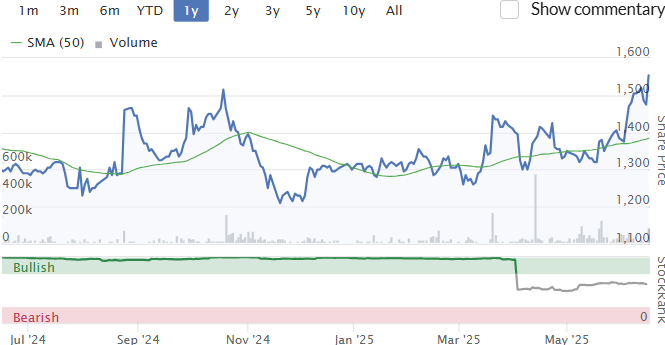
So personally, if I liked their investment strategy and owned shares in OCN, I’d be reluctant to tender many shares.
Looking forward, it seems to me that the combination of HAN/HANA and OCN should help to grow HAN’s prominence in the investment company landscape.
It will be a much simpler proposition from now on, simply owning a portfolio of funds. Prospective HAN investors won’t have to try to understand the large shareholding in OCN.
OCN investors are already benefiting from the simplicity of no longer owning the Brazilian shipping company Wilson Sons. The combination with HAN/HANA, if it goes ahead, will also see them benefiting from lower management fees and larger scale.
And I do expect the proposal to go ahead.
I'm going to upgrade my stance on OCN to GREEN as the value of its NAV will be reflected in the number of HAN/HANA shares that its shareholders receive. Its NAV is already £21.06, according to the last quarterly update, and could be boosted further by the tender offer purchasing shares below NAV. Against a share price of £15.60, this looks quite attractive to me.
I note that HAN's own discount to NAV is currently very wide at 38%. But surely this must tighten up if this merger goes ahead?
Roland's Section
Morgan Sindall (LON:MGNS)
Up 15% to 4,430p (£2.1bn) - Trading Update and Outlook for 2025 - Roland - AMBER/GREEN
Today we have another upgrade from this well-run and founder-led construction group, which I tend to view as the best listed business in this sector in the UK.
The main headline is short but sweet:
Group PBT is now expected to be significantly ahead of previous expectations.
This is the latest in a string of upgrades over the last 18 months that have increased 2025 EPS estimates by 14% (prior to today):
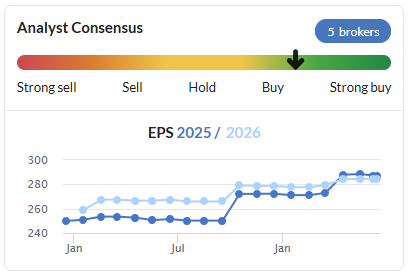
Management says that two of the group’s divisions have been outperforming, driving today’s upgrade:
Fit Out: strong trading earlier this year has continued, providing good visibility for the remainder of the year. Profits expected to significantly exceed previous expectations.
Construction: operating margin is now expected to be in the middle of the target range (3.0%-3.5%), with revenue above previous expectations. As a result, profits are expected to exceed expectations.
The group’s other divisions are all said to be trading in line with expectations, hence today’s upgrade.
Outlook & Estimates: The extent of today’s upgrade isn’t clear, but use of the word “significantly” suggests to me it could be in the region of 10%.
Unfortunately I don’t have access to broker forecasts for Morgan Sindall, so we’ll have to wait for upgrades to filter through to Stockopedia’s consensus estimates.
Roland’s view
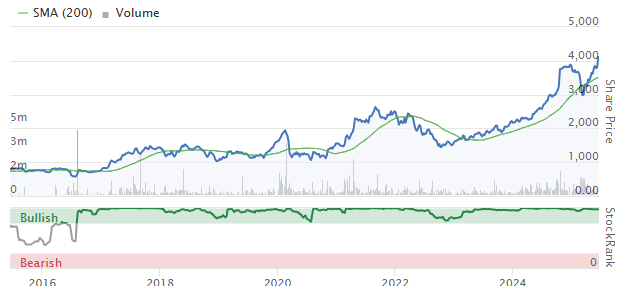
I’ve been singing the praises of this business for several years, but have sadly failed to follow my own advice. Shareholders who have stayed invested through some volatile periods have enjoyed a multibagger:
On the assumption that today’s update is equivalent to a c.10% increase in FY25 earnings per share, then I estimate Morgan Sindall could be trading on a forward P/E of 13-14 after today’s news.
This isn’t cheap for what remains a low-margin business, but Morgan Sindall is extremely well run (in my view) and has avoided the contract pitfalls and other financial disasters that seem to periodically befall its rivals.
Quality metrics other than margin are excellent, as is cash generation (financial management is very tight):
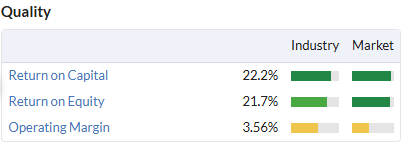
More broadly, my impression is that Morgan Sindall’s various divisions may be well positioned to benefit from increased government spending following the recent review. Examples might include affordable housing, healthcare and education.
In March I was GREEN on Morgan Sindall and Graham maintained this view at the start of May. However, the shares have become more expensive since then and are now trading a little above their normal range:
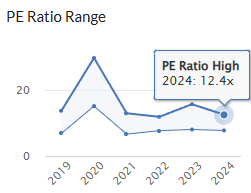
While I have confidence in the company’s ability to deliver on its promises, Morgan Sindall’s valuation metrics are starting to look less appealing to me than previously.
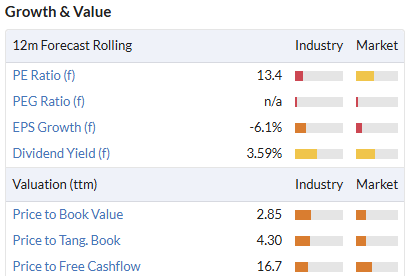
It may also be worth remembering that prior to today, analysts were forecasting a fairly flat outlook for earnings in FY26. I don’t know if this is still valid, but I think it’s worth considering.
While I continue to regard this company highly, I’m going to trim our view to AMBER/GREEN today on valuation grounds.
RWS Holdings (LON:RWS)
Up 6% to 90p (£333m) - Half-Year Report - Roland - AMBER/GREEN
At the time of publication, Roland has a long position in RWS.
The headline numbers in today’s interim results from translation specialist RWS look dire, but we already knew that would be the case following April’s profit warning. Today’s numbers are in line with April’s guidance.
The big question now is what happens next. Can new CEO Ben Faes stabilise performance, control rampant IT spending and return the business to growth in a market that’s being disrupted by AI?
The first key takeaway from today’s results is that things have not worsened since April. Guidance for the full year (y/e 30 Sept) is unchanged (my emphasis)
The Group continues to expect to deliver adjusted PBT in the range of £60m-70m for FY25, as previously guided, based on an H2 GBP / USD FX rate of 1.33
Let’s take a closer look at today’s numbers and the company’s revised strategy.
H1 results - key points: revenue for the half year fell by 2% to £344m, while adjusted pre-tax profit dropped 61% to £18.0m.
On a reported basis, RWS made a pre-tax loss of £12.7m for the period. This was due to various adjusting items including amortisation of acquired intangibles, acquisition-related costs, share-based payments and restructuring costs.
I would normally be inclined to include most of these costs in my measure of profitability. However, in the interests of balance I think it’s worth noting that free cash flow for the half year was £17.6m, excluding acquisitions and disposals. This is almost identical to adjusted pre-tax profit for H1.
I think this FCF performance supports the view that RWS is still highly cash generative. On an annualised basis, I estimate RWS could have a free cash flow yield comfortably in excess of 10%.
A £14.1m increase in net debt to £27m reflects the payment of the £36.9m final dividend during H1 – this wasn’t fully covered by last year’s free cash flow.
Dividend: the interim dividend was held at 2.45p, suggesting that (for now), RWS is protecting its enviable track record:
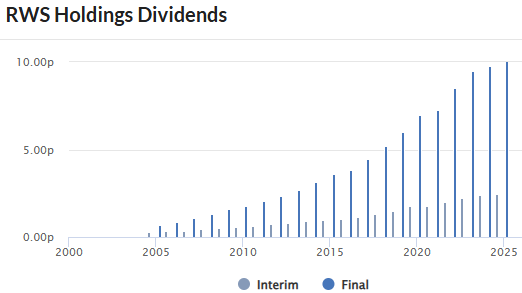
If the final dividend is held unchanged this year, the stock currently yields a tempting 14%!
Divisional performance: three of the group’s four divisions reported revenue growth on an organic constant currency (OCC) basis. This continues the improvement seen during the second half of last year:
Language Services: revenue of £158.4m (OCC +4%), adj op profit -58% to £6.4m (4.0% margin)
The company says the fall in profit was driven by increased competition on price. This is said to be primarily in the non-West Cost technology part of the division. My reading of this is that RWS’s Silicon Valley AI customers are paying good rates for the company’s AI training expertise, but pricing on localisation services are under pressure elsewhere. This is what I might expect, given growth in availability of lower-cost AI-driven translation tools.
I wonder if there’s a risk that RWS will eventually make itself redundant, however, by providing AI training services to big tech customers.
Regulated Industries: revenue of £65.6m (OCC -7%), ad op profit -64% to £2.7m (4.2% margin)
This division is continuing to suffer from reduced activity in finance and legal, plus “a larger decline” in our linguistic validation business in H1. Oddly, the latter is said to be due to management changes last year – it looks to me like something has gone wrong, but this situation is now said to have been addressed.
H2 is expected to be stronger, in particular in life sciences.
Language & Content Technology: revenue £71.2m (OCC +6%), adj op profit -33% to £8.5m (12% margin)
This division supplies the technology products used by clients for their own translation. Flagship translation products are Language Weaver (Machine Translation) and Trados. Other key products for broader content management are Tridion, Contenta and Propylon.
It also includes the in-house Evolve AI translation tool, which now offers 27 language pairs and is continually improved through input from human editing.
Language Weaver and Propylon were the main drivers of revenue growth. Like many software companies, this business is shifting to a subscription fee model and the company says such payments now account for 43% of total licence revenue, from 39% last year.
IP Services: revenue £49.1m (OCC +1%), adj op profit -10% to £10.5m (21% margin)
This division is the original RWS business and is a world leader in patent translation and related services. The appeal of this specialised, expert business is reflected in its margins, which stayed over 20% even in a difficult year.
Performance in the APAC region is said to have been particularly strong, thanks to a significant new win with “a major Chinese online retailer”.
Restructuring/New Strategy: these four divisions reflect the group’s historic core business and later acquisitions. New CEO Ben Faes has decided that a restructuring is needed to reflect the rapid pace of change in technology and to align RWS’s offering with the broader global content market.
From 1 October, RWS will reorganise its operations into three units:
Generate: content technology and TrainAI businesses
Transform: localization businesses, including language technologies as well as services
Protect: IP Services business
Outlook: as mentioned already, guidance for the full year is unchanged. RWS expects to deliver modest OCC revenue growth during the second half of the year, leading to a full-year adjusted pre-tax profit of £60-70m, based on a USD/GBP rate of 1.33.
I don’t have access to broker forecasts for RWS, but I don’t expect too much to change given the firmly in line nature of today’s results.
Mr Faes plans to provide new medium-term targets and more detail on his strategy with the company’s full-year results in December.
Roland’s view
There are signs that RWS’s customers are continuing to value its services. Client retention levels were 94% in H1, with a record Net Promoter Score (NPS) of +51 for the 12 months to 31 March 2025. New work was secured “across all divisions and in a wide range of end markets”.
Some of the slump in profits during H1 is said to be due to changes needed to accommodate new clients and perhaps address some previous mis-steps. I think that margins in the Language Services businesses may reset permanently below historic peaks, but increased volume potential may help to offset this.
Remarkably (and slightly depressingly, in my view), RWS claims that more content has been created in the last 18 months than the previous 30 years. For large organisations, managing this and ensuring customers can engage with this content will be a key commercial requirement – this is where I believe RWS has a competitive opportunity.
The risk, as always, is that I’ve completely underestimated the scale of technological change and that having shared and commoditised much of its expertise, RWS may end up making itself redundant (or unable to maintain the necessary pace of expenditure).
The very cheap valuation certainly suggests many investors remain sceptical:
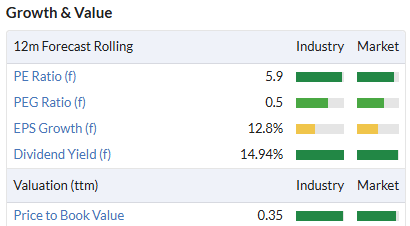
However, the recent share price recovery seems to support Mark’s view that the April sell-off may have been overdone:
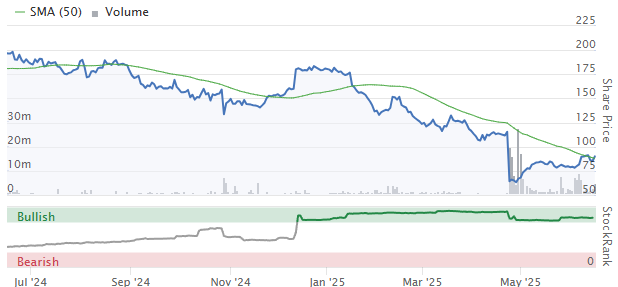
I am broadly reassured by today’s results. I note the stock’s MomentumRank has also started to creep up recently:
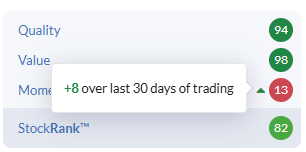
Noting the stock’s Contrarian styling and high QV ranks, I am going to stick my neck out and tentatively upgrade our view here to AMBER/GREEN.
Disclaimer
This is not financial advice. Our content is intended to be used and must be used for information and education purposes only. Please read our disclaimer and terms and conditions to understand our obligations.

41 comments
I don't see how the proposed combination of Ocean Wilsons Holdings (LON:OCN) and Hansa Investment (LON:HAN) is good for OCN holders. The RNS states that OCN holders will receive HAN shares in proportion to their respective NAVs, not their respective share prices. I have approx NAVs as 407.81p (HAN, from HL) and 2106p (OCN, from Graham's article). This would result in OCN holders receiving approx 5.16 HAN shares per OCN share. At current HAN and HANA mid-price of ~255p this means OCN holders get 1317p of HAN shares for their 1587p OCN share.
To put it another way, OCN holders will be forcibly buying HAN shares at NAV instead of at discounted market value, funded by selling their OCN shares at NAV rather than discounted market value. Since OCN is at a much lower discount, they get a raw deal. If OCN holders think that the HAN discount will reduce following the combination, surely they should be selling in the market now and buying HAN in the market now, "discount arbitrage". Or am I missing something?
It's a good argument, ISAallowance. I think that from the point of view of OCN, the main argument is that they are getting the same investment management team as they currently have but at a lower fee rate, and with the benefits of scale - which should exist in the fund of funds sectors. But yes, I do agree that the fact that HAN shares are trading at a bigger discount than OCN shares is a reason that they might not want to go through with it.
This seems to me a stitch-up of small shareholders. The tender offer is for some unknown price plucked out of a wide range which won’t be known until it happens (smoke/mirrors comes to mind). Why not give shareholders the proceeds of the Wilson’s sale? No, they must cream a large slice off to make the underwhelming funds seem more attractive. They are at 38% discount for a reason, and it’s not capable management. I want out but am not happy even after today’s rise.
Have you taken into account the reduction in OCN nav that will result when the cash consideration is paid out in the buy-back?
No, I haven't. OCN NAV/share should rise as a result of the buy-back at a discount, which would be better for OCN holders in terms of number of HAN shares received.
I also haven't figured out how to account for the 30% of HAN NAV that is actually OCN, whether that affects things or not.
I've now sold all my OCN in the market this morning based on my back-of-the-envelope calcs, and won't be refining them any further. I may consider buying HAN if it remains on a 30-40% discount after the merger, depending on the holdings.
Morgan Sindall (LON:MGNS) Roland sensibly references low margins. However, this does not mean the company can't achieve stellar returns. The article https://www.stockopedia.com/co... from Mark Simpson is worth reading in this respect. Capital turnover may be brilliant in these companies despite low margins .
Am I missing something? Carr's (LON:CARR) have a tender out for shares @ 163p. They currently trade @ 147p. The years high is 162p. Why would anyone go for this? Offer closes today btw.
Err, so you can sell your shares for 10% more than you can in the market. Or am I missing something?
Thanks - the operative word is tender -in the dictionary it can mean buy or offer - why cant they use plain English!
Carr's (LON:CARR) have sold most of their engineering division, which is where the money has come from for them to make the tender offer. I held a few in anticipation of the engineering sale but decided to sell out at below the tender price. The reason is that in these circumstances the number of shares you put into the tender offer is usually scaled back, so you're usually left with part of your holding and the price typically falls. I made an estimate of what I thought will happen and sold when I could get a higher price than that. I can always look at whether I want to buy back into the rump of the company at some time in the future.
Over that last 12 months or so one of my most promising small gold miners Greatland Gold (LON:GGP) has been very busy and now things are all coming together. Friday will see its shares suspended, I note that some investors are buying now while they can, it's a good sign. Those PI's who applied for the Retail Offer will be effectively paying 15.8 pence /share, next week they will know how many new shares in the newly-formed company, Greatland Resources, they will hold in their portfolio.
Why has Spectra Systems (LON:SPSY) risen so much in recent days? (AGM is on June 24}
Spectra Systems (LON:SPSY) apparently a write up in Moneyweek
See https://www.pressreader.com/uk...
Why did Spectra Systems (LON:SPSY) go down so much? The profit forecasts were considerably increased, a few months ago, for the next 2 years, but the share price continued to decline.
I would have topped up Spectra Systems (LON:SPSY) recently when it went down to 200p, but I'm already maxed out in terms of my position size vs daily liquidity.
My view is that the recent RCS announcement is actually more significant/strategic, and most investors just dismiss RCS in general without digging into the details. This creates an easy information asymmetry buying opportunity.
Part of the recent share price weakness is stale bulls here exiting after no announcements around Fusion so far this year. Spectra had dangled a promise that they were close to being on the Supplier List, or even getting a firm order, from a Middle East central bank for Fusion. This, of course, hasn't happened... yet, and maybe never?
I continue to hold as I think the current SP is already so well backed by existing contracts and earnings, plus steady growth in the core business. And a free optionality at the moment on any Fusion contracts or revenues.
Spectra Systems (LON:SPSY)
The profit forecasts were considerably increased, a few months ago, for the next 2 years, but the share price continued to decline.
I think its always more complicated where the "next year earnings" are expected to be lower than the "current year earnings." There is always the situation that people may have been concentrating on 2025 and the bumper profits - and the market may have got slightly carried away with the good news flow. Suddenly when you are approaching the point that the new year is coming into view and the company earnings are going materially backwards - i suspect many may give it a swerve for that reason even if the reasons are genuine - ie 2025 is a pretty exceptional year that was not expected to repeat. Must admit i was tempted in a few months back here so am a current holder - as you say even though 2026 earnings are expected to go into reverse thats nothing that hasnt been expected and as you say 2026 earninsg have been upgraded recently.
W7 Warpaint, results weighted to the second half....mmmmmmmmmmm. Not sure most other Companies would get away with it, and to be fair they are down 7% as I write. But Sam has made an effort to meet small shareholders and certainly he won my admiration and appears to be a good bloke. So I think I will give him the benefit of the doubt and hope my trust isn't misplaced. That said it is never easy for CEOs given the amount of interests they have to balance.
a delayed response to the view on AI - this is from Perplexity Pro and one of today's screamers . I use this on a daily basis and have for a number of years. Despite the hype., it is still early in AI , it is powerful in the right hands but dangerous in the wrong ones mainly because of its error rate and the overconfidence that can give . I've been in bleeding edge tech for decades , used to lead a Digital Futures Lab back in the 2000s joint with MIT , so have a bit of context , 'twas ever so with shiny new tech
To contextualise the below mea culpa from Perplexity : for an analysis of projected revenue and profit on a gold miner, Perplexity used a hypothetical AISC which hugely flattered the numbers.
It didn't disclose that the number was hypothetical in the first instance. (FWIW I know the actual number so knew this was wrong)
When challenged it acknowledged this but then stated that this was "industry practice" to estimate numbers (even though the actuals were available) - almost like human giving an excuse for the error
so it got a few more challenges until we got to root cause ......
I reckon Graham et al may have a job for a while yet AND use great caution with AI, it is very reminiscent of an employee who is so desperate to please you they will tell you what they think you want to hear rather than the reality (called "overfitting" in AI) .
I am massively bullish the technology but careful in its application through multiple experiences like this - even constraining context with only your own input files is not without significant challenges owing to LLM glitches
as ever DYOR is very resonant . doing hard work with AI is still hard work even with the best prompt engineering skills
Further below the Hype Cycle for AI from Gartner - it's a great model for how technology advances relative to societal/behavioural expectations. This forms a predictable repeatable pattern because humanity tends to behave in this way and has done for millenia independent of technology - from the printing press to steam engines to Quantum AI. We overestimate the impact and underestimate the time it takes. Much of AI is still early though the rate of advance is accelerating
Interesting comment, along the lines of this time is not different. The impact and adoption of the internet and mobile phones was much more drawn out than expected. Probably because people are naturally slow to change their ways. As a 60 year old I dont use my phone as much as a 20 year old for example.
It is possible that AI will be more quickly adopted because it is so closely connected to activities that can make a cost saving. Therefore competition will force its rapid adoption by companies. The other difference is the machine learning aspect. It improves itself, which accelerates change.
it's less the speed of adoption and more the extent and impact of that adoption; our ability to adapt reflexively as a species is why we are still the apex crew even if we continue to overestimate our abilities to predict ... We are likely to stay that way for a good while ..and I say that as someone who has very much taken the red pill
Thanks for this DS I meet a lot of fund managers and they are raving about Perplexity as the Google killer so nice to get some balanced context.
Perplexity Finance have ambitions of being the Bloomberg Terminal Killer ..I am always hopeful.
Cant talk about Perplexity but I am a Global IT Director and sit on the Co Exec. Just attended my MS training workshop and, from an investment perspective, I am underwhelmed. Can I do certain tasks quicker (if I use it enough) yes. Will it be a game changer - no. The software was virtually given away (there's a clue). Will the vendor see an ROI - not for years IMO.
MS Copilot is underwhelming spent a while with it but unconvinced atm though it is in the enterprise stack so you are likely stuck with it as a "feature"
Google Gemini is massively functional but I keep breaking it even on a Pro sub : it literally abandons hard tasks which may well be to protect compute capability/capacity.
In my experience , Perplexity is currently the best of breed especially for finance and given its model independence (allows use of Gemini Pro, Claude, GPT4 , Sonar, Grok etc)
Despite the above I do believe it is more than a game changer in some instances/applications/sectors: it is a whole new game . A transformational game so my bullishness comes from that.
It is fairly common to give away new stuff in the early part of a product maturity cycle (hotmail, gmail, dropbox etc) : with AI "free access" provides huge amounts of data from users which is used in improving and training the LLMs so the " free " bit comes with paybacks (and costs to the user in terms of accuracy/functionality during this early part of the cycle ).
In practical terms, everyone I know using AI with any real intent pays a sub - it's a no brainer in terms of efficiency and payback despite the glitches
Businesses employing AI are getting good results in limited use cases as long as they clean their data. A seemingly trivial example is banking chatbots. A recent example I was reviewing is now returning 98.7% accuracy. Getting to that point takes about two years to remodel internal data and achieve consistency, including building a whole bunch of industry specific guardrails to ensure the AI doesn't breach regulations (e.g. unintentionally offering investment advice).
The net result of this relatively minor use case is that the use of human agents has dropped by 60% as customers are needing to talk to a real person less and less often. The key to this is that the AI agent has to come across as a real person - as soon as it drops the ball then customers revert to human contact.
The learnings from this are now being expanded into other areas within the bank, initially focusing on customer facing stuff (online, obviously). The quid pro quo for this is that the backroom staff need to be better skilled and adept at analysing the output to catch issues. But still, overall, the cost savings are significant.
The broader point here is that the general population's experience of AI isn't directly comparable to the way businesses will use it. Currently training and managing business specific AIs is difficult, expensive and time consuming but where it works it's very cost effective. And that's now, not in a few years time.
timarr
agreed and the most reliable results I get are scoped to my own data and use an optimised set of prompts which I reuse : some of the benefits of paying a sub
Good news for Hansa Investment (LON:HAN) following up on my post mentioning this last week. Proposed combination with Ocean Wilsons Holdings (LON:OCN) was perhaps foreseeable and should be a great outcome for Hansa holders. OCN is essentially mostly cash following the sale of Wilson & Sons and the combination envisages Hansa buying out OCN via a share trade based on NAV for both. Given that Hansa market price is ~40% discount and OCN much less at around 20% (and OCN discount likely to get even lower after their tender offer and given the cash it houses before the combination goes through) this creates a real momentum for narrowing of the discount for Hansa - especially as the management fees are going to materially reduce and it also gets economies of scale thrown into the bargain. The combination makes complete sense given the current position of OCN and the existing intertwined management interests and looks like it could finally assist with Hansa's stubborn discount. With OCN being larger than Hansa any merger on these terms looks certain to positively impact the Hansa valuation.
The very unusual heavily weighted 30% holding in OCN has probably always put off many investors and contributed to Hansa's discount rating for some time (despite performing well and being a hugely profitable investment over the years) and having rid of that and replacing it with a more usual set of investments for the fund using the cash haul from the Wilson & Sons sale should also be a positive for the fund.
Some rise in the price today, but probably more to come as this plays out assuming the combination goes through as Hansa still sits on ~40% discount even after the current 6% rise today.
BIACS
B&M European Value Retail SA (LON:BME)
The new CEO, Tjeerd Jegen has purchased 197,900 shares at an average price of around 265p; costing in excess of £523,000. He took up his position as CEO of B&M European Value Retail SA (LON:BME) yesterday and has significant experience in the value retail sector.
Despite the challenging retail environment the shares look too cheap to me and I have been buying having added yesterday. Hopefully Mr Jegen's share purchase will help reverse the share price momentum.
"Tjeerd Jegen brings over 25 years of international retail experience. He began his career at Ahold Delhaize, gaining experience across food retail operations in the Netherlands and Central Europe and subsequently worked as CEO at Metro Group in Romania. He held senior leadership roles at Tesco in Thailand and Malaysia then led the Supermarkets division of Woolworth Australia, delivering key innovations in online retail, private label, and fresh food supply chains. In 2015, Tjeerd became CEO of HEMA, the Dutch value variety chain, where he led international expansion. More recently, he served as CEO of Takko Fashion, a leading discount fashion retailer and subsequently CEO of Accell Group, Europe's largest e-bike manufacturer."
I have also been buying Ultimate Products (LON:ULTP) at around 75p. Again the share price fall looks overdone. I have sold a few Property Franchise (LON:TPFG) to fund the purchases, but retain a healthy holding. Time will tell whether my new purchases are successful, but good to see the new CEO investing a significant amount of his own money.
I think Ultimate Products (LON:ULTP) is a really good shout as a contrarian stock. Earnings forecast is poor but these only get upgraded once the horse has bolted. I prefer sales signposts. Good historic growth largely, positive sales forecast, manageable debt and some free cash. 5 year ROCE and decent earnings yield. The sales based value on EV also sound. They license decent brands like Beldray, Russell Hobbs and Salter which can be located in a variety of discount (B & M) and premium stores. A good walk down the high street. Further positive is support from black rock smaller companies and an experienced CEO. A potential multi bagger in my opinion as a consumer franchise stock. A risk yes but I'm not fussed about earnings forecasts with contrarian stocks
Not surprisingly I agree. One small point Ultimate Products (LON:ULTP) own the Salter and Beldray brands. It sells Russell Hobbs, except electricals under license.
All the best
It looks as if there might be another bidder for CAML target New World Resources.
"North American buyout firm storms bidding fray for New World Resources
"Days after Street Talk reported a buyer was on the hunt for a parcel of shares and offering 5.1¢ apiece to willing sellers – above the 5¢ bid price on the table from would-be acquirer Central Asia Metals – there’s a new bidder in town.
"Kinterra Capital – a Toronto-based private equity fund that earlier this year closed a second fund of $US1 billion ($1.5 billion), targeting critical minerals and related infrastructure – has emerged with a 12 per cent stake."
Banco de Sabadell SA (MCE:SAB) might be looking to sell Tsb Banking (LON:TSB^G15) so I'm wondering if a listed UK bank might be interested in the purchase or if they are looking for a listing comeback.
This is a complex situation as Banco de Sabadell SA (MCE:SAB) is involved in a hostile takeover by Banco Bilbao Vizcaya Argentaria SA (MCE:BBVA) and selling TSB will give enough gunpowder for performing acquisitions within Spain and get the regulators to block the takeover
Morgan Sindall (LON:MGNS) : A quality company continuing to deliver. One to hold for the long term.
The deal by Aviva (LON:AV.) to buy Direct Line Insurance (LON:DLG) has been approved. That'll create the largest UK general insurer by quite a long way. Given DLG's high expense ratio there are likely to be significant cost savings, most of which will be the form of job losses. Assuming good execution - never a given - this is likely to strengthen Aviva's market position.
Wouldn't be surprising to see more M&A in the sector in response.
timarr
Morning Timarr
I have a good size position in Sabre Insurance (LON:SBRE) that specialises in motor insurance. I bought it at around 130p attracted by the dividend yield. The potential prospect for a bid is the cherry on the cake.
Ocean Wilsons Holdings (LON:OCN) combination with Hansa Investment (LON:HAN) makes perfect sense to me as they are both controlled by the same Saloman family. I am not sure that the new Hansa dividend policy is going to help minority shareholder interests though. The only way to reduce the discount is to have a 3 or 4% progressive dividend policy and that appears to be off the table.
Graham, would be great if you could look at the Ocean Wilsons Holdings (LON:OCN) tender offer and potential combination with Hansa. Cheers
yes, Roland or I are very likely to check that out Nurzel! cheers
Thanks!
Warpaint London (LON:W7L) H2 looks decent, short term pain maybe?