DS Smith (LON:SMDS) - sustainable long-term growth

Summary
Packaging group DS Smith (LON:SMDS) is reporting positive growth despite uncertain macroeconomic conditions. However, the group’s shares appear to be priced for value, suggesting a potential opportunity.
Bull points
- DS Smith operates a circular models, producing, collecting and recycling its own packaging
- The group only produces cardboard and paper-based packaging, most of which is highly recyclable
- Structural trends such as ecommerce growth, urbanisation and sustainability mean that the company expects volume growth to outpace GDP growth in its markets
- The shares look affordably valued with a positive momentum outlook
Bear points
- This sector is cyclical and there are already early signs of weaker volumes due to slowing economic activity
- The company has pushed through significant price increases to reflect higher input costs, but customers may ask for price cuts if commodity prices ease
- DS Smith’s profitability has lagged behind UK-listed peers in recent years
Profile
About the stock
DS Smith (LON:SMDS) operates in the Basic Materials sector and is part of the Containers & Packaging industry group.
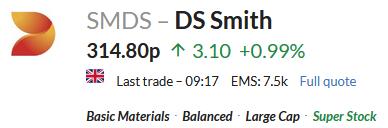
The group’s shares currently trade at 315p on the LSE Main Market. DS Smith is a member of the FTSE 100 and has 1.4bn shares in issue, giving a market cap of £4.3bn. Free float is 96%, so liquidity should be excellent.
The StockRanks are highly favourable for DS Smith, with particularly strong ValueRank and MomentumRank scores. The company is classified as a Balanced Large Cap Super Stock by Stockopedia’s algorithms.

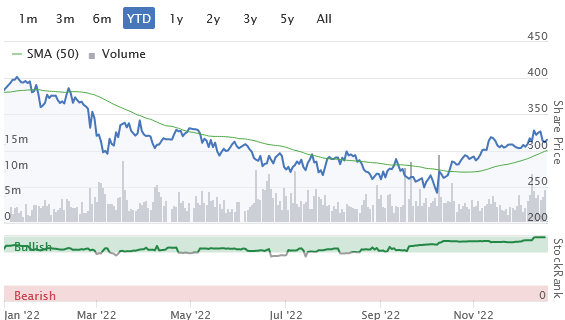
After a year-to-date share price decline of 20%, DS Smith shares are showing signs of entering an uptrend, with a high, improving StockRank:
About the opportunity
DS Smith is classified as a Super Stock, indicating that it could be a good, cheap and improving business.
The potential opportunity here is that the business will continue to grow, while also delivering improved profitability and a higher valuation rating. This could lead to significant share price gains over time.
However, this is a cyclical business as well. I think it’s instructive to consider the opportunity through the lens of Peter Lynch’s six categories.
Lynch said that stocks could often fit into more than one category. In this case, I’d argue that DS Smith fits into both the Stalwart (>GDP growth) and Cyclical categories.
In other words, for investors who are willing to ride out cyclical dips, I expect an underlying trend of volume and profit growth, driven by recent investment in the business and by structural demand trends.
Business & Model
What is the company’s history and what does it do?
DS Smith was founded in London by the Smith family in the 1940s. The group’s original focus was on box-making. It’s since expanded to include papermaking and recycling and is now a FTSE 100 business operating across Europe and North America.
Key business segments and revenue breakdown
DS Smith operates across the spectrum of fibre-based packaging, but the majority of the group’s volumes lie in two sectors, food and drink and non-food consumer goods:

Source: DS Smith 2022 results presentation
DS Smith doesn’t seem to provide a detailed breakdown of revenue across packaging types. But in 2022, the firm said that 83% of its corrugated packaging customers by volume came from the FMCG (fast-moving consumer goods) sector.
The company’s main reporting segments are geographical. This chart from the 2022 annual report shows how 76% of group revenue comes from western European markets, split here into southern and northern groupings:

Source: DS Smith 2022 annual report
As things stand, I think it’s fair to describe DS Smith as a predominantly European business serving the food and consumer goods sectors.
The company is investing in the US market and has added new capacity over the last few years. But it remains a small part of the business at present.
What is the business model? How does it make money?
DS Smith offers customers corrugated (cardboard) and paper packaging products. The group also operates an in-house recycling business that provides much of the fibre needed for the firm’s papermaking activities.
The company’s products and services can be grouped into five categories:
- Packaging solutions: including transport, retail and industrial products
- Recycling services: general recycling, sector-specific services and materials trading
- Paper products: a wide range of trade products for labelling and packaging
- Point of Sale Display Solutions: focused on the food and retail sectors
- Packaging machinery: specialising in end-of-line packaging machines, such as partition inserters, case packers and tray formers
Markets & Competition
What is the state & size of the company’s market?
The market for corrugated packaging is large and growing steadily. Demand growth for corrugated packaging is being driven by a number of structural trends, especially in consumer sectors:
- Plastic replacement products
- Ecommerce growth: online penetration remains sub-15% in many European markets
- Changing retail formats
- Urbanisation, changing shopping habits and demographics
One report I’ve seen suggests the corrugated packaging market could grow at a compound average growth rate (CAGR) of 5% over the next decade, taking it to $219bn.
An alternative report suggests a CAGR of 6.5%, taking the market to over $350bn in 2031.
Estimates clearly vary, but these estimates are consistent with DS Smith’s own strategy of targeting GDP +1% growth in its core markets.
In the context of these figures, DS Smith’s 2022 revenue of £7.2bn, suggests the corrugated packaging market remains highly fragmented and offers plenty of scope for market share gains.
It seems unlikely to me that DS Smith will need to contend with saturated market conditions, except perhaps during periods of recession.
Who are the company’s key competitors?
Among UK-listed businesses, FTSE 100 peers Mondi (LON:MNDI) and Smurfit Kappa (LON:SKG) both have comparable offerings, albeit with slightly different product ranges and geographic footprints.
In the US, competitors include International Paper and Packaging of America are example competitors. There are many more, including companies offering packaging made out of alternate materials such as plastic.
What is the company’s strategy?
The company’s strategy is to produce value-adding, sustainable and cost-effective corrugated packaging.
The firm works closely with major customers to manage cost and risk, and invests in manufacturing and research to minimise packaging time and waste.
How does it derive its competitive advantage?
DS Smith tends to have long-lived customer relationships. In 2022, the company said its average customer relationship was 19 years. This suggests the group does have some degree of competitive advantage.
Likely reasons for this advantage include:
- Network effects & scale: DS Smith’s scale means that it can provide a consistent service with secure supplies over wide geographic areas.
- Switching costs: the company works closely with clients to develop optimum solutions, including bespoke packaging and supply chain integration. Switching to a rival supplier could be disruptive and expensive.
- Cost advantages: by operating at scale with high levels of utilisation and specialisation, the group is able to manage energy and commodity costs successfully and benefit from economies of scale.
- Vertical integration: in-house collection and recycling services ensure high levels of effective recycling and traceability for customers, who can use this data within their own carbon accounting.
These factors present barriers to entry for new rivals and engender a high degree of customer loyalty.
However, it’s less clear how much of a competitive advantage DS Smith has over other large, well-established firms. The company’s long-term average ROCE is just 8%, suggesting that this remains a competitive marketplace.
Is the competitive advantage durable?
The packaging market is consolidating steadily. This tends to create favourable conditions for larger companies to expand.
DS Smith’s customers longevity suggests they value the company’s offering and are disinclined to switch to rival firms.
While it’s possible that third-party innovation could disrupt this market and provide opportunities for new entrants to displace established firms such as DS Smith, this does not seem especially likely at the moment.
On balance, DS Smith’s advantages appear to be relatively durable, in my view.
Financials & Ownership
What is the record of growth & profitability?
DS Smith has delivered fairly consistent revenue growth over the last decade:

Operating profit has also trended higher, albeit with a double hit from the pandemic and rampant cost inflation over the last two years:

Combining these two charts shows that the group’s operating margin has been fairly stable over the last decade:

Operating profit has generally been converted quite reliably into free cash flow, according to Stockopedia data. I’ve excluded acquisition costs from this measure of FCF:

Shareholders have been rewarded with strong dividend growth since a cut in 2008, but the payout was cut again last year. I wonder if DS Smith needs to adopt a slightly more conservative payout policy.

What is the state of the balance sheet?
DS Smith has spent quite extensively on acquisitions over the last decade, according to Stockopedia data:

Long-term debt reached £2.4bn in 2019, but has since started to fall:

The company says that its net debt/EBITDA ratio had fallen to 1.0x by the end of October 2022, from 1.9x one year earlier.
This reduction was achieved thanks to higher EBITDA and a significant reduction in net debt:

On balance, I would argue that DS Smith’s balance sheet is in reasonably good health, with no serious cause for concern.
The stock’s strong Piotroski fundamental health score appears to support this view:

Is there evidence of historic share dilution?
Shareholders suffered a modest level of dilution between 2017 and 2019, when shares were issued to help fund the acquisitions of US firm Interstate Resources and Spanish company Europac.

Earnings per share performance since then has been mixed, albeit clouded by the impact of the pandemic. I think this makes it hard for us to be sure yet whether these deals were reasonably priced, or a little expensive:

What is the ownership structure of the company? Do management have stakes?
The group’s shareholder register is dominated by large institutions. There’s little of note, although the presence of Canadian high-conviction fund manager Black Creek suggests that the shares may be seen by some as a value play:

The 2022 annual report shows chief executive Miles Roberts holding just over 2m shares, which I estimate are worth around £6.5m at present. For context, Mr Roberts total remuneration last year was around £2.6m.
This aside, there’s no significant management shareholding or inside ownership.
Valuation
How does the relative valuation compare versus industry and sector?
DS Smith looks a little cheaper than its main UK-listed rivals, Smurfit Kappa and Mondi, based on the latest consensus forecasts:

The shares also look good value on a trailing basis relative to industry peers:

All the main valuation metrics seem to suggest the shares are reasonably valued, I think, assuming earnings don’t collapse.
Trends & Catalysts
Are there any significant macro trends that the business is benefiting from?
Sustainability: this is one of the big megatrends that I think is likely to shape the packaging market over the coming years. Plastic substitution is one key growth opportunity, but reducing wasted packaging and cutting costs (weight, materials, transport) is another.
Ecommerce: in the UK it seems like almost everyone orders online. But ecommerce penetration is much lower in many European countries. Even in the UK, it seems likely that there is room for further growth and evolution in internet commerce.
Food and drink: this is DS Smith’s largest single market sector. Trends such as more frequent shopping, cooked food delivery and the overriding need to reduce both food and packaging waste are driving growth opportunities for packaging producers.
Are there any catalysts that could drive a rerating in the medium term?
Profitability: To justify a lasting re-rating, I think the DS Smith may need to demonstrate a sustained improvement in profitability.
The firm admirably quotes return on capital employed as one of its key performance indicators. However, even the firm’s preferred, adjusted measure of return on average capital employed (ROACE) does not suggest very high levels of profitability.
Full-year ROACE in 2022 was 10.8%, while the H1 2023 figure was a more encouraging 13.2%.
At a statutory level, DS Smith’s five-year average ROCE of 7.4% is behind Smurfit Kappa (9.1%) and Mondi (15.7%).
Potential routes to improved profitability include gaining market share, consolidation and innovation.
Risks, Threats & Hurdles
The cyclical nature of this business and its exposure to commodity prices are key risks, in my view. Interestingly, the company itself listed these factors plus cyber attacks as its top three risks in its last annual report:

Source: DS Smith 2022 annual report
The macroeconomic risk is given more urgency by this year’s interim results, which showed that volumes have already fallen in some customer sectors:

Source: DS Smith H1 2023 results presentation
Recent Trading & News
Recent trading summary
Half-year report (8 Dec 2022)
“... we now expect FY23 performance to be ahead of previous expectations with H2 being consistent with H1.”
DS Smith’s half-year results struck a positive tone
- Revenue +26% to £4,299m
- Adjusted operating profit +49% to £418m
- Adjusted earnings +49% to 20.9p per share
- Interim dividend +25% to 6p per share
Guidance for the second half of the year was upgraded, eliminating the expected H2 weakness.
However, as the graphic posted above shows, like-for-like volumes fell in a number of categories. DS Smith says that box volumes fell by 3%, representing a £64m decline in revenue. The weakness was said to be mainly due to economic and industrial sector challenges in the UK and Germany.
The decline in volumes was massively outweighed by the impact of price rises to reflect raw material and energy costs. Price increases totalled £950m during the half year, supporting an increase in operating margins to 8.1% (H1 2022: 6.2%).
The overall outlook remains positive and CEO Miles Robert is confident that changes and investments made in recent years are bearing fruit, including through US growth.
What do the brokers currently think and are they upgrading estimates?
City analysts have upgraded their earnings estimates on several occasions since the summer. However, earnings growth is expected to level out in 2023/24:

What would the person selling to us be thinking and who are they?
DS Smith shares look affordable and the company’s recent performance has improved. On this basis, I’d suggest sellers are likely to be those who expect a more severe recession in Europe and the USA than is currently expected.
Sellers may also be concerned that when inflation eases, the tailwind of price increase will reverse, putting pressure on margins. Without an in-depth understanding of the company’s contracts and pricing structure, it’s not easy to evaluate this risk.
Conclusion
DS Smith appears to satisfy the majority of the criteria for a Super Stock. The firm appears to be reasonably priced, with improving profitability and recently-upgraded earnings forecasts.
Cyclical and economic risks remain a potential concern. But on balance, my view is that the current valuation includes a margin of safety and could represent an attractive medium-long-term entry point, especially given the 5.6% dividend yield.
Disclaimer
This is not financial advice. Our content is intended to be used and must be used for information and education purposes only. Please read our disclaimer and terms and conditions to understand our obligations.

12 comments
Talk about last minute! RNS at 16 53 - 7 minutes before deadline.
Basically agreed in principle but deadline extended to sort out some detail.
"Mondi shareholders would own 54 per cent. and DS Smith shareholders would own 46 per cent. of the issued and to be issued share capital of Mondi;
* Based on Mondi's closing share price of 1,381 pence per share on 7 February 2024 (being the day prior to the commencement of the offer period), the termsof the Combination would represent an implied value of 373 pence per DS Smith share and a premium of 33 per cent. to DS Smith's closing share price of 281 pence per share on 7 February 2024".
DS Smith (LON:SMDS) closed at 325.2 and Mondi (LON:MNDI) at 1380 today.
PUSU day today. The companies have until 5 p.m. to announce (or agree an extension with the Takeover Panel). SP up at the moment in anticipation.
From a 'Brokers' Ratings' list yesterday:
Barclays raises Mondi price target to 1,215 (1,200) pence - 'underweight'
Barclays raises DS Smith price target to 420 (360) pence - 'overweight'
With Mondi at 1375 and DS Smith at 328.8 at close yesterday suggests there could be more upside for SMDS when (if!) the offer is made.
Mondi prelims Thurs. 22nd.
An interesting article with views of Barclays analyst Pallav Mittal including consolidation in the packaging industry is “inevitable".
https://markets.businessinside...
A similar article by Reuters adds:
"DS Smith CEO Miles Roberts, who announced in December his plans to retire by no later than November 2025, had overseen the London-based company's expansion into Europe and the U.S".
(Click on retire for a detailed article).
Amongst all the forms 8.3 and 8.5 cluttering up the news box from now on Stocko has inserted this:
By Aimee Donnellan
LONDON, Feb 9 (Reuters Breakingviews) - Three years
after its last approach, $7.4 bln Mondi wants to merge with $5.4
bln DS Smith. Amid slowing consumer demand, there’s more
strategic and financial logic in uniting the UK-listed
packagers. That doesn’t mean there won’t be a squabble over how
they’re scrunched together.
Full view will be published shortly.
https://www.stockopedia.com/sh...
Mondi (LON:MNDI) has now replied:
"Mondi confirms that it is in the early stages of considering a possible all share combination with DS Smith". (My bold),
For the rest, including its reasons for this being a good deal see: https://www.londonstockexchang...
Well .... a possible bid from Mondi (LON:MNDI) has taken the sp back to almost the same spot as on the date of this article:
Mondi has MCap £6bn compared to SMDS £4bn and both have debt so I suspect this could be an all share offer.
Early days - any thoughts Roland?
A good report. Comparing the sector SMDS 20/40, Mondi 12/40, SKG6/40, Macf 3/40. I shall stick with SMDS.
Thanks for the write up. I’ve been buying more of this stock over the last few weeks.
Hi Roland,
Great article and very thorough as always. I particularly like how you include the section on what sellers might be thinking.
On reading last week's article I was naively expecting you to cover Macfarlane (LON:MACF) as you own shares already. With DS Smith being in the same sector I doubt many would invest in both, so the big question - is it a better investment opportunity than Macfarlane at current levels? With a higher yield, lower PE, higher stockrank and higher expected EPS growth DS Smith looks good on paper (excuse the pun). I'm interested what aspects of Macfarlanes bull case (or DS Smith's bear) are stopping you from making the transition from MacFarlane to DS Smith?
Cheers,
Ben
Impressive. How do I log in to your regular articles
Thanks, Munday!
To see an archive of any author's articles, just click on their profile name at the top and then click "Activity" below their picture.
To see posts only, not comments, you'll then need to switch the choice at the top from "all recent activity" to "all posts".
For example, here's mine:
https://www.stockopedia.com/co...
Regards,
Roland