Harbour Energy: a transformational opportunity?

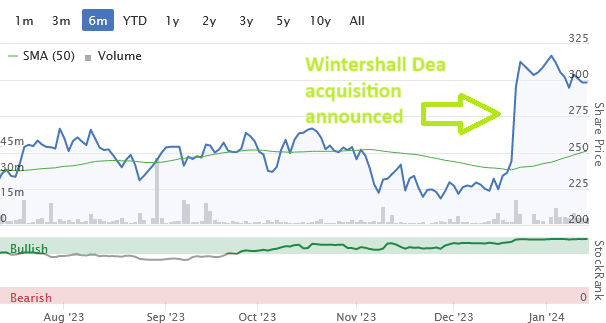
FTSE 250 oil and gas producer Harbour Energy (LON:HBR) is now the largest independent oil producer in the North Sea. I reckon it could also become a FTSE 100 member by the end of 2024, if the recently-announced $11.2bn deal to acquire the majority of Wintershall Dea’s production assets goes ahead as planned.
Harbour is also currently one of the most highly-ranked UK shares in the Stockopedia universe, with Super Stock status and a StockRank of 98 at the time of writing:

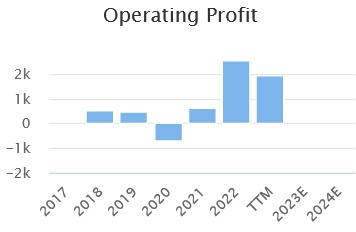
Recent financial performance has been excellent. Soaring gas prices in 2022 boosted profits:
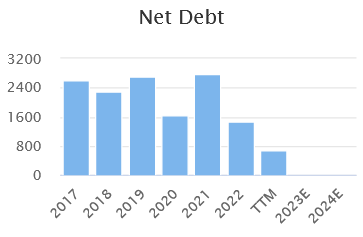
These windfall profits also enabled Harbour to accelerate its planned debt repayments. Net debt fell from $2.8bn at the end of 2021 to less than $800m at the end of June 2023:
The word transformative is sometimes overused in investment commentary, but I don’t think it’s an exaggeration in terms of the potential impact of the Harbour/Wintershall Dea combination.
I looked at Harbour’s smaller North Sea rival Serica Energy (LON:SQZ) in a recent piece, following that company’s own transformative acquisition with Tailwind Energy.
Given the recent news and share price action from Harbour Energy, now seems a good time to take a closer look at Harbour and at the Wintershall Dea deal.
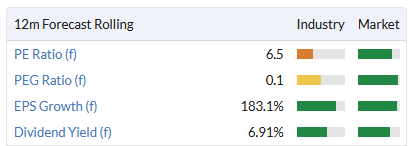
With a rolling forecast P/E of 6 and a dividend yield of nearly 7%, Harbour’s value metrics appear quite attractive:
Does Harbour offer an opportunity here for private investors, or do the apparently favourable terms of this deal hint at pitfalls to come?
Harbour Energy: a big roll-up
Private investors who have been in the UK markets for a while are likely to remember Premier Oil. This business was a well-established North Sea operator and also had assets in certain Asian markets.
My impression was always that Premier was a good operator, but its financial position was weak.
Like a number of others, including Enquest (LON:ENQ), Premier overcommitted to expensive development projects ahead of the 2015/16 oil sector crash. The group was then left with unmanageable levels of debt, but some attractive assets that gradually came into production.
Premier staggered on until 2021, when the business was merged with Harbour Energy’s UK operating company Chrysaor through a reverse takeover.
Harbour Energy had already been engaged in buying up unwanted North Sea assets from the majors prior to the Premier deal. The merger provided a convenient route to a LSE listing and added further attractive assets, including Premier’s hefty tax losses:

In some ways, history is now repeating itself. The Wintershall Dea deal is a reverse takeover that will see Harbour absorb a much larger entity.
And although the debt problems that plagued Premier are no longer an issue, I think there’s still some uncertainty about the Harbour's medium-term future.
Without the Wintershall Dea assets, the 2P reserve life (remaining production lifespan from developed assets) from Harbour’s current portfolio would be six years. The company’s June 2023 balance sheet also showed $4.3bn of future decommissioning liabilities.
Compare this to Harbour’s £2.3bn market cap and $1.4bn net asset value, and I think it becomes clear why balance sheet strength and acquisitions are key elements of Harbour’s strategy.
Adding Wintershall Dea’s assets to the Harbour portfolio will extend the reserve life of the portfolio and may dilute decommissioning liabilities somewhat. Perhaps more importantly, it should also strengthen Harbour’s financial position and significantly reduce its cost of capital.
Wintershall Dea: what’s the deal?
Wintershall Dea is an independent oil and gas producer owned jointly by German chemical giant BASF (73%) and investment group LetterOne (27%).
According to comments from Harbour CEO Linda Cook on the analyst call, BASF wants to get out of oil and gas, but LetterOne does not. This provides some context for the sale, I think.
Harbour Energy is paying $11.2bn to buy Wintershall Dea’s upstream (production) assets in Norway, Germany, Denmark, Argentina, Mexico, Egypt, Libya and Algeria. This is substantially all of Wintershall Dea’s upstream assets except those located in Russia.
Combining these two sets of assets should create a much larger and better-diversified independent production business:
Harbour Energy | Wintershall Dea | Combined group | |
Production | c.190,000 boepd | >300,000 boepd | >500,000 boepd |
2P reserves | 410m boe | 1.1bn boe (65% gas) | c.1.5bn boe |
Operating cost | c.$16/boe | $9/boe | $11/boe |
2P reserves life | 6 years | 10 years | c. 8 years |
The metrics above show the attractions – higher volume, lower cost production, with a big weighting to gas.
The deal will involve issuing a large number of new shares (see below), but Harbour says that the combined business will provide an improvement on all key per-share metrics, too. Notably, improved free cash flow is expected to support a 5% dividend increase:

Norway will be the largest geographic region in terms of production, which should provide welcome stability:

Payment terms: the $11.2bn headline price tag for the deal dwarfs Harbour’s current £2.8bn enterprise value (market cap plus net debt).
Post transaction, this will be quite a different business, with existing shareholders exerting far less influence than at present.
As we might expect, the payment structure will include debt, equity and cash elements:

Broadly speaking, I think the structure of this deal is favourable for Harbour shareholders. But there are some elements I think are worth commenting on.
Equity: approximately 921.2m new shares will be issued to Wintershall Dea shareholders at a price of 360p – a significant premium to the share price prior to the deal and indeed to the current share price of c.300p.
Initially, at least, the Harbour-Wintershall Dea deal will give BASF a 46.5% shareholding in Harbour, with existing Harbour shareholders holding the remaining 53.5%. BASF will be able to nominate two non-executive directors to Harbour’s board.
LetterOne will be issued with a new class of unlisted, non-voting preference shares. This is being done to prevent issues relating to Russian sanctions on some of LetterOne's minority shareholders. These shares will pay a 13% premium on all dividends, to reflect their lack of liquidity and voting rights. My sums suggest this could give a yield of nearly 8%.
However, there is a route to convert these non-voting shares to ordinary voting shares if certain conditions are met. In this scenario, LetterOne would own 14.9% of Harbour, BASF 39.6% and existing Harbour shareholders 45.5%.
I think it’s fair to say that BASF and perhaps LetterOne will be able to exert considerable influence over Harbour’s future strategy and its prospects as a listed company.
Cash: the $2.15bn cash element of this deal is expected to be funded by free cash flow generated by the Wintershall Dea assets from the deal’s effective date of June 2023 through to completion.
However, Harbour has also secured a $1.5bn bridging facility and a new $3bn revolving credit facility in order to make up any shortfall and provide additional liquidity if needed.
I wonder if this may be more necessary than it might first seem. Wintershall Dea generated €2,333m of free cash flow during the first nine months of 2022. But in 2023, this figure reversed to a free cash outflow of €224m.
Harbour CFO Alexander Krane was asked about this on the analyst call in December. He suggested some of the shortfall might be due to timing issues with Norwegian tax payments, but his answers seemed a little vague to me.
Wintershall Dea’s accounts are available on its website, so I took a look. Tax paid during the first nine months of 2023 rose by about €400m versus 2022, so that did have some impact. Capex was slightly higher, too.
However, by far the largest reason for the free cash flow slump seems to have been commodity price exposure.
Revenue from own production oil and gas sales fell by 38% from €6,241m in 9M22 to €3,850m in 9M23.
In addition, Wintershall Dea also said that its revenue from “gas sales trading” fell from €7,807m to €3,625m in 9M23. This is what the company says about its trading activities:
The headquarter’s trading activities for the purpose of margin improvement and in the comparison period also the trading transactions of the Russian subsidiary YRGM Trading are shown net of cost under trading revenues.
It’s not clear to me how much of Wintershall’s trading income relates to its Russian activities. Nor do I know to what extent (if any) Harbour carries out trading activities beyond managing the sale of its own production.
However, until we see evidence of stronger free cash flow from Wintershall Dea, I think it’s worth considering the risk that the premium on the equity might be partially offset by additional debt drawn down to fund the $2.15bn cash obligation.
Debt / Bonds: one significant benefit of this acquisition is that it is expected to allow Harbour Energy to secure an investment grade credit rating. This should give the company access to lower-cost funding than at present – a big advantage.
In effect, Harbour seems to be acquiring Wintershall Dea’s existing investment grade rating by acquiring both its assets and the related debts.
The $4.9bn bonds that form part of the transaction were originally issued by Wintershall Dea and have a weighted average coupon of 1.8% and a weighted average maturity of 4.5 years.
I assume that Wintershall Dea secured this financing when interest rates were lower. When Harbour needs to refinance in a few years, I expect the cost will be higher, albeit still lower than it would have been without an investment grade rating.
My thoughts
Despite the tone of some of my comments, I have a fairly positive view on this deal. I think it’s logical, reasonably valued and should create a larger, more sustainable business for Harbour Energy shareholders.
At the same time, I don’t believe in the tooth fairy. Market conditions in 2022 provided independent oil and gas producers with a huge profit boost that’s unlikely to be repeated.
Companies selling oil and gas assets often also have good reasons to be exiting the market. In addition to energy transition considerations, many of these assets have short remaining lifespans and will incur sizeable decommissioning costs.
I think the cost of decommissioning is largely being overlooked by investors at the moment. But my feeling is that it could have a significant impact on equity values when/if we reach a point where production is in structural decline and there’s little incentive to acquire new production. As I've said before, I think this is why companies such as Harbour and Serica are so focused on maintaining strong balance sheets -- and why their shares are trading on such low multiples.
For example, Harbour Energy reported decommissioning liabilities of $4.3bn at the end of June 2023, paired with a remaining 2P reserve life of just six years.
Wintershall Dea’s latest accounts show c.$2bn of decommissioning liabilities. I’m not sure how much of this might relate to the group’s Russian assets, which are excluded from this deal.
However, I think it’s reasonable to assume that the enlarged Harbour business could have decommissioning liabilities of c.$6bn that will start to come due over the next decade.
Against this backdrop, continually scaling and consolidating makes sense as a strategy to generate cash and stay ahead of the decommissioning cost curve.
Conclusions: it’s worth remembering that as with any major acquisition or merger, Harbour will continue to report its current financials situation until after completion. Harbour Energy’s StockReport will be based on these figures, as will broker forecasts, in general.
Harbour’s accounts will change completely when/if the deal completes. This will almost be a different company – so basing too much analysis on current financials may not be entirely helpful.
Having said all of that, the company’s projections for a 5% increase to the dividend seem fairly reasonable to me. This would give the stock a yield of around 7%, which could prove to be an attractive entry point, in my view.
More generally, I think that the current rosy outlook for Harbour and other independent producers seems to be dependent on reserve replacement and sector consolidation at a faster rate than historic norms, potentially while also managing higher rates of decommissioning activity.
I think Harbour and other independent operators will offer opportunities for investors who understand the market, but this is a case where I think it is necessary to do research beyond the standard numbers to understand more about the business and the wider sector.
Disclaimer
This is not financial advice. Our content is intended to be used and must be used for information and education purposes only. Please read our disclaimer and terms and conditions to understand our obligations.

13 comments
Thank you. Helpful review. Share price are falling, I guess due to production issues in 2024. Fingers crossed. Not sure when to sell though?
I cannot claim to have done too much research, but have been tempted by the chart signals into purchasing a stake in Harbour Energy (LON:HBR) today
This is telling us what we already know - HBR needs acquisitions and mergers in order to maintain / increase profitabilty. Without the Wintershall deal going through it would need to look elsewhere (it's carbon capture/ store plans aren't going to bring in money anytime soon). The Wintershall deal is a biggy with many unknown variables - I think it's too much of a leap of faith to invest prior to more info being available. Personally I am hoping that the SP drops to nearer that immediately prior to the announcement being made.
Just a quick update following the Harbour Energy (LON:HBR) FY trading update this morning and the resulting share price fall.
2023 numbers seem broadly in line -- although production was at the bottom end of the guidance range, free cash flow of c.$1bn appears to be in line with forecasts. A decent result with good debt reduction as OldSchool05 highlights below.
2024: I felt this was a little disappointing. Production from the current Harbour assets could fall by up to 20% due to maintenance etc and this is not expected to recover in 2025 - a useful reminder IMO that many of these fields are essentially run-off assets.
Perhaps the main takeaway from the 2024 guidance for me was that free cash flow is expected to fall to just $200m this year -- coincidentally, the exact amount of the current dividend... This highlights the operating leverage here, in my view -- even with quite bullish commodity price forecasts for a realised oil price of $84 and gas at 100p/therm (helped by hedging, I think), the drop in production and higher operating costs/boe mean that cash generation will drop sharply.
2025: projections for 2025 will obviously change completely if the Wintershall Dea deal goes ahead. But HBR does expect a recovery in FCF from its existing assets next year, which seems encouraging.
Roland's view: on balance, this doesn't significantly change my view on the risk/reward situation. I would personally wait until the prospectus is released in Q2 with detailed information on the Wintershall Dea assets before making a decision. But there doesn't seem any immediate risk to the 7% yield, so it could be interesting at sub-300p.
Please DYOR, as always -- this is only my opinion. As I tried to highlight in my original article above, there are a lot of moving parts here that could change the eventual outcome for equity holders.
Harbour Energy (LON:HBR) produced a trading update this morning. This now shows that net debt is only $200m at the end of 2023 (from $800m at end 2022). This means that HBR now stands at an enterprise value of $3.3bn (or £2.6bn). It expects to be net debt free during H1 2024.
In 2023, from a shareholder perspective we received $200m in dividends and they undertook $200m in share buybacks. That's a very good return in its own right on an enterprise value of $3.3bn.
From here in 2024, we should be receiving another $200m in dividends, no mention of buybacks at present as far as i can see.
There is potential disruption to oil and gas in the Middle East if current events continue.
I don't know how to assess whether the Wintershall Dea acquisition will go through, although HBR today mentions it has received irrevocable approval of >25% of its shareholder base. I would be staggered if the deal fell through due to HBR shareholders.
I took the decision to sell my holding in Harbour Energy (LON:HBR) this week based on a few factors;
1. Whilst the decision to diversify means they are less reliant on the North Sea this remains a major part of their stocks. I cannot see a Labour Govt making things any easier.
2. Long-term I see things getting harder for the O&G majors - that's not to say they won't make money and at times be a good investment, but the headwinds are going to continue as more and more focus is pushed onto alternatives
3. I don't like the risks that sit around decommissioning costs and can only see these risks and associated costs increasing
4. There is still a long way to go before this deal is completed and any bumps in the road could see the recent rise reversed
I appreciate I might be bailing at just the time it starts a major uptrend, but I am looking to move my PF to a more diversified slant with more collectives - I cannot afford to get things wrong on one-dimensional stocks as I near retirement. But I could be wrong.
Because of this, I am keeping my holding in Serica Energy (LON:SQZ) which whilst less diversified (once Harbour complete their deal) does come with a stronger dividend and I feel a bigger upside in the medium-term when all risks are considered. But again I could be wrong and reserve the right to change my mind.
Excellent article - thanks Roland. I am in the exact same camp as KevinS1 though and sold out a day after the announcement made. Having bought in early November I was more than happy to take the near 30% gain - think the froth may come off a little more yet, but current sp trend appears to disagree! I'll use any drop to get back on board if the story is as good as has been heralded. Time will give more opinions and 'expert' comments to appear and better clarity on which to base a decision - too many questions at the moment. Continuing to hold onto my Serica.
Will there not be a persistent large seller in the market in BASF though? Even if there's a lock in period presumably if they want out of O&G they will then start to sell.
Interesting Roland but I have 8.5% of my Portfolio in Serica Energy (LON:SQZ) which is down 17% at present so I am biding my time on Oil. Like Silver Moon I enjoy the Div from Serica.
Thanks for the write up Roland, great to see some coverage of O&G stocks on Stocko. I’m trying to assess the likelihood of the merger not going through? 50/50?
Thanks 14DoubleUp,
Today's trading update said 25% of shareholders have agreed, up from c.18% at the time the deal was announced in December.
I'm not sure if that's good progress or not. I would say it's not a done deal yet, but I suspect the merger will go through.
Roland
Thanks Roland, and the German government has announced it will closely review the transaction from BASF perspective. Could be just politics (given UK is now outside of EU), but is probably weighing down on the shares today.
Back in 2015 I lost a heck of a lot of money in Harbour Energy (LON:HBR) , have not killed the dog by selling out and in the meantime living in hope. I never figured out why the share price crashed and remain nervous. I also hold Serica Energy (LON:SQZ) and while I like Harbour Energy's Momentum I much prefer Serica's dividend.