How the StockRank Styles pointed to trouble at Dignity

Shares in the funeral services group Dignity halved in value recently after it issued what amounted to a big profit warning for the year ahead. Competition is fierce in the funeralcare market, yet confirmation of a new pricing plan and downgraded figures were still met with shock. The resulting price collapse left the stock with a market cap of just £480 million - a level it hasn’t seen since mid-2012.
Stockopedia’s research into profit warnings shows that selling immediately is often the best option for chastened shareholders in this type of situation. You can read our Profit Warning Survival Guide here. But trading decisions aside, an interesting feature of this particular profit warning is that Dignity was previously prized for being a uniquely defensive and highly profitable stock. After all (the argument went) it offered the sort of certainty you only get when you’re dealing with death. In fact it was so highly regarded that it made it into the top 2018 stock picks in one of the main shares magazines recently.
So was it really so hard to detect changes in Dignity’s investment profile? The answer is that there were warning signs when you look at it through the framework of the StockRank Styles.
A High Flyer under pressure
The StockRank Styles are Stockopedia’s way of showing the level of exposure that a share has got to Quality, Value and Momentum. They are are published at the top of each company StockReport. A high enough exposure to two or more of those factors will give it a ‘winning style’. But high exposure to one or none of those factors will likely classify it as a losing investment style. This graphic tells the full story:
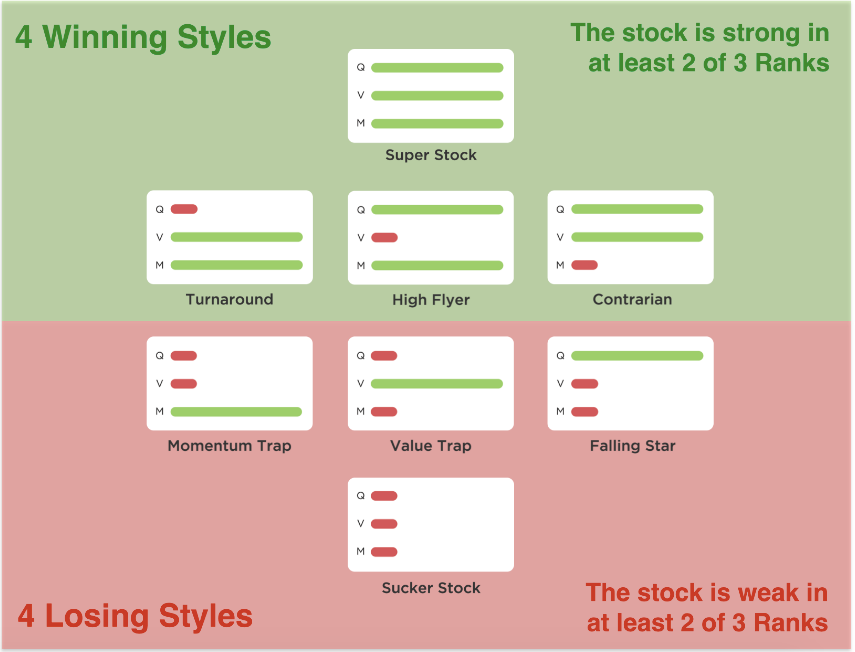
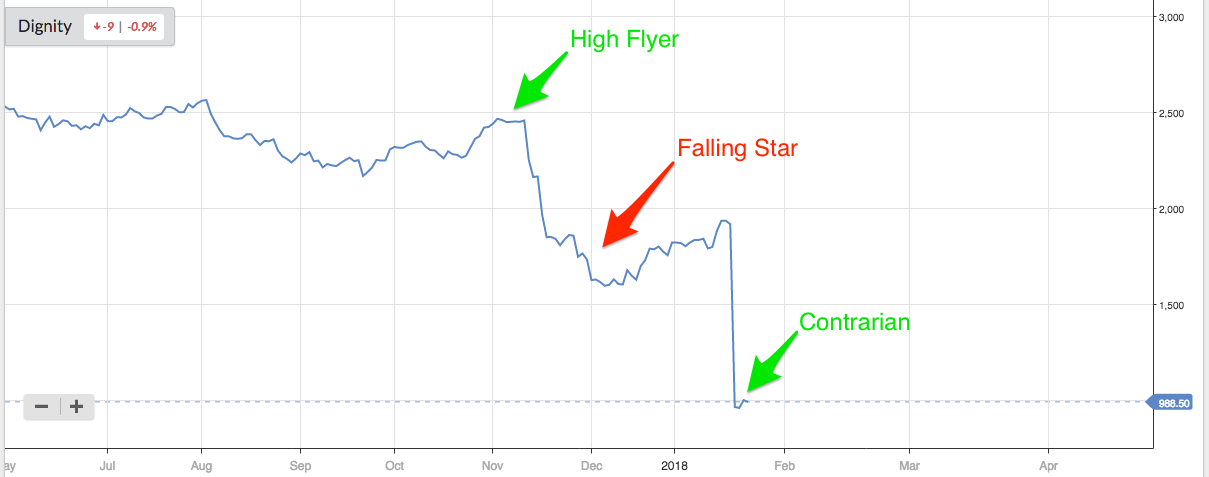
Through much of 2017, Dignity had a mid-range StockRank, which meant it was generally Style Neutral. But there were also periods when its high Quality and strong Momentum were enough to qualify it as a High Flyer. Its high QualityRank benefited from a track record of strong, stable profitability, which was reflected in impressive operating margins and return on capital.
This kind of financial quality is often found in firms that have what Warren Buffett describes as “wide economic moats”. And while it was hard to see much of a moat around Dignity, the point is that it had signs of strong pricing power. So it’s arguable that investors saw the only funeralcare firm on the stock market as a nicely profitable, defensive play.
But in truth Dignity was, and still is, in ferocious competition with other players. In a presentation last summer, it said it was seeing “aggressive pricing activity from competitors on both funerals and pre-arranged funeral plans”. This is ultimately the reason why it has had to drastically rethink its prices.
So in reality, Dignity was what the analyst Pat Dorsey calls a ‘mistaken moat’. In The Little Book That Builds Wealth, he explains: “High returns will always be competed away eventually, and for most companies - and their investors - the regression is fast and painful… It’s easy to get caught up in fat profit margins and fast growth, but the duration of those fat profits is what really matters.”
From High Flyer to Falling Star
A risk with High Flyers is that if (or when) their Momentum fades, the only redeeming feature is their quality. This transition can be quick, which is why High Flyers need to be watched carefully. What you can be left with is a high quality stock that is both poor value (expensive) and deteriorating. This is what we call a Falling Star, and it’s the profile Dignity took on when it reported its Q3 figures last November. The fall in Momentum can bee seen in the graphics below.
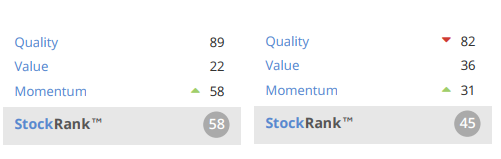
At this point it looks like the market was beginning to take more seriously the concerns about competition and profitability. Unsurprisingly, the share price fell as analysts cut their earnings forecasts.
But an upward drift in the share price late last year - propelled by a magazine tip - suggests that some were willing to put their faith in Dignity’s previous form. In hindsight this was a mistake given the subsequent reaction to the January profit warning.
From Falling Star to Contrarian
Post-profit warning, Dignity finds itself reclassified in a completely new, and positive, StockRank Style - a Contrarian. In this framework, Contrarian shares have high exposure to both Quality and Value. That might not be much comfort for existing investors who have lost money, but for onlookers it offers a new view.
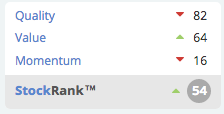
In a business that is racing to shore up its market share by cutting prices, there are still many unknowns. Our profit warning research shows that any recovery could take many months to kick in. But as Graham Neary commented in his Small Cap Report, it could now be a recovery play.
Different investment perspectives
When I saw the price destruction unfolding at Dignity after its profit warning it reminded me of a conversation I had back in 2016 with Giles Hargreave, the small-cap fund manager. I’d asked him about the investment decisions that he most regretted, and he rued the times he’d acted in haste by selling a good stock and snatching a profit. He said:
“Every time I do it - which I like to think only happens once every several blue moons - it makes me feel so sick. I remember when we sold Dignity - I get so cross! I never bought them back again and I’ve been cursing about it ever since.”
That comment is an interesting counterbalance for those who have been caught out with Dignity. For a long time it was regarded as a gem by some very experienced investors. But it’s StockRank Style saw a marked change in the latter months of 2017, which signalled that the investment case had weakened. As a Contrarian stock now, many will be hoping that it can bounce back.
Disclaimer
This is not financial advice. Our content is intended to be used and must be used for information and education purposes only. Please read our disclaimer and terms and conditions to understand our obligations.
26 comments
Probably its best to not touch this company till well after its year end results. Or if you are able to short this one you can pull in a lot of money as bad news happens in 3`s.
Also I find the style a very very bad indicator.
The style should be reclassified and massively demoted.
The article has clearly been very useful in stimulating discussion which has arguably been more informative than the article itself.
A funeral company chasing profit margins is wholly unethical, never mind listing itself on the stock market. Its just wrong. Funeral care is absolutely about ethics. I am not going to change my opinion on this company nor its investors.
The one who red arrowed is a vulture like this company. As far as I am concerned one must invest with an ethical foundation.
belazela - I think you have a somewhat fair point. Companies that pursue price gouging, like Valeant, often come unstuck. However, some companies that are to the detriment of their users do well - gaming, tobacco. In this instance, though, the unethical behaviour didn't work out for Dignity. Although its management made a fortune off it. Surely it is better to be in a company that is giving people value such as Ryanair. People are happy with cheap seats.
Hi Ben, it seems to me that your article does not address the real question here: did Stockopedia _actively_ warn its subscribers against investing in Dignity?
For example,
- did short selling screens flash red on Dignity?
- is there a short selling screen relating to the strategic issue indicated above (a cp. that drives sales through price increases, with competitors that have higher growth rates)?
- which other warning signs did Stockopedia flash when Dignity traded at 2'500?
@_Jr_ & others,
Just backing up Ben here - I don't think he's saying the StockRanks called the top in this share. He's saying it moved from a winning style - High Flyer - (which was clearly a false positive at the time) to a losing style "Falling Star" as the stock fell from 2500 to 1800.
"Falling Stars" are a StockRank Style that in aggregate have a relatively poor outcome in the market - watch this webinar if you want to further your understanding. Or read up here for the performance result of this kind of share https://help.stockopedia.com/p...
We've written a load of content about the Style Classifications - and I think we've made our perspectives clear statistically on these kinds of shares - personally I'd never own a losing style share - and it's an instant sell for me... but that's just me.
This chart is a bit old, but illustrates the point....
At this time Dignity was also flagging with a sub 50 StockRank and was qualifying for the Altman short selling screen with a high bankruptcy risk.
Dignity has fallen a further 50% since the classification moved from "High Flyer" to "Falling Star"....
We don't tip, and we don't advise. We'd never say "sell this" - we try to educate about the data so people can make their own decisions. In my opinion there was enough in the data to save people 50% on their money after the fairly poor November results before the recent profit warning.
Hear, hear!!
Its bonkers to expect an algorithm to identify the ideal buying and selling points. All it can do is analyse the available data, just like the rest of us. The figures for Dignity clearly looked good in a number of ways for a long time, there was a wobble in the November results and it was then either a recovery play or a falling knife. Its easy enough to jump the wrong way but the risk being taken was blindingly obvious. Blaming an algorithm is like hitting your thumb with a hammer and complaining to the guy who made it. The data and analysis on this site is a brilliant tool but no-one ever said it was a guaranteed "kerching" and the way in which the stockranks for example are calculated is exceptionally transparent and well explained.
Sorry, bit of a rant. I keep hearing people who seem to think they should be compensated for their own decisions. the clincher being someone who "invested" £250k in wine that they knew nothing about, and never saw, via a salesman they had never met, and when they lost their money seemed to think it was all the FCA's fault and the tax payer should compensate them. Anyway, I'll go and have nice cup of tea now!!
Please keep up the good work!
I am inclined to concur with JE - there are things to be learned from this article but a Stockopedia victory it is not. I am quite impressed with Stockopedia and have found some good stocks that I wouldn't have been aware of otherwise but frankly this looks like a bit of sales puffery to me.
john652, I don't know if they will every produce a proper backward looking stock rank curve but you can get spot views of historical rankings at about monthly intervals using the Print menu at the top RHS of the stock report page. I find it quite useful. Default seems to be print to .pdf which then downloads electronically rather than print to paper.
Sinking ship of Dignity - Gross margins are a wonderful early canary and March release of FY 2016 showed the first fall in GM since it listed. Nothing tells you more about pricing power, or lack of, than GM and it's also the least polluted profit margin measure. Directors did some selling of shares last year. One of the more obvious profit warnings in a long time. The short sale note was superb analysis too. The barriers to entry are incredibly low in the industry. Always interrogate management on a GM decline. Debt has to be a real worry now, it's private equity sort of levels.
This is all very interesting, but what about all the instances where the stock rank dropped into the loser category, but the company and the share price subsequently recovered? In this case it would have been wrong to sell. What Stockopedia desperately needs is backtesting capability. Only that way can the sample size be large enough to draw firm conclusions.
For me the best red flag with Dignity was this article in the Grauniad, published when the shares were near the top:
https://www.theguardian.com/money/2016/sep/03/funeral-cost-small-directors-bereaved-families-cremation-burial
In my view, Dignity largely highlights the failure of historic ratios so I don't think it would work on the Stockrank system. We can add momentum to try to counteract this but by itself it is a difficult thing to work with.
This is not a criticism of the Stockopedia system it is simply to say that past ratios and financial statistics are not necessarily a guide to the future. A company can have a great return on capital and see this fall away when new competition comes in. I personally think a basic qualitative assessment adds value. This was highlighted very clearly in the Funeralbookers note. All you had to ask is this: is Dignity's strategy sustainable and what are the risks? Not rocket science. I can't see how past financial ratios can always identify future risks.
Playing devils's advocate (if that's appropriate with a funeral company), the Dignity (LON:DTY) profit warning is forward looking and self made in that they are addressing increased market competition/loss of market share by cutting the cost of their basic funeral package by 25% or so.
Rather than losing their moat, it looks like they are are potentially re-building one through a combination of predatory pricing and investment in marketing. While I accept that the funeral market is competitive on price due to the relative ease with which prices can be compared online, presumably this also works in Dignity (LON:DTY) 's favour if they can become a low(est) cost provider.
If this involves cost reductions etc., to restore margins and in due course profitability, one wonders whether this will have an adverse impact on their business on the grounds that while clients might shop on price, there presumably aren't many of us (hopefully) who will buy more more than one or possibly two funerals per lifetime. Provided they don't get sloppy and the quality standards drop to the extent that they get a bad market name (do people really go online to rate the quality of their funeral provider?) I wonder if their large scale gives them an opportunity to re-invent their business model as a low cost rather than premium provider? At the very least, their management are clearly aware of the problem and seem to have a strategy for addressing it.
No position, but wondering if there is a floor to the price at which this becomes an interesting value play.
Gus.
I’m not really seeing that the Stock Ranks had any predictive power in this case. The stock was a High Flyer at the start of September with a Quality Rank of 88. JamesFuneralBroker made his post on Sept 19th and he clearly saw things that the Stockopedia rankings didn’t, and perhaps never will, about the sustainability of the business model.
So I think it’s pushing it too far to claim this as any sort of victory for the Stocko system.
John,
That's fair enough. I haven't really meant to say that, and it's my fault if it sounds like it. The Quality Rank wouldn't have predicted a problem necessarily because it focuses on medium to long term trends in profitability, safety etc, which is why it was quite high in Dignity's case - and still is.
I guess I was just highlighting how it has moved through different styles - and how some styles (like a Falling Star) need careful handling. So if you were looking at it last November, after the initial price drop, it wasn't necessarily a good company that was just a bit cheaper. But that's how some people were seeing it. My point was that it still looked expensive and the price strength had fallen away - so it maybe needed a bit of care. It's fair to say that it may have recovered.
So I'm not really claiming it as a victory, just quite an interesting example of how an investment profile can change - and how some styles can point to possible trouble.
Thanks, Ben
Hi Ben, are you considering a feature that allows a graph to be viewed of the historical stock rank? (if one doesn't exist)
I agree. It would be a really useful feature.
I'd like to understand how many false positive figures the stockrank generates. For example, if the rank falls from say 90 to 60 is this a sell signal? Or could it just as easily shake you out of a successful long term holding?
Also, as the stockrank includes momentum, it might just be signalling pre existing price falls in the case of falling stars. I.e. is it telling you any more than could be understood by something as crude as a stop loss strategy?
This article
https://www.stockopedia.com/content/could-you-win-this-game-295103
contains cumulative probability distributions for the top and bottom stockrank deciles which give a quite good picture of the distribution of returns you can expect.
Hello John,
Yes, it's a feature that is coming. It's in high demand but right now all of the effort is going into building a new Stockopedia platform. With that we'll be much better placed to release new features like the SR charts and a lot more. We're accelerating towards this.
The point about moats is that they have to be maintained - that is the difference between the Unilever brand portfolio and the Premier Foods brand portfolio, or a drug company with a viable pipeline of new drugs and one that milks existing patents for cash and fails to invest in new discoveries.
The Dignity model involved acquisition fuelled growth and high leverage. It is a simple recipe with predictable results - for a time it gathers momentum, and those who get on and off at the right time do well out of it, but in the end the wheels tend to come off.
Hindsight is wonderful of course. I always had half an eye on Dignity because, probably like others, I thought demographic changes meant it would have a growing market among customers with money to spend. As it happens the high valuation put me off and I never looked closely at the business.
Hot Socks - A company cannot always maintain its moat if competition increases. Dignity's issues were due to digital disruption (more price transparency) and new entrants. There wasn't really a moat the company just undertook high priced acquisitions then jacked up prices to justify them.
In fact Dignity's strategy reduced the most. This is because by becoming a high priced player it made it more attractive for competitors to expand. Also by financing acquisitions with debt it wasn't able to cut prices. Otherwise where was the justification for the high priced acquisition?
So I think this wasn't a case of Dignity not maintaining its moat. The company actively weakened its moat through price gouging. Ryanair, by contrast has a strong moat as it has low costs and charges low prices. Dignity made it easier for competitors to expand and grow.
It was an unsustainable strategy that made Dignity's management risk given that they sold shares at the peak. Not sure this is a question of hindsight. You only had to consider the barriers to entry in the funeral service sector.
ratioinvestor - I agree with much of what you say and your points are well made. I was getting really at the distinction between a business that invests in some differentiating factor and develops its business in response to competition on the one hand and a business that generates growth through acquisitions and leverage on the other.
I do think it is possible to construct a moat in competitive environments - think of Waitrose in the supermarket sector. Its quality and reputation set it apart from other operators but they have to be maintained, and if they were to slip the results would be brutal. You may think that is not the best or most enduring moat (I would agree with you) but it is definitely a moat. You would believe me if you spent some time trying to persuade my wife to shop anywhere else!!
I don't know the funeral business and have not researched it, but I can imagine that there might be a moat of sorts given the sensitivities involved. Speaking personally I would not book a funeral based on online pricing, I would be worried about the experience that those I left behind would have and would be prepared to pay more for a service that I thought would make things easier for them. I think I would be influenced by recommendations from people I knew and what they said about their experiences.
As I understand it Dignity bought up local funeral businesses from owner managers, increased prices and let the owners leave and set up again elsewhere. After the take over the volume of funerals went down but the profits were maintained for a time by the higher prices.
In a service driven business a strategy which involves (a) losing successful managers and (b) hiking prices with no corresponding improvement in the service or product is like you say a road to disaster. Perhaps the results would have been different had Dignity invested in its service delivery and looked for efficiency gains instead of price rises to increase margins.
A slightly different example is baked beans. As Mr Buffett has shown Heinz can generate great returns. If they were to reduce the number of beans in a tin and hike the prices too high it probably wouldn't last. The brand gives them a moat, maintained by product quality and marketing, notwithstanding that a tin with some beans in it is not in itself a unique or difficult to replicate product and that there are lots of competitors in the baked bean business. I do not think that the moat is always intrinsic to a product or activity, sometimes great businesses find ways to create a moat out of apparently unpromising circumstances.
If they have been buying up local operators & then allowing them to set up in competition, that must be an error on their part ?
I'm not sure what would stand up in court, but surely there should be some no compete clause for 2~3 years & dignity need to retain the local branding ?
I always thought the theory was that funerals were not a particularly price sensitive businesses, as the purchasers tend not to want to do funerals on the cheap. The relatives are also supposed to be somewhat distressed at the time of purchase, so not really wanting to haggle, or shop around.
Back in the area where I come from, most of the funeral announcements seem to be with the same well known firm of undertakers.
However, every time I looked at Dignity, it failed my value check, so I haven't researched it any further.
Just as well, since what was supposed to be a safe business has seen the share price fall by 68% in less than 18months.
Getting back to the not shopping around concept, a quick google search brings up a price comparison website for funerals. That must help the consumer.
https://www.yourfuneralchoice.com/
Some form of earn out arrangement to keep existing management in the business for a year or two plus covenants for two or three years would be normal in my experience of high street type businesses but my experience does not extend to undertakers specifically. If it is true that Dignity weren't securing those it does seem pretty odd.
There is a link to a Guardian article in one of the comments above which suggests they continued to operate acquired businesses under the existing names. Presumably no value in a Dignity brand then. That article also has some pretty stark pricing info.
I am not a huge fan of momentum as it implies we should trade in and out of shares. Good companies that deliver over decades often have weak momentum at certain periods. Does that mean we should trade out of them and reduce returns through transaction costs? I understand the rationale for momentum but it does mean that the stockrank system will "predict" all stocks that go wrong as long as they have weak momentum before hand? As the previous poster noted it does seem like circular reasoning.
There are quite a few trading systems that can say we predict all major winners. This is because they have a breakout/momentum element. However, they fail to state that they also predict lots of stocks that do badly. The momentum criteria always means that stocks that collapse are "predicted" and stocks that do well are "predicted." A great way to sell trading systems.
I haven't looked at Stockopedia's quality indicator in depth but I think this should be preferred as a predictor of company issues. It was 89 when Dignity was riding high which is concerning. Shouldn't the high level of net debt have been an issue? Surely this should reduce the quality of the business? Or shouldn't we have a separate risk metric taken from a range of variables.
I would also say that the main driver of company profits are the profit margins. If a company says that competition is getting more intense shouldn't that be a concern? There could perhaps be a machine learning tool to go through results and find references to competition.
In my view, we can't rely on volatility to pick up risk. That is like asking other people who you don't know to set your parachute up before you jump out of a plane. Risk should be driven by factors like debt, competitive moat etc. These are the factors that have hit Dignity. Volatility does work where investors are aware of the risk, such as when a company is near bankruptcy and it is well known. However, volatility doesn't work for a company that hasn't experienced issues recently.
In my view, risk is mainly a qualitative factor as you are seeking to assess demand and the long-term franchise. I don't think you can use "momentum" as a risk tool. It sounds good but would mean huge portfolio turnover.
Having said all that I think these kind of exercises are good i.e. they can show how Stockopedia might be improved. I don't know if Stockopedia really worked well to warn against losses in this instance apart from the loss of momentum after a weak update and the somewhat high valuation. The Quality criteria for Dignity was high but in reality events have shown that this doesn't really merit being described as a quality business i.e. few barriers to entry.
This sounds like circular reasoning to me.
Since the ranking changes from "High flyer" to "Falling Star" when the Momentum collapses (i.e. price drops) then it is not really useful for telling you when to exit. It is just saying: "this stock has fallen in price" which you knew anyway.