Hunting for cash-rich bargain companies

It’s a tough market for UK investors at the moment, especially in small caps. Even companies with a stable outlook and strong balance sheets are seeing their shares sold off.
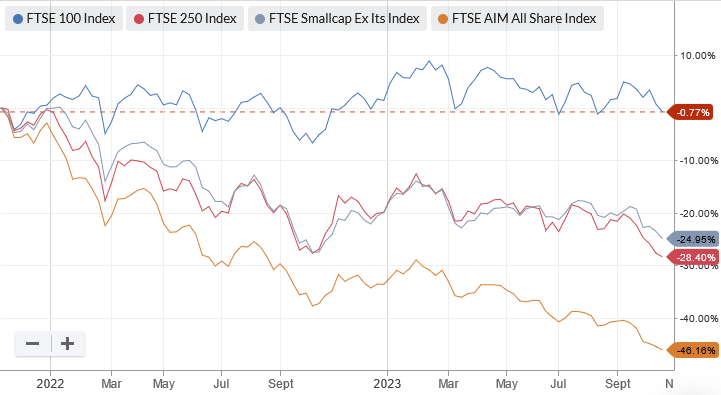
For investors, the discomfort is real. But history suggests that this difficult period won't last forever and is very likely to create opportunities for forward-looking investors.
Earlier this year, Mark took a look at the idea of investing in net nets – stocks trading below the value of their liquid assets.
I’m not pursuing such an extreme approach to value. Instead, one of the main strategies I’m using in this environment is looking for good companies with plenty of cash that are not being rewarded for their prudent balance sheets.
I see this as a sleep-at-night strategy. It combines two key attractions which I believe are likely to support market-beating returns over time:
Enough cash to provide a margin of safety and protect against most conceivable problems
A reasonably valued underlying business, with the potential to drive a share price re-rating when market conditions improve
Companies offering this combination of qualities aren’t always readily available, but I think that there are some opportunities of this kind in today’s market.
To help me find these opportunities, I’ve built a new screen targeting cash-rich companies.
My cash-rich companies screen
Stockopedia’s screening tools make it fairly easy to find companies that satisfy these requirements on paper. But I do need to add a word of warning.
Not all net cash is surplus cash. I’ll highlight some examples of this below.
In addition, some companies’ cash positions can disappear very quickly in certain situations.
For these reasons, it’s important to have some understanding of the businesses involved and their current circumstances. These screening results are a starting point for further research, not a list of shares to buy.
With that caveat in mind, here are the rules I’ve created for this new screen. I’ve tried to keep things as simple as possible, in order to avoid being too restrictive or biased.
Price to Net Cash (latest) - this is a useful value screening ratio that allows us to compare a company’s market cap with its net cash position.
For this screen, I’ve chosen to look for companies where the latest accounts showed a net cash balance equivalent to 15% or more of the current market cap. This is equivalent to a price to net cash ratio of seven.
Economic sector - the net cash figures shown in Stockopedia are not meaningful for most financial businesses, so I’ve excluded the financial sector altogether.
Market capitalisation - I’ve specified a minimum market cap of £25m. Companies below this level are likely to be illiquid and require greater levels of research, making them more specialist investments.
StockRank - I’ve specified a minimum StockRank of 70 as a broad measure of value, quality and momentum.
Good opportunities may exist with lower StockRanks, but history suggests these may be less likely to deliver positive outcomes.
Primary Listing - I only want to invest in companies whose primary listing is in the UK.
Here’s how the finished rules look:

Let’s take a look at some of the results.
Screen results
At the time of writing the screen returns 40 results in total, covering a wide range of sectors and market caps.


I think it’s fair to say that this list contains a number of companies that do not satisfy my sleep-at-night test. But there are some names that interest me too.
In the remainder of this piece, I’ll share my thoughts on a few of these companies, including some that look potentially attractive to me.
Centrica (LON:CNA) - the owner of British Gas has been able to execute a remarkable turnaround and clear its debts, thanks mainly to bumper profits from oil and gas production (assets that were previously for sale!).
This quote from the half-year results highlights the scale of the transformation:
"Our balance sheet has been transformed, with adjusted net cash of more than £3bn at June 2023 compared to adjusted net debt of £3bn at the end of 2020. In addition, decommissioning liabilities and the technical pension deficit in total combined have halved over the same period to around £2bn."
I suspect this is more a case of fortunate timing than brilliant management, but Centrica does look far more investable to me than it did a few years ago. My sums suggest the shares are probably reasonably priced, based on an estimate of normalised earnings.
Costain (LON:COST) - the very first article I wrote for Stockopedia in 2015 looked at this infrastructure construction group. At the time I remember discussing Costain’s net cash position and pointing out that it was at least partly due to a recent equity raise.
The same thing is true today – Costain has a sizeable net cash position, but shareholders have suffered terrible dilution.

Ultimately, this is a low-margin sector where companies need upfront cash to win contracts and fund new projects, but periodically run into problems.
The near-term outlook for Costain seems reasonably positive, but I don’t see this business as the kind of long-term investment I’m looking for.
Morgan Sindall (LON:MGNS) - this founder-led business operates in some of the same areas as Costain but has a much larger, broader business. Morgan Sindall also has an outstanding financial record in my view, with no significant dilution in the last 10 years and a far stronger record of shareholder returns:

Morgan Sindall is one of the few companies in the construction sector that I’d consider buying.
Taylor Wimpey (LON:TW.) & Barratt Developments (LON:BDEV) - I think both of these big housebuilders are probably quite reasonably priced at the moment.
If the housing market really freezes up, they could suffer problems from a collapse in volumes. But both of these businesses have high levels of cash and minimal debt – unlike in 2008.
I think they’re worth considering as fairly safe choices, at a reasonable price.
PayPoint (LON:PAY) - I’ve owned shares in this payment firm in the past, but I'm still a little unsure about its ability to deliver sustainable growth to offset the structural decline of its cash payments business.
Nevertheless, I’ve always admired PayPoint’s remarkable UK network (c.28,000 locations), good cash generation, and strong quality metrics:

This business has lots of moving parts and needs further research, in my view. I think there could be value here, but I’m not sure if PayPoint satisfies my sleep-at-night test.
James Latham (LON:LTHM) - this family-controlled timber merchant was founded in 1757, making it one of the oldest businesses on the UK market.
Return on capital employed has averaged about 15% per year since the financial crisis and the balance sheet looks extremely strong to me. Net cash of £56m covers a quarter of the £200m market cap.
The outlook for the next year or so looks a little subdued, but I expect this well-run business to retain its market-leading position and emerge stronger when economic conditions improve:

In the meantime, the forecast P/E of 10 and well supported 2.9% dividend yield look tempting to me. I see Latham as a very safe long-term choice.
Clarkson (LON:CKN) (disc: I hold) - I own shares in this FTSE 250 shipbroker. It’s the market leader in most major shipping sectors and has been in business for 170 years – a period spanning depressions, global wars, and many other difficult periods.
Long-term performance has been good, but the shares are down by around 35% from a pandemic high of £40:

The group consistently reports a net cash position, but it’s worth noting that around half its current cash balance is held in regulated entities or reserved for bonus payments. The latest results suggest a free cash figure of £128m, from a total cash balance of £286m.
Clarkson’s dividend hasn’t been cut for 30 years. The shares look cyclically cheap to me at the moment, trading on 11 times forecast earnings. I may add to my position.
Oxford Metrics (LON:OMG) - this small-cap technology group appears to be trading well, but currently has a £60m net cash position that’s equivalent to more than half its £113m market cap.

This cash pile is the result of the recent sale of one of OMG’s two operating businesses. Management hasn’t decided what to do with this windfall yet, but another acquisition seems likely.
At face value, Oxford Metric’s remaining operating business looks decent value to me, but investors will have to hope that the company is able to deploy its cash balance to equally good effect.
Disclosure: at the time of publication, Roland owned shares in Clarkson.
Disclaimer
This is not financial advice. Our content is intended to be used and must be used for information and education purposes only. Please read our disclaimer and terms and conditions to understand our obligations.

10 comments
Surely Paypoint counts as a financial stock? I have never understood why it is listed as an industrial.
Most of the companies shown in the table have a totally different cash position!
Guys ,is there a way to bookmark /save this article ? (Very interesting Roland cheers )
Why not just create a bookmarks folder in Chrome or Edge specifically for Stockopedia links? That whats it for. You can also create subfolders too, and have a folder for each of the contributers such as Roland or Mark. Don't see the point in spending cash duplicating a feature that already exists in the browser.
Good finking ! Cheers GB
You can copy the URL ( ie the HTTPS://. etc), and paste it a word file, or just bookmark the page.
Morning Roland. Is there a link to the screen? Thanks
Hi bsharman,
Apologies - the link to the screen somehow went missing from the article. I've added it back in now - here it is:
https://www.stockopedia.com/sc...
Roland
A few other cash-rich companies that didn't make this list but might be worth a look - Bloomsbury Publishing (LON:BMY) Polar Capital Holdings (LON:POLR) Plus500 (LON:PLUS) and Augmentum Fintech (LON:AUGM) - the latter is an investment company but currently with a nice cash position and trading on a very wide discount.
Morning Roland,
Thank you for your thoughts.
Of the companies mentions I hold :
Jet2 (LON:JET2) in my view a well managed forward thinking company with excellent customer service trading on derisory metrics notwithstanding the economic headwinds. Good employee reviews on Glassdoor with the founder, Phillip Meeson retaining an 18% holding despite standing down recently
Galliford Try Holdings (LON:GFRD) bought around 170p as my view is that it will benefit from infrastructure spending in regulated markets. Especially in the water industry where it benefits from expertise that it has recently expanded by some canny acquisitions mainly from administrators. No bank debt or pension liabilities and significant net cash, albeit in fairness much of this is advance payments from clients. I like the newish management under CEO, Bill Hocking and much prefer it to Costain (LON:COST) despite the higher rating .
Sanderson Design (LON:SDG) has been revitalised by Lisa Montague since her arrival 2 or 3 years ago. The management team has monetised the popularity of the brands via numerous licensing agreements. The irreplaceable archive of Arthur Sanderson and Willian Morris is in large part owned by the company and its likely value is greater than the share price. It has close to £16m cash on the balance sheet and thanks to licensing income and expansion in the USA continues to trade in line on paltry metrics, despite the economic gloom.
I like PayPoint (LON:PAY) but share your concerns. I also think that James Latham is an excellent company which I have previously owned, but sold as I thought the share price had got ahead of itself at around £13 (LON:LTHM). Clarkson (LON:CKN) has done well for shareholders over time, but management remuneration appears somewhat generous for my liking.