Stock In Focus - Costain Group Plc

This feature is part of a new series titled “Stock in Focus". Each week we'll be taking a look at a stock highlighted by the StockRanks in a specific sector - this week it's Costain Group from the Industrials sector. As ever these are not recommendations… so DYOR.
When a profitable company decides to raise fresh capital by issuing new shares, there's usually a good reason. The fresh cash often points to acquisition or expansion plans. This often changes the investment outlook for a stock, so it's usually worth a closer look.

A case in point is Costain Group Plc (LON:COST), a £330m construction and engineering business listed on the London Stock Exchange, that raised £75m through a placing and open offer in March 2014.
Costain's management believes the fresh cash will enable the firm to move up the value chain and compete successfully for larger, more profitable projects. It's this opportunity which I believe lies behind the investment case for the stock and makes it this week's Stock in Focus.
From houses to infrastructure
Costain was founded by Richard Costain and his brother-in-law in 1865. The firm first grew by meeting the fast-growing need for new housing in south-east England.
Costain then branched out into infrastructure work and started to expand overseas. Big projects in the Middle East, Asia, Australia and the US sat alongside high-profile UK projects such as the Thames Barrier. However, an overambitious venture involving deep coal mines in the US nearly destroyed the company in the 1990s.
Since then, Costain has regrouped and now focuses only on UK water, energy and transport infrastructure projects. Turnover was £1.1bn last year, and projects are often undertaken as joint ventures with peers such as Balfour Beatty and Morgan Sindall.
Costain's current projects include the redevelopment of Bond Street and London Bridge railway stations. The firm is also managing the supply and delivery of an additional evaporator at Sellafield nuclear power station.
Costain's goal is to target larger and more complex projects, in which it can take a leading role. If successful, I believe this should gradually add to Costain's profitability and to its defensive moat. Could this deliver substantial upside for investors?
In a sweet spot?

Costain ended last year with a record £3.5bn order book. The firm's 2014 results suggest that the firm may currently be sitting in a sweet spot combining growth, value and momentum.
A first glance at Stockopedia's StockReport for Costain appears to support this conclusion. Costain's StockRank of 99 is backed by scores of 94 for quality, 92 for momentum, and 83 for value.
Quality
Although Costain's operating margin has only averaged 2.6% since 2009, that's not bad for this type of business. The firm's margins have been fairly consistent over this time and all debt has been repaid.
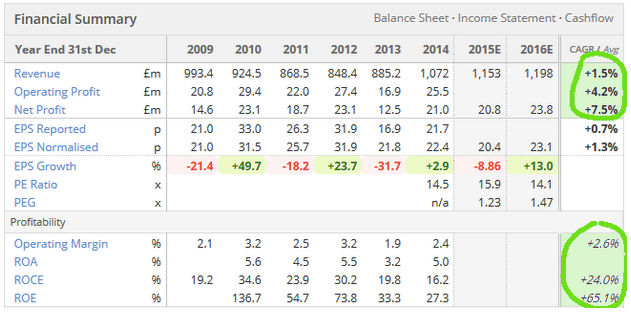
Drilling down further, Costain's improving fundamentals are illustrated by a strong Piotroski F-Score of 7. This nine point checklist of financial direction highlights cash-generative profit growth, a strong balance sheet and improving productivity.
In an interview CEO Andrew Wylie, who owns over £1m in Costain equity, highlighted the company's focus on long term, low risk projects. Costain's ROCE has averaged 24% since 2009, more than double that of close peer Morgan Sindall. In my view, this adds to the attraction of Costain as the pick of this sector.
Investors may note that Costain's return on capital employed (ROCE) has varied widely over the last few years. Personally, I don't think this is a big concern, as the firm's small asset base means that changes in profit have a big impact on ROCE.
Growing momentum?
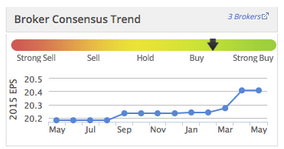
Broker forecasts for Costain have moved steadily higher over the last year, but the firm's momentum appears to have been underestimated by City analysts. Costain has qualified for the Stockopedia Earnings Surprise screen since February 2014, and beat earnings forecasts by 11.5% last year.
Interestingly, Costain also qualified for the Josef Lakonishok momentum screen in February 2015. This screen aims to identify undervalued companies at the point when the market is starting to recognise their appeal. This can often signal a good time to invest.
Costain's inclusion in these two momentum screens is a positive signal that recent outperformance may continue in the short term. Earnings per share are expected to rise by 13% in 2015, and while last year's fundraising caused Costain's share price to slide sharply, the firm's stock has since rebounded strongly.
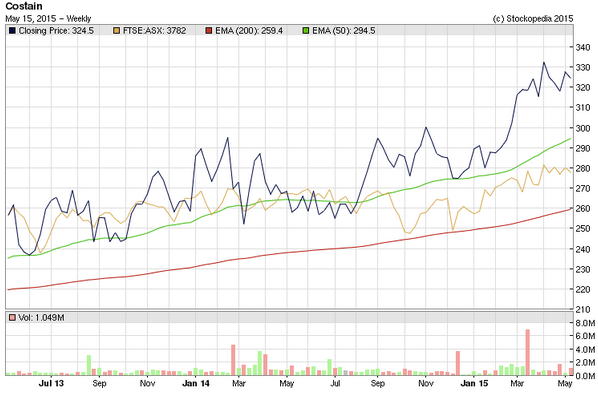
Costain was one of the honourable mentions in Ed Croft's “New Year NAPS" and is already up 16% year to date. Costain shares have risen by 20% over the last 14 months and by 45% over the last five years. This puts them well ahead of the FTSE All-Share index, which has gained 4% and 33% over the same periods, respectively.
Value
Costain's shares currently trade on forecast P/E of 15, which on first impressions doesn't appear particularly cheap.
However, by stripping out net cash and focusing on Costain's enterprise value, the firm's forecast P/E falls to around 11.
This looks more attractive, but small cap blogger Paul Scott has highlighted reservations about this approach in his previous comments:
"I wouldn't get carried away with the net cash position as the cash has come from a favourable skewing of working capital, which is almost certainly up-front stage payments by customers being ahead of the costs incurred at any point in time."
In other words, Costain receives payments from its customers before it pays its own sub-contractors. This is highlighted by Costain's negative working capital and is standard practice across the industry.
In a liquidation scenario, net cash would be largely absorbed by outstanding creditors and the pension deficit, as Paul implies. However, I think this view is overly harsh, given Costain's strong order book, consistent profitability and lack of debt.
I'd be tempted to discount net cash by 50%, instead, giving a forecast P/E of about 13. I believe this is a reasonable price to pay, especially given Costain's 3.1% prospective yield.
Last year's figures suggest to me that Costain's 2015 dividend should be covered by free cash flow. Looking ahead, the dividend is expected to rise by 11% to 11.2p in 2016, giving a 3.5% prospective yield.
Too good to be true?
Costain's optimal blend of quality, value and momentum suggests it could be classified in the Stockopedia 'taxonomy' as a 'super stock'. However, it's worth taking a look at possible problems which could derail the firm's progress.
I believe the two biggest risks are declining profitability and stagnating sales revenue.
The simplest way to monitor profitability is with the operating margin, which I'd prefer to see remain above 2%.
The critical factor is that Costain continues to win projects that are structured to reimburse costs and provide adequate returns. As Paul Scott highlights, companies in this sector tend to run into trouble when they are exposed to cost overruns or underbid to win work.
Another important sign of progress will be revenue growth. Costain's fundraising last year was meant to help the firm move into the big league. If this fails to translate into top-line sales growth, investors will need to ask why.
Finally, it's also worth taking a closer look at last year's fundraising. At the time, the placing price of 225p seemed a big discount to the previous day's closing price of 319p. Were investors reluctant to participate?
We're never likely to know, but private investors were able to avoid dilution by taking part in the open offer. Looking back, I believe the fundraising has reduced risk and improved the stock's growth outlook. Costain's management now needs to deliver on its promises.
Positive outlook
Costain has a strong record of delivering projects successfully and 90% of its order book is repeat work. I personally believe the shares could do well from here if Costain can deliver on the promise of its strengthened balance sheet and broad skillset.
As ever when making any investment decision, it's important to come to your own conclusions and do your own research. If you have any thoughts or additional insights on Costain please do help fill in the picture by adding comments below.
Disclaimer
This is not financial advice. Our content is intended to be used and must be used for information and education purposes only. Please read our disclaimer and terms and conditions to understand our obligations.

19 comments
Well Kier shares are up today over 2% so the market has reactived well to the rights issue take up.
Hi Roland - Good article, thank you. However, you can't really compare the uptake in a rights issue (Keir) with a placing (Costain). Unlike a placing, provided shareholders exercise their rights, the pricing of the new shares does not dilute ownership - it simply adjusts the share price post issue. In addition, even if shareholders in Keir choose not to take up the rights, their rights will be sold on their behalf through the placing of the rump. 91% uptake is pretty good. The discount on the Costain placing was a reflection of what the market was willing to pay for newly issued shares in the company - so you are right it would be interesting to understand better why the discount was so substantial!
Hi Martin, thanks for your comment.
I agree that the uptake on the Kier (LON:KIE) placing is a reasonable result. I don't entirely agree with your view on placings vs rights issues, though!
Both types of fundraising will dilute shareholders who don't choose to/aren't able to put new money in and buy some of the newly-issued shares.
A discount is often necessary to entice buyers, but the main difference is how the shares are marketed. A rights issue is more hassle for the firm but gives all shareholders a guaranteed equal opportunity to maintain their stake.
A placing targets big institutional holders and is generally much quicker and less hassle, but leaves small shareholders facing dilution unless the firm also runs an open offer. In the case of Costain (LON:COST), an open offer was run alongside the placing.
A firm's share price tends to adjust after discounted placing shares are admitted to trading, as happens with rights issue shares. On this basis, I think the discount does stand (broad) comparison despite the technical differences. In both cases, the discount indicates what investors will pay to put new money into the firm and expand its equity base.
Cheers, Roland
I hold Kier shares, I think the problem with the rights take up is many shareholders were not happy with this takeover and the change of direction Kier is going, Mouchel went bankrupt a few years ago? Its low margin, Kier is becoming more like Costain, think shareholders would rather be taking over a small housebuilder like Inland than going into roads. I did take up the rights but I nearly sold them. I think with Costain its easier to see the benefits of the fund rasising, with takeovers there are always doubts as to how it will work out.
@herbie47 I can see your point, although personally I wouldn't think that now, with prices so high, would be an attractive time to takeover a housebuilder.
I agree that takeovers of this scale (relative to the acquirer) are always risky.
Ultimately both the Costain (LON:COST) and Kier (LON:KIE) fundraisings require a certain amount of faith in management -- I guess we'll see which can best deliver on their promises over the next few years.
Yes I agree housebuilders are not cheap, I'm reporting what other shareholders have said But I agree with them, although they have sold out, I'm holding on for now. The operating margin of Kier is 1%, INL is around 15-20% I think you can see the attraction, with public finances being squeezed I can't see the Op. margins for Kier improving soon. You can argue in a recession Kier or Costain is safer bet than a housebuilder.
Hi Roland
Out of interest how did you know that Costain (LON:COST) qualified for the Earnings Surprise screen (since Feb 2014) and the Josef Lakonishok momentum screen (since Feb 2015)? Are subscribers able to get access to this data, if so how?
Also when you say it beat earnings forecasts last year by 11.5%, is this information available on the stock report?
Best wishes,
Imran.
Yes you can just go into the screen and it states which shares were added when. Also tells you the EPS surprise, last year, on the Josef Lakonishok screen.
Thanks Herbie47, much appreciated.
herbie47,
Carillion (LON:CLLN) certainly looks attractive too, especially for income. However, it's a much bigger firm (£1.4bn vs £341m) and may not be able to grow as readily as Costain (LON:COST).
It's also interesting to note that while Carillion's operating margin is higher, its return on capital employed is much lower, at 9%, versus 16% for Costain. Arguably this is a better measure of a firm's true ability to generate shareholder returns as it compares profit to money invested, rather than just to turnover.
Similarly, Costain looks cheap on an EV/EBITDA and price/free cash flow basis.
As I mentioned, I agree with Paul that the size of the discount in the Costain fundraising was surprising. However, it doesn't necessarily follow that this will need to be repeated. Carillion was not a basket case before the fundraising, and the new money was billed as growth money.
Perhaps this is a little unconventional for a firm of this type and size, but if successful Costain could double its market cap and still be half the size of Carillion. That's the investment case, in my view -- Carillion is unlikely to be able to do the same, IMHO.
As always, it's a case of DYOR. My comments are my opinion only and certainly not advice.
Cheers, Roland
Yes but as reported by Paul, last year they had to do a fund raising to fix the balance sheet, new shares were issue at a large discount to current share price, think you need to take this into account for the future, if they have to do that every so often? Carillion looks a safer bet to me, with much higher margins and dividend.
http://www.stockopedia.com/content/small-cap-value-report-27-feb-2014-zyt-dgb-cost-81648/
Going back to the Costain (LON:COST) discounted fundraising last year, I'm beginning to wonder if investors just aren't keen on funding businesses in this sector without a discount.
According to an RNS this morning, FTSE 250 construction firm Kier (LON:KIE) has struggled to get its £340m rights issue away despite offering a big discount:
http://www.investegate.co.uk/kier-group-plc--kie-/rns/result-of-rights-issue/201506030700230431P/
Kier wants the money to fund a major acquisition (Mouchel). It offered shares in a rights issue at 858p, a 36% discount to the current 1,360p share price. However, according to an RNS this morning the firm was unable to sell the full allocation. 3.3m shares (approx £28m) remain unsold and will have to be disposed of by the underwriters, potentially at a further discount.
In this context, Costain's placing last year, at a 29% discount to the previous day's closing price, looks more successful.
Roland
If you look at the EPS growth its up and down every other year, the worrying thing was its only up 2.9% last year, est to be down 8% this year.
Compared to Carillion its does look expensive.
I think they fixed the balance sheet recently. The problem with Costain and most in that section is the low operating margin of around 2%.
Herbie47 -
I think the low operating margin is a valid risk, but as you say it's fairly typical of the sector.
In the case of Costain (LON:COST), I think the risk is reduced by the firm's historic consistency and high level of repeat custom. Limiting exposure to cost overruns is also essential. Any hint that the firm's new contracts were deviating from this principle would be a serious concern for me.
Explosive growth isn't likely from such a low margin, but steady cash flow generation and rising returns should be, if Costain can maintain its reputation for quality execution of complex projects.
Cheers, Roland
Hi Roland -
Great analysis relating it back to Stock Value, Momentum and Quality. However it appears that your review hasn't covered balance sheet strength. As it happens Costain's balance sheet is strong. But we know from a number of previous discussions here, of companies with high StockRanks but very weak balance sheets.
Hi Ramridge, thanks for your comment.
I touched on a few aspects of the Costain (LON:COST) balance sheet, such as net cash, negative working capital and the firm's high Piotroski F-Score, but I agree that I didn't dwell on it in much detail.
I did look carefully at the balance sheet when writing the article, however, and had I seen anything that concerned me I would definitely have flagged it up.
A high StockRank doesn't necessarily guarantee a strong balance sheet, but I think the QualityRank is a more direct indicator of financial health, and certainly in this case the data support this conclusion.
Cheers,
Roland
I found this really useful. I appreciate the manner in which you analyze Costain with respect to Momentum, Quality and Value and relate that to the various sections of it's Stock Report. So this has helped me better analyze other stocks, and I look forward to assessing of other stocks as you offer them. Very many thanks!
RG
Charles,
Glad you found this useful. I agree that the QVM ranks provide a good framework to analyse a stock and build up a complete picture, rather than cherry-picking the numbers that support a particular conclusion.
Drilling down into the numbers behind each rank is a good way of understanding what's driving the company's performance and share price, too.
Roland