Ibstock: 2026 profit guidance cut by c.25% as debt risks mount, our view remains negative

Analyst’s view:
I estimate today's profit warning has wiped around 25% from previous expectations for this year. More worryingly, my sums suggest that Ibstock could be at risk of breaching its lending covenants at the end of 2026 if the company fails to deliver meaningful debt reduction. While it's unusual for us to be fully negative on an established mid-cap stock, I think our RED view remains justified here.
Down 10% at 73p (£296m) - Q3 Trading Update (profit warning)
Ibstock is one of the UK's largest brick producers, but it's also been by far the weakest performer among its listed rivals over the last two years:
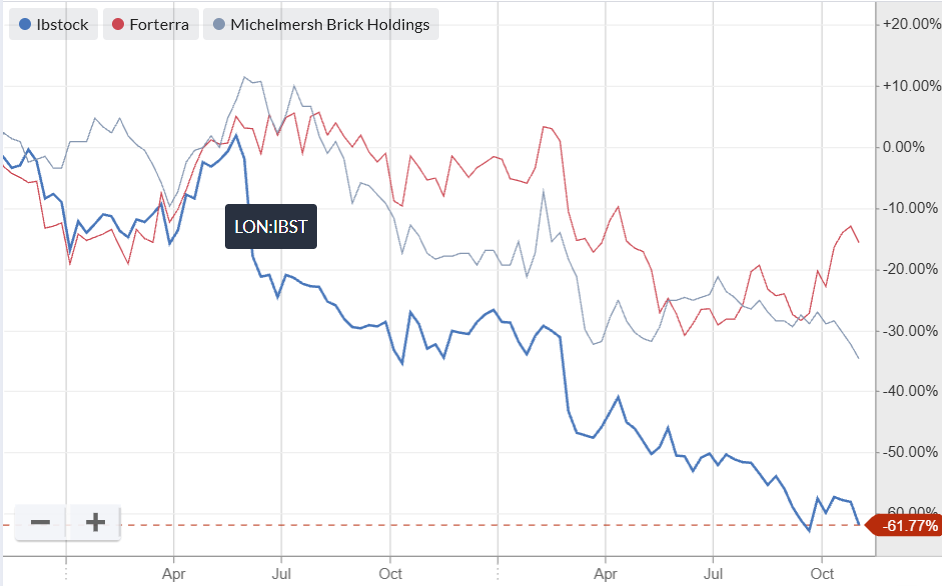
Today's profit warning has cut full-year profit guidance by perhaps 25%, adding to the pressure on the stock and making our decision to take a RED view on Ibstock in June 2025 seem prescient: the stock has halved since then, while earnings forecasts for the current year had fallen by around 75% even before today's profit warning.
Ibstock has another problem too - debt. This was the reason why Graham chose to go RED last year, rather than our more normal choice of AMBER/RED for profit warnings at established companies. I maintained our RED view in October 2025, when Ibstock warned on profits again.
Sadly for shareholders, the downgrades have continued relentlessly since then:
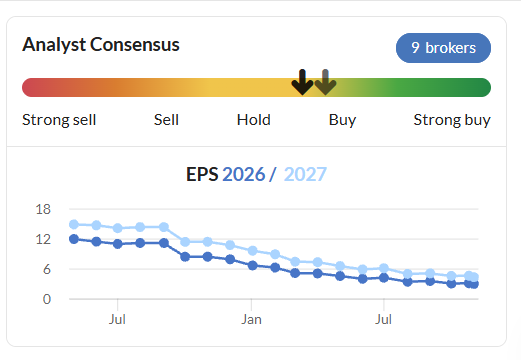
Today's update has left Ibstock shares trading at an all-time low, but the share price movement today has been relatively modest. As I type, the stock is down by 10%.
A small reaction to a big profit warning is sometimes a sign that bad news is already price in. Does that mean it's time to consider Ibstock as a turnaround opportunity? I'm not convinced, as I'll explain.
H2 profit to be "materially below" expectations
The weak state of the UK housing market is no secret. But I was still surprised by the slowdown in brick demand seen in recent months.
Ibstock says that UK brick market volumes fell by 17% in July and August, compared to the same period last year. Within this, the company says its market share "was consistent", suggesting a similar decline in sales volumes.
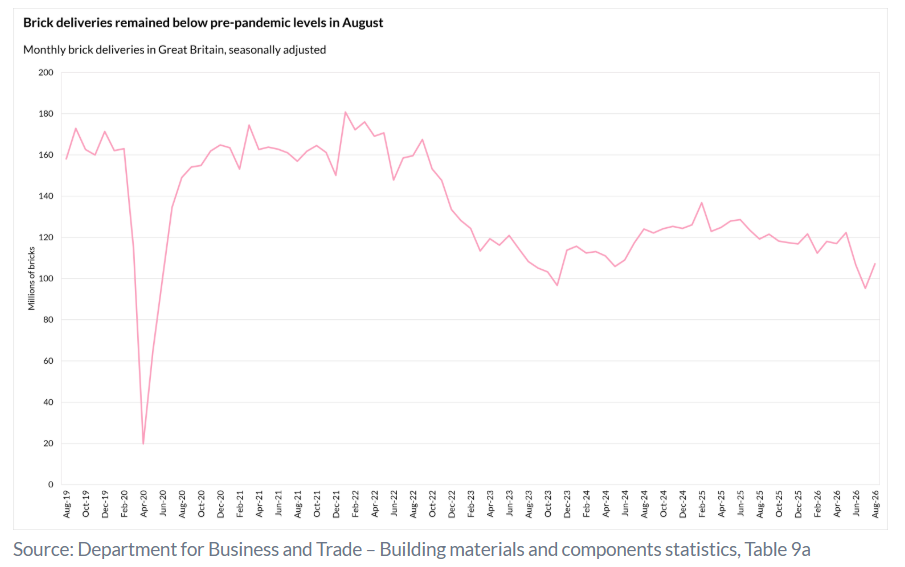
Source: BCIS Latest building materials and components statistics (08/10/26)
We don't have industry data for September or October yet, but today's commentary from Ibstock suggests volumes were much lower than expected (my emphasis):
Weak market conditions continued through September and October. As a result, (Clay division / brick) sales in Q3 were 22% below expectations.
As a result, the company has cut Q3 production by c.20% against its previous plans, in an effort to stop inventories building up too much.
Revised 2026 profit guidance: lower production volumes will reduce fixed cost absorption. In other words, the fixed costs of Ibstock's operations will be spread across fewer bricks, reducing profitability.
The company says that this factor alone is expected to reduce adjusted EBITDA by £6m.
In addition to this, the company will also face the financial impact of lower sales volumes.
Unsurprisingly, Ibstock's H2 performance is now expected to be "materially below expectations".
As a result, the group's 2026 adjusted EBITDA is now expected to be "in the mid-£40 million range".
Previous guidance (in August) was for adj EBITDA at the lower end of £59m to £68m. To me, this suggests that EBITDA expectations have been cut by c.25% today. That's quite a big reduction at this late stage in the year.
I don't have access to revised broker forecasts today, but my guesstimate would be that adjusted earnings will be less than 2.5p per share this year, with reported profits showing a loss for the year.
Debt covenent risk? Today's statement doesn't include an updated net debt figure, so the latest we have to go on is the £151m reported for 30 June 2026. I view the lack of disclosure today as a sign that net debt may have risen since June, although I can't be sure of this.
Assuming net debt is unchanged since June implies forecast FY26 net debt/EBITDA leverage of 3.4x.
This is well above the 2.0x level I'd generally view as a safe maximum for a business of this type.
More worryingly, this suggests to me that Ibstock may be at risk of breaching its lending covenants. These limit leverage to 3.0x, according to June's half-year results.
CEO Joe Hudson says Ibstock is cutting costs and pursuing the sale of surplus assets to reduce debt:
The Group is prioritising cash generation through disciplined management of inventory, capital expenditure and discretionary costs. We remain confident that our strategic land assets, including calcined clay, will provide near term support to accelerate debt reduction.
However, the lack of any firm update on debt levels or assets sales today suggests to me that progress has been limited so far. I see this as a serious risk for equity holders.
Assuming 2026 adj EBITDA of £45m (mid-40s), then year-end net debt needs to fall to c.£135m. It's not clear to me whether this is realistic.
Roland's view
Ibstock is one of the UK's two largest brick producers, together with Forterra.
If the company's problems were limited to the cyclical downturn in its end markets, then I'd probably view this as a potential turnaround opportunity. After all, the shares are now trading in line with their June '26 tangible net asset value of c.£295m (c.75p).
However, Ibstock's debt levels change the picture altogether for me. Based on the information provided to date, I think there's a meaningful risk the company could breach its lending covenants at the end of the year.
For shareholders, the risk is that lenders will take priority and force the company into a dilutive equity raise. With the shares trading at record lows, that could be painful.
More broadly, there's the risk that Ibstock's ability to adapt to market conditions and invest for the next upturn is being constrained by its weak balance sheet.
Last week's Budget didn't include any major incentives to boost housebuilding. While the Your First Home scheme may provide a modest stimulus, it doesn't start until April 2027. This raises the risk that first-time buyer activity could weaken even further before then, as potential buyers wait to be able to take advantage of this scheme.
I'm going to leave our RED view on Ibstock unchanged today. While it's unusual for us to take such a negative view of a well-established mid-cap business, I think it's justified in this case.
Disclaimer
This is not financial advice. Our content is intended to be used and must be used for information and education purposes only. Please read our disclaimer and terms and conditions to understand our obligations.
Discussion on Ibstock (5)
Comments here are also visible in the Daily Stock Market Report
Thank you Roland. As long term holders of MBH (down 20%) and recent investors in BRCK (starter position close to today's price) I read analysis of brick manufacturers carefully. Patience needed.
There has been a lot of coverage of BRCK (LON:BRCK) on this board following the poor results and we have today Ibstock (LON:IBST) confirming the trend of lower brick sales. Perhaps the more muted reaction in the share price means Mr Market had already decided ' read across' applied. Seems housebuilding market still in the lower reaches of doldrums and I think Marshalls (LON:MSLH) results due later this month may be just as illuminating
I note that Rockwood Strategic (LON:RKW) has taken stakes in Marshalls (LON:MSLH), Stelrad (LON:SRAD) and LSL Property Services (LON:LSL) plus two more, as yet unnamed, building related companies. In Richard Staveley's own words:
‘The valuations now in the UK market are unbelievable,’ he said. ‘We’ve just bought three market leaders, all on single-digit price-earnings ratios, all yielding between 4% and 5%.’
timarr
Hi Timarr, I also hold all 3 in varoius family ISAs. All were trading in line at the last updates and all are cheap on current metrics.
My view is that Stelrad, the largest European producer of steel radiators should play across the housing market RMI and new build ( private and affordable).
Marshalls should get some assistance from infrastructure as landscaping is by far its largest division.
LSL is the biggest provider of property valuation services nationally, I believe. It also operates a franchise model for private landlords similar to the Property Franchise Group that should provide some resilience.
They may get cheaper in the sort term but the balance sheets are not stretched unlike Ibstock.
All the best
RE:Ibstock/ Marshalls
I would think that Marshalls might benefit from home improvement - but whether this can be enough in the current climate remains to be seen.
The September S&P Global UK Construction PMI saw some further decline in house building but at a softer pace of decline...
https://www.pmi.spglobal.com/Public/Home/PressRelease/3203e5be51634752abf03b1da82356ae
The next update will be in a couple of days when the October report will be available.